

Author: mfnnews
Likely end of government shutdown in sight as House lawmakers poised to clear final hurdles
The House moves to end the historic 42-day government shutdown as the Rules Committee prepares to vote on Senate funding bill.
Built like they used to be: American-made tools worth every penny
Shop complete sets of hand tools and select power tools manufactured right here in the United States.
Understanding Modernity
Tom Knighton, writing at Townhall, notes the lack of stigma that exists in today’s culture and how the absence of such stigma has hurt society generally. The piece is a bit rantish for my taste (All rants are bad except when I write them 😉 ) but the point is well taken. Behaviors that once sat in a corner by themselves are now mainstream and certainly cannot be “judged.”
The post Understanding Modernity appeared first on The Hugh Hewitt Show.
The H-1B system is broken. Here’s how to fix it.

Imagine spending four years studying to become an engineer or computer scientist, believing a STEM degree would guarantee success, only to graduate jobless.
That isn’t a hypothetical. It’s the reality facing thousands of young Americans. According to the Federal Reserve Bank of New York, graduates in physics, computer engineering, and computer science now face some of the highest unemployment rates of any field.
American workers have lost out on jobs given to visa holders and have been forced to work for lower wages, creating a race to the bottom for companies to treat workers as widgets.
America’s flawed H-1B visa system is a major reason why. Established under the Immigration Act of 1990, the H-1B program was intended to let companies hire exceptional foreign specialists only when no qualified Americans were available.
It no longer serves that purpose. Today the H-1B has become the nation’s largest temporary work visa program, with nearly 600,000 foreign workers and 50,000 participating companies. In 2022, the 30 biggest H-1B employers hired more than 34,000 new visa workers while cutting roughly 85,000 existing jobs.
Companies claim they can’t find American STEM talent, yet the numbers tell a different story. In 2023, roughly 134,000 Americans and green card holders earned computer science degrees. That same year, the federal government issued work permits to 110,000 foreign guest workers in computer-related jobs.
In some STEM fields, up to half of new American graduates can’t find work. Tens of thousands of qualified workers remain unemployed while their government floods the market with cheaper, compliant labor.
How companies game the system
The law requires H-1B workers to be paid the same as Americans, but reality tells another story. In 2019, 60% of H-1B positions paid below the median wage for comparable U.S. workers. The visa lottery treats low-paying jobs and high-paying jobs the same, incentivizing companies to pursue cheap labor.
Even the statutory cap on H-1B visas doesn’t stop abuse. A loophole known as Optional Practical Training lets foreign students work in the United States for up to a year after graduation, or three years if they hold a STEM degree.
OPT isn’t authorized by law. It has no cap, no wage floor, and no accountability. Worse, it acts as a corporate subsidy because employers don’t pay payroll taxes on any of the half million foreign workers now in the country under this program.
Time for a real fix
Even the architects of the H-1B system admit it’s broken. Former Connecticut Rep. Bruce Morrison, a Democrat who helped design the visa in 1990, told “60 Minutes” in 2017 that “the H-1B has been hijacked as the main highway to bring people from abroad and displace Americans.”
To build on that effort, I’ve reintroduced the American Tech Workforce Act, which attacks the problem on three fronts.
RELATED: Trump admin announces major H-1B visa abuse investigation, but critics want more
 Photo by Andrew Harnik / Contributor via Getty Images
First, it raises the wage floor. Companies that truly need foreign specialists should pay them the same as top American workers, ending the incentive to undercut domestic wages.
Second, it closes the OPT loophole. Foreign students shouldn’t have a back door to replace American graduates. The jobs belong to the people who earned them here.
Finally, my bill would shut down staffing scams. Third-party agencies flood the H-1B lottery with low-quality applications to drive down wages. My bill blocks those schemes and creates a true marketplace where visas go to the highest bidders — boosting both fairness and economic value.
According to the Institute for Progress, these reforms would strengthen the economy by $1.1 trillion over the next decade.
Putting Americans first
The current system rewards corporate exploitation and punishes American ambition. Workers lose jobs, wages stagnate, and graduates who followed every rule are told to wait in line behind foreign contractors. Discrimination based on national origin is already illegal, yet Washington’s visa policies effectively endorse it.
President Trump’s executive order, combined with the American Tech Workforce Act, offers a rare opportunity to restore sanity to the system. We can defend innovation while defending American workers — the people who built this country and still drive its future.
The next generation deserves more than broken promises and outsourced dreams. They deserve a fair shot to work, build, and thrive in the nation they call home.
Church-hopping: Confessions of an itinerant worshipper
I have been church-hopping since the summer of 2020. This means that a lot of “concerned evangelicals” have felt justified in asking, “What are you searching for?”
That first summer, I claimed to be searching for holy ground. However, I already knew that this was wherever a saint steps — wherever God speaks to us and we listen in prayer.
We had spent a wonderful evening with an elderly Latter-day Saints couple who found us hitchhiking, then brought us home to ‘show us some literature.’
I have never been searching for anything as much as I have been interested to see what it is that others claim to have found. It thrills me to see that it is all pretty much the same, in minor degrees. Some pastors are more boring than others. Everyone makes claims about the “other” churches in town. Everyone has their rituals, their deeds, the words that are not works. And very few are curious about the others.
“Seek and ye shall find,” they murmur among themselves in the territory of their home church, patting one another on the back because they somehow found truth without seeking it. Why aren’t the others seeking it? They’d be here among them if they sought — if they loved the truth as they loved the Bible.
Not all. Only the majority. Maybe not even that many — only a few loud ones.
I, too, among them, also vocal, a little charismatic, a little opinionated, forgetting what it means to seek before you find.
The world is not our home
Now I have dragged my husband in on the game of flirting with the appearance of universalism. And yet we are no more universalist than Paul or St. Francis of Assisi or C.S. Lewis. We are curious, alive, and nonplussed by the promissory comforts of the world. This world is not our home, and neither is a single building.
And yet, if you seek, ye shall find. It matters not that my intentions were no different from those of an atheist — to attend, to observe, to write. I am relating to the woman at the front of the church who is not Catholic but is hired to sign the sermon and songs for the deaf attendees, thus hearing every word of the priest and chorus more thoroughly than any of the parishioners and finding that her job has morphed into a spiritual awakening.
I am finding community, kindred spirits, truth outside my understanding of it, and a narrow path. I am becoming less curious as a larger passion consumes my heart and soul.
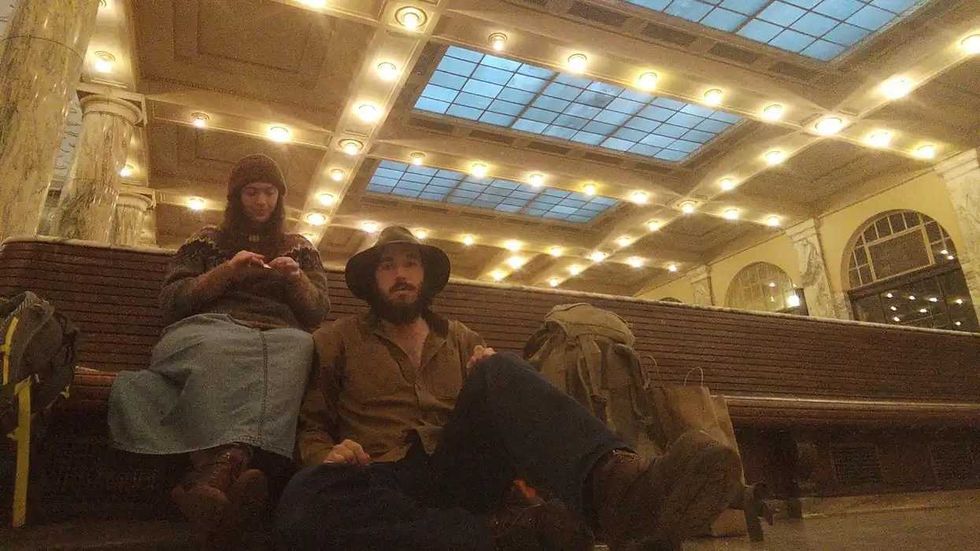
We intended to attend Mass while on our honeymoon — something difficult to do when you have no agency over where you will be day to day, as hitchhikers reliant upon the goodwill of strangers and public transit. We joked about putting up a cardboard sign, our thumbs in the air, “TAKE US TO CHURCH.” Maybe someday.
Instead we went where we could.
RELATED: The USA Rail Pass: Across America by train
 A.M. Hickman
A church for widows
The first place was an Anglican church in Newfoundland that seemed to be run by little old ladies — 30 of them, to be precise, scattered in the pews, in the choir, and at the altar. There were only five men, all of them seated. This did not bode well, we thought.
But it was truly a church for widows, a church that was doing its very best to remain active, putting on plays and picnics even though there were no young people or children. The Spirit was there with those little old ladies. It was comforting them, pushing them forward even though they had lost much. It was reminding them of all that awaited them in paradise. And they were ready.
They gave us cookies and greeted us with forgetful, motherly smiles, as if we were not mere strangers but apparitions of heavenly promises. We were their reminder to keep hoping, and they were our nudge toward charity. We sat, we witnessed, and we listened.
Seventh-day supper
After that we found different Catholic churches to pray in, which somehow always seemed to be far away when Sunday came around. There was a large one — a shrine — on the border of Quebec, Labrador, and Newfoundland, then another a little farther into Quebec, in an Inuit village. This one hearkened to the traditions of these people, too. How beautiful, I remember thinking, the way the Church uses each people’s specific culture and history to express the truth.
Then we walked by a window that sported “Seventh-day Adventist” in a French-Canadian Maine town. It was a Thursday, and we had already determined to stay in town for a French-Acadian Mass on Sunday.
“Let’s go there,” I told my husband. “It might be a little frustrating, but it’ll be a good experience for you.”
He agreed, and so we brought ourselves and our backpacks there Saturday morning. The church was new — it looked more like a Main Street business because of its location and the large windows. There were only six or so people inside.
“Can we join you all?” I asked. “No, I am not Seventh-day Adventist, but I’ve attended many services because my family keeps Sabbath on Saturday.”
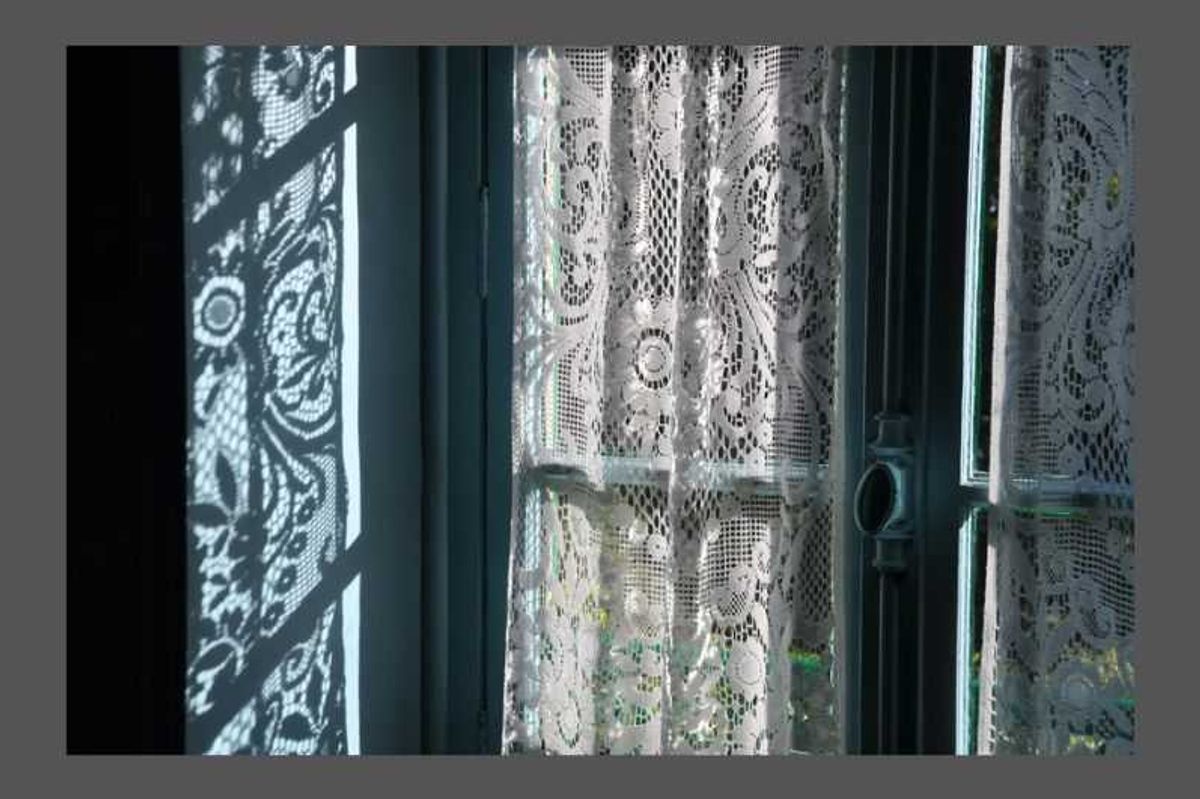
We put our bags in front of a pile of unopened boxes of “The Great Controversy,” and they handed us a booklet on Romans and two pens. The room was ugly, like a warehouse, except for the lace curtains in the windows.
For the next two hours, we “studied the Bible,” mostly discussing how wonderful Jesus is and what it means to pray — how often we should pray and what makes prayer sincere — and how all Protestant churches are basically Catholic because they acknowledge the authority of Rome and the pope to change the Sabbath from Saturday to Sunday.
The church service was bland, hard to follow. I tatted a lace bookmark to try to keep awake. The speaker was likeable, but he droned on about a Bible story, not really recounting it accurately. I don’t think that was the point of his speaking, though — they were simply allowing him a moment to speak, because he was a man and the church had few members and needed participation from everyone in order to keep the spirit alive.
They did not give us cookies, but something better — a meal of various bean and rice dishes. There was fresh homemade hummus, too.
Nine out of Ten
As we ate, everyone continued to ramble on about how awful it was that other churches didn’t care to follow all of the Ten Commandments.
“Evangelicals want the Ten Commandments in schools, and yet they do not want them in their churches.”
“If children came home from school and refused to do their homework on Saturday, most Christian parents would not be happy.”
“There’s a church in town that has the Ten Commandments hanging on the outside of their building,” the pastor began.
So I talked to them about it and asked them why they don’t care about the fourth commandment. Oh, boy! The pastor said he’d get back to me, and let me tell you, oh boy, oh boy, that he finally decided that he could piecemeal a bunch of verses today and how he thinks he can prove that Jesus wants us to keep all the commandments now except that one.
That night the pastor let us stay in his house, and as he showed us all his proof for Saturday Sabbath and how the Catholic Church has duped nearly all mainstream churches, Andy finally confessed, “I am a Roman Catholic, and I believe the Church had the authority to change the Sabbath to distinguish us from the Jewish faith.”
The man started. Then he said, “Well, I think Jesus will save Catholics, too, even though they are only keeping nine of 10 of God’s commandments. But they will be judged for disregarding the Sabbath Day.”
We were friends now.
Answered prayers
In the middle of Maine, we attended one other church. All the days leading up to it were edifying. We had spent a wonderful evening with an elderly Latter-day Saints couple who found us hitchhiking, then brought us home to “show us some literature.” It was not the “Book of Mormon.” They handed us a glass of orange juice and a box of raisins and played old 1960s and 1970s love songs for us, then told us their love story — of how they had a temple wedding in Switzerland; of their 14 children, 88 grandchildren, and 17 great-grandchildren.
After we played a game of cards, they brought us to our destination, where we stayed with a Quaker-esque hippie Christian family. This family brought us to their church the next day.
It was as if God was answering our longing for Mass. Although the church was small and non-denominational, it felt how an early church might feel or how a Catholic service might feel if it were in someone’s home. They prayed and sang some of the songs you’d hear in a Catholic church, along with songs from an Assemblies of God or Baptist-type non-denominational church. They said the Apostles’ Creed together and took communion as a Catholic church does, with everyone coming up front and receiving it in long lines from the pastor.
The sermon was sound — like a homily — and did not feel as scattered with pieces of scripture as many non-denominational church services are. We were spellbound. If it weren’t for how modern everyone seemed to be dressed, I would have thought we had been transported to an era before the Reformation.
Shared roots
After it was over, I asked the pastor if their church had any Catholic influence.
He laughed and said no, that if there were ex-Catholic members, they would probably oppose these traditional Orthodox inclusions. No, these were things he had included because from his studies and experiences, he had come to believe that there was a lot that Protestantism lost when it spurned tradition and ritualism, and he was slowly trying to incorporate it back into church. “It’s in our roots, too.”
I talked to his wife and told her about my Living Room Academy (she had heard of it) and how it was partially inspired by my travels in woke circles when I realized that many lesbians and liberal women were doing a better job of being women and passing on beauty and skills than Christian women. Her eyes opened wide. “You’re right.” I’ve heard that since we left, she has decided to open her own iteration of the Living Room Academy for the girls in their church.
What I loved about their church was that they didn’t seem to be stuck in their bubble. Their church wasn’t really their “home” as much as it was them trying to find out what home means by looking to the past and looking to paradise. They seem to be doing a very good job at making it work — their church was filled with children, happy-looking teenagers, and a diversity of fashion from very beautiful dresses to jeans with frilly purses. There seemed to be room for expression of faith.
Coming home
After that we finally made it to a Mass in Fitchburg, Massachusetts. And I must admit, it kind of felt like coming home.
I hadn’t realized how much I had come to love attending Catholic churches with my husband. There are still many questions I have had to sort through about the Church and whether or not I can in good conscience submit myself to its authority. However, being there, surrounded by the beauty of the type that God requested when He detailed the temple He wanted from the Jews, feels like being at home … in paradise.
Everything else feels so earth-like, so business-minded and corporate and mechanical. Even though the “music” of mainstream churches claims to have more life in the show, there’s nothing quite like the chorus in a cathedral. And while you might get a good sermon in a Protestant church, you’re not going to hear near as much scripture read as is read at Mass.
Most Protestants would complain if they had to sit through half of what is read — they want a Bible verse that corroborates a sermon. Meanwhile, you might get about 15 minutes of rich preaching at a Mass — the rest is pure scripture.
It’s almost a hobby now — I will certainly never stop church-hopping, comparing and pondering. I want our children to have these experiences. So many wonderful conversations have sprung up between my husband and me because of these visits, and we are finding ourselves growing more spiritually aligned because of it.
And so I will continue to exhort anyone of any faith: Visit the churches around you, no matter their denomination. Every church has something to offer you and will give you an opportunity to practice humility and charity.
Editor’s note: A version of this essay earlier appeared on the Polite Company Substack.
The SECRET every young man NEEDS to hear

Young men are inheriting a spiritually starving society, where they’re being sold a future of cheap pleasures, hollow heroes, and never-ending screen time.
It’s a lot of noise, and it will rob the youth of all purpose.
But Blaze Media co-founder Glenn Beck has some advice.
“If there is anything virtuous, lovely, of good report, or praiseworthy, seek those things. Don’t admire them. Don’t nod at them. Seek them. Hunt them. Chase them. Build your life around those things,” Glenn explains.
“A man who will do that, a boy, a young man who will do that, will become different, noticeably different. He will stop letting the culture feed him garbage. He stops applauding the trivial. He stops laughing at the obscene or cheering for the cruel. He will become a curator of real, lasting beauty in an age that has forgotten what beauty even looks like.”
“When other men are chasing down or holding up cynicism, this man holds up hope. When everyone around him is chasing dopamine, he chooses discipline. When others will blame their circumstance, he’ll take responsibility for his own action. When the world worships the shallow, he goes and searches for the deep.”
“You become what you seek. If you seek trash, you become trash. You seek virtue, you become a man of virtue. You seek excellence, and your life will begin to shine, not loudly, but steadily like the steel glow of a blade being forged.”
The world, Glenn says, already has a never-ending supply of “angry,” “addicted,” and “distracted” boys.
What it needs now, he explains, are men.
“Whole men. Clear-eyed men. Men whose souls are anchored to something higher than the algorithms trying to own them,” he says. “Build a life worthy of admiration. Forget about the applause. Fill your mind with words that make you wiser.”
Want more from Glenn Beck?
To enjoy more of Glenn’s masterful storytelling, thought-provoking analysis, and uncanny ability to make sense of the chaos, subscribe to BlazeTV — the largest multi-platform network of voices who love America, defend the Constitution, and live the American dream.
Uwan heads for Taiwan; Signal No. 1 in 9 areas

Nine areas in Luzon are under Signal No. 1 as Severe Tropical Storm Uwan continues to weaken while approaching Taiwan, PAGASA said late Tuesday afternoon.
COP30 highlights growing need of countries for resilience to storms, flood and fires

BELEM, Brazil – With typhoons tearing across Southeast Asia this week while areas of Jamaica and Brazil are still clearing debris from damaging storms, delegates at Brazil’s COP30 summit began grappling with how best to help the vulnerable withstand worsening weather and other climate extremes.
Devil in the beetails: Australian scientists discover new ‘lucifer’ bee

SYDNEY, Australia — As if deadly snakes, spiders and sharks were not enough, Australia now has a new creepy critter: a “lucifer” bee with devil-like horns.
OFW opens and grows restaurant in Dubai amid pandemic, wins award

DUBAI, UNITED ARAB EMIRATES – She did not want to be an employee forever. That”s what kept her going. She opened a restaurant, later grew it into three branches. She won an international award. And she”ll be launching an alternative soda drink for kids. All this for 39-year-old Lourds Adala-Evertse, who started out in Dubai when she was 19 years old, fresh out of college in the Philippines, in the desert summer of 2007.





