

Day: December 5, 2025
Olivia Nuzzi parting ways with Vanity Fair following affair allegations
Vanity Fair and Olivia Nuzzi are parting ways at the end of her contract after allegations of inappropriate relationships with interview subjects had surfaced.
Congress melts down: Members unleash personal attacks after weeks of shutdown drama
Congress prioritizes personal attacks over legislating as lawmakers target colleagues with censure efforts, creating dysfunction on Capitol Hill.
Matthew McConaughey’s painful stunt blunder that taught him valuable Hollywood lesson
Matthew McConaughey revealed his bizarre stunt injury from “Reign of Fire” on “Hot Ones,” sharing how a simple six-foot jump led to an unexpected injury.
Odell Beckham Jr. ROASTED for $100 million complaint — Whitlock calls ‘old, broke joke’ a byproduct of matriarchy

Odell Beckham Jr. is being roasted online by fellow athletes and other NFL personalities for a resurfaced video that went viral over Thanksgiving weekend.
In October 2024 on “The Pivot” podcast with former NFL players Ryan Clark, Fred Taylor, and Channing Crowder, OBJ made a comment about money that many interpreted as tone-deaf, given the majority of Americans are struggling with the rising cost of living.
In the clip, he says, “Bro, you give somebody a five-year $100 million contract, right? What is it really? It’s five years for $60 [million]. You’re getting taxed. Do the math. That’s $12 [million] a year, you know, that you have to spend, use, save, invest, flaunt, like whatever.”
“Just being real. I’ma buy a car. I’ma get my mom a house. Everything costs money. So if you spending $4 million a year, that’s really $40 million over five years — $8 [million] a year — and now you start breaking down the numbers, it’s, like, that’s a five-year span of where you’re getting $8 million. Can you make that last forever?” he continued, adding that people who “ain’t us” couldn’t possibly understand this kind of struggle.
And the response online was essentially: You’re right — we can’t understand your luxury problem of an eight-figure salary.
Jason Whitlock, BlazeTV host of “Fearless,” says OBJ’s real problem is the black culture that’s conditioned him to think that any pushback on his financially “irresponsible behavior” is just racism or white folks selling out black excellence.
“What he’s basically saying is, like, ‘Hey, white people can’t relate. They don’t get it — all the pressure that we’re under and … all the people we have to help,”’ Whitlock translates.
Whitlock — who grew up legitimately poor, spent years grinding to achieve financial success, and had to assume financial responsibility for both his mother and grandmother at a young age — says he knows “the pressure that OBJ is talking about.”
But this kind of pressure isn’t unique to black people. Whitlock says he’s seen his “adoptive family,” who’s white, navigate the same scenario of having money and feeling obligated to help out struggling friends and family.
The pushback OBJ has received for his comments sparked some defensiveness. On December 2, the free agent tweeted:
Whitlock says OBJ’s inability to receive criticism is a result of the “feminized matriarchal culture” of “excuses and delusion” he exists in.
When this is your context, “you end up embracing a lifestyle and an image that will make you [an] old, broke joke — and that’s what OBJ is,” he says.
To hear more of Whitlock’s take, watch the episode above.
Want more from Jason Whitlock?
To enjoy more fearless conversations at the crossroads of culture, faith, sports, and comedy with Jason Whitlock, subscribe to BlazeTV — the largest multi-platform network of voices who love America, defend the Constitution, and live the American dream.
Trump administration limits work permits for asylum seekers following deadly National Guard shooting

Following the tragic shooting of two National Guard members in Washington, D.C., last week, allegedly by an Afghan national, President Trump has ramped up his rhetoric against foreigners coming into our country. Now his administration is taking action with some important policy changes.
On Thursday, U.S. Citizenship and Immigration Services announced a major slash in the duration of work permit validity, according to the Washington Post.
‘It’s even more clear that USCIS must conduct more frequent vetting of aliens.’
Specifically the new policy affects asylum seekers by changing the work permit authorization period from five years to a mere 18 months.
“Reducing the maximum validity period for employment authorization will ensure that those seeking to work in the United States do not threaten public safety or promote harmful anti-American ideologies. After the attack on National Guard service members in our nation’s capital by an alien who was admitted into this country by the previous administration, it’s even more clear that USCIS must conduct more frequent vetting of aliens,” USCIS Director Joseph Edlow said in a Thursday press release.
RELATED: Suspect in Guardsmen shooting tied to Biden’s Operation Allies Welcome
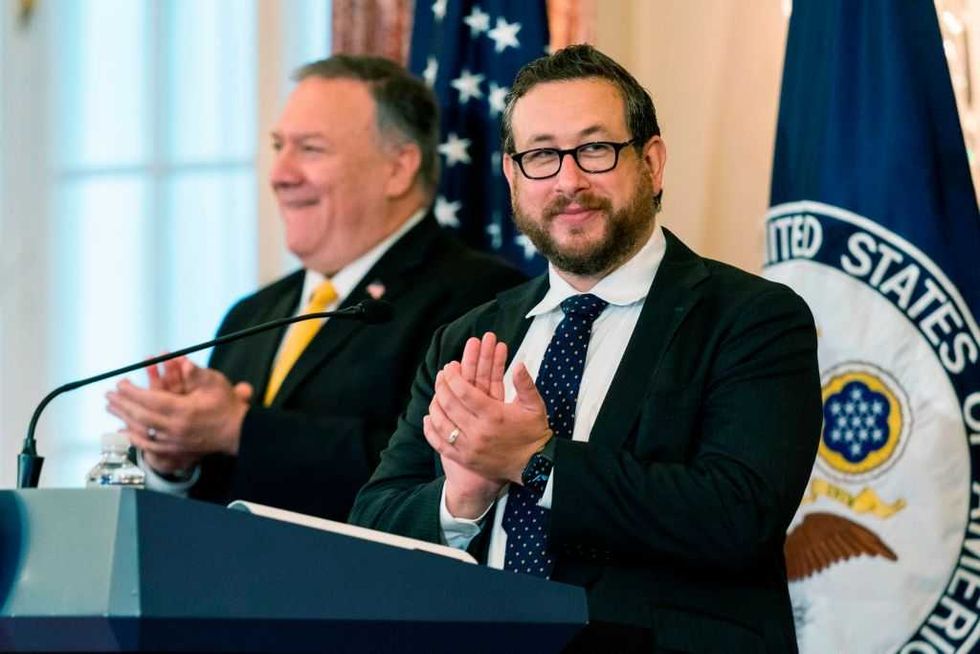 Photo by MANUEL BALCE CENETA/POOL/AFP via Getty Images
USCIS stated in the press release that these changes to maximum validity period for Employment Authorization Documents are part of a broader policy update to ensure more thorough screenings of foreigners.
Fwd.us, an immigration advocacy group, told the Washington Post that the move is expected to impact hundreds of thousands of asylum seekers.
The group also estimated that around 1.4 million of the three million asylum seekers currently in the United States are working.
These policy changes come shortly after it was revealed that the suspected shooter is an Afghan national tied to the Biden-era migrant relocation program, Operation Allies Welcome.
Like Blaze News? Bypass the censors, sign up for our newsletters, and get stories like this direct to your inbox. Sign up here!
Washington’s new favorite lie: ‘Most migrants are safe’

If anyone from a backward and unstable country could be vetted for anti-American hostility, it would have been someone like Rahmanullah Lakanwal, the Afghan national who allegedly shot two National Guardsmen in Washington, D.C., the day before Thanksgiving. He had been vetted by the CIA, worked with our military in Afghanistan, and was later approved for asylum alongside his wife and five children.
And still, he turned his gun on the very country that took him in. How many more reminders do we need before we shut off the spigot?
Tackling America’s economic challenges will be tricky. But an immigration shutoff is easy. Trump can — with the stroke of a pen — halt all entries that threaten national security.
In response to the attack, President Trump vowed to “permanently pause migration from all third world countries.” Many Americans hoped this meant fulfilling the pledge he made nearly a decade ago: “A total and complete shutdown of Muslims entering the United States until our country’s representatives can figure out what the hell is going on.”
On Thanksgiving Day, U.S. Citizenship and Immigration Services Director Joseph Edlow announced a “full-scale, rigorous reexamination of every green card” holder from “every country of concern.” When pressed, Edlow pointed to the 19 countries listed in Trump’s June 4 proclamation, “Restricting the Entry of Foreign Nationals to Protect the United States from Foreign Terrorists and Other National Security and Public Safety Threats.”
That June order established two tiers of restrictions.
Full restriction: Afghanistan, Burma, Chad, Republic of the Congo, Equatorial Guinea, Eritrea, Haiti, Iran, Libya, Somalia, Sudan, Yemen.
Partial restriction: Burundi, Cuba, Laos, Sierra Leone, Togo, Turkmenistan, Venezuela.
This week, the White House announced its intention to pause all immigration from all 19 countries and freeze naturalization applications from nationals already here.
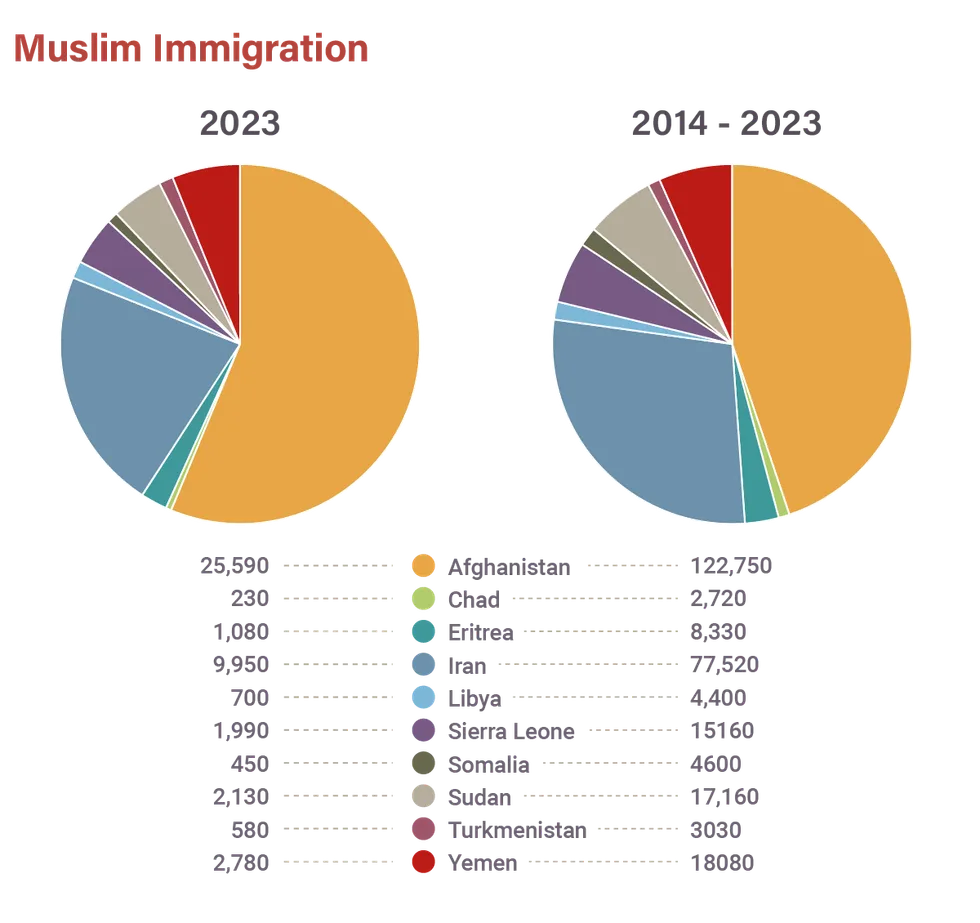
It’s a start. But it doesn’t address the larger reality: Even a total shutdown of these 19 countries barely dents the scale of Islamic-world migration into the United States.
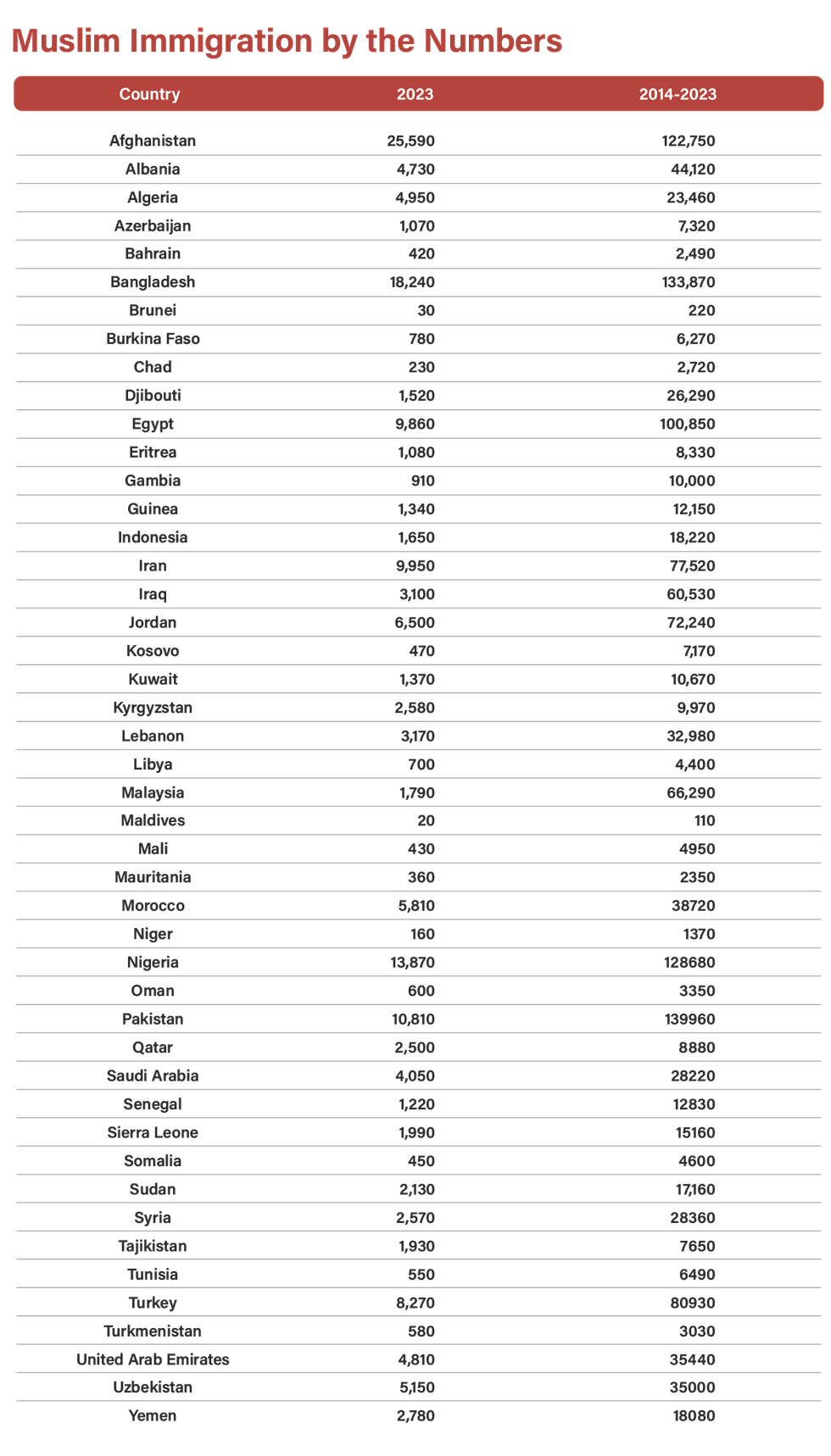
By my calculations, these countries account for only 27% of Muslim-origin immigration in 2023 — and just 18% of our intake from the Islamic world over the past decade.
Ten of the 19 targeted countries are majority-Muslim. But there are 39 other majority-Muslim countries — most overwhelmingly Muslim — from which we admit well over 100,000 green-card recipients each year.
Here is the updated breakdown of immigration from all majority-Muslim countries in 2023 and over the prior 10 years:
 Blaze Media
This is a numbers game. You simply cannot import roughly 175,000 Muslim migrants every year — not counting tens of thousands more on student and temporary visas — without replicating the social unraveling we have seen in Europe.
Trump’s expanded ban would block about 47,000 of these arrivals annually. But it leaves massive sending countries — Bangladesh, Egypt, Turkey, Lebanon, Syria, Saudi Arabia, Jordan, Iraq, Uzbekistan — effectively untouched.
 Blaze Media
The problem with limiting the moratorium to these 10 Islamic countries (plus nine other hostile or unstable states) isn’t just numerical. It’s philosophical. The order implies that we are only concerned with countries that have poor diplomatic relations or inadequate data-sharing with the United States.
But the challenge of Islamic migration has never been solely about vetting. Most individuals who embrace Sharia supremacism, support suicide attacks, or reject Western norms are not sworn members of al-Qaeda or Hezbollah. The issue is ideological — a form of unreformed Islam that never passed through the Enlightenment and remains fundamentally incompatible with liberal Western society.
For decades, small-scale migration masked this reality. But we have admitted roughly 3 million Muslims since 9/11. They cluster, build Qatari-funded or Muslim Brotherhood-affiliated mosques, and reproduce the same ideological ecosystem from which they emigrated. High-volume flows reinforce the problem exponentially.
And contrary to the foreign-policy establishment’s assumptions, hostility does not only come from “enemy” states. In fact, migrants from “friendly” governments often pose greater risks. Regimes such as Egypt and Jordan suppress their own Islamist movements. Uzbekistan bans full beards. These governments contain radicalism at home — and we import the very people they fear.
We’ve seen the consequences repeatedly. A sampling:
- Akayed Ullah, who arrived from Bangladesh in 2011, detonated a pipe bomb in the Port Authority Bus Terminal, declaring support for ISIS. Bangladesh now sends more than 18,000 immigrants annually.
- Sayfullo Saipov, who came from Uzbekistan in 2010 on a diversity visa, murdered eight people in a truck attack in Manhattan while shouting “Allahu Akbar.”
- Dilkhayot Kasimov, Abdurasul Juraboev, Abror Habibov, all Uzbeks, conspired to support ISIS, discussed attacking President Obama, and scouted U.S. military targets. We continue admitting over 5,000 Uzbeks per year through the Diversity Visa Lottery — a program Trump should end immediately.
- Muhammad Khair Alabid, a student from Egypt, plotted a Fourth of July vehicle-bomb attack in Cleveland.
- Mohamed Sabry Soliman, also from Egypt, firebombed a pro-Israel rally in Boulder in 2025, killing one and injuring 12. He and his family were admitted by the Biden administration and overstayed. We have issued more than 100,000 green cards to Egyptian nationals in the past decade.
- Muhammad El-Sayed, admitted from Jordan on a diversity visa, built an ISIS-linked terror cell in Minneapolis, scouting military bases and Jewish centers.
- Abdullah Muhammad Zain-ul-Abideen, a student visa-holder from Jordan, provided material support in the Garland, Texas, terrorist attack on the “Draw Muhammad” event.
 Photo by Cindy Ord/Getty Images for BAFTA
The most glaring case of false security is Mohammed Saeed Alshamrani, a Saudi military trainee brought here on an A-2 visa. In 2019, he murdered three American service members at Naval Air Station Pensacola. He was here because our government trusted Saudi vetting.
This is the pattern: Working with a regime is not the same as trusting its people. In many cases, these governments fear their own populations. Yet we continue importing those populations at scale.
For example: The United States and Israel prop up the Hashemite monarchy in Jordan precisely because its people are more radical than their rulers. Yet we have brought in over 72,000 Jordanians in the past decade. If those populations are too dangerous for their own government, why do we assume they are safe for ours?
When it comes to transformational immigration policy, there is no such thing as “lukewarm hell.” Trump should impose a full moratorium on all Islamic-majority countries and abolish the Diversity Visa Lottery entirely.
Tackling America’s economic challenges ahead of the midterms will be tricky. But an immigration shutoff is easy. Under Section 212(f) of the Immigration and Nationality Act, Trump can — with the stroke of a pen — halt all entries that threaten national security.
He has already done it for 19 countries. He has no reason not to finish the job.
Karen Carpenter starved herself in public; today’s celebs have pharmaceutical help

“Pop singer Karen Carpenter died this morning from complications of anorexia nervosa,” said the perfectly made-up anchorwoman on KTLA while I sat at the table eating my Raisin Bran.
It was one of those bright Southern California mornings in 1983. There’s something jarring about hearing awful news in a chipper tone of voice when the sun is out and a new day is starting. Of course I was sad to hear about Karen’s death; she was that nice lady with the prettiest voice in the world who sang “the Sesame Street song.”
I fear we’re watching a replay of what happened in the 1970s and ’80s, when anorexia nervosa spread rapidly through the culture.
Sing of good things, not bad
Sing of happy, not sad
A voice from God
It wasn’t until many years later that I felt a deeper sadness and loss when I contemplated Karen Carpenter’s death at 33. She had a voice from God that comes along once in a century if we’re lucky. We had all watched her slowly kill herself right there on television. Like most deeply troubled people, Karen denied that anything was wrong, even as she sat under the interview lights as a skeleton in a sweater.
We’re seeing the same thing today in our “stars,” but unlike the early 1980s, grown-up America seems to think it’s normal. Maybe even “empowered.”
“There are rumors, though, that you were suffering from the slimmer’s disease, from anorexia nervosa. Was that right?” a British interviewer said to Karen in 1981.
“No,” said Karen, rolling her eyes inside a face that looked like a moving skull, all jagged planes and bone surfaces shining through translucent skin.
No looking away
Two years later, Karen died on the floor of her mother’s upstairs closet in Downey, California, before she made it down for breakfast. Despite having recently been treated for anorexia and gaining back a modest amount of weight, the long-term damage Karen did to her heart and organs made them give out.
And everyone knew it would. Everyone talked about it. Most adults in that era had looked on with worried skepticism at the gaunt Twiggy when she became a top model in the 1960s. Everyone knew women on TV or at the office who dieted a little too hard. But America had never seen something as extreme as what happened to Karen Carpenter.
There was no looking away, no denying it. Karen stood on stage with Ella Fitzgerald for a TV special. She was barely able to stand up, and if she weighed 90 pounds, I’ll eat my hat. That velvet syrup voice was almost enough to distract from the approaching death, but not quite.
Do we even notice when our stars kill themselves in public today?
The Ozemporexia nervosa era
We’re entering our Ozemporexia nervosa era. As usual, few people are saying out loud what everyone already knows: People with troubled minds and troubled relationships to substances including food are taking the drugs to cover over, or to enhance, an eating disorder. The semaglutide injectable diabetes drugs work in part by chemically controlling appetite, so the primary reason these drugs are prescribed today is, of course, weight loss.
If you have turned on a computing device or entered a store within the past few months, you cannot avoid noticing the oversaturation of advertisements for the movie “Wicked: For Good.” This is the sequel to the movie “Wicked,” based on the long-running Broadway musical, itself based on Gregory Maguire’s 1995 novel.
Maguire tells the story of the young Elphaba, the innocent green-skinned girl who would go on to terrorize Oz as the Wicked Witch of the West. Maguire’s novel pioneered what has now become commonplace in our entertainment: recasting the evil, the sinister, and the villainous as misunderstood and traumatized wee harmless ones who are actually the heroes.
RELATED: Out-of-control Ozempic use means sad, saggy future for TL;DR generation
 PHAS/Getty Images
Folie à deux
Cynthia Erivo plays Elphaba, although her knife-edged cheekbones and six-inch acrylic talons are less witchy and more “Nosferatu.” The actress certainly seems to have the strange, self-absorbed charisma of a vampire, wasting away before our eyes even as she mesmerizes Hollywood into all manner of unnatural acts. Like casting her as Jesus in “Jesus Christ Superstar.”
But it is in Erivo’s jarring relationship with fellow extreme ectomorph Ariana Grande — who co-stars as a young Glinda the Good — that we really sense the vampiric.
Like Erivo, Grande seems much frailer than she did just a few years ago. The two appear in public as if they were sewn together at the hip. In nearly every press interview for their “Wicked” movies, Erivo clicks her claws around Grande’s neck and head, fiddling with her jewelry in a creepily proprietary way. Or the two are holding hands as if they were waifs being introduced to grown-ups for the first time outside the orphanage.
Celebrities looking and acting weird. Big shock, right? This is Hollywood we’re talking about. The town is a magnet for dysfunctional people. Neglected, abused, and exploited children run for the big city lights so they can be beautiful, adored, and good enough in a way they could never be for their parents.
Eating disorders, addiction, and declining mental health all stem from these childhood circumstances, and they are worsened for those who choose fame as a means of “getting over” them.
The influence of anxiety
This is not to say that Erivo or Grande suffer from any of this or even that they use Ozempic. But their alarmingly thin bodies and their brittle, performative intimacy do not exist in a vacuum. While young people have been entranced by celebrity culture since the mid-20th century, the desperate absorption and imitation of every star’s psychiatric distress by ordinary American kids has never been as extreme as it is in 2025.
One can make a reasonable argument for using the semaglutide drugs to lose weight when one’s health is in jeopardy and other methods have not worked. Every patient has to run that calculation for herself and consider it with her doctor.
But I fear we are watching a replay of what happened in the 1970s and ’80s, when anorexia nervosa spread rapidly through the culture and clinicians noted that the intense public focus on Karen Carpenter’s illness seemed to accelerate the trend.
But this has a pharmaceutical assist that will give a “normal” brand name to what is just old-fashioned self-starvation.
All-ages contagion
British researcher Gerald Russell first described bulimia nervosa (binge eating, followed by purging, usually vomiting) in some of his anorexic patients in a paper published in the 1970s. He later shared his alarm that his paper, and the spread of terms and diagnostic language around the condition, may have caused it to spread among women in the Western population.
Russell was arguably correct, though he can’t be blamed for trying to help sufferers. Young women are especially vulnerable to trends and fads; they will do almost anything, no matter how potentially dangerous, to keep up with what their friends are doing. If Becca manages to keep her figure by discreetly puking up her lunch, why shouldn’t Caitlin?
Michelle Obama has recently displayed an alarming weight loss on a frame that didn’t have much to lose. On her Instagram she shared an behind-the-scenes image from her recent shoot with photographer Annie Leibovitiz.
At 61 years old, Obama is dressing in teen-style distressed jeans and clingy, skin-baring tops, showing off how her female curves are melting away.
Look at her face. Does this woman look healthy or happy?
No one left to notice
The problems that celebrities, normal young women, and some men and boys face about body image aren’t about a particular drug or a time-limited fashion trend. What we see today in Hollywood is not different from what we have always seen in the entertainment industry and among the kids and teens who consume it.
The problems begin at home — the home that no longer exists. Fatherlessness, divorce, and normalized neglectful, hands-off parenting have left today’s kids even more vulnerable to self destruction than those of my generation in the 1980s. And if you are old enough to remember what that was like, you remember plenty of screwed-up kids from screwed-up families.
It’s worse today because we’re pretending that it’s not wrong, that it’s not unhealthy. It has brand names and “rizz,” and besides, everyone is doing it. How can it be wrong?
In 1983, adults spoke about what happened to Karen Carpenter with alarm, and they said it out loud. Today, cool moms get glammed up along with their daughters in officially licensed Wicked(™) outfits and stand in line for tickets to watch the actresses perform “fun” while their minds and bodies decay.
Isn’t modernity wonderful?
Tim Walz tries gaslighting Americans again — this time about Trump’s ‘garbage’ remark

Democratic Minnesota Gov. Tim Walz appears keen to clutch pearls and hold President Donald Trump to a different standard than Walz did the previous president — especially after Trump called Walz “seriously retarded.”
Quick background
During a Cabinet meeting on Tuesday, Trump leaned into his criticism of Somalia, the rampant fraud in Minnesota’s Somali community, and Somalia’s top spokeswoman in Congress, Rep. Ilhan Omar (D-Minn.).
‘This is on top of all the other vile comments.’
“Somalia, which is barely a country, you know, they have no, anything. They just run around killing each other. There’s no structure,” said the president.
Somalia is a Sunni Muslim nation on the easternmost part of Africa with a population of just over 19 million, a high rate of female genital mutilation, a GDP of $12.94 billion, and an adult literacy rate of 54%.
The country is a haven for crime and terrorism, ranking 34th out of 193 countries for criminality on the Global Organized Crime Index. With 10 being the most severe, Somalia scores 8.5 for human trafficking; 8 for human smuggling; 9.5 for extortion and protection racketeering; 9 for arms trafficking; 7 for financial crimes; and 7 for trade in counterfeit goods.
Trump appears to suspect that America imported some of Somalia’s chronic problems when accepting its refugees.
Following a report detailing instances of alleged and confirmed fraud perpetrated by numerous members of the Somali community in Minnesota, Trump announced on Nov. 21 that he was terminating the Temporary Protected Status designation for Somalia.
RELATED: DHS to increase operations in Twin Cities region as Somali fraud becomes unignorable
 Photo by Chip Somodevilla/Getty Images
“Somalians ripped off that state for billions of dollars. Billions every year. Billions of dollars, and they contribute nothing. The welfare is like 88%. They contribute nothing,” continued Trump. “I don’t want them in our country; I’ll be honest with you. Some might say, ‘Oh, that’s not politically correct.’ I don’t care. I don’t want them in our country. Their country is no good for a reason. Their country stinks, and we don’t want them in our country. I can say that about other countries too.”
Trump added, “We’re at a tipping point. I don’t know if people mind me saying that, but I’m saying it. We could go one way or the other, and we’re going to go the wrong way if we keep taking in garbage into our country.”
“Ilhan Omar is garbage. She’s garbage. Her friends are garbage. These aren’t people that work,” Trump said, leaving no room for ambiguity.
“These are people who do nothing but complain.”
Walz whines, gaslights
Walz made a big show on Thursday of denouncing Trump’s remarks and calling on others to do likewise.
“Donald Trump’s calling our Somali neighbors ‘garbage’ and the state of Minnesota a ‘hellhole’ is, I’m assuming, is unprecedented for a United States president,” said Walz, who has bent the truth to his benefit on numerous occasions.
The use of the term “garbage” by an American president in reference to a group of people is not unprecedented. In fact, Walz downplayed former President Joe Biden’s use of the term to describe nearly half the country just last year.
When stumping for then-presidential candidate Kamala Harris in October 2024, Biden fixated on a joke made by comedian Tony Hinchcliffe about Puerto Rico during a humorous speech at a Trump rally in New York City — a rally that Walz had likened to a Nazi rally. Rather than brush off the joke, Biden apparently tried to outdo Hillary Clinton’s “deplorables” smear.
“A speaker at his rally called Puerto Rico a ‘floating island of garbage.’ Well, let me tell you something,” said Biden. “In my home state of Delaware, they’re good, decent, honorable people. The only garbage I see floating out there is his supporters.”
After Biden suggested that the over 77.3 million who would ultimately vote for Trump were “garbage,” Walz downplayed the remark when asked in a “CBS Mornings” interview whether that comment and others like it undercut the Democratic campaign’s “closing message of unity.”
“No, certainly not,” said Walz. “I think that the frustration we’ve seen since January 6, the frustration with Donald Trump’s rhetoric of division, it does fire passions.”
After suggesting on Thursday that Trump’s “garbage” remark was a first, Walz, a champion of racist DEI initiatives, said that “demonizing an entire group of people by their race and their ethnicity — a very group of people who contribute to the vitality, economic [sic], culture of this state is something I was hoping we’d never have to see. This is on top of all the other vile comments.”
The Democratic governor said that any officials in Minnesota who would not condemn Trump’s “vile attack” are “complicit in it.”
Like Blaze News? Bypass the censors, sign up for our newsletters, and get stories like this direct to your inbox. Sign up here!





