

Category: Jesus
Chick-fil-A worker on why he didn’t keep $10K cash left in restroom: ‘That’s not what Jesus would’ve done’

Chick-fil-A employee Jaydon Cintron told WITN-TV he was taking his break on Good Friday morning when he found two white envelopes in the men’s restroom at the restaurant in Kinston, North Carolina. Kinston is about 90 minutes southeast of Raleigh.
“They were on the floor next to the toilet. My first thought was just like, … OK, no, this isn’t happening,” Cintron told WITN. “Something is wrong.”
‘Money is useless without character.’
But it was happening — and something most definitely was wrong for the person to whom the envelopes belonged.
Return to sender
You see, one envelope was labeled First Citizens Bank, and it contained $5,000; the other envelope was labeled Truist Bank, and it contained $4,333, the station said.
And how did Cintron react?
He told the station he simply picked up the envelopes and brought them to human resources.
A WITN reporter asked the 18-year-old why he didn’t keep the cash for himself.
Cintron replied to the station with the following: “That’s not what Jesus would’ve done. That’s not what God would’ve wanted.”
RELATED: The secret to Chick-fil-A’s success has nothing to do with chicken
‘True integrity’
Cintron added to WITN that his faith guides his thought process: “Money is useless without character.”
Kinston Police Chief Keith Goyette told the station that “a lot of people will unfortunately take that money and run with it. But kudos to that employee at Chick-fil-A. [He] definitely deserves an award.”
John McPhaul, owner of the Kinston Chick-fil-A, noted to WITN that Cintron embodies the restaurant’s principles: “True leadership, true integrity is doing the right thing when no one’s watching. And Jay did that in this case, and he should be commended for it.”
The station said the restaurant tried to search security video in an attempt to identify the owner of the money but had no luck.
However, Chief Goyette told WITN the owner of the money came forward Monday morning to claim the $9,333.
It’s own reward
Cintron revealed to the station that the owner of the money approached him and offered him a $500 reward for his good deed, but Cintron initially declined and told the man he expected no reward for what his faith told him was the right thing to do.
“I don’t want anything out of this,” Cintron told the station, adding, “I did this because that’s what Jesus would do.”
WITN noted that after declining the reward multiple times, the teenager finally accepted it — and numerous viewers agreed that Cintron deserves all the recognition he’s receiving.
Like Blaze News? Bypass the censors, sign up for our newsletters, and get stories like this direct to your inbox. Sign up here!
UConn star Tarris Reed praises Jesus ahead of national championship: ‘He changed everything about me’

University of Connecticut star Tarris Reed Jr. spoke beautifully about Easter, the Resurrection, and how Jesus has affected him following the March Madness semifinals on Saturday.
Reed took the podium following a 71-62 win over Illinois, which sent UConn to the national championship against Michigan, his former team, on Monday night.
‘He changed everything about me.’
Surprisingly, a reporter in Indianapolis brought up Easter weekend during Reed’s press conference, asking the 22-year-old what the Resurrection means to him.
Praise and proof
With a smile on his face, Reed rubbed his chin and said, “That’s a great question.”
“The resurrection is really everything,” he began. “That’s like, the staple of Christianity. So like, without the Resurrection, there is no Christian [faith], there is no Jesus.”
Reed then went into details that are rarely heard in the sports world, which may signal a continued shift into faith being proclaimed by high-level athletes.
“I feel like once you can show a lot of significant evidence for the Resurrection, I mean, it shows a lot of proof towards Christianity. So I feel like just to go through, where I came from throughout my college career … Jesus just literally changed my mind.”
RELATED: Olympic Committee adopts new policy on ‘trans’ athletes
Bible based
Before the national tournament, Reed said he has been drawing inspiration from his Christianity, saying he reads the Bible every morning. When his confidence has been low, he has turned to God and been “strong” in his faith.
It was then that Reed began telling reporters that his belief in Jesus has changed him completely.
“He changed everything about me,” Reed said on Saturday night. “It’s crazy looking back; like I saw my old team Michigan the other day and spoke to a couple of those guys. We [have] just seen each other just grow so much and just change. So it’s just been a blessing just to see myself just, like I said, grow through Jesus. I mean He just, like I said, wiped my eyes clean.”
While there aren’t as many instances, Reed had spoken about being a Christian during his time at Michigan, but he admitted recently he did not read the Bible when he played there.
Interestingly enough though, he cited similar reasoning for turning to his faith in 2023 with the Wolverines.
“When things are crumbling down, I know that I have faith in Jesus Christ. He’s going to produce and carry me through the storm,” he said at the time.
RELATED: Jason Whitlock: The NCAA tournament has a Bruce Pearl problem
 Patrick Smith/Getty Images
Walking of faith
Ahead of the tournament final, the 6’11” center says he has completely changed due to his faith, right down to the way he walks.
“My whole mind is different. The way I talk, walk, act changed. The way I treat other people. It’s like more not to get, but more to serve. You know, I feel like I’m here to really serve and serve others.”
UConn plays Michigan Monday night at 8:50 p.m. ET for the national championship.
Like Blaze News? Bypass the censors, sign up for our newsletters, and get stories like this direct to your inbox. Sign up here!
Whose past predicts your future?
Watching the reports out of Old Dominion University following the terrorist attack last month, the details came in the way they always do. Confusion. Fear. Families waiting for answers that arrive agonizingly slow.
There are no clever observations for moments like this. Only grief, a sober anger at what has been done, and a quiet respect for those who move toward danger despite the risks.
In the hours that followed, law enforcement stood before the microphones and said something familiar about the terrorist.
Past behavior predicts future performance.
The gospel does not offer a refined version of our past. It replaces it.
It was not delivered with edge or indignation. It sounded more like a sigh, the kind that comes from seeing the same pattern unfold one too many times.
We all understand what that means.
As Americans stood in grief, that phrase was repeated as the events were recounted. Members of the media, pundits, and political officials picked it up as well, and it echoed for days. And it lingered. You know how some phrases land hard and stay with you?
Past behavior predicts future performance.
I couldn’t shake it. It followed me for several weeks. As Easter approached, that phrase pressed further.
While the pattern is clearly seen in terrorists and career criminals, the harder question is whether that diagnosis is limited to them. Or does that diagnosis reach further — into the human condition itself?
The apostle Paul describes the same struggle with unsettling honesty, doing what he does not want to do and returning to what he knows he should leave behind. The issue is not merely what we do, but what we are by nature.
That uncomfortable truth points to something we recognize much closer to home — not in acts of terror or even criminal behavior, but in patterns we cannot seem to break. We see that uncomfortable truth in the anger that resurfaces, the grudges we carry, the actions we excuse and quietly return to.
Our actions are different in degree, certainly. They are not the same in consequence — but not unrelated.
Scripture does not blur those distinctions, but it does press deeper than behavior. And that is where the discomfort settles in.
RELATED: Scripture or slogans — you have to choose
 Godong/Universal Images Group/Getty Images
Because if this is not just “out there,” then we are not merely observers of the pattern. It’s one thing to recognize the pattern in others. It’s another to consider whether it touches us as well. And that raises a question most of us would rather not sit with for long.
Are we simply watching something broken in the world, or are we looking at something that runs through us as well?
Because if it is the latter, then the problem is not occasional, but continual.
It is not just in headlines, it is in our hearts. And that is a harder place to stay.
Because if the future depends on us, then the trajectory is not uncertain. It is already set.
Our culture often insists that we are basically good people.
If so, then why would we need a savior? If not, then what are the implications?
The men who framed this country wrestled with that thought. They did not build a system on the assumption that people would consistently do what is right or that they are basically good. They built a government filled with oversight that restrains what is wrong, because they knew what resides in the human heart eventually shows up in government.
Which raises a harder question than any press conference can answer.
What breaks the pattern?
Because history suggests we do not. We adjust, we regulate, we respond, and all of that has its place. But none of it reaches far enough to change what drives the pattern in the first place.
And this is precisely where Easter speaks.
RELATED: Where Easter really comes from
 Bernard Jaubert/UCG/Universal Images Group/Getty Images
It’s not that people try harder or gradually become better versions of themselves. Left to ourselves, we cannot change. We must be changed.
The gospel does not offer a refined version of our past. It replaces it. Not my record, but His. Not a cleaned-up life, but a different standing altogether.
What Scripture calls sin is not managed at the cross. It is judged. And what we could not produce is given.
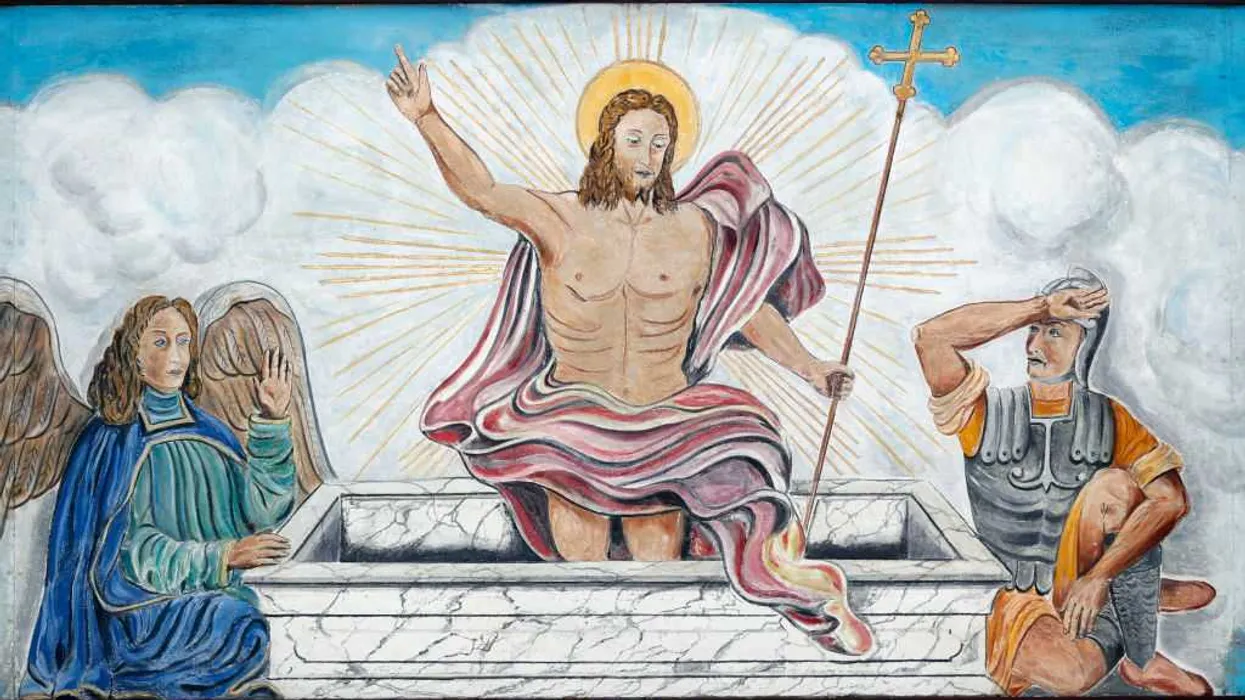
That is why the Resurrection matters.
Because death has always been the final confirmation that the pattern holds. It is where every life, left to itself, arrives. But if death itself is overturned, then the pattern it confirms is no longer absolute.
Something has interrupted it.
The apostle Paul captured it in a single phrase:
“And such were some of you” (1 Corinthians 6:11).
Were.
Left to ourselves, the pattern holds. It always has. But Easter declares that we are not left to ourselves.
Past behavior may predict future performance. It often does. But it is no longer the final authority.
Because the One who stepped into history, took our past upon Himself, and walked out of the grave now defines the future of all who belong to Him.
Not a second chance or a fresh start, but a new standing.
Not my record, but His. And that changes everything.
This Easter, remember the cost of discipleship

For many people across the U.S., Easter Sunday means pastel-colored clothes, jelly beans, Cadbury eggs, or marshmallow Peeps. But Easter is far more than a cultural tradition or seasonal celebration. It is a declaration that should actually shape the way we live and has the power to transform lives: He is risen!
That truth, echoed by believers all around the world every Easter Sunday, is the foundation of a faith that calls us not to a life of comfort, but to a life of commitment.
To follow Christ is not only to receive the hope of eternal life, but to carry that hope into the world around us.
Too often, we treat Christianity as a system designed to make life easier, provide emotional reassurance, or help us get something from God. Scripture makes it clear, and believers throughout history have experienced, that true Christianity costs us something. It calls for surrender, obedience, and a willingness to follow Christ even when the path is difficult.
It’s natural to gravitate toward a version of Christianity that prioritizes comfort over sacrificial living. But in truth, persecution and hardships are not only possible but an expected outcome for a life of wholehearted devotion to following Christ.
Jesus Christ, our example, willingly left the comfort of heaven’s glory to enter a broken world and dwell among us. He lived among the very people He created, walking dusty roads, experiencing hunger and fatigue, facing rejection and temptation, enduring suffering — all ultimately to make the Father known.
Throughout His ministry, He healed the sick, fed the hungry, and performed miracles — yet He never wanted people to follow Him merely for those “simple” benefits.
During Jesus’ ministry on earth, massive crowds followed Him simply for the possibility of free bread. They wanted miracles and meals. But He wanted them to look past all of that and see that the true gift was Himself. “I am the bread of life,” He told them. “Believe in me!”
Only a few individuals would see past their own desires and take the step to say, “I believe, and I will follow you no matter what.” As a result, they would be forever changed and go on to change the world.
RELATED: Where Easter really comes from
 Bernard Jaubert/UCG/Universal Images Group/Getty Images
This is the truth of the Christian life: Following Christ requires us to embrace discomfort, sacrifice, and even suffering. The Bible does not hide this reality, but Easter reframes that suffering in light of something greater.
The cross is not the end of the story.
On that first Easter morning, everything changed. Jesus’ resurrection was not only a victory over death, but a promise that suffering does not have the final word. Sin, brokenness, and the grave were defeated. Because of this, even while withstanding hardship, believers can live with an unshakable hope rooted in the promise of eternity.
As we read in 2 Corinthians 4:17-18, “For this light momentary affliction is preparing for us an eternal weight of glory beyond all comparison, as we look not to the things that are seen but to the things that are unseen.”
And this hope is not meant to be kept to ourselves.
Years ago, a friend of mine who was overseas asked a shop owner, “Excuse me, sir, do you know Jesus Christ?” The man turned around and said, “We’ve got Pepsi, we’ve got Coke, but we don’t have Jesus Christ.” He had never heard the name of Jesus, so he thought Jesus Christ was a new soft drink.
As someone who grew up in different cultures, I’ve seen firsthand the harsh truth that many people around the world still haven’t heard the gospel.
Here in Texas where I live now — in the heart of the Bible Belt — it can seem like there is a church on every corner. On the other hand, I have gone more than 300 miles in some countries without passing a single church. As ambassadors for Christ, we still have so much work to do.
After all, even in places like Texas, we have neighbors, co-workers, and friends who may recognize the name of Jesus but do not really understand what His death and resurrection are all about.
For many, Easter remains a holiday without meaning, a tradition without truth.
This is where the calling of every believer becomes both a responsibility and a privilege.
RELATED: Easter changes everything: What the empty tomb means for you today
 Urupong/Getty Images
To follow Christ is not only to receive the hope of eternal life, but to carry that hope into the world around us. It is to reflect His love and choose to live so that others are drawn to the reality of who He is.
That calling may be uncomfortable, to require us to step outside our routines, and even to risk rejection, but it is also one of the greatest privileges we are given: to bring light into a suffering world.
Easter is a time to remember Christ’s sacrifice and His victory over sin, Satan, and death. He poured out His life so that we might partake of Him and be made like Him. That process requires obedience, faithfulness, and self-denial.
But for all who trust Him and choose to live for Him as an act of worship, He will fill them with His presence. He will refresh, replenish, and empower us to bring His healing presence into the world around us.
Editor’s note: This article was originally published by RealClearReligion and made available via RealClearWire.
8 arguments that the Resurrection really happened

If you had to summarize what Christians believe in as few words as possible, you could do worse than “He is risen.”
In fact, the resurrection is so central to the faith that believers and nonbelievers alike often lose sight of it. In arguing over what Jesus said and what he meant by it and whether or not his moral prescriptions make sense in our “enlightened” 21st century, it’s easy to skip over the one simple, historical question at the heart of it all.
Even ex-evangelists like Ehrman accept that Paul genuinely believed he had an encounter with the risen Jesus.
Did the first-century Jewish leader known as Jesus of Nazareth, executed by Roman authorities in Judea circa A.D. 33, come back from the dead?
If he didn’t, Christianity is nothing more than a nice set of lessons and aphorisms. If he did, well, even the staunchest anti-Christian has some explaining to do.
He is risen. It’s such an embarrassingly outlandish claim, and so obscured by the mists of time, that it is easy to see why even some Christians are tempted to hedge and say it’s a metaphor.
But when you look at the evidence, the “it’s just a story” line gets harder to maintain.
Here are eight reasons why. Have a blessed Easter.
1. The tomb really was empty
If Jesus’ body were still in the grave, Christianity ends before it begins. The movement started in Jerusalem, within weeks of the crucifixion, under hostile scrutiny. Had the authorities been able to produce a body, they certainly would have.
Even the non-Christian historian Michael Grant acknowledged that historians, applying normal standards, cannot simply dismiss the empty tomb. The earliest counterclaim (first reported in the Gospel of Matthew) — that the disciples stole the body — concedes the point: The tomb was empty.
2. The first witnesses were the least credible
All four Gospels agree on an awkward detail: Women discovered the empty tomb first.
As even skeptical scholar Bart D. Ehrman has pointed out, this is not the kind of detail early Christians would be likely to invent in a culture where female testimony carried less weight. If you’re crafting a persuasive story, you don’t start here.
3. The disciples’ behavior doesn’t make sense otherwise
Before the Resurrection, Jesus’ followers were scattered, afraid, and in hiding. Afterward, they were publicly proclaiming that he had risen — at real personal cost, knowing it could mean persecution or even martyrdom.
New Testament scholar E.P. Sanders — hardly anyone’s idea of a biblical fundamentalist — wrote: “That Jesus’ followers (and later Paul) had resurrection experiences is, in my judgment, a fact. What the reality was that gave rise to the experiences I do not know.”
4. The earliest testimony is too early to be legend
In 1 Corinthians 15, Paul presents a creedal formula about Jesus’ death and Resurrection that predates the Gospels:
For what I received I passed on to you as of first importance: that Christ died for our sins according to the Scriptures, that he was buried, that he was raised on the third day according to the Scriptures, and that he appeared to Cephas, and then to the Twelve (1 Corinthians 15:3-5, NIV).
New Testament scholar James D.G. Dunn dates this material to within just a few years of the crucifixion. That’s far too early for legend to develop, with no time for stories to evolve, circulate, and displace living eyewitnesses who could correct them.
5. There are multiple, overlapping eyewitness claims
We don’t just have one Resurrection story. We have multiple early accounts and traditions, including the four detailed narratives presented by the Gospels.
According to Richard Bauckham, the Gospels are best understood as closely tied to eyewitness testimony. Why? Because they read like accounts anchored to real people — named witnesses, stable core details, and traditions formed while eyewitnesses were still alive to check them.
6. Skeptics and enemies didn’t stay that way
Two of the most important early Christians weren’t early believers at all: James and Paul the apostle.
Even ex-evangelists like Ehrman accept that Paul genuinely believed he had an encounter with the risen Jesus. You can argue about what it was, but not that it didn’t happen.
7. It spread fast, in the place where it could most easily be disproved
Christianity didn’t grow slowly as a tale imported from some distant region. It took off in Jerusalem, the very place where Jesus had been publicly executed and buried — and the place where its radical claims could most readily be checked, challenged, and shut down.
New Testament scholar Larry Hurtado has shown how rapidly early devotion to the risen, divine Jesus emerged — far earlier than standard models of religious evolution would predict.
8. The “pagan copycat” theory falls apart under scrutiny
It’s common to argue that Christianity borrowed the resurrection from pagan myths — usually that of Mithras, deity of a Greco-Roman mystery cult.
But the parallels don’t hold. The confusion comes from the fact that Mithraic imagery includes themes of cosmic renewal and salvation tied to the famous bull-slaying scene — language that can sound, at a distance, like death and rebirth. In the actual myth, however, Mithras does not die and return to life; rather, killing the sacred bull creates new life and order. He is a conquering figure, not a dying and rising savior.
Scholar of religion Tryggve N.D. Mettinger — himself no Christian apologist — concluded that while some ancient myths involve dying and rising figures, none match the Jewish, historical, bodily resurrection claim of Christianity.
Do you follow a diluted Jesus — or the full-strength one?

One of the most revealing features of modern Christianity — across Catholic, Protestant, and nondenominational churches alike — is how Jesus is so often presented: gentle, affirming, and above all reassuring. He is described primarily as the “Prince of Peace,” a title that appears only once in scripture (Isaiah 9:6), or reduced to a generalized ethic of niceness often summarized as “Jesus is love.”
The problem is not that these ideas are false. It is that they are radically incomplete.
Jesus prays for His followers, not for the world as such. He commands love of neighbor, but He never pretends that truth and allegiance are optional.
Scripture presents God as merciful, gracious, and abundant in goodness and truth (Exodus 34:6), but the same passage insists that He “will by no means clear the guilty.” Love, in the biblical sense, is inseparable from justice.
When Jesus commands His disciples to love one another, the apostle Paul clarifies what this means: to fulfill the law and do no harm to one’s neighbor (Romans 13:8-10). Love is not affirmation of wrongdoing; it is obedience to God’s moral order.
This distinction was not always obvious to me.
Scriptural reckoning
For much of my life, I was a Christian in name only — attending church, absorbing familiar slogans, and assuming that the moral core of Christianity consisted of kindness paired with a firm prohibition against judgment or righteous anger. That changed four years ago when I began reading scripture seriously, first through a Jewish translation of the Old Testament and later through a King James Study Bible in weekly study with a close friend.
We made a simple but demanding commitment: start at Genesis and read every verse, in order, without skipping the difficult passages. We are now in Matthew 6. This approach differs sharply from curated reading plans that promise familiarity with the Bible while quietly filtering out the parts that unsettle modern sensibilities.
Reading scripture this way forces a reckoning.
Anger management
Consider Matthew 5:22, where Jesus warns against being angry with one’s brother “without cause” — a qualifying phrase absent from many modern translations. That distinction matters. Without it, the verse suggests that all anger is sinful. With it, scripture acknowledges a truth borne out repeatedly: Anger can be justifiable, but it must be governed.
Jesus Himself demonstrates this. He overturns tables in the Temple (Matthew 21:12). He rebukes religious leaders sharply. He experiences betrayal, grief, and indignation — yet never loses control. The lesson is not emotional suppression, but moral discipline.
Reading the King James Bible makes these tensions impossible to ignore. Its language is austere and elevated, but more importantly, it preserves a view of humanity that allows for courage, judgment, and resolve alongside mercy. This stands in contrast to many modern ecclesial presentations of Christ, which portray Him almost exclusively as a comforting presence whose primary concern is emotional reassurance.
RELATED: The day I preached Christ in jail — and everything changed
 menonsstocks/Getty Images Plus
No more Mr. Nice Guy
But Jesus explicitly rejects this reduction. In Matthew 5:17-20, He states plainly that He did not come to abolish the law or the prophets, but to fulfill them. The New Testament does not replace the Old; it completes it. The Old Testament establishes the moral and civilizational framework. The New Testament builds the interpersonal life of faith upon it.
Jesus is eternal (John 8:58), one with the Father and the Spirit (John 14). He is not absent from the demanding and often terrifying episodes of Israel’s history. The same Christ who calls sinners to repentance is present when God judges nations, disciplines His people, and establishes His covenant through struggle and sacrifice.
This continuity matters because it exposes the weakness of a Christianity that treats faith primarily as therapy. Churches shaped around likability and marketability inevitably soften doctrine. Hard truths drive people away; reassurance fills seats. The result is a faith that speaks endlessly about peace while avoiding the cost of discipleship.
A pastor at my church recently put it well: It is better to hold a narrow theology — one that insists scripture means what it says — and to extend fellowship generously to those who submit to it, than to hold a broad theology that can be made to say anything and therefore demands nothing. Jesus prays for His followers, not for the world as such (John 17). He commands love of neighbor, but He never pretends that truth and allegiance are optional.
This is why Jesus’ own words about conflict are so often ignored. In Luke 22:36, He tells His disciples to prepare themselves, even to the point of acquiring swords. The passage is complex and easily abused, but its presence alone undermines the notion that Jesus preached passive moral disarmament. Scripture consistently portrays a God who calls His people to vigilance, readiness, and courage — spiritual first, but never abstracted from the real world.
Cross before comfort
Many of Jesus’ parables involve kings, landowners, or rulers — figures of authority, stewardship, and judgment. The Parable of the Ten Minas in Luke 19 is especially unsettling. There Jesus depicts a king rejected by his people, fully aware of their hatred, and describes the fate rebellion would merit if this were a worldly kingdom. The point is not to license violence, but to make unmistakably clear that rejection of Christ is not morally neutral.
Modern Christianity often flinches at this clarity. It prefers a Jesus who reassures rather than commands, who affirms rather than judges. But scripture presents something sterner and more demanding. Jesus does not seek universal approval. He seeks faithfulness. He does not promise comfort. He promises a cross.
As the late Voddie Baucham frequently observed, the cross is not a symbol of tolerance; it is a declaration of war against sin.
The question Christianity ultimately poses is not whether Jesus is kind — He is — but whether He is Lord. And if He is, discipleship is not a matter of sentiment, but allegiance.
Jesus, Trump, Charlie Kirk reportedly named role models by elementary students — but school staffer allegedly squashes picks

Elementary school students in Kansas reportedly chose the likes of Jesus, President Donald Trump, and Charlie Kirk as role models during an assignment — but a guidance counselor reportedly squashed those picks, KWCH-TV reported.
The incident at Marshall Elementary School in Eureka took place in late October, the station said, citing a civil rights complaint the American Center for Law & Justice filed Tuesday.
‘This action undermines trust between schools, students, and parents.’
The ACLJ is representing a parent and an elementary school student in the case, KWCH said.
The station reported that a guidance counselor assigned sixth-grade students to call out their role models in a project called “Find Your Voice” while one student designated as a “student teacher” wrote the names on a board.
The ACLJ provided the following narrative of what it said happened, KWCH noted:
“When a student identified Charlie Kirk as a role model, [the guidance counselor] got very uncomfortable and refused to allow this name to be written on the board, yelling that he was ‘not a hero,’ and that he was not a role model. The student teacher had already started writing Charlie Kirk’s name on the board, and was ordered by [the guidance counselor] to remove it. When another student selected President Donald J. Trump as a role model, [the guidance counselor] reiterated her prohibition even more angrily, stating that students could not write political or religious figures on the board, and in fact excluded political and religious topics altogether. However, [the guidance counselor] permitted other controversial figures to be listed as heroes.”
The station said it spoke with a Eureka parent of a sixth-grade student who recalled that another student wanted Jesus as a role model, but that choice also was not allowed as part of the assignment.
RELATED: Yet another SoCal HS teacher allegedly embroiled in anti-Trump controversy — this time it’s over a student’s MAGA clothing
The ACLJ’s complaint accuses the school district of religious discrimination, political/viewpoint discrimination, violation of free speech rights, and retaliation, KWCH noted.
Oh, and the law firm also accused the powers that be of encouraging students to not tell their parents about the incident, the station said.
Specifically, the ACLJ called out “egregious conduct in engaging in viewpoint-based discrimination against students who identified conservative political figures as role models, and the subsequent directive instructing students not to report concerns to their parents,” KWCH reported.
In addition, the ACLJ maintained that while students were allowed to list whomever they wanted in their written assignments, they were prohibited from calling out the names of “religious or political heroes publicly on the board,” the station said.
The ACLJ further argued that “the selective prohibition created immediate confusion among students about whose voices were valued and whose were not,” KWCH said.
More from the station:
The group also called out school’s response to what happened, saying that the administration claimed that prohibiting political and religious figures from being discussed in the “Find Your Voice” activity was in the name of being “inclusive and neutral.”
The American Center for Law & Justice particularly took issue with an alleged instruction for students to bring concerns to teachers or the principal first, not directly to their parents.
The ACLJ said the directive “instructing children not to report concerns to their parents … violates fundamental principles of parental rights, educational ethics, and child safety,” KWCH added.
The Eureka school board reportedly addressed the issue during a Dec. 8 meeting and met in executive session, the station said. However, the ACLJ said “no public response was provided, no corrective action has been announced, and the violations continue to remain unaddressed,” KWCH reported.
U.S. Rep. Ron Estes of Kansas’ 4th Congressional District, which includes Eureka, shared the following on social media about the controversy, the station said:
“It’s alarming to hear of a Kansas teacher silencing students’ voices in the classroom. Schools shouldn’t be a place where a teacher’s political beliefs are forced onto students. This is a violation of their constitutional rights and does not represent Kansas schools’ fundamental principles.
“Parents should have the confidence in schools to allow their children to grow and engage in classrooms that support their children’s ideas and opinions. This action undermines trust between schools, students, and parents. I do not condone this type of political censorship in any school.”
Marshall Elementary School Principal Stacy Coulter noted the following in response to the civil rights complaint and a request to discuss the issue, KWCH reported:
“We are aware of this incident and are always working with families and our school staff to make sure every learning activity is a positive and encouraging experience for every student.
“We are unable to comment on the individuals involved because of our commitment to the privacy of our students and employees. This information is also protected by confidentiality laws. Thank you for your understanding.”
Like Blaze News? Bypass the censors, sign up for our newsletters, and get stories like this direct to your inbox. Sign up here!
The Christmas Gift of Walter Russell Mead
This Christmas season, do yourself a favor by clicking on Providence magazine, a journal devoted to Christian realism, to read…
What the Left Doesn’t Get Right About Christmas
Ever since God became man and was born in a stable in Bethlehem some 2,000 years ago, the season of…
How Jesus modeled loving confrontation — and why niceness was never the goal

Modern Christianity often treats “niceness” as its highest virtue and “offending” as its worst. The American church is far too often shaped by this creed.
Yet the Gospels paint a far different picture of Jesus. He was loving, compassionate, and merciful, yes — but He was also unapologetically offensive when truth required it. When we avoid speaking hard truths for the sake of being liked or preserving a shallow sense of “peace,” we slip into spiritual complacency, apathy, and lukewarmness — all things Jesus rebuked.
Jesus never softened the truth to keep crowds happy.
The American church has developed an aversion to tackling tough cultural issues that are, at their core, purely biblical. Pastors often retreat in fear of angry emails, pushback from congregants, or worse, the loss of Sunday pew-warmers.
Last year, in my home state of South Dakota, an amendment allowing abortion up to nine months was on the ballot. A pastor of one of the state’s largest churches refused to address it, worried about being labeled the “abortion church.” He chose the path of cowardice instead of defending the innocent unborn.
At its core, this kind of timidity is rooted in the fear of man, disguised as a desire to “attract” people to the gospel. Numbers are prioritized over hearts, popularity over true discipleship.
What most pastors try so hard to avoid today, Jesus hit head on. Jesus offended — and offended often. His offense was never petty but was always purposeful. He never once flinched from boldly proclaiming truth because it might “offend” someone or ruffle feathers. Quite the opposite, in fact.
Jesus set the example: Truth will offend
The Pharisees were Jewish religious leaders of Jesus’ day, esteemed by many and considered high-class elites.
But Jesus didn’t care how lofty and noble these men appeared to be — He saw straight through their transgressing hearts, calling them offensive names like “hypocrites,” “blind fools,” “brood of vipers,” “serpents,” “children of hell,” “whitewashed tombs,” and “greedy and self-indulgent.” Naturally they were offended.
In Matthew 15:1-12 and Matthew 23, the disciples pulled Jesus aside after He offended the Pharisees by exposing their spiritual corruption. Jesus told these perceived religious zealots they honor God with their lips, but their hearts are far from Him.
The disciples questioned, “Do you know that the Pharisees were offended when they heard this saying?” (Matthew 15:12). Jesus’ backbone, as stiff as steel, responded, “Let them alone; they are blind guides” (Matthew 15:14). He didn’t have any time for nonsense.
Jesus didn’t just offend the Pharisees with truth; He offended His disciples too.
RELATED: The era of Christian loserdom is over
 Christ driving money-changers from the Temple (Fine Art Images/Heritage Images via Getty Images)
In John 6, the disciples took offense at Jesus’ teaching on the bread of life. He challenged their religious assumptions and expectations about the Messiah as He proclaimed, “I am the living bread” (John 6:51), and symbolically called them to “eat the flesh of the Son of Man and drink his blood” (John 6:53).
Their offense shows their difficulty understanding the spiritual truths that transcended human understanding.
Jesus offends repeatedly all throughout the Gospel stories. When He claims He existed before Abraham as John 8:56-59 says, the Jewish leaders interpreted His teaching as blasphemy, which led them to try to stone Him. When one of the Pharisees invites Him to dinner in Luke 11:37-54, instead of a surface-level conversation about the weather, Jesus didn’t waste time and immediately unmasked their hypocrisy, legalism, and spiritual emptiness. In response, they began plotting against Jesus — not repenting and humbling themselves.
Jesus never softened the truth to keep crowds happy. He offended religious leaders, political authorities, and even His own followers when they opposed the kingdom of God. His love was inseparable from honesty.
If we claim to follow Him, we cannot avoid offending people. Jesus reminds us in the Gospel of John that if the world hates us to remember it hated Him first. Faithful discipleship means being willing to confront lies, challenge sin, and speak truth, even when it divides, disrupts, or costs us something — or everything.
Courageous truth-telling is a biblical virtue
The modern church often elevates “niceness” above righteousness and holiness. But Jesus wasn’t crucified for being nice — He was crucified because He spoke truth that offended people even though a week before they spread cloaks and branches, shouting “Hosanna” as He entered Jerusalem.
I recently read through the Gospels, noticing the countless times Jesus “offended” but for good reason. He never offended for the sake of it — but always because it was the outcome of teaching truth with conviction.
In Jesus’ hometown, people were both astonished and “offended” when Jesus taught in their synagogue as Matthew 13:54-57 recounts. Their familiarity led to their unbelief, and Jesus exposed the depth of their spiritual blindness. The people of Nazareth then tried to throw Jesus off a cliff. They were first impressed but then violently offended (Luke 4:16-30).
‘Modern religion focuses upon filling churches with people. The true gospel emphasizes filling people with God.’
Imagine congregants trying to throw a modern-day pastor off a cliff because he was too bold? Oh, to have more courageous pastors who righteously offend. Many would cower to the crowds or be taken to the side by their elder board demanding they tone it down, but not Jesus; He continued preaching truth at all costs.
Even up to His crucifixion and death on the cross, Jesus didn’t try to appease or reason with the people. He didn’t apologize. He didn’t use caveats. He was mission-focused on preaching the gospel that saves and leads to repentance. Not once did He try to people-please at the price of watering down sound doctrine.
Niceness avoids conflict, clarity, and offense — but Jesus didn’t. He embodied compassion and mercy, yet He also spoke hard, confrontational truths when necessary.
True Christlikeness means loving people enough to tell them what they need to hear — not what keeps us comfortable or well-liked.
Jesus didn’t offend to be cruel or to win an argument; He offended to reveal truth, to expose bondage, to free hearts, and to reveal God’s kingdom. His offense was holy, rooted in love, and aimed at transforming hearts and minds.
Fear of offending has paralyzed the church
A.W. Tozer wisely said, “Modern religion focuses upon filling churches with people. The true gospel emphasizes filling people with God.”
Many American pastors avoid addressing culturally explosive but biblically clear issues because they don’t want to offend. This silence stems from the fear of man — fear of losing members, donations, reputation, and influence.
The result is lukewarm churches that prioritize optics over obedience. Nothing is “wrong” with the church, but nothing is “right” with it either. People aren’t leaving convicted or repentant. They’re leaving feeling pretty good about themselves as they wallow in complacency.
Why does the American church continue to sit on the truth? True disciples follow Jesus until death.
No boats have been rocked, no hearts have been transformed, and no one has been truly discipled.
But the apostle Paul in Galatians 1:10 makes clear: “If I were still trying to please man, I would not be a servant of Christ.” You can only serve one master: God or the world.
When leaders refuse to speak on matters like abortion, sexuality, or sin because they might upset people, they are choosing self-preservation over faithfulness.
“If there is a decay of conscience, the pulpit is responsible for it. If the church is degenerate and worldly, the pulpit is responsible for it,” declared Charles Finney, a minister and leader during the Second Great Awakening.
Speaking truth in love: The cost of radical discipleship
John the Baptist offended people when he called them to repentance, criticized Herod for committing adultery, and condemned religious hypocrisy. He lost his head as a result. Paul offended people by preaching the Christ crucified and calling out legalism and man-made traditions. He was decapitated because of it. Elijah offended King Ahab and the prophets of Baal by confronting idolatry. Jezebel threatened to kill him. Amos offended the Israelites in the Northern Kingdom when he spoke out against wealth, corruption, and injustice in Israel. He faced rejection and threats.
These were all offenses they were willing to make because they lived for an audience of one.
So why does the American church continue to sit on the truth? True disciples follow Jesus until death.
Christian Nigerians right now are being slaughtered for their faith by the thousands, yet they continue gathering in droves to worship their King. Meanwhile American churches are sitting on the sidelines too worried about offending people to speak truth, rather than taking up our cross and truly following Christ.
As believers, we must be strong and courageous, with a truth-telling edge. We should not be harsh or abrasive but rather love people enough to say what’s hard.
If Jesus’ ministry provoked offense for the sake of truth, perhaps ours should too.





