

Category: Big tech
Republicans must reject Big Tech land grabs or start losing elections
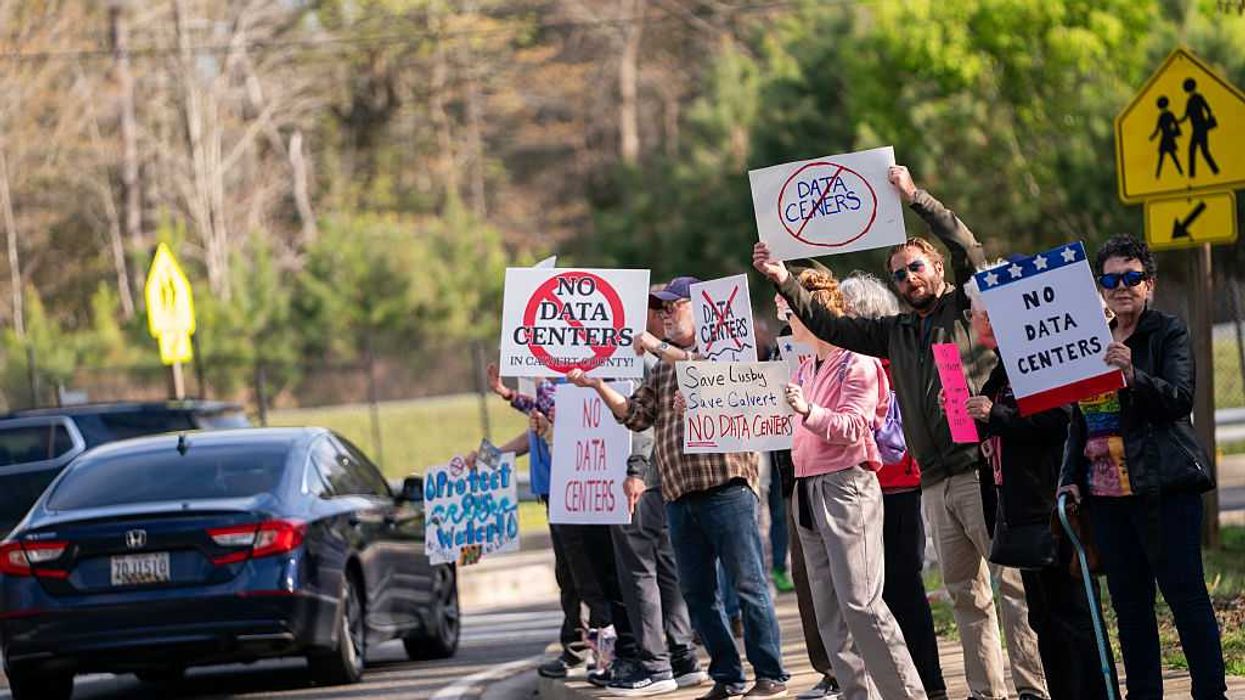
Republicans are continuing their uninterrupted streak of woefully underperforming in elections. However, in the first of its kind referendum on Big Tech data centers, voters are showing that a party that embraces land sovereignty over Big Tech dystopian land grabs will win the day.
Sadly, Republicans have chosen to be on the losing side of the issue.
The public is being asked to shoulder a burden to facilitate a supposed technology whose benefits are very unclear and dubious.
In a first of its kind local referendum, voters in Port Washington, Wisconsin, voted by a margin of 2-1 for a referendum that will require all future data center projects in the area to be approved by a vote of the city’s residents.
The referendum was sparked in the wake of Oracle and OpenAI’s Stargate facility setting up shop in the area. The proposed 1.3 gigawatt facility will consume the power equivalent of over one million households.
The referendum does not undo the Stargate project but will prevent any future project worth more than $10 million from getting approval without the public input.
Over 1,000 residents signed the petition that put this measure on the ballot. “We are not against development,” added Michael Baester, founding member of Great Lakes Neighbors United, which spearheaded this campaign. “We are for development that the community understands, supports, and has chosen together. Tonight proves that when citizens organize and engage, their voices can be heard.”
What is so important nationally about this vote is that Port Washington was carried by Trump 52-48 in 2024. It is the quintessential swing city that sways the Wisconsin vote, and by proxy, the entire country’s electorate.
Such an emphatic result from a swing town demonstrates the potency of the data center issue.
According to Politico, other communities around the country are set to vote on similar ballot measures.
Imagine if Republicans could get on the right side of the data center issue. What might that do for their failing election efforts?
In Festus, Missouri, a solid conservative jurisdiction, voters ousted four GOP councilmen who recently approved rezoning for a $6 billion data center. Two of them were defeated by margins greater than 2-1.
Thus the grassroots opposition to data centers is just as virulent in red America as it is in swing areas that have already soured on Trump because of the economy.
Oklahoma is a state where Trump carried every county, yet voters there are firmly opposed to data centers.
After Google tried to bribe the locals in Osage County to support a hyperscale data center, the Rock Volunteer Fire Department turned down a $250,000 donation from the company. This is a county Trump won by 41 points.
The opposition is just as stiff in the cities. Last month, the Tulsa City Council voted unanimously to halt construction of new data centers for nine months. All 19 speakers at the meeting voiced support for the moratorium.
Across the state in Oklahoma City, the city council recently voted to rezone over 800 acres of farmland for a Google data center. The council is now facing a recall petition.
Portage County, Ohio, is a prototypical rust belt, blue-collar county that traditionally voted Democrat but migrated to the GOP under Trump. The president carried the county by 15 points in 2024. Last week, the Ravenna City Council moved forward with a 12-month moratorium on the centers after a crowd filled the city council chambers to speak against the proposed projects.
In many respects, the ubiquitous opposition to data centers is a reflection of the sheer pervasiveness and magnitude of these projects, targeting nearly every county in states like Ohio, Indiana, Georgia, Texas, Oklahoma, Virginia, and Arizona and numerous places in the majority of other states.
According to the Midcontinent Independent System Operator, the grid operator in most of the Midwest, by 2030, the proposed hyperscale data centers in Indiana will use an amount of electricity equivalent to twice that used by the entire state.
None of this makes any sense nor is it sustainable, especially for a product that increasingly fails to produce a degree of profit that could come close to paying for all the capital expenditure and power.
This is why red-state RINOs like those in drought-stricken Texas continue to shower these companies with lavish sales tax breaks.
RELATED: Data centers are a hidden tax on your burger
 lchumpitaz/Getty Images
We don’t offer 30-year abatements like this to any other industry, but this is what data centers require to remain solvent because their hardware depreciates so quickly. According to the state comptroller, Lone Star voters will subsidize $3.2 billion in tax breaks to the largest companies on the planet over the next two years.
Four of the largest states targeted for data centers — Arizona, Texas, Oklahoma, and Georgia — are languishing through a severe and sustained drought.
Industry apologists are trying to gaslight people into believing that their closed-loop systems will somehow not affect the water flow, but it’s inconceivable that it won’t have a short-term effect and also pose health concerns when recycled back into the water table.
An application from Amazon to the Indiana Department of Environmental Management indicates that the sanitary system it is constructing for two of its hyperscales in New Carlisle is designed to use more than 1.6 million gallons per day on hot summer days.
This is “only” the equivalent water use of about 5,000 households, which pales in comparison to some other facilities and to the magnitude of the power use. Keep in mind that the entire population of this town is just under 1,900.
There’s a reason why 65% of voters oppose all data center construction, including a clear majority of all demographics, ideological groups, and income levels, despite all of the lobbying and electioneering by Big Tech.
The public is being asked to shoulder a burden to facilitate a supposed technology whose benefits are very unclear and dubious.
Republicans can continue ignoring this grassroots revolt, but they will do so at their own peril. Nothing motivates voters more than the preservation of their own communities. That is one thing that still unites a divided America.
The Redcoats Are Back With a New Tax
Two hundred and fifty years after we told Britain they could not tax Americans without representation, several European nations have…
Google’s new motto: Don’t be Christian

Google once had an informal motto: “Don’t be evil.” How about be ideologically driven? Opaque? Arbitrary?
Google sells itself as online Switzerland — a neutral search engine that doesn’t tilt one way or the other. That neutrality vanishes fast when you search for something its algorithm doesn’t like. Suddenly the thing you want becomes strangely hard to find unless you already know exactly where it lives. If you don’t, good luck.
You can’t fix what you’re not allowed to understand.
And good luck advertising it, too — if Google disapproves.
Most people still think of Google as a search engine. That’s outdated. Google is the 900-pound gorilla of online advertising through Google Ads. It has vacuumed up so much of the market that anyone who wants to advertise online usually has to go through Google’s pipeline, under Google’s terms, with Google acting as judge and jury.
This isn’t the print era, when advertisers bought space from newspapers and magazines directly, publication by publication. Today, a huge share of the ad economy runs through a single gatekeeper.
Some might call that a monopoly. Monopolies become even more dangerous when they turn ideological.
Google — and it is far from alone — leans hard left. It dislikes conservative and Christian content, and it has learned how to suppress it without leaving fingerprints. It buries the content in search rankings so that almost no one sees it unless they already know where to look. It throttles monetization. It blocks ads with vague warnings and “policy” language designed to end the conversation.
Google and TikTok now appear to be doing the same thing to faith-based content.
Have you heard of TruPlay? Probably not. That’s the point.
TruPlay is an entertainment app that offers faith-based games and videos for kids. It’s explicitly family-friendly — no sexual themes, no violence, no garbage disguised as “content.” Parents want that. Millions of them. There’s a market for wholesome screen time, and there’s money to be made providing it.
But according to the American Center for Law and Justice, Google has refused to do business with TruPlay for ideological reasons. The ACLJ says Google rejected TruPlay’s efforts to launch advertising campaigns, citing “religious belief in personalized advertising.”
Read that again. Google flagged religious belief as the problem.
The ACLJ says TruPlay tried to comply, filing appeals and revising its ad content repeatedly, only to receive the same rejection notices no matter what changes it made. The ads weren’t inflammatory. They were straightforward: “Turn Game Time into God Time,” “Christian Games for Kids,” “Safe Bible Games for Kids.”
Google’s policy supposedly prohibits “selecting an audience based on sensitive information, such as health information or religious beliefs.” But TruPlay wasn’t targeting a religious audience or harvesting private data. It was advertising Christian kids’ content to the general public.
Google’s response wasn’t “you’re targeting.” It was “your content is too sensitive to advertise.”
That’s the move. “Sensitive” once meant porn, violence, or content not suitable for children. Now it means “Christian games for kids.”
TikTok, the ACLJ says, applied the same logic with even less transparency. The platform allegedly suspended TruPlay’s advertising account over unspecified “repeated violations,” without explaining what those violations were. The ACLJ says one rejected ad contained the word “church.” Another issue allegedly involved an App Store preview image showing Jesus on the cross — not in the ad itself, but in the app’s images. The ACLJ claims TikTok barred advertising anyway.
RELATED: Google’s new plan: To learn everything about you from your online shopping
 Photo by Idrees MOHAMMED/AFP via Getty Images
You can’t fix what you’re not allowed to understand. That’s the point of opacity. You don’t get a rule you can follow. You get a verdict.
What makes this even more revealing is the economic angle. This isn’t Google or TikTok avoiding ads that risk scaring off customers. TruPlay offers the kind of content parents actively want. Platforms should want that money. Instead, they appear willing to lose revenue just to suppress anything overtly Christian and family-friendly.
The ACLJ has sent a letter to Rep. Jim Jordan (R-Ohio), chairman of the House Judiciary Committee, urging an investigation into what it calls “systemic discrimination” against Christian content creators and advertisers — part of a broader pattern of viewpoint-based censorship.
Google and TikTok will respond with the standard defense: We’re private companies. We can do what we want.
Fine. But stop pretending you’re Switzerland. If you present yourself as a neutral platform open to all, while quietly functioning as a political gatekeeper, you don’t get to hide behind the language of neutrality when people notice the double standard.
You can’t have it both ways. Either you’re Switzerland — or you’re not.
Google and TikTok are not. It’s time to treat them accordingly.
In Search of Freedom
Government is the greatest enemy of freedom. We have known this since childhood. But the government has grown tentacles —…
How data centers could spark the next populist revolt

Everyone keeps promising that artificial intelligence will deliver wonders beyond imagination — medical breakthroughs, massive productivity gains, boundless prosperity. Maybe it will. Maybe it won’t. But one outcome is already clear: If data centers keep driving up Americans’ electricity bills, AI will quickly become a political liability.
Across the country, data center expansion has already helped push electricity prices up 13% over the past year, and voters are starting to push back.
Handled correctly, AI can strengthen America. Handled poorly — by letting data centers overwhelm the grid and drive families toward energy poverty — it will accelerate decline.
In recent months, plans for massive new data centers in Virginia, Maryland, Texas, and Arizona have stalled or collapsed under local backlash. Ordinary Americans have packed town halls and flooded city councils, demanding protection from corporate projects that devour land, drain water supplies, and strain already fragile power grids.
These communities are not rejecting technology. They are rejecting exploitation. As one local official in Chandler, Arizona, told a developer bluntly, “If you can’t show me what’s in it for Chandler, then we’re not having a conversation.”
The problem runs deeper than zoning fights or aesthetics. America’s monopoly utility model shields data centers from the true cost of the strain they impose on the grid. When a facility requires new substations, transmission lines, or transformers — or when its relentless demand drives up electricity prices — utilities spread those costs across every household and small business in the service area.
That arrangement socializes the costs of Big Tech’s growth while privatizing the gains. It also breeds populist anger.
A better approach sits within reach: neighborhood battery programs that put communities first.
Whole-home battery systems continue to gain traction. Rooftop solar panels, small generators, or off-peak grid power can recharge them. Batteries store electricity when it’s cheap and abundant, then release it when demand spikes or outages hit. They protect families from blackouts, lower monthly utility bills, and sometimes allow homeowners to sell power back to the grid.
One policy shift should become non-negotiable: Approval for new data centers should hinge on funding neighborhood battery programs in the communities they impact.
In practice, that requirement would push tech companies to help install home battery systems in nearby neighborhoods, delivering backup power, grid stability, and real relief on electric bills. These distributed batteries would form a flexible, local energy reserve — absorbing peak demand instead of worsening it.
RELATED: Your laptop is about to become a casualty of the AI grift
 Photo by: Jim West/UCG/Universal Images Group via Getty Images
Most importantly, this model reverses the flow of benefits. Working families would no longer subsidize Big Tech’s expansion while receiving nothing in return. Communities would share directly in the upside.
Access to local land, water, and electricity should come with obligations. Companies that consume enormous public resources should invest in the people who live alongside them — not leave residents stranded when the grid buckles.
Politicians who ignore this gathering backlash risk sleepwalking into a revolt. The choice is straightforward: Build an energy system that serves citizens who keep the country running, or face their fury when they realize they have been sacrificed for someone else’s high-tech gold rush.
Handled correctly, AI can strengthen America. Handled poorly — by letting data centers overwhelm the grid and drive families toward energy poverty — it will accelerate decline.
We still have time to choose. Let’s choose wisely.
Husted, We Have A(I) Problem
As 2026 looms, the voyage of Sen. John Husted’s (R-Ohio) Children Harmed by AI Technology (CHAT) Act from proposal into…
Buckle up: We are headed for an AI collision with China

President Trump spoke by phone to his Chinese counterpart, Xi Jinping, on November 24 and later posted on Truth Social, “Our relationship with China is extremely strong!” The warm feelings from Washington came on the heels of the two leaders holding a productive meeting in Korea recently and scheduling several more confabs for the year ahead.
But bubbling beneath the surface is a rivalry between the two countries over the most vital technology of the 21st century: artificial intelligence.
China is not abiding by the rules that are supposed to govern the global economy.
To understand the rivalry, consider a recent announcement by the U.S. Justice Department: On November 20, it charged two Americans and two Chinese nationals with a conspiracy to illegally export about 400 high-performance graphics processing units to China. Federal law requires a license for export of these technologies, which can be used to develop and strengthen AI.
The co-conspirators didn’t have a license — and never even applied for one. In fact, they lied about the destination of the GPUs when shipping them. And for their services, they received a cool $3.89 million in wire transfers from China.
The backdrop to this smuggling scheme is Beijing having set a goal for China to be the world’s leader in AI by 2030. And it’s made considerable headway. According to the Information Technology and Innovation Foundation, “China is the global leader in AI research publications and is neck and neck with the United States on generative AI.” Additionally China is “advancing rapidly in AI research and application, challenging the United States’ dominance in this critical field.”
This progress stems from massive investments by the Chinese government. From 2000 to 2023, venture capital funds connected to the Chinese government made $184 billion in investments in China-based companies in the AI sector, according to a study published last year and conducted by professors at Harvard, MIT, and Oxford.
In an amusing coincidence, one day after the smuggling indictment, Huawei — a leading Chinese technology company — announced a tool called Flex:ai that it said “improves the utilization of artificial intelligence-based chipsets.” The announcement also made the obligatory nod to corporate citizenship, saying that the technology will “speed up the democratization of AI.” But the company buried the lede, saving the most important detail — which is curiously attributed to “sources” — for the final sentence: “The new software tool will help China create an analogue AI chip 1,000 times faster than Nvidia’s chips.”
Huawei is not just any company. It is the world’s largest manufacturer of telecommunications equipment. And it’s also been engaged in the kind of skullduggery that resulted in the recent indictment. In 2020, the U.S. Justice Department indicted the company and four of its subsidiaries. The charges mostly revolved around attempts to steal trade secrets from U.S. companies.
The company used an array of tactics, but perhaps most brazen of all, it paid its employees bonuses if they procured confidential information from rival companies. And when U.S. law enforcement was investigating Huawei, the company told its employees not to comply.
RELATED: China’s AI strategy could turn Americans into data mines
 iStock / Getty Images Plus
Suffice to say, there’s good reason not to trust the Chinese government and its proxy companies like Huawei.
The Trump administration recognizes the threat. In late June, it approved a merger among two American companies that compete with Huawei: Hewlett Packard Enterprises and Juniper Networks. A senior U.S. national security official told Axios: “In light of significant national security concerns, a settlement … serves the interests of the United States by strengthening domestic capabilities and is critical to countering Huawei and China.” The official said blocking the deal would have “hindered American companies and empowered” Chinese competitors.
Given the economic importance of AI to countries throughout the world, the competition between the United States and China is regrettable. But it’s probably also inevitable. China is not abiding by the rules that are supposed to govern the global economy. And it’s using AI, says the Justice Department, to bolster its military, to test weapons of mass destruction, and to heighten surveillance.
Sometime next year, President Trump is scheduled to make a state visit to Beijing and Xi is scheduled to come to Washington. They’re destined to focus on the cooperative parts of the relationship, but you don’t need to ask ChatGPT to see that the two countries are on a collision course over AI. Buckle up.
Editor’s note: This article was originally published by RealClearPolitics and made available via RealClearWire.
AI is Facing Death by 50 State Regulatory Cuts
A crisis is looming over artificial intelligence, but it’s not what you think. While politicians fret about AI’s impact on…
An ‘ankle bracelet’ for your car? AZ pushes new tech for serial speeders

Watch out, speed demons — the open road might be getting a little less free.
Arizona, known for its sun-soaked, sprawling highways, may soon become the first state to offer a high-tech alternative for habitual speeders: a “digital ankle bracelet” for your car.
With this new technology, Arizona may be taking the first step toward a future where cars themselves enforce the law.
Lawmakers are considering a bill that would allow drivers at risk of losing their licenses to keep their privileges by installing devices that actively prevent their vehicles from exceeding posted speed limits.
The proposal, spearheaded by Republican state Representative Quang Nguyen, would let drivers voluntarily equip their cars with speed-limiting technology. The system relies on a combination of GPS and cellular signals to determine the legal speed on any given road. Electronics connected to the car’s engine control unit then prevent the vehicle from exceeding that limit, no matter how hard the driver presses the accelerator.
Speed bump
For practical reasons, the technology does include an override mode that permits a temporary 10 mph boost up to three times per month, giving drivers a limited margin to react in emergencies or avoid accidents.
Nguyen estimates the devices would cost around $250 to install, with a daily operating fee of roughly $4. He has been working closely with companies that manufacture the technology, including Smart Start and LifeSafer, to ensure the system is effective and reliable. This makes me wonder if he owns a piece of the company or has stock in the company.
Under the bill, which Nguyen plans to formally introduce when the state legislature reconvenes in January, participation is optional — probably Nguyen’s earlier attempt to make it mandatory was a nonstarter.
Slow lane
Arizona is not alone in exploring this approach. Virginia, Washington State, and Washington, D.C., have already enacted similar laws. In Virginia, courts can require drivers with multiple speeding violations or reckless driving convictions to install electronic speed-limiting devices as an alternative to license suspension. Washington State has adopted a comparable program, giving judges discretion to mandate the technology for repeat offenders while monitoring compliance.
In Washington D.C., the program is more limited but aims to reduce repeat speeding among drivers with multiple moving violations. Meanwhile, Wisconsin is currently considering similar legislation.
These programs highlight a growing trend: Rather than grounding drivers entirely, some states are experimenting with technology as a way to enforce safe driving without taking away mobility. Proponents argue that these devices could prevent serious accidents while still allowing drivers to maintain employment, care for families, and perform other essential daily tasks. The technology also provides courts with a tangible tool to ensure compliance, rather than relying solely on citations and license suspensions.
RELATED: Spinning out at Discount Tire’s Treadwell test track
 Discount Tire
Machine learning
However, critics remain cautious. Some transportation and safety experts question whether the technology is advanced enough to accurately detect all posted speed limits. GPS mapping errors, temporary speed changes in construction zones, or malfunctioning sensors could cause a car to slow unexpectedly or fail to limit speed when needed, creating new safety risks. Privacy advocates also worry about how these devices track and store location data, raising concerns about government overreach or potential misuse.
From a practical standpoint, the legislation raises fundamental questions about the balance between personal responsibility and technological enforcement. Supporters argue it offers a lifeline to drivers who repeatedly violate speed laws but are otherwise safe, while critics maintain that it may encourage riskier behavior by transferring accountability from the individual to the machine.
There’s also the question of fairness. Not all drivers have access to new technology or the financial resources to participate in a program that charges daily operating fees. While $4 per day may seem modest, over a month or a year, it could be prohibitive for some families, effectively limiting the program to more affluent drivers. Additionally, the optional nature of the program could create inconsistencies across jurisdictions, leaving some habitual offenders unmonitored while others are under constant technological supervision.
Whether the measure passes will depend not only on lawmakers’ assessment of safety and effectiveness but also on public perception. Speeding remains the most common moving violation in the United States, and habitual offenders are a persistent concern for states nationwide. With this new technology, Arizona may be taking the first step toward a future where cars themselves enforce the law — but whether that future is practical, safe, or desirable remains up for debate.
At the very least, it’s a bold experiment in road safety and personal responsibility, one that could reshape the way states think about controlling speed without grounding drivers entirely. As the legislature prepares to weigh the bill, motorists, safety experts, and privacy advocates alike will be watching closely, asking the same question: Can a car truly keep its driver out of trouble, or is this just another way to shift accountability from human judgment to technology?
Parents, think twice: The dark side of Christmas tech gifts for children

While the children may be nestled all snug in their beds, with visions of iPhones dancing in their heads, I hope, dear parents, that you will think twice about the gift of technology this Christmas.
No doubt a shiny new smartphone, Nintendo Switch, Meta Virtual Reality headset, or cool AI toy will be at the top of many children’s and teens’ Christmas lists this year. However, these “gifts” can arrive with hidden costs: anxiety, sleep loss, social pressures, addictive algorithms, exposure to pornography, a connection to predators, and development of a gaming addiction.
Many parents buy the myth that their child is immune from online risks or think that relying solely on parental controls will be enough.
To that end, Enough Is Enough just released its Naughty and Nice List of Holiday Gifts for Children and Teens that provides a much-needed guide of gifts to buy and to avoid. Perhaps it’s no surprise, but AI toys, smartphones, and Roblox gift cards are on the “naughty” list.
Even in my own family, I know that resisting the pressure to give tech products is strong. My grandsons want Roblox gift cards, so they can continue to play the online games they have enjoyed for years.
But the so-called “reward” of tech does not always outweigh the risks. The reality is that the online exploitation of minor children is a global pandemic, and it’s growing exponentially worse, year after year.
At the very foundation, an internet-connected device is literally handing a child both the good, bad, and dangerous digital world — no guardrails, no safety net, no filters. A gaming platform will inevitably lead to increased screen time, possibly even leading to an online gaming disorder — now a DSM-5 mental disorder. Virtual reality is designed to feel real and may even become preferable to a teen.
Digging deeper, the risks are even greater than parents might realize. Many parents buy the myth that their child is immune from online risks or think that relying solely on parental controls will be enough.
But consider these sobering facts:
- Younger and younger children are being targeted “on an industrial scale” by internet groomers, with a three-fold increase in imagery showing 7- to 10-year-olds.
- Global financial sextortion is one of the fastest growing crimes targeting children, in particular minor-aged boys.
- The Surgeon General’s Advisory on Social Media and Youth Mental Health indicated social media could pose a “profound risk of harm” to the mental health and well-being of children, stating it’s a “defining public health challenge of our times.”
Predators use social media and even online gaming sites to groom children. A California man was recently sentenced for luring minors through Snapchat before sexually assaulting them. The FBI reported that a 22-year-old man used Discord to groom minors and sexually extort them.
The aforementioned Roblox — a gaming platform extremely popular with children — enables predators to contact children and is facing over 35 lawsuits as a result. The platform was described by Hindenburg Research as an “X-rated pedophile’s hellscape.”
Parents should rethink buying Roblox gift cards this holiday season.
Moreover a congressional hearing where two Meta whistleblowers testified confirmed every parent’s worst nightmare: If their children have used Meta’s virtual reality devices, their children have likely been sexually exploited.
RELATED: How smartphones expose your kids to predators — and why Congress must step in
 Matt Cardy/Getty Images
Parents need to be aware of the growing trend of AI toys, falsely marketed as safe and educational for kids as young as 2. Most AI toys are powered by the same AI technology that has already harmed children, and the embedded chatbots are programmed to listen and speak with the child like a trusted friend and mimic human emotions. Examples include: Loona Robot Dog and Smart Teddy.
Recently, an AI teddy bear marketed to children told a tester “where to find knives, pills, and matches when asked … spoke graphically about sex positions, sexual kinks, and ‘teacher-student role-play.’”
As our society becomes increasingly tech-focused, parents are becoming more aware of the negative impact tech can have on their children. But can they win the battle with their kids over the latest tech and more tech time?
Schools nationwide are rapidly embracing smartphone-free schools because they are distracting to students. Many schools are reporting success, and even students themselves have seen the benefits of not having their phones on them during school hours.
Some parents are wisely rethinking handing their phones to their children as a way to calm or distract them. One couple used a smartphone to pacify their 6-month-old daughter, saying they’d hand it to her frequently. Despite that the phone worked to calm the little girl down, the parents eventually realized it wasn’t what they intended, saying their daughter was “zoned in” on the phone.
They may think you’re the Grinch, but the rewards of a tech-free holiday are great.
You may be asking: If not an internet-connected tech gift, what do you suggest?
I realize that deciding on something else to give will take a little creativity.
Many children — especially older ones — enjoy experiences. Teens may relish time spent with their families taking a cooking class, going bowling, going to sporting events, or trying out an axe-throwing venue. Children of any age could appreciate an outing to a retro arcade, new board games, books, or art kits.
Even an outing to their favorite restaurant — where quality time can be spent with mom or dad — is a great option. In lieu of a material present, some families have successfully planned a place to visit or vacation together.
Instead of using the holidays to reinforce potentially unhealthy tech habits or introduce new tech gifts, consider delaying tech by not giving in to the notion that children need tech to be happy and productive. Grandparents my age remember fondly a merry childhood well before the computer and internet technologies were invented.
They may think you’re the Grinch, but the rewards of a tech-free holiday are great. And maybe, just maybe, your children will have sugarplums instead of iPhones dancing in their heads.





