Day: December 30, 2025
‘Nobody can get their equipment!’ Senators from both sides explode at fire-truck giants’ alleged price-gouging scheme

“9-1-1. What is your emergency?”
When crisis strikes, Americans in big cities and rural landscapes alike trust that first responders such as firefighters and EMTs are just a phone call away. However, recent spikes in costs and wait times associated with fire trucks have left fire departments across the country scrambling to make do with what they have — sometimes to the detriment of public safety.
‘Your profits have grown five times over the last five years, $250 million, but nobody can get their equipment!’
Much of the problem appears to stem from a massive consolidation of fire apparatus manufacturers nearly 20 years ago. This consolidation “effectively created a duopoly” that severely restricted competition, according to a recent op-ed from Kansas City, Kansas, Fire Chief Dennis Rubin and retired New Haven, Connecticut, Battalion Chief Frank Ricci, who together have more than 60 years of field experience.
The problem has grown so wide in scope that it has drawn the attention of lawmakers from both sides of the aisle. On April 3, 2025, U.S. Senate Subcommittee on Disaster Management Chairman Josh Hawley (R-Mo.) and Ranking Member Andy Kim (D-N.J.) sent a letter to the executives of Rev Group, Oshkosh Corporation, and Rosenbauer, which collectively corner between 70% and 80% of the fire-truck market share.
In just the past few months, multiple class-action lawsuits have been filed against these companies alleging anti-trust law violations, and Hawley claimed at a subcommittee hearing in September that their “business models are identical.”
One such “identical” tactic the companies appear to have taken, according to the lawmakers, is to delay fulfilling orders on purpose to keep costs and demand artificially high.
Just six short years ago or so, Rev Group, for example, had a backlog of fire equipment orders totaling about $1 billion, with an expected wait time of 12 to 18 months, the New York Times reported in February. Now, however, the company backlog total has quadrupled, and wait times have jumped to two or three years.
“Your profits have grown five times over the last five years, $250 million, but nobody can get their equipment!” Sen. Hawley railed to Mike Virnig, president of REV Fire Group, at the September hearing.
“What have these gigantic corporations done with all that market power? Well, they have hiked prices, restricted supply, and created a dangerous backlog of firefighting equipment,” added Sen. Elizabeth Warren (D-Mass.).
Furthermore, even when departments can get the equipment, it shows no “discernible improvements in technology,” the letter said.
Rubin and Ricci argued that this alleged market manipulation has had serious consequences. In the summer of 2023, so many pumper fire trucks were out of commission in Kansas City, Kansas, that firefighters were forced to use SUVs and a borrowed brush truck that lacked essential tools.
“Based on the lack of fire truck repair parts, our fire department in Kansas City, Kansas, has been negatively impacted on several occasions. This situation is not acceptable!” Chief Rubin — who previously served as chief of the department in Atlanta, Georgia, and Washington, D.C. — told Blaze News in a statement.
“The impact is real, and it directly affects ability to deliver the level of service the public counts on every day,” added P.J. Norwood, retired deputy chief in East Haven.
‘It is wrong when private equity companies deliberately distort the efficient operation of the free market.’
A spokesperson for Oshkosh indicated to Blaze News that disruptions to supply chains during COVID and customization are two major factors that can help account for the rise in prices and delayed orders.
“Depending on the options a customer chooses, producing a single fire truck can take up to 7,000 hours, with an average of approximately 2,000 hours,” the spokesperson said.
“We acknowledged the lead time problem as soon as it emerged, and we have made — and will continue to make — historic investments to increase throughput,” Dan Meyer, vice president of sales at Oshkosh’s Pierce Manufacturing, told Sens. Hawley, Kim, Warren, and others at the September hearing.
“We know customers want and deserve shorter lead times, and the manufacturers who can accomplish that will win their business. Pierce is determined to meet our customers’ needs, which is why our company is committed to investing in our people and our manufacturing capabilities to reduce lead times and best serve the firefighter community.”
Rubin and Ricci do not deny that specific customization demands from so many municipalities remain a major problem, and they encourage the adoption of “a more standardized production model, with separate lines for urban, suburban, or rural, and custom builds” to address this issue. They also believe that states and cities ought to revisit their bidding procedures to root out any unfair practices that further drive up prices.
Still they view the limited competition at the manufacturing level as the main cause.
“We must champion American manufacturing that wins on competition and merit — not monopolistic tactics,” Ricci told Blaze News.
“There’s nothing wrong with earning a profit, but it is wrong when private equity companies deliberately distort the efficient operation of the free market on the one hand — and then fire departments rig the bidding process on the other,” added Yankee Institute President Carol Platt Liebau. “If legislators aren’t willing or able to ask the tough questions, then of course it’s the taxpayers — as always — who are exploited and ripped off.”
Rev Group, Rosenbauer, and Sen. Kim’s office did not respond to a request for comment. Sen. Hawley’s office directed Blaze News to his statements at the September hearing.
Like Blaze News? Bypass the censors, sign up for our newsletters, and get stories like this direct to your inbox. Sign up here!
NBA legend calls on Trump to implement mandatory military service

A Hall of Fame basketball player says that mandatory service would help Americans with discipline and structure.
Compulsory service is required in many first-world countries, like South Korea, Finland, and Sweden. While duties and service time vary, many believe the requirement can foster a more responsible citizenry.
‘Learn how to defend yourself. Shoot and handle guns properly.’
A former NBA player and champion, 6’10” Dwight Howard recently called upon President Trump to consider implementing a mandatory term of service for Americans.
“I honestly feel like the president should make one year of service mandatory for everyone born in America,” Howard wrote on X. “A lot of other countries do it. And I think it would help with discipline and structure.”
Howard then asked, “I’m curious what yall think[:] would this help America or nah[?]”
RELATED: NBA players finally drop brutal truth bombs on WNBA stars: ‘It should be common sense’
Howard responded to a few reader remarks, including one who suggested such service could be performed during summers while a student is in high school.
In response, Howard revealed his stance on the duration for service.
“Everyone should do a year,” he wrote.
Another reader suggested mandatory customer service work for Americans, such as working in “retail, serving, bartending,” or answering phones. That notion saw Howard remain steadfast in his opinion that Americans should perform military service.
“I think military service would be better,” he replied. “Learn how to defend yourself. Shoot and handle guns properly. The bond and respect for each other would go up.”
RELATED: Rookie NFL QB declared the new Obama — and the ‘most powerful black man since 2009’
 Photo by Mike Coppola/Getty Images
Following his NBA career, Howard played basketball overseas in the T1 League in Taiwan, where he again became a star. Perhaps this is where his inspiration came from, as Taiwan has a mandatory 12 months of military training for males ages 18-36, according to World Population Review.
Howard has discipline and law enforcement in his family’s background; an archived USA Basketball profile notes that his father, Dwight Sr., was a Georgia state trooper as of 2007.
According to Sky News, approximately 80 countries have some form of mandatory service or conscription. Some countries reportedly have mandatory service for women, as well, such as Sudan, Morocco, Mozambique, North Korea, and Sweden.
Like Blaze News? Bypass the censors, sign up for our newsletters, and get stories like this direct to your inbox. Sign up here!
The courts are running the country — and Trump is letting it happen

One of the most consequential developments of 2025 has received far less scrutiny than it deserves: the steady surrender of executive authority to an unelected judiciary.
President Trump was elected to faithfully execute the laws of the United States, yet his administration increasingly behaves as if federal judges hold final authority over every major policy decision — including those squarely within the president’s constitutional and statutory powers.
Judicial supremacy thrives on abdication. It advances because presidents comply, lawmakers defer, and voters are told this arrangement is normal.
By backing down whenever district courts issue sweeping injunctions, the administration is reinforcing a dangerous precedent: that no executive action is legitimate until the judiciary permits it. That assumption has no basis in the Constitution, but it is rapidly becoming the governing norm.
The problem became unmistakable when federal judges began granting standing to abstract plaintiffs challenging Trump’s deployment of the National Guard to protect ICE agents under attack. Many assumed such cases would collapse on appeal. Instead, the Supreme Court last week declined to lift an injunction blocking the Guard’s deployment in Illinois, signaling that the judiciary now claims authority to second-guess core commander-in-chief decisions.
Over the dissent of Justices Samuel Alito, Clarence Thomas, and Neil Gorsuch, the court allowed the Seventh Circuit’s decision to stand. That ruling held that violent attacks on ICE agents in Chicago did not amount to a “danger of rebellion” sufficient to justify Guard deployment and did not “significantly impede” the execution of federal immigration law.
That conclusion alone should alarm anyone who still believes in separation of powers.
No individual plaintiff alleged personal injury by a Guardsman. No constitutional rights were violated. The plaintiff was the state of Illinois itself, objecting to a political determination made by the president under statutory authority granted by Congress. Courts are not empowered to adjudicate such abstract disputes over executive judgment.
Even if judges disagree with the president’s assessment of the threat environment, their opinion carries no greater constitutional weight than his. The commander in chief is charged with executing the laws and protecting federal personnel. Courts are not.
If judges can decide who has standing, define the scope of their own authority, and then determine the limits of executive power, constitutional separation of powers collapses entirely. What remains is not judicial review but judicial supremacy.
And that is precisely what we are witnessing.
Courts now routinely insert themselves into immigration enforcement, national security decisions, tariff policy, federal grants, personnel disputes, and even the content of government websites. The unelected, life-tenured branch increasingly functions as a super-legislature and shadow executive, vetoing or mandating policy at will.
RELATED: Judges break the law to stop Trump from enforcing it
 Cemile Bingol via iStock/Getty Images
What, then, remains for the people acting through elections?
If judges control immigration, spending, enforcement priorities, and foreign policy, why bother holding congressional or presidential elections at all? The Constitution’s framers never intended courts to serve as the ultimate policymakers. They were designed to be the weakest branch, confined to resolving concrete cases involving actual injuries.
Trump’s defenders often argue that patience and compliance will eventually produce favorable rulings. That belief is not only naïve — it is destructive.
For every narrow win Trump secures on appeal, the so-called institutionalist bloc on the court — Chief Justice John Roberts, Brett Kavanaugh, and Amy Coney Barrett — uses it to justify adverse outcomes elsewhere. Worse, because lower courts enjoin nearly every significant action, the administration rarely reaches the Supreme Court on clean constitutional grounds. The damage is done long before review occurs.
Consider the clearest example of all: the power of the purse.
Congress passed a budget reconciliation bill explicitly defunding Planned Parenthood. The bill cleared both chambers and was signed into law. Under the Constitution, appropriations decisions belong exclusively to Congress.
Yet multiple federal judges have enjoined that provision, effectively ordering the executive branch to continue sending taxpayer dollars to abortion providers in defiance of enacted law. Courts have not merely interpreted the statute; they have overridden it.
That raises an unavoidable question: Does the president have a duty to enforce the laws of Congress — or to obey judicial demands that contradict them?
Continuing to fund Planned Parenthood after Congress prohibited it is not neutrality. It is executive acquiescence to judicial nullification of legislative power.
The same pattern appears elsewhere.
Security clearances fall squarely within executive authority, yet the first Muslim federal judge recently attempted to block the president from denying clearance to a politically connected lawyer. Immigration, long recognized as a sovereign prerogative, has been transformed by courts into a maze of invented rights for noncitizens — including a supposed First Amendment right to remain in the country while promoting Hamas.
States fare no better. When West Virginia sought to ban artificial dyes from its food supply, an Obama-appointed federal judge intervened. When states enact laws complementing federal immigration enforcement, courts strike them down. But sanctuary laws that obstruct federal authority often receive judicial protection.
Heads, illegal aliens win. Tails, the people lose.
RELATED: The imperial judiciary strikes back
 Moor Studio via iStock/Getty Images
What we are witnessing is adverse possession — squatter’s rights — of constitutional power. As Congress passes fewer laws and the executive hesitates to assert its authority, courts eagerly fill the vacuum. In 2025, Congress enacted fewer laws than in any year since at least 1989. Meanwhile, judges effectively “passed” nationwide policies affecting millions of Americans.
This did not happen overnight. Judicial supremacy thrives on abdication. It advances because presidents comply, lawmakers defer, and voters are told this arrangement is normal.
It is not.
Trump cannot comply his way out of this crisis. No president can. A system in which courts claim final authority over every function of government is incompatible with republican self-rule.
The Constitution does not enforce itself. Separation of powers exists only if each branch is willing to defend its role.
Right now, the presidency is failing that test.
Chosen at 13 to be the pastor’s ‘maiden’: Sex-cult survivor shares her horrifying story

When Lindsay Tornambe was just 11 years old, her parents and four siblings moved out to remote Minnesota to join a religious compound called River Road Fellowship. The group was led by a man named Victor Barnard, who claimed that God had ordained him to gather and shepherd the fragmented people of the Way International — a deeply heretical “Christian” sect — after its founder Victor Paul Wierwille died in 1985.
At first, things were almost idyllic. Lindsay spent her days playing with the other kids, tending to animals, and skating on the frozen lake. But it wasn’t long before Barnard’s sinister intentions shattered the pastoral facade he had created, condemning Lindsay and other victims to years-long servitude in a sex cult.
On this episode of “Relatable,” Allie Beth Stuckey interviews Lindsay about her decade as a “maiden” in a cult whose leader is currently serving a 30-year prison sentence.
After secretly grooming Lindsay, Victor, who had taken off his wedding ring, claiming he was “married to the church” like Christ, reportedly preached a sermon from the passage in Exodus where God commands the Israelites to “give” Him their firstborns, meaning redemption through small payments or temple service.
As many cult leaders do, however, Victor reportedly twisted the passage to mean that parents must literally give their firstborn daughters over to him.
“He read off a list of names. Mine was on there,” says Lindsay.
This all happened during the early 2000s, amid lingering influences from the 1999 “Summer of Love” — a notorious period in the Way International when leadership allegedly encouraged widespread sexual promiscuity among members, including married people, as a supposed expression of “God’s love.”
Victor, however, didn’t frame the girls’ role as sexual. They were merely being asked to serve Christ and the church. Lindsay, after seeing her friends eagerly volunteer, consented to being a “maiden,” having no idea what awaited her.
She, along with nine other young girls, was then removed from her family home and taken to live in Victor’s private living compound. The maidens were assigned different duties, like gardening, cooking, cleaning, and assisting Victor with various tasks, many of which were intimate.
“Things in the beginning were kind of okay,” says Lindsay, noting that she initially believed her time as a maiden was temporary.
“I was under the impression that I would serve there and live at the camp … and then I would go home and be homeschooled,” she says.
But a shepherdess who helped oversee the young girls told 13-year-old Lindsay, who had expressed excitement about returning home to her family, that her role as a maiden was a lifetime commitment. “You’re not going home. This is your home now,” she said.
“It was shortly after that that I was raped by Victor for the first time,” says Lindsay, adding that he justified his actions by claiming that “Jesus Christ had Mary Magdalene and the apostle Paul had Phoebe” as sexual partners.
He also claimed that “even though he would be having sex with me, I could remain a virgin spiritually,” she adds.
This abuse, which was often accompanied by physical and emotional abuse, lasted for years, she says.
Eventually, fear and manipulation brainwashed Lindsay into believing she genuinely loved her captor. “One thing that Victor would tell us is that the more we dedicated ourselves to him in this life and to God, the better place in heaven we would have, and so I think the thought of not being in heaven with the maidens and with Victor really scared me,” she says.
But Lindsay’s sympathetic view of Victor was a ticking time bomb.
In 2008, after most of the girls had been moved to another remote location in Washington state, one of the maidens was deported to Brazil after her student visa expired. Victor sent other maidens to live for temporary periods in Brazil alongside her.
When it was Lindsay’s turn to go, she was exposed to the outside world for the first time since her family had joined the commune. The taste of freedom was intoxicating.
When she returned to Washington, the maidens had started their own cleaning business. As a housemaid, Lindsay got another taste of life outside the cult, as she studied family pictures on walls and heard secular music drifting from radios.
This view of the outside world had already begun to sour Lindsay’s feelings for Victor, but then news came that he, still legally married to his wife, who lived next door to him, had been sleeping with married women in the community.
In Minnesota, it is against the law for pastors to have sexual relations with their congregants, so one of the women in the commune reported Victor to the police and even shared some information about his “maidens,” forcing him to flee. The infidelity broke up the original commune in Minnesota, sending Lindsay’s family back to their home state.
Lindsay, deeply disturbed by Victor’s philandering but still unaware of her own abuse, decided she was done being a maiden. Even though fellow maidens and Victor pleaded with her to stay — calling her Judas and accusing her of not loving God — Lindsay’s mind was made up.
She called her parents, who were still committed to the Way International and Victor, and they agreed to allow her to come home.
“They gave me $500 and bought me a train ticket, and I took Amtrak all the way from Washington state to 30th Street Station in Philadelphia,” says Lindsay.
Re-entering secular society at 23 proved difficult and confusing for Lindsay. “At that point, I thought the only way to make a man happy was to sleep with him, and so I slept around a lot. I lived in a lot of sin,” she says.
“I just was really interested in exploring and living life and making friends and getting away from my parents, because they were still supporting Victor.”
While her outside life looked fun and exciting, Lindsay’s internal world grew darker over the years, as she reckoned with her past life in the cult.
“I just kept thinking over and over again: If God is a God of love that I read and believed for so long, why would he let this happen to me? If heaven is so great, why don’t I kill myself now and not live in this internal pain that I feel?” she admits.
To quell the pain, Lindsay experimented with a gamut of “remedies” — self-love programs, crystals, witchcraft, even self-harm.
“I always came up feeling so empty, so unsatisfied,” she says.
But despite Lindsay’s doubt and sin, God was working in ways she couldn’t see. Single motherhood, unexpected friendships, and perfect timing wove together and allowed Lindsay to distinguish the real God from the phony one who had been used to warp and manipulate her as a child.
To hear the beautiful story of Lindsay’s redemption, including where her family is today and the trial that landed Victor behind bars, watch the full interview above.
Want more from Allie Beth Stuckey?
To enjoy more of Allie’s upbeat and in-depth coverage of culture, news, and theology from a Christian, conservative perspective, subscribe to BlazeTV — the largest multi-platform network of voices who love America, defend the Constitution, and live the American dream.
Pope Leo calls out gambling addiction and ‘demographic crisis’ in Vatican meeting

Pope Leo XIV says people need more face-to-face interaction in their lives.
Speaking with Italian mayors from the association of local Italian authorities, the Assocazione Nazionale dei Comuni Italiani, the pope touched on some of the biggest issues faces the world today.
‘Democracy atrophies, becomes just a name, a formality.’
During the Vatican meeting, Pope Leo noted that a “demographic crisis” and “struggles” among families and young people remain top issues. According to Vatican News, the Catholic leader also stated that social isolation and “social conflicts” are pervasive issues in Italy.
At the same time, the pope — Robert Francis Prevost — said he wanted to focus on one of the biggest topics in today’s world: gambling. The Chicago native explained that he wanted to “draw attention in particular to the scourge of gambling,” which has “ruined many families.”
Citing a “major increase” in gambling in Italy in recent years, Prevost cited a recent report that described gambling as a “serious problem” in terms of education, mental health, and societal trust for Italians.
RELATED: New York Archbishop Timothy Dolan resigns; pope appoints his replacement
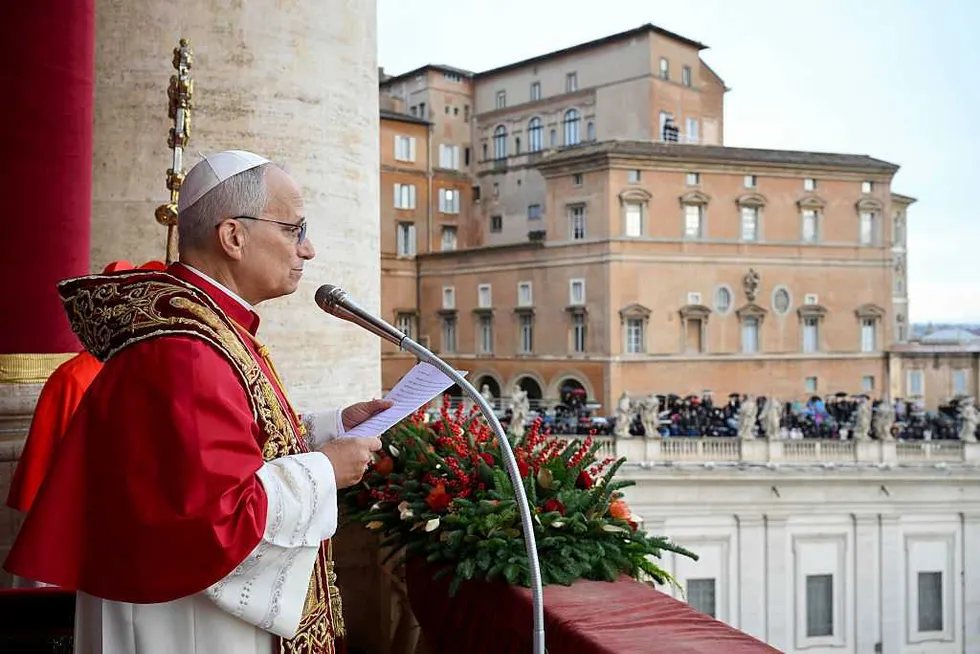 Photo by Simone Risoluti – Vatican Media via Vatican Pool/Getty Images
The pope stressed that gambling addiction is a form of “loneliness” and called on the local mayors to promote “authentically human relationships between citizens” as a way to tackle the issue.
Pope Leo reportedly drew from 20th-century Italian priest and activist Don Primo Mazzolari in order to illustrate the need for social interactions between Italians.
“[Italy] does not only need sewers, houses, roads, aqueducts, and pavements,” but also “a way of feeling, of living, a way of looking at one another, and a way of coming together as brothers and sisters.”
 Photo by Jacopo Raule/Getty Images for Philipp Plein
To solve many of these modern issues, authorities must listen to the weak and the poor, the pope said. If not, he said, “democracy atrophies, becomes just a name, a formality.”
Like Blaze News? Bypass the censors, sign up for our newsletters, and get stories like this direct to your inbox. Sign up here!


Pinky Amador, pinuri ang Gen Zs sa pagbabago ng political landscape sa eleksyon

Inihayag ni Pinky Amador ang kaniyang paghanga sa Gen Zs dahil sa pagiging mga mapanuri nila sa eleksyon. Dahil dito, nagkaroon umano ng pagbabago sa political landscape sa bansa.
Bianca King, inilahad na hindi planado ang pagtira niya sa Australia

Magbabalik-showbiz si Bianca King matapos ang anim na taon na paninirahan sa Australia kasama ang kaniyang mister at anak. Ayon sa aktres, hindi naman planado ang pagtira niya doon na nangyari sa panahon ng COVID-19 pandemic.