

Category: China
This Past Year Was Pretty Great. Here’s a Wish List for 2026.
Listening to the usual legacy media suspects, one might think 2025 was an apocalyptic wasteland of sorts — an authoritarian…
Currency Competition In The Digital Age
South Korea will become an unwitting participant if it is not careful

China’s Spy Network in America: A People’s War Against an Open House
Qian Xuesen, a Chinese rocket scientist and California Institute of Technology professor, worked on U.S. missile programs during World War…
Your laptop is about to become a casualty of the AI grift

Welcome to the techno-feudal state, where citizens are forced to underwrite unnecessary and harmful technology at the expense of the technology they actually need.
The economic story of 2025 is the government-driven build-out of hyperscale AI data centers — sold as innovation, justified as national strategy, and pursued in service of cloud-based chatbot slop and expanded surveillance. This build-out is consuming land, food, water, and energy at enormous scale. As Energy Secretary Chris Wright bluntly put it, “It takes massive amounts of electricity to generate intelligence. The more energy invested, the more intelligence produced.”
Shortages will hit consumers hard in the coming year.
That framing ignores what is being sacrificed — and distorted — in the process.
Beyond the destruction of rural communities and the strain placed on national energy capacity, government favoritism toward AI infrastructure is warping markets. Capital that once sustained the hardware and software ecosystem of the digital economy is being siphoned into subsidized “AI factories,” chasing artificial general intelligence instead of cheaper, more efficient investments in narrow AI.
Thanks to fiscal, monetary, tax, and regulatory favoritism, the result is free chatbot slop and an increasingly scarce, expensive supply of laptops, phones, and consumer hardware.
Subsidies break the market
For decades, consumer electronics stood as one of the greatest deflationary success stories in modern economics. Unlike health care or education — both heavily monopolized by government — the computer industry operated with relatively little distortion. From December 1997 to August 2015, the CPI for “personal computers and peripheral equipment” fell 96%. Over that same period, medical care, housing, and food costs rose between 80% and 200%.
That era is ending.
AI data centers are now crowding out consumer electronics. Major manufacturers such as Dell and Samsung are scaling back or discontinuing entire product lines because they can no longer secure components diverted to AI chip production.
Prices for phones and laptops are rising sharply. Jobs tied to consumer electronics — especially the remaining U.S.-based assembly operations — are being squeezed out in favor of data center hardware that benefits a narrow set of firms.
This is policy-driven distortion, not organic market evolution.
Through initiatives like Stargate and hundreds of billions in capital pushed toward data center expansion, the government has created incentives for companies to abandon consumer hardware in favor of AI infrastructure. The result is shortages that will hit consumers hard in the coming year.
Samsung, SK Hynix, and Micron are retooling factories to prioritize AI-grade silicon for data centers instead of personal devices. DRAM production is being routed almost entirely toward servers because it is far more profitable to leverage $40,000 AI chips than $500-$800 laptops. In the fourth quarter of 2025, contract prices for certain 16GB DDR5 chips rose nearly 300% as supply was diverted. Dell and Lenovo have already imposed 15%-30% price hikes on PCs, citing insatiable AI-sector demand.
The chip crunch
The situation is deteriorating quickly. DRAM inventory levels are down 80% year over year, with just three weeks of supply on hand — down from 9.5 weeks in July. SK Hynix expects shortages to persist through late 2027. Samsung has announced it is effectively out of inventory and has more than doubled DDR5 contract prices to roughly $19-$20 per unit. DDR5 is now standard across new consumer and commercial desktops and laptops, including Apple MacBooks.
Samsung has also signaled it may exit the SSD market altogether, deeming it insufficiently glamorous compared with subsidized data center investments. Nvidia has warned it may cut RTX 50 series production by up to 40%, a move that would drive up the cost of entry-level gaming systems.
Shrinkflation is next. Before the data center bubble, the market was approaching a baseline of 16GB of RAM and 1TB SSDs for entry-level laptops. As memory is diverted to enterprise customers, manufacturers will revert to 8GB systems with slower storage to keep prices under $999 — ironically rendering those machines incapable of running the very AI applications they’re working on.
Real innovation sidelined
The damage extends beyond prices. Research and development in conventional computing are already suffering. Investment in efficient CPUs, affordable networking equipment, edge computing, and quantum-adjacent technologies has slowed as capital and talent are pulled into AI accelerators.
This is precisely backward. Narrow AI — focused on real-world tasks like logistics, agriculture, port management, and manufacturing — is where genuine productivity gains lie. China understands this and is investing accordingly. The United States is not. Instead, firms like Roomba, which experimented with practical autonomy, are collapsing — only to be acquired by the Chinese!
This is not a free market. Between tax incentives, regulatory favoritism, land-use carve-outs, capital subsidies, and artificially suppressed interest rates, the government has created an arms race for a data center bubble China itself is not pursuing. Each round of monetary easing inflates the same firms’ valuations, enabling further speculative investment divorced from consumer need.
RELATED: China’s AI strategy could turn Americans into data mines
 Grafissimo via iStock/Getty Images
Hype over utility
As Charles Hugh Smith recently noted, expanding credit boosts asset prices, which then serve as collateral for still more leverage — allowing capital-rich firms to outbid everyone else while hollowing out the broader economy.
The pattern is familiar. Consider the Ford plant in Glendale, Kentucky, where 1,600 workers were laid off after the collapse of government-favored electric vehicle investments. That facility is now being retooled to produce batteries for data centers. When one subsidy collapses, another replaces it.
We are trading convention for speculation. Conventional technology — reliable hardware, the internet, mobile computing — delivers proven, measurable utility. The current investment surge into artificial general intelligence is based on hypothetical future returns propped up by state power.
The good old laptop is becoming collateral damage in what may prove to be the largest government-induced tech bubble yet.
Feds’ Case Against Ex-Democrat Aide Accused Of Working With China Hits Roadblock
Prosecutors said they intend to retry the case
Roomba maker iRobot files for bankruptcy, putting it in Chinese hands
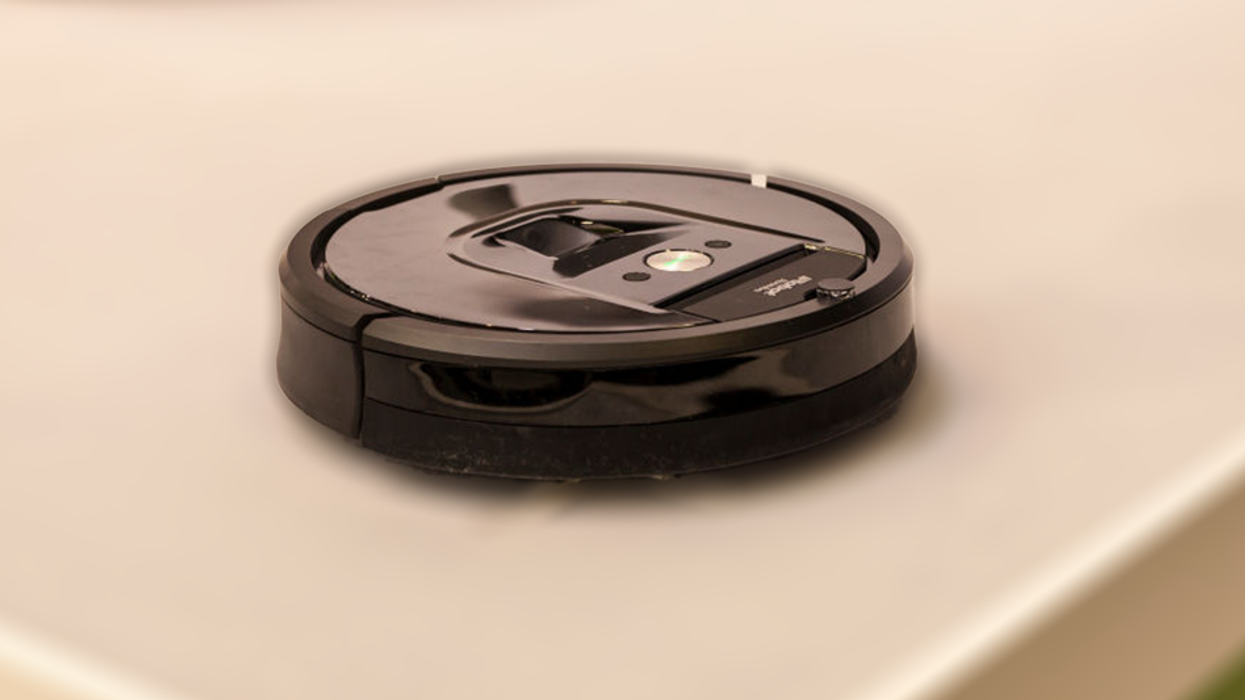
Autonomous vacuums could go extinct unless they are made in the United States.
This is the harsh reality affecting companies like iRobot, the creator of Roomba, which just filed bankruptcy.
‘… with no anticipated disruption to its app functionality.’
Despite the company generating over $680 million in 2024, iRobot has been crippled by U.S. tariffs. Due to a 46% import tariff on Vietnam, iRobot’s costs were raised by $23 million in 2025, according to Reuters, which reviewed the court filings.
The court filings also reportedly noted that while Roomba is still dominating in U.S. and Japanese markets, it lost too much money on price reductions and investments in technological upgrades in order to maintain pace with its competitors.
According to the Verge, the company said it will continue to operate “with no anticipated disruption to its app functionality, customer programs, global partners, supply chain relationships, or ongoing product support.”
Simply put, after more than 20 years on the market, the Roomba is able to operate without online connectivity.
The bankruptcy will put iRobot under Chinese control moving forward, with the manufacturing company that controls its debt.
RELATED: The ultimate Return guide to escaping the surveillance state
 Photo by: Andrew Lipovsky/NBCU Photo Bank/NBCUniversal via Getty Images via Getty Images
Court documents reportedly showed that Picea, a Chinese manufacturer, purchased iRobot while taking its debt on board, which is estimated to be about $190 million. The vacuum company took on the debt in 2023 to refinance its operations, Reuters claimed.
The debt came even after Amazon paid a $94 million termination fee after backing out of a $1.7 billion acquisition deal in 2024, according to the New York Times.
It has not been that long since iRobot had a massive market value at $3.56 billion in 2021; it is now estimated to be worth just $140 million.
New owners Picea will take 100% ownership of the company and cancel the $190 million in debt, while also canceling a $74 million debt that iRobot owed through a manufacturing agreement.
RELATED: The AI takeover isn’t coming — it’s already here
Not only did iRobot need to deal with Vietnamese tariffs, other manufacturing that was established in Malaysia in 2019 was also likely affected.
It was not announced that Roomba had cut manufacturing from the country, and if it remained, would likely have been subjected to a 24% tariff rate from the Trump administration, which included taxing machinery and electronics.
Like Blaze News? Bypass the censors, sign up for our newsletters, and get stories like this direct to your inbox. Sign up here!
Hong Kong, Once Free, Now Suppresses Any Dissent
As expected, Beijing’s Hong Kong enforcers have convicted former publisher Jimmy Lai of violating China’s National Security Law. Standing up for…
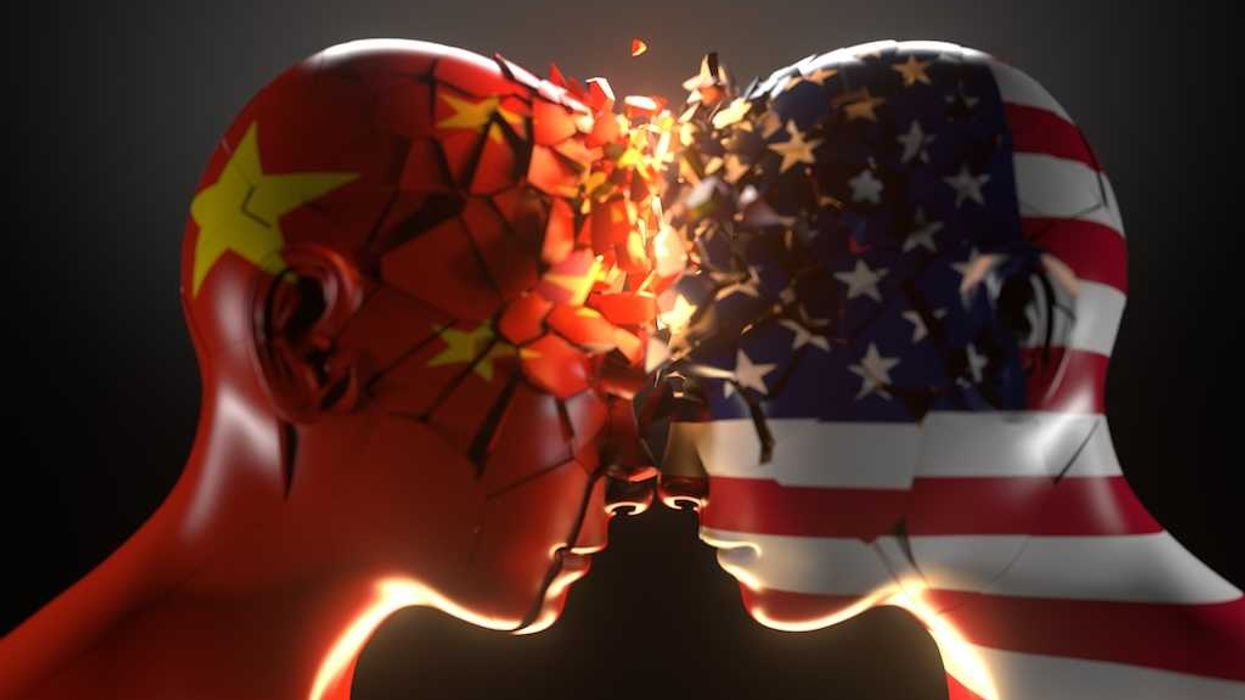
Buckle up: We are headed for an AI collision with China
President Trump spoke by phone to his Chinese counterpart, Xi Jinping, on November 24 and later posted on Truth Social, “Our relationship with China is extremely strong!” The warm feelings from Washington came on the heels of the two leaders holding a productive meeting in Korea recently and scheduling several more confabs for the year ahead.
But bubbling beneath the surface is a rivalry between the two countries over the most vital technology of the 21st century: artificial intelligence.
China is not abiding by the rules that are supposed to govern the global economy.
To understand the rivalry, consider a recent announcement by the U.S. Justice Department: On November 20, it charged two Americans and two Chinese nationals with a conspiracy to illegally export about 400 high-performance graphics processing units to China. Federal law requires a license for export of these technologies, which can be used to develop and strengthen AI.
The co-conspirators didn’t have a license — and never even applied for one. In fact, they lied about the destination of the GPUs when shipping them. And for their services, they received a cool $3.89 million in wire transfers from China.
The backdrop to this smuggling scheme is Beijing having set a goal for China to be the world’s leader in AI by 2030. And it’s made considerable headway. According to the Information Technology and Innovation Foundation, “China is the global leader in AI research publications and is neck and neck with the United States on generative AI.” Additionally China is “advancing rapidly in AI research and application, challenging the United States’ dominance in this critical field.”
This progress stems from massive investments by the Chinese government. From 2000 to 2023, venture capital funds connected to the Chinese government made $184 billion in investments in China-based companies in the AI sector, according to a study published last year and conducted by professors at Harvard, MIT, and Oxford.
In an amusing coincidence, one day after the smuggling indictment, Huawei — a leading Chinese technology company — announced a tool called Flex:ai that it said “improves the utilization of artificial intelligence-based chipsets.” The announcement also made the obligatory nod to corporate citizenship, saying that the technology will “speed up the democratization of AI.” But the company buried the lede, saving the most important detail — which is curiously attributed to “sources” — for the final sentence: “The new software tool will help China create an analogue AI chip 1,000 times faster than Nvidia’s chips.”
Huawei is not just any company. It is the world’s largest manufacturer of telecommunications equipment. And it’s also been engaged in the kind of skullduggery that resulted in the recent indictment. In 2020, the U.S. Justice Department indicted the company and four of its subsidiaries. The charges mostly revolved around attempts to steal trade secrets from U.S. companies.
The company used an array of tactics, but perhaps most brazen of all, it paid its employees bonuses if they procured confidential information from rival companies. And when U.S. law enforcement was investigating Huawei, the company told its employees not to comply.
RELATED: China’s AI strategy could turn Americans into data mines
 iStock / Getty Images Plus
Suffice to say, there’s good reason not to trust the Chinese government and its proxy companies like Huawei.
The Trump administration recognizes the threat. In late June, it approved a merger among two American companies that compete with Huawei: Hewlett Packard Enterprises and Juniper Networks. A senior U.S. national security official told Axios: “In light of significant national security concerns, a settlement … serves the interests of the United States by strengthening domestic capabilities and is critical to countering Huawei and China.” The official said blocking the deal would have “hindered American companies and empowered” Chinese competitors.
Given the economic importance of AI to countries throughout the world, the competition between the United States and China is regrettable. But it’s probably also inevitable. China is not abiding by the rules that are supposed to govern the global economy. And it’s using AI, says the Justice Department, to bolster its military, to test weapons of mass destruction, and to heighten surveillance.
Sometime next year, President Trump is scheduled to make a state visit to Beijing and Xi is scheduled to come to Washington. They’re destined to focus on the cooperative parts of the relationship, but you don’t need to ask ChatGPT to see that the two countries are on a collision course over AI. Buckle up.
Editor’s note: This article was originally published by RealClearPolitics and made available via RealClearWire.
’50 high-quality sons’: Chinese men are siring US citizen ‘mega-families’ via surrogacy: Report

Chinese elites are reportedly building “mega-families” by commissioning U.S. surrogates to produce for them scores of American-born children. This practice, which has apparently encouraged the growth of a secondary industry of accommodation, has prompted concerns about underregulation of the surrogacy industry as well as about birthright citizenship.
A recent Wall Street Journal report detailed multiple cases where affluent individuals in communist China — where surrogacy is illegal — have shelled out millions for U.S.-based surrogates to “help them build families of jaw-dropping size.”
At a cost of up to $200,000 per child, they can reportedly send their genetic material abroad, have their babies carried to term, delivered, cared for, and ultimately shipped back.
Xu Bo, an anti-feminist billionaire in the gaming industry, reportedly told an American family court judge in 2023 that he hoped to have 20 boys born in the U.S. through surrogacy, with the hope that they could one day take over his business. At the time, several of his surrogate-born children — whom he had yet to meet — were being raised by nannies in California.
A social media account operated by Xu noted in a message reviewed by the Journal that he hoped to have “50 high-quality sons,” and Xu’s company has since bragged that Xu has supposedly paid to sire over 100 children through surrogacy in the United States.
Wang Huiwu, the CEO of Sichuan-based education group XJ International Holdings, has fathered 10 girls through American surrogates using the eggs he purchased for at least $6,000 a pop from models, a musician, and others, the Journal reported. Wang apparently wants girls, as he figures they could one day marry world leaders.
Xu, Wang, and other elites in the adversarial nation who are similarly motivated to commission armies of children with American citizenship apparently don’t have to step foot in the United States to start or complete the process.
At a cost of up to $200,000 per child, they can reportedly send their genetic material abroad, have their babies carried to term, delivered, cared for, and ultimately shipped back. Agencies, law firms, and nanny services have emerged to help accommodate the growing foreign demand.
RELATED: Buying fatherhood: The devastating toll of our rent-a-womb society
 Photo by: BSIP/Universal Images Group via Getty Images
Nathan Zhang, the CEO of IVF USA, told the Journal that whereas his clientele were historically parents trying to bypass China’s one-child policy, he has begun to see an increasing number of “crazy rich” clients who are paying for dozens or even hundreds of U.S.-born babies with the aim of “forging an unstoppable family dynasty.”
Zhang indicated that he rejected one Chinese businessman as a client who sought over 200 children via surrogates after he proved unable to account for how he might raise them all. Not all such requests, however, are turned down.
The Journal cited, for instance, the case of a California surrogacy agency whose owner confirmed the fulfillment of an order for a Chinese individual seeking 100 children in recent years.
While industry groups apparently recommend that agencies and IVF clinics refrain from working with parents seeking more than two simultaneous surrogacies, such recommendations often go unheeded, fueling concerns among critics over the industry’s lack of oversight.
A study published last year in the peer-reviewed journal Fertility and Sterility noted that international gestational surrogacy has grown greatly over the past two decades — of the 40,177 embryo transfers to a prospective mother in the U.S. from 2014 to 2020, 32% were for foreigners.
Foreign intended parents “were more likely to be male sex (41.3% vs. 19.6%), older than 42 years (33.9% vs. 26.2%), and identify as Asian race (65.6% vs. 16.5%),” the study said.
Of all the international parents siring children in the U.S. through surrogacy during the six-year window, 41.7% were from China.
The study stressed that “given that individuals are increasingly traveling to the U.S. for this care, it is imperative to understand the trends and outcomes of international gestational surrogacy in the U.S.”
According to Emma Waters, a policy analyst for the Center for Technology and the Human Person at the Heritage Foundation, international commercial surrogacy is a “situation of immigration fraud as well as a national security risk.”
After all, Chinese men — the cohort most commonly exploiting the system — can deploy their U.S.-born, China-raised, and Chinese Communist Party-influenced children to advance Beijing’s interests in the United States.
Last month, Sen. Rick Scott (R-Fla.) introduced the Stopping Adversarial Foreign Exploitation of Kids in Domestic Surrogacy Act with the aim of preventing adversarial nations, including China, from using American surrogates to obtain U.S. citizenship for their children.
“America’s surrogacy system is meant to help individuals build families — it should never be the avenue to allow abuse, neglect, or deceit of innocent women and babies,” Scott said. “And it’s terrifying that this might be at the hands of foreign adversaries with the sole intent of having a child that is a U.S. citizen.”
The U.S. Supreme Court agreed earlier this month to hear arguments for and against President Donald Trump’s order to end birthright citizenship. Success on the part of the president may serve to devalue Chinese elites’ breeding scheme.
Like Blaze News? Bypass the censors, sign up for our newsletters, and get stories like this direct to your inbox. Sign up here!





