

Day: November 29, 2025
Elton John reveals what would make Trump ‘one of the greatest presidents in history’
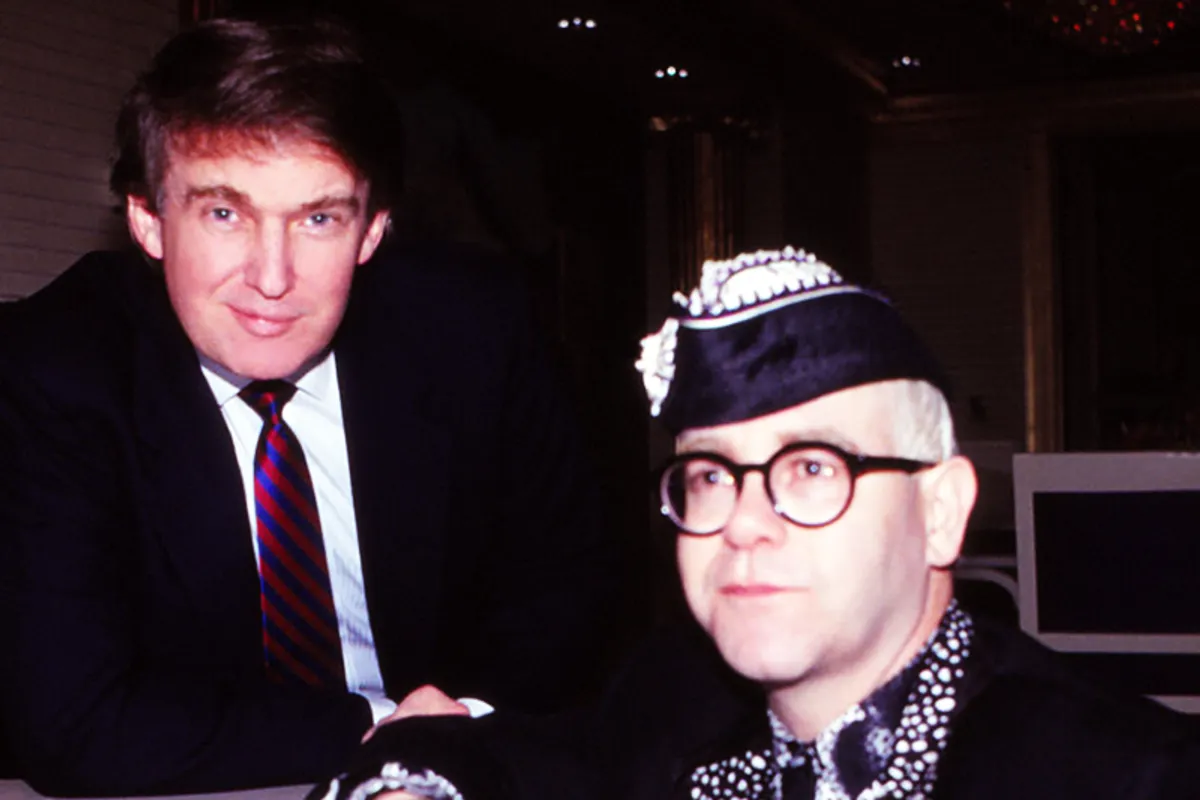
Elton John has recently praised President Donald Trump for his foreign policy work but stopped short of saying he was one of the nation’s greatest presidents.
Instead, the beloved musician explained what could cement Trump as one of the greatest American presidents ever to sit in the Oval Office.
Last year, John called it “brilliant” when Trump labeled North Korean Supreme Leader Kim Jong Un “Rocket Man” in reference to one of John’s songs, but the singer faced backlash over allegedly endorsing Trump for the 2024 presidential election.
‘If he wants to go down as one of the greatest presidents in history…’
John later clarified his position in an Instagram post, saying he was “simply acknowledging the fact that Trump has long been a fan” of John’s music and that “historically he’s been very kind” to him.
Fast-forward to an interview with Variety published Tuesday, and the 78-year-old is still not shy about giving the president credit where it is due. Moreover, John praised Republicans who have shown interest in his work to find a cure for AIDS.
“The bipartisan thing makes common sense. To see us come so far with the medical and scientific advances, and to think this is the only disease that can be completely cured in one’s lifetime,” John explained.
“President Trump has maybe solved the peace problem. If he wants to go down as one of the greatest presidents in history … if he ended AIDS, that would really be a feather in his cap.”
RELATED: Trump called Kim Jong Un ‘Rocket Man’— and Elton John ‘thought it was brilliant’
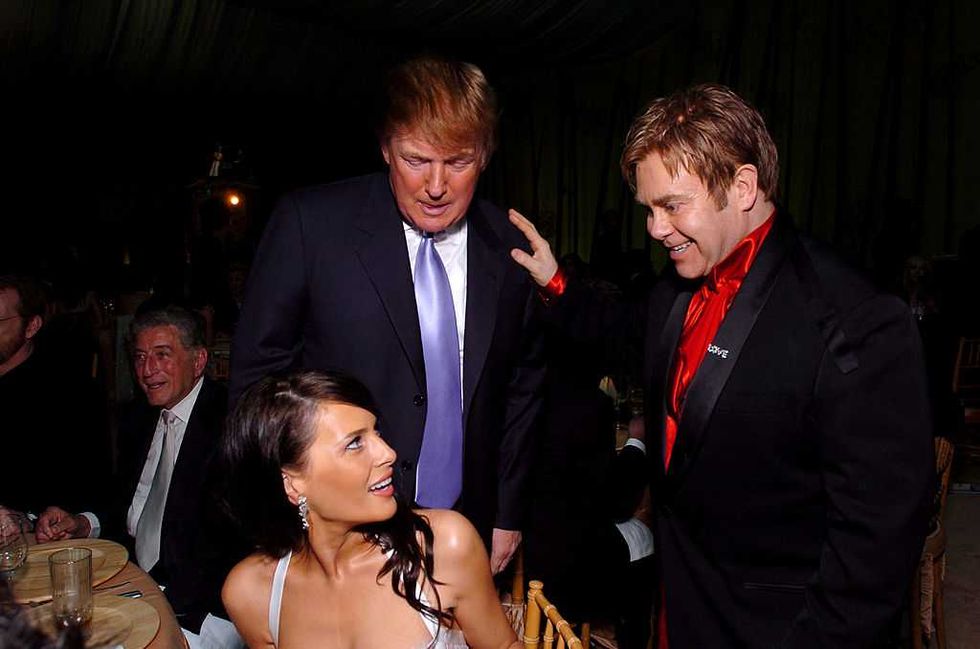 2004: Melania Knauss, Donald Trump and Sir Elton John during 12th Annual Elton John AIDS Foundation Oscar Party Co-hosted by In Style – Inside at Pearl in West Hollywood, California, United States. Photo by Dimitrios Kambouris/WireImage
Sir Elton spoke more generally on Trump’s peacemaking progress overseas, expressing hope that the “big war” between Israel and Palestine will be “settled” soon.
He then referred to AIDS as “another war” that is being prevented from ending because governments won’t allow medicine to get to the people who need it.
“There are crimes against millions of other people that are happening because of governments and stigma and hate,” John remarked to Variety. “It’s so frustrating when you have the medicine, you have prep, you have the antiretrovirals. We can stop the spread of AIDS, if people just got off their backsides and treated human beings in a Christian kind of way.”
RELATED: Trump admin leaves Elon Musk’s Grok, xAI off massive list of AI tech partners
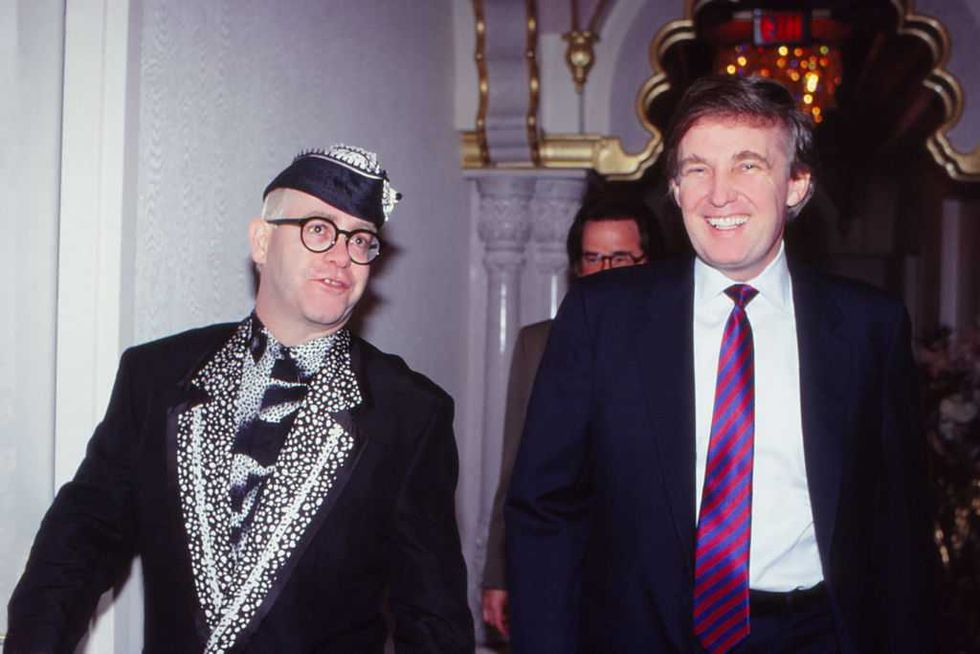 Donald Trump and Elton John walking together at the Taj Mahal Casino Hotel in Atlantic City, New Jersey May 19 1990. Photo by Jeffrey Asher/ Getty Images
During his first administration, Trump launched an initiative called Ending the HIV Epidemic in the U.S. and announced it during the 2019 State of the Union address.
“In recent years, we have made remarkable progress in the fight against HIV and AIDS. Scientific breakthroughs have brought a once-distant dream within reach,” Trump said in February 2019.
The president said the goal of the program was to eliminate the HIV epidemic in the United States within the next 10 years.
“We have made incredible strides. Incredible. Together, we will defeat AIDS in America and beyond,” he added.
Like Blaze News? Bypass the censors, sign up for our newsletters, and get stories like this direct to your inbox. Sign up here!
Big Tech CEOs should leave policy to the politicians
President Donald Trump’s latest comments on semiconductor exports sounded almost conciliatory — until they weren’t. Speaking recently on “60 Minutes,” the president said he would let Nvidia “deal with China” but drew a bright red line: Beijing could buy chips, just not the “most advanced” ones. The message was calibrated for maximum effect: permissive enough to please markets, hawkish enough to claim toughness. Nvidia’s stock jumped immediately — but China did not get what it wanted.
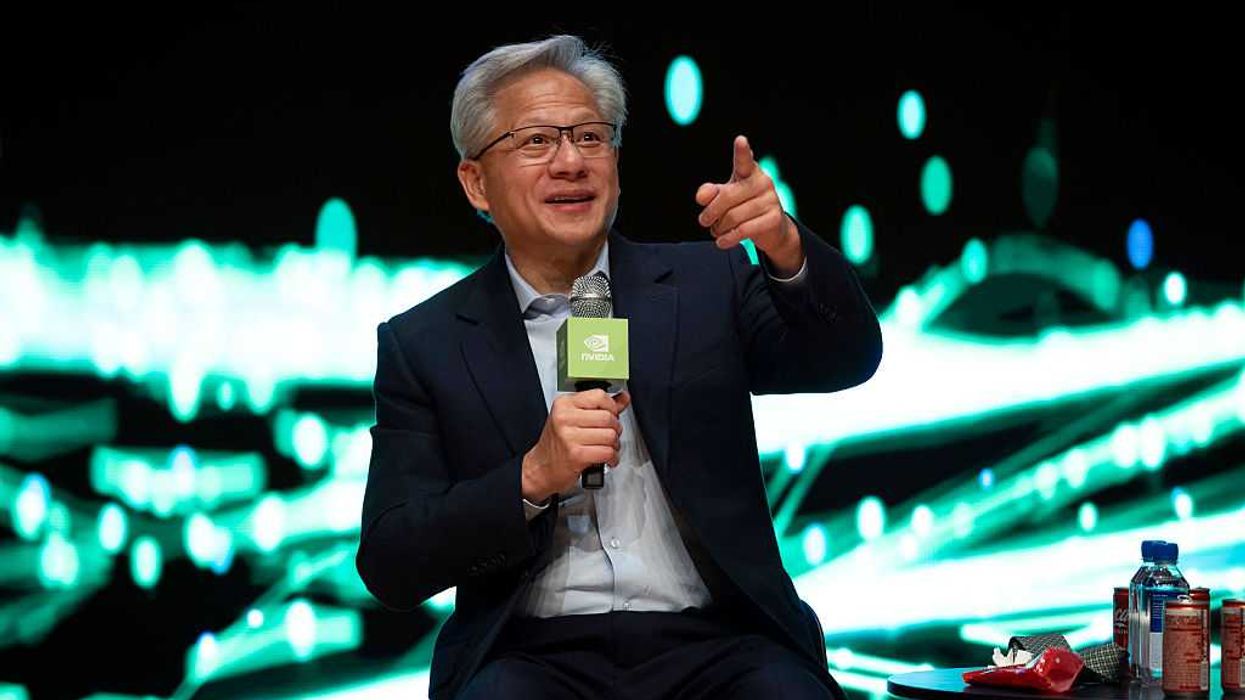
Days later, in a Financial Times interview, Nvidia’s CEO, Jensen Huang, warned that if the U.S. blocked his company from selling more of its advanced chips to China, it would “lose” the AI race. The argument was astonishing in its candor: Cut us off, Beijing wins.
As grateful as America should be for breathtaking innovations, an irreconcilable tension exists between national interest and fiduciary duty.
The comparison between a president sounding measured and a CEO trying to sound indispensable captures a dangerous inversion of power. Nvidia has become more than America’s most valuable company. It’s attempting to become its policymaker, shaping the boundaries of what Washington thinks possible in its competition with China.
To understand how one company reached that position, it helps to revisit what happened in Washington just days before Trump met Xi Jinping in South Korea.
Nvidia called it a GPU Technology Conference. Yet the event felt less like a developer’s conference and more like a tech-bro-meets-MAGA jamboree: free swag and a booming video hymn to American genius — from Thomas Edison to Donald J. Trump. Huang, leather jacket gleaming, strode out like a preacher to proclaim that the age of reindustrialization had arrived.
The D.C. version of GTC was not the San Jose GTC tech insiders have come to know. For the first time, Nvidia brought a full-blown edition of its developers’ confab to the capital, a strategic choice. The company does not merely want to sit at the table where policy is made — it wants to own it.
After hours of Super Bowl-style buildup — financiers whispering, tech CEOs hinting — attendees were herded into a dimly lit hall, where Huang unveiled a cascade of partnerships. The headline act that made sleeves roll up on both the policy bench and the brokerage floor was the Vera Rubin Superchip, billed as made in America and spoken of with the gravity reserved for national monuments.
It’s a dazzling feat of engineering: silicon that can be waved before a crowd as proof that America can still design, assemble, and scale. Expected to debut next year, the chip is music to policy wonks’ ears, a gleaming symbol of reindustrialization, and perhaps a psychological hedge against the fragility of Taiwan. For investors, it’s manna. As robots increasingly take charge, building chips in the U.S. will keep the supply chain close to home and safeguard companies against the whims of geopolitics.
Then, with the applause fading, an undercurrent of tension lingered, one that perhaps only the wonks could fully register. After that opening montage, capped by Jensen’s almost rhetorical question, “Was that video amazing?” the subtext became harder to ignore. And when he closed his remarks by thanking the audience “for your service and for making America great again,” it was impossible not to think of what the financiers were murmuring on the next stage over.
“Nvidia will — or should — ship more GPUs to China.” “Jensen’s flying straight to Korea after GTC to meet Trump.” “A deal’s coming.”
Those were among the refrains traded by figures like Cantor Fitzgerald’s C.J. Muse and Altimeter Capital’s Brad Gerstner. All this, of course, is contrary to the prevailing consensus among China-watchers that the notion of rendering Beijing dependent on Nvidia’s chips is fantasy. Cultivating indigenous capability by acquiring American technology by legal or illicit means has long been Beijing’s modus operandi.
Huang knows this. Still, his company has long worked to blunt export controls and push China-specific versions of its flagship Blackwell chip, the so-called B20. It’s a familiar playbook: First came the H100, then its “export-compliant” cousins, the H800 and H20. Each time, Washington tightens the rules; each time, Nvidia finds a workaround. But this must stop.
RELATED: Big Tech’s AI boom hits voters hard — and Democrats pounce
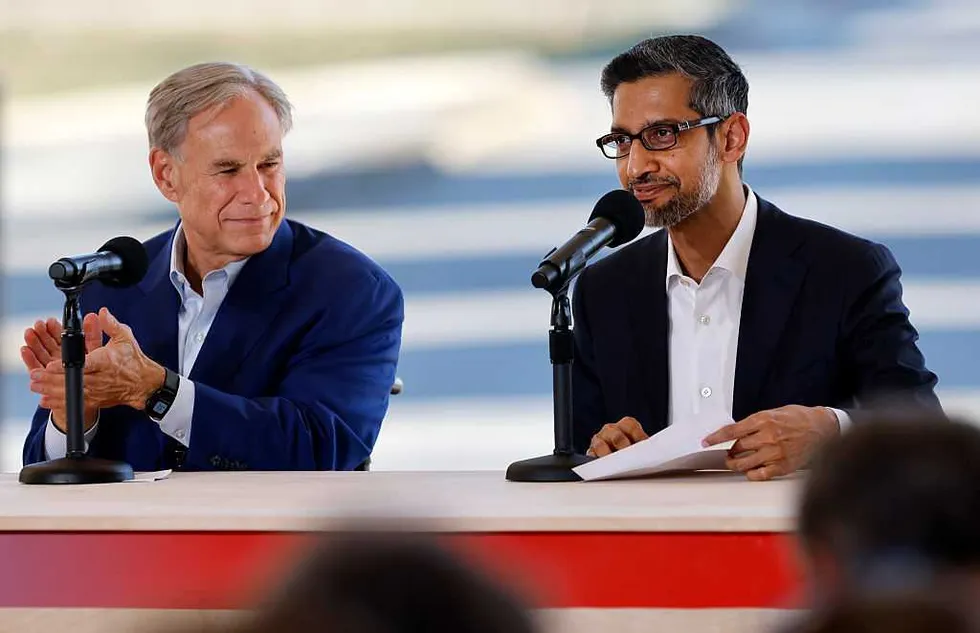 Photo by Ron Jenkins/Getty Images
The dilemma is simple but corrosive. As grateful as America should be for breathtaking innovations, an irreconcilable tension exists between national interest and fiduciary duty. Huang may sound bullish on “betting on America,” but the reality is starker: If his company could power the AI revolutions of both superpowers at once, it would add trillions to its market cap. He is pragmatic and coldly arithmetic. Build the best chips, profit from ubiquity. You don’t get where he is without knowing your math.
At GTC, I saw the divide play out in miniature. As Altimeter’s Brad Gerstner floated the idea that “logic is on the side of letting Nvidia compete with China,” I turned to a biotech researcher. Blunt and unamused, he said: “Bulls**t.” He went on to explain that, in his field especially, China’s ascent has been a wholesale rejection of the “make China dependent” fantasy. He wasn’t wrong: Under Xi Jinping, the Made in China 2025 agenda has rendered such dependency theories delusional.
Huang tries to thread the needle gracefully, extolling U.S. manufacturing while signaling an embrace of Chinese developers. As an American, it’s hard not to be charmed by his all-American chip. As a realist, however, one leaves with questions no press release can answer. In a way, the release of this patriot-approved superchip was meant to suggest, “See, now we can sell some Blackwells to China.” As charmed as one can be, the answer is still no.
One could have told the Roosevelt administration that cutting Germany off from nuclear materials would stifle innovation. Yet we did exactly that during the Manhattan Project. And we won. It may not sound like it, but this is the same choice we face today — only this race has even greater implications for the future of civilization.
The goal can’t be attempting to trap Beijing in “dependency.” The stakes are too high. The most prudent approach is to focus on surpassing them in innovation while closing loopholes that let Beijing do what it has mastered: Learn from us, then try to replace us.
Jensen Huang has every right to fight for his company’s profits. But foreign policy shouldn’t run on a corporate playbook. The U.S. needs innovators — not influencers — setting the terms of technological rivalry.
Editor’s note: A version of article appeared originally at the American Mind.
‘Circling the drain’: California has become a warning to the nation
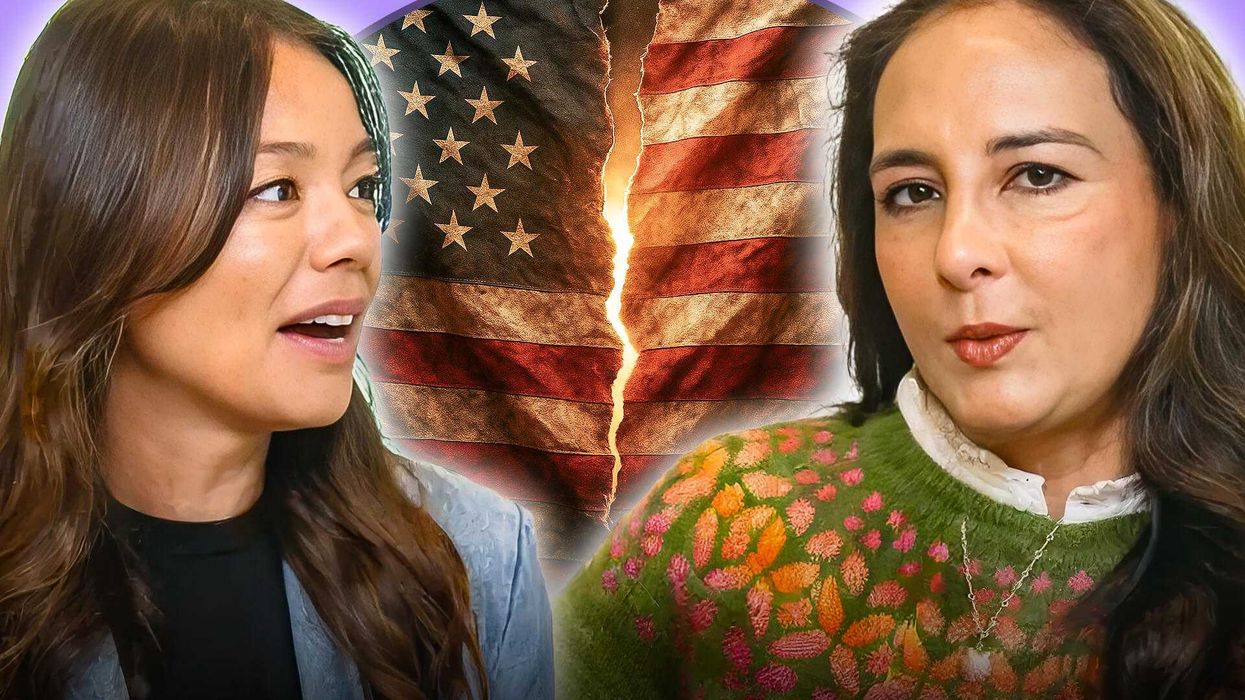
California once stood as the symbol of American innovation and unity — but today, it has become the warning sign for a nation in decline.
Harmeet Dhillon and BlazeTV host Nicole Shanahan both live in California, and while it remains one of the most aesthetically beautiful places to live, policy and unity-wise, it is anything but beautiful.
“Some younger folks may not remember the time when people would be giving speeches on the opposite sides of something in Congress, and then they would play basketball together afterwards,” Dhillon tells Shanahan.
“That doesn’t happen any more in D.C., and it doesn’t happen any more in Sacramento. I mean, Sacramento has become like the paradigm of, you know, just sclerotic inefficiency over there. It’s just a one-party state, with terrible results for the consumers because of that,” she continues.
“If we had a vibrant two-party state here, we would have some compromise, and we would have some solutions,” she says, noting that instead the state is just “circling the drain” and has become “unlivable here for most people.”
And despite the way Silicon Valley and other densely populated areas of California may vote, Dhillon points out that when “you look at the map, California is a red state.”
“There’s a thin slice of blue on the coast, where there’s a population overload, but most of the state … you just drive an hour into the interior of our state, and there’s Trump signs everywhere, and there’s people working with their hands, and there’s people involved in their communities, and there’s nature, and there’s beauty,” she says.
“It is really two states in that sense. … But, you know, it’s sort of with self-interested line-drawing and the so-called independent commission, which isn’t independent. It really defines a ceiling for Republicans right now, until that system changes,” she continues.
“We’ve had Republican leaders in the state when the state was great, and I don’t think other states want to emulate California’s infrastructure, its schools, its, you know, health care system,” she says, adding, “We are not a paradigm of anything positive right now, and that should change.”
Want more from Nicole Shanahan?
To enjoy more of Nicole’s compelling blend of empathy, curiosity, and enlightenment, subscribe to BlazeTV — the largest multi-platform network of voices who love America, defend the Constitution, and live the American dream.
Pinay OFW killed in HK fire–consulate

The Philippine Consulate General in Hong Kong has confirmed the death of an overseas Filipino worker in the Nov. 26 fire that struck Tai Po.
James Patterson claims Marilyn Monroe was murdered in explosive new book theory
James Patterson claims Marilyn Monroe was murdered in his new book ‘The Last Days of Marilyn Monroe,’ citing her dangerous relationships with JFK and others.
Texas girl rescued after sand hole she was digging collapses, burying her
A 12-year-old girl was rescued in Texas after becoming completely buried when a large hole she was digging in sand collapsed on Thanksgiving Day.
New video emerges of DC National Guard shooting as soldier clings to life
Eyewitness video shows part of the brazen daylight attack on National Guard members that left one soldier dead, another fighting for his life.
Chinese hackers turned AI tools into an automated attack machine
Chinese hackers used Anthropic’s Claude AI to launch autonomous cyberattacks on 30 organizations worldwide, marking a major shift in cybersecurity threats.
Mysterious marijuana-linked vomiting disorder gets official WHO code as ER cases jump
WHO officially recognizes cannabis hyperemesis syndrome, a dangerous vomiting disorder linked to chronic marijuana use, helping doctors diagnose cases.
Ohio State gets revenge against Michigan in dominant rivalry victory at Big House
Ohio State ended its four-game skid against Michigan with a dominant win at the Big House, reclaiming rivalry glory and setting up a Big Ten title clash with Indiana.





