Day: December 1, 2025
I thought I was too old to fall in love again — until two chords proved me wrong
I have a new favorite band. I know that sounds weird. I’m not a teenager. I’m a grown adult man.
I was in my car when I first heard the song “Jupiter” on the alternative music station. It began with a distinctive guitar part, two chords played in a simple rhythmic pattern.
An actual band is too much like a gang. Or a terrorist group. Four white guys roaming around the country in a van? We better have the FBI look into that.
It was super catchy. Very simple. Nice groove. It didn’t sound like anything else on the radio. The band is called Almost Monday.
Smoothed and removed
I downloaded “Jupiter” and put it on a playlist. It stood out, even among some classic songs. I found myself humming it during my day. And then needing to listen to it when I got home.
A month or two later, another new song by Almost Monday came out, “Can’t Slow Down.” It had a similar repetitive guitar riff. But in this song, there was a great bass part as well.
Both songs had a slick quality. Super produced. Really clean and effortless.
I think of music like that as “not letting you in.” You, the listener, are experiencing music so smooth and polished, you can’t imagine actual people playing it.
You can’t picture the band members. They’re projecting a wall of glossy perfection. And you can’t see through it.
*******
I downloaded “Can’t Slow Down” and put that on a playlist. But it sounded best on my car radio while I was driving. Fortunately, it was on heavy rotation, and I drive a lot. So I heard it constantly.
“Jupiter” was still playing continuously as well. The two songs were like a one-two punch. By July, it seemed Almost Monday was the breakout band of the summer.
“Jupiter” and “Can’t Slow Down” were definitely my “summer songs.” And probably a lot of other people’s as well.
It was almost like Almost Monday had become my new favorite band.
Trends to the end
I haven’t had a favorite band in a long time. I didn’t even think I was capable of having a favorite band again, to be honest. I mean, I still listen to the radio. I still follow the trends in music.
I enjoyed the “yacht rock” trend from a couple of years ago. But that was more of a joke. But even joke-trends can produce good music.
If I were a music critic, I would describe Almost Monday as “post-yacht rock, California pop.” Smooth, catchy melodies. Clever lyrics. No politics, no depressing thoughts. A strong Southern California vibe (the band is from San Diego).
*******
Looking back, my first favorite bands were Led Zeppelin and Aerosmith. That was in high school. In college, it was Echo and the Bunnymen. When I lived in San Francisco after college, it was the Smiths.
All these bands became like close friends to me. I would miss them if I didn’t hear them at least once a day. I needed my fix.
When I got into my 30s, I became more of a general fan. That was when grunge happened. I liked all those bands, but none really stood out as my favorite.
After grunge, there were many music groups I liked. Radiohead. Interpol. Elliott Smith. Sufjan Stevens’ “Carrie & Lowell” album. But I wouldn’t say any of these were “my favorite band.”
The trouble with happiness
One thing I should say: I don’t usually enjoy music like Almost Monday. I was never into that carefree, happy-sunshine, California vibe. I typically like heavier, moodier stuff.
But maybe because the tone of society is so dark and fraught right now, the lightness of their music feels almost revolutionary. How dare they be so easy-going. So outwardly cheerful. Who do they think they are?
Also, they’re a bunch of white guys. Which is not exactly in fashion. Shouldn’t they have some women and some racial diversity in their group?
And even being “a band” seems retrograde and reactionary. Current pop music is about individual stars. Chappell Roan. Benson Boone. Sabrina Carpenter. Bad Bunny.
These are individual “artists” with specific marketing concepts and replaceable musicians.
An actual band is too much like a gang. Or a terrorist group. Four white guys roaming around the country in a van? We better have the FBI look into that.
*******
All summer I listened to “Can’t Slow Down” and “Jupiter,” multiple times a day. But I’d still never actually seen the group. I didn’t feel a need to.
But then one night, I had the TV on, and I heard Jimmy Kimmel introduce the group on his show. I hurried over to the TV and turned up the sound.
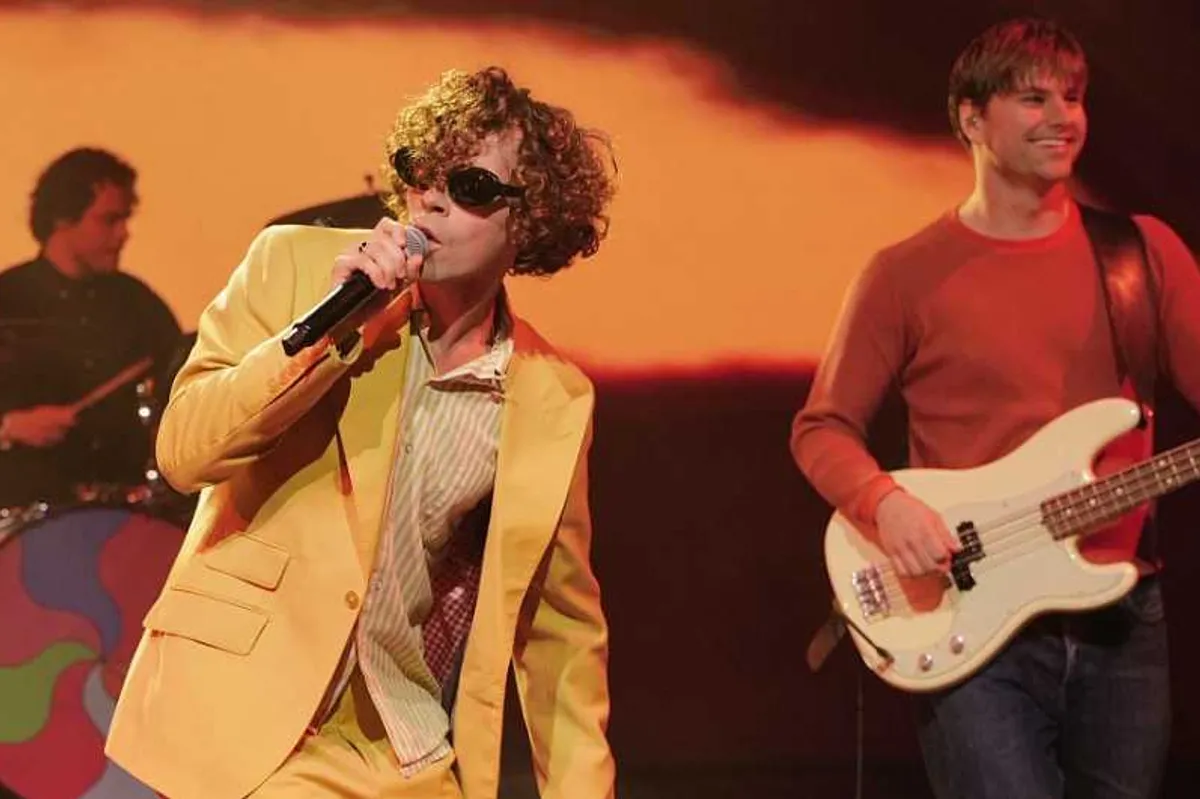
They played “Can’t Slow Down.” They were super simple in their stage presentation. Just four guys. Singer, bass, drums, guitar.
They had no amps, I noticed. There was almost nothing on the stage. The guitarist played that one simple repeating progression.
They were super chill. The singer moved around a little. The guitarist and bassist just played. The drummer drummed. They didn’t let you in.
Really, it was fantastic. But would America appreciate their understated cool? Their simplicity? Their Zen-like reserve?
They’d had two smash-hit singles on alternative radio that summer. But what did that mean in the music biz? Was “alternative music” still a big market? Do young people even listen to music anymore? How do bands make money nowadays?
RELATED: Where have all the rock bands gone?
 Jeff Kravitz/Getty Images
I’ll see you in September
In September, I rode a ferry up to Alaska. This was not a cruise. It was a ferry, with dogs and trucks and locals. It took three days. There was no TV on board, nothing much to do.
That’s when I realized how close I felt to Almost Monday. I would hang around on deck for a couple of hours, then go back to my bunk and listen to “Jupiter” and “Can’t Slow Down.”
I dug up some of their other songs that I’d downloaded. Now I had time to listen to these closely and develop new favorites.
It was fun because in my mind these were “summer songs,” but every hour we steamed north on the ferry, it got colder.
Summer was not fading away over a month or two, like usual. It was fading hour by hour.
So I binged on the summer sounds of Almost Monday, as the skies grew dark and people on deck started wearing down parkas.
*******
A favorite band is like a best friend. It is the first person you want to talk to in the morning. And the last person you want to hear from before you go to bed. During the day, you don’t need to be in constant contact, but you’re relieved when you’re in their presence again.
*******
Now I’m back in Portland. It’s wet and cold, but I still listen to Almost Monday every day.
I hope they make it big. Or big enough to never have to get normal jobs.
That’s all I ever wish for, for my fellow creatives: I hope they make some money. I never wish for them wild success or huge fame. That can be bad for a person.
But I do want them to make enough money that they can be artists for the rest of their lives. And not have to worry about paying their rent.
In music, sometimes all it takes is to write a couple great songs (and own the publishing rights). I know Almost Monday has already accomplished that. So hopefully the rest is gravy.
A nation without trust is a nation on borrowed time

Something drastic is happening in American life. Headlines that should leave us stunned barely register anymore. Stories that once would have united the country instead dissolve into silence or shrugs.
It is not apathy exactly. It is something deeper — a growing belief that the people in charge either cannot or will not fix what is broken.
When people feel ignored or betrayed, they will align with anyone who appears willing to fight on their behalf.
I call this response the Bubba effect. It describes what happens when institutions lose so much public trust that “Bubba,” the average American minding his own business, finally throws his hands up and says, “Fine. I will handle it myself.” Not because he wants to, but because the system that was supposed to protect him now feels indifferent, corrupt, or openly hostile.
The Bubba effect is not a political movement. It is a survival instinct.
What triggers the Bubba effect
We are watching the triggers unfold in real time. When members of Congress publicly encourage active duty troops to disregard orders from the commander in chief, that is not a political squabble. When a federal judge quietly rewrites the rules so one branch of government can secretly surveil another, that is not normal. That is how republics fall. Yet these stories glided across the news cycle without urgency, without consequence, without explanation.
When the American people see the leadership class shrug, they conclude — correctly — that no one is steering the ship.
This is how the Bubba effect spreads. It is not just individuals resisting authority. It is sheriffs refusing to enforce new policies, school boards ignoring state mandates, entire communities saying, “We do not believe you anymore.” It becomes institutional, cultural, national.
A country cracking from the inside
This effect can be seen in Dearborn, Michigan. In the rise of fringe voices like Nick Fuentes. In the Epstein scandal, where powerful people could not seem to locate a single accountable adult. These stories are different in content but identical in message: The system protects itself, not you.
When people feel ignored or betrayed, they will align with anyone who appears willing to fight on their behalf. That does not mean they suddenly agree with everything that person says. It means they feel abandoned by the institutions that were supposed to be trustworthy.
The Bubba effect is what fills that vacuum.
The dangers of a faithless system
A republic cannot survive without credibility. Congress cannot oversee intelligence agencies if it refuses to discipline its own members. The military cannot remain apolitical if its chain of command becomes optional. The judiciary cannot defend the Constitution while inventing loopholes that erase the separation of powers.
History shows that once a nation militarizes politics, normalizes constitutional shortcuts, or allows government agencies to operate without scrutiny, it does not return to equilibrium peacefully. Something will give.
The question is what — and when.
The responsibility now belongs to us
In a healthy country, this is where the media steps in. This is where universities, pastors, journalists, and cultural leaders pause the outrage machine and explain what is at stake. But today, too many see themselves not as guardians of the republic, but of ideology. Their first loyalty is to narrative, not truth.
The founders never trusted the press more than the public. They trusted citizens who understood their rights, lived their responsibilities, and demanded accountability. That is the antidote to the Bubba effect — not rage, but citizenship.
How to respond without breaking ourselves
Do not riot. Do not withdraw. Do not cheer on destruction just because you dislike the target. That is how nations lose themselves. Instead, demand transparency. Call your representatives. Insist on consequences. Refuse to normalize constitutional violations simply because “everyone does it.” If you expect nothing, you will get nothing.
Do not hand your voice to the loudest warrior simply because he is swinging a bat at the establishment. You do not beat corruption by joining a different version of it. You beat it by modeling the country you want to preserve: principled, accountable, rooted in truth.
RELATED: Blue cities reject law, reject order — and reject America
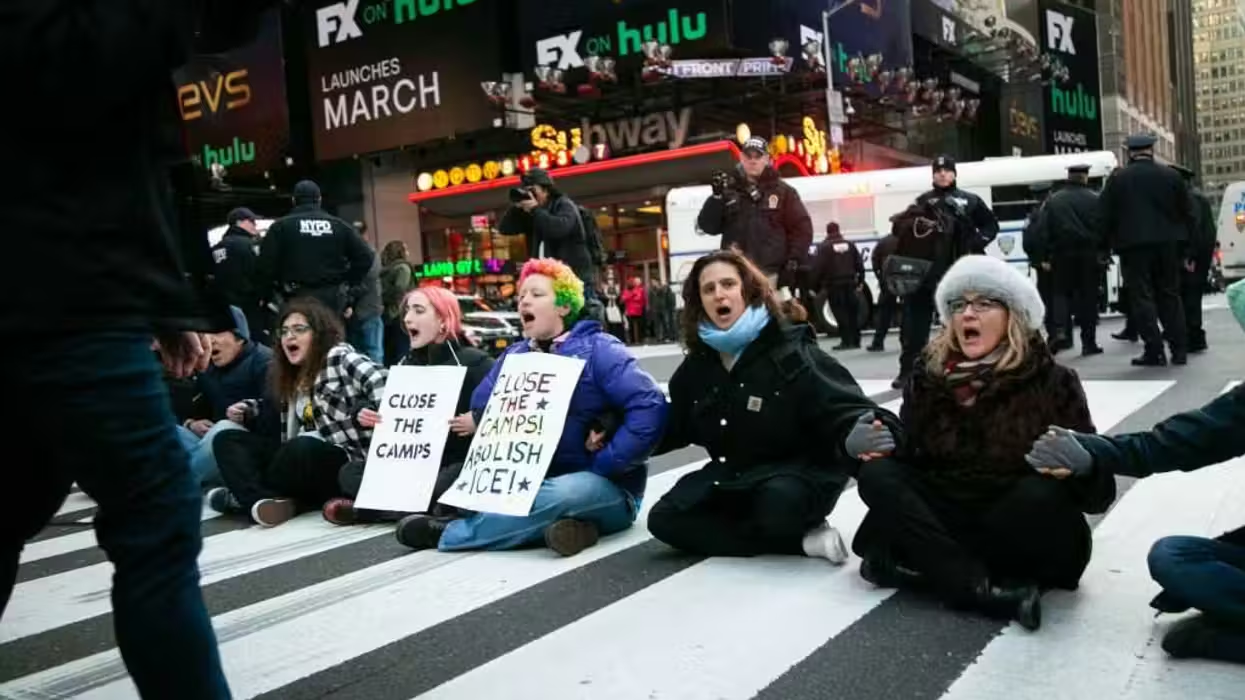 Photo by Karla Ann Cote/NurPhoto via Getty Images
Every republic reaches a moment when historians will later say, “That was the warning.” We are living in ours. But warnings are gifts if they are recognized. Institutions bend. People fail. The Constitution can recover — if enough Americans still know and cherish it.
It does not take a majority. Twenty percent of the country — awake, educated, and courageous — can reset the system. It has happened before. It can happen again.
Wake up. Stand up. Demand integrity — from leaders, from institutions, and from yourself. Because the Bubba effect will not end until Americans reclaim the duty that has always belonged to them: preserving the republic for the next generation.
Want more from Glenn Beck? Get Glenn’s FREE email newsletter with his latest insights, top stories, show prep, and more delivered to your inbox.
Landmark study drops 6 bombshells about women in the workforce — and the truth is complicated

According to feminist doctrine, women are the victims of patriarchal discrimination in the workforce. This applies even to billionaire global icons like Taylor Swift, who aired her grievances in a 2019 song (or melodized tantrum) titled “The Man,” in which she insists she’d have reached the top faster, faced far less skepticism, and been universally hailed as a “genius” or “fearless leader” if only she had been born a man.
“I’m so sick of running as fast as I can / wondering if I’d get there quicker if I was a man,” the chorus reads.
While Swift’s hypocrisy is nauseating to say the least, the truth is many everyday people still believe that sexism is rampant in the workplace.
But do their claims hold up to raw data?
On this episode of “Stu Does America,” Stu Burguiere dives into a recent study that unveiled what the data really tells us about sexism in America’s workforce.
“Honestly, sexism is a real thing. It’s been a real thing — certainly throughout our history at times in certain areas,” he acknowledges. “You wonder though: Have we made any progress in this?”
Media, academia, Hollywood, and any institution captured by progressive dogma will undoubtedly say, “Absolutely not,” and maybe even argue that we’ve regressed.
But a 2023 landmark study from the Association for Psychological Science mostly debunked these pervasive myths about gender discrimination in academic science — a field that has been used as the textbook example of entrenched patriarchal sexism. The research team reviewed hundreds of existing studies and large datasets that tested claims of anti-women bias in academic science and came away with six key findings:
1. Women with equal credentials are now hired at higher rates than men.
2. Women win grants at rates equal to men.
3. Women’s journalistic manuscripts are accepted at the same rates as men’s.
4. Recommendation letters for women are equally strong as men’s and have no negative effect on hiring or promotion.
5. Women receive systematically lower teaching evaluations than equally effective men.
6. Women earn slightly lower salaries than equally qualified men.
“The fact is that we have an entire society built on this idea, this assumption, that women go into these fields … and women are being cracked down upon,” says Stu.
“And the truth is the opposite.”
In an ideal world, he says, “People are considered equally for jobs based on their merit as individuals.”
To hear more findings from the APS study, watch the episode above.
Want more from Stu?
To enjoy more of Stu’s lethal wit, wisdom, and mockery, subscribe to BlazeTV — the largest multi-platform network of voices who love America, defend the Constitution, and live the American dream.

’12 Days of Kurakot’ ng ‘Bubble Gang,” patok sa netizens

Kinaaliwan ng netizens ang Christmas caroling ng “Bubble Gang” na “12 Days of Kurakot,” na katunog ng awiting “12 Days of Christmas.”
Marco Masa says he is getting to know Eliza Borromeo in the outside world

Marco Masa and Eliza Borromeo had an unexpected connection while they were inside the “Pinoy Big Brother” house.
‘Reply 1988″ cast members reunite for 10th anniversary special episodes

The cast members of “Reply 1988” have reunited for the 10th anniversary special of the beloved South Korean series.
‘Pinoy Big Brother’: Sofia Pablo turns emotional as she remembers promise to Allen Ansay

Sofia Pablo could not help but turn emotional following the confession of fellow housemate Iñigo Jose in “Pinoy Big Brother: Celebrity Collab Edition 2.0.”

NCAA: JRU exceeded expectations, says Epondulan, as they go back to drawing board for next season

For Jose Rizal University head coach Nani Epondulan, the Heavy Bombers exceeded expectations after emerging as a threat to many teams in NCAA Season 101.