Author: mfnnews
Hegseth warns traffickers after deadly drug boat strike: ‘We will kill you’
Secretary of War Pete Hegseth announced another deadly strike against a vessel trafficking drugs, noting that three “narco-terrorists” had been killed
MSNBC’s ‘risky’ rebrand to MS NOW draws skepticism from branding experts
The drastic move to turn MSNBC into MS NOW comes after Comcast spun off its cable assets into a new company that distances the progressive network from the NBC brand.
Fox News Digital’s News Quiz: November 7, 2025
This week’s Fox News Quiz covers Trump’s reaction to former House Speaker Nancy Pelosi’s retirement decision and the situation with stranded Chinese astronauts.
Fox Nation Patriot Awards honors Melania Trump, Erika Kirk and more top headlines
Get all the stories you need-to-know from the most powerful name in news delivered first thing every morning to your inbox.
Russian hackers use fake CAPTCHA tests to spread new malware families across multiple targets
Russian hackers use fake CAPTCHA tests to spread dangerous malware targeting governments and journalists. Learn how to protect yourself from these deceptive attacks.
What we know about the Chinese nationals accused of smuggling biological materials while at university lab
Three Chinese nationals from University of Michigan charged with smuggling biological materials including roundworms from China under false customs declarations.
The gatekeepers are fighting each other now

For most of human history, people could only dream of having ready access to all the world’s knowledge. Books were highly prized rarities, literacy was uncommon, and news could take weeks or months to arrive. The idea that the sum of human experience could fit into a little box in everyone’s pocket once sounded utopian — a paradise of informed, free citizens.
Instead, when handed access to everything, most people went looking for someone to tell them what to think.
The information age isn’t a utopia or a nightmare — it’s a permanent revolution. And it’s only getting wilder from here.
Humans are social creatures, political animals, as Aristotle observed. We crave belonging more than truth. We need a story about our place in the social order, status to pursue, and a circle to protect. Our minds aren’t wired to handle thousands of relationships. Dunbar’s number — about 150 — marks the natural limit of our social world. Online, we can connect with millions, but our capacity to process that much humanity collapses. We stop seeing people as people.
The same is true of information. In theory, access to all knowledge should make us wiser. In practice, it’s like drinking from a fire hose. Facts alone don’t illuminate anything without context, and the flood is too vast for anyone to master.
So people specialize. Like workers on an assembly line, each focuses on one task and trusts others to handle the rest. Expertise becomes a kind of currency, and every expert becomes a gatekeeper, a choke point through which understanding must pass.
Manufacturing consent
Control over that flow of information is control over perception itself. From the birth of mass media, political actors understood this. In “Public Opinion” (1922), journalist Walter Lippmann argued that elites must guide the public toward the “right” decisions because ordinary citizens couldn’t process the flood of modern information. Governments — including our own — and corporations eagerly agreed, building propaganda systems to shape consent.
Mass communication democratized information but kept control in a few hands. Printing presses, radio networks, television studios, and movie production required massive capital. The means of communication were concentrated in a small elite that decided what counted as “truth.” These media barons and their favored experts built a system in which opinion was managed from the top down. The gatekeepers defined what the public got to see, hear, and believe.
For decades, political and media elites relied on this system to shape public sentiment. Academics, think-tank analysts, and professional commentators framed policy for the masses. People felt informed while repeating narratives crafted by others. The monopoly on expert opinion kept both left- and right-wing elites secure.
RELATED: Conservatives turn their fire on each other after Charlie Kirk’s assassination
 Blaze Media Illustration
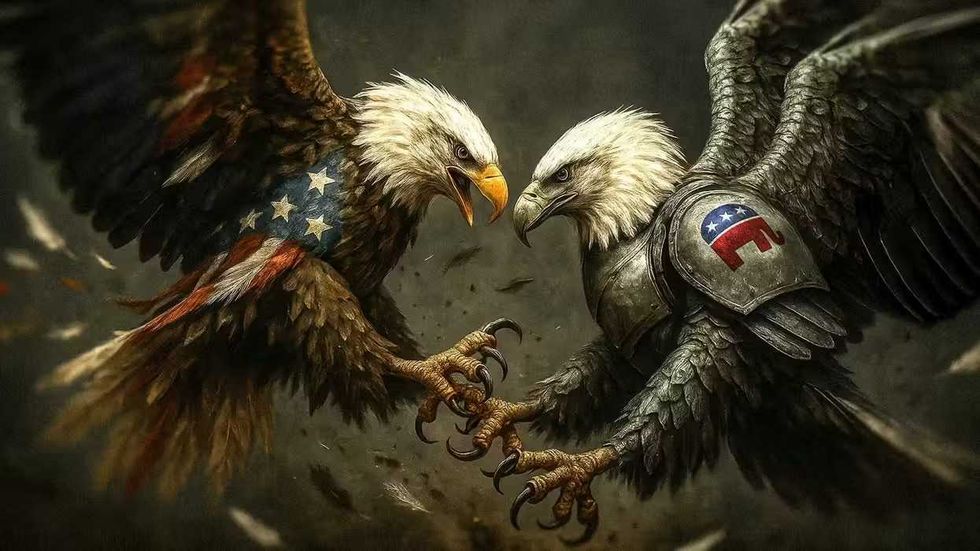
Then came the internet, which shattered the old paradigm and plunged our system into chaos. Anyone with a microphone and a laptop could broadcast to the world. Legacy media cut costs, and now its anchors sit in home offices on the same streaming platforms as the amateurs they used to mock. The line between credentialed gatekeeper and average guy with an opinion has all but disappeared.
The result? Panic.
Mutating information war
Liberal elites were horrified to see Donald Trump, JD Vance, and countless populists bypass their filters and speak directly to millions of people. Podcasts hosted by comedians or outsiders broke through censorship walls. Conservative leaders cheered — until their own control started slipping. As legacy conservative networks fractured and independent creators rose, the movement’s “approved experts” lost their monopoly too.
Now both sides are scrambling to rebuild the gates. The establishment insists that chaos proves we need “trustworthy experts.” But the expert class discredited itself, and the internet made gatekeeping technologically impossible. The average citizen may not always discern truth from falsehood, but the public no longer trust those who claim to decide it for them.
The information war isn’t ending. It’s mutating. Every collapse of authority spawns a new order, and every new order fights to become the next gatekeeper. Unless governments impose hard censorship, as Europe has begun to do, the chaos will continue. The information age isn’t a utopia or a nightmare — it’s a permanent revolution. And it’s only getting wilder from here.
Kiray Celis, fiancé Stephan Estopia take streets of Tokyo for prenup shoot

Kiray Celis and her fiancé, Stephan Estopia, are so in love in Tokyo, Japan!
Who is Xolo Maridueña, the actor who will play ‘One Piece’s’ Ace?
_2025_11_07_13_19_11.jpg)
Xolo Maridueña is officially joining the live-action “One Piece” Season 3 series as Portgas D. Ace, the older brother of Luffy.