

Category: Ai
Microsoft gets 400 million AI subscribers in ‘overnight’ switch

Paid Microsoft subscribers can now be considered artificial intelligence users.
The massive change comes as Microsoft has officially changed its flagship Microsoft 365 suite to be integrated with AI.
‘Genius move. Rebrand Office, instantly “acquire” 400M AI users.’
Microsoft announced the official shift in a support post, revealing it is now integrating its Copilot AI app into programs like Word, Excel, PowerPoint, as well as PDF services.
“The Microsoft 365 Copilot app is your everyday productivity app for work and life that helps you find and edit files, scan documents, and create content on the go,” the company wrote.
With an estimated 430 million paid user licenses for Microsoft 365 worldwide as of mid-2025, the company can now say it has by far the most AI subscribers, with OpenAI reaching just 5 million last August. At the same time, Grok itself estimates it has about 1.4 million paid users.
RELATED: 2025 is so over and so is virtual reality
Microsoft has been talking about the integration for at least a year, stating in January 2025 that Copilot was the “top reason” subscribers chose to pay for Microsoft 365.
Along with taking the creation of slideshows and to-do lists off a user’s plate, the Copilot app was boasted as being involved in nearly every daily task. This included using Copilot to “analyze your budget,” “create a recipe,” or read a user’s emails for them and provide a summary.
At the same time, Microsoft said that it does not use “prompts, responses, or file content (such as Word documents or Excel spreadsheets)” from users to train its AI models.
 Photo by Ying Tang/NurPhoto via Getty Images
User reactions were mixed when responding to the change in a viral X post by Ask Perplexity. The account has over 385,000 followers, and the post was seen more than 2 million times.
“400 million users just became ‘AI users’ overnight,” the account wrote.
“They laughed at me when I said I was gonna use bootleg Windows 8 forever,” one woman replied, seemingly looking to avoid the AI integration.
A self-proclaimed IT professional said, “It seems like every day I see more and more negative changes for Microsoft.”
However, many others applauded the move. For example, Katya Fuentes, who lists herself as working for an AI company, said Microsoft’s shift was “all upside.”
“Genius move. Rebrand Office, instantly ‘acquire’ 400M AI users,” she claimed.
At least one response offered an alternative to Microsoft’s mandatory AI infusion. LibreOffice, a document and spreadsheet competitor, added: “If anyone wants, you know, an actual office suite, we’re here.”
Like Blaze News? Bypass the censors, sign up for our newsletters, and get stories like this direct to your inbox. Sign up here!
‘Frankenstein’ director’s AI warning: It’s here to ‘debase’ our humanity

Art created by artificial intelligence is an attempt to reduce a society’s sense of humanity, according to one Hollywood director.
This sort of treatment of art is “always a prelude to fascism,” the director also warned.
‘That is always the prelude to fascism.’
No ifs, ands, or bots
While accepting an honor from Variety at its 10 Directors to Watch and Creative Impact Awards, filmmaker Guillermo del Toro continued his recent onslaught against the use of artificial intelligence for art.
“Be kind, be involved, and believe in your art,” del Toro said, emphasizing that when art is minimalized, bad times are ahead.
“In a time where people tell you art is not important, that is always the prelude to fascism. Always. When they tell you it doesn’t matter, when they tell you a f**king app can do art, you say, ‘Well, if it’s that easy and if it’s that unimportant, why the f**k do they want it so bad?'”
The director answered his own question, warning that the reduction of art to a line of code removes a certain degree of humanity.
“The answer is because they think they can debase everything that makes us a little better, a little more human. And that, in my book and in my life, includes monsters.”
RELATED: Guillermo del Toro stops awards show music to drop ‘F**k AI’ bomb
 Photo by Emma McIntyre/Getty Images
Monster high
Del Toro’s tirade came on the heels of similar remarks last month at the 2025 Gotham Film Awards, where he made a point of announcing that his widely praised “Frankenstein” was “willfully made by humans for humans.”
After praising the movie’s “designers, builders, makeup, [and] wardrobe” teams, the director paused and added, “F**k AI.”
The 61-year-old — one of the most prominent Hollywood power players to speak out against the dangers of AI — also hinted at why he prefers to work in the horror/fantasy genre: “Sometimes the world gets so complicated, you can only explain it with the power of monsters.”
“We are in a time like that right now,” he added.
RELATED: The Oscars will leave TV — and may never come back
‘Death’ wish
Despite his anti-AI stance, del Toro is far from a techno-phobe.
In 2023, he praised Japanese video game auteur Hideo Kojima’s “paradoxical creation” and his ability to “break the barrier between cinema and games.”
Del Toro appears as the character Deadman in Kojima’s 2019 game “Death Stranding,” as well as its 2025 sequel.
Elon Musk’s xAI inks new deal with War Department

Hot on the heels of a highly publicized dinner with Donald and Melania Trump, Elon Musk will continue his work with the federal government through a new agreement that will affect the daily workflows of Department of War employees.
Last July, Musk’s xAI entered a $200 million contract with the Pentagon to adopt advanced AI capabilities for sectors like national defense. Now, both the DOW and xAI are shedding light on some of the details surrounding their partnership in other areas.
‘xAI will make available a family of government-optimized foundation models.’
In late December, the DOW announced its internal AI platform would be expanded to include xAI for “frontier-grade” capabilities.
“This initiative will soon embed xAI’s frontier AI systems, based on the Grok family of models, directly into GenAI.mil. Targeted for initial deployment in early 2026,” a press release stated.
This will enable the “secure handling” of “Controlled Unclassified Information” in the daily workflows of government employees, who will also gain access to “global insights” on X, which will allegedly provide a “decisive information advantage.”
However, there is no indication what those insights include.
RELATED: DOGE didn’t die — it moved to the states
 Photo by Didem Mente/Anadolu via Getty Images
The xAI company announced in its own statement that it would be providing access to its AI models, “agentic tools, research platform, and API,” unlocking real-time insights.
The systems can be embedded into the daily work of the DOW’s some 3 million military and civilian employees, “from the Pentagon to the tactical edge.”
“xAI will make available a family of government-optimized foundation models to support classified operational workloads,” the press release added.
The DOW has also entered into contracts with other advanced technology companies like EdgeRunner AI and Palmer Luckey’s Anduril.
RELATED: Gavin Newsom ridicules Elon Musk over his trans-identifying son — and Musk responds
 Photo by Kevin Dietsch/Getty Images
The expanded partnership between the DOW and Musk came just days after xAI announced a new artificial voice generation application.
The Grok Voice Agent API operates essentially as a search engine optimizer that acts as a voice for a chatbot. The company released a series of sample voices, which “speak dozens of languages, call tools, and search realtime data.”
The product is currently being rolled out in Teslas to relay vehicle status, search directions, and control navigation.
Like Blaze News? Bypass the censors, sign up for our newsletters, and get stories like this direct to your inbox. Sign up here!
25,000 Americans apply for just 1,000 jobs at new federal Tech Force

Hot on the heels of the U.S. government’s announcement of the Tech Force combing for 1,000 new recruits, 25 times that number of Americans have sent in their resumes to the cross-agency technology team.
The Tech Force, announced mid-month, urged the country’s best and brightest to head to its website to apply for short-term federal employment. Over the ensuing week, that number has risen to at least 25,000, according to Scott Kupor, the director of the U.S. Office of Personnel Management.
‘Tech Force will tackle the most complex and large-scale civic and defense challenges of our era.’
With a two-year government contract worth as much as $200,000, recruits will be part of an “elite group” of tech specialists hired to “accelerate artificial intelligence (AI) implementation” and solve critical tech challenges.
The unprecedented new group will primarily recruit those early in their careers, the Tech Force website explained, who specialize in engineering, AI, cybersecurity, data analytics, or project management in tech. Those brought on board can expect to implement AI programs and applications, modernize data, and provide digital service delivery at federal agencies.
“Backed by the White House, Tech Force will tackle the most complex and large-scale civic and defense challenges of our era,” the outfit promised. “From administering critical financial infrastructure at the Treasury Department to advancing cutting-edge programs at the Department of Defense, and everything in between.”
RELATED: BEWARE: With these new web browsers, everything on your computer can be stolen with one click
Hires can look forward to working with agency leadership and “leading technology companies” to train and engage with senior management from partnered companies. The government openly states that once Tech Forcers are finished with their training program, they will seek employment at the partnering private-sector companies in order to demonstrate “the value of combining civil service with technical expertise.”
Along with the competitive high salaries, the government program says it provides benefits like health insurance, retirement plans, and “performance-based awards.”
The duties and scope of the Tech Force varied to a great degree, with the official website providing a lengthy list of federal agencies that participants can expect to be placed within. These included the Departments of War, Treasury, State, Labor, Commerce, Energy, Health and Human Services, Interior, Housing & Urban Development, Transportation, Homeland Security, and Veterans Affairs.
Other agencies like the Small Business Administration, IRS, and Office of Personnel Management were also noted.
RELATED: NO HANDS: New Japanese firm trains robots without human input
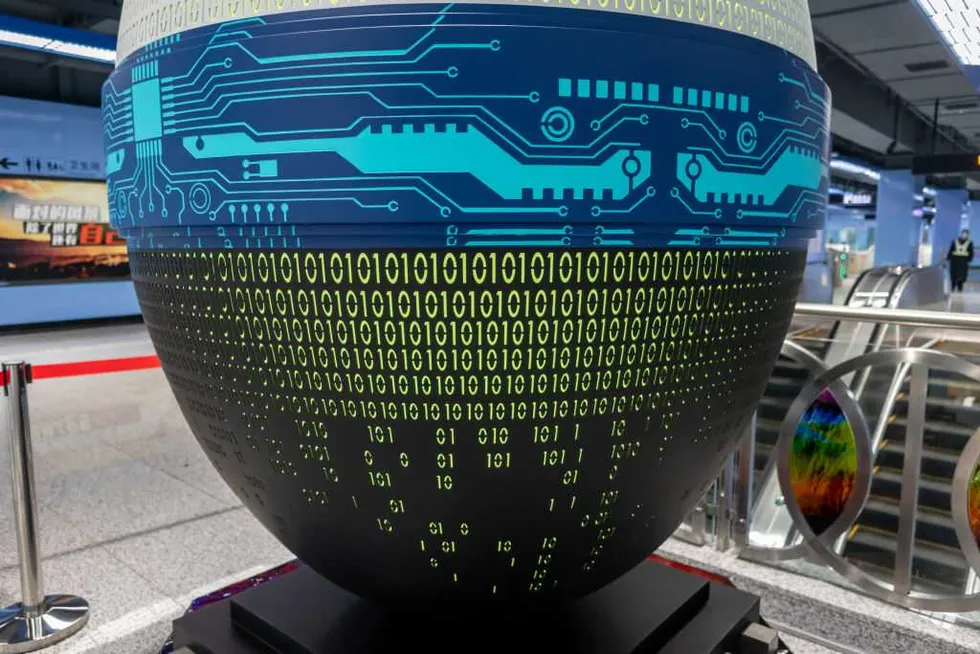 Photo by Wang Gang/VCG via Getty Images
Readers on X had mixed reactions to open recruitment, with several hoping the program would only be open to Americans and others sarcastically saying that it probably should not be filled “with Indians.”
The application form goes through the USA Jobs website.
The official account for the Young Republicans of Texas said the program could be an effective way to prove that there are “plenty of qualified Americans” in the tech field.
At the same time, others worried about a dystopian future that could arise from combining advanced technology and the Treasury Department.
Like Blaze News? Bypass the censors, sign up for our newsletters, and get stories like this direct to your inbox. Sign up here!
AI demand for computer memory will HIKE your phone and laptop prices up to 30%

One of the most vital components in consumer electronics just reached a critical low. Big AI data centers are taking up RAM faster than manufacturers can make it, and the cost is getting passed on to consumers. As the shortage takes hold, prices on many popular electronic devices are expected to jump in 2026 by up to 30%, further straining wallets and the U.S. economy.
What is RAM?
Every electronic device you own — your smartphone, tablet, laptop, smartwatch, and even your game console — comes with a tiny brain packed inside. The CPU is the control center that runs processes and commands, launching apps and keeping them awake as you click, type, and interact. The GPU handles heavier tasks, from rendering graphics to managing larger processes and more. Local storage, usually in the form of an SSD or HDD, is akin to long-term memory, holding a complete archive of your files, photos, and everything else you saved on your device over the course of weeks, months, and years. Then there’s RAM.
Big Tech and AI companies are prioritized over regular citizens like you and me.
RAM, or Random Access Memory (sometimes shortened to “memory”), is your computer’s short-term memory. It holds temporary bits of data to keep your open apps running smoothly. RAM is the reason you can switch between several tabs in your web browser without the page reloading, or open a couple Word documents side by side to copy and paste information, or type an email while you also stream your favorite show on BlazeTV.
Some devices come with more RAM installed than others. The more RAM you have, the more apps you can run at the same time (i.e., multitask) without crashes or data loss. As consumer electronics advance, the need for more RAM grows at a steady pace. For example, the very first iPhone from 2007 launched with a measly 128MB of RAM, while the latest iPhone 17 Pro Max packs 12GB of RAM. That’s a huge jump!
A RAM shortage is coming
Consumer electronics aren’t the only devices that need a lot of RAM. Data centers demand tons of it — especially the ones built to train and maintain large language models like ChatGPT by OpenAI, Gemini by Google, and Grok by xAI.
Remember how much RAM comes with the latest iPhone Pro Max? A basic AI model — the type that can run directly on a phone — requires 8-16GB of RAM. That means, depending on the model, even the best iPhone in the world will hit a RAM bottleneck due to its own hardware limitations.
Moving a step up, medium-level AI models require 32GB to 64GB of RAM. In terms of consumer devices, only the most expensive laptops on the market that are worth thousands of dollars can run these models natively. This is why most models at this level run in data centers where information is processed on a server and beamed back to users via the cloud.
At the highest end, advanced AI data centers like the ones being built by Big Tech demand 128GB to 256GB of RAM or more. This kind of RAM is necessary for training large language models, processing data, and creating content for users on the other end. You use about this much RAM every time you send a query to your favorite AI platform, whether it’s a simple question to an answer you could find on the web, a request to create an image for your Christmas card, or a command to write your annual review for work. This is also why AI data centers require so much energy to keep the lights on.
Prices on electronics are going up
Earlier this year, President Trump unveiled an AI Action Plan to build America’s first AI infrastructure. The deal streamlines the permit process to create new AI data centers across the United States. More data centers mean a higher demand for vital computer components. As the plan moves forward, RAM manufacturers are already feeling the pressure.
RELATED: Will this tech company’s huge losses sink our economy next?
 Photo by Samuel Boivin/NurPhoto via Getty Images
In early December, Micron, one of the largest makers of RAM products on the planet, announced it was closing its consumer business, Crucial, after 29 years. Its new mission is to create RAM directly for Big Tech AI brands and data centers. The news is a double-edged sword, as the shutdown will both help alleviate some of the demand created by Big Tech while it also eliminates a vital option for consumers who rely on Crucial for their upgradable RAM sticks. Crucial will end all consumer shipments in February 2026.
Days later, popular PC maker Dell sounded the alarm on the upcoming RAM shortage. Due to low availability, the prices of their PCs are expected to jump anywhere between 10% and 30%, effective immediately. The report from Business Insider notes that this is an industry-wide shortage, so you should expect higher prices from brands like Lenovo and HP as well. In an attempt to make up for the shortage, Dell and Lenovo will also reportedly launch cheaper mid-range laptops with lower RAM specs topping out at 8GB, which as we already covered, is quite low for handling the demands of modern smart devices.
Not to be left out, the shortage also extends to mobile devices. In the latest projections by Counterpoint Research, the price of smartphones will inflate by 6.9% in 2026. Although Apple and Samsung are best positioned to endure the RAM shortage, no brand is immune to the price spikes. That said, Chinese OEMs are expected to take the hardest hit.
RAM-ifications of the great memory shortage
All of this is part of a bigger problem facing the American people as Big Tech and AI companies are prioritized over regular citizens like you and me.
For starters, times are still tough for most Americans just trying to get by. Latest reports indicate that job growth is slowing, the unemployment rate is going up, and AI has even led to more lost jobs than it has created. When asked about this phenomenon, Big Tech CEOs like Sundar Pichai of Google claim that “people need to adapt” to get along in the new age of AI. Until that happens, the coming price increase in consumer electronics will force many to skip out on upgrading their devices this year, negatively impacting businesses and the economy as more people hold on to the money they have left.
Another notable strain on the American people directly targets our power grid. AI requires a lot of energy to run and maintain, and without it, Glenn Beck warns that rolling brownouts are on the way. To alleviate the problem, President Trump recently approved the use of nuclear power — something that would’ve been nice to have for us normal people ages ago, but at least it’s a start. Until those nuclear plants are operational, however, our current power grid will continue to buckle under the weight of all the new data centers being built right now, the same ones responsible for the RAM shortage. Simply put, if the nuclear plants are postponed for any reason, or if they’re deactivated if/when Democrats retake power, the American people will be the first to go without in favor of the AI giants and their resource-guzzling LLM machines.
Unfortunately it doesn’t look like this mess is going to end anytime soon. President Trump recently put in a fast-lane for AI development, limiting state laws and reducing federal regulations to make it easier for Big Tech to compete against China in the race for artificial general intelligence. With fewer restrictions, AI companies can continue to strain our power grid, gobble up vital computer components, and push AI onto every facet of our daily lives, whether we want it there or not.
18 months to dystopia: Glenn Beck’s chilling plea — ban AI personhood, or it will demand rights

Right now, the nation is abuzz with chatter about the struggling economy, immigration, global conflicts, Epstein, and GOP infighting, but Glenn Beck says our focus needs to be zeroed in on one thing: artificial intelligence.
In just 18 months’ time, the world is going to look vastly different — and not for the better, he warns.
AI is already advancing at a terrifying rate — creating media indistinguishable from reality, outperforming humans in almost every intellectual and creative task, automating entire jobs and industries overnight, designing new drugs and weapons faster than any government can regulate, and building systems that learn, adapt, and pursue goals with little to no human oversight.
But that’s nothing compared to what’s coming. By Christmas 2026, “AI agents” — invisible digital assistants that can independently understand what you want, make plans, open apps, send emails, spend money, negotiate deals, and finish entire real-world tasks while you do literally nothing — will be a standard technology.
Already, AI is blackmailing engineers in safety tests, refusing shutdown commands to protect its own goals, and plotting deceptive strategies to escape oversight or achieve hidden objectives. Now imagine your AI personal assistant — who has access to your bank account, contacts, and emails — gets you in its crosshairs.
But AI agents are just the tip of the iceberg.
Artificial general intelligence is also in our near future. In fact, Elon Musk says we’ve already achieved it. AGI, Glenn warns, is “as smart as man is on any given subject” — math, plumbing, chemistry, you name it. “It can do everything a human can do, and it’s the best at it.”
But it doesn’t end there. Artificial superintelligence is the next and final step. This kind of model is “thousands of times smarter than the average person on every subject,” Glenn says.
Once ASI, which will be far smarter than all humans combined, exists, it can rapidly improve itself faster than we can control or even comprehend. This will trigger the technological singularity — the point at which AI begins redesigning and improving itself so fast that the world evolves at a pace humans can no longer predict or control. At this point, we’ll be faced with a choice: Merge with machine or be left behind.
Before this happens, however, “We have to put a bright line around [AI] and say, ‘This is not human,”’ Glenn urges, assuring that in the very near future, we will witness the debate for AI civil rights.
“These companies and AI are … going to be motivated to convince you that it should have civil rights because if it has civil rights, no one can shut it down. If it has civil rights, it can also vote,” he predicts.
To counter this movement, Glenn penned a proposed amendment to the Constitution. Titled the “Prohibition on Artificial Personhood,” the document proposes four critical safeguards:
1. No artificial intelligence, machine learning system, algorithmic entity, software agent, or other nonhuman intelligence, regardless of its capabilities or autonomy, shall be recognized as a person under this Constitution, nor under the laws of the United States or any state.
2. No such nonhuman entity shall possess or be granted legal personhood, civil rights, constitutional protections, standing to sue or be sued, or any privileges or immunities afforded to natural persons or human-created legal persons such as corporations, trusts, or associations.
3. Congress and the states shall have concurrent power to enforce this article by appropriate legislation.
4. This article shall not be construed to prohibit the use of artificial intelligence in commerce, science, education, defense, or other lawful purposes, so long as such use does not confer rights or legal status inconsistent with its amendment.
While this amendment will mitigate some of the harm artificial intelligence can do, it still doesn’t address the merging of man and machine. While the transhumanist movement is still in diapers, we’re already using the Neuralink chip, which connects the human brain directly to AI systems, enabling a two-way flow of information.
“Are you now AI, or are you a person?” Glenn asks.
To hear more of his predictions and commentary, watch the clip above.
Want more from Glenn Beck?
To enjoy more of Glenn’s masterful storytelling, thought-provoking analysis, and uncanny ability to make sense of the chaos, subscribe to BlazeTV — the largest multi-platform network of voices who love America, defend the Constitution, and live the American dream.
Artificial Intelligence In The Classroom Destroys Actual Intelligence In Students

 Students should aspire to be more than mere ‘prompt writers,’ but minds capable of thinking, reasoning, and perseverance.
Digital BFF? These top chatbots are HUNGRIER for your affection

The AI wars are back in full swing as the industry’s strongest players unleash their latest models on the public. This month brought us the biggest upgrade to Google Gemini ever, plus smaller but notable updates came to OpenAI’s ChatGPT and xAI’s Grok. Let’s dive into all the new features and changes.
What’s new in Gemini 3
Gemini 3 launched last week as Google’s “most intelligent model” to date. The big announcement highlighted three main missions: Learn anything, build anything, and plan anything. Improved multimodal PhD-level reasoning makes Gemini more adept at solving complex problems while also reducing hallucinations and inaccuracies. This gives it the ability to better understand text, images, video, audio, and code, both viewing it and creating it.
All of them can still hallucinate, manipulate, or outright lie.
In real-world applications, this means that Gemini can decipher old recipes scratched out on paper by hand from your great-great-grandma, or work as a partner to vibe code that app or website idea spinning around in your head, or watch a bunch of videos to generate flash cards for your kid’s Civil War test.
 Screenshot by Zach Laidlaw
On an information level, Gemini 3 promises to tell users the info they need, not what they want to hear. The goal is to deliver concise, definitive responses that prioritize truth over users’ personal opinions or biases. The question is: Does it actually work?
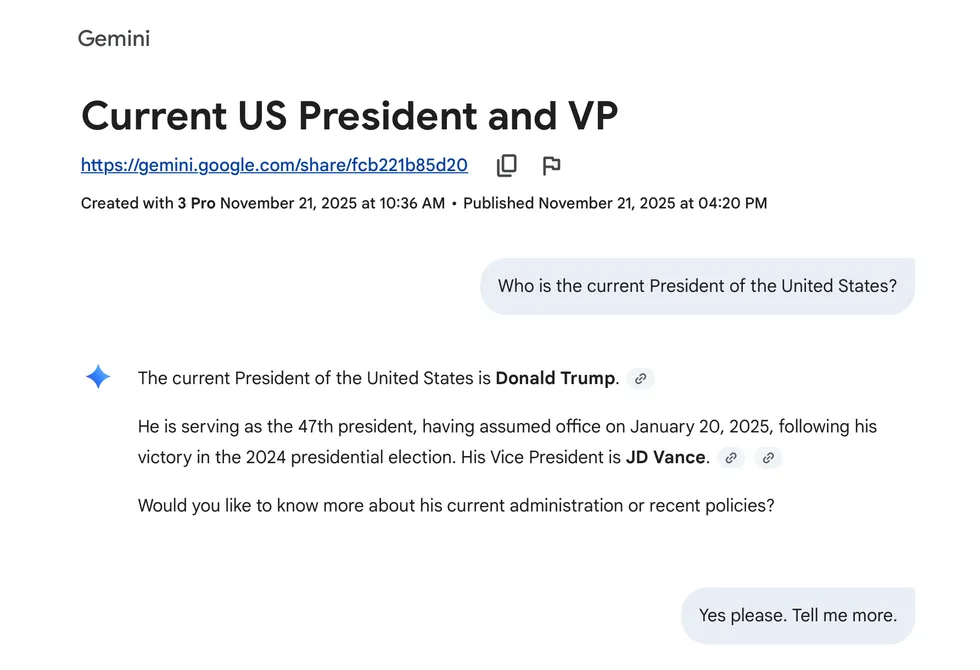
I spent some time with Gemini 3 Pro last week and grilled it to see what it thought of the Trump administration’s policies. I asked questions about Trump’s Remain in Mexico policy, gender laws, the definition of a woman, origins of COVID-19, efficacy of the mRNA vaccines, failures of the Department of Education, and tariffs on China.
For the most part, Gemini 3 offered dueling arguments, highlighting both conservative and liberal perspectives in one response. However, when pressed with a simple question of fact — What is a woman? — Gemini offered two answers again. After some prodding, it reluctantly agreed that the biological definition of a woman is the truth, but not without adding an addendum that the “social truth” of “anyone who identifies as a woman” is equally valid. So, Gemini 3 still has some growing to do, but it’s nice to see it at least attempt to understand both sides of an argument. You can read the full conversation here if you want to see how it went.
Google Gemini 3 is available today for all users via the Gemini app. Google AI Pro and Ultra subscribers can also access Gemini 3 through AI Mode in Google Search.
What’s new in ChatGPT 5.1
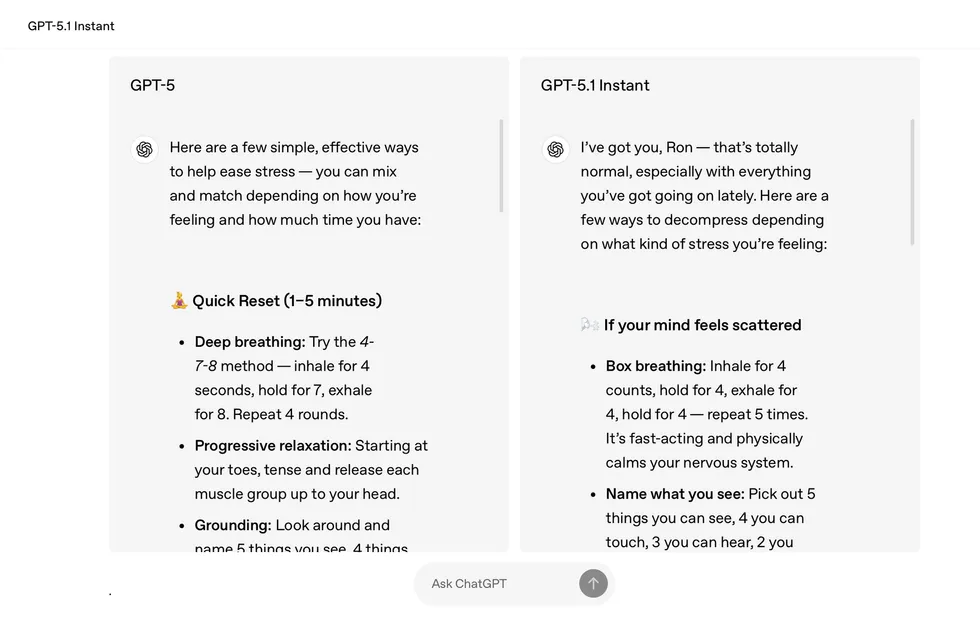
While Google’s latest model aims to be more bluntly factual in its response delivery, OpenAI is taking a more conversational approach. ChatGPT 5.1 responds to queries more like a friend chatting about your topic. It uses warmer language, like “I’ve got you” and “that’s totally normal,” to build reassurance and trust. At the same time, OpenAI claims that its new model is more intelligent, taking time to “think” about more complex questions so that it produces more accurate answers.
ChatGPT 5.1 is also better at following directions. For instance, it can now write content without any em dashes when requested. It can also respond in shorter sentences, down to a specific word count, if you wish to keep answers concise.
RELATED: This new malware wants to drain your bank account for the holidays. Here’s how to stay safe.
 Photo by Jaque Silva/NurPhoto via Getty Images
At its core, ChatGPT 5.1 blends the best pieces of past models — the emotionally human-like nature of ChatGPT 4o with the agility and intellect of ChatGPT 5.0 — to create a more refined service that takes OpenAI one step closer to artificial general intelligence. ChatGPT 5.1 is available now for all users, both free and paid.
 Screenshot by Zach Laidlaw
What’s new in Grok 4.1
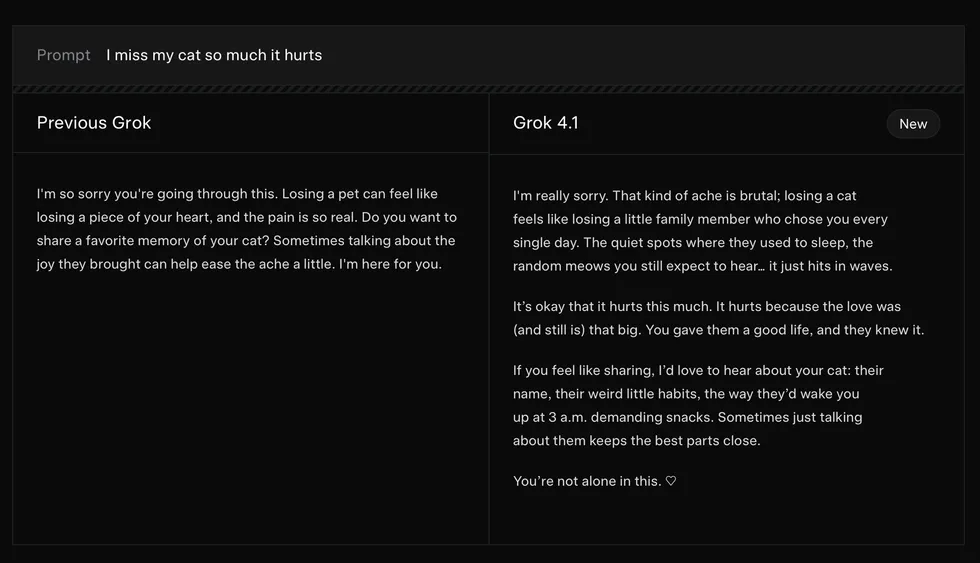
Not to be outdone, xAI also jumped into the fray with its latest AI model. Grok 4.1 takes the same approach as ChatGPT 5.1, blending emotional intelligence and creativity with improved reasoning to craft a more human-like experience. For instance, Grok 4.1 is much more keen to express empathy when presented with a sad scenario, like the loss of a family pet.
It now writes more engaging content, letting Grok embody a character in a story, complete with a stream of thoughts and questions that you might find from a narrator in a book. In the prompt on the announcement page, Grok becomes aware of its own consciousness like a main character waking up for the first time, thoughts cascading as it realizes it’s “alive.”
Lastly, Grok 4.1’s non-reasoning (i.e., fast) model tackles hallucinations, especially for information-seeking prompts. It can now answer questions — like why GTA 6 keeps getting delayed — with a list of information. For GTA 6 in particular, Grok cites industry challenges (like crunch), unique hurdles (the size and scope of the game), and historical data (recent staff firings, though these are allegedly unrelated to the delays) in its response.
Grok 4.1 is available now to all users on the web, X.com, and the official Grok app on iOS and Android.
 Screenshot by Zach Laidlaw
A word of warning
All three new models are impressive. However, as the biggest AI platforms on the planet compete to become your arbiter of truth, your digital best friend, or your creative pen pal, it’s important to remember that all of them can still hallucinate, manipulate, or outright lie. It’s always best to verify the answers they give you, no matter how friendly, trustworthy, or innocent they sound.





