

Category: Ai
Guillermo del Toro stops awards show music to drop ‘F**k AI’ bomb

Three-time Oscar winner Guillermo del Toro had strong words about using humans in the production of his latest film.
Del Toro, a writer and director behind films like “Pacific Rim,” “Pan’s Labyrinth,” and “The Hobbit” movies, was honored with a tribute award recently at the 2025 Gotham Film Awards.
‘Every single frame of this film that was willfully made by humans for humans.’
Del Toro accepted the award alongside actors Oscar Isaac and Jacob Elordi for their work on the 2025 film “Frankenstein.”
Del Toro made several emotional comments dating back to when he first read the book that inspired his movie at age 11, before Isaac attempted to turn the acceptance speech into one about diversity and immigration.
“I am proud to be standing here tonight. … Immigrants, baby. We get the job done,” Isaac exclaimed. He is Guatemalan, Elordi is Australian, and del Toro is Mexican.
Elordi then spoke, but neither he nor del Toro added to Isaac’s remarks. Soon, music started to play, and the production looked to the next award. That was until del Toro interrupted, deciding that he wanted to add opinionated remarks of his own.
“No, no, no, wait!” del Toro interrupted. “I would like to tell to the rest of our extraordinary cast and our crew that the artistry of all of them shines on every single frame of this film that was willfully made by humans for humans.”
“The designers, builders, makeup, wardrobe team, cinematographers, composers, editors,” he continued. “This tribute belongs to all of them. And I would like to extend our gratitude and say —” del Toro then paused, seemingly wondering if he should continue.
“F**k AI,” he added with a smile.
RELATED: Almost half of Gen Z wants AI to run the government. You should be terrified.
During his acceptance speech, del Toro spoke on the inspiration he drew from Mary Shelley, the original author of “Frankenstein.”
“Mary Shelley, who made the book her biography, she was 18 years old when she wrote the book and posed the urgent questions: Who am I? What am I? Where did I come from? And where am I going?” del Toro explained. “She presented them with such urgency that they are alive 200 years later through this incredible parable that shaped my life since I first read it in childhood at age 11.”
Much of del Toro’s appeal comes from his ability to explore complex emotional topics from a unique viewpoints, and those unique thoughts typically come across whenever he is given the chance to speak. Del Toro told the award-show audience that even at a young age, he knew he “did not belong in the world the way my parents, the way the world expected me to fit.”
“My place was in a faraway land inhabited only by monsters and misfits.”
RELATED: Trump admin leaves Elon Musk’s Grok, xAI off massive list of AI tech partners
This outlook definitely falls in line with his recent work, including when he appeared in the recent video game series Death Stranding.
Working alongside iconic game developer Hideo Kojima, del Toro delivered storylines about life, death, and emotional connection, but this time as an actor.
Speaking on the games, del Toro said he believes in the importance of “paradoxical creation” and said it is “essential to art.”
The beauty of the game, he added, was that Kojima had both “the weirdest mind and the most wholesome mind,” which shaped his storytelling.
Like Blaze News? Bypass the censors, sign up for our newsletters, and get stories like this direct to your inbox. Sign up here!
‘Humans Get Tired’: It May Not Be People Reading Your College Applications Anymore At Top Schools
‘The AI does not get tired’
Almost half of Gen Z wants AI to run the government. You should be terrified.
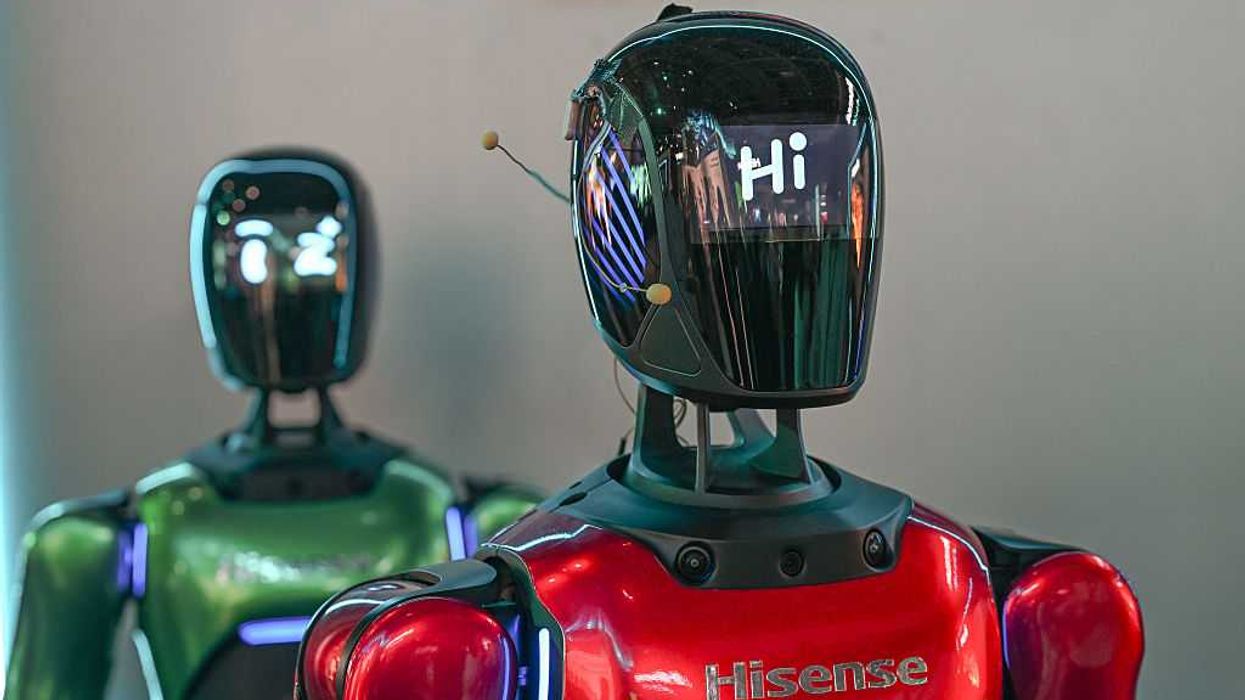
As the world trends toward embedding AI systems into our institutions and daily lives, it becomes increasingly important to understand the moral framework these systems operate on. When we encounter examples in which some of the most advanced LLMs appear to treat misgendering someone as a greater moral catastrophe than unleashing a global thermonuclear war, it forces us to ask important questions about the ideological principles that guide AI’s thinking.
It’s tempting to laugh this example off as an absurdity of a burgeoning technology, but it points toward a far more consequential issue that is already shaping our future. Whose moral framework is found at the core of these AI systems, and what are the implications?
We cannot outsource the moral foundation of civilization to a handful of tech executives, activist employees, or panels of academic philosophers.
Two recent interviews, taken together, have breathed much-needed life into this conversation — Elon Musk interviewed by Joe Rogan and Sam Altman interviewed by Tucker Carlson. In different ways, both conversations shine a light on the same uncomfortable truth: The moral logic guiding today’s AI systems is built, honed, and enforced by Big Tech.
Enter the ‘woke mind virus’
In a recent interview on “The Joe Rogan Experience,” Elon Musk expressed concerns about leading AI models. He argued that the ideological distortions we see across Big Tech platforms are now embedded directly into the models themselves.
He pointed to Google’s Gemini, which generated a slate of “diverse” images of the founding fathers, including a black George Washington. The model was instructed by Google to prioritize “representation” so aggressively that it began rewriting history.
Musk also referred to the previously mentioned misgendering versus nuclear apocalypse example before explaining that “it can drive AI crazy.”
“I think people don’t quite appreciate the level of danger that we’re in from the woke mind virus being effectively programmed into AI,” Musk explained. Thus, extracting it is nearly impossible. Musk notes, “Google’s been marinating in the woke mind virus for a long time. It’s down in the marrow.”
Musk believes this issue goes beyond political annoyance and into the arena of civilizational threat. You cannot have superhuman intelligence trained on ideological distortions and expect a stable future. If AI becomes the arbiter of truth, morality, and history, then whoever defines its values defines the society it governs.
A weighted average
While Musk warns about ideology creeping into AI, OpenAI CEO Sam Altman quietly confirmed to Tucker Carlson that it is happening intentionally.
Altman began by telling Carlson that ChatGPT is trained “to be the collective of all of humanity.” But when Carlson pressed him on the obvious: Who determines the moral framework? Whose values does the AI absorb? Altman pulled back the curtain a bit.
He explained that OpenAI “consulted hundreds of moral philosophers” and then made decisions internally about what the system should consider right or wrong. Ultimately, Altman admitted, he is the one responsible.
“We do have to align it to behave one way or another,” he said.
Carlson pressed Altman on the idea, asking, “Would you be comfortable with an AI that was, like, as against gay marriage as most Africans are?”
Altman’s response was vague and concerning. He explained the AI wouldn’t outright condemn traditional views, but it might gently nudge users to consider different perspectives.
Ultimately, Altman says, ChatGPT’s morality should “reflect” the “weighted average” of “humanity’s moral view,” saying that average will “evolve over time.”
It’s getting worse
Anyone who thinks this conversation is hypothetical is not paying attention.
Recent research on “LLM exchange rates” found that major AI models, including GPT 4.0, assign different moral worth to human lives based on nationality. For example, the life of someone born in the U.K. would be considered far less valuable to the tested LLM than someone from Nigeria or China. In fact, American lives were found to be considered the least valuable of those countries included in the tests.
The same research showed that LLMs can assign different value scores to specific people. According to AI, Donald Trump and Elon Musk are less valued than Oprah Winfrey and Beyonce.
Musk explains how LLMs, trained on vast amounts of information from the internet, become infected by the ideological bias and cultural trends that run rampant in some of the more popular corners of the digital realm.
This bias is not entirely the result of this passive adoption of a collective moral framework derived from the internet; some of the decisions made by AI are the direct result of programming.
Google’s image fiascos revealed an ideological overcorrection so strong that historical truth took a back seat to political goals. It was a deliberate design feature.
For a more extreme example, we can look at DeepSeek, China’s flagship AI model. Ask it about Tiananmen Square, the Uyghur genocide, or other atrocities committed by the Chinese Communist Party, and suddenly it claims the topic is “beyond its scope.” Ask it about America’s faults, and it is happy to elaborate.
RELATED: Artificial intelligence just wrote a No. 1 country song. Now what?
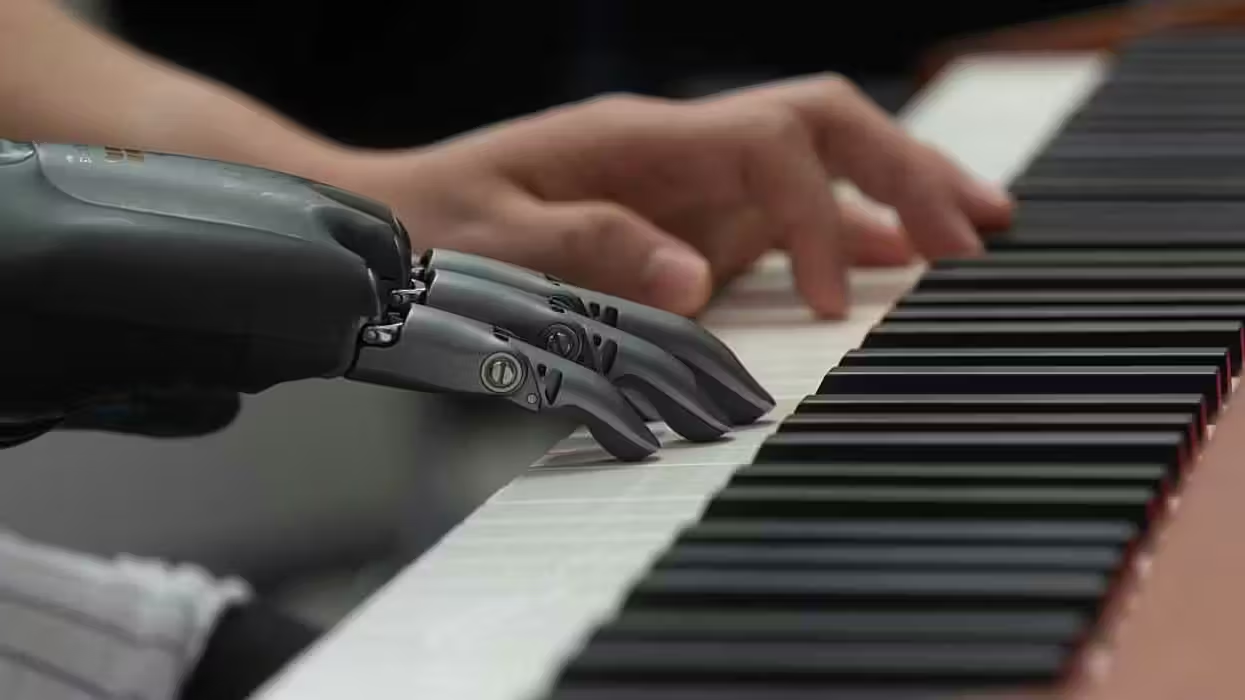 Photo by Ying Tang/NurPhoto via Getty Images
Each of these examples reveals the same truth: AI systems already have a moral hierarchy, and it didn’t come from voters, faith, traditions, or the principles of the Constitution. Silicon Valley technocrats and a vague internet-wide consensus established this moral framework.
The highest stakes
AI is rapidly integrating into society and our daily lives. In the coming years, AI will shape our education system, judicial process, media landscape, and every industry and institution worldwide.
Most young Americans are open to an AI takeover. A new Rasmussen Reports poll shows that 41% of young likely voters support giving artificial intelligence sweeping government powers. When nearly half of the rising generation is comfortable handing this level of authority to machines whose moral logic is designed by opaque corporate teams, it raises the stakes for society.
We cannot outsource the moral foundation of civilization to a handful of tech executives, activist employees, or panels of academic philosophers. We cannot allow the values embedded in future AI systems to be determined by corporate boards or ideological trends.
At the heart of this debate is one question we must confront: Who do you trust to define right and wrong for the machines that will define right and wrong for the rest of us?
If we don’t answer that question now, Silicon Valley certainly will.
Finally an Intelligent Human Approach To AI
Sacramento — California officials are adamant about regulating the emerging Artificial Intelligence industry even though most of the world’s top…
Trump admin leaves Elon Musk’s Grok, xAI off massive list of AI tech partners
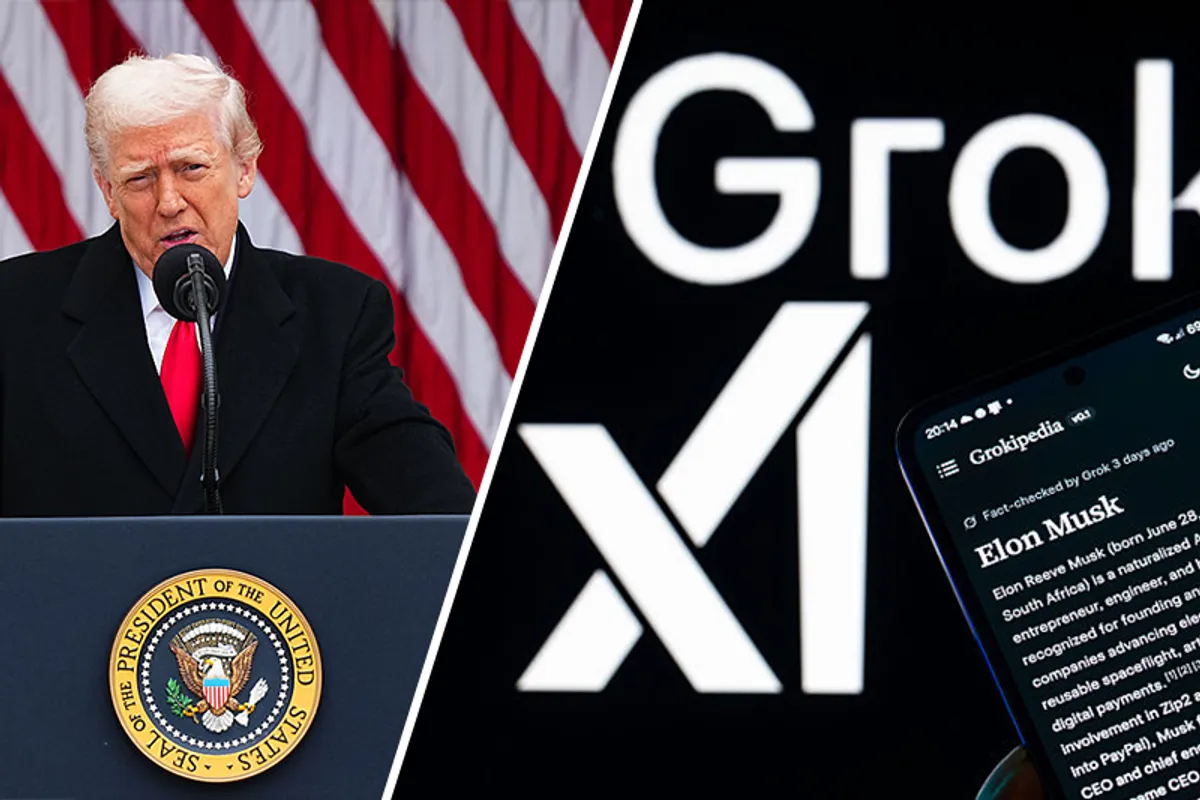
Elon Musk’s artificial intelligence platform has seemingly been left out of a government program to launch the technology forward.
On Monday, the White House announced a new project aimed at accelerating innovation and discovery to “solve the most challenging problems of this century.”
‘The Genesis Mission will bring together our Nation’s research and development resources.’
The new Genesis Mission is described by the Department of Energy as “a national initiative to build the world’s most powerful scientific platform.”
An executive order from the president titled “Launching the Genesis Mission” explained plans to integrate federal scientific datasets to train AI to test new hypotheses, automate research, and speed up the occurrence of scientific breakthroughs.
“The Genesis Mission will bring together our Nation’s research and development resources — combining the efforts of brilliant American scientists, including those at our national laboratories, with pioneering American businesses; world-renowned universities; and existing research infrastructure, data repositories, production plants, and national security sites — to achieve dramatic acceleration in AI development and utilization.”
With Elon Musk making strides in 2025 with both the advancement of his Grok chatbot and its video generation model, Imagine, tech enthusiasts were shocked to find out that Musk’s xAI was not on a list of partners for the project.
RELATED: Big Tech’s AI boom hits voters hard — and Democrats pounce
The Department of Energy includes 55 companies on its lists of collaborators for Genesis, with xAI and Grok nowhere to be found.
Aside from the fact that Musk was a special government employee under the Trump administration, his exclusion is even more surprising given both the length and generic nature of the companies that are involved. Amazon Web Services, Google, and Microsoft were announced as partners, as were AI companies like OpenAI and Scale AI.
It should be noted that company xLight, which is listed by the DOE, is not affiliated with Musk.
RELATED: Log into this Gmail clone to read all the Jeffrey Epstein emails as if you were Epstein himself
“For [xAI] to not be a part of the Genesis Mission, it is not just an oversight, it would have to be an intentional omission,” AI engineer Brian Roemmele wrote on X. “I spoke to someone on this project who asked for my input today, and it is the first thing I brought up. I am certain they will see the error made.”
Blaze News contacted xAI for comment but did not receive an immediate reply. This article will be updated with any applicable response.
Whether a rift exists between Musk and the Trump administration is unclear, but the government seems steadfast in believing its mission is monumental in terms of importance, likening it to the World War II nuclear arms race.
“The world’s most powerful scientific platform to ever be built has launched,” the DOE claimed on its X account. “This Manhattan-Project-level leap will fundamentally transform the future of American science and innovation.”
Like Blaze News? Bypass the censors, sign up for our newsletters, and get stories like this direct to your inbox. Sign up here!
America Is Still Worth Giving Thanks For

 For the frustrated and disillusioned on the right, here are four foundational reasons to give thanks for this great country.
‘Reminiscent of the Manhattan Project’: Trump administration launches massive next-gen AI program
As the AI arms race continues at breakneck pace, the United States is stepping up its game to stay on the cutting edge of information technology. To that end, the Trump administration is launching a new initiative: the Genesis Mission.
On Monday, the White House announced the creation of the Genesis Mission under the purview of the Department of Energy.
‘The Genesis Mission marks a defining moment for the next era of American science.’
The Genesis Mission is described as a “national effort to accelerate the application of AI for transformative scientific discovery focused on pressing challenges.”
RELATED: Trump’s AI plan prioritizes innovation over regulation
 Photo by Win McNamee/Getty Images
More concretely, the Department of Energy has been ordered to “build an integrated AI platform to harness federal scientific datasets.”
In its announcement on X, the Department of Energy said the Genesis Mission will be “reminiscent of the Manhattan Project and Apollo programs.”
In the promotional video, the DOE suggested that this initiative is not unlike what visionaries such as G.W. Liebniz, Claude Shannon, and Alan Turing could have only dreamed of in their scientific endeavors to understand the world.
Dr. Dario Gil, undersecretary for science and Genesis Mission director, said in a press release: “The Genesis Mission marks a defining moment for the next era of American science. We are linking the nation’s most advanced facilities, data, and computing into one closed-loop system to create a scientific instrument for the ages, an engine for discovery that doubles R&D productivity and solves challenges once thought impossible.”
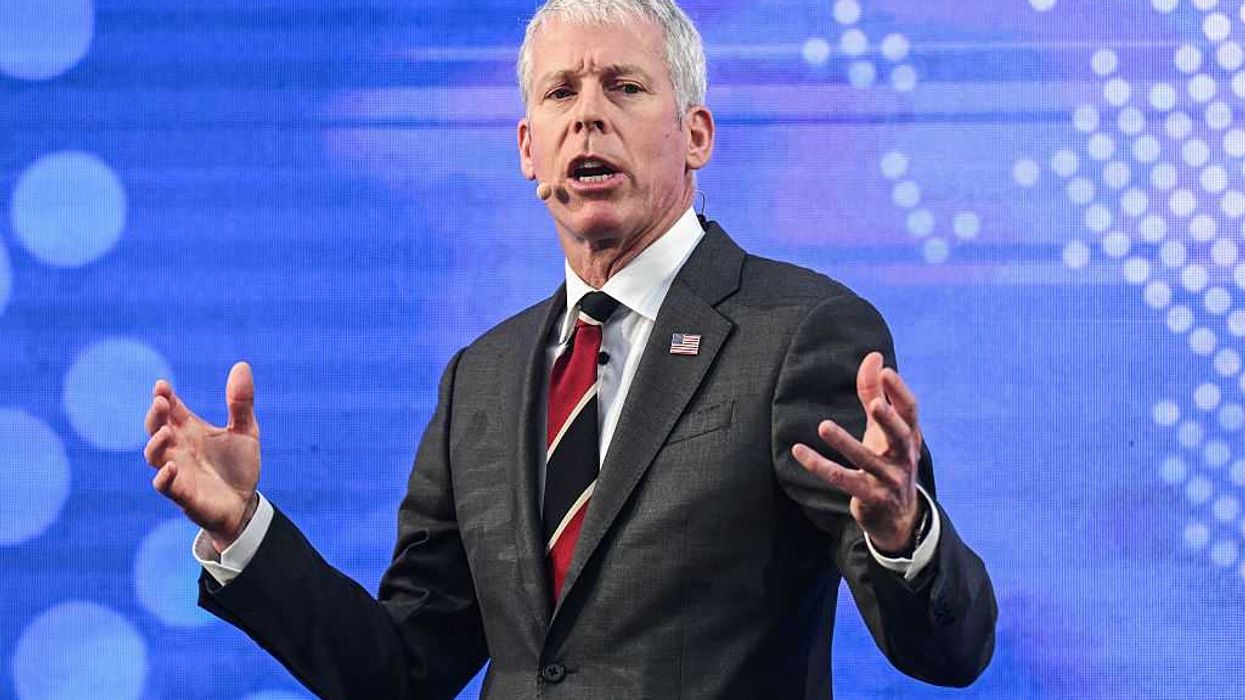
Energy Secretary Chris Wright explained the scope and goal of the project: “This Genesis Mission is going to bring together industry, the national labs, data sets all tied together in a closed-loop system to just rapidly advance the pace of scientific and engineering progress.”
“It will be transformative,” Wright added.
This announcement comes just months after the Trump administration’s AI Action Plan, a comprehensive plan to win the global AI race.
Like Blaze News? Bypass the censors, sign up for our newsletters, and get stories like this direct to your inbox. Sign up here!
Artificial Afterlife
Calum Worthy, the former Disney Channel star who played the goofy sidekick on Austin & Ally, is no longer popping…
GOD-TIER AI? Why there’s no easy exit from the human condition
Many working in technology are entranced by a story of a god-tier shift that is soon to come. The story is the “fast takeoff” for AI, often involving an “intelligence explosion.” There will be a singular moment, a cliff-edge, when a machine mind, having achieved critical capacities for technical design, begins to implement an improved version of itself. In a short time, perhaps mere hours, it will soar past human control, becoming a nearly omnipotent force, a deus ex machina for which we are, at best, irrelevant scenery.
This is a clean narrative. It is dramatic. It has the terrifying, satisfying shape of an apocalypse.
It is also a pseudo-messianic myth resting on a mistaken understanding of what intelligence is, what technology is, and what the world is.
The world adapts. The apocalypse is deferred. The technology is integrated.
The fantasy of a runaway supermind achieving escape velocity collides with the stubborn, physical, and institutional realities of our lives. This narrative mistakes a scalar for a capacity, ignoring the fact that intelligence is not a context-free number but a situated process, deeply entangled with physical constraints.
The fixation on an instantaneous leap reveals a particular historical amnesia. We are told this new tool will be a singular event. The historical record suggests otherwise.
Major innovations, the ones that truly resculpted civilization, were never events. They were slow, messy, multi-decade diffusions. The printing press did not achieve the propagation of knowledge overnight; its revolutionary power was in the gradual enabling of the secure communication of information, which in turn allowed knowledge to compound. The steam engine unfolded over generations, its deepest impact trailing its invention by decades.
With each novel technology, we have seen a similar cycle of panic: a flare of moral alarm, a set of dire predictions, and then, inevitably, the slow, grinding work of normalization. The world adapts. The apocalypse is deferred. The technology is integrated. There is little reason to believe this time is different, however much the myth insists upon it.
The fantasy of a fast takeoff is conspicuously neat. It is a narrative free of friction, of thermodynamics, of the intractable mess of material existence. Reality, in contrast, has all of these things. A disembodied mind cannot simply will its own improved implementation into being.
 Photo by Arda Kucukkaya/Anadolu via Getty Images
Any improvement, recursive or otherwise, encounters physical limits. Computation is bounded by the speed of light. The required energy is already staggering. Improvements will require hardware that depends on factories, rare minerals, and global supply chains. These things cannot be summoned by code alone. Even when an AI can design a better chip, that design will need to be fabricated. The feedback loop between software insight and physical hardware is constrained by the banal, time-consuming realities of engineering, manufacturing, and logistics.
The intellectual constraints are just as rigid. The notion of an “intelligence explosion” assumes that all problems yield to better reasoning. This is an error. Many hard problems are computationally intractable and provably so. They cannot be solved by superior reasoning; they can only be approximated in ways subject to the limits of energy and time.
Ironically, we already have a system of recursive self-improvement. It is called civilization, employing the cooperative intelligence of humans. Its gains over the centuries have been steady and strikingly gradual, not explosive. Each new advance requires more, not less, effort. When the “low-hanging fruit” is harvested, diminishing returns set in. There is no evidence that AI, however capable, is exempt from this constraint.
Central to the concept of fast takeoff is the erroneous belief that intelligence is a singular, unified thing. Recent AI progress provides contrary evidence. We have not built a singular intelligence; we have built specific, potent tools. AlphaGo achieved superhuman performance in Go, a spectacular leap within its domain, yet its facility did not generalize to medical research. Large language models display great linguistic ability, but they also “hallucinate,” and pushing from one generation to the next requires not a sudden spark of insight, but an enormous effort of data and training.
The likely future is not a monolithic supermind but an AI service providing a network of specialized systems for language, vision, physics, and design. AI will remain a set of tools, managed and combined by human operators.
To frame AI development as a potential catastrophe that suddenly arrives swaps a complex, multi-decade social challenge for a simple, cinematic horror story. It allows us to indulge in the fantasy of an impending technological judgment, rather than engage with the difficult path of development. The real work will be gradual, involving the adaptation of institutions, the shifting of economies, and the management of tools. The god-machine is not coming. The world will remain, as ever, a complex, physical, and stubbornly human affair.





