

Category: Big tech
How Texas slammed the gate on Big Tech’s censorship stampede

Texas just sent a blunt message to Silicon Valley: You don’t get to censor Texans and then run home to California.
In a world where Big Tech routinely decides who may speak and who must be silenced, Defense Distributed v. YouTube, Google, and Alphabet has become a defining moment in the national fight over digital free expression. The shock isn’t the censorship at issue; it’s the fact that Big Tech — for once — lost.
In a time when Americans are desperate for leaders willing to stand up to media and tech conglomerates, Texas showed what real resolve looks like.
Defense Distributed, a Texas company, committed the unpardonable offense of promoting the constitutional right to keep and bear arms.
Our videos and ads — some of them simply announcing court victories — were throttled, suppressed, or removed by YouTube and Google. None of this surprised us. These platforms built vast empires on controlling information and burying viewpoints that fall outside their ideology.
Texas prepared for this fight
The surprise is that Texas saw this coming and armed itself for the conflict. HB 20 — now Chapter 143A of the Texas Civil Practice and Remedies Code — directly prohibits viewpoint-based censorship by major platforms. The law doesn’t hint, suggest, or politely advise. It states outright: Social media companies may not censor Texans for their viewpoints, and lawsuits brought under this chapter stay in Texas courts no matter what boilerplate corporate contracts say.
So when Defense Distributed filed suit, YouTube and Google reached for their favorite escape route: forum-selection clauses that force nearly every challenger into California courts, where Big Tech enjoys home-field advantage. It’s a delay tactic, a cost-inflation tactic, a shield against accountability — and it almost always works.
But Texas slammed that door shut before they reached it.
No escape
HB 20 doesn’t merely frown on these clauses; it voids them. The statute declares that any attempt to waive its protections violates Texas public policy — public policy the law describes as “of the highest importance.” The legislature anticipated Big Tech’s usual playbook and locked the gates years in advance.
The federal court recognized this. Judge Alan Albright ruled that transferring the case to California would directly undermine Texas’ strong public policy. Under federal law, courts cannot enforce a forum-selection clause that contradicts a state’s deeply rooted interests — especially when the legislature spells those interests out with the clarity found in HB 20.
Silicon Valley does not hear the word “no” very often. Big Tech’s money, influence, and political allies usually clear the path. But in a federal courtroom in the Lone Star State, Texas’ commitment to protecting its citizens from ideological censorship outweighed Silicon Valley’s customary dominance. The court refused to let YouTube and Google drag the case back to California.
The fight stayed in Texas — exactly where the legislature intended.
A national shift and a model for states
The timing matters. Americans now understand that Big Tech can shape elections, suppress dissent, and curate truth itself. HB 20 was mocked by the press, attacked by activists, and targeted by corporate lobbyists from the moment it passed. Yet today, it stands as one of the most potent legal tools in the country’s fight against digital censorship.
HB 20 is no longer just a statute; it is proof that a state with conviction can push back and win.
RELATED: Big Tech CEOs should leave policy to the politicians
 Photo by Win McNamee/Getty Images
This victory is more than a procedural ruling. It affirms that Big Tech’s era of unchallenged authority is not inevitable. Defense Distributed didn’t merely keep our lawsuit in Texas; we preserved the principle that powerful corporations cannot hide their censorship behind “terms of service” fine print.
Texas drew a line in the sand, and — for once — Silicon Valley stopped.
In a time when Americans are desperate for leaders willing to stand up to media and tech conglomerates, Texas showed what real resolve looks like. This ruling promises that citizens still have a fighting chance, that speech still matters, and that even the world’s largest corporations remain subject to the laws of a state determined to defend its people.
Big Tech CEOs should leave policy to the politicians

President Donald Trump’s latest comments on semiconductor exports sounded almost conciliatory — until they weren’t. Speaking recently on “60 Minutes,” the president said he would let Nvidia “deal with China” but drew a bright red line: Beijing could buy chips, just not the “most advanced” ones. The message was calibrated for maximum effect: permissive enough to please markets, hawkish enough to claim toughness. Nvidia’s stock jumped immediately — but China did not get what it wanted.
Days later, in a Financial Times interview, Nvidia’s CEO, Jensen Huang, warned that if the U.S. blocked his company from selling more of its advanced chips to China, it would “lose” the AI race. The argument was astonishing in its candor: Cut us off, Beijing wins.
As grateful as America should be for breathtaking innovations, an irreconcilable tension exists between national interest and fiduciary duty.
The comparison between a president sounding measured and a CEO trying to sound indispensable captures a dangerous inversion of power. Nvidia has become more than America’s most valuable company. It’s attempting to become its policymaker, shaping the boundaries of what Washington thinks possible in its competition with China.
To understand how one company reached that position, it helps to revisit what happened in Washington just days before Trump met Xi Jinping in South Korea.
Nvidia called it a GPU Technology Conference. Yet the event felt less like a developer’s conference and more like a tech-bro-meets-MAGA jamboree: free swag and a booming video hymn to American genius — from Thomas Edison to Donald J. Trump. Huang, leather jacket gleaming, strode out like a preacher to proclaim that the age of reindustrialization had arrived.
The D.C. version of GTC was not the San Jose GTC tech insiders have come to know. For the first time, Nvidia brought a full-blown edition of its developers’ confab to the capital, a strategic choice. The company does not merely want to sit at the table where policy is made — it wants to own it.
After hours of Super Bowl-style buildup — financiers whispering, tech CEOs hinting — attendees were herded into a dimly lit hall, where Huang unveiled a cascade of partnerships. The headline act that made sleeves roll up on both the policy bench and the brokerage floor was the Vera Rubin Superchip, billed as made in America and spoken of with the gravity reserved for national monuments.
It’s a dazzling feat of engineering: silicon that can be waved before a crowd as proof that America can still design, assemble, and scale. Expected to debut next year, the chip is music to policy wonks’ ears, a gleaming symbol of reindustrialization, and perhaps a psychological hedge against the fragility of Taiwan. For investors, it’s manna. As robots increasingly take charge, building chips in the U.S. will keep the supply chain close to home and safeguard companies against the whims of geopolitics.
Then, with the applause fading, an undercurrent of tension lingered, one that perhaps only the wonks could fully register. After that opening montage, capped by Jensen’s almost rhetorical question, “Was that video amazing?” the subtext became harder to ignore. And when he closed his remarks by thanking the audience “for your service and for making America great again,” it was impossible not to think of what the financiers were murmuring on the next stage over.
“Nvidia will — or should — ship more GPUs to China.” “Jensen’s flying straight to Korea after GTC to meet Trump.” “A deal’s coming.”
Those were among the refrains traded by figures like Cantor Fitzgerald’s C.J. Muse and Altimeter Capital’s Brad Gerstner. All this, of course, is contrary to the prevailing consensus among China-watchers that the notion of rendering Beijing dependent on Nvidia’s chips is fantasy. Cultivating indigenous capability by acquiring American technology by legal or illicit means has long been Beijing’s modus operandi.
Huang knows this. Still, his company has long worked to blunt export controls and push China-specific versions of its flagship Blackwell chip, the so-called B20. It’s a familiar playbook: First came the H100, then its “export-compliant” cousins, the H800 and H20. Each time, Washington tightens the rules; each time, Nvidia finds a workaround. But this must stop.
RELATED: Big Tech’s AI boom hits voters hard — and Democrats pounce
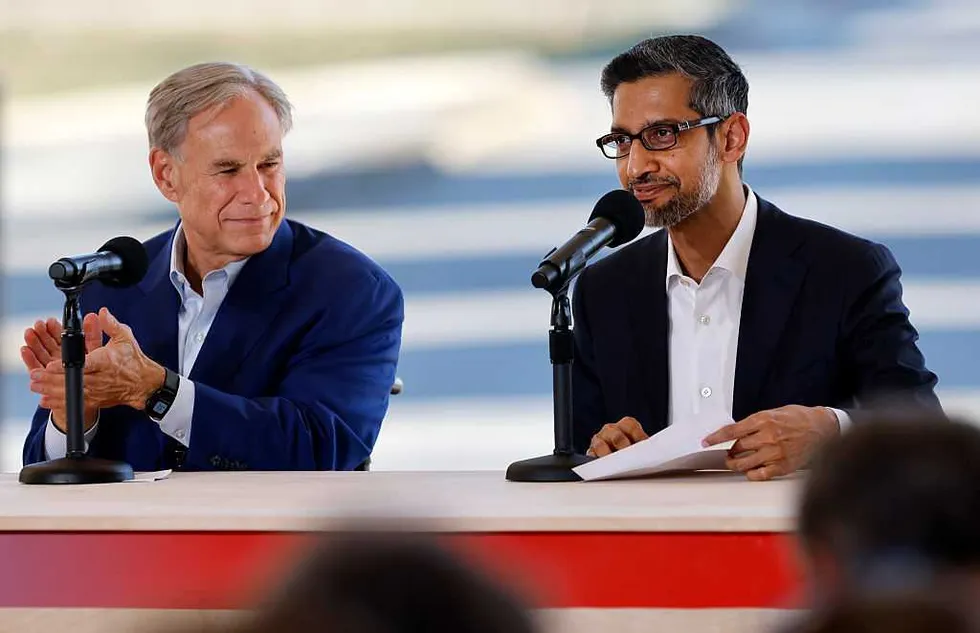 Photo by Ron Jenkins/Getty Images
The dilemma is simple but corrosive. As grateful as America should be for breathtaking innovations, an irreconcilable tension exists between national interest and fiduciary duty. Huang may sound bullish on “betting on America,” but the reality is starker: If his company could power the AI revolutions of both superpowers at once, it would add trillions to its market cap. He is pragmatic and coldly arithmetic. Build the best chips, profit from ubiquity. You don’t get where he is without knowing your math.
At GTC, I saw the divide play out in miniature. As Altimeter’s Brad Gerstner floated the idea that “logic is on the side of letting Nvidia compete with China,” I turned to a biotech researcher. Blunt and unamused, he said: “Bulls**t.” He went on to explain that, in his field especially, China’s ascent has been a wholesale rejection of the “make China dependent” fantasy. He wasn’t wrong: Under Xi Jinping, the Made in China 2025 agenda has rendered such dependency theories delusional.
Huang tries to thread the needle gracefully, extolling U.S. manufacturing while signaling an embrace of Chinese developers. As an American, it’s hard not to be charmed by his all-American chip. As a realist, however, one leaves with questions no press release can answer. In a way, the release of this patriot-approved superchip was meant to suggest, “See, now we can sell some Blackwells to China.” As charmed as one can be, the answer is still no.
One could have told the Roosevelt administration that cutting Germany off from nuclear materials would stifle innovation. Yet we did exactly that during the Manhattan Project. And we won. It may not sound like it, but this is the same choice we face today — only this race has even greater implications for the future of civilization.
The goal can’t be attempting to trap Beijing in “dependency.” The stakes are too high. The most prudent approach is to focus on surpassing them in innovation while closing loopholes that let Beijing do what it has mastered: Learn from us, then try to replace us.
Jensen Huang has every right to fight for his company’s profits. But foreign policy shouldn’t run on a corporate playbook. The U.S. needs innovators — not influencers — setting the terms of technological rivalry.
Editor’s note: A version of article appeared originally at the American Mind.
BIG TECH COVERUP? Scandalous BLACKOUT of Would-Be Trump Assassin and Biden’s FBI Director: MRC Report

Does Big Tech want you to forget would-be Trump assassin Thomas Crooks?

A Beastly Idea

“A Beastly Idea,” editorial cartoon by Yogi Love for The American Spectator on Nov. 11, 2025.
When the AI bubble bursts, guess who pays?

For months, Silicon Valley insisted the artificial-intelligence boom wasn’t another government-fueled bubble. Now the same companies are begging Washington for “help” while pretending it isn’t a bailout.
Any technology that truly meets consumer demand doesn’t need taxpayer favors to survive and thrive — least of all trillion-dollar corporations. Yet the entire AI buildout depends on subsidies, tax breaks, and cheap credit. The push to cover America’s landscape with power-hungry data centers has never been viable in a free market. And the industry knows it.
The AI bubble isn’t about innovation — it’s about insulation. The same elites who inflated the market with easy money are now preparing to dump the risk on taxpayers.
Last week, OpenAI chief financial officer Sarah Friar let the truth slip. In a CNBC interview, she admitted the company needs a “backstop” — a government-supported guarantee — to secure the massive loans propping up its data-center empire.
“We’re looking for an ecosystem of banks, private equity, maybe even governmental … the ways governments can come to bear,” Friar said. When asked whether that meant a federal subsidy, she added, “The guarantee that allows the financing to happen … that can drop the cost of financing, increase the loan-to-value … an equity portion for some federal backstop. Exactly, and I think we’re seeing that. I think the U.S. government in particular has been incredibly forward-leaning.”
Translation: OpenAI’s debt-to-revenue ratio looks like a Ponzi scheme, and the government is already “forward-leaning” in keeping it afloat. Oracle — one of OpenAI’s key partners — carries a debt-to-equity ratio of 453%. Both companies want to privatize profits and socialize losses.
After public backlash, Friar tried to walk it back, claiming “backstop” was the wrong word. Then on LinkedIn, she used different words to describe the same thing: “American strength in technology will come from building real industrial capacity, which requires the private sector and government playing their part.”
When government “plays its part,” taxpayers pay the bill. Yet no one remembers the federal government “doing its part” for Apple or Motorola when the smartphone revolution took off — because those products sold just fine without subsidies.
The denials keep coming
OpenAI CEO Sam Altman quickly followed with a 1,500-word denial: “We do not have or want government guarantees for OpenAI datacenters.” Then he conceded they’re seeking loan guarantees for infrastructure — just not for software.
That distinction exposes the scam. Software revolutions scale cheaply. Data-center revolutions depend on state-sponsored power, water, and land. If this industry were self-sustaining, Trump wouldn’t need to tout Stargate — his administration’s marquee AI-infrastructure initiative — as a national project. Federal involvement is baked in, from subsidized energy to public land giveaways.
Altman’s own words confirm it. In an October interview with podcaster Tyler Cowen, released a day before his denial, Altman said, “When something gets sufficiently huge … the federal government is kind of the insurer of last resort.” He wasn’t talking about nuclear policy — he meant the financial side.
The coming crash
Anyone paying attention can see the rot. Nvidia, OpenAI, Oracle, and Meta are all entangled in a debt-driven accounting loop that would make Enron blush. This speculative bubble is inflating not because AI is transforming productivity, but because Wall Street and Washington are colluding to prop up stock prices and GDP growth.
When the crash comes — and it will — Washington will step in, exactly as it did with the banks in 2008 and the automakers in 2009. The “insurer of last resort” is already on standby.
The smoking gun
A leaked 11-page letter from OpenAI to the White House makes the scheme explicit. In the October 27 document addressed to the Office of Science and Technology Policy, Christopher Lehane, OpenAI’s chief global affairs officer, urged the government to provide “grants, cost-sharing agreements, loans, or loan guarantees” to help build America’s AI industrial base — all “to compete with China.”
Altman can tweet denials all he wants — his own company’s correspondence tells a different story. The pitch mirrors China’s state-capitalist model, except Beijing at least owns its industrial output. In America’s version, taxpayers absorb the risk while private firms pocket the reward.
RELATED: Stop feeding Big Tech and start feeding Americans again
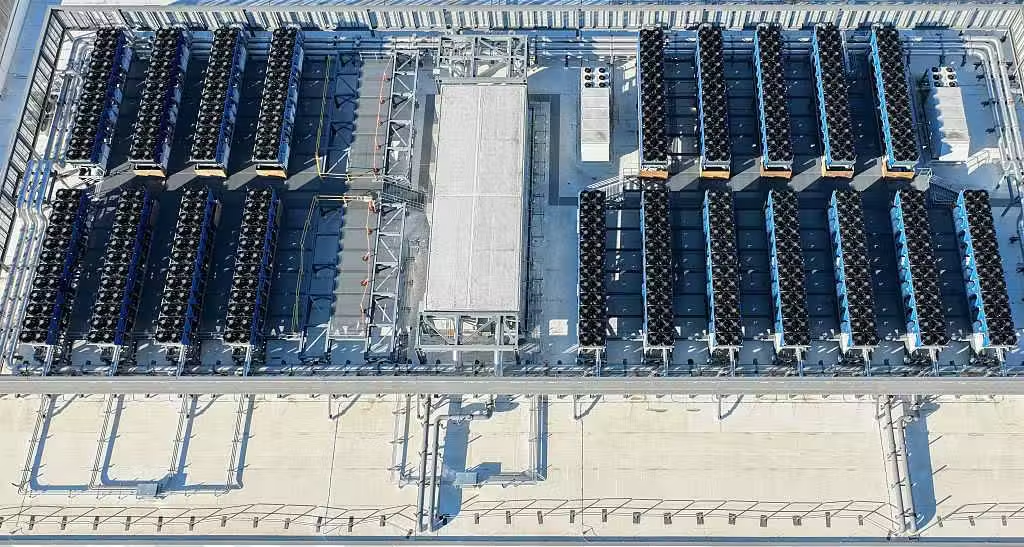 Credit: Photo by Mario Tama/Getty Images
Meanwhile, the data-center race is driving up electricity and water costs nationwide. The United States is building roughly 10 times as many hyper-scale data centers as China — and footing the bill through inflated utility rates and public subsidies.
Privatized profits, socialized losses
When investor Brad Gerstner recently asked Altman how a company with $13 billion in revenue could possibly afford $1.4 trillion in commitments, Altman sneered, “Happy to find a buyer for your shares.” He can afford that arrogance because he knows who the buyer of last resort will be: the federal government.
The AI bubble isn’t about innovation — it’s about insulation. The same elites who inflated the market with easy money are now preparing to dump the risk on taxpayers.
And when the collapse comes, they’ll call it “national security.”
Stop feeding Big Tech and start feeding Americans again

America needs more farmers, ranchers, and private landholders — not more data centers and chatbots. Yet the federal government is now prioritizing artificial intelligence over agriculture, offering vast tracts of public land to Big Tech while family farms and ranches vanish and grocery bills soar.
Conservatives have long warned that excessive federal land ownership, especially in the West, threatens liberty and prosperity. The Trump administration shares that concern but has taken a wrong turn by fast-tracking AI infrastructure on government property.
If the nation needs a new Manhattan Project, it should be for food security, not AI slop.
Instead of devolving control to the states or private citizens, it’s empowering an industry that already consumes massive resources and delivers little tangible value to ordinary Americans. And this is on top of Interior Secretary Doug Burgum’s execrable plan to build 15-minute cities and “affordable housing.”
In July, President Trump signed an executive order titled Accelerating Federal Permitting of Data Center Infrastructure as part of its AI Action Plan. The order streamlines permits, grants financial incentives, and opens federal properties — from Superfund sites to military bases — to AI-related development. The Department of Energy quickly identified four initial sites: Oak Ridge Reservation in Tennessee, Idaho National Laboratory, the Paducah Gaseous Diffusion Plant in Kentucky, and the Savannah River Site in South Carolina.
Last month, the list expanded to include five Air Force bases — Arnold (Tennessee), Davis-Monthan (Arizona), Edwards (California), Joint Base McGuire-Dix-Lakehurst (New Jersey), and Robins (Georgia) — totaling over 3,000 acres for lease to private developers at fair market value.
Locating AI facilities on military property is preferable to disrupting residential or agricultural communities, but the favoritism shown to Big Tech raises an obvious question: Is this the best use of public land? And will anchoring these bubble companies on federal property make them “too big to fail,” just like the banks and mortgage lenders before the 2008 crash?
President Trump has acknowledged the shortage of affordable meat as a national crisis. If any industry deserves federal support, it’s America’s independent farmers and ranchers. Yet while Washington clears land for billion-dollar data centers, small producers are disappearing. In the past five years, the U.S. has lost roughly 141,000 family farms and 150,000 cattle operations. The national cattle herd is at its lowest level since 1951. Since 1982, America has lost more than half a million farms — nearly a quarter of its total.
Multiple pressures — rising input costs, droughts, and inflation — have crippled family farms that can’t compete with corporate conglomerates. But federal land policy also plays a role. The government’s stranglehold on Western lands limits grazing rights, water access, and expansion opportunities. If Washington suddenly wants to sell or lease public land, why not prioritize ranchers who need it for feed and forage?
The Conservation Reserve Program compounds the problem. The 2018 Farm Bill extension locked up to 30 million acres of land — five million in Wyoming and Montana alone — under the guise of conservation. Wealthy absentee owners exploit the program by briefly “farming” land to qualify it as cropland, then retiring it into CRP to collect taxpayer payments. More than half of CRP acreage is owned by non-farmers, some earning over $200 per acre while the land sits idle.
RELATED: AI isn’t feeding you
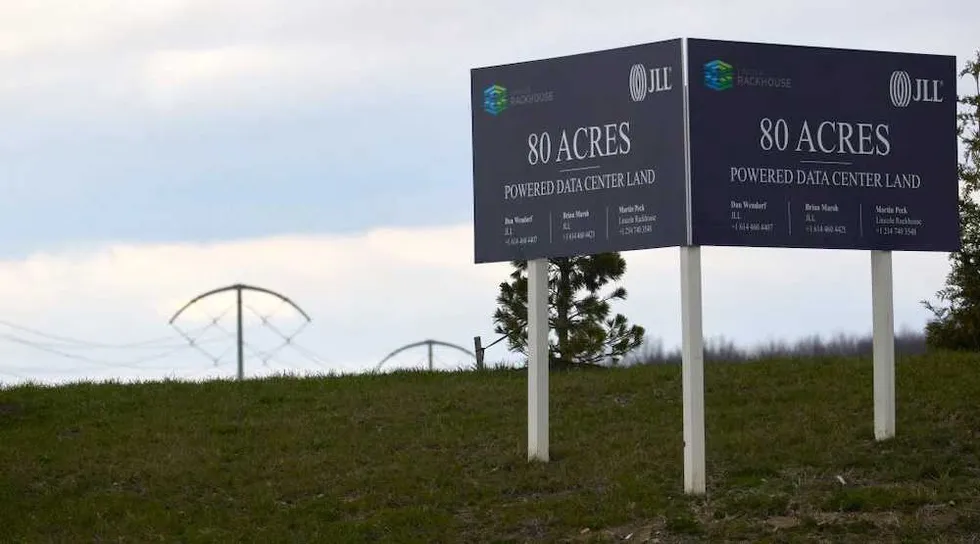 Photo by Brian Kaiser/Bloomberg via Getty Images
Those acres could support hundreds of cattle per section or produce millions of tons of hay. Instead, they create artificial shortages that drive up feed costs. During the post-COVID inflation spike, hay prices spiked 40%, hitting $250 per ton this year. Even now, inflated prices cost ranchers six figures a year in extra expenses in a business that operates on thin margins.
If the nation needs a new Manhattan Project, it should be for food security, not AI slop. Free up federal lands and idle CRP acreage for productive use. Help ranchers grow herds and lower food prices instead of subsidizing a speculative industry already bloated with venture capital and hype.
At present, every dollar of revenue at OpenAI costs roughly $7.77 to generate — a debt spiral that invites the next taxpayer bailout. By granting these firms privileged access to public land, the government risks creating another class of untouchable corporate wards, as it did with Fannie Mae and Freddie Mac two decades ago.
AI won’t feed Americans. It won’t fix supply chains. It won’t lower grocery bills. Until these companies can put real food on real tables, federal land should serve the purpose God intended — to sustain the people who live and work upon it.
States Need To Stop AI Chatbots From Warping 70 Percent Of American Teens (And Counting)

 Our nation is in desperate need of legislation that protects children from the dangerous interactions of exploitative AI companion chatbots.
Bill Gates quietly retires climate terror as AI takes the throne

For decades, Americans have been told that climate change is an imminent apocalypse — the existential threat that justifies every intrusion into our lives, from banning gas stoves to rationing energy to tracking personal “carbon scores.”
Microsoft co-founder Bill Gates helped lead that charge. He warned repeatedly that the “climate disaster” would be the greatest crisis humanity would ever face. He invested billions in green technology and demanded the world reach net-zero emissions by 2050 “to avoid catastrophe.”
The global contest is no longer over barrels and pipelines — it is over who gets to flip the digital switch.
Now, suddenly, he wants everyone to relax: Climate change “will not lead to humanity’s demise” after all.
Gates was making less of a scientific statement and more of a strategic pivot. When elites retire a crisis, it’s never because the threat is gone — it’s because a better one has replaced it. And something else has indeed arrived — something the ruling class finds more useful than fear of the weather.
The same day Gates downshifted the doomsday rhetoric, Amazon announced it would pay warehouse workers $30 an hour — while laying off 30,000 people because artificial intelligence will soon do their jobs.
Climate panic was the warm-up. AI control is the main event.
The new currency of power
The world once revolved around oil and gas. Today, it revolves around the electricity demanded by server farms, the chips that power machine learning, and the data that can be used to manipulate or silence entire populations. The global contest is no longer over barrels and pipelines — it is over who gets to flip the digital switch. Whoever controls energy now controls information. And whoever controls information controls civilization.
Climate alarmism gave elites a pretext to centralize power over energy. Artificial intelligence gives them a mechanism to centralize power over people. The future battles will not be about carbon — they will be about control.
Two futures — both ending in tyranny
Americans are already being pushed into what look like two opposing movements, but both leave the individual powerless.
The first is the technocratic empire being constructed in the name of innovation. In its vision, human work will be replaced by machines, and digital permissions will subsume personal autonomy.
Government and corporations merge into a single authority. Your identity, finances, medical decisions, and speech rights become access points monitored by biometric scanners and enforced by automated gatekeepers. Every step, purchase, and opinion is tracked under the noble banner of “efficiency.”
The second is the green de-growth utopia being marketed as “compassion.” In this vision, prosperity itself becomes immoral. You will own less because “the planet” requires it. Elites will redesign cities so life cannot extend beyond a 15-minute walking radius, restrict movement to save the Earth, and ration resources to curb “excess.” It promises community and simplicity, but ultimately delivers enforced scarcity. Freedom withers when surviving becomes a collective permission rather than an individual right.
Both futures demand that citizens become manageable — either automated out of society or tightly regulated within it. The ruling class will embrace whichever version gives them the most leverage in any given moment.
Climate panic was losing its grip. AI dependency — and the obedience it creates — is far more potent.
The forgotten way
A third path exists, but it is the one today’s elites fear most: the path laid out in our Constitution. The founders built a system that assumes human beings are not subjects to be monitored or managed, but moral agents equipped by God with rights no government — and no algorithm — can override.
RELATED: How Bill Gates and friends turned global health into a profit machine — at your expense
 AvigatorPhotographer via iStock/Getty Images
That idea remains the most “disruptive technology” in history. It shattered the belief that people need kings or experts or global committees telling them how to live. No wonder elites want it erased.
Soon, you will be told you must choose: Live in a world run by machines or in a world stripped down for planetary salvation. Digital tyranny or rationed equality. Innovation without liberty or simplicity without dignity.
Both are traps.
The only way
The only future worth choosing is the one grounded in ordered liberty — where prosperity and progress exist alongside moral responsibility and personal freedom and human beings are treated as image-bearers of God — not climate liabilities, not data profiles, not replaceable hardware components.
Bill Gates can change his tune. The media can change the script. But the agenda remains the same.
They no longer want to save the planet. They want to run it, and they expect you to obey.





