

Category: Christianity
How Joe Rogan stumbled into defending Christianity — and exposed atheist nonsense
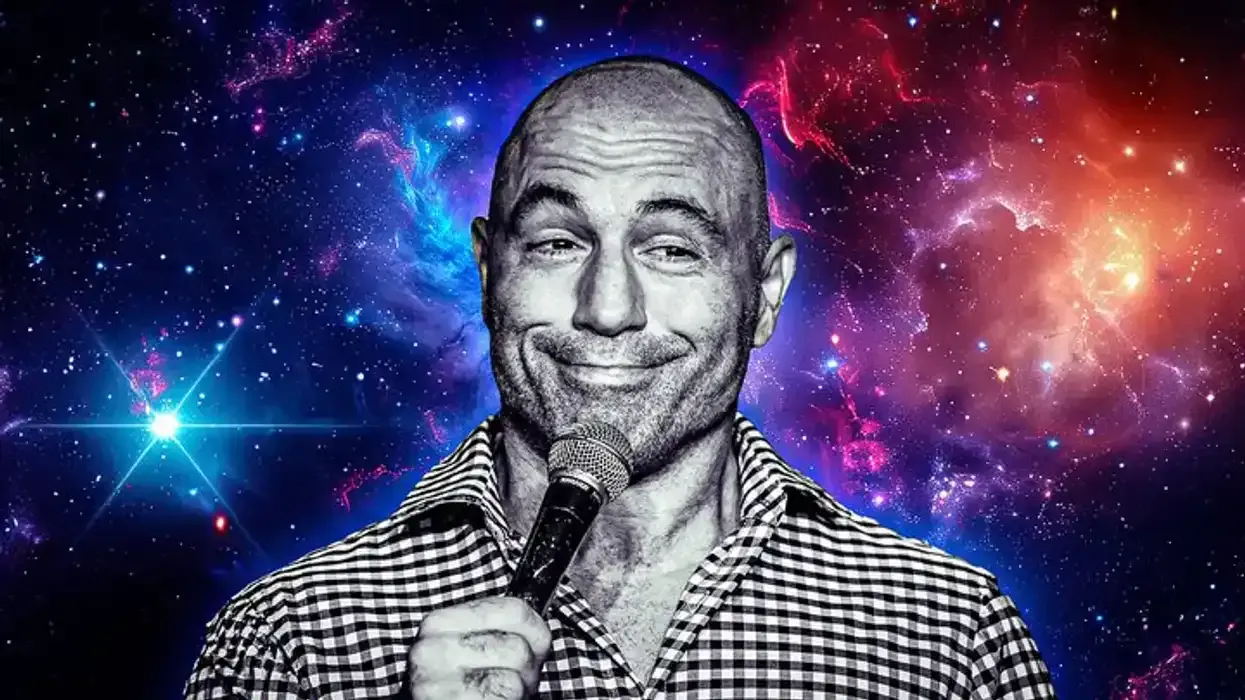
Joe Rogan is undoubtedly the most popular podcaster in the world, hosting intriguing and expansive conversations about topics ranging from politics to sports — and everything in between. Rogan’s influence over the culture cannot be overstated.
That’s why his recent comments about Jesus, the Bible, and church are so notable.
‘I’m sticking with Jesus on that one. Jesus makes more sense. People have come back to life.’
Before this year, many had long assumed Rogan was a firm agnostic based on various on-air proclamations and statements. But 2025 seemed to signify what can only be described as a spiritual shift in the host’s life.
Specifically, Rogan’s recent statements about Christianity aren’t merely pointed and effective; they actively dismantle and challenge some of the most absurd atheist arguments against the Christian faith, with Rogan’s responses to Jesus, the Big Bang, and other related issues raising eyebrows.
Intrigue over his spiritual journey kicked into high gear in May when Christian apologist Wesley Huff, who appeared on “The Joe Rogan Experience” in January, revealed that Rogan had started attending church on a “consistent” basis.
Not long after this stunning news, Rogan delivered remarks that went mega-viral when he openly bolstered belief in Jesus’ resurrection and casted doubt on the Big Bang theory.
“It’s funny, because people will be incredulous about the resurrection of Jesus Christ, but yet they’re convinced that the entire universe was smaller than the head of a pin and for no reason that anybody’s adequately explained to me — that makes sense — instantaneously became everything? OK,” Rogan told fellow podcaster Cody Tucker, noting that the Big Bang isn’t as credible as some believe.
RELATED: Like, subscribe, and spread the good news: Joe Rogan helps gospel go viral
Rogan quoted late ethnobotanist Terence McKenna, who reportedly once made notable comments about the debate over faith and science — comments with which Rogan agreed. Ultimately, when juxtaposing Christ’s story with science’s claims about creation, the podcast host said there’s a clear winner.
“That’s McKenna’s great line … the difference between science and religion is that science only asks you for one miracle … the Big Bang,” Rogan said.
“I’m sticking with Jesus on that one. Jesus makes more sense. People have come back to life.”
These comments were just the beginning, though, because Rogan again dove into similar issues on another recent episode of his show. In fact, he addressed his church attendance and said he sees incredible benefits from being present inside houses of worship.
“It’s a bunch of people that are going to try to make their lives better. They’re trying to be a better person,” Rogan said.
“I mean, for me — at least the place that I go to — they read and analyze passages in the Bible. I’m really interested in what these people were trying to say, because I don’t think it’s nothing.”
It’s this latter quote that’s most notable, because Rogan was speaking to the essential issues of the Christian faith — the questions core to the debate over biblical truth. Is scripture real or filled with fables? Are the stories we read in the Bible rooted in eternal truth — or are they mere allegories and fictitious sentiments?
While Rogan said “atheists and secular people” will go out of their way to dismiss the Bible, the mega-popular podcaster offered a checkmate of sorts, asserting that there’s more happening in the pages of the New and Old Testaments than these critics are willing to recognize.
“I hear that among self-professed intelligent people, like, ‘It’s a fairy tale.’ I don’t know that’s true. I think there’s more to it,” he said. “I think it’s history, but I think it’s a confusing history. It’s a confusing history because it was a long time ago, and it’s people telling things in an oral tradition and writing things down in a language that you don’t understand, in the context of a culture that you don’t understand.”
And he wasn’t done there. Rogan went on to herald Christianity as the “most fascinating” of all religions, noting that Jesus’ life, ministry, crucifixion, and resurrection are all hallmarks that differentiate the faith.
“Christianity in particular is the most fascinating to me, because there’s this one person that everybody agrees existed that, somehow or another, had the best plan for how human beings should interact with each other and behave,” he said.
“He didn’t even protest,” Rogan said. “[He] died on the cross, supposedly for our sins. It’s a fascinating story. What does it represent, though? That’s the real thing. What was that? What happened? Who was Jesus Christ, if it was a human being? What was that? That’s wild.”
RELATED: Is Joe Rogan’s podcast becoming a platform for Christian truth?
Ponder the fact that the most popular podcaster on Earth is seeking, asking important questions — and offering compelling arguments to push back on so much of the atheistic nonsense that has dominated our discourse.
From the media to Hollywood, we have endured decades of ludicrous absurdity, with many folks forcing down our throats secular humanism and anti-Christian folly. And now an unlikely hero — a podcaster not previously known for faith chops — has emerged and is taking the world along for his personal journey.
My only hope is that we all start to pray for Rogan’s faith, life, and spiritual growth. His platform is massive, and his foray into the Christian faith — if it persists — could be key to helping further shift young people and older generations to move closer to the Lord.
America’s best and worst states for religious freedom — and what it means for our future
Now is a good time for religion in America.
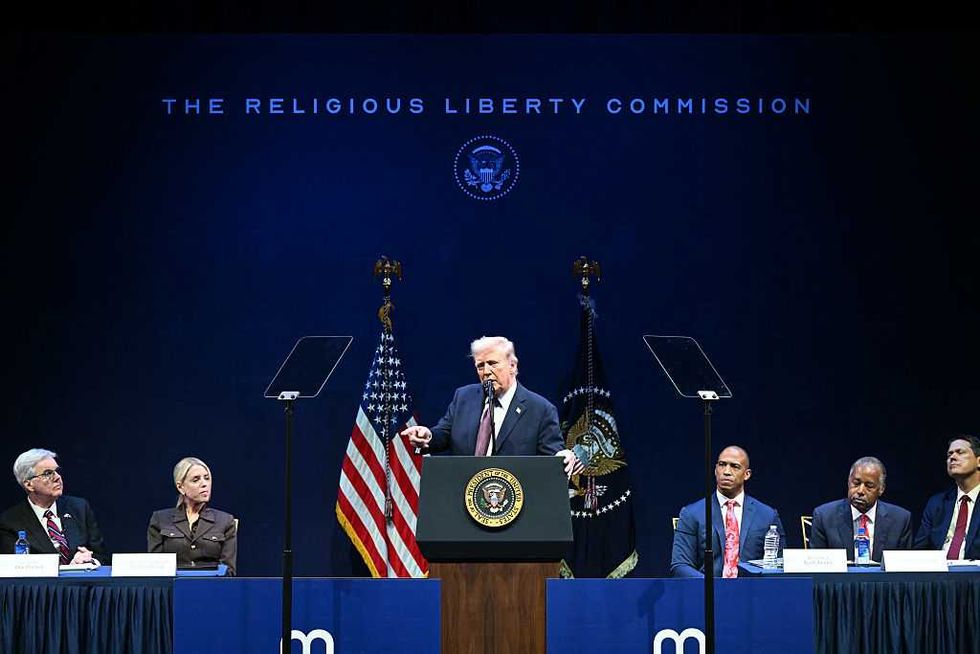
President Trump has established the White House Religious Liberty Commission, led by a diverse group of religious leaders and scholars, including Mary Margaret Bush, Napa Legal’s own former executive director. The commission is identifying some of the nation’s most pressing religious liberty issues and developing plans for action.
Lawmakers should take advantage of the moment to enact durable protections that will outlast any administration.
The U.S. Supreme Court, too, has protected religious liberty in several crucial cases. In Carson v. Makin (2022), the court held that it is unconstitutional to exclude religious schools from generally available government funding programs. In Kennedy v. Bremerton, it found that coach Joseph Kennedy’s postgame prayers did not violate the First Amendment. This year brought additional victories in Mahmoud v. Taylor, where the court upheld parents’ rights to opt their children out of LGBT content in elementary school classes, and Catholic Charities v. Wisconsin, where a unanimous court prevented state officials from favoring some religions over others.
These encouraging developments might tempt Americans to believe that the battle for nationwide religious freedom has already been won.
Yet even with such powerful forces defending religious liberty at the federal level, state laws affecting religious organizations remain critical for ensuring that everyday Americans do not suffer persecution for their firmly held religious beliefs.
Consider what just happened in Washington state.
In 2025, Catholic priests there faced an impossible choice between obeying their faith and complying with state law. A new Washington state statute required clergy to report instances of abuse or neglect they heard during confession, despite the Church’s centuries-old sacramental seal. The law singled out priests while giving others, like lawyers, a pass, and it carried the threat of jail time and fines.
Thankfully, a federal court blocked the law before it could take effect, ruling in Etienne v. Ferguson that the state could not force clergy to violate the sacred seal of confession.
But that case never should have been necessary. Washington’s law reflected the same pattern Napa Legal’s research has uncovered repeatedly: When state laws are weak or hostile to faith-based organizations, those organizations are left vulnerable even when the federal government and Supreme Court appear friendly to religion.
This month, the Napa Legal Institute released the third edition of the Faith and Freedom Index, an analysis of state laws across the country that either help or hinder religious organizations. Whether national politics seem to favor or oppose religious liberty, state laws remain central to its long-term health.
The states with the top overall scores were:
- Alabama
- Kansas
- Indiana
- Texas
- Mississippi
The five lowest scores went to:
- Michigan
- Washington
- Massachusetts
- West Virginia
- Maryland
What distinguishes the states at the top of the list from those at the bottom? Several types of laws come into play. For example, the index’s highest performing states have built frameworks that proactively safeguard religious organizations. Their laws provide broad protections for religious exercise and create environments where ministries can thrive.
By contrast, it’s no coincidence that Washington state ranks near the bottom. The same state that passed one of the most intrusive laws in recent memory also reflects on the Index a legal system that makes it far too easy for governments to intrude on matters of faith.
That is why it is important to strike while the iron is hot. When the federal government is friendly to religious liberty, that is precisely the time to act. Political conditions can change quickly, but good laws endure. Lawmakers should take advantage of the moment to enact durable protections that will outlast any administration.
RELATED: Why Trump’s religious liberty agenda terrifies the left
 SAUL LOEB/AFP via Getty Images
There are many reasons why state laws remain decisive. First, state statutes can still contradict clear federal precedent. After the Supreme Court struck down Wisconsin’s discriminatory law in Catholic Charities v. Wisconsin, a similar law remained in effect in New York. Religious organizations there had to continue the litigation even after the Supreme Court had essentially decided the issue.
It is also not enough for states to rely solely on constitutional protections or a Religious Freedom Restoration Act.
These safeguards are vital but not sufficient. When a religious organization’s hiring or service conflicts with state “nondiscrimination” laws, it should not have to spend years in court to prove its right to operate according to its beliefs. States can and should pass clear exemptions that prevent such conflicts from ever arising.
Finally, state tax and regulatory codes can have a major impact on whether faith-based organizations thrive. Many religious nonprofits are treated like for-profit corporations, subject to tax regimes and administrative filings, fees, and audits that make it hard for them to operate. States should look closely at such laws and remove unnecessary burdens that divert precious time and resources away from ministry and service.
No matter who sits in the White House or on the Supreme Court, state laws remain a foundation of religious liberty. The Faith and Freedom Index remains an important tool to protect and foster the work of religious organizations and religious liberty in general.
Voters should consider how laws in their states burden religion when they cast their votes. Policymakers should pay close attention to laws that may seem tedious but can make or break the needed work of religious organizations. And our government leaders should work to enact laws that foster religious liberty, so that religion can serve its proper role in contributing to the common good.
Stevie Nicks just said the quiet part out loud about abortion — and it’s horrifying
Almost every civilization has, at one point or another, practiced child sacrifice. In our rebellion against God and rejection of Jesus Christ, modern America is no exception.
While we may not burn our children like the Canaanites, cut out their hearts like the Aztecs, or drown them like the Gauls, we most certainly sacrifice our children in acts of worship to benefit ourselves.
We cannot afford to overlook the severity of this sin or its stench before the one true and living God.
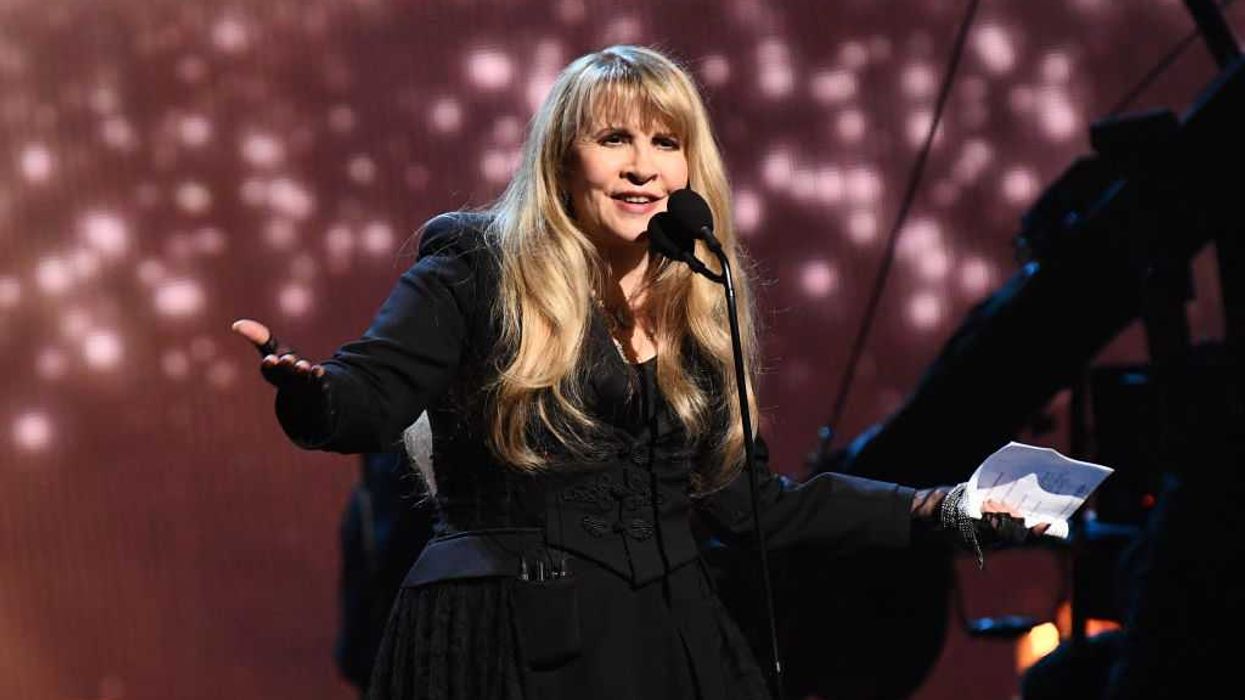
Take the example of Stevie Nicks, the singer-songwriter best known for her years with Fleetwood Mac. Nicks boasted about the benefits of her past abortion in a recent video posted on social media and described as a “must watch” by the Center for Reproductive Rights.
In recalling her past abortion, Nicks was not filled with regret or shame, but with a sober admission that murdering her own pre-born baby was worthwhile for allowing her to continue her music career.
“Fleetwood Mac is three years in, and it’s big, and we’re going into our third album,” Nicks recounted.
“It would have destroyed Fleetwood Mac,” she said of her baby.
“I would have, like, tried my best to get through, you know, being in the studio every single day expecting a child,” Nicks continued.
“It would have been a nightmare scenario for me to live through.”
RELATED: Fleetwood Mac’s real breakup story: Death before motherhood
Rather than making Nicks seem sympathetic in her decision to have an abortion, the video posted by the Center for Reproductive Rights made her look callous. The organization plainly acknowledged that “access to abortion made her life, her art, and her voice possible.”
Nicks admitted to murdering her baby in exchange for career success: She took the life of her own child for the specific reason of pursuing stardom in the music world.
In other words, she committed child sacrifice.
In the same way that past civilizations sacrificed their children to enable abundant harvests, victory over their enemies, or improved rainfalls, Americans sacrifice our children to enable success in our careers, more financial freedom, or fewer inconvenient responsibilities.
But unlike other civilizations, we do not murder our children in the name of any specific false god or demonic entity. Instead we serve ourselves as our own gods — murdering our babies as an act of devotion in the cult of our own autonomy.
We cannot afford to overlook the severity of this sin or its stench before the one true and living God.
Rather than speaking clearly on abortion as child sacrifice, many pro-life organizations over the past few decades have not only downplayed the distinctly spiritual nature of the abortion holocaust, but have insisted that many of its perpetrators are themselves victims.
In speaking about abortion — even writing laws against abortion — many pro-life leaders emphasize the small minority of cases in which women are compelled with threat of life and limb into having abortions.
But in the vast majority of cases, women who have abortions are active participants or even willful initiators, not passive victims compelled into abortions they do not want.
Stevie Nicks is a perfect example. By her own admission, nobody forced her into having an abortion. Nicks willfully chose her music career over the life of her child, and several decades later, she would clearly make the same decision once more.
The notion that all women are categorical second victims of abortion downplays the moral agency women have as image-bearers of God and obscures the justice due to pre-born babies as true victims of abortion.
By defending the legal ability of women to willfully murder their own children, pro-life organizations sorrowfully allow the abortion holocaust to continue, even in conservative states that misleadingly claim to ban abortion.
RELATED: Why defunding Planned Parenthood is a distraction from the real fight
Just like men, women are ultimately responsible for their own actions. Just like men, women will one day stand in judgment before God and provide an account for those actions.
Stevie Nicks may publicly boast about her abortion today, but when she stands before a perfectly holy God, she will no longer boast in her decision. And unless she turns from her sins and trusts in Jesus Christ for salvation, she will bear the penalty of her decision for all of eternity.
When pro-life organizations insist that women can only be victims of abortion — and oppose laws that would criminalize abortion for all parties willfully involved — they fail to deter women from committing sin that destroys both their babies and their very own eternal souls.
That is why we must simply make murdering anyone illegal for everyone.
The exact same laws that protect born people from murder must protect pre-born people as well, or else we are denying the truth that pre-born babies are image-bearers of God worthy of equal protection under our laws.
The existing laws against murder deter the vast majority of murders from happening in the first place. If we extend those same laws to apply from fertilization — without loopholes allowing women to enjoy special murder privileges over their pre-born babies — we will deter the vast majority of abortions as well.
God judges nations that commit child sacrifice. America is well on its way to joining the Canaanites, the Aztecs, and the Gauls in the history of nations that murder their own children and are brought to their knees by the God who cannot endure such rebellion forever.
If we want our nation to continue, we must protect all image-bearers of God from murder, criminalizing the unjustified taking of human life for everyone willfully involved.
Rather than rebelling against God, our nation must turn in repentance and faith toward Jesus Christ — abandoning the works of death and once more bowing the knee to the only one who offers everlasting life.
Why defunding Planned Parenthood is a distraction from the real fight
In the past three years since the overturn of Roe v. Wade, pro-life organizations have been searching for a new national priority. They appear to have found one in the form of permanently defunding Planned Parenthood.
This objective, of course, is far from an original idea. Any conservative voter will know all too well that Republicans have been promising it for decades.
We should end the abortion holocaust without exception or compromise.
This year saw the first time national Republicans actually did defund Planned Parenthood. But it was only for one year — a lackluster achievement given that Republicans control both Congress and the White House.
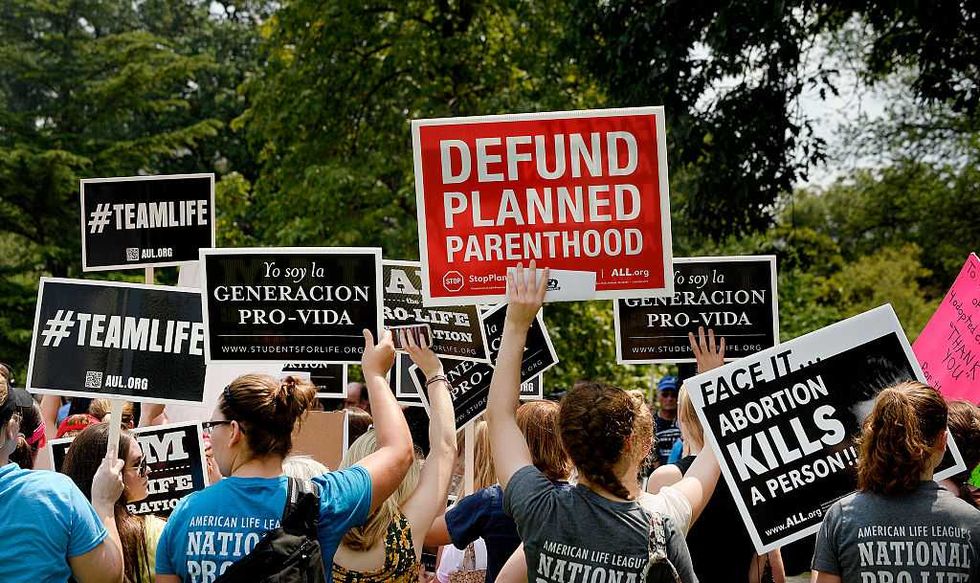
A coalition of pro-life groups such as Live Action, Students for Life, and National Right to Life has now set “a permanent taxpayer defund of all organizations that commit abortion” as their new national priority.
The intention, according to Live Action, is to make sure Planned Parenthood is “permanently defunded” by July 4 of next year.
Certainly, stopping the flow of taxpayer dollars to organizations like Planned Parenthood is a worthy action, and we hope it is successful. But setting that as a central priority of the anti-abortion agenda is underwhelming at best, and doing so will end up distracting from what should be the ultimate goal — passing laws to abolish abortion.
Defunding is not enough
We live in the midst of a holocaust. Beyond the more than 65 million pre-born babies murdered under Roe, abortion numbers have continued to increase over the past three years since it was overturned, now surpassing 1 million pre-born babies per year.
This trend even extends to red states with restrictions claiming to ban abortion.
The removal of taxpayer dollars from the abortion holocaust is not wrong. But it is far from an action that will move us toward a decisive end to the bloodshed. Moreover, setting the mere defunding of baby murder as a central priority diminishes the gravity of this atrocity.
The main problem with abortion is not that we are forced to help pay for it. The main problem is that people are murdering babies.
We should not merely defund specific facilitators of the abortion holocaust. We should end the abortion holocaust without exception or compromise. The best way to defund Planned Parenthood is to criminalize abortion as murder.
For every year we let something else overshadow that objective, we allow another million babies made in the image of God to be murdered.
False victory
As we have seen before, many leading pro-life groups have shown a pattern of overstating their wins. Some will undoubtedly do that if Planned Parenthood is defunded. Such inflated rhetoric misleads anti-abortion Christians and conservatives to think substantial victories have been won, decreasing their zeal to remain engaged and win the actual battle.
When leaders at Planned Parenthood Michigan closed four locations earlier this year, Students for Life insisted that “the death industry is collapsing under its own weight” and proclaimed that “fewer Planned Parenthoods” means there are now “fewer babies killed.”
RELATED: Planned Parenthood’s ugly truth finally has consequences
 Olivier Douliery/Getty Images
But just a few months after that proclamation of victory, Planned Parenthood Michigan announced that it would expand virtual appointments to “seven days a week, including weekends, morning, and evening appointments.” The organization also reported “growing demand” for the virtual appointments, leading it to “expand the program even further.”
Susan B. Anthony Pro-Life America has also called the defunding of Planned Parenthood this year the “biggest national pro-life victory” since the overturn of Roe v. Wade. The organization has repeatedly highlighted the closure of individual abortion clinics as evidence that “the lives of moms and babies are being protected.”
In its public statements about the move, Susan B. Anthony Pro-Life America insisted that Planned Parenthood closures are evidence that “life is winning.” The organization failed to include the context that abortion rates across the nation are still on the rise.
In other words, the closure of physical abortion clinics does not necessarily mean fewer babies murdered. But pro-life groups celebrating as if that were the case are sorrowfully leading anti-abortion people to think otherwise.
Exaggerated impact
Planned Parenthood facilitates about one-third of all abortions in America. But even if it lost access to taxpayer dollars, the same number of abortions in our nation would almost certainly continue.
If the federal government were to cut off all funds to Planned Parenthood, the organization would find money elsewhere — from blue-state legislatures, from private billionaire donors, and most of all from the men and women who themselves fund Planned Parenthood by paying to murder their own pre-born babies.
Also, taxpayer money does not cause the abortion holocaust in our nation, but it subsidizes an already existing marketplace that will continue even if Planned Parenthood disappears tomorrow.
In other words, as long as there is abortion demand, there will be some form of abortion supply. We must address both the supply and demand for abortions, or else the murder of pre-born babies will continue.
The real priority
By prioritizing a weak objective of defunding Planned Parenthood, pro-life groups might achieve exactly that goal, but they will not get more than that goal any time soon. In order even to substantially decrease abortion in America, let alone actually abolish abortion, a much more ambitious goal must be set.
That is why every anti-abortion leader and organization should support legislation enacting equal protection of the laws for pre-born babies, which would not only break the power of abortion providers, but truly abolish abortion itself.
Christian conservatives rightly affirm that pre-born babies are made in the image of God and should be protected from the moment of fertilization. By calling for equal protection bills at the state and federal levels, anti-abortion groups would be setting the expectation that the exact same laws protecting born people from murder should protect pre-born people as well.
The focus should remain on establishing equal protection. This is the only policy that would criminalize abortion as murder for all parties involved, obey God, and dramatically reduce the number of murders of pre-born babies in America.
If such an expectation is set, then state and federal lawmakers may still defund Planned Parenthood — probably even faster than they otherwise would have. But setting a lower expectation than equal protection, such as defunding Planned Parenthood, decreases the likelihood of strong anti-abortion policies advancing.
The pro-life organizations searching for a new priority after the overturn of Roe should not set their sights too low, and they most certainly should not exaggerate their victories.
If they truly desire to protect pre-born babies and move America toward the abolition of abortion, merely defunding Planned Parenthood will not suffice. They must remember that we are in a holocaust that has continued for far too long — and act with the appropriate urgency and priority.
Protestant pastor says polygamy is biblical: ‘He divinely ordained it’

A protestant pastor is not backing down from his claim that he can have multiple wives.
Rich Tidwell, a pastor in Canton, Missouri, has sparked an online debate about the acceptance of polygamy in Christianity and whether or not it is biblically justifiable.
‘I have two beautiful wives.’
To the expected amount of backlash, Tidwell recently made an announcement on his Instagram page that his second wife is expecting his eighth child.
“I have two beautiful wives,” Tidwell wrote in a long entry. “We’re thrilled for what the Lord has done for our family,” he added, citing Bible passage Luke 18:29.
The pastor wrote about his justifications in an article called “Plural marriage,” labeling the practice as polygyny, which refers to one man being married to multiple women.
“In 2019, I discovered the surprising fact that God not only never prohibited polygyny throughout the entire biblical narrative (as He did with polyandry or homosexuality), He divinely ordained it in several cases,” Tidwell claimed.
He then cited more passages.
RELATED: Church-hopping: Confessions of an itinerant worshipper
Exodus 21:10 regulates but does not prohibit the practice, Tidwell claimed, when it says, “If he takes another wife to himself, he shall not diminish her food, her clothing, or her marital rights.”
Tidwell also noted 2 Chronicles 24:2-3, which mentions that “Jehoiada took two wives for him, and he became the father of sons and daughters,” as well as 2 Samuel 12:7-8:
This is what the Lord, the God of Israel, says: “I anointed you king over Israel, and I delivered you from the hand of Saul. I gave your master’s house to you, and your master’s wives into your arms. I gave you all Israel and Judah. And if all this had been too little, I would have given you even more.”
The pastor continued with more citations and said that if God explicitly gave men more than one wife at any time in history, “Then it was not and is not sin.”
For those who argued that polygyny is not the original design for mankind, Tidwell countered, “Neither is death, nor clothing, nor eating meat.”
RELATED: This crisis in churches is real. Will Christians fight back?
In an article titled “Should polygamist families be welcome at church?” Tidwell shared a letter he wrote to an Anglican church in Missouri requesting to attend its worship services; he was soundly denied.
A priest replied, saying the bishop, clergy, and parish council “unanimously decided against” the family’s participation.
“On multiple levels, polygamy is forbidden in our convictions, interpretation of Scripture, and the Canons and Constitution of the [Anglican Church of North America],” the unknown representative wrote, citing the following: “Canon II.7: Of Christian Marriage, which defines marriage as a lifelong union of one man and one woman.”
“These convictions are non-negotiable,” the letter said. “If you ever repent and become functionally and theologically monogamous, you are welcome to participate.”
Tidwell is a pastor at the nondenominational Ormond Church in Canton, Missouri, according to Protestia.
Like Blaze News? Bypass the censors, sign up for our newsletters, and get stories like this direct to your inbox. Sign up here!
Church-hopping: Confessions of an itinerant worshipper
I have been church-hopping since the summer of 2020. This means that a lot of “concerned evangelicals” have felt justified in asking, “What are you searching for?”
That first summer, I claimed to be searching for holy ground. However, I already knew that this was wherever a saint steps — wherever God speaks to us and we listen in prayer.
We had spent a wonderful evening with an elderly Latter-day Saints couple who found us hitchhiking, then brought us home to ‘show us some literature.’
I have never been searching for anything as much as I have been interested to see what it is that others claim to have found. It thrills me to see that it is all pretty much the same, in minor degrees. Some pastors are more boring than others. Everyone makes claims about the “other” churches in town. Everyone has their rituals, their deeds, the words that are not works. And very few are curious about the others.
“Seek and ye shall find,” they murmur among themselves in the territory of their home church, patting one another on the back because they somehow found truth without seeking it. Why aren’t the others seeking it? They’d be here among them if they sought — if they loved the truth as they loved the Bible.
Not all. Only the majority. Maybe not even that many — only a few loud ones.
I, too, among them, also vocal, a little charismatic, a little opinionated, forgetting what it means to seek before you find.
The world is not our home
Now I have dragged my husband in on the game of flirting with the appearance of universalism. And yet we are no more universalist than Paul or St. Francis of Assisi or C.S. Lewis. We are curious, alive, and nonplussed by the promissory comforts of the world. This world is not our home, and neither is a single building.
And yet, if you seek, ye shall find. It matters not that my intentions were no different from those of an atheist — to attend, to observe, to write. I am relating to the woman at the front of the church who is not Catholic but is hired to sign the sermon and songs for the deaf attendees, thus hearing every word of the priest and chorus more thoroughly than any of the parishioners and finding that her job has morphed into a spiritual awakening.
I am finding community, kindred spirits, truth outside my understanding of it, and a narrow path. I am becoming less curious as a larger passion consumes my heart and soul.
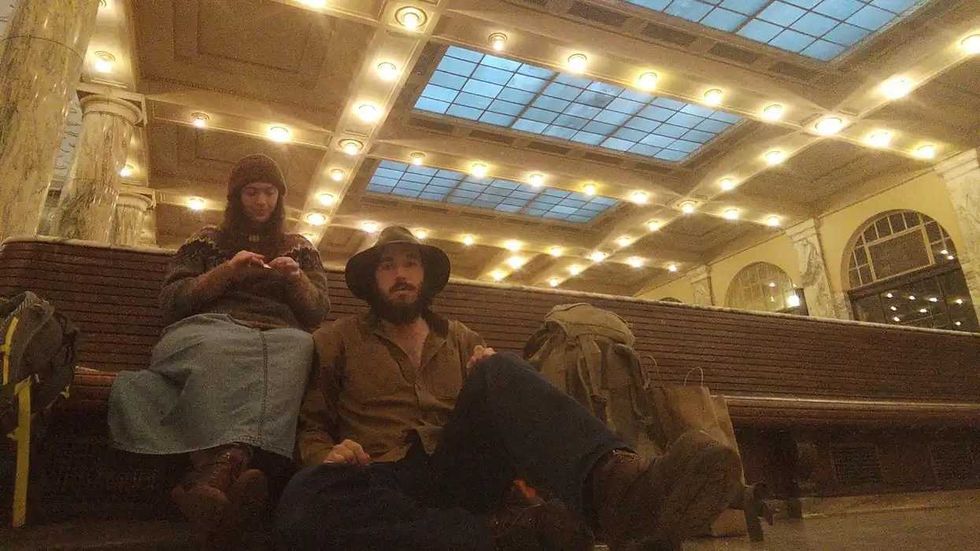
We intended to attend Mass while on our honeymoon — something difficult to do when you have no agency over where you will be day to day, as hitchhikers reliant upon the goodwill of strangers and public transit. We joked about putting up a cardboard sign, our thumbs in the air, “TAKE US TO CHURCH.” Maybe someday.
Instead we went where we could.
RELATED: The USA Rail Pass: Across America by train
 A.M. Hickman
A church for widows
The first place was an Anglican church in Newfoundland that seemed to be run by little old ladies — 30 of them, to be precise, scattered in the pews, in the choir, and at the altar. There were only five men, all of them seated. This did not bode well, we thought.
But it was truly a church for widows, a church that was doing its very best to remain active, putting on plays and picnics even though there were no young people or children. The Spirit was there with those little old ladies. It was comforting them, pushing them forward even though they had lost much. It was reminding them of all that awaited them in paradise. And they were ready.
They gave us cookies and greeted us with forgetful, motherly smiles, as if we were not mere strangers but apparitions of heavenly promises. We were their reminder to keep hoping, and they were our nudge toward charity. We sat, we witnessed, and we listened.
Seventh-day supper
After that we found different Catholic churches to pray in, which somehow always seemed to be far away when Sunday came around. There was a large one — a shrine — on the border of Quebec, Labrador, and Newfoundland, then another a little farther into Quebec, in an Inuit village. This one hearkened to the traditions of these people, too. How beautiful, I remember thinking, the way the Church uses each people’s specific culture and history to express the truth.
Then we walked by a window that sported “Seventh-day Adventist” in a French-Canadian Maine town. It was a Thursday, and we had already determined to stay in town for a French-Acadian Mass on Sunday.
“Let’s go there,” I told my husband. “It might be a little frustrating, but it’ll be a good experience for you.”
He agreed, and so we brought ourselves and our backpacks there Saturday morning. The church was new — it looked more like a Main Street business because of its location and the large windows. There were only six or so people inside.
“Can we join you all?” I asked. “No, I am not Seventh-day Adventist, but I’ve attended many services because my family keeps Sabbath on Saturday.”
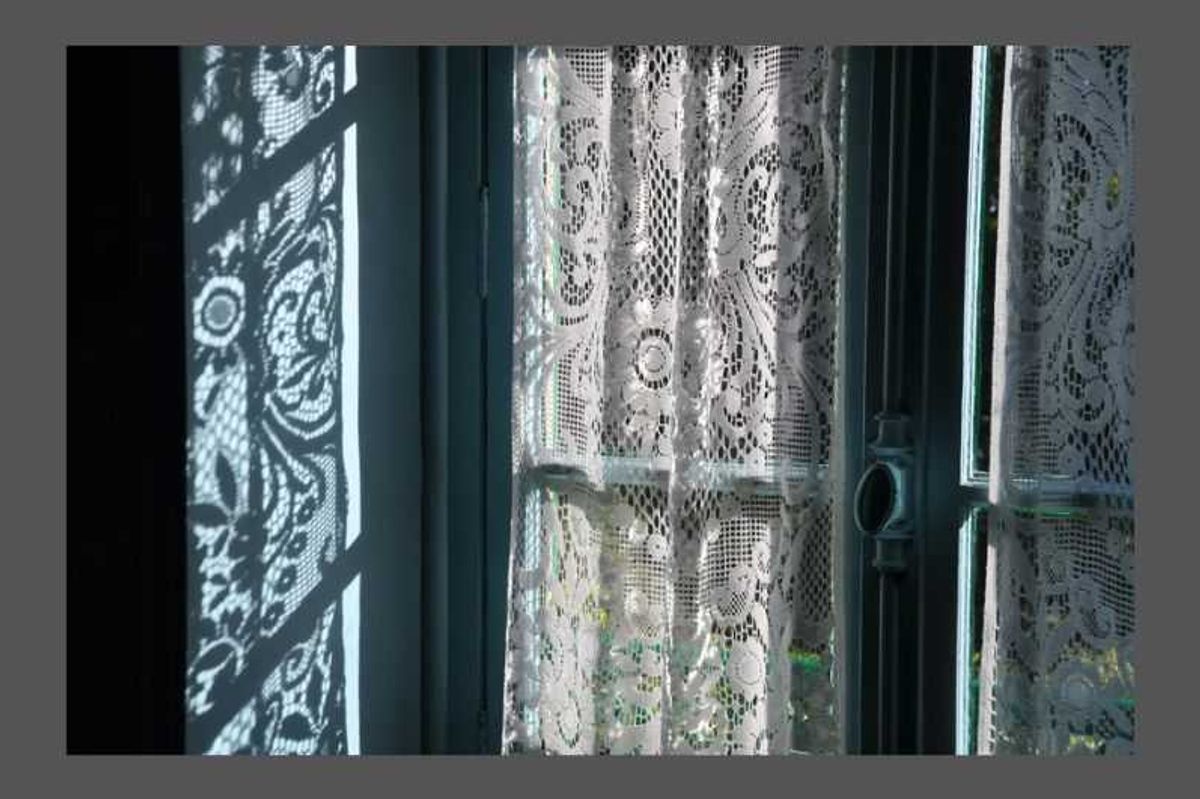
We put our bags in front of a pile of unopened boxes of “The Great Controversy,” and they handed us a booklet on Romans and two pens. The room was ugly, like a warehouse, except for the lace curtains in the windows.
For the next two hours, we “studied the Bible,” mostly discussing how wonderful Jesus is and what it means to pray — how often we should pray and what makes prayer sincere — and how all Protestant churches are basically Catholic because they acknowledge the authority of Rome and the pope to change the Sabbath from Saturday to Sunday.
The church service was bland, hard to follow. I tatted a lace bookmark to try to keep awake. The speaker was likeable, but he droned on about a Bible story, not really recounting it accurately. I don’t think that was the point of his speaking, though — they were simply allowing him a moment to speak, because he was a man and the church had few members and needed participation from everyone in order to keep the spirit alive.
They did not give us cookies, but something better — a meal of various bean and rice dishes. There was fresh homemade hummus, too.
Nine out of Ten
As we ate, everyone continued to ramble on about how awful it was that other churches didn’t care to follow all of the Ten Commandments.
“Evangelicals want the Ten Commandments in schools, and yet they do not want them in their churches.”
“If children came home from school and refused to do their homework on Saturday, most Christian parents would not be happy.”
“There’s a church in town that has the Ten Commandments hanging on the outside of their building,” the pastor began.
So I talked to them about it and asked them why they don’t care about the fourth commandment. Oh, boy! The pastor said he’d get back to me, and let me tell you, oh boy, oh boy, that he finally decided that he could piecemeal a bunch of verses today and how he thinks he can prove that Jesus wants us to keep all the commandments now except that one.
That night the pastor let us stay in his house, and as he showed us all his proof for Saturday Sabbath and how the Catholic Church has duped nearly all mainstream churches, Andy finally confessed, “I am a Roman Catholic, and I believe the Church had the authority to change the Sabbath to distinguish us from the Jewish faith.”
The man started. Then he said, “Well, I think Jesus will save Catholics, too, even though they are only keeping nine of 10 of God’s commandments. But they will be judged for disregarding the Sabbath Day.”
We were friends now.
Answered prayers
In the middle of Maine, we attended one other church. All the days leading up to it were edifying. We had spent a wonderful evening with an elderly Latter-day Saints couple who found us hitchhiking, then brought us home to “show us some literature.” It was not the “Book of Mormon.” They handed us a glass of orange juice and a box of raisins and played old 1960s and 1970s love songs for us, then told us their love story — of how they had a temple wedding in Switzerland; of their 14 children, 88 grandchildren, and 17 great-grandchildren.
After we played a game of cards, they brought us to our destination, where we stayed with a Quaker-esque hippie Christian family. This family brought us to their church the next day.
It was as if God was answering our longing for Mass. Although the church was small and non-denominational, it felt how an early church might feel or how a Catholic service might feel if it were in someone’s home. They prayed and sang some of the songs you’d hear in a Catholic church, along with songs from an Assemblies of God or Baptist-type non-denominational church. They said the Apostles’ Creed together and took communion as a Catholic church does, with everyone coming up front and receiving it in long lines from the pastor.
The sermon was sound — like a homily — and did not feel as scattered with pieces of scripture as many non-denominational church services are. We were spellbound. If it weren’t for how modern everyone seemed to be dressed, I would have thought we had been transported to an era before the Reformation.
Shared roots
After it was over, I asked the pastor if their church had any Catholic influence.
He laughed and said no, that if there were ex-Catholic members, they would probably oppose these traditional Orthodox inclusions. No, these were things he had included because from his studies and experiences, he had come to believe that there was a lot that Protestantism lost when it spurned tradition and ritualism, and he was slowly trying to incorporate it back into church. “It’s in our roots, too.”
I talked to his wife and told her about my Living Room Academy (she had heard of it) and how it was partially inspired by my travels in woke circles when I realized that many lesbians and liberal women were doing a better job of being women and passing on beauty and skills than Christian women. Her eyes opened wide. “You’re right.” I’ve heard that since we left, she has decided to open her own iteration of the Living Room Academy for the girls in their church.
What I loved about their church was that they didn’t seem to be stuck in their bubble. Their church wasn’t really their “home” as much as it was them trying to find out what home means by looking to the past and looking to paradise. They seem to be doing a very good job at making it work — their church was filled with children, happy-looking teenagers, and a diversity of fashion from very beautiful dresses to jeans with frilly purses. There seemed to be room for expression of faith.
Coming home
After that we finally made it to a Mass in Fitchburg, Massachusetts. And I must admit, it kind of felt like coming home.
I hadn’t realized how much I had come to love attending Catholic churches with my husband. There are still many questions I have had to sort through about the Church and whether or not I can in good conscience submit myself to its authority. However, being there, surrounded by the beauty of the type that God requested when He detailed the temple He wanted from the Jews, feels like being at home … in paradise.
Everything else feels so earth-like, so business-minded and corporate and mechanical. Even though the “music” of mainstream churches claims to have more life in the show, there’s nothing quite like the chorus in a cathedral. And while you might get a good sermon in a Protestant church, you’re not going to hear near as much scripture read as is read at Mass.
Most Protestants would complain if they had to sit through half of what is read — they want a Bible verse that corroborates a sermon. Meanwhile, you might get about 15 minutes of rich preaching at a Mass — the rest is pure scripture.
It’s almost a hobby now — I will certainly never stop church-hopping, comparing and pondering. I want our children to have these experiences. So many wonderful conversations have sprung up between my husband and me because of these visits, and we are finding ourselves growing more spiritually aligned because of it.
And so I will continue to exhort anyone of any faith: Visit the churches around you, no matter their denomination. Every church has something to offer you and will give you an opportunity to practice humility and charity.
Editor’s note: A version of this essay earlier appeared on the Polite Company Substack.
Israel, the Church, and the Unraveling of Conservative Unity
There are few subjects that more quickly ignite controversy among believers and conservative thinkers than the question of Israel. The…
Dear Christian: God didn’t call you to be a ‘beautiful loser’
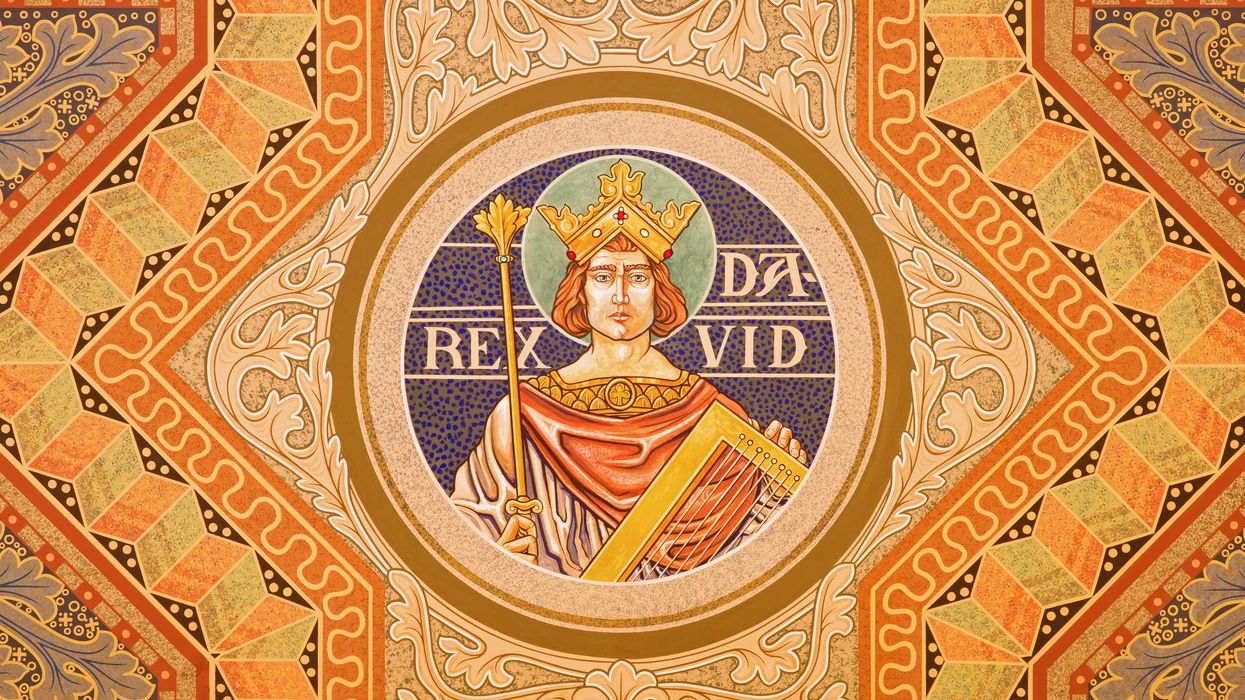
Many Christians aim too low. We mistake humility for passivity and meekness with mediocrity, thinking God wants us to suppress all ambition. In doing so, we turn losing into a kind of twisted Christian virtue. We call it humility, but really, it’s just unbelief.
God never called His people to be beautiful losers. He called us to reign with Christ.
To seek glory, honor, and immortality is to seek what God Himself promises to the faithful.
The Bible’s vision of humanity is larger and more dignified than the self-loathing — the false humility that passes for spirituality today. The Christian life was never meant to be small. Redeemed men and women are not required to limp through life. Rather, He made us for glory.
Consider Paul’s words in Romans 2:6-8: “He will render to each one according to his works: to those who by patience in well-doing seek for glory and honor and immortality, he will give eternal life.”
For a long time, I’d come to this verse in my Bible reading plan, and it struck me as odd. Paul can’t be saying we are saved by seeking glory and honor, since the whole book of Romans teaches the opposite. We are saved by grace, not works. So what is Paul saying?
Here’s my answer in a nutshell that I’ll develop below:
God originally created man to pursue glory, honor, and immortality through faithful obedience and exercising dominion over creation. Since Adam sinned, he “fell short” of this glory. But Christ, the second Adam, succeeded where Adam failed and restored man to his original purpose. Therefore, redeemed Christians are now free to pursue glory and honor by faith, in the power of the Holy Spirit, exercising godly dominion for the glory of God.
Adam’s lost glory
To understand Paul’s statement in Romans 2:6-10, let’s go back to the Garden of Eden. Genesis 2 teaches that there were two trees in the garden: (1) the tree of life and (2) the tree of the knowledge of good and evil. Adam was permitted to eat from the first tree but forbidden to eat from the second.
When Adam sinned, the verdict was exile. “[God] drove out the man, and at the east of the garden of Eden he placed the cherubim and a flaming sword that turned every way to guard the way to the tree of life” (Genesis 3:24).
The trees represented two possible destinies: glory or death. Had Adam persevered in obedience, he would have eaten from the tree of life and entered into immortality. Instead, he reached for forbidden knowledge and fell under the curse of death.
Though Adam was created in innocence, he was not yet as glorious as he could have become. God gave him a gloriously ambitious task to “be fruitful and multiply and fill the earth and subdue it and take dominion” (Genesis 1:28). That’s a global ambition. Adam’s task was to take the wild and untamed world outside of Eden and bring it under subjection to him. In other words, God created Adam with an eschatology — a purpose, telos, or end — that he might rise from innocence to glory through faithful obedience.
To fulfill God’s command, Adam would need to develop various skills he wasn’t created with. He would have needed to learn to plant gardens, name animals, lead a wife, and raise children. Those latent potentialities would have been drawn out of him through experience over time.
In other words, though Adam was morally innocent, he was not yet as glorious as he would have become had he been faithful to God’s commands. He could have attained glory by becoming a more skilled and excellent man in the pursuit of glorious goals. In so doing, Adam would have grown intellectually, physically, spiritually.
Christ succeeded where Adam failed. And the result of Christ’s obedience was glory.
In other words, innocence was the starting line, glory was the finish line.
With this in mind, notice Paul’s famous description of sin as not merely “doing bad things” but falling short of the glory of God (Romans 3:23). That’s important. Sin is more than merely breaking the rules; it is the forfeiture of glory. Because of Adam’s sin, he was no longer able to attain the glory God made him for. He “fell short of the glory of God.” And humanity has been falling short ever since.
Christ, the second Adam, attains the glory of God
But the story doesn’t end in failure. Scripture presents Christ as the “last Adam” who succeeded where the first Adam failed. In His human nature, Christ sinlessly retraced Adam’s path.
The author of Hebrews (quoting Psalm 8) draws this out explicitly:
What is man, that you are mindful of him,
or the son of man, that you care for him?
You made him for a little while lower than the angels;
you have crowned him with glory and honor,
putting everything in subjection under his feet. (Hebrews 2:6-8)
Notice Hebrews 2 and Romans 2 both use the same word pair: “glory” and “honor.” The author or Hebrews 2 is citing Psalm 8, which is a commentary on Genesis 1–2. In other words, these texts tie together the creation of man, the image of God, and the dominion mandate.
Hebrews 2 also connects the creation of Adam with the incarnation of Christ, who was likewise crowned with glory and honor. And through His suffering and death, Christ brought “many sons to glory” (Hebrews 2:10).
Thus, Christ succeeded where Adam failed. And the result of Christ’s obedience was glory. Jesus said it Himself: “Was it not necessary that the Christ should suffer these things and enter into his glory?” (Luke 24:26).
Therefore, Jesus hit the reset button on the human story. Adam’s sin broke the circuit of glory, but Christ reconnected it. Jesus secured the glory that Adam lost and offers it freely to His people. He restores humanity to its intended place as rulers over creation, crowned with glory and honor, who must once again revisit the dominion mandate given to Adam.
Thus, Christ completed the redemption arc of humanity. The fullest Christian life will not be marked by mediocrity but glory. And our savior will reward his faithful servants who pursue it. Through Christ, obedience is glorious again.
Redeemed humanity restored to the pursuit of glory
This brings us back to Romans 2:6-7. When Paul says that God “will render to each one according to his works,” he isn’t teaching salvation by merit. He’s describing the reward of faith — the fruit of a life transformed by grace. Those who “seek for glory and honor and immortality” are not grasping for self-exaltation; they’re following the path of Christ, the second Adam, who entered glory through obedience.
Christians are to do all things to the glory of God (1 Corinthians 10:31) while also hoping in glory as our inheritance (Romans 5:2). Those united to Him by faith are once again free to pursue what Adam forfeited.
God is ambitious. The creation mandate is ambitious (Genesis 1:28). The great commission is ambitious (Matthew 28:18-20). These ambitions are global in scale and and can only be accomplished by Spirit-filled men and women who dare attempt great things for God. Thus, redeemed Christians are likewise made to pursue great and glorious ambitions.
Christians who, therefore, think small, equating humility with mediocrity, are settling for less than what God made them for. God intends His people to exercise dominion under Christ’s authority — to build, teach, create, and govern. To seek glory, honor, and immortality is to seek what God Himself promises to the faithful.
Glory is not a zero-sum game
Perhaps you may find it surprising to hear that when we obey God, giving God the glory, there is also a glory that overflows back to us. But it does. God’s glory is not a zero-sum game.
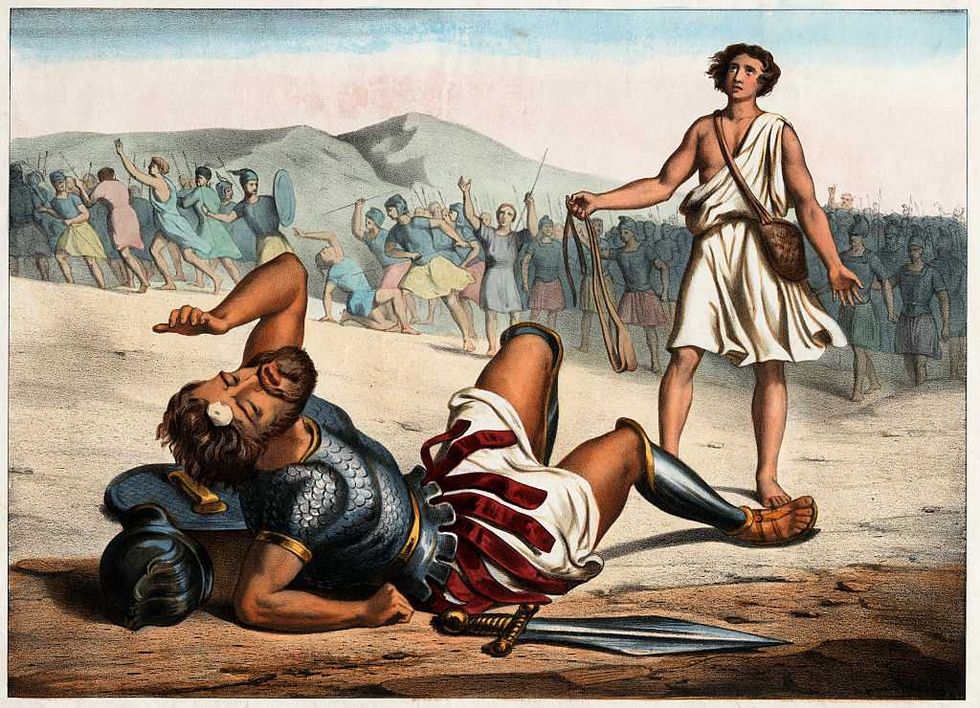
Take David’s victory over Goliath, for example. Who gets the glory for that? That’s actually a trick question. David could have stayed home that day, tending his sheep, playing it safe, and keeping his hands clean. If he’d stayed home, he would have remained innocent, but he would not have received glory.
RELATED: How ‘loser theology’ is poisoning the church
 Stefano Bianchetti/Corbis via Getty Images
Innocence isn’t the same as glory. One can remain innocent while doing nothing. Glory requires risk, faith, and obedience. When David stepped onto that battlefield, he was seizing the opportunity to magnify God through courage. That’s why we know his name. King David is on the Mount Rushmore of the Christian faith because he didn’t stay home. We know his name because he courageously rushed into battle.
In the defeat of Goliath, God gets the glory, but David also shares in it. That’s because God’s glory is not a zero-sum game — it is expansive. The more we glorify God, the more His glory spills over onto those who take courageous action by faith.
When some Christians feel satisfaction for succeeding at a great task, they might feel a little guilty for enjoying it. They might wonder if it’s pride or selfish ambition. That’s certainly possible, but it’s also possible that they’re merely enjoying an echo of glory in their achievement.
Rather than allowing the fear of pride to smother the glory we’re meant to enjoy, it is better to pursue glory while repenting of any pride that we see arising within us. Better to repent of sin while pursuing great things than to bury your talents and avoid the risk.
Greater ambition, greater glory
This matters because glory can be a powerful motivator for faithful Christians to pursue ambitious goals. The greater the ambition, the greater the glory when it is accomplished.
Put another way, glory scales with ambition. The kid who wins a backyard football game may feel a taste of glory, but the man who wins a Super Bowl ring experiences it in full. This same pattern applies to life in God’s kingdom: the greater the goal, the greater the glory. Glory is out on the battlefield, not at home on your couch.
There’s glory in raising faithful children, mastering your craft, building a business that blesses others, and serving others with excellence. Christians should be the most competent, disciplined, and creative people in the world. Why shouldn’t we be? We are indwelled by the Holy Spirit, sent on a divine mission, and commanded to take dominion. That means aiming high — not low.
Aim higher
Since many Christians don’t think this way, they end up aiming too low. They pray, go to church, pay a tithe, read their Bible, and stay out of trouble, thinking that’s the fullness of the Christian life. None of those things are wrong, but they’re not glorious either.
Innocence is where the journey begins, but glory is where we should end up.
So if there’s a promotion offered at work, go for it. If you’ve got a business idea, build it. If you’re presented with a leadership opportunity, take it. Godly Christians should make the best business owners and bosses in the world, should they not?
Pursue excellence in your vocation such that you will be a blessing to others. That’s what practical dominion taking looks like.
God has given you gifts and opportunities. The question is: What will you do with them? Will you aim low out of false humility? Or will you seek glory, by faith?
We were never meant to limp through life as losers or apologize for our successes. God crowned us with glory and honor and set us loose in His world. So don’t smother your ambition under the guise of humility. God doesn’t call us to be beautiful losers. He called us to reign with Christ. So aim higher. Pursue greatness for the glory of God. And when you succeed, give Him the glory and enjoy the reciprocal glory He delights to share with you.
May your pursuit of glory lead you upward, outward, expanding, and fruitful.
This essay was adapted from an article published at Michael Clary’s Substack.
Did science just accidentally stumble upon what Christians already knew?

A new study titled “Architecture of Near-Death Experience Spaces” has caught the attention of both the empirics and the eternalists, because it’s not often that a study about dying reads like a map to heaven.
The researchers asked participants who had clinically died and been resuscitated not to describe their near-death experiences in words, but to draw them. What emerged were recurring shapes — cones, ellipses, radiant fields — across people from entirely different cultures.
As the apostle Paul wrote, ‘Now we see through a glass, darkly.’ And science, for once, seems to glimpse the flicker of eternity.
But here’s the kicker: These weren’t the random doodles of oxygen-starved brains. They were geometric symphonies, ordered and elegant. It was as if consciousness, freed from the flesh, had glimpsed the very scaffolding of creation itself.
For a Christian, this is profound. Scripture has long told us that creation is not chaos but design. “The heavens declare the glory of God,” wrote the psalmist (Psalm 19:1), and here, perhaps, the dying do, too. When the heart stops and the veil lifts, what appears before the eyes of the departing may not be fantasy but revelation — a structure that feels deliberate, like architecture drawn by divine hands.
Dr. Jeffrey Long has spent decades collecting such glimpses. An oncologist by trade and founder of the Near-Death Experience Research Foundation, Long has catalogued over 5,000 accounts from people who claim to have died and returned. His findings echo the new study’s quiet suggestion: There’s order here.
Across cultures, creeds, and continents, the same themes recur.
Consciousness separates from the body. A light appears — intelligent, loving, unthreatening. A panoramic life review follows, often described as instantaneous yet complete. Time dissolves and peace floods in. And then, inevitably, a choice or command to return.
These aren’t vague platitudes. They are astonishingly consistent. Whether the subject was Christian, atheist, or vaguely spiritual, the pattern is the same.
RELATED: Science’s God-denying narrative just got crushed again
 Pobytov/iStock/Getty Images Plus
Long’s data also reveals what happens after the return. Many report their faith deepening not from glimpses of pearly gates, but from meeting something that made sense on a cosmic scale. Others who had never believed before find themselves suddenly convinced that life does not end in nothingness. Across thousands of testimonies, moral clarity re-emerges like a melody.
Long told me his work has been called everything from pseudoscience to prophecy. But to him, the evidence points to something beyond the brain. When the same story emerges from a Buddhist in Nepal and a Baptist in Tennessee, argument starts to feel like denial.
When I reached out for comment about the link between near-death experiences and religious faith, Long directed me to his archive of testimonies — hundreds of raw, personal accounts from people who have stood at the edge of eternity and come back changed. They speak of a presence no doctrine can fully capture and a peace that science could never explain.
It’s the same paradox Christ left us with: The kingdom of heaven, near enough to touch, yet utterly beyond our comprehension.
Long shared with me four short lines from his archive, chosen because they capture what even theology struggles to say.
- “They said the energy of love is a good reason to return,” wrote Galadriel K, who described her experience with a calm certainty that makes disbelief feel naive.
- “It’s an unconditional love. I know Him. I met Him. … I met Jesus,” said Sharlene S, her words somewhere between testimony and awe.
- “When I got close enough to the Light, I felt unconditional love and time stopped,” recalled Judy G, as if describing an emotion too large for language.
- And then there was Charles T, whose final line needs no interpretation: “I knew what the source of that Light was. … It was Jesus.”
There’s something disarmingly simple in those statements — no grand theories, no intellectual gymnastics. Just awe. They testify to a presence that makes earthly distinctions fade. All melt away before the presence that burns through every pretense.
Critics will, of course, roll their eyes. They’ll talk about cerebral starvation, neural fireworks, the brain’s desperate attempt to comfort itself as it shuts down. But these explanations sound increasingly like the dying gasps of materialism. If consciousness were merely chemical, it shouldn’t behave so coherently at the brink of breakdown. It shouldn’t script the same story in so many minds.
There’s a dark humor in watching science stumble, wide-eyed, into what the faithful have always known. The modern world has spent centuries insisting that heaven is a myth, the soul a silly superstition, and death nothing but a switch flipped off.
In an age when every mystery is monetized and every miracle gets fact-checked by faith-phobic bureaucrats, it’s oddly comforting to know there are still places where no human instrument can reach.
Yet now, with the help of MRI machines and EEG scans, researchers are rediscovering the same truths that Sunday-school children sing. Progress, it seems, has come full-circle — proof that even unbelief can only wander so far before bumping into God.
To the Christian reader, these findings are not a challenge but a confirmation. The consistency of these visions, their moral coherence, their geometrical appeal — all resonate with a faith that has always held the visible world to be only the shadow of the invisible.
As the apostle Paul wrote, “Now we see through a glass, darkly” (1 Corinthians 13:12). And science, for once, seems to glimpse the flicker of eternity.
Of course, it would be wrong to make doctrine out of data. Faith is built in pews, not in peer reviews. But it’s just as foolish to ignore what so many have seen. In an age when every mystery is monetized and every miracle gets fact-checked by faith-phobic bureaucrats, it’s oddly comforting to know there are still places — perhaps the oldest place of all — where no human instrument can reach.
In that space between pulse and paradise, geometry gives way to grace. People describe radiant fields. But what they really mean is radiance itself — love, light, life. The shapes may differ, but the direction is always the same: toward something higher, brighter, unending.
Maybe that’s what the dying have been trying to tell us all along: that death is not the end of knowledge but the beginning of understanding. And no matter how mighty our machines or how certain our reason, humanity — from Maine to Manila — keeps sketching its diagrams of eternity: cones, ellipses, celestial plains.
Each line is a breath from beyond, proof that what we call death is only design, still unfolding.
This crisis in churches is real. Will Christians fight back?
A new study has uncovered an alarming trend: Fewer regular churchgoers believe the Bible is clear on transgenderism and homosexuality.
The survey — conducted by the Family Research Council and the Cultural Research Center at Arizona Christian University — found that only 47% of regular churchgoers believe that scripture is “clear and decisive” about “whether homosexuality is morally acceptable.” That’s a significant decline from 63% in 2023.
The moment believers treat biblical truth as negotiable, Christians become yet another cultural echo chamber.
Researchers, meanwhile, found that 26% believe the Bible is “unclear or ambiguous” about homosexuality, while another 16% said they believe scripture doesn’t address the issue.
Even worse, only 40% of regular churchgoers said the Bible is “clear and decisive” on “whether transgenderism is morally acceptable,” a 12-point drop from 2023. Nearly a quarter (23%) said they believe the Bible is “unclear and ambiguous” on trans ideology, while 24% said they believe the Bible doesn’t address it.
These results demonstrate that American churches are experiencing a crisis of biblical truth.
But how?
But these results are surprising for two important reasons, not least of which is that they appear to refute suggestions of a Christian revival in America.
First, while these are two issues central to the progressive project that have largely become cultural orthodoxy, a growing number of young people are rejecting the left’s version of the good life. Thus, you’d expect the data to reflect the trend away from progressivism and toward objective truth.
Second, the Bible is by no means unclear or ambiguous on either issue — no matter what “progressive Christians” say.
On homosexuality, the Bible establishes in Genesis that central to the union of man and woman (i.e., marriage) is the ability to reproduce. This prescription is reaffirmed countless times. Jesus even cites Genesis when challenged about the true purpose of marriage (hint: He does not affirm homosexuality). Moreover, as the fledgling church grappled with questions of sexual morality, the apostles affirmed that sexual immorality of any kind — that is, porneia, or any sexual activity beyond the confines of a marriage between one man and one woman — is sinful and contrary to God’s design. This, of course, includes homosexuality.
On transgenderism, Genesis is clear: God created man and woman, a complementary pair that reflects the divine union. God chooses our gender for us — not our feelings.
So what do we do?
First, we must name this for what it is: not a cultural or data problem, but a discipleship problem. The Bible hasn’t changed, and scripture isn’t suddenly vague. The truth is that many pastors and churches have gone quiet on these important issues, which demand moral and biblical clarity.
Silence has a cost, and now the bill is due. When pulpits grow timid, the pews grow confused.
Second, Christians must recover confidence in the Bible’s authority. God’s word is true and timeless. It doesn’t need to be apologized away or reinterpreted to acquiesce to our cultural moment. It speaks as clearly today as it always has. Cultures and politics may change, but God’s truth remains the same.
The moment believers treat biblical truth as negotiable, Christians become yet another cultural echo chamber — and lose their saltiness.
RELATED: The poisoned stream of culture is flowing through our churches
 ChristinLola/iStock/Getty Images Plus
Third, Christian leaders must teach clearly, intentionally, and with conviction what the Bible says about sex, marriage, and human identity. Christians today are drowning in confusion, as this study proves. They desperately need clarity, truth, and courage to stand up for biblical truth and to live it out.
Finally, Christians must take heart and remember that decline isn’t defeat. It’s never the end of the story. Every generation of God’s people has faced moments of crisis and confusion. Revival is found on the other side of those moments. And it happens when ordinary Christians rediscover and reaffirm the power of God’s word and refuse to bow to cultural idols.
But that renewal only comes when Christians stop apologizing for what God has already made clear, is making clear, and will continue to make clear.
Now is the moment for Christians to decide what kind of witness they will be. One that bends to the culture? Or one that stands firm on the Rock? The world is desperate for truth. Thankfully, we have access to God of truth, and in the end, He wins.





