Category: Covid
PHOTOS: Winter storm forecast turns Dallas grocery stores into a war zone

Everyone who lived in Dallas five years ago remembers the record-setting snowstorm in February 2021, and with a forecast that suggests similar weather coming up this weekend, many people aren’t taking any chances.
The storm in 2021 shut down the city for nearly a week, thanks to the roads icing over and limited equipment to respond to a weather event of that magnitude. Power outages shook the state, and disastrous accidents were caused by ice on the highways.
These factors, among others, led to shortages at the grocery stores, a fact many people have now recalled as they look at the upcoming forecast.
I found myself on a quest to find fruit, primarily apples and bananas, for smoothies on what could likely be one of the busiest days for area grocery stores this year. Here are some of the photos I took, which reminded me not so much of February 2021 as of March 2020, the beginning of the pandemic — yes, including carts full of toilet paper.
These photos were taken at an Aldi and a Walmart in Irving, Texas, on the evening of January 22, 2026.
Aldi
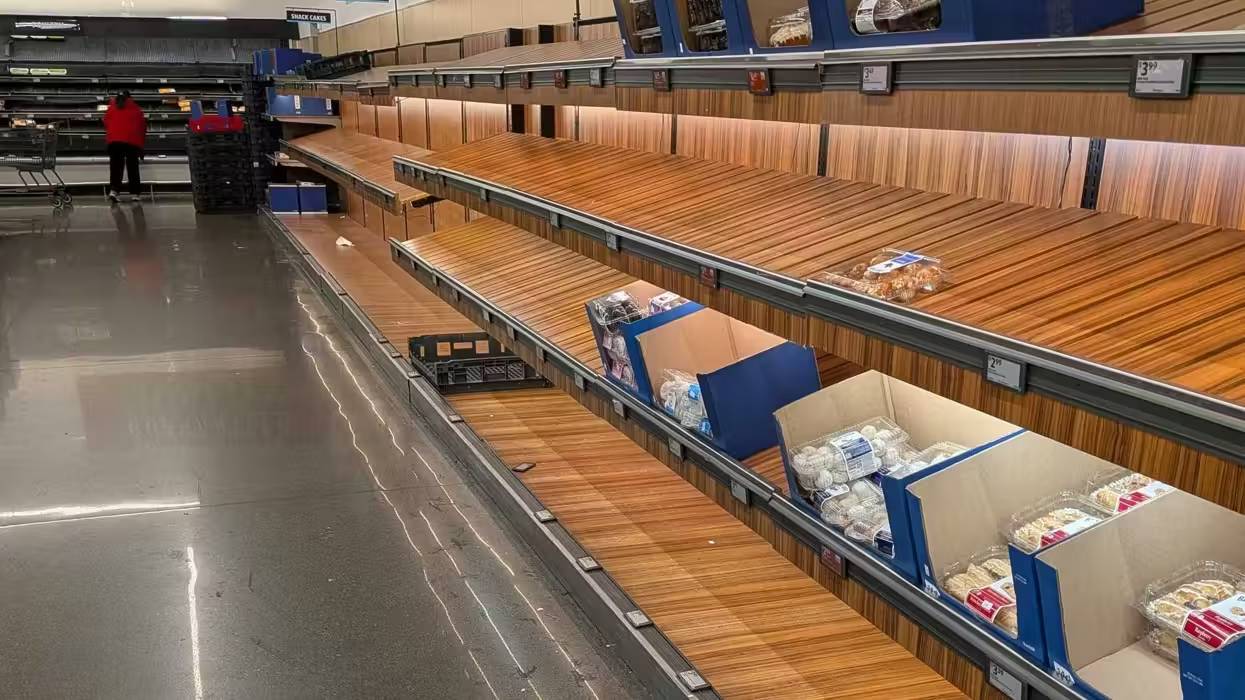 The shelf usually stocked with bread was almost entirely bare at AldiCooper Williamson
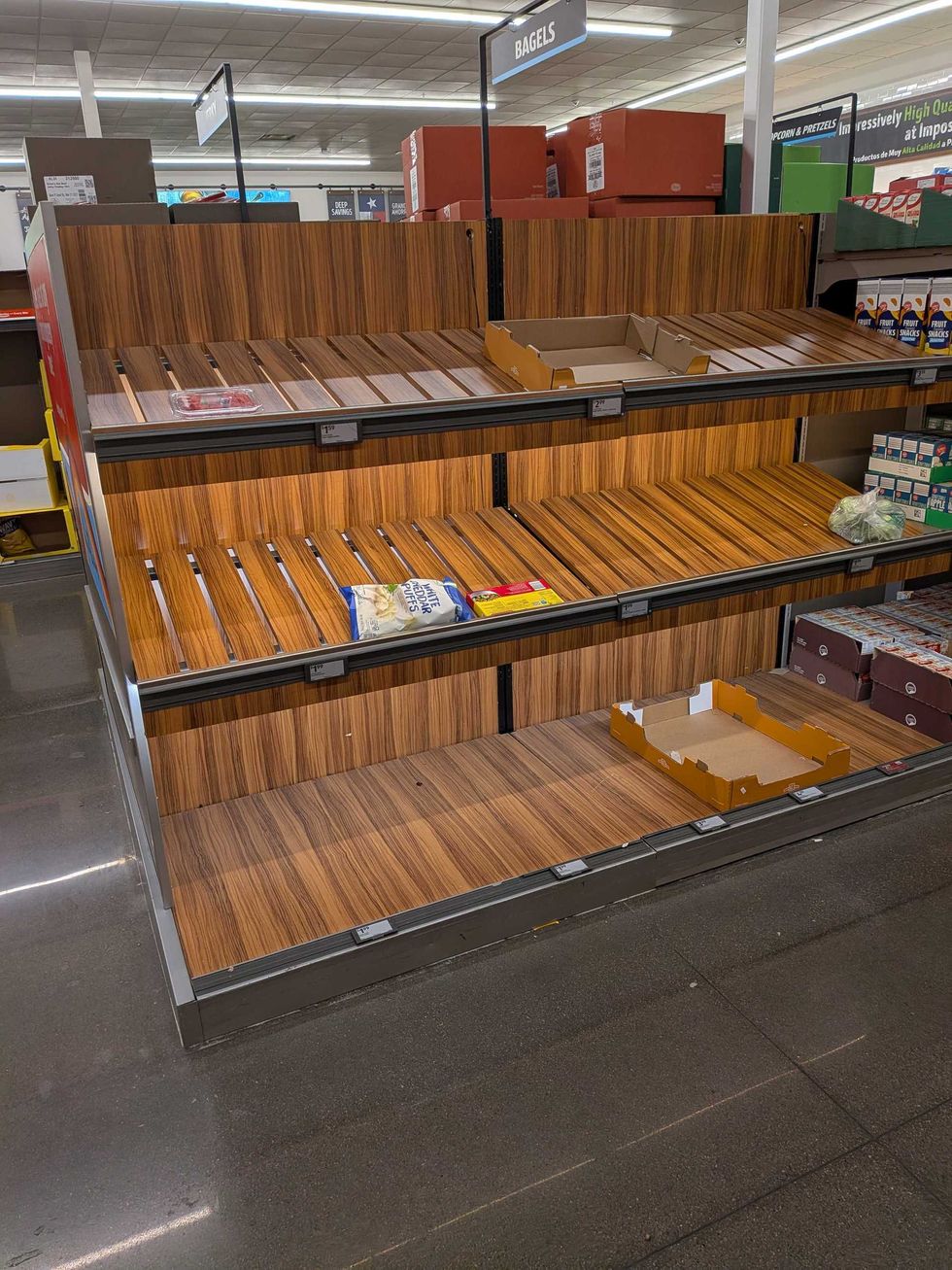 The bagel shelf, opposite the larger bread shelf, was similarly picked clean. Cooper Williamson
Before Aldi, I got most of my other groceries at Sam’s Club, which was packed but largely well stocked — except for the shopping carts. There were no shopping carts in the reserves at the entrance; they were all being used or in the parking lot.
As I waited in line for a slice of pizza before I began my shopping, I watched helplessly as a man snuck up and grabbed the cart that I had parked near the cafe. Back to the parking lot for another one.
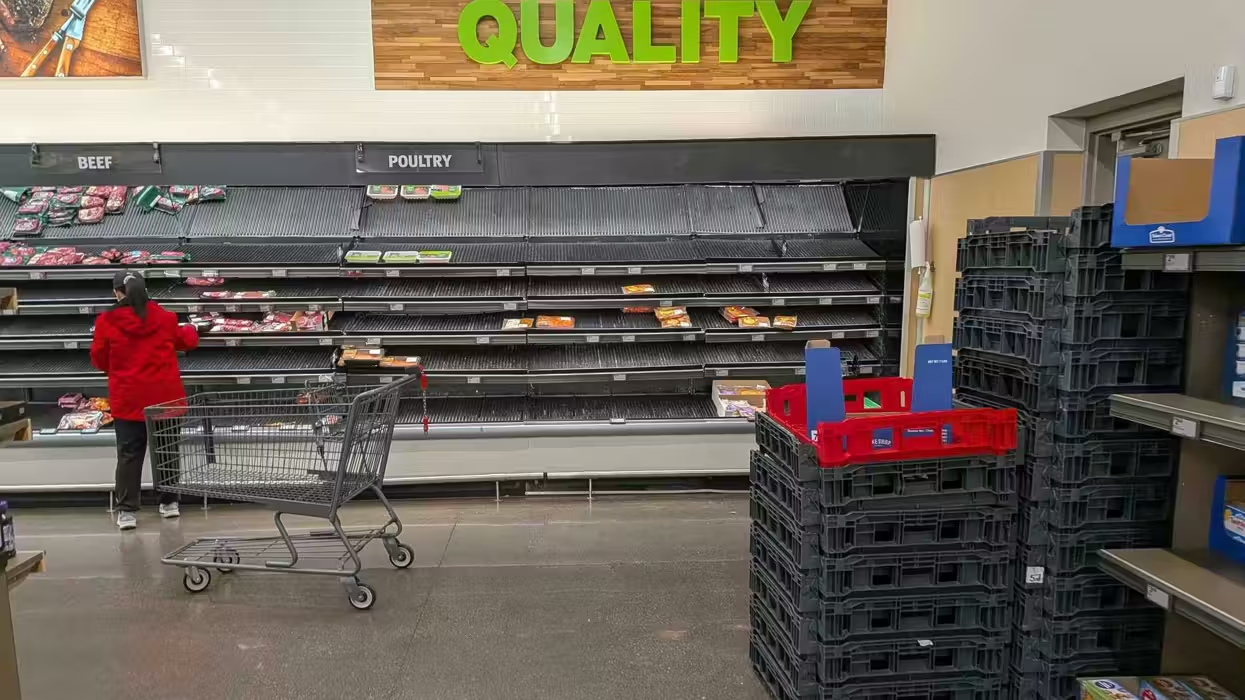 The meat aisle was nearly empty.Cooper Williamson
Luckily, I had done most of my shopping at Sam’s Club and didn’t need any sandwich materials. Aldi was nearly clean out of all of them.
RELATED: Here’s what SHOCKED liberals the most when they tried to panic-buy guns in California
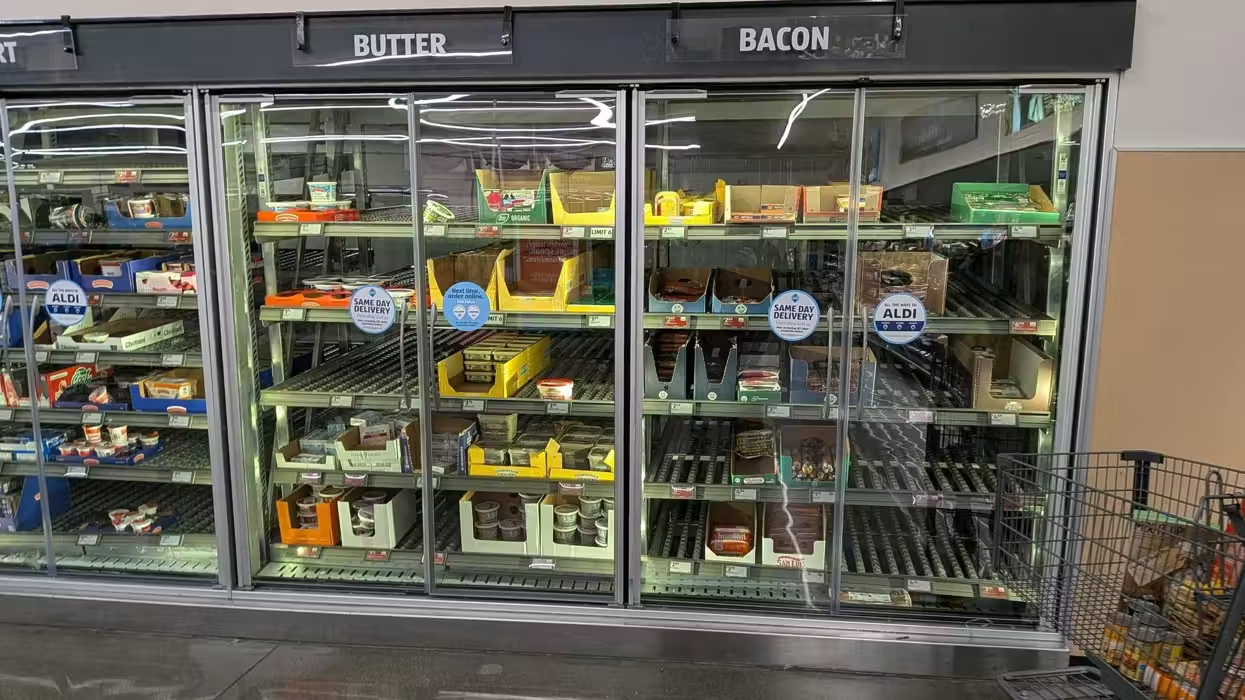 The bacon, butter, and yogurt sections.Cooper Williamson
But Sam’s wasn’t immune to the panic-buying hive mind that had overtaken all of Dallas. I was at Aldi because Sam’s too had been raided of all of its apples and bananas.
The best the stores had to offer at this point were some of the worst relatives of these coveted fruits.
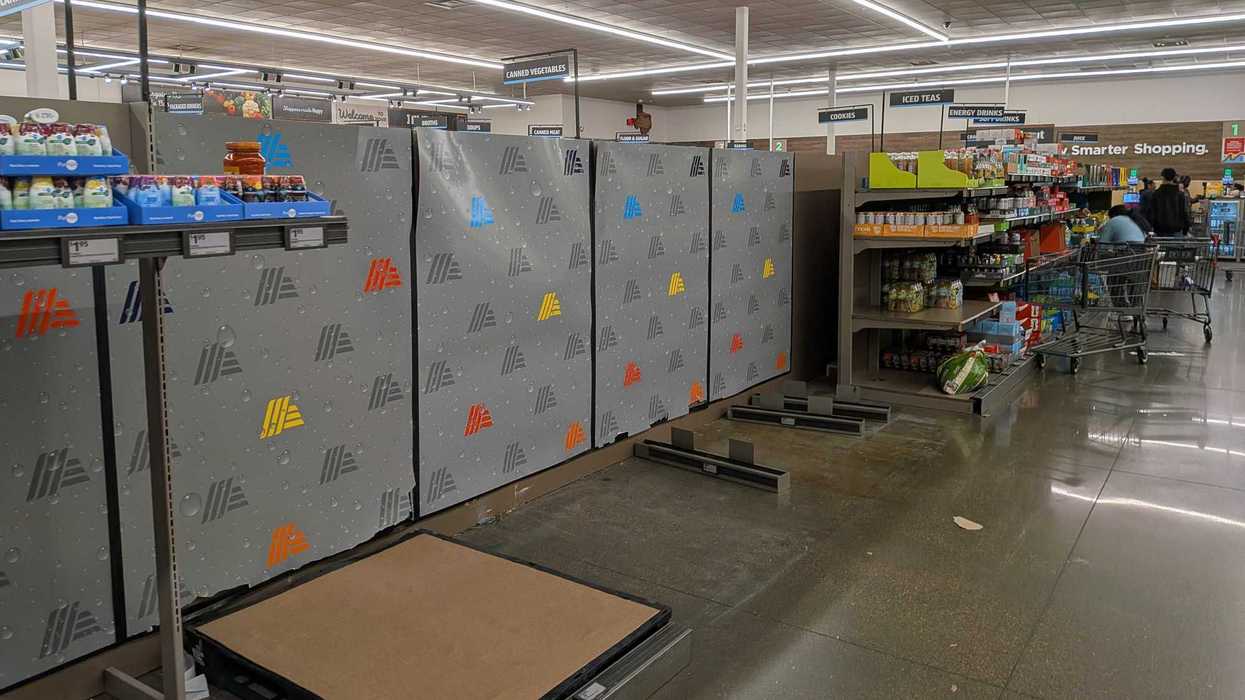 There was not a single case of bottled water left in the store. Cooper Williamson
From a distance, I thought I had found the key ingredient for my smoothies after much searching. However, to my disappointment, what I thought were bananas turned out to be plantains — and there were no bananas in the store whatsoever.
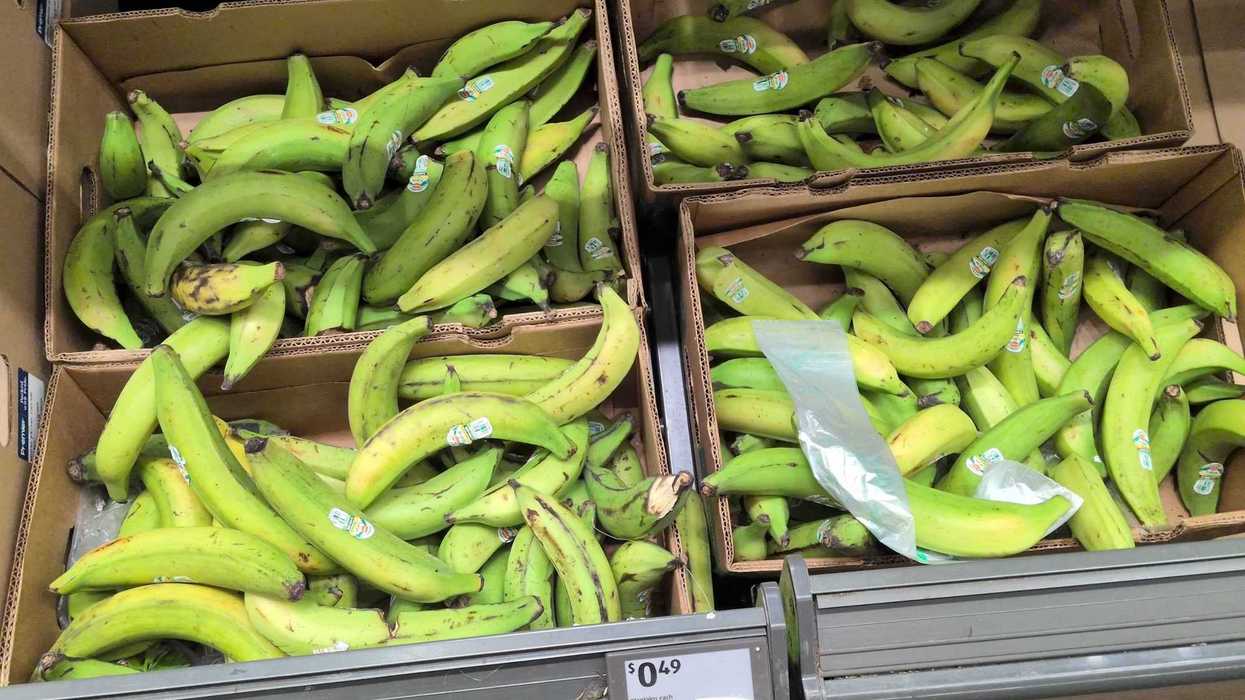 No bananas to be found in the grocery store; only some ripe plantains. Cooper Williamson
Despite my failure to find bananas at Aldi, I had come too far and would not be denied. I ventured to Walmart, which proved to be even more chaotic than Aldi.
Walmart
Forced to park all the way in the back of the parking lot due to the crowds, I didn’t know what to expect as I walked into Walmart. Walking in, however, I quickly surmised that it would be similar to, if not worse than, Aldi. I ended up looking around the aisles to see what people were grabbing at the highest rate. Here are some of the Dallas snowstorm preppers’ favorites.
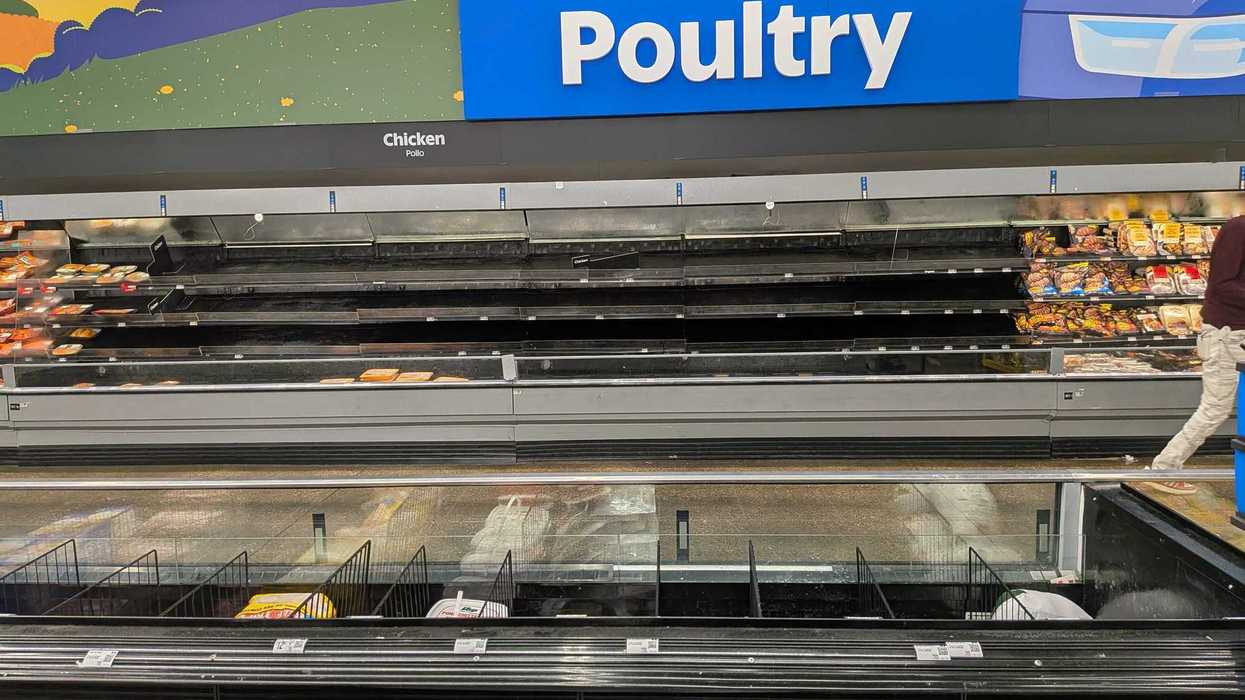 The poultry section was cleaned out. Cooper Williamson
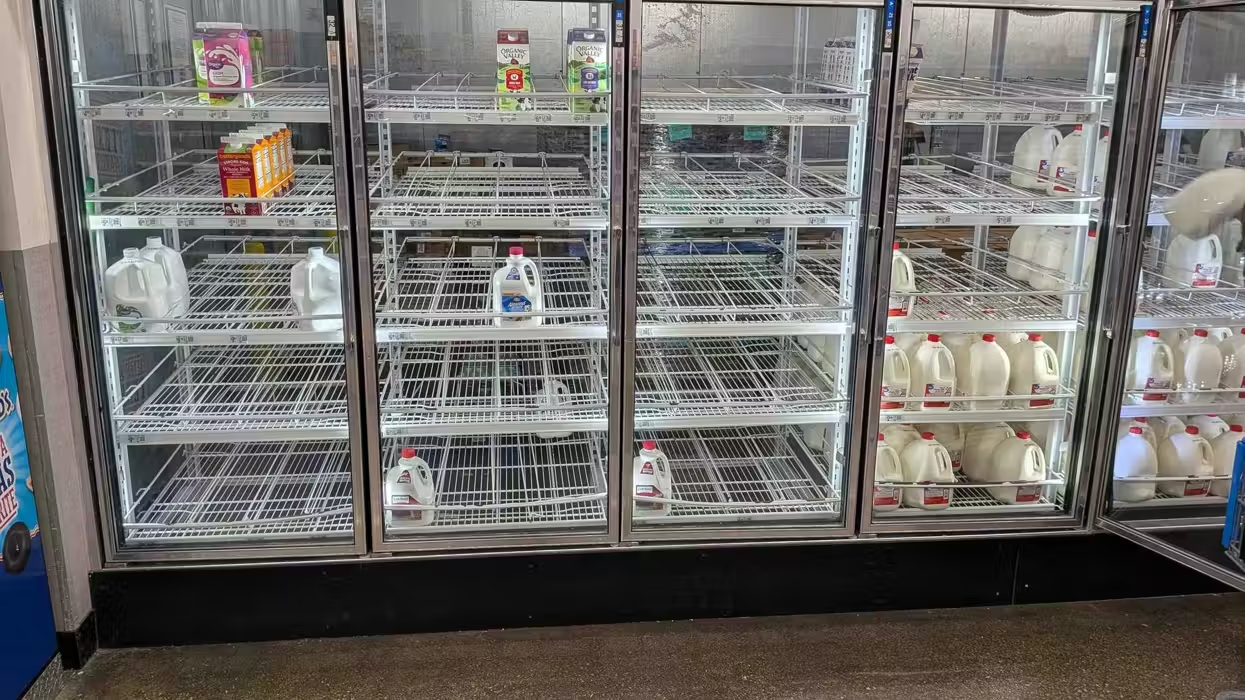 Several varieties of milk were missing. Cooper Williamson
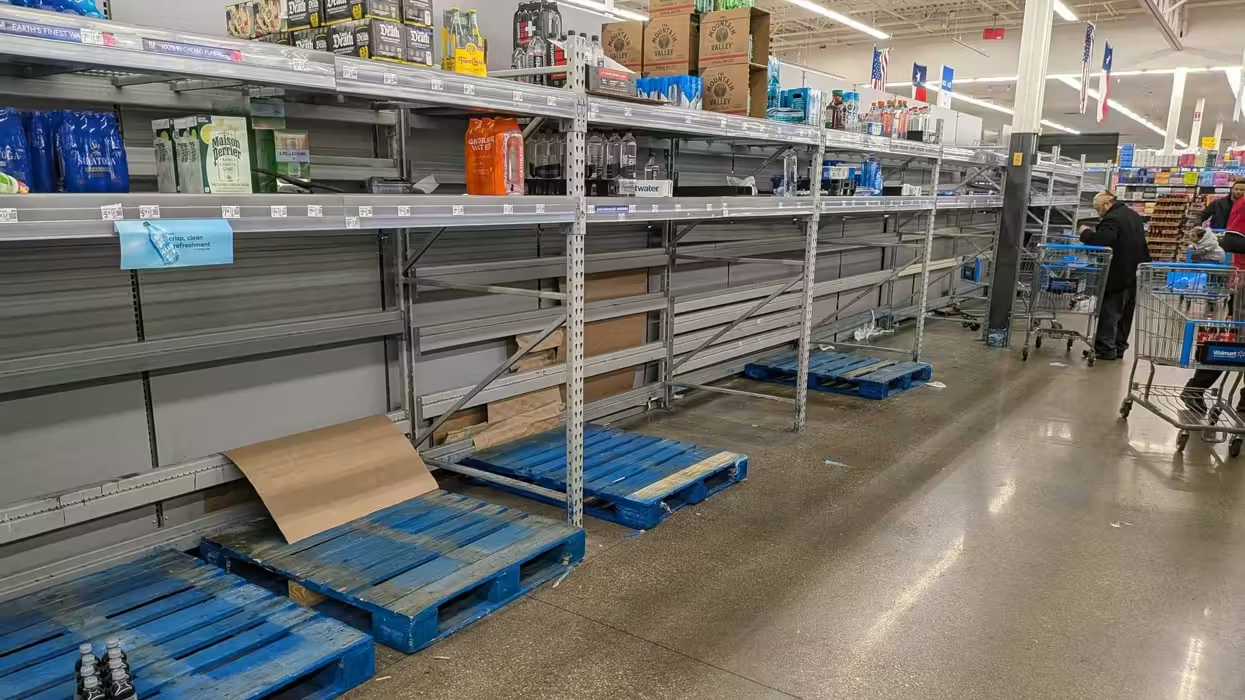 Like Aldi, the usually full aisle of bottled water packages was barren. Cooper Williamson
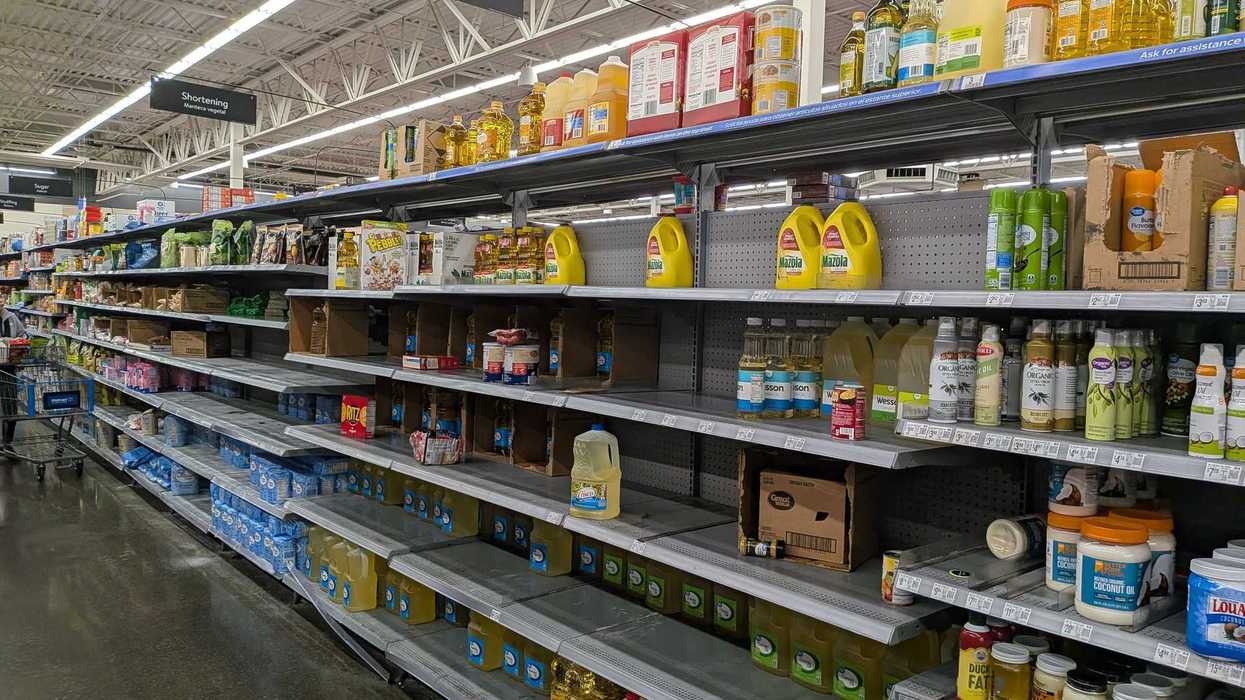 Americans love their vegetable oil. Cooper Williamson
Finally, I circled back to the produce section. At first, I was worried that I wouldn’t find any bananas when I saw entire shelves that looked like they had been raided hours before.
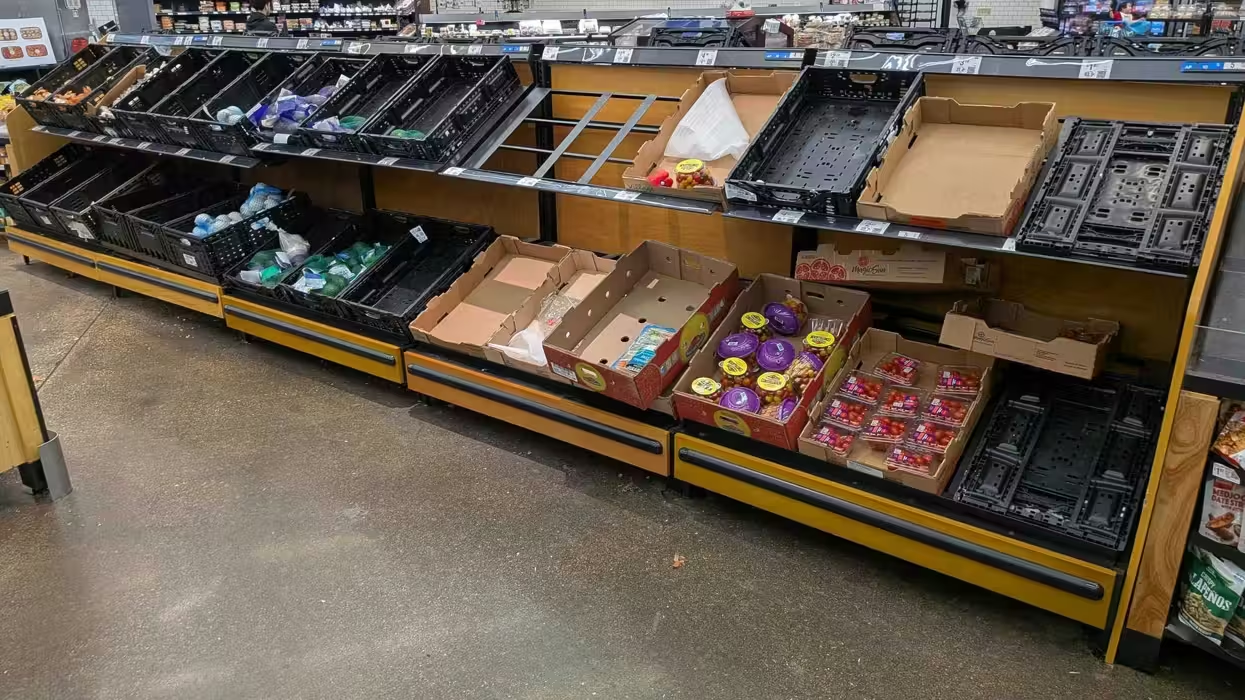 Crates of assorted fruits, some entirely empty. Cooper Williamson
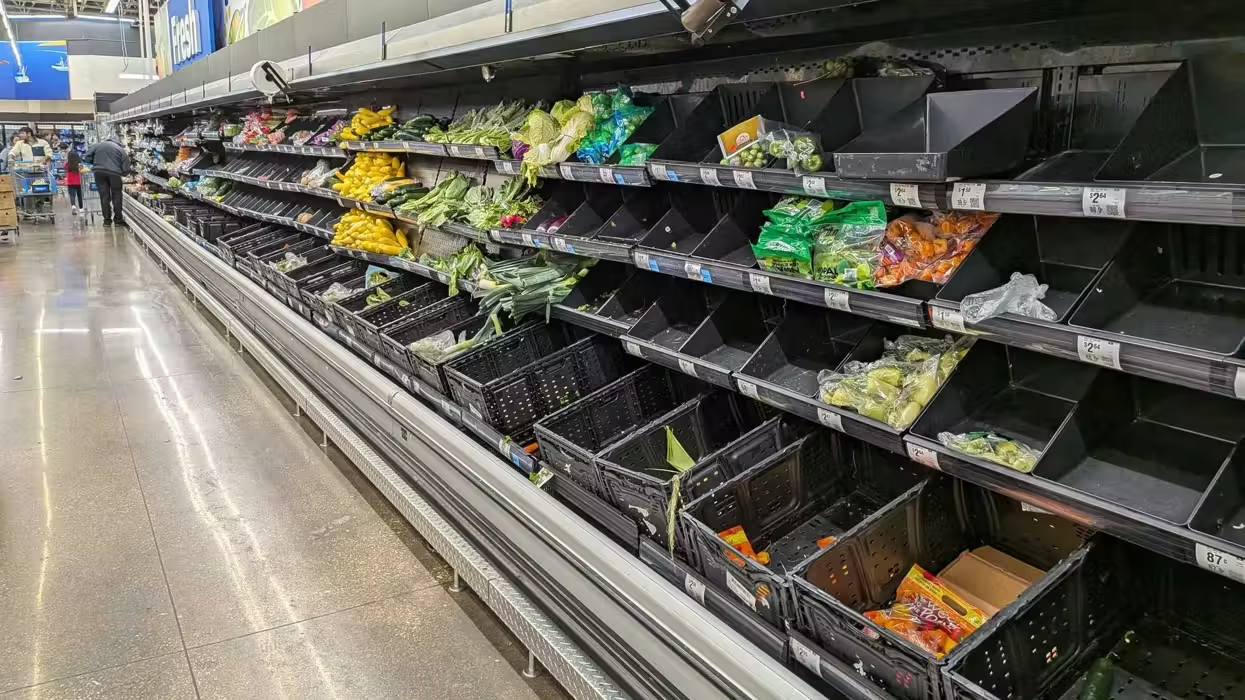 The vegetable display showed which vegetables Americans would be willing to part with for a week or so. Cooper Williamson
However, in the midst of the empty shelves sat a display of bananas. Even this display, though stocked, was missing half of its capacity.
Caught up in the exciting moment of discovery, I forgot to get a photo of them, though I gladly spent the 86 cents for a bunch and readily made my way home after a long five hours of shopping.
The panic consensus
As I sit here writing this article on the morning of January 23, sipping on a green smoothie (bananas, apples, and all), I wonder whether this is the new reality. I wonder whether every time the forecast warns of a snowstorm, Southern states like Texas will overreact like the last few times we have gotten a storm forecast.
I complained earlier that it took me most of an evening to get all of my shopping done. While it’s true that I am a picky eater and not a very efficient shopper, it is astounding that it took going to four stores (yes, I also went to the Kroger near the Aldi to get romaine and apples for the smoothie) over the course of five hours to find a bunch of bananas.
In bad weather, it is true that the roads are only as safe as the people driving the cars. Growing up in Colorado, a place that gets a lot more snow, I always found it strange that Texas can’t handle a few inches of snow. And I also don’t remember people panic-buying food and water like they were preparing for a hurricane before the pandemic.
Perhaps this is just another reminder that the preppers aren’t as crazy as people make them out to be. I certainly don’t want to repeat my quest to the grocery store on the eve of the next cold front moving through Dallas.
Like Blaze News? Bypass the censors, sign up for our newsletters, and get stories like this direct to your inbox. Sign up here!
Harvard Professor Calls Out University’s ‘Exclusion Of White Males’ In Scathing Public Resignation
‘Admitting a white male was ‘not happening this year”
Don’t Go Wobbly on China
As the sun rises on a new Trump-era geopolitical chapter, Washington confronts a defining choice: Will America view the People’s…
The Ghosts of Christmas Past
As Americans prepare for Christmas, they might recall that five years ago, government bureaucrats warned against holiday gatherings. Consider coronavirus…
Federal Prosecutors Who Indicted 78 Fraudsters Aren’t ‘Adding Value’ in Minnesota, St. Paul Mayor Says

The Democratic mayor of St. Paul, Melvin Carter, said federal officials aren’t “adding value” in Minnesota because it was the “state’s law enforcement presence” that uncovered the largest COVID fraud scheme in the country. Federal prosecutors have indicted 78 individuals associated with that fraud scheme, while the state has indicted 0.
The post Federal Prosecutors Who Indicted 78 Fraudsters Aren’t ‘Adding Value’ in Minnesota, St. Paul Mayor Says appeared first on .
‘Children Died’ And 20 Other Shocking Things An FDA Scientist Just Said About Covid Shots

 ‘Like many academic physicians, we felt the FDA and CDC abdicated their duty to the American people,’ Prasad wrote.
America’s new lost generation is looking for home — and finding the wrong ones
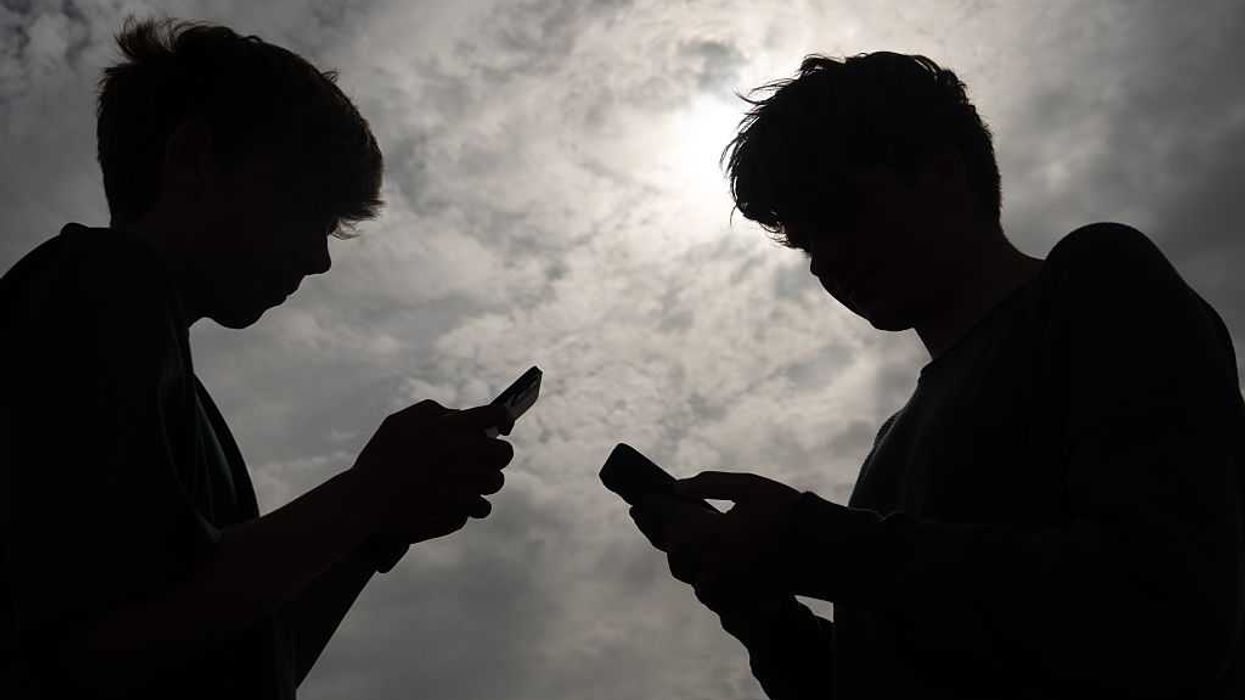
A friend who works with high school students recently said to me, “I overheard a group of boys talking about ‘international Jewry.’” He was in disbelief to hear these seemingly mild-mannered kids express views that, not 20 years ago, would have been considered taboo.
What is going on with Gen Z?
I have written elsewhere that Gen Z is experiencing a kind of church resurgence. That remains true. But at the same time, Gen Z is one of the most polarized generations in American history.
Social systems that seek to reorient reality by means of uprooting history and tradition will ultimately create a rootless and disaffected class in search of belonging.
In 2024, Gen Z — led in part by young activists like Charlie Kirk and Scott Presler — shifted toward Donald Trump. He won 46% of Gen Z voters — 56% of young men and 40% of young women. This led many to expect that a younger, more populist generation would shift the country rightward. But now in 2025, the self-proclaimed Democratic Socialist Zohran Mamdani won 78% of the youth vote in New York City — 67% of young men and 84% of young women. Far from being locked into any one existing political party, young people are more divided than ever.
One cause of this is what I call “nomadic progressivism.” Kids born between, say, 1997 and 2012 have been thoroughly inundated with progressivism and identity politics from birth. They came of age amid several key developments that shaped their moral and social formation:
- The Supreme Court’s Obergefell v. Hodges decision in 2015 and the legalization of same-sex marriage.
- The killing of Trayvon Martin and the rise of Black Lives Matter.
- The surge of transgender activism that dominated headlines in the early 2020s.
- The appearance of Greta Thunberg and the new climate movement.
- The explosive growth of Facebook, Twitter, Snapchat, Instagram, and Vine.
We could list hundreds of others, but these movements captured Gen Z’s moral imagination. Each sought, in the name of justice or progress, to undermine the inherited order, replacing the inherited structures of culture with moral and social uncertainty.
Gen Z grew up bullied by progressive ideology, and until the shocking election of Donald Trump in 2016, there was no visible reaction. Society appeared to be marching unopposed toward progressive utopia. But Trump’s election broke the spell. His first term was marked by protests, the rise of transgender ideology, and a wave of social revolt.
Then came COVID-19. As the left preached “safety,” Gen Z was locked inside, immersed in a digital environment, and wracked by depression and anxiety. Created for engagement and real community, young people were instead sent to their rooms and told to stay there.
This, I believe, is the key: Progressivism prepared the soil for radicalization. It removed the roots — churches, families, communities — that once grounded Gen Z’s moral life. It left young people searching for belonging in a barren landscape.
The philosopher and novelist Simone Weil wrote in “The Need for Roots” that “human beings have roots by virtue of their real, active, and natural participation in the life of a community, which preserves in living shape particular treasures of the past and particular expectations for the future.” When that participation is stripped away, people search for roots elsewhere.
For Gen Z women, that search often led to Instagram and other social media platforms. They heard celebrities and influencers denounce the status quo. They were told marriage was oppressive, men were vile, and independence was the highest good. But that “empowerment” was often just loneliness in disguise.
RELATED: Young, broke, and voting blue: 2025’s harsh lesson for the right
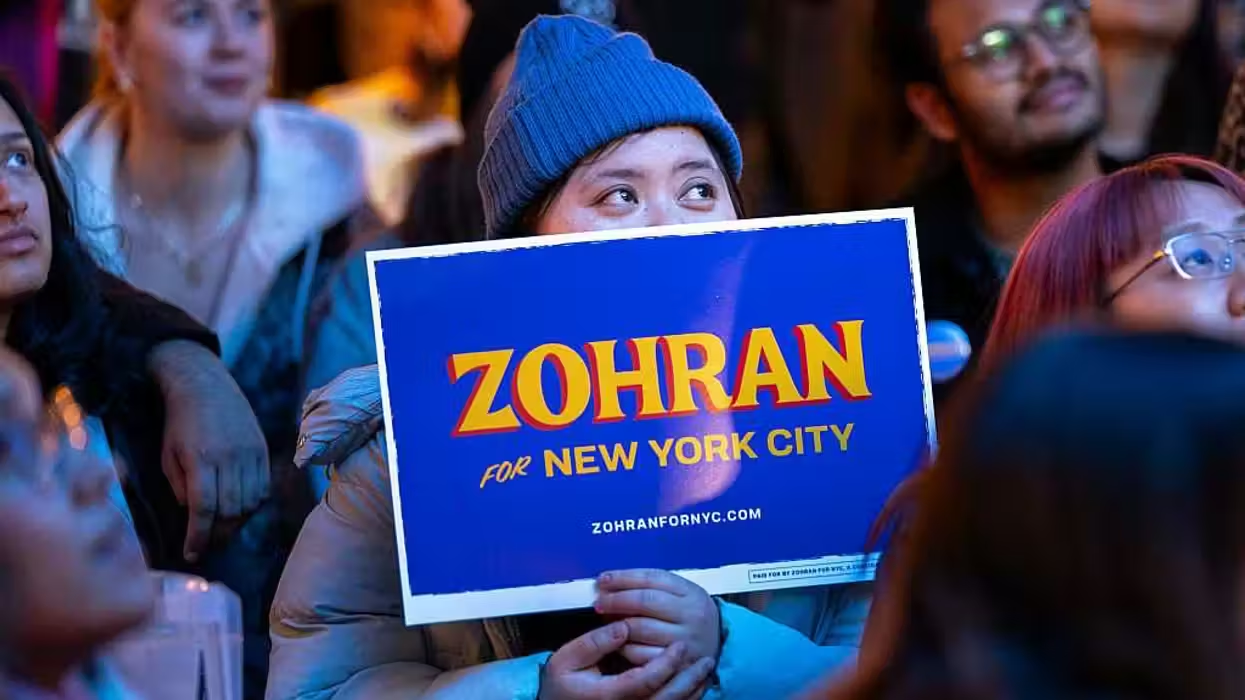 Photo by Jeremy Weine/Getty Images
As for Gen Z men, constant ridicule and belittlement left them disoriented. Why invest in a society that despises you? Why build what the world condemns? In this vacuum arose the “manosphere.” Figures like Andrew Tate offered refuge. They told men it was OK to be men — and as they were among the only ones saying so, they had free rein to define what it meant. If honor, discipline, and respectful courtship were only going to get you mocked and condemned, manosphere influencers reasoned that you might as well double down on boorishness, lust, and aggression.
As distrust of the government and institutions grew, young men turned elsewhere for truth. In gnostic fashion, figures like Nick Fuentes promised to reveal “how things really are.” But as Christopher Rufo has noted, it is a ruse. Fuentes exploits the crisis of masculinity to peddle resentment and historical denialism. Progressive Gen Z women, seeking fulfillment in the depths of the online space, are little different from the young men seeking connection and meaning from those like Fuentes.
Gen Z is a generation longing for roots. Its members are trying to find them on the fringes of society, since their own roots were dug out years ago. Progressivism creates nomads. Social systems that seek to reorient reality by means of uprooting history and tradition will ultimately create a rootless and disaffected class in search of belonging. And they will find it in dark places.
The men and women of Gen Z are not uniquely radical. They are uniquely rootless. They have inherited a moral landscape stripped of shared meaning, through which they drift amid ideologies that promise belonging but deliver only bitterness. The progressive order unmoored them; now the reactionary order recruits them. And unless a deeper renewal of faith, family, and community takes root, this generation will continue to wander — searching for the very home that modernity taught them to forget.
Editor’s note: A version of this article appeared originally at the American Mind.