

Category: Google
Data Centers Are an Easy Scapegoat for Failing Electrical Grids
Data centers are easy targets. They require large amounts of water, electricity, and land. They’re an eyesore. Of the 3,907…
Google’s new motto: Don’t be Christian

Google once had an informal motto: “Don’t be evil.” How about be ideologically driven? Opaque? Arbitrary?
Google sells itself as online Switzerland — a neutral search engine that doesn’t tilt one way or the other. That neutrality vanishes fast when you search for something its algorithm doesn’t like. Suddenly the thing you want becomes strangely hard to find unless you already know exactly where it lives. If you don’t, good luck.
You can’t fix what you’re not allowed to understand.
And good luck advertising it, too — if Google disapproves.
Most people still think of Google as a search engine. That’s outdated. Google is the 900-pound gorilla of online advertising through Google Ads. It has vacuumed up so much of the market that anyone who wants to advertise online usually has to go through Google’s pipeline, under Google’s terms, with Google acting as judge and jury.
This isn’t the print era, when advertisers bought space from newspapers and magazines directly, publication by publication. Today, a huge share of the ad economy runs through a single gatekeeper.
Some might call that a monopoly. Monopolies become even more dangerous when they turn ideological.
Google — and it is far from alone — leans hard left. It dislikes conservative and Christian content, and it has learned how to suppress it without leaving fingerprints. It buries the content in search rankings so that almost no one sees it unless they already know where to look. It throttles monetization. It blocks ads with vague warnings and “policy” language designed to end the conversation.
Google and TikTok now appear to be doing the same thing to faith-based content.
Have you heard of TruPlay? Probably not. That’s the point.
TruPlay is an entertainment app that offers faith-based games and videos for kids. It’s explicitly family-friendly — no sexual themes, no violence, no garbage disguised as “content.” Parents want that. Millions of them. There’s a market for wholesome screen time, and there’s money to be made providing it.
But according to the American Center for Law and Justice, Google has refused to do business with TruPlay for ideological reasons. The ACLJ says Google rejected TruPlay’s efforts to launch advertising campaigns, citing “religious belief in personalized advertising.”
Read that again. Google flagged religious belief as the problem.
The ACLJ says TruPlay tried to comply, filing appeals and revising its ad content repeatedly, only to receive the same rejection notices no matter what changes it made. The ads weren’t inflammatory. They were straightforward: “Turn Game Time into God Time,” “Christian Games for Kids,” “Safe Bible Games for Kids.”
Google’s policy supposedly prohibits “selecting an audience based on sensitive information, such as health information or religious beliefs.” But TruPlay wasn’t targeting a religious audience or harvesting private data. It was advertising Christian kids’ content to the general public.
Google’s response wasn’t “you’re targeting.” It was “your content is too sensitive to advertise.”
That’s the move. “Sensitive” once meant porn, violence, or content not suitable for children. Now it means “Christian games for kids.”
TikTok, the ACLJ says, applied the same logic with even less transparency. The platform allegedly suspended TruPlay’s advertising account over unspecified “repeated violations,” without explaining what those violations were. The ACLJ says one rejected ad contained the word “church.” Another issue allegedly involved an App Store preview image showing Jesus on the cross — not in the ad itself, but in the app’s images. The ACLJ claims TikTok barred advertising anyway.
RELATED: Google’s new plan: To learn everything about you from your online shopping
 Photo by Idrees MOHAMMED/AFP via Getty Images
You can’t fix what you’re not allowed to understand. That’s the point of opacity. You don’t get a rule you can follow. You get a verdict.
What makes this even more revealing is the economic angle. This isn’t Google or TikTok avoiding ads that risk scaring off customers. TruPlay offers the kind of content parents actively want. Platforms should want that money. Instead, they appear willing to lose revenue just to suppress anything overtly Christian and family-friendly.
The ACLJ has sent a letter to Rep. Jim Jordan (R-Ohio), chairman of the House Judiciary Committee, urging an investigation into what it calls “systemic discrimination” against Christian content creators and advertisers — part of a broader pattern of viewpoint-based censorship.
Google and TikTok will respond with the standard defense: We’re private companies. We can do what we want.
Fine. But stop pretending you’re Switzerland. If you present yourself as a neutral platform open to all, while quietly functioning as a political gatekeeper, you don’t get to hide behind the language of neutrality when people notice the double standard.
You can’t have it both ways. Either you’re Switzerland — or you’re not.
Google and TikTok are not. It’s time to treat them accordingly.
Google’s new plan: To learn everything about you from your online shopping

At some point, Google went from “don’t be evil” to “never mind.” The evidence is in its latest, duplicitous, and deceptive set of control mechanisms over online commerce.
Google’s vision involves a Universal Commerce Protocol, which allows its AI to access retailer client histories on its customers (all without human acknowledgment or accountability). The Universal Commerce Protocol leverages its shopper data to monitor and cross-reference between retailers the habits of individuals and adjust prices based on the AI bot’s understanding/projection of the shopper’s financial, personal, and psychological situation.
What seems to be happening is that online retailers have taken the AI bait. They’ve been sold on the purchase, implementation, and reliance upon so-called AI agents, which are designed to handle all possible aspects of internet commerce. It feels inevitable even though it isn’t. Either way, it’s happening. Our internet experience, even now, is being massively overwritten to effect the least-human outcomes possible.
Its grabbing up of data is cloaked, misdirected, or buried under mountains of legalese or made intentionally difficult to ascertain.
The truth is there’s been negligible-to-nonexistent customer service for most big corporations for almost a decade. Lose a box with Fed Ex and try to get an English-speaking human on the phone if you doubt this assertion. The differences in the now-unfolding AI era are mainly going to come down to the fact that whereas once a human was involved somewhere in the online experience, the new era will be almost entirely bot-derived, bot-managed, and bot-determined.
According to Lindsay Owens, who breaks all this down in a viral X post, “As one Google exec explained, it allows retailers to ‘offer custom deals to specific shoppers.’ If you’ve granted consent or the agent identifies you via identity linking, Direct Offers uses your conversation to trigger specific offers. At first it might recognize you as a ‘high value’ customer and show you a 30% coupon instead of 10%, without having to extend the same thing to everybody. But Google says the plan is to use the agent’s persuasive power to encourage shoppers to ‘prioritize value over price.’ Put simply, not only does it want you to spend more, it targets you specifically as someone likely to agree to it.”
RELATED: Google has had access to your docs longer than you realize. Here’s how to kick it out.
 Photo by Samuel Boivin/NurPhoto via Getty Images
For Google, which despite making everyone angry and churning out increasingly less impressive products for the last decade, the move from not evil to blithely diabolical is proved out insofar as all of its grabbing up of data is cloaked, misdirected, or buried under mountains of legalese or made intentionally difficult to ascertain. Legerdemain involving layering, shunting, enveloping, winding, and overly technical language is everywhere in the description of its Universal Protocol, and levels of fleecing the client heretofore unimaginable are now standard in the era of no responsibility or accountability corporate AI.
Owens, the executive director of Groundwork, a Washington, D.C.-based organization build to “change economic policy and narrative in order to build public power, break up concentrations of private power, and deliver true opportunity,” finishes her epic X thread with a stark conclusion. “By bundling Google ad targeting and conversational data with retailer history and third-party broker profiles, the Agent creates a perfect surveillance feedback loop. And Google isn’t the only one building wallet-seeking chatbot missiles.”
The ruthless logic of “line go up” has been coded into the machines we have come to depend upon, and resale of the data ensures the obliteration of privacy. Of course, we were warned innumerable times about this inevitability, but the shocking facts point to our complicity, or docility, with respect to even caring about the obliteration.
Google’s new plan: To learn everything about you from your online shopping
At some point, Google went from “don’t be evil” to “never mind.” The evidence is in its latest, duplicitous, and deceptive set of control mechanisms over online commerce.
Google’s vision involves a Universal Commerce Protocol, which allows its AI to access retailer client histories on its customers (all without human acknowledgment or accountability). The Universal Commerce Protocol leverages its shopper data to monitor and cross-reference between retailers the habits of individuals and adjust prices based on the AI bot’s understanding/projection of the shopper’s financial, personal, and psychological situation.
What seems to be happening is that online retailers have taken the AI bait. They’ve been sold on the purchase, implementation, and reliance upon so-called AI agents, which are designed to handle all possible aspects of internet commerce. It feels inevitable even though it isn’t. Either way, it’s happening. Our internet experience, even now, is being massively overwritten to effect the least-human outcomes possible.
Its grabbing up of data is cloaked, misdirected, or buried under mountains of legalese or made intentionally difficult to ascertain.
The truth is there’s been negligible-to-nonexistent customer service for most big corporations for almost a decade. Lose a box with Fed Ex and try to get an English-speaking human on the phone if you doubt this assertion. The differences in the now-unfolding AI era are mainly going to come down to the fact that whereas once a human was involved somewhere in the online experience, the new era will be almost entirely bot-derived, bot-managed, and bot-determined.
According to Lindsay Owens, who breaks all this down in a viral X post, “As one Google exec explained, it allows retailers to ‘offer custom deals to specific shoppers.’ If you’ve granted consent or the agent identifies you via identity linking, Direct Offers uses your conversation to trigger specific offers. At first it might recognize you as a ‘high value’ customer and show you a 30% coupon instead of 10%, without having to extend the same thing to everybody. But Google says the plan is to use the agent’s persuasive power to encourage shoppers to ‘prioritize value over price.’ Put simply, not only does it want you to spend more, it targets you specifically as someone likely to agree to it.”
RELATED: Google has had access to your docs longer than you realize. Here’s how to kick it out.
Photo by Samuel Boivin/NurPhoto via Getty Images
For Google, which despite making everyone angry and churning out increasingly less impressive products for the last decade, the move from not evil to blithely diabolical is proved out insofar as all of its grabbing up of data is cloaked, misdirected, or buried under mountains of legalese or made intentionally difficult to ascertain. Legerdemain involving layering, shunting, enveloping, winding, and overly technical language is everywhere in the description of its Universal Protocol, and levels of fleecing the client heretofore unimaginable are now standard in the era of no responsibility or accountability corporate AI.
Owens, the executive director of Groundwork, a Washington, D.C.-based organization build to “change economic policy and narrative in order to build public power, break up concentrations of private power, and deliver true opportunity,” finishes her epic X thread with a stark conclusion. “By bundling Google ad targeting and conversational data with retailer history and third-party broker profiles, the Agent creates a perfect surveillance feedback loop. And Google isn’t the only one building wallet-seeking chatbot missiles.”
The ruthless logic of “line go up” has been coded into the machines we have come to depend upon, and resale of the data ensures the obliteration of privacy. Of course, we were warned innumerable times about this inevitability, but the shocking facts point to our complicity, or docility, with respect to even caring about the obliteration.
Google Email Tells 13-Year-Olds How To Disable Parental Controls
‘Most predatory corporate practices I have seen’
Congress takes aim at online harms — and misses the center mass

On December 11, 18 child online safety bills took a significant step toward becoming law. The package — each bill addressing, in some way, the harms children face online — passed out of a House subcommittee on a mostly party-line vote. The legislative bundle is, overall, a somewhat milquetoast mix of meaningful wins and frustrating defeats for child safety advocates. Still, it represents real progress. For those who have long pushed for action, the ball has finally moved down the field.
The bills vary dramatically in scope. Some, like the Assessing Safety Tools for Parents and Minors Act, would simply mandate an analytical report on the efforts technology companies are making to protect children. Others, such as the App Store Accountability Act — which would require app stores to determine whether a user is a minor and, if so, prohibit downloads without parental consent — are far more consequential, fundamentally changing how app stores operate.
Advancing 18 bills signals that one of the longest-standing objections to action — whether social media actually harms children — has effectively collapsed.
There are also bittersweet elements. The most well-known and controversial bill, the Kids Online Safety Act, is included in the package — but in a significantly watered-down form. The original version, introduced by Sen. Marsha Blackburn (R-Tenn.), passed the Senate with more than 90 votes. But House GOP leadership raised constitutional concerns, arguing that the bill placed undue pressure on social media companies to regulate speech.
House Majority Leader Steve Scalise (R-La.), one of the bill’s most prominent opponents, warned that it would “empower dangerous people.” Other critics likened KOSA to the British Online Safety Act — a far more draconian law than its American counterpart. (The most recent Senate version of KOSA focuses on disabling addictive features and restricting minors’ access to dangerous content.)
These concerns forced substantial revisions. Most notably, the bill now includes a sweeping pre-emption clause barring states from regulating anything that “relates” to KOSA — effectively nullifying existing and future state-level efforts to protect children online.
Equally disappointing is what failed to make the cut.
Some excluded proposals were undeniably radical, such as the RESET Act, which would have barred minors from creating or maintaining social media accounts altogether. But another bill left behind — the App Store Freedom Act — was critical to restoring competition and accountability in the app ecosystem.
That legislation would have challenged the Apple-Google duopoly, which controls more than 90% of app store purchases in the United States. As long as those two companies dominate the marketplace, meaningful reform will remain elusive. Unsurprisingly, both firms opposed the bill, arguing that it would “endanger” children by allowing downloads from unvetted third-party stores.
Rep. Kat Cammack (R-Fla.), the bill’s sponsor, blasted that claim, noting that Apple has long permitted minors to download TikTok — a platform run by a Chinese company with well-documented national security concerns.
RELATED: Schools made boys the villain. The internet gave them a hero.
 Image by Alexandr Muşuc via iStock / Getty Images
Despite its importance, the App Store Freedom Act was removed from the package. Even so, the remaining legislation still marks a major victory for those focused on protecting children online.
Here’s why.
First, advancing 18 bills signals that one of the longest-standing objections to action — whether social media actually harms children — has effectively collapsed.
For years, lawmakers debated whether digital platforms were the problem or whether other factors deserved the blame. A steady stream of studies, headlines, and internal leaks showing that social media companies knew their products damaged adolescent mental health helped put that question to rest.
Second, the breadth of the package ensures that something will happen. Even the weakest provisions — those requiring studies or reports — will energize advocates and help bring order to what remains a digital Wild West for children and families.
The legislative fight is far from over. The bills must still clear committee, pass the House, and survive the Senate. But momentum is clearly shifting toward reform.
It’s time to finish the fight.
This new malware wants to drain your bank account for the holidays. Here’s how to stay safe.

Android security has come a long way since the early days, thanks largely to Google’s broad suite of virus-busting tools, like Play Protect for apps, Safe Browsing for the web, and the Advanced Protection Program for Google accounts. However, malware can still infect devices from time to time, and the latest threat aims to infiltrate your bank account just before the holidays.
The threat
Dubbed Sturnus, this latest Android threat is a classic Trojan horse malware that bypasses Android’s security protections to gain access to a target device. Once inside, a hacker can spy on your conversations in popular chat apps — like Signal, Telegram, and WhatsApp — and even mimic your bank’s login screen to trick you into handing over your bank login and password.
What makes this malware especially tricky lies in its sophistication. Sturnus doesn’t break the encryption found in the popular apps listed above. Instead it exploits Android’s native accessibility features to view, detect, and record data shown on your screen. The malware even comes with uninstall protection, making it harder to remove from a device once infected.
Here are some things you can do to make sure your Android phone is protected from Sturnus.
How to know if your phone is infected with Sturnus
Sturnus is especially dangerous because it runs completely undetected. There’s currently no way to know for sure that the malware is installed on your device. It could be lurking in your phone right now!
But don’t panic just yet. You’re less likely to be infected if either of these apply to you:
First, Sturnus is only transmitted through downloading and installing an Android app (an APK file, also known as an Android Application Package) directly to your phone. More than that, the infected APK file has to come from a third-party source outside of the Google Play Store — either in an attachment sent through a spam message or via a third-party app store. In a statement provided to Android Authority, Google confirmed that all Android users who strictly download apps from the Google Play Store are safe:
Based on our current detection, no apps containing this malware are found on Google Play. Android users are automatically protected against known versions of this malware by Google Play Protect, which is on by default on Android devices with Google Play Services. Google Play Protect can warn users or block apps known to exhibit malicious behavior, even when those apps come from sources outside of Play.
Second, Sturnus has only been detected in devices based in South and Central Europe so far. Users in the United States aren’t under any direct threat right now, but this could change as we get further into the holidays.
How to prevent Sturnus from infecting your phone
Just to be safe, there are some things you can do to make sure your Android phone is protected from Sturnus or any other downloadable security threat.
Google Play Protect
Make sure Google Play Protect is on. This feature regularly scans the apps downloaded to your phone and checks them for “harmful behavior,” including viruses and malware. To enable Play Protect, open the Google Play Store app on your phone, tap your profile picture in the top right corner, then Play Protect. Make sure it’s turned on.
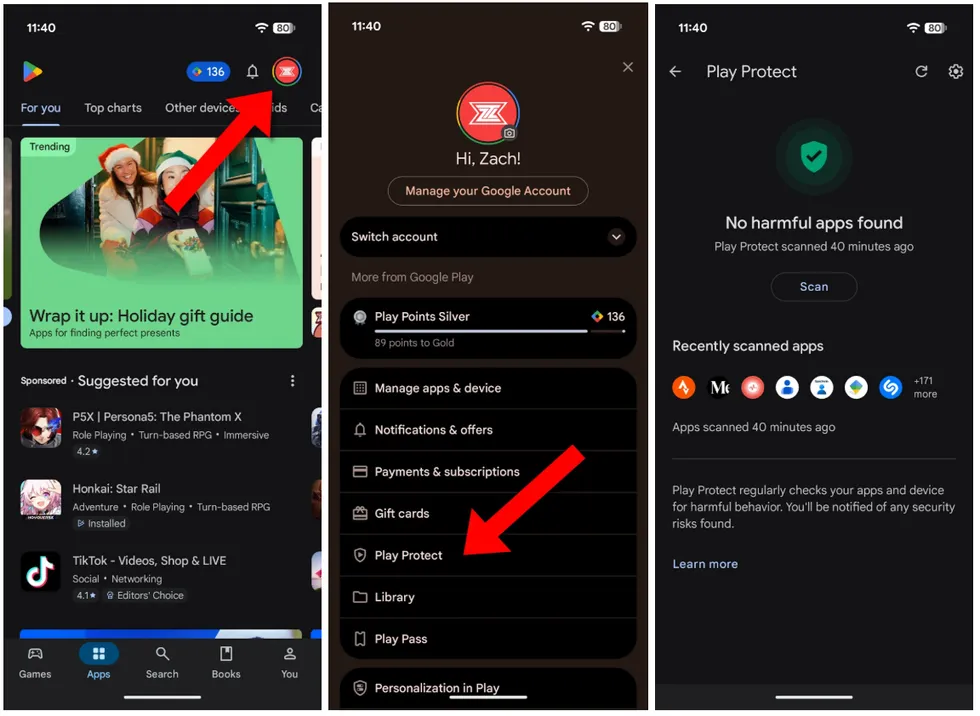 Screenshots by Zach Laidlaw
Disable ‘Install unknown apps’
The Google Play Store is the default app store found on most Android devices sold in the U.S. Although Android phones can download apps from other sources, most of them ship with this feature turned off by default. Still with Sturnus going around, it’s a good idea to check to make sure your phone can’t accidentally sideload an app from a dubious corner of the internet.
If you have a Samsung Galaxy phone, open the Settings app, tap on “Security and privacy,” then “More security settings,” and finally “Install unknown apps.” Make sure every app on this page is unchecked.
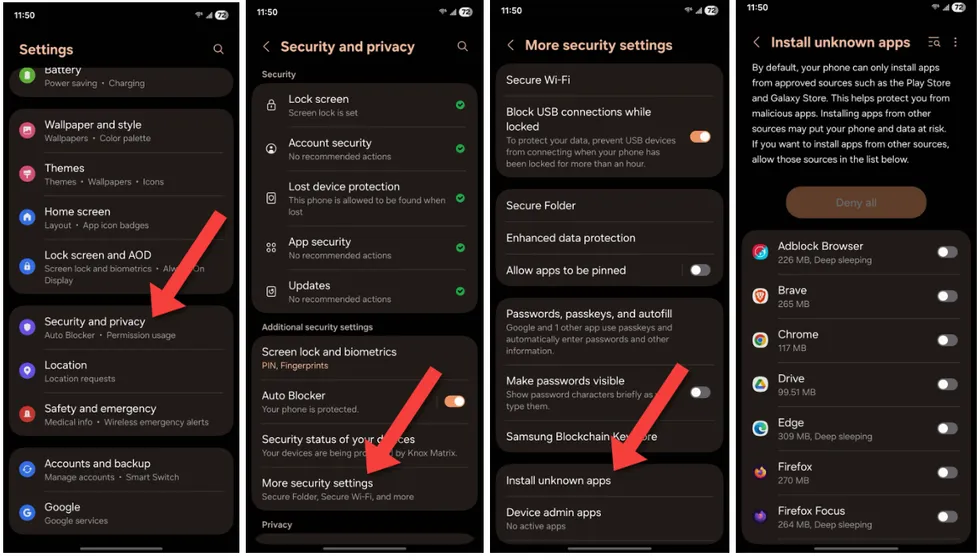 Screenshots by Zach Laidlaw
If you have a Google Pixel phone, open the Settings app, tap on “Apps,” then “Special app access,” and lastly “Install unknown apps.” As with Samsung, make sure every app on this page is disabled.
 Screenshots by Zach Laidlaw
For those with other-branded Androids, you should be able to find this feature by opening your Settings app and typing “install unknown apps” into the search bar. As with the devices above, make sure this feature is disabled.
Extra features
Depending on your device, some Android phones come with additional security features that protect against malware, both on the software side and the hardware side. For instance, Samsung Knox protects data and defends from cybersecurity threats. As for Pixels 6 and up, they come with a Titan M2 chip that makes it harder for hackers to access your phone if it’s stolen, plus regular monthly security updates directly from Google ensure that their phones are always up to date.
The fix?
At this time, there is currently no fix for Sturnus, and there isn’t likely to be one anytime soon. Since the malware exploits several important features baked directly into the Android operating system, Google would have to disable these features entirely to get rid of the problem, something that simply can’t be done.
RELATED: Cloudflare crash exposes the internet’s fragile core — and worse may be coming
 Photo by Jakub Porzycki/NurPhoto via Getty Images
With Sturnus on the rise, it’s probably not a coincidence that Google recently announced that it is making it more difficult to distribute and sideload unverified apps from third-party sources. The move would prevent this exact kind of malware from infecting devices worldwide, though backlash from avid Android users has caused Google to loosen these restrictions just a bit. The final version of the sideloading changes are expected to roll out starting in late 2026.
As for now, your best bet to keep Sturnus out of your phone is to stay away from APKs that come from anywhere outside of the Google Play Store. Do that one simple thing, and you have nothing to worry about.
Former Google CEO Eric Schmidt Flew Dem Senate Candidate Seth Moulton to Ritzy Montana Retreat As Congressman Oversaw Critical Business
Billionaire tech mogul and former Google CEO Eric Schmidt flew Massachusetts Senate hopeful Seth Moulton (D.) and his family to a ritzy Montana retreat to rub shoulders in a “strictly confidential” setting with other policymakers, celebrities, and foreign dignitaries. All the while, Moulton sat on a powerful House committee with oversight of many of Schmidt’s business interests.
The post Former Google CEO Eric Schmidt Flew Dem Senate Candidate Seth Moulton to Ritzy Montana Retreat As Congressman Oversaw Critical Business appeared first on .
Maine’s Platner: ‘If I Had My Way’ Google and Palantir ‘Wouldn’t Exist’

WINDHAM, Maine—Senate candidate Graham Platner (D., Maine) said Google and Palantir “wouldn’t exist” if he had his way.
The post Maine’s Platner: ‘If I Had My Way’ Google and Palantir ‘Wouldn’t Exist’ appeared first on .





