

Category: Helicopter parents
Parents: Let your kids out to play
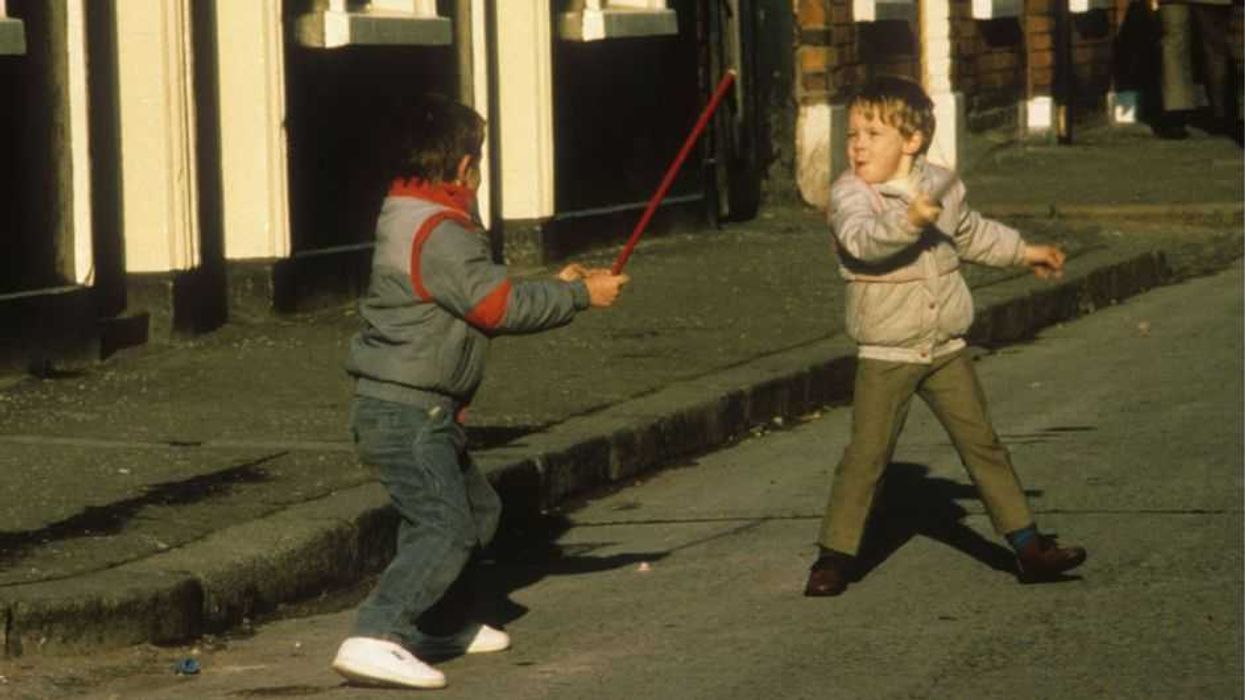
My childhood had a simple structure: Leave the house, come back when hungry.
Nobody tracked my location. Nobody scheduled my fun. I roamed a small Irish village with a rotating gang of kids, knocking on doors to collect whoever was free, wandering fields we didn’t own, climbing trees we absolutely shouldn’t have.
Our treehouse was born from boredom. Three of us, on a long summer afternoon, with nothing to do.
Our treehouse — built from stolen timber, held together, technically, by two bent nails — would have given a structural engineer a full breakdown. We were enormously proud of it.
Bumps and bruises
There were scuffles. Real ones, occasionally bloody, always brief. Someone would throw a punch over some perceived injustice. A disputed goal, a broken rule, an insult that landed a little too cleanly. Five minutes later, we’d be back at it, whatever it was that day.
No adults mediated. No one processed feelings. The fight resolved itself because the game needed bodies, and everyone knew it. You learned, quickly, that holding a grudge cost you far more than swallowing it.
The point isn’t that we were tougher or that children today are soft, although I would argue that both are true. The point I’m trying to make is that we were unsupervised, and supervision, it turns out, changes everything.
I say this not from a rocking chair but as someone who, at age 8 or 9, split his time between farm chores and disappearing into the village like a feral little fugitive. Less than 25 years ago. A blink of the eye, really, except apparently long enough to completely reinvent childhood.
Rationing daylight
Now, one in 10 parents say their young children play outside once a week or less. One week. Seven days. Imagine rationing daylight like that. Childhood has migrated indoors, onto screens, into carefully arranged playdates where two children sit in a living room while two adults hover nearby, making sure nobody says anything upsetting. The kids sense the performance. They behave accordingly.
Researchers from Denmark recently did something beautifully simple: They asked children what good play actually feels like.
Not what it teaches. Not what skills it builds. What it feels like from inside.
The answers were slightly embarrassing for every adult who has ever built a color-coded activity schedule. Children cared about the feeling of play. That loose, almost electric sense that something is genuinely alive. They cared about belonging — not polite, managed inclusion, but being genuinely wanted by the group. They cared about imagination running slightly off the rails. They even valued a certain productive chaos, the kind that adults instinctively shut down.
Adults, predictably, care about outcomes — cognitive development, motor skills, social learning they can point to and measure. Children care about none of this while they’re playing. What they actually care about is whether it’s fun, whether they’re wanted, and whether there’s the slightest chance that it might go delightfully wrong.
Screen police
Our games always went somewhere unexpected. A football match would mutate, mid-afternoon, into something involving a rope, an old mattress someone had dumped in a field, and rules nobody could fully explain afterward. The logic was impeccable at the time. The mattress did not survive.
Modern play environments iron out exactly these qualities. Soft surfaces, approved equipment, and an adult nearby to ensure fairness and prevent anything resembling genuine consequence. The result looks like play. Children sense that it isn’t, the way you sense when a photograph has been retouched slightly too much. Something essential has been removed.
Screens fill the gap with surgical efficiency. Nearly a third of young children now engage regularly in what researchers call “media play” — a phrase that earns its quotation marks. Tapping a screen is not the same as negotiating who gets to be the villain or managing the social fallout when the smallest kid turns out to be the best climber and everyone has to begrudgingly update their hierarchy. Digital games have fixed rules, predictable rewards, and zero social friction. That’s precisely their appeal. It’s also precisely their poverty.
The consequences don’t arrive with bruises or a note from school. They arrive later, wearing other disguises. Low frustration tolerance. Social anxiety with no obvious origin. A deep unfamiliarity with boredom, which is actually the raw material of invention.
RELATED: The day my father handed me the gun
 NurPhoto/Getty Images
Free range
Our treehouse was born from boredom. Three of us, on a long summer afternoon, with nothing to do. Within an hour, we had made a plan. Within a week, we had made something structurally catastrophic and deeply satisfying. Nobody told us to build it. Nobody approved the design. Nobody stood beneath it checking for hazards, which was probably wise given what happened to the second shelf.
Children need exactly that kind of space. Not the park for 15 minutes before the grocery run, but long, unscheduled stretches where the only available resource is other children and whatever the back yard contains. Boredom long enough to become uncomfortable. Discomfort long enough to force creativity.
They need, occasionally, for nobody to be watching.
We turned out fine, most of us. There were scraped knees. One incident involved a gate left wide open, a bull wandering into the street, and a level of collective amnesia that has never fully lifted. The treehouse was, after much deliberation, abandoned to the weather. The nails, I’m told, are still there.





