

Category: Indian
Indian students score $200K ‘food racism’ payout from UC Boulder

A 35-year-old Indian student says he was told that curry stinks, but sandwiches do not.
Aditya Prakash and his fiancée, Urmi Bhattacheryya, won a settlement of $200,000 from the University of Colorado Boulder in a story dripping with progressivism.
‘My food is my pride, and notions about what smells good or bad to someone are culturally determined.’
The BBC described the ordeal as a case of “food racism” while outlet Indian Express said Prakash was the “target of racism” over his microwaved food.
Ate crime
The couple reportedly claimed they faced a series of “microaggressions and retaliatory actions” after a staff member at the university — who was British, according to the BBC — complained about the “smell” of the food Prakash had in the microwave.
The staffer allegedly said the food was giving off a “pungent” odor and informed Prakash there was a rule against heating foods that have strong odors. Prakash reportedly claimed there was no such rule publicly stated and said, “It’s just food. I’m heating and leaving.”
The Indian also said he later inquired what foods were considered pungent. He was allegedly told that smelly foods included curry but not sandwiches.
In a pickle
The couple claimed they soon lost their research funding and teaching roles, and a lawsuit followed. Prakash claimed it was not about money, though.
“It was about making a point — that there are consequences to discriminating against Indians for their ‘Indianness,'” he said.
RELATED: Illegal alien truckers with California licenses accused of hauling $7M in cocaine across state lines
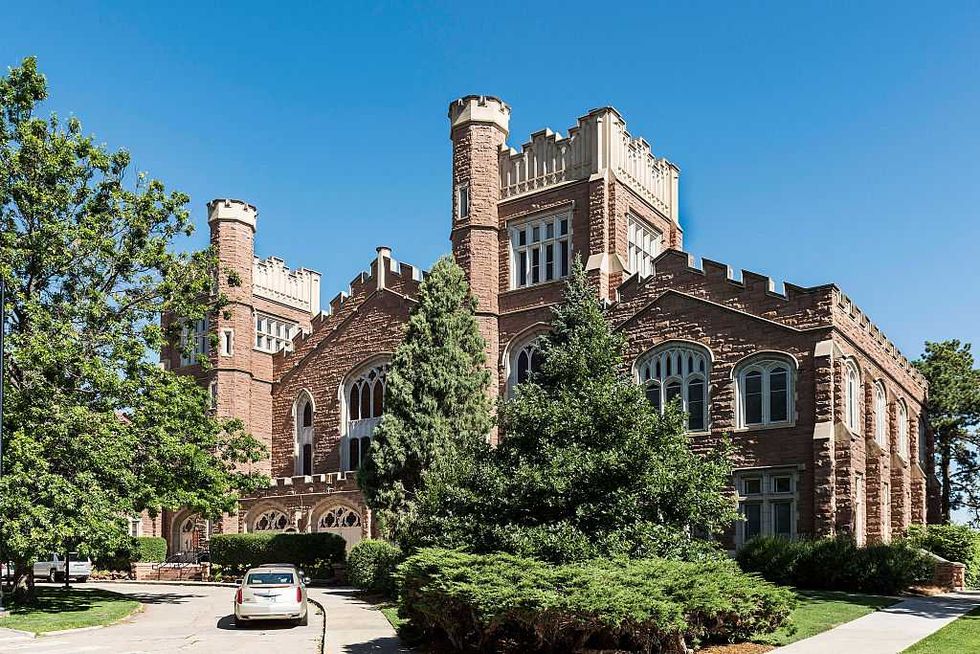 Photo by John Greim/LightRocket via Getty Images
Prakash also claimed he was a victim of “systemic racism” because his department “refused to grant” his Master’s degree.
“That’s when we decided to seek legal recourse,” he said.
The May 2025 lawsuit alleged discriminatory treatment and a “pattern of escalating retaliation” but was settled with the university that September. The terms reportedly include giving the students their degrees while denying all liabilities and banning them from studying or working at the school in the future.
Paneer miss
The dish at the center of the controversy is called palak paneer, which, according to cooking website Hooked on Heat, contains some strong ingredients.
The main parts of the dish include spinach and paneer, a soft white cheese considered to be the Indian version of cottage cheese. Also added to the dish are onion, ginger, garlic, chili powder, garam masala (Indian spices), and more.
Prakash reportedly argued that his food only stinks according to some people.
“My food is my pride, and notions about what smells good or bad to someone are culturally determined,” he posited.
Cruciferous context
A counterargument he allegedly faced was that even broccoli is not allowed to be heated because of its odor, but Prakash claimed that “context matters,” before adding, “How many groups of people do you know who face racism because they eat broccoli?”
His fiancée says that President Trump’s re-election has caused a “narrowing of empathy” toward foreigners.
“Institutions talk a lot about inclusion, but there is less patience for discomfort, especially if that discomfort comes from immigrants or people of colour,” she claimed.
Currying favor
The university told BBC that while it cannot comment on the specifics of the claims due to privacy laws, it is “committed to fostering an inclusive environment for all students, faculty and staff regardless of national origin, religion, culture and other classes protected under U.S. laws and by university policies.”
“When these allegations arose in 2023, we took them seriously and adhered to established, robust processes to address them, as we do with all claims of discrimination and harassment,” the school continued. “We reached an agreement with the students in September [2025] and deny any liability in this case.”
The couple has reportedly not since returned to the United States, with Prakash saying he is willing to start over.
“If this case can send out a message that this (‘food racism’) cannot be practiced with impunity, that we, as Indians, will fight back, that would be the real victory,” he said, per Indian Express.
Like Blaze News? Bypass the censors, sign up for our newsletters, and get stories like this direct to your inbox. Sign up here!
Seattle professor punished for mocking land acknowledgments fights back, scores win against woke university

A professor at the University of Washington was punished for having the audacity to poke fun at the school’s moral exhibitionism. Stuart Reges, a professor at UW’s Paul G. Allen School of Computer Science and Engineering, fought back and, on Friday, secured a decisive victory.
Reges ruffled feathers at the university where he has worked for decades by including a parodic land acknowledgment in his 2022 course syllabus.
‘The Coast Salish people can claim historical ownership of almost none of the land.’
According to the Foundation for Individual Rights and Expression, the outfit that represented Reges, the university recommended in its “best practices” guide that instructors incorporate an “Indigenous Land Acknowledgment” in their course syllabi, providing the following as an example statement: “The University of Washington acknowledges the Coast Salish peoples of this land, the land which touches the shared waters of all tribes and bands within the Suquamish, Tulalip, and Muckleshoot nations.”
In a December 2021 faculty email thread, one of Reges’ colleagues referred to an article that characterized land acknowledgments as “moral onanism.” Reges said in response that he was uncertain about the value of making such statements and noted that he might include a mock statement in his syllabus.
Sure enough, the professor included the following land acknowledgment on the syllabus of his winter 2022 computer science course: “I acknowledge that by the labor theory of property the Coast Salish people can claim historical ownership of almost none of the land currently occupied by the University of Washington.”
Administrators at UW’s Paul G. Allen School of Computer Science and Engineering punished Stuart Reges over his failure to conform, which they claimed had caused a “disruption to instruction” but had in reality enraged only ideologically delicate members of the faculty and the school’s DEI student committee.
 Stuart Reges. Courtesy of Twinkle Don’t Blink
The director of UW’s computer science department, Magdalena Balazinska, ordered Reges to remove the statement because it was supposedly “offensive” and generated a “toxic environment.”
According to court documents, when Reges refused to remove his dissenting statement, Balazinska unilaterally removed it, then apologized to Reges’ students, detailing ways that they could file complaints against their professor.
‘Land acknowledgments are performative acts of conformity that should be resisted.’
In addition to inviting students to switch out of Reges’ computer programming course and into a “shadow” class section taught by a different professor, university administrators launched a years-long disciplinary investigation into Reges.
In July 2022, Reges sued Balazinska, then-UW President Ana Mari Cauce, and other school officials, accusing them of violating his First Amendment rights.
“University administrators turned me into a pariah on campus because I included a land acknowledgment that wasn’t sufficiently progressive for them,” Reges said at the time. “Land acknowledgments are performative acts of conformity that should be resisted, even if it lands you in court.”
U.S. District Court Judge John Chun, an appointee of former President Joe Biden, dismissed Reges’ lawsuit last year, claiming that “the disruption caused by Plaintiff’s speech rendered it unprotected.”
Reges appealed and found a court that viewed his case differently.
In a 2-1 decision on Friday, a Ninth Circuit Court of Appeals panel disagreed with and reversed the Biden judge’s ruling, remanding the case for further proceedings.
Circuit Judge Daniel Bress, writing for the majority, noted, “Debate and disagreement are hallmarks of higher education. Student discomfort with a professor’s views can prompt discussion and disapproval. But this discomfort is not grounds for the university retaliating against the professor. We hold that the university’s actions toward the professor violated his First Amendment rights.”
Bress, an appointee of President Donald Trump, highlighted the long-standing debate over the value, factual basis, and political nature of land acknowledgments as well as Reges’ sense that they are part of “an agenda of ‘diversity, equity, and inclusion’ that treats some groups of students as more deserving of recognition and welcome than others on account of their race or other immutable characteristic.”
While acknowledging the right of members of the UW community to speak out against Reges and his views, Bress stressed that “Reges has rights too. And here, we conclude that UW violated the First Amendment in taking adverse action against Reges based on his views on a matter of public concern.”
Will Creeley, the legal director of FIRE, said that the ruling “recognizes that sometimes, ‘exposure to views that distress and offend is a form of education unto itself.'”
“If you graduate from college without once being offended, you should ask for your money back,” added Creeley.
Like Blaze News? Bypass the censors, sign up for our newsletters, and get stories like this direct to your inbox. Sign up here!
Convicted hacker twins who landed jobs as federal contractors nabbed for allegedly deleting government databases

Muneeb and Sohaib Akhter, a pair of convicted hackers based in Alexandria, Virginia, were arrested on Wednesday over an alleged conspiracy to destroy government databases and other crimes.
After doing prison time for wire fraud and conspiring to hack into the U.S. State Department, the Akhter twins, one of whom previously served as a cybersecurity contractor with the State Department, managed to secure jobs as federal contractors — working as engineers for Opexus.
‘Their actions jeopardized the security of government systems.’
Opexus, a company that handles sensitive data for most federal agencies and has received over $50 million in contracts from various agencies over the past decade, determined earlier this year that it had been compromised in February by two employees.
A Bloomberg investigation revealed in May that after one of the agencies with which Opexus was working, the Federal Deposit Insurance Corporation, flagged the twins as possible threats on account of their criminal records, the duo were fired on Feb. 18.
The company later discovered that while being fired and immediately afterward, the twins allegedly accessed sensitive documents and compromised or scrubbed dozens of databases, including those containing data from the General Services Administration and the Internal Revenue Service.
The FBI, FDIC Office of Inspector General, Department of Homeland Security Office of Inspector General, and Homeland Security Investigations investigated the case.
The brothers were indicted on Nov. 13 for allegedly working to harm Opexus and its U.S. government clients “by accessing computers without authorization, issuing commands to prevent others from modifying the databases before deletion, deleting databases, stealing information, and destroying evidence of their unlawful activities,” the DOJ said in a release.
RELATED: Could hackers target your car’s tires?
 Muneeb Akhter. Photo by Evelyn Hockstein/Washington Post via Getty Images
According to the indictment, Muneeb Akhter allegedly deleted approximately 96 databases storing U.S. government information — including databases containing records and documents related to Freedom of Information Act matters as well as sensitive federal investigative files.
Muneeb Akhter is also accused of asking an artificial intelligence tool how they could cover their tracks after deleting a DHS database.
After he got fired from Opexus, Muneeb Akhter allegedly obtained data from the U.S. Equal Employment Opportunity Commission and is accused further of stealing copies of IRS information including federal tax information and other identifying information for at least 450 individuals.
Opexus did not respond to a request for comment from Blaze News.
“These defendants abused their positions as federal contractors to attack government databases and steal sensitive government information,” said Matthew Galeotti, acting assistant attorney general at the Department of Justice’s Criminal Division, in a statement. “Their actions jeopardized the security of government systems and disrupted agencies’ ability to serve the American people.”
Muneeb Akhter has been charged with conspiracy to commit computer fraud and to destroy records, two counts of computer fraud, theft of federal records, and two counts of aggravated identity theft. His twin, Sohaib Akhter, was charged with conspiracy to commit computer fraud and to destroy records and computer fraud.
While Sohaib Akhter faces a maximum penalty of six years in prison, Muneeb Akhter faces a mandatory minimum penalty of two years of prison time for each aggravated identity theft count and a maximum penalty of 45 years for the other charges.
The duo pleaded guilty in 2015 to a different set of crimes.
Muneeb Akhter hacked into the website of a cosmetics company and stole thousands of customers’ credit card and personal information. He and his brother used the stolen data to pay for flights, hotel stays, various goods, and attendance at professional conferences. Muneeb Akhter proceeded to hand off the stolen data to a “dark net” operator who cut him in on the profits from the sales.
The other brother, meanwhile, used his contract position at the State Department in 2015 to steal personally identifiable data belonging to various people including co-workers and a federal law enforcement agent who was investigating him.
According to the Justice Department, Sohaib Akhter later hatched a scheme to ensure perpetual access to various State Department systems and, with the help of his twin, attempted to install an electronic collection device inside a State Department office, which would have enabled the hackers to remotely steal federal data.
Years earlier, Muneeb Akhter hacked into a Maryland-based private data aggregation company that he was performing contract work for, giving his brother access to a database of federal contract information to give their technology company an upper hand when bidding for contracts and clients.
Like Blaze News? Bypass the censors, sign up for our newsletters, and get stories like this direct to your inbox. Sign up here!





