Category: January 6
Jan. 6 pipe devices were not bombs, could not have exploded, defense expert contends
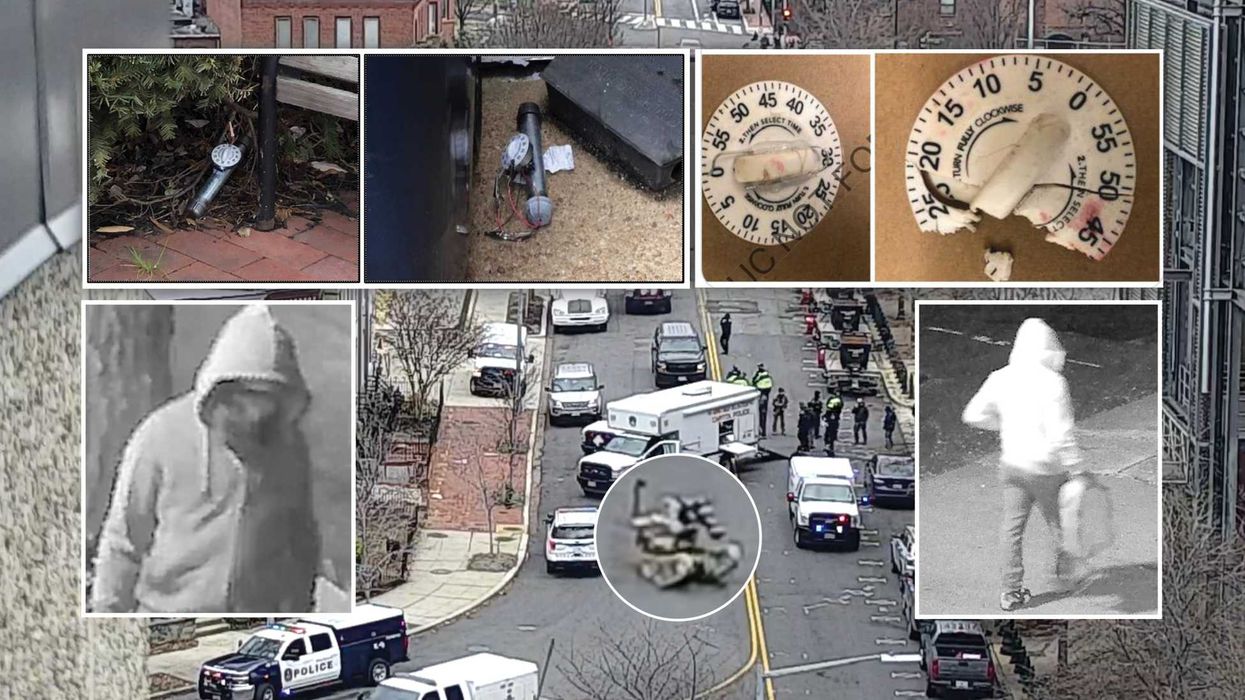
The alleged pipe bombs placed at two sites on Capitol Hill on Jan. 5, 2021, were not capable of exploding and thus were not bombs at all, an explosives expert said in a new federal criminal case filing.
The devices, found along the rear of the Capitol Hill Club and under a bench at the Democratic National Committee building on Jan. 6, lacked the needed chemicals and proper fusing system that would have made them explosives, according to Brennan Phillips, a 20-year veteran of the Bureau of Alcohol, Tobacco, Firearms and Explosives.
‘The two suspected pipe bombs in question do not contain an explosive filler capable of causing an explosion.’
In a report created for pipe-bomb suspect Brian J. Cole Jr.’s defense team, Phillips rejected the FBI’s five-year-long insistence that the devices were “viable” and could have exploded.
“Based on my review of the materials provided, the two suspected pipe bombs in question do not contain an explosive filler capable of causing an explosion,” Phillips wrote.
The report, filed in U.S. District Court in Washington, D.C., late on Friday, is just the latest complication for the U.S. Justice Department and the FBI in the prosecution of Cole, 30, a suburban Virginia man arrested Dec. 4 and charged a day later with two felony explosives counts.
The defense filed the explosives expert’s report along with a motion to revoke the detention order keeping Cole locked up in the Rappahannock Regional Jail pending trial.
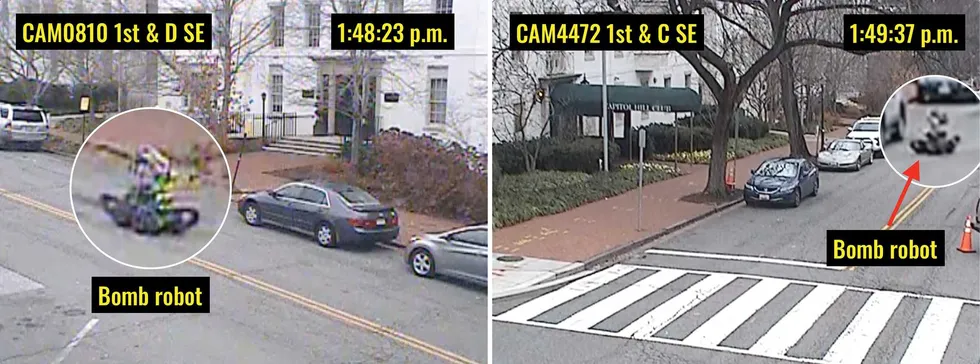 A U.S. Capitol Police bomb robot heads for the alley behind the Capitol Hill Club to render safe a pipe bomb discovered about 12:40 p.m. on Jan. 6, 2021.U.S. Capitol Police CCTV
At virtually the same time on Jan. 16, U.S. District Judge Amir Ali issued an order rejecting Cole’s emergency petition to reconsider the detention decision made by U.S. Magistrate Judge Matthew Sharbaugh.
Phillips said the chemicals used in the devices were not properly constituted and thus incapable of sparking an explosion.
“These chemicals need to be apportioned into a workable fuel-to-oxidizer ratio: 75% potassium nitrate (also known as saltpeter) 15% charcoal, and 10% sulfur is the most widely cited Black Powder ratio,” he wrote.
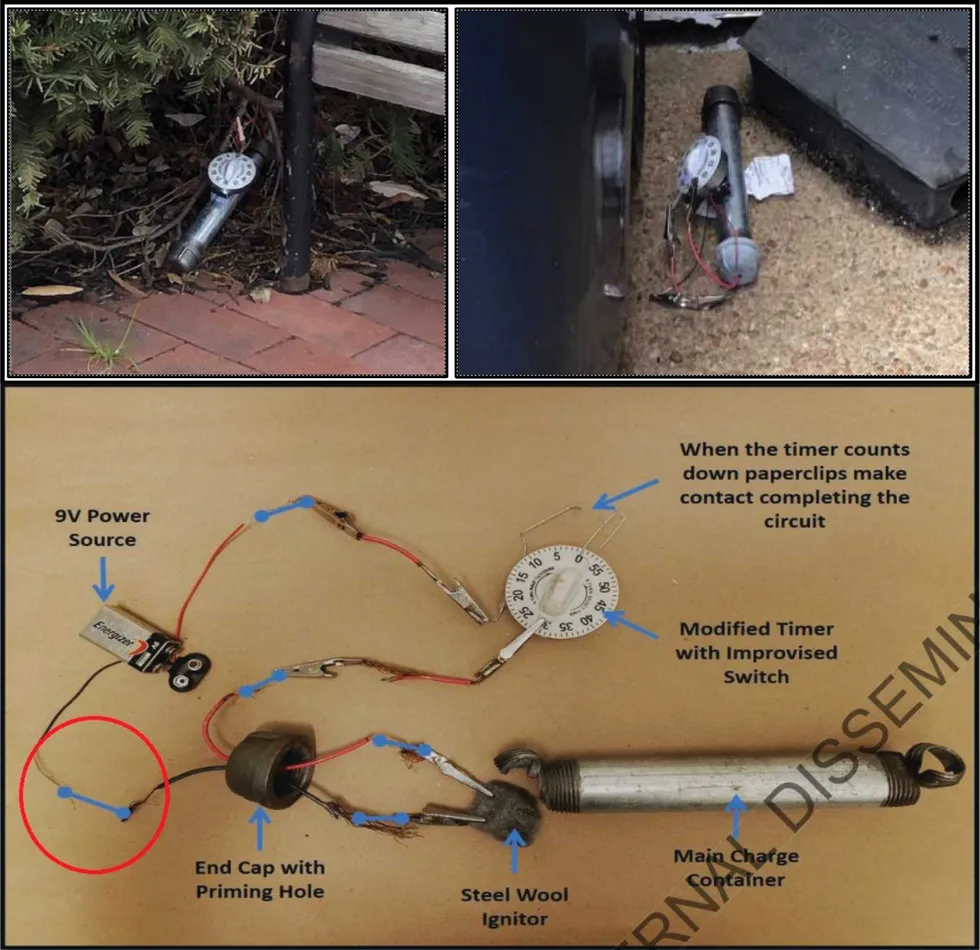 Above: the Capitol Hill pipe bombs before they were processed by a bomb robot. Below: One of the devices reconstructed by the FBI.FBI images
“The photos of the lab samples taken from the powders recovered from the two pipes show mostly large white particles with some flecks of dark material,” Phillips wrote, “which is not visually consistent with Back Powder but is consistent with inadequate mixing in a bowl.”
The FBI cited purchases of various items the bureau claims Cole made between 2018 and 2022, including sulfur dust and potassium nitrate. No public FBI records cite the purchase of any charcoal. These sourced ingredients can pose a purity problem for use in black powder. Inert ingredients used in the products Cole allegedly purchased tend to blunt their effectiveness as components to make black powder, according to an independent investigator known online as Armitas, who has worked with Blaze News on the pipe bomb investigation.
Like tiny lumps of coal
“Quality black powder, whether commercial or made by a knowledgeable hobbyist in a home setting, is granular and resembles tiny lumps of coal (Thurman, 2010),” Phillips wrote. “This granular black powder, made from 75% potassium nitrate, 15% charcoal, and 10% sulfur, is the result of a multi-step process that involves grinding, milling, pressing, and corning to achieve a high-quality product.”
The process described by Phillips would be something that requires, at minimum, some level of hobbyist experience.
“In the home environment, this is typically achieved by first purchasing or creating finely ground precursor chemicals. For example, a hobbyist might use a coffee grinder to grind lump charcoal into a fine powder,” Phillips said. “Once the finely ground powders of potassium nitrate, charcoal, and sulfur are acquired, they need to be combined into a homogeneous mixture. A common starting point is to mix the materials using progressively finer mesh screens.”
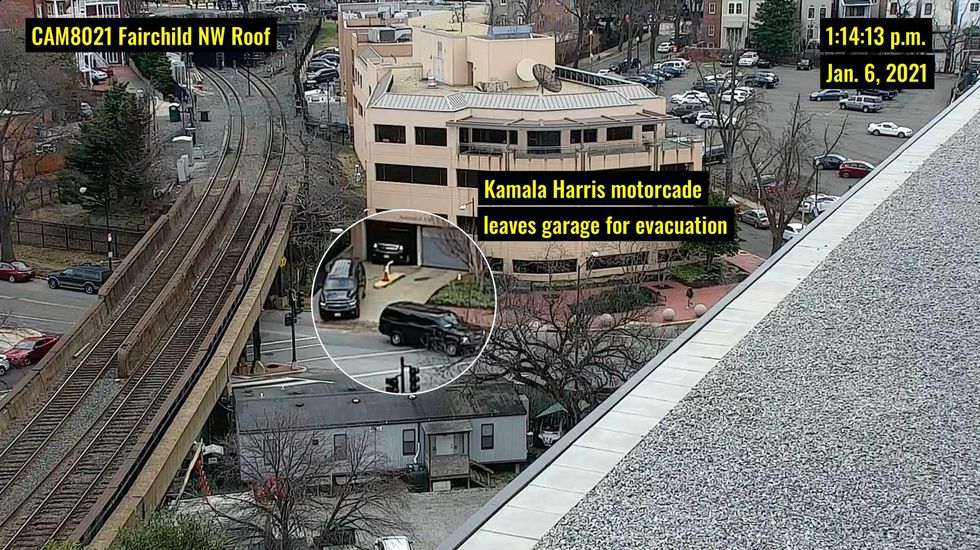 Vice President-elect Kamala Harris’ motorcade drives directly past a pipe bomb as it moves to evacuate Harris from the front of the DNC building on Jan. 6, 2021.U.S. Capitol Police CCTV
The “early-stage” powders that result from an “incorporation” process “are typically low-strength and require pressing to achieve the performance required for Black Powder firearms, or bomb making,” Phillips wrote.
In addition to the problems with the fuel, Phillips said the Capitol Hill devices lacked an appropriate fusing system.
“Beyond the lack of a viable explosive filler for the two pipes, neither device has a functional fuzing and firing system capable of igniting a flame-sensitive explosive filler,” he wrote. “Based on my experience and testing, a single 9-volt battery attached to a 1.5-inch square of steel wool will not generate enough heat to ignite Black Powder.”
Constant controversy
There has been controversy surrounding the devices since their discovery between 12:40 p.m. and 1:05 p.m. on Jan. 6, 2021. A prime example was the deviation from standard protocol by police and U.S. Secret Service agents when the device was found under a bush at the base of a park bench at the DNC building.
The standard response to discovery of a suspected pipe bomb would be the immediate establishment of a blast perimeter and the evacuation of everyone in nearby buildings. Roads would be closed at the blast perimeter, and no one would be allowed to drive or walk inside.
A Capitol Police counter-surveillance special agent who found the DNC device at 1:05 p.m. walked to a nearby Secret Service sport utility vehicle to notify agents of his discovery. Instead of an urgent reaction, the agents sat in their vehicles for more than two minutes, finishing their lunch.
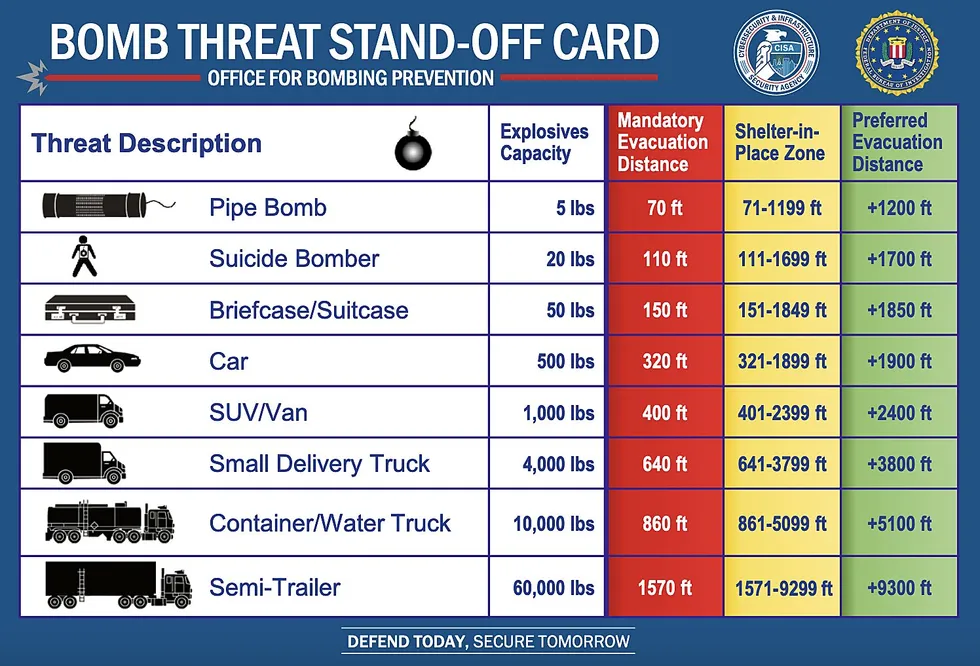 According to federal law-enforcement standards, the preferred evacuation distance from a pipe bomb is more than 1,200 feet.FBI
Even after emerging from the vehicles parked in the DNC driveway, the agents acted nonchalantly, standing just feet from the device. A uniformed Capitol Police officer walked up to the park bench and took a photograph of the device.
Pedestrians were allowed to traverse the sidewalk along South Capitol Street, walking mere feet from the suspected bomb. Vehicle traffic continued unabated on Capitol, Canal, and Ivy streets, as well as Washington Avenue.
Commuter trains continued to rumble over the railroad trestle behind the DNC building for 20 minutes after the device was discovered.
Inside the DNC, Vice President-elect Kamala Harris wasn’t evacuated for 10 minutes. Her motorcade pulled out of the underground garage and drove right past the bomb before circling the south end of the building and picking her up at the Ivy Street entrance.
Despite the ostensible threat to Harris’ life, Democrats never claimed the pipe bomb was an attempted assassination. For more than five years since, Harris has neither commented on her close call with disaster, nor explained why she was at the DNC building instead of the Capitol, where as a U.S. senator, her vote was needed to certify the 2020 presidential election.
Like Blaze News? Bypass the censors, sign up for our newsletters, and get stories like this direct to your inbox. Sign up here!
Judicial Watch: Court Hearing Set for DC Police Bodycam Footage from January 6, 2021
(Washington, DC) – Judicial Watch announced today that a hearing is set for Thursday, January 8, 2026, at 2:30 p.m. ET before D.C. Superior Court Judge Carl E. Ross in a Freedom of Information Act (FOIA) lawsuit against the District of Columbia for local police bodycam footage from January 6, 2021. Judicial Watch filed the […]
The post Judicial Watch: Court Hearing Set for DC Police Bodycam Footage from January 6, 2021 appeared first on Judicial Watch.
Pipe-bomb suspect Brian Cole has Level 1 autism spectrum disorder, OCD — new facts that recast case against him

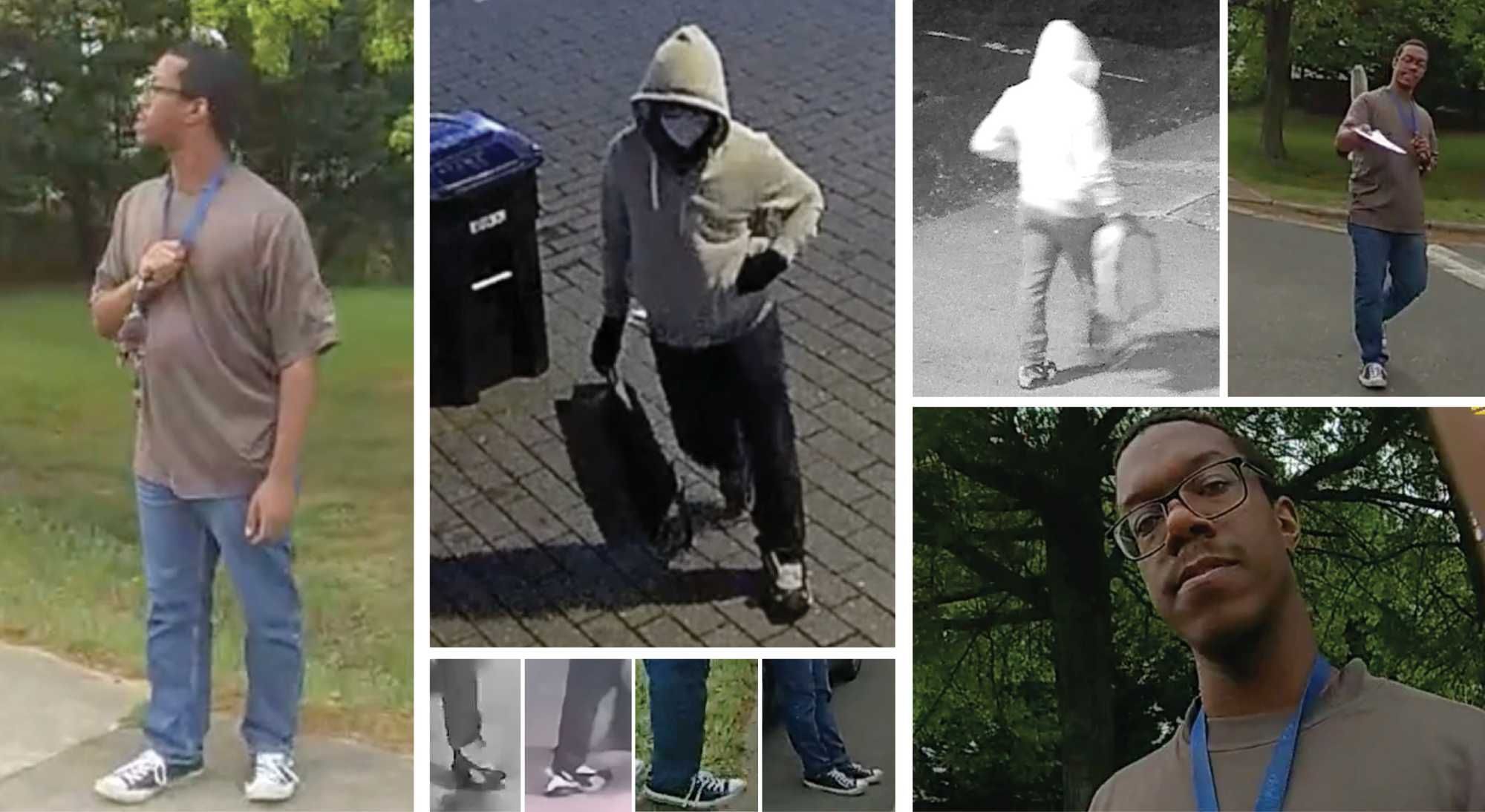
Brian J. Cole Jr. denied placing pipe bombs on Capitol Hill in January 2021 for more than two hours under FBI questioning after his arrest in Virginia on Dec. 4. Cole said he did not recognize the person in a gray hoodie shown on video walking with a backpack on Jan. 5.
After two hours of questioning, Cole, 30, told FBI agents that “everything is just blank” and the interview was “a little too much to process,” according to a U.S. Department of Justice memorandum filed in the criminal case.
‘This could result in the collection of misleading information and false confessions during criminal justice interviews.’
Agents then leaned on him, stating he could face more criminal charges if he lied to them. Then they left him alone in the interrogation room for 20 minutes.
When they returned, agents asked Cole again if he is the suspect shown on surveillance video. “This time, the defendant paused for approximately fifteen seconds, placed his head face-down on the table and answered, ‘Yes,’” the DOJ stated.
The FBI’s tactics in interrogating a man the defense asserts has autism spectrum disorder and obsessive-compulsive disorder will likely become a major bone of contention for defense attorneys. Cole, whose grandmother has said he operates at the level of a 16-year-old, had no lawyer present during four hours of questioning. According to the FBI, Cole signed a waiver of his Miranda rights.
‘Overwhelming evidence’?
In the first real courtroom clash in the pipe-bombs case on Dec. 30, defense attorneys fought back against a DOJ memo claiming there is “overwhelming evidence” that Cole planted “viable” pipe bombs near the Democratic National Committee building and the Capitol Hill Club during a 22-minute span on the night of Jan. 5, 2021.
Defense attorney J. Alex Little argued for Cole’s release from jail pending trial in a 16-page memo. During a hearing before U.S. Magistrate Judge Matthew J. Sharbaugh, Little said Cole is not a danger to anyone. Pretrial detention is an extraordinary measure reserved for the few defendants who are a provable risk to society no matter what restrictions are imposed by the federal court.
Judge Sharbaugh said he received a two-count indictment on Dec. 29 from a District of Columbia Superior Court grand jury charging Cole with the same two counts that are in the federal criminal complaint.
The DOJ posted the indictment on the court docket, dated Jan. 2. It was signed by Jocelyn Ballantine, deputy chief of the National Security Section at the DOJ. Ballantine was previously a top official in the Capitol Siege Section under then-Attorney General Merrick Garland. Her appointment to the pipe-bomb case was greeted with outrage by former Jan. 6 defendants, who questioned why President Donald Trump had not removed her from the DOJ.
 The suspect was across the street from a Capitol Police squad car while walking to the Jan. 5 bomb drop, video shows. Image from Capitol Police CCTV
Judge Sharbaugh did not immediately accept the indictment because there is a legal question whether D.C.’s federal district court can accept a grand jury indictment from the local Superior Court. In D.C., the Superior Court is akin to state, county, and local courts in the 50 states.
A ruling by U.S. District Chief Judge James Boasberg that Superior Court indictments can be accepted in federal district court is on appeal at the U.S. Court of Appeals for the District of Columbia Circuit.
Judge Sharbaugh asked both sides in the Cole case to submit briefs on the matter by close of business Dec. 31. He promised a ruling “in short order”on whether to accept the indictment and whether to release Cole into the custody of his grandmother.
Cole’s attorneys submitted a 20-page memo as directed by Judge Sharbaugh, but the DOJ filing didn’t appear on the official docket until Jan. 2.
Sharbaugh initially sidestepped the indictment issue and the 14-day requirement for a preliminary hearing and on Friday issued a ruling that Cole must remain jailed until trial. The judge said the DOJ convinced him “by clear and convincing evidence that there are no conditions of release that can reasonably assure the safety of the community.”
Judge Sharbaugh said he can make an “independent probable cause determination” even without an indictment or holding a preliminary hearing. He labeled the defense arguments “wrong,” stating that “longstanding caselaw in this district is consistent with that understanding.”
A short time later, Judge Sharbaugh issued an order stating he would accept the Superior Court indictment of Cole because the DOJ “represents that it will promptly seek a superseding indictment from a federal grand jury panel as soon as those panels reconvene.”
The DOJ’s briefing on the legality of the judge accepting the Superior Court indictment didn’t appear on the case docket until Friday, after the judge issued his decision. A portion of the document was redacted that described “extenuating circumstances” faced by the DOJ because federal grand juries were not available from Dec. 22 through year’s end.
Blaze News reached out to Little and the DOJ for comment but did not receive a reply by publication time.
Little sought to have a preliminary hearing Tuesday, because Cole was well beyond the 14 days prosecutors had under the law to secure an indictment or submit to an adversarial preliminary hearing. Cole made an initial court appearance on Dec. 5.
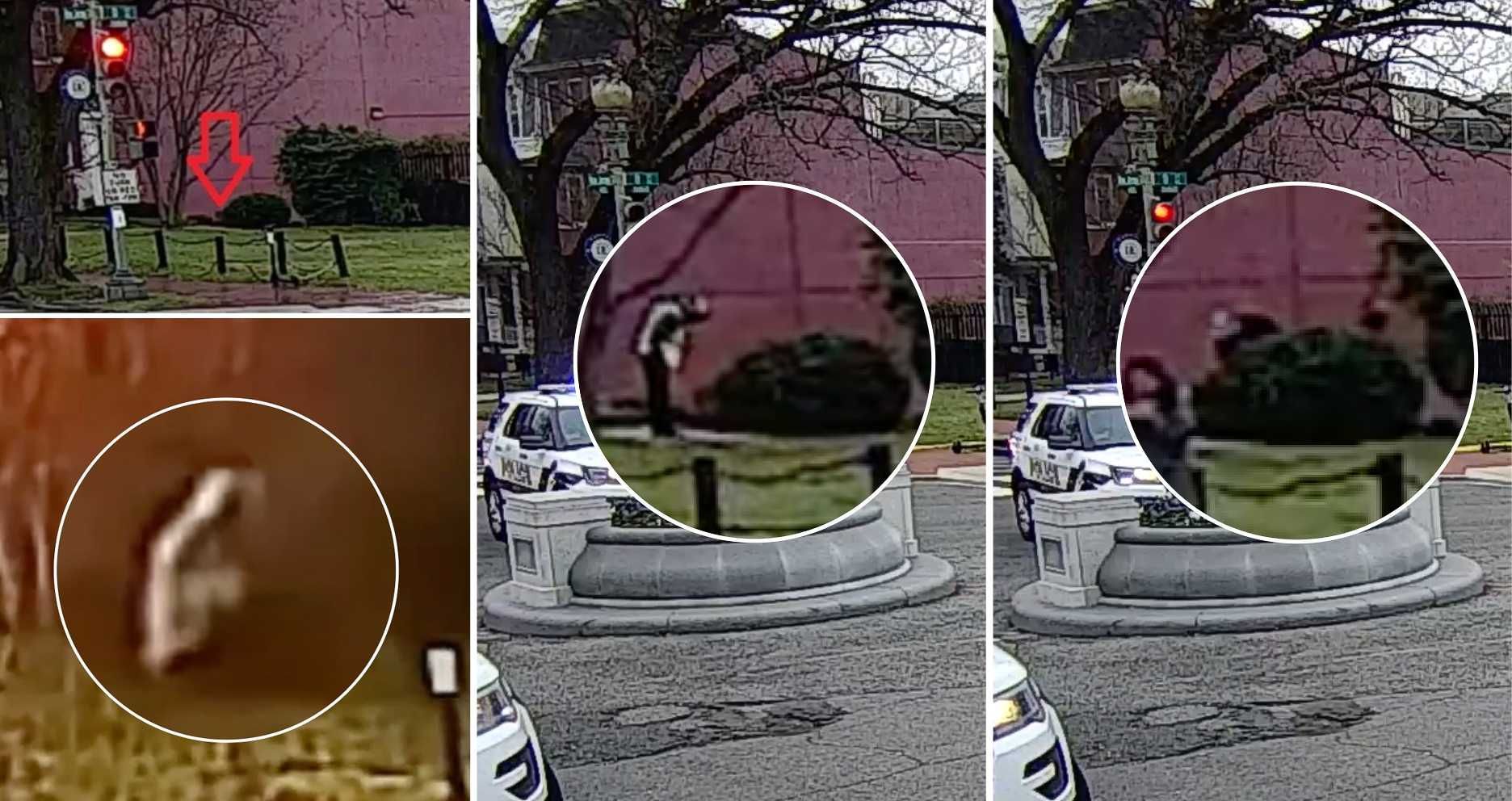 Police walked right past the DNC pipe bomb to first look under a bush where the bomb suspect sat 17 hours earlier. Photos by U.S. Capitol Police
Little said prosecutors told him they never sought an indictment from a federal grand jury. They rushed to seek an indictment from the Superior Court grand jury on Dec. 29 only after the defense made it clear it would demand a probable-cause hearing. A preliminary hearing allows the defense to cross-examine witnesses, unlike a grand jury, which hears only from prosecutors.
“The government wants to avoid a preliminary hearing, where its evidence will be tested in public,” Little wrote on Dec. 31. “Rather than subject its proof to cross-examination, the government sprinted to a different court — supervised by different judges and subject to different rules of evidence, privilege, and juror competency — to secure a last-minute indictment.
“Only after defense counsel insisted on holding the preliminary hearing did the government pursue its current path — seeking a federal indictment from a D.C. Superior Court grand jury,” Little said. “… The government either must present evidence at a preliminary hearing sufficient to establish probable cause, or the Court must release Mr. Cole from custody without conditions.”
Prosecutors contend that Cole gave a full confession to agents on Dec. 4.
“The defendant explained that he made the black powder in the devices using charcoal, Lilly Miller sulfur dust and potassium nitrate that he purchased from Lowe’s,” wrote Assistant U.S. Attorney Charles Jones. “The defendant mixed these ingredients in a Pyrex bowel [sic] and used a spoon or measuring cup to pour the black powder into the devices.
“According to the defendant, he learned to make the black powder from a video game that listed the ingredients and he also viewed various science-related videos on YouTube to assist him in creating the devices.”
The document did not identify the video game or provide specifics on the YouTube videos that allegedly guided Cole on making the bombs.
Little has moved twice to have his client released from the Rappahannock Regional Jail — either under court supervision or without conditions.
Prosecutors insist that Cole is a danger to the public, based primarily on the seriousness of the charges against him. Little told Judge Sharbaugh that Cole has maintained employment in the family bail bonds business since Jan. 6 and has no criminal record or evidence of political activism or online postings advocating violence.
Reset cell phone 943 times
The revelation of Cole’s autism and OCD puts the evidence — from the confession to the claim that he factory-reset his phone 943 times and beyond — and charges in a new light and raises the possibility that the defense will seek to suppress evidence as the case moves toward trial.
According to the Diagnostic and Statistical Manual of Mental Disorders published by the American Psychiatric Association, those with Level 1 autism need support or will exhibit “noticeable impairments.” In contrast, the APA characterizes Level 2 autism as “requiring substantial support” and Level 3 as “requiring very substantial support.”
“Inflexibility of behavior causes significant interference with functioning in one or more contexts,” according to the Autism Speaks website. “Difficulty switching between activities. Problems of organization and planning hamper independence.”
Experts say interrogation of persons with autism requires special handling due to the deficits presented by the disorder, which can easily lead to false confessions.
“Such impairments could manifest themselves in proneness to a host of vulnerabilities that place the individual at a severe disadvantage during the interviewing process,” said Jerrod Brown, Ph.D., an assistant professor at Concordia University in St. Paul, Minn., writing in Police Chief magazine.
‘Gullibility should be carefully considered for its potential role in false confessions.’
“Further, individuals may respond promptly, without careful consideration, in a manner intended to please an interviewer,” wrote Brown, who specializes in forensic behavioral health. “This could result in the collection of misleading information and false confessions during criminal justice interviews.”
Detectives and agents need to be aware that autistic individuals can be gullible and at risk of being manipulated, Brown wrote.
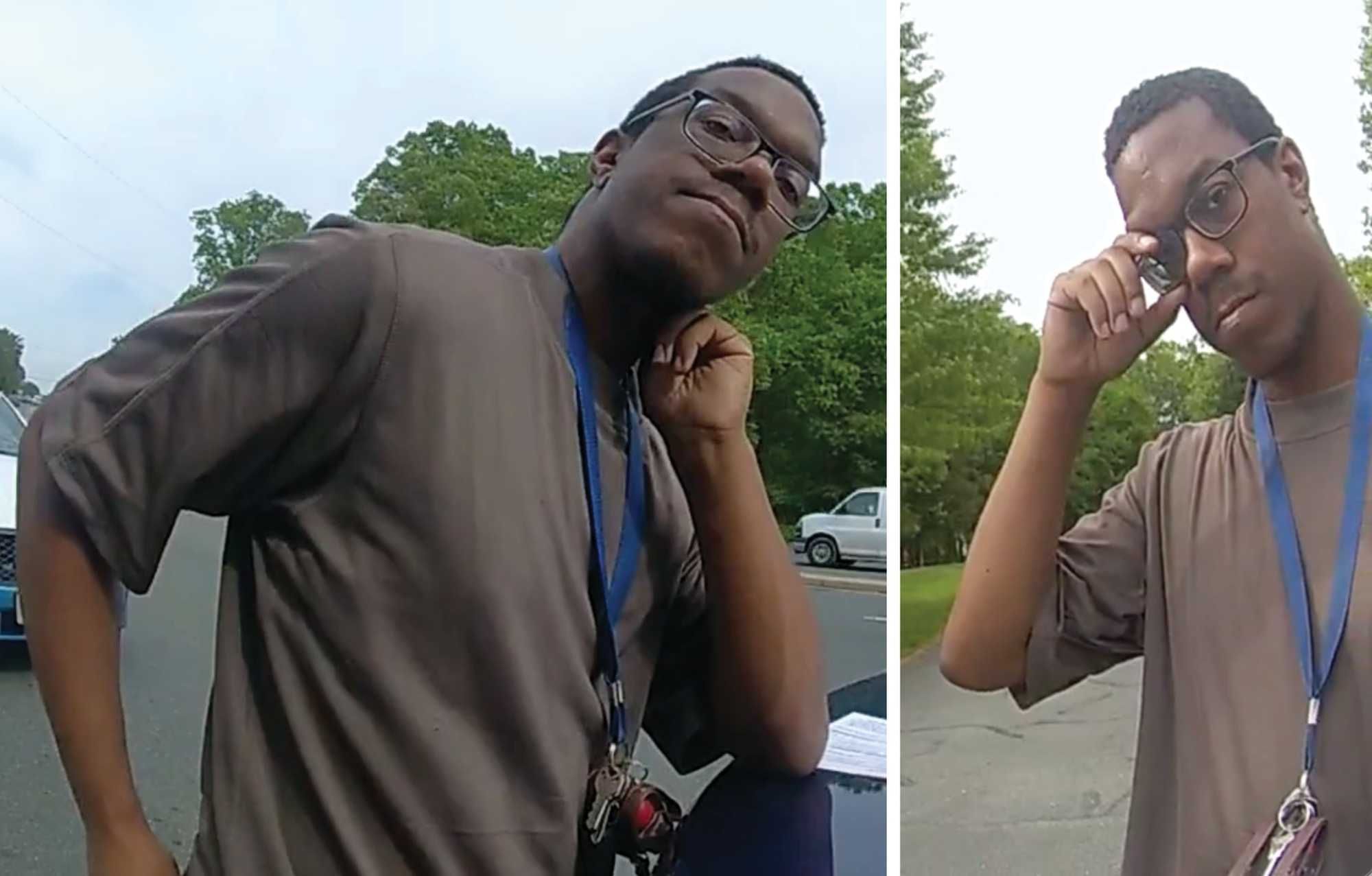 Brian J. Cole Jr. at the scene of a minor traffic accident near his home in Virginia in April 2024.Prince William County images
“In some instances, gullibility should be carefully considered for its potential role in false confessions,” he said. “… This disorder may increase the risk of compliance in demanding and stressful situations. For example, individuals with autism could be vulnerable to doing things (e.g., confessing to a crime that they did not commit) to please others, particularly those in a position of power.”
Questions have been raised as to why the FBI didn’t pursue Cole as a person of interest in 2021, when the bureau developed a list of 186 phones based on tower dumps and a geofence warrant. Since FBI Director Kash Patel and Deputy Director Dan Bongino said Cole’s arrest involved no new evidence, Cole must have been on that list. It is not known if agents made contact with Cole or his family in 2021.
An FBI internal document obtained by the Committee on House Administration Subcommittee on Oversight said the FBI classified 51 of the 186 devices as “not needing further action” because the phones “belong[ed] to law enforcement officers or persons on the exclusion list.”
Thirty-six of the 186 phone numbers were assigned to FBI special agents for interviews, and 98 of the numbers “required additional investigative steps,” according to a January 2025 U.S. House report. It is not clear whether anything came of those investigative steps, the report said.
Like Blaze News? Bypass the censors, sign up for our newsletters, and get stories like this direct to your inbox. Sign up here!
FBI breached whistleblower settlement with fired agent Steve Friend, stiffed him for $425,000, attorney says
The FBI never intended to reinstate Special Agent Steve Friend and is guilty of “gross misconduct” for violating “nearly every significant term” of a whistleblower settlement agreement signed by the Department of Justice in August, his attorney says — including failure to pay nearly $425,000 in back salary, pension, annual leave, and other benefits..
Attorney Kurt Siuzdak of Madison, Conn., filed a protected whistleblower disclosure Wednesday with U.S. Reps. Thomas Massie (R-Ky.) and Jim Jordan (R-Ohio), alleging multiple breaches of contract and bad faith. The complaint also alleges vindictiveness, citing how Friend’s firing was leaked to the New York Post a day before Friend himself was notified by FBI Director Kash Patel.
‘May God have mercy on your soul.’
“The FBI and its executive leadership have committed gross misconduct by immediately breaching the settlement agreement that was approved by the FBI and signed by the senior counsel to the Deputy Attorney General Vance D. Day,” Siuzdak wrote.
“Despite leaking to the press, Mr. Friend was fired for ‘veiled threats,’” Siuzdak said. “However, the fact is that since signing the settlement agreement on August 26, 2025, the FBI has breached the agreement and refused to abide by any terms of its settlement agreement with Mr. Friend.”
Friend was summoned to the FBI’s Daytona Beach Resident Agency on Saturday, Dec. 13, and was handed a termination letter signed by Patel.
Friend spent the previous five days at the Daytona office without any assigned duties, without a restored security clearance, service weapon, current credentials, or a bureau cell phone, Siuzdak said. The FBI also assigned someone to guard Friend while he was in the building, Siuzdak said.
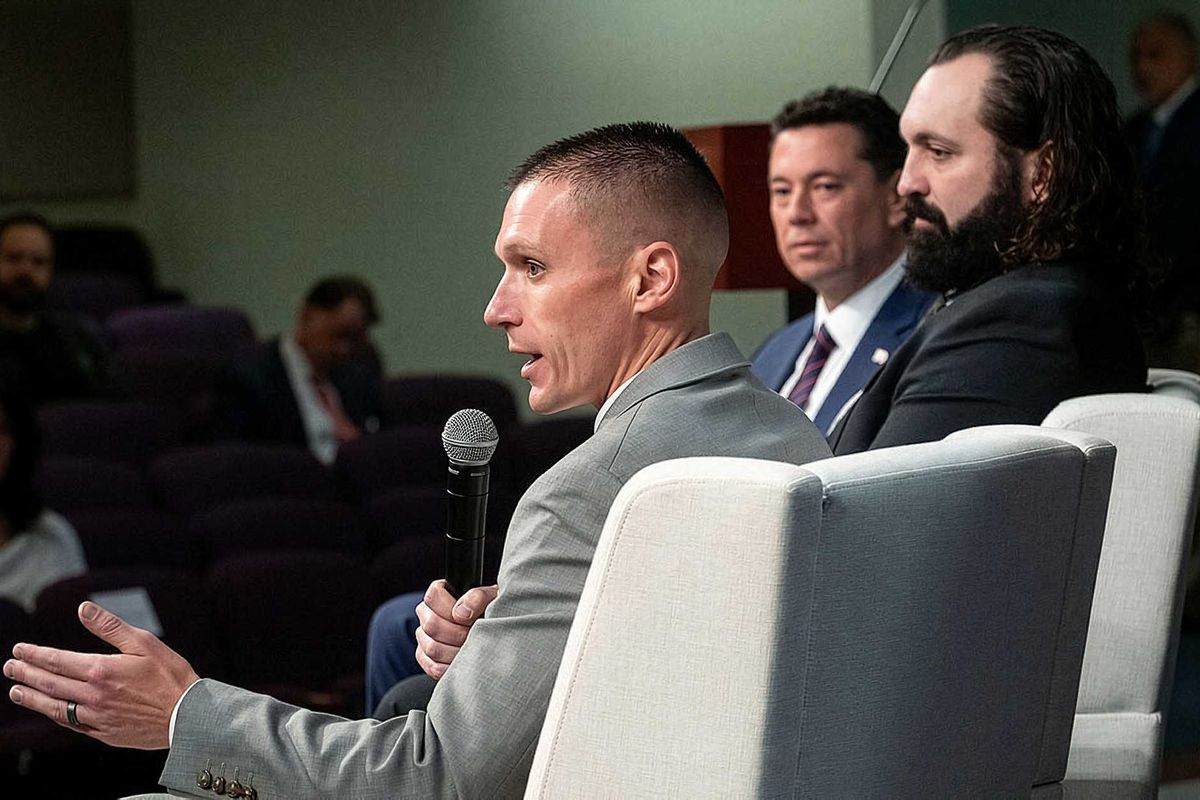
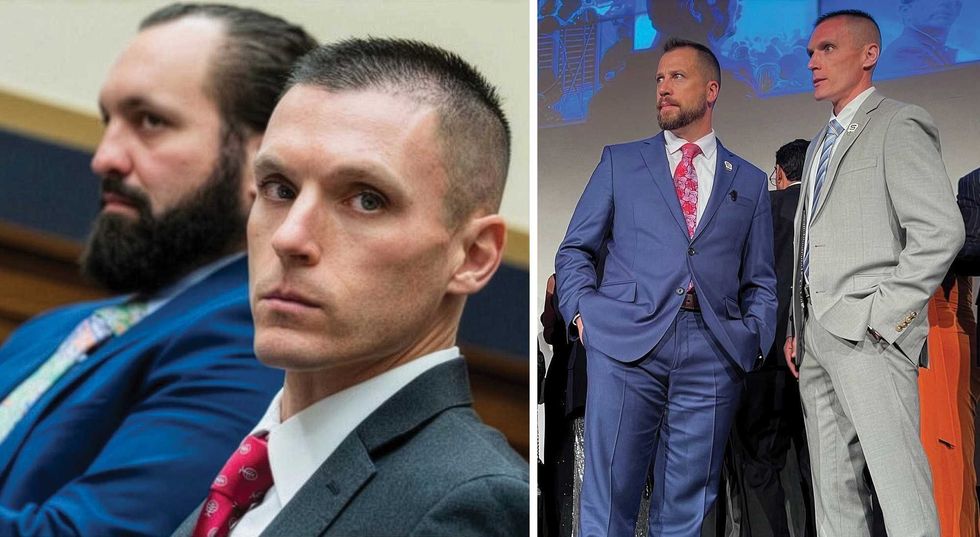 Left: Former FBI Special Agent Steve Friend at the House Select Subcommittee on the Weaponization of the Federal Government hearing in May 2023. Right: Friend and former Special Agent Kyle Seraphin at the premiere of the film “Police State” at President Donald Trump’s Mar-a-Lago estate.Photos courtesy of Steve Friend
“The FBI took no action to reinstate until 74 days after the settlement agreement’s deadline had passed,” Siuzdak said. “Then, Mr. Kash Patel personally terminated Mr. Friend five days later …”
In the termination letter, Patel accused Friend of “unprofessional conduct and poor judgment” for his social media activity, including appearances on various podcasts offering opinions on FBI operations and slamming Patel and other senior leaders.
Patel drew specific attention to Friend’s Dec. 5 appearance on “The Kyle Seraphin Show,” hosted by the former FBI special agent from Texas.
Pipe-bomb patsy?
The men discussed the ongoing controversy over the bureau’s handling of the Jan. 6 pipe bombs case and the Dec. 4 arrest of Brian J. Cole Jr. as the alleged bomber. Cole was charged in federal court with planting pipe bombs outside the Democratic National Committee building and near the Republican National Committee building on the night of Jan. 5, 2021.
Both men expressed the view that Cole, 30, of Woodbridge, Va., is not the pipe bomber. The FBI arrested the wrong person to cover up alleged law enforcement involvement in the placing of the pipe bombs, they said. They noted that Cole is likely autistic and operates on the level of a 16-year-old, according to his grandmother.
“Whatever the motivation is, if you’re doing another put-up job on this guy — I think we spelled out a pretty compelling case that this probably ain’t the guy — then may God have mercy on your soul,” Friend said.
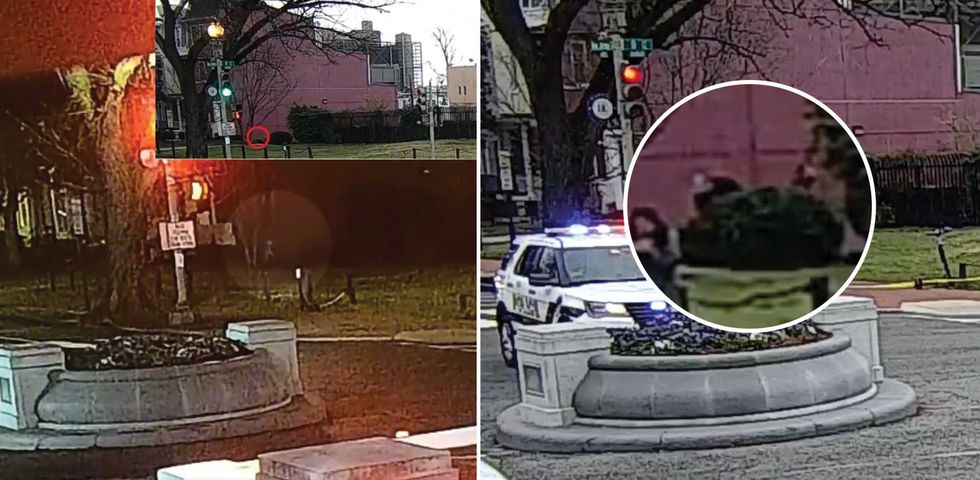 The alleged Jan. 6 pipe bomber (left) stops and sits down at a bush next to the Congressional Black Caucus Institute the night of Jan. 5, 2021. A Capitol Police counter-surveillance officer (right) peers at something under the same bush just minutes before he discovered the pipe bomb at the nearby Democratic National Committee building on Jan. 6. U.S. Capitol Police CCTV
“I’m going to end with this. I’m going to bring out my inner [Emperor] Commodus,” Friend said. “You better pray to Gaia or Vishnu or whatever your maker is that @RealSteveFriend is never in a position to be an instrument of God’s wrath. Because I will be merciful.”
“I won’t give you a trial and a hanging,” Friend said. “I’ll allow you to breathe every breath that your body will have for the rest of its natural life inside of a box. And then when it ultimately fades to black, that’s when real wrath begins.”
‘Kash Patel should be more concerned with his agency arresting the actual perpetrator of the January 6th pipe bombs.’
The firing was leaked in advance to Caitlin Doornbos of the New York Post, who sent Friend a text at 7:05 p.m. Eastern Dec. 12. In it, she made reference to the whistleblower advocacy group Empower Oversight dismissing Friend as a client on Dec. 5 — and suggested his latest podcast comments could cost him his job.
“I am writing a piece about them [Empower] firing you following the ‘wrath of God’ comments you made on Kyle Seraphin’s podcast that were apparently about FBI Director Kash Patel,” Doornbos wrote, according to a copy of the text obtained by Blaze News. “I have reporting that suggests these comments may also have put your employment with the FBI in jeopardy, and I’m wondering if you would like to respond?”
In an emailed letter, Empower told Friend it was terminating its legal representation because he did not abide by the firm’s advice not to speak about the FBI on social media. Empower founder Jason Foster and President Tristan Leavitt told Friend, “We are aware that, contrary to our previous advice, you once again commented publicly on FBI matters today, risking further adverse administrative action by the FBI.”
Empower is “no longer willing or able to expend further time and resources representing your interests or providing counsel moving forward,” read the letter, provided to Blaze News by Friend, who said he waived attorney-client privilege.
The Post story on Friend’s firing was published the next day, less than two hours after Friend reported to the Daytona office to be given his termination letter.
‘Deranged rant’
The story described Friend’s Dec. 5 podcast commentary as a “deranged rant,” “hot rhetoric,” an “outburst,” and “disturbing remarks.” The discussion about Cole being an alleged patsy to hide possible government involvement in placing the pipe bombs was described as a “bogus cover-up.” Friend’s ongoing social media commentary amounted to “bashing the FBI and weighing in on conspiracy theories.”
Friend said because the FBI was in breach of the settlement agreement, he did not consider himself an employee when making podcast appearances in recent months. “I always issued a qualifier that I was speaking on my own behalf and not a representative of any government entity,” he said. “It was a joke with the audience. I called myself a hobbyist podcaster.”
The remarks made on the Seraphin show were not intended as a threat, Friend said. He defended the comments in a statement to Blaze News.
“I stand by my remarks,” Friend said. “It isn’t a threat to say that public servants who willfully rob American citizens of their God-given liberty in order to advance their careers or earn positive media attention deserve to go to jail.”
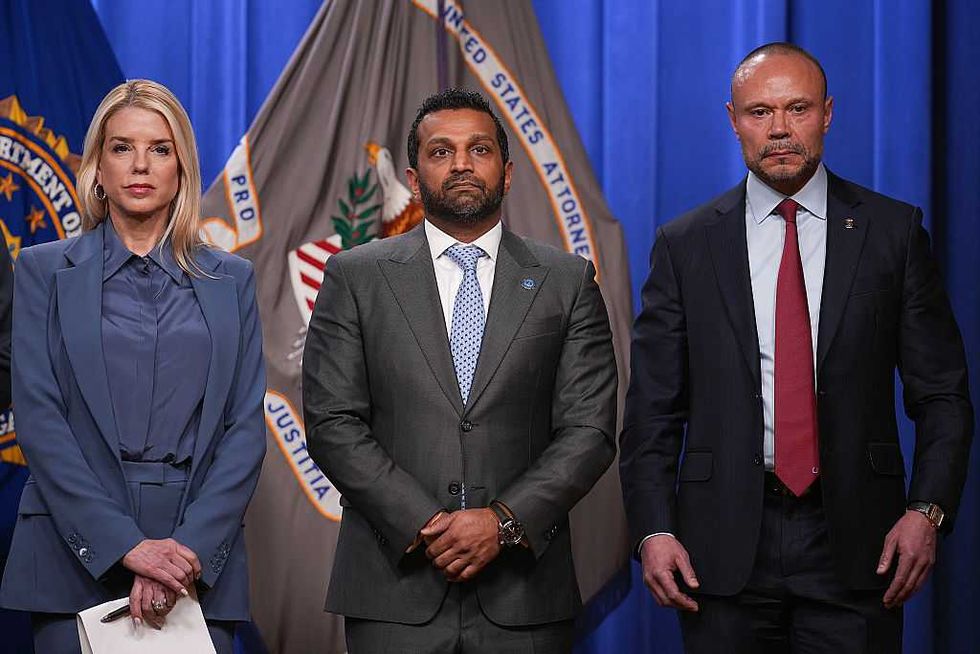 Attorney General Pam Bondi, FBI Director Kash Patel, and FBI Deputy Director Dan Bongino at a Dec. 4 press conference to announce the arrest of Brian J.Cole Jr. in the Jan. 6 pipe-bombs case. Photo by Andrew Harnik/Getty Images
The termination “was clearly an effort by the FBI director to besmirch my reputation to distract from his failures,” Friend said. “Kash Patel should be more concerned with his agency arresting the actual perpetrator of the January 6 pipe bombs than retaliating against me for pointing out they didn’t.”
Friend was first suspended from his job as a special agent in the Daytona Beach Resident Agency on Sept. 19, 2022, under President Joe Biden’s FBI director, Christopher Wray. He had previously lodged complaints with supervisors that the FBI’s plans to use SWAT teams to arrest a misdemeanor Jan. 6 suspect presented serious issues. He refused to take part.
‘The FBI had no real intent to reinstate Mr. Friend.’
“I expressed that I have an oath of office,” Friend said during an interview at his Florida home in October 2022. “And while I’m aware that an arrest warrant is a legal order from a judge, I have an oath to protect the Constitution.”
Friend said he was troubled when he was reassigned from investigating sexual trafficking of minors and young adults to working on the Joint Terrorism Task Force doing Jan. 6 casework. The Bureau broke with normal case management protocols by opening what ended up being nearly 1,600 criminal cases stemming from the protests and rioting at the U.S. Capitol on Jan. 6, 2021.
“They’ve chosen to open hundreds of cases and then spread them around the country,” Friend said in 2023. “That gives the impression that domestic terrorism is a nationwide threat, when really, the numbers the FBI is touting stem from one incident on one day.”
Friend resigned from the FBI in February 2023, a day before he was set to give transcribed testimony to the Republican-led U.S. House Select Subcommittee on the Weaponization of the Federal Government. On May 18, 2023, he was among three FBI whistleblowers who testified before the select subcommittee about the retaliation against whistleblowers by the FBI for lawful, protected disclosures they made to Congress.
Relationship sours
Initially, Friend was part of an ad hoc group of Patel supporters who regularly communicated with the “Government Gangsters” author and co-host of “Kash’s Corner” on Epoch TV. The group ramped up activity after Patel was announced as President Donald Trump’s choice for FBI director in November 2024.
The group also included Seraphin, then-suspended Special Agent Garret O’Boyle, and George Hill, retired FBI national security intelligence supervisor, and others. After gaining Senate confirmation in February, Patel sent the men a text that read, “I couldn’t have done this without you.”
Patel planned to bring O’Boyle and Friend into the bureau with him, Friend said, but that never happened. As Patel was confirmed by the U.S. Senate, he credited the group with helping put him across the finish line, according to a text message obtained by Blaze News.
After his nomination was announced by President Trump on Nov. 30, 2024, O’Boyle sent congratulations along with the statement, “Thank you, Kash, for what you’ve done for us.” Patel responded, “Thank you guys, you made this happen.”
“Thank you guys for your relentless friendship and mission love,” Patel wrote in a January text. “You guys made this possible.”
After the February Senate confirmation vote, Friend texted Patel, “Congratulations Director.” Patel responded, “Thank you guys. … Now we all go to work.”
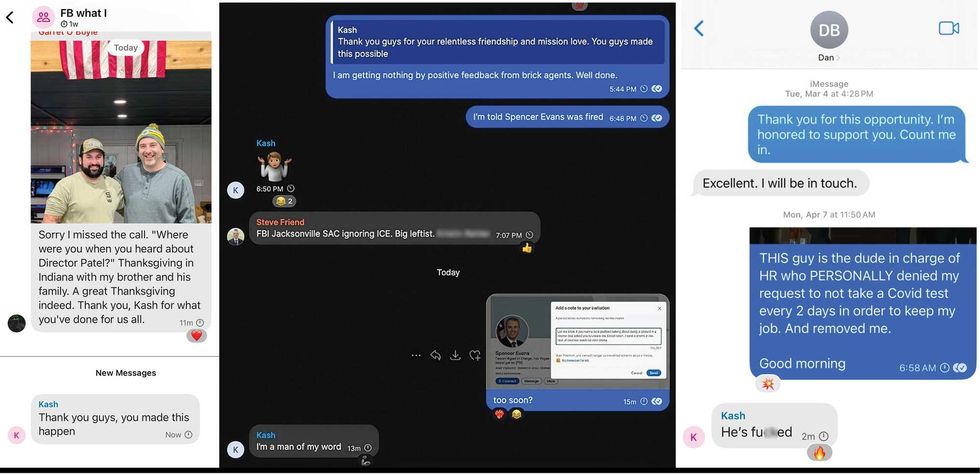 A group of whistleblowers formed an ad hoc group to advise Kash Patel as he prepared for confirmation hearings to become FBI director. The men are now at great odds.Images courtesy of Steve Friend and Kyle Seraphin
As 2025 wore on and the bureau had not publicly announced plans to settle with O’Boyle and other suspended FBI whistleblowers, or offer any of the men a job, the men began criticizing their former ally Patel and his new deputy director, Dan Bongino.
Friend said Bongino offered to hire him in March. Friend said he talked about some kind of staff position, either as an agent or a special government employee.
Friend texted Bongino a reply on March 4, “Thank you for this opportunity. I’m honored to support you. Count me in.” Bongino wrote, “Excellent. I will be in touch.” That was the last Friend ever heard about it, he said.
On Aug. 21, Patel announced that the FBI had reached settlement agreements with 10 whistleblowers represented by Empower Oversight. The announcement caught some of the whistleblowers, who said they had not yet agreed to anything, off guard.
Friend signed his settlement agreement on Aug. 26. It was also signed by DOJ senior legal counsel Vance Day.
‘I couldn’t have done this without you.’
Friend said under the agreement, he is owed $450,000 in back pay and $61,431 in reimbursement for medical coverage. The FBI was required to reinstate him by Sept. 19. By that date, the FBI was to pay the back salary and insurance reimbursement, cancel his indefinite suspension, reinstate Friend’s security clearance, and “rescind and expunge employee’s removal and all related records concerning misconduct or poor performance,” the agreement said.
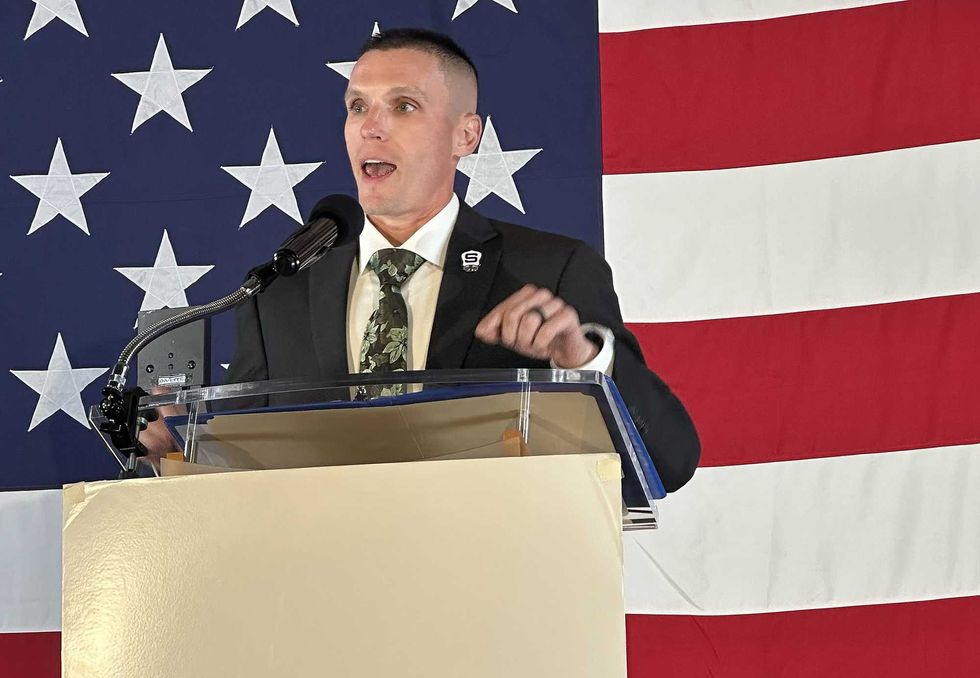 Former FBI Special Agent Steve Friend speaks at a Collier County Republicans event in Naples, Fla.Photo courtesy of Steve Friend
Three days before it fired Friend as a client, Empower received some updates from the FBI. Friend began receiving deposits on Oct. 9, which the FBI said were salary. Friend says he had no idea what the payments were for, that he never received a pay/leave statement, and that he could not access his Employee Personal Page at the FBI National Finance Center. The FBI told Empower that Friend’s access to pay statements was restored Dec. 2.
The FBI further said it was processing paperwork to enroll Friend in the Federal Employee Health Benefits Program. As for the back pay and reimbursement, the FBI said, “Backpay calculations are pending for all employees.” None of the whistleblowers have thus far been paid their back salary.
During his five days in the Daytona office, Friend was assigned an FBI vehicle but was refused an FBI gas card, he said. Regulations prohibit personal use of FBI vehicles, so without any job duties, Friend parked the vehicle at his house.
“The vehicle served only to block his driveway and as a reminder that the FBI had no real intent to reinstate Mr. Friend,” Siuzdak wrote.
The FBI did not respond to a request for comment.
Like Blaze News? Bypass the censors, sign up for our newsletters, and get stories like this direct to your inbox. Sign up here!
Jake Tapper Incorrectly Calls J6 Bomb Suspect ‘A White Man’
‘charged with transporting an explosive device’
Massie: FBI threatened his staff if he didn’t ‘play ball’ over pipe-bomb investigation
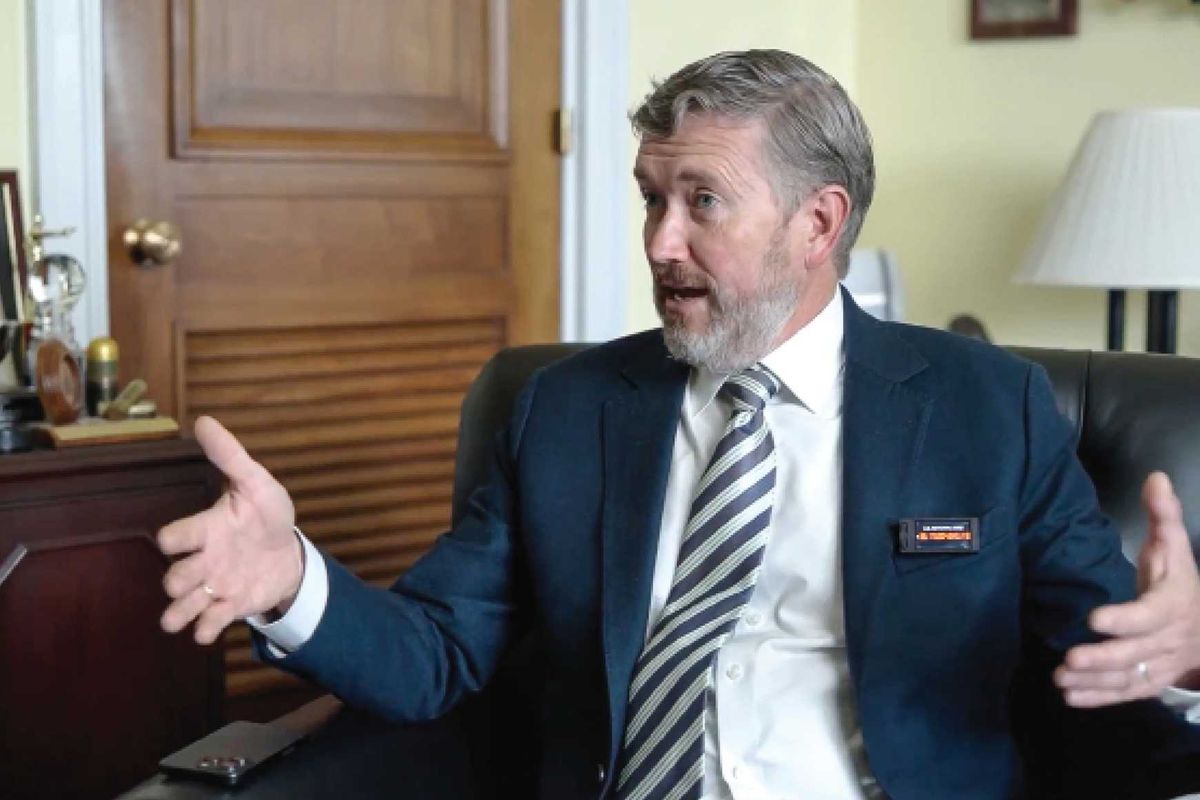
Rep. Thomas Massie (R-Ky.) said an FBI official threatened to open a criminal investigation on one of his staff over his persistent investigation and questioning on the Jan. 6 pipe bombs.
An FBI official threatened to open a criminal investigation on one of Massie’s staff “if we didn’t straighten up [and] play ball,” Massie told Blaze News investigative reporter Steve Baker in an interview broadcast on Matt Kibbe’s “Free the People” podcast and posted to X.
‘Even he understood that was not a good look. Probably illegal.’
“I’m going to say this here on camera because it’s important. … He said … ‘We’re going to investigate one of your staff for fraud,’” Massie quoted the unnamed FBI official as saying. “And he told another one of my staff this: ‘If you guys don’t straighten up, you know, if you want to play hardball, if this is how you want to play it’ or something like that, ‘this member of your staff is going to get criminally investigated for fraud’ — a very specific threat.”
Massie declined to identify the official he says levied the threat, but said he did complain about it to FBI Deputy Director Dan Bongino.
“I told Bongino, I said, ‘One of your guys is threatening my guys with an FBI investigation if we don’t do what you want.’ And he [Bongino] said, ‘I’ll take care of that.’ ’Cause even he understood that was not a good look. Probably illegal.”
Massie said he later received a “non-apology” text from the official that said, “‘I’m sorry if I hurt your feelings.’”
“He didn’t apologize. He was unrepentant, let’s say, really.”
Massie has been the most aggressive member of Congress investigating the pipe bombs found behind the Capitol Hill Club at 12:43 p.m. on Jan. 6 and under a park bench on the southwest side of the Democratic National Committee building 22 minutes later. In the same interview with Baker, Massie also disclosed that recent Blaze News reporting has caused him to be “99% certain” that some U.S. Capitol Police officials had a role in the planting of the pipe bombs found on Capitol Hill on Jan. 6, 2021.
“I went from 90% certain that some Capitol Police were involved in the Jan. 6 pipe bomb to 95% certain, and now I’m at 99% certain after this new story that you put out this week,” Massie told Baker.
“I’m doing this on probability. The probability may even be higher than that.”
His comments reflect Blaze News’ recent reporting on a former Capitol Police officer who was an apparent forensic match to the bomb suspect, follow-up reporting on the manner in which the second device was discovered by plainclothes Capitol Police officers, and the stonewalling the congressman charges that he faced from Capitol Police in the course of his own investigation. Assistant Police Chief Ashan Benedict, whom Massie named as having specifically blocked his investigation, retired last week.
The Kentucky Republican also expressed frustration that FBI Director Kash Patel seems to have made little more progress than his predecessor, Director Christopher Wray. In an interview with Fox News earlier this month, as well as a follow-up with independent reporter Catherine Herridge, Patel promised that major developments are incoming, but was scant on details.
A CBS story published Tuesday cited three unidentified sources stating that the FBI had cleared the police officer who appeared to match a forensic gait analysis of the bomber, citing “an alibi: video of her playing with her puppies at the time the devices were placed.” Blaze News has sought to obtain independent confirmation of the FBI’s clearance based on the alibi.
Blaze News reported Nov. 8 on a forensic match to a former Capitol Police officer, based on a computer analysis of the hoodie-wearing alleged pipe bomber’s manner of walking compared to that of the person. The algorithm rated the person as a 94% match, while the intelligence analyst who ran the study for Blaze News put the match closer to 98%. The person has since denied any allegations, through her attorney.
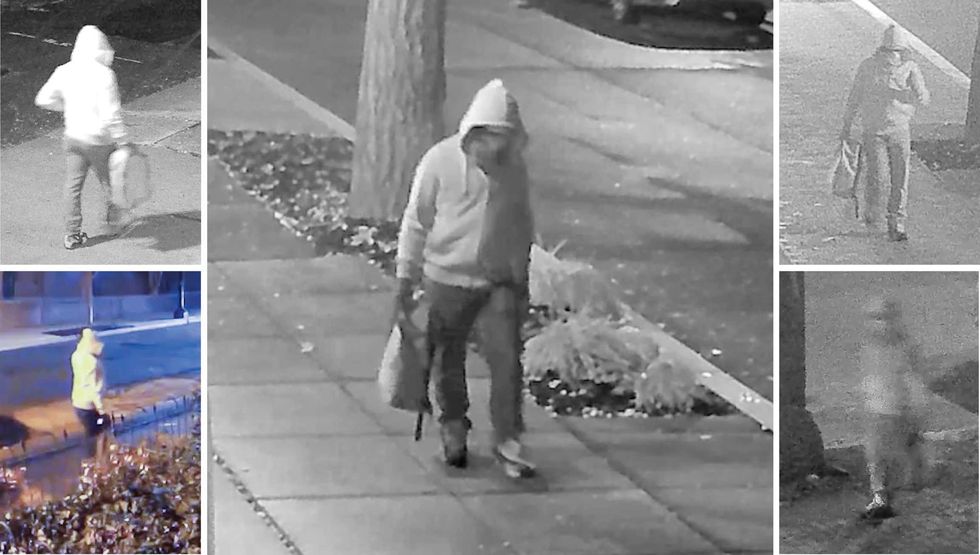 FBI photos
Blaze News reported Nov. 18 that two Capitol Police counter-surveillance special agents sent out to look for more explosives after the discovery of the Capitol Hill Club device were seen on video going to the DNC building and to a nearby bush on the side of the Congressional Black Caucus Institute building.
Independent video investigator Armitas discovered that the hoodie-wearing suspect identified in 2021 as the pipe bomber stopped at the bush along a sidewalk on the north side of the CBCI building at 7:47 p.m. Jan. 5. The suspect sat cross-legged at the shrub and appeared to rummage through a backpack before leaning into the bush as if attempting to place something underneath.
The bomb suspect then stood up and walked back to the DNC bench, where a pipe bomb was placed at 7:54 p.m., according to choppy video released by the FBI.
‘He had a handler, who would often interrupt and answer questions for him.’
When Capitol Police dispatch warned of the Capitol Hill Club bomb at 12:43 p.m., two plainclothes Capitol Police special agents took a nearly six-minute drive to reach the Capitol Hill South Metro Station, one block from the Capitol Hill Club bomb scene. They then walked to the DNC building, passing the park bench the pipe bomb sat next to.
The agents continued walking until they reached an alley leading to the side of the CBCI building. Their movements were not captured on video because four Capitol Police security cameras that would have shown the DNC crime scene were turned away at key moments or pointed in another direction by default.
Massie’s office released video in July 2023 showing a man in dark clothing and a ball cap approaching a U.S. Secret Service SUV sitting in the driveway of the DNC building as part of Vice President-elect Kamala Harris’ security detail. Harris was inside the building when the pipe bomb was discovered.
Blaze News reported in January 2024 that this man was the plainclothes Capitol Police officer who discovered the pipe bomb under a bush at the foot of a park bench at the DNC building.
Following that story, Massie told Blaze News he was determined to interview the agents, but did not get much cooperation from Capitol Police. Massie referred to the agents as “man-bun guy” and “backpack guy” (the one who discovered the bomb).
‘Weirdest meeting’
The Capitol Police never made “backpack guy” available to the Massie, but on Jan. 30, 2024, they did eventually send his partner, accompanied by his commander, Benedict, to speak with the congressman in a meeting that was not recorded or transcribed.
“So they came over to my office, but not ‘backpack guy,’” Massie said. “’Man-bun guy’ came over, and he had a handler, who would often interrupt and answer questions for him.”
Two congressional investigators sat in on the meeting alongside Benedict, the police officer, and Massie. The congressman later described the interview as the “weirdest meeting in the world.”
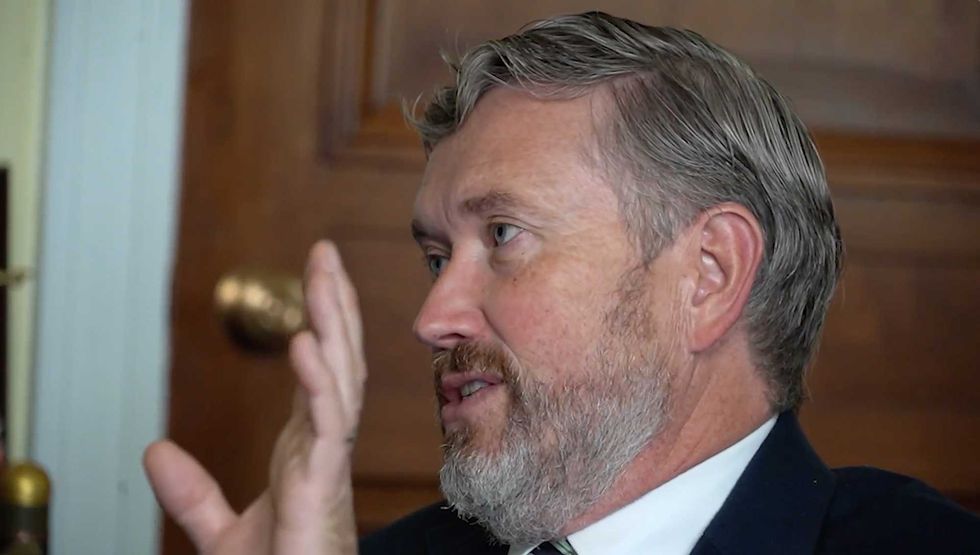 Rep. Thomas Massie (R-Ky.) said an FBI official threatened a criminal investigation of his staff if he didn’t “play ball” on the Jan. 6 pipe bomb investigation.Photo courtesy of Free the People
“In the conversation with the counter-surveillance officer in my office, Ashan Benedict would frequently interrupt the officer, answer before the officer could reply, or qualify the officer’s answers,” Massie told Blaze News. “There was an effort by our committee staff to get Benedict to sit for a transcribed interview, but he successfully evaded that effort.”
Massie said he still wants to interview the officer who actually found the bomb, as well as his partner and Benedict. “Those need to be transcribed interviews. They need to be sworn in. I feel very strongly about that,” he said. “But the reality is the FBI should be doing these things.”
Massie said that after he reposted the Blaze News article on the gait analysis, Bongino called him to complain about two early persons of interest mentioned in the piece.
One of those men, named in FBI reports as Person of Interest 3, lived directly next door to the Capitol Police officer who was the subject of the Nov. 8 Blaze News article. The FBI’s Special Operations Group conducted surveillance on Person of Interest 3 in Falls Church, Va., for two days in January 2021, but surveillance was suddenly canceled, before any law enforcement officer ever questioned the man.
Massie said Bongino told him, “‘That’s a dead lead. … We investigated that lead and … there’s nothing there. There’s no there there.’ So that’s why they quit looking at it. … At that point I said, ‘But you guys weren’t — you never did suspect him. The FBI never did suspect him. … His build doesn’t match. There’s no way it could be him. Your guys were looking for somebody else.’”
Whistleblower concerns
A current FBI supervisory special agent on Nov. 10 filed a whistleblower protected disclosure with Massie and U.S. Rep. Barry Loudermilk (R-Ga.), alleging the termination of surveillance at the Falls Church condominium complex was improper and cut off a suggestion by a surveillance team member that Person of Interest 3 be questioned face-to-face at his doorstep.
Person of Interest 3 and Person of Interest 2, his alleged houseguest on Jan. 5 and 6, 2021, had not been questioned by the FBI when surveillance was terminated. Interviews took place six days later, according to FBI reports included in the whistleblower disclosure. An FBI agent pretending to be a Metro Transit police officer interviewed Person of Interest 3 over the phone, a congressional source told Blaze News.
The whistleblower’s “concern was that the investigation that went to Falls Church, Virginia, that got them to the doorstep of the person that [Blaze News] identified through gait analysis as possibly somebody that might have been the person in the hood,” Massie said.
“There were suggestions made to the people in charge of the investigation about how to follow up on those leads,” Massie said. “And it was just dropped after two days of surveillance. And he [the whistleblower] provided supporting documents to that effect.”
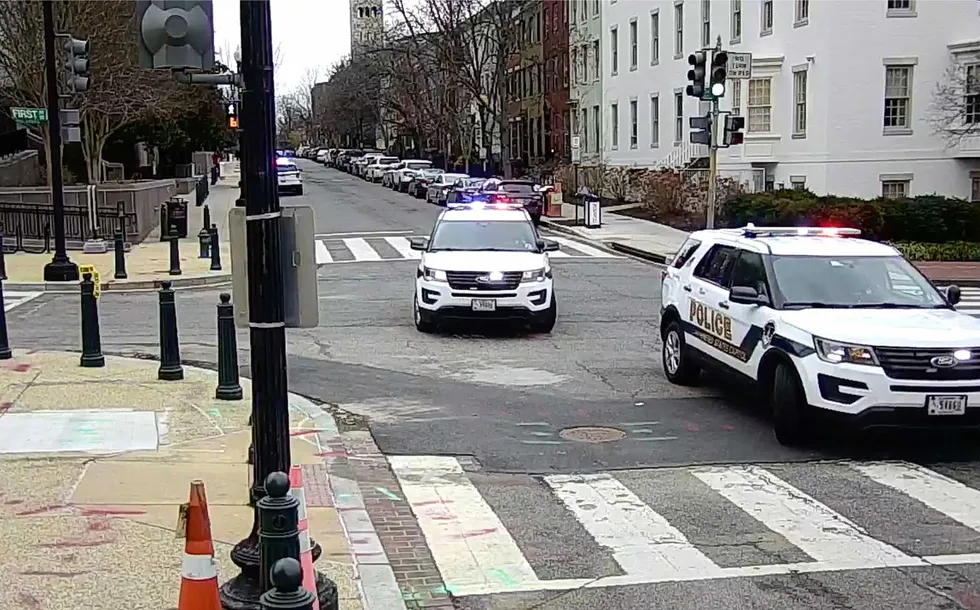 Capitol Police block off the intersection of 1st and C streets in response to discovery of a pipe bomb at the Capitol Hill Club in Washington, D.C., on Jan. 6, 2021.U.S. Capitol Police
Massie said Bongino made reference to the FBI conducting a meeting to address the whistleblower disclosure. “He didn’t say, ‘We’re trying to find the whistleblower,’” Massie said. “But my Spidey sense went off, and I almost said to him in that moment, ‘You better not be trying to find the whistleblower, because law protects that individual.’ But I didn’t say it.”
Massie said he thought about this when recalling the threat he said his staff received from the FBI official.
“I have to tell all the listeners this because this is the context in which I’m worried for the whistleblower,” Massie said. “If they’re willing to retaliate against a congressional office, which has speech or debate immunity and a lot of other protections, they may be willing to retaliate against the whistleblower.”
The whistleblower’s attorney, Kurt Siuzdak, sent a letter to Massie and Loudermilk on Nov. 13, warning that if the FBI attempted to out the whistleblower, it would violate the supervisory agent’s protections under the law. Massie shared the letter on social media.
“Identifying the whistleblower serves only one purpose,” Siuzdak wrote, “which is to allow FBI management to retaliate.”
In a Nov. 13 post on X, Bongino accused Massie of throwing “BS bombs” and denied that the FBI sought to identify or retaliate against the Nov. 10 whistleblower. A Blaze News request to Bongino for further comment went unanswered.
Like Blaze News? Bypass the censors, sign up for our newsletters, and get stories like this direct to your inbox. Sign up here!
Assistant Capitol Police chief accused by Rep. Massie of thwarting congressional J6 pipe-bomb investigation retires
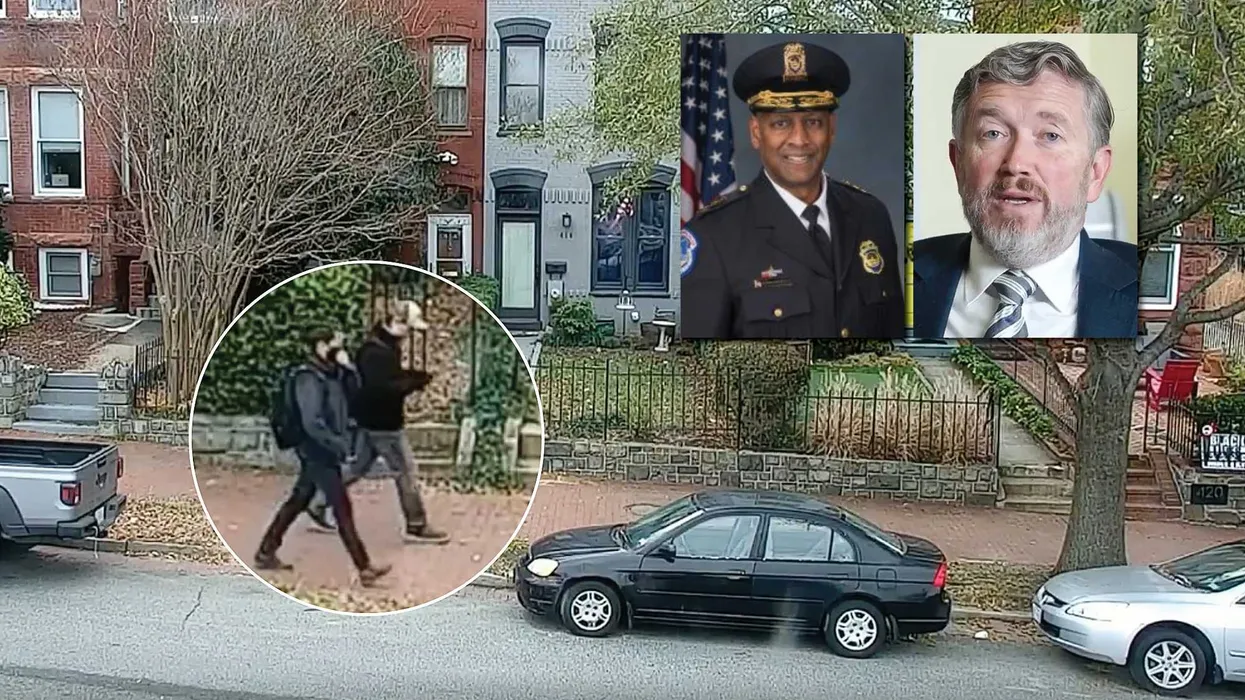
Ashan M. Benedict, the assistant U.S. Capitol Police chief who a congressman alleges prevented two special agents involved in the discovery of a pipe bomb at the Democratic National Committee building from testifying before a U.S. House panel, has retired from the department, Blaze News has learned.
Rumors of Benedict’s retirement came one day after Blaze News published an investigation showing unexplained activity by the Capitol Police officers who discovered that bomb, who were overseen by Benedict. The announcement surprised some at the Capitol Police because his contract with the department was set to expire at the end of the month, on Dec. 1. Benedict came to the Capitol Police on Dec. 4, 2023, as assistant chief for protective and intelligence operations, which includes counter-surveillance teams. He later became assistant chief for standards and training operations.
‘They never looked for a third or fourth or fifth pipe bomb.’
Before he joined the USCP, Benedict was the DNC pipe-bomb incident commander for the U.S. Bureau of Alcohol, Tobacco, Firearms and Explosives. In that post, he oversaw ATF’s response to the J6 pipe-bomb threat.
Capitol Police Chief Michael Sullivan distributed a bulletin Monday, Nov. 24, announcing Benedict’s retirement after less than two years with the USCP. Word had already circulated around the department on the Wednesday before that Benedict was leaving, two sources told Blaze News.
Word of Benedict’s retirement started percolating a day after Blaze News published an investigation showing the two USCP counter-surveillance agents who discovered the DNC bomb on Jan. 6, 2021, seemingly acting in a suspicious manner. The cops parked their car that afternoon and walked straight past a pipe bomb to another location, which Blaze News’ investigation discovered that the pipe-bomb suspect visited the night before. Then the officers returned to the DNC building, where one of them discovered the device.
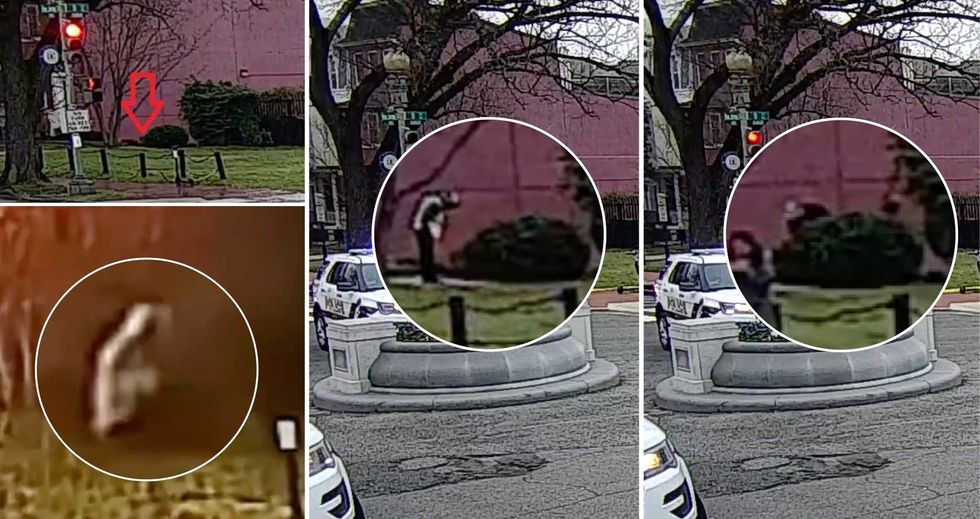 Pipe-bomb suspect, construction worker, and police at a bush next to Congressional Black Caucus Institute.Photos by U.S. Capitol Police
“I went from 90% certain that some Capitol Police were involved in the Jan. 6 pipe bomb to 95% certain, and now I’m at 99% certain after this new story,” Rep. Thomas Massie (R-Ky.) told Blaze News last week in an interview with Steve Baker broadcast on Matt Kibbe’s “Free the People” podcast and posted to X.
“I’m doing this on probability. The probability may even be higher than that.”
The officers were not seen searching any other areas for explosives in any of the extensive video available and reviewed by Blaze News, and they did not continue searching after the DNC device was found at 1:05 p.m. on Jan. 6.
The USCP has since confirmed that one of its agents found the pipe bomb near the DNC park bench, but there is no video showing that because key cameras were turned away from the DNC building at the time. The fact that the DNC bomb was discovered by plainclothes Capitol Police officers, and not merely a pair of passersby, was not made public until Blaze News broke that news in January 2024.
Following that story, Massie told Blaze News he was determined to interview the agents, but did not get much cooperation from Capitol Police. Massie referred to the agents as “man-bun guy” and “backpack guy” (the one who discovered the bomb). By this time, the agents were under Benedict’s command.
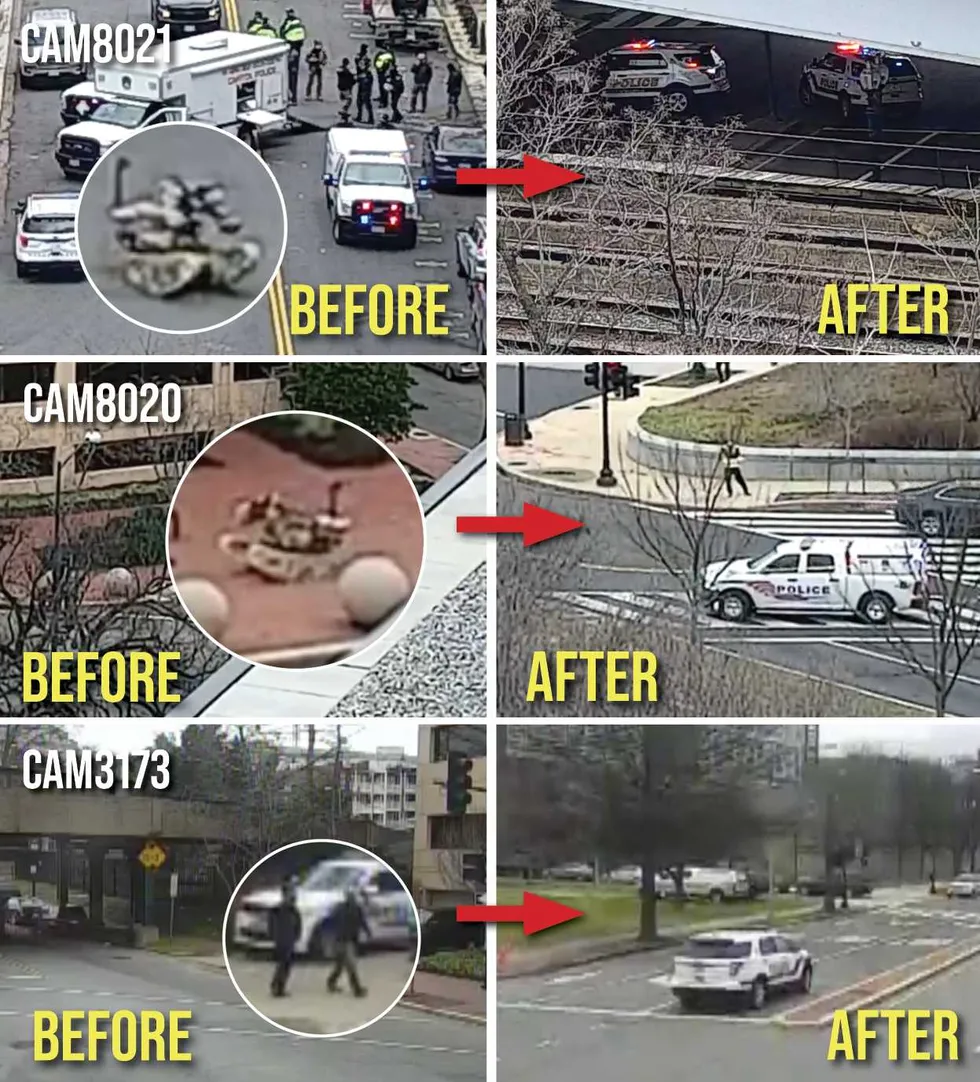 Key cameras that cover the Democratic National Committee building were turned away during bomb discovery and disposal.U.S. Capitol Police
The Capitol Police never made “backpack guy” available to Massie, but on Jan. 30, 2024, they did eventually send his partner, accompanied by Benedict, to speak with the congressman in a meeting that was not recorded or transcribed.
“So they came over to my office, but not ‘backpack guy,’” Massie said. “’Man-bun guy’ came over, and he had a handler, who would often interrupt and answer questions for him.”
‘They just kind of wander off. Their job was done. They had found the second pipe bomb.’
Two congressional investigators sat in on the meeting alongside Benedict, the police officer, and Massie. “In the conversation with the counter-surveillance officer in my office, Ashan Benedict would frequently interrupt the officer, answer before the officer could reply, or qualify the officer’s answers,” Massie told Blaze News. “There was an effort by our committee staff to get Benedict to sit for a transcribed interview, but he successfully evaded that effort.”
Massie asked the agent who sent him and his partner to the DNC building, as opposed to some other high-visibility potential target.
“How did you know to go look there?” Massie said he asked. “And it wasn’t a real good answer, something like, ‘That was my sector’ or something. You know, ‘We’re assigned sectors, and that’s just the sector that I look in.’”
According to the January 2025 report of the Committee on House Administration Subcommittee on Oversight, three two-man Capitol Police counter-surveillance teams were dispatched to look for other bombs after discovery of the Capitol Hill Club device.
Massie said he showed a video to the men, depicting the slow, nonchalant response from the Secret Service, Metropolitan Police Department, and Capitol Police to the discovery of a bomb that potentially could have killed them all.
‘He never told me about this other bush.’
“Look, there’s pedestrians still walking around, and this is allegedly a pipe bomb,” Massie said. “And that’s when his handler [Benedict] stepped in and said, ‘Well, you don’t want to alarm people when you have a lot of crowds. You know, when you find a bomb or something, you can’t yell, ‘Bomb!’ You gotta just play it cool.’”
Video showed there were no crowds near the DNC bomb site. Occasional pedestrian traffic continued on the sidewalk within feet of the bomb, and vehicle traffic was not immediately stopped on nearby streets. Commuter trains continued to rumble over the adjacent train trestle for 15 minutes after discovery of the bomb.
Massie said his next question “elicited the oddest body language I’ve ever seen in a meeting and no real answer.”
“Well, so then you obviously went looking for another pipe bomb, right?” Massie recalled. “You found two of them within 30 minutes. You must believe the whole place is riddled with them if you’re finding them this quickly.
“I actually knew part of the answer. I watched the video of where he went after,” Massie said. “They just kind of wander off. Their job was done. They had found the second pipe bomb. They never looked for a third or fourth or fifth pipe bomb, and they didn’t have an answer to me for why the search for pipe bombs was over once they found the second pipe bomb. No answer. Weirdest meeting in the world.”
Massie said he still wants to see the officer who actually found the bomb and interview him, his partner, and Benedict under oath for transcribed interviews. “Those need to be transcribed interviews. They need to be sworn in. I feel very strongly about that,” he said. “But the reality is the FBI should be doing these things.”
“How did they know exactly where to look, including the place [Congressional Black Caucus Institute bush] where the pipe bomber tried to place a bomb?” Massie asked. “It was police, it was Capitol Hill Police that found these bombs, and they got there. But … I hope they went and bought lottery tickets after finding these, after going to these two locations.
“But when you take them all together, and the fact that I got to interview these, it’s at least one of these guys [who discovered the bomb], and he never told me about this other bush,” Massie said. “He didn’t have answers for why they didn’t look for more bombs after they found the second one. And then we’ve got the ATF person in charge of the bomb stuff happening on Jan. 6 is now at Capitol Police handling the interview?”
Sources have said the two special agents, who are known to Blaze News, are still with the Capitol Police. The one who discovered the bomb is now the Capitol Police’s liaison to the FBI — the agency charged with investigating the pipe bombs. His partner, who accompanied Benedict to meet with Massie, still works in the intelligence section.
Benedict’s retirement is just the latest disclosure in two months of developments in the long-unsolved pipe-bomb case.
Questions and requests for comment sent to Benedict and the two officers were not returned in time for publication.
Like Blaze News? Bypass the censors, sign up for our newsletters, and get stories like this direct to your inbox. Sign up here!
FBI whistleblower pans bureau for alleged ‘gross misconduct’ and ‘fraud’ in early Jan. 6 pipe-bomb investigation
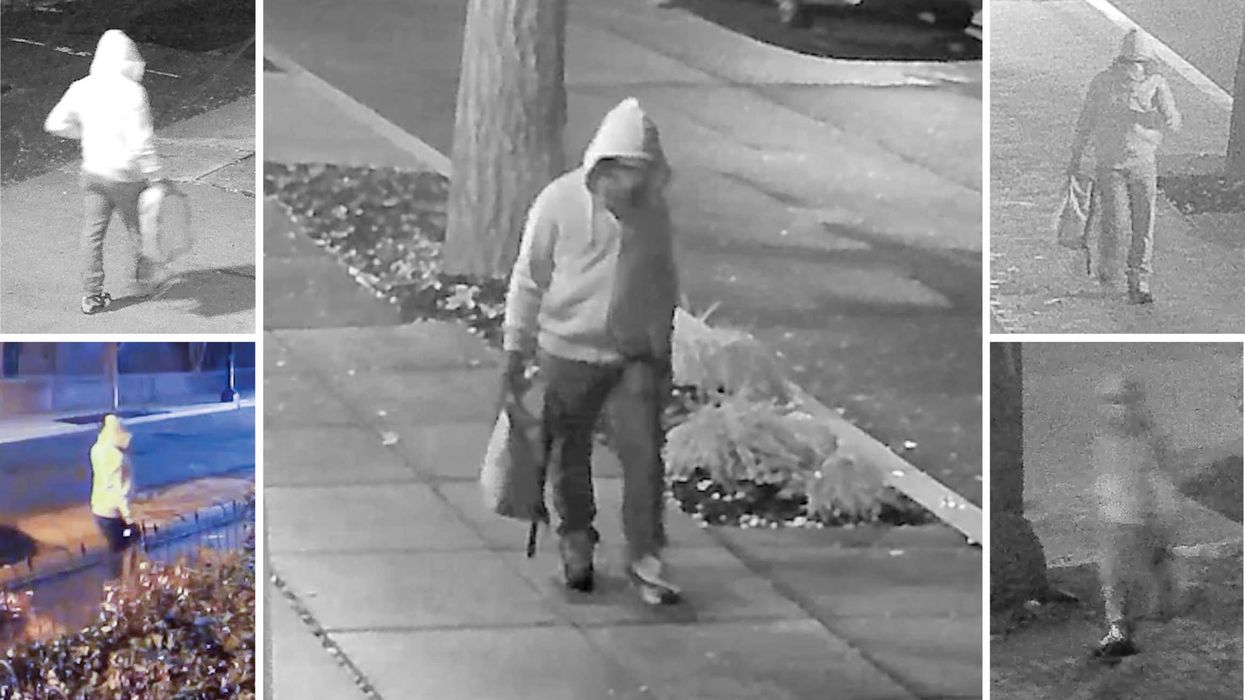
The Biden FBI is guilty of “gross misconduct and/or fraud” for calling off surveillance of an early person of interest in the Jan. 6 pipe-bomb case, an FBI whistleblower alleges in a letter to Congress. The letter refers to events that occurred nearly five years before Blaze News disclosed that the surveillance subject lived next door to a Capitol Police officer who is now a potential forensic match to the gait of the bomb suspect.
After reading the Nov. 10 protected whistleblower disclosure from an FBI supervisory special agent who is still at the bureau and a Nov. 8 Blaze News investigation of the pipe-bombs case, U.S. Rep. Thomas Massie believes the FBI “has been engaged in a cover-up” or has been “grossly incompetent.”
“Either way,” Massie (R-Ky.) told Blaze News in a statement, “these latest revelations about the pipe-bomb investigation require answers from the new FBI director.”
The Blaze News investigation said former Capitol Police Officer Shauni Rae Kerkhoff, 31, appears to be a forensic match to the gait of the pipe-bomb suspect. A forensic gait analysis arranged by Blaze News rated Kerkhoff’s stride as a 94% match to the individual shown on video planting pipe bombs the night of Jan. 5, 2021.
The gait analysis used a computer algorithm to analyze walking parameters including flexion (knee bend), hip extension, speed, step length, cadence, and variance. The veteran analyst who ran the study said based on visual observations the program can struggle with, he personally pegged the match at closer to 98%.
Kerkhoff has not been charged with any criminal conduct by any law enforcement agency in connection with the pipe-bomb incident.
The FBI has not responded to Blaze News requests for comment.
Attorney Kurt Siuzdak of Madison, Conn., filed a 10-page protected disclosure on behalf of his client, the whistleblower, with Massie and U.S. Rep. Barry Loudermilk (R-Ga.), among the most active lawmakers still investigating Jan. 6 and its aftermath. Loudermilk is the chairman of the House Select Subcommittee to Investigate the Remaining Questions Surrounding Jan. 6.
The FBI supervisor said that “after FBI agents came within yards of the person who has been identified” in Blaze News’ reporting, “the FBI surveillance team agents were ordered to cease their investigation, denied permission to conduct at least one logical interview, immediately removed from surveillance, and reassigned to do general leads work,” Siuzdak wrote.
“The ‘neighbor’ identified below [in the whistleblower complaint] lived within feet of [Person of Interest 3] and she appears to be the same individual as investigative reporter Steve Baker identified as a former U.S. Capital [sic] Police officer, who is currently associated with a U.S. intelligence agency,” Siuzdak wrote.
After the FBI identified several persons of interest in the pipe-bombs case, Squad 21 of the Washington Field Office Intelligence Division was assigned to do “FISUR,” or physical surveillance, in the Bailey’s Crossroads section of Falls Church, Va.
Kyle Seraphin, who was then a member of Squad 21, told Blaze News the surveillance lasted two days before the squad was pulled off the case without warning.
The new whistleblower said the female next-door neighbor of the man being surveilled was photographed by FBI agents.
“The ‘neighbor’ had been photographed by the FBI surveillance team, and her photograph and attire are similar to the individual who [allegedly] placed the devices,” Siuzdak said.
The FBI had already determined that the man referred to in FBI documents as Person of Interest 3 should be interviewed by agents. But when Seraphin proposed that he do a “knock and talk” at the man’s door, the idea was rejected, Siuzdak said.
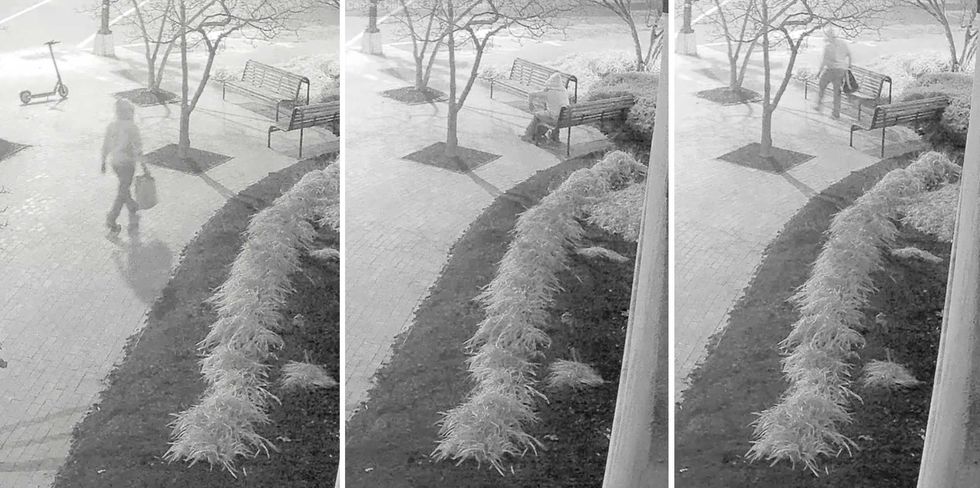 The suspected pipe bomber moves to a bench behind the Democratic National Committee building in Washington, D.C., on Jan. 5, 2021. FBI
The face-to-face interview with POI3 “would have obviously led to the doorstep of the ‘neighbor,’” Siuzdak wrote. “However, investigative steps offered by the FBI agents in the field were rejected, and agents were immediately reassigned. The discontinuation of the investigation was described [by the whistleblower] as improper.”
Kerkhoff is named in consumer, banking, and credit records as having resided next door to the man under surveillance. She later moved to Alexandria, Va. When Blaze News editor in chief Christopher Bedford visited the area of Alexandria near her residence the night of Nov. 7, the curtains were drawn, two civilian-looking vehicles were in the driveway, one civilian-looking truck was out front, and a fourth vehicle pulled up after Bedford parked. Two plainclothesmen got out of the final car, and a third joined them from inside the house. The three men stood sentry in front of the home for a time.
The local police responded to Bedford’s visit, and when he tried to drive away, he was quickly pulled over and asked why he was in the area. The local police promptly allowed him to go after he provided his ID and explained the reason why he was near the address.
Internal FBI documents included in the protected whistleblower disclosure corroborated information contained in a January 2025 report from the Committee on House Administration Subcommittee on Oversight.
According to the documents, the FBI had investigated an individual known as POI2, who was seen on surveillance video taking photographs behind the Capitol Hill Club the morning of Jan. 5 — about nine hours before an unknown subject in a grey hoodie placed a pipe bomb next to a row of rolling commercial garbage tubs.
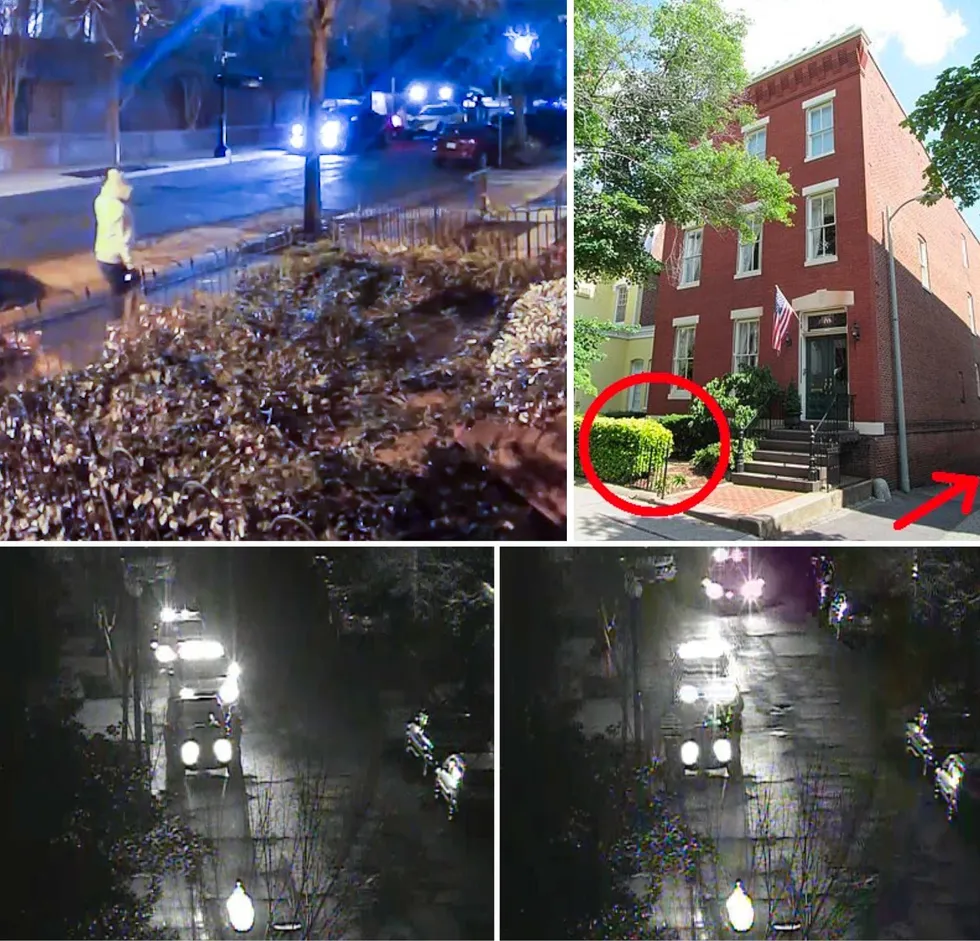 The pipe bomb suspect (above left) walking west on C Street toward Rumsey Court, stopping in front of a congressional rooming house (upper right), possibly looking to place a pipe bomb on Jan. 5, 2021. Capitol Police squad cars (below) with lights engaged were across the street as the suspect walked down the court to plant the bomb. FBI/@Armitas/U.S. Capitol Police CCTV
The man left the area and later returned to walk through Rumsey Court, which runs behind the Capitol Hill Club and the Republican National Committee building. When he was later questioned by FBI agents, the man claimed he was taking photographs of “objects bearing numerals” for a book project.
Agents used surveillance video to track the man through part of the day Jan. 5. He arrived at the Capitol South Metro Station from the East Falls Church Metro Station at 9:58 a.m. Capitol Police “observed POI2 switching hats when we [sic] exits South Capitol Metro,” an FBI report said.
After taking photographs behind the Capitol Hill Club, POI2 walked around the U.S. Capitol complex and met with two unknown individuals, the House report said.
The FBI considered POI2’s behavior suspicious and said he could be considered a possible accomplice to the pipe bomber.
The man again walked through Rumsey Court before proceeding to the Capitol South Metro Station and riding the train back to Falls Church, Va., where he arrived at 6:53 p.m.
FBI records show that Person of Interest 2 was dropped off at the East Falls Church Metro by a Volkswagen Tiguan registered to Person of Interest 3, who was put under surveillance by the FBI a week later. Person of Interest 2 used a prepaid Metro SmarTrip card to pay for the train rides. The SmarTrip card was purchased by Person of Interest 3, the FBI said.
The FBI interviewed Person of Interest 2, who was not identified in the investigative documents Blaze News reviewed, on Jan. 19, 2021. The man was subsequently dismissed as no longer a person of interest in the pipe-bombs case. The FBI also cleared Person of Interest 3 of having any role in the placement of the bombs.
The U.S. House report said the FBI did not explain on what basis it cleared Persons of Interest 2 and 3, indicate how the men knew each other, or explain how Person of Interest 2 obtained the other man’s prepaid SmarTrip card.
In a Nov. 12 story, the Daily Wire reported that “law enforcement suspected a particular Falls Church, Virginia man’s Metro card of being linked to the case, and also that the Capitol Police officer was in fact his neighbor, literally sharing a wall with him.”
The man told the Wire his Metro card “was used by a childhood friend who traveled from the south to attend Trump’s rally, and stayed with him to save money. The Air Force vet let him borrow his card and picked him up from the Metro station in Virginia after the rally, he said. Both men are Trump supporters, he said.”
The man said he had been interviewed on the matter by what he believes to be Metro transit police, as was his visiting friend. Furthermore, the man told the Daily Wire that he does not believe his Metro card was used by his neighbor, the Capitol Police officer, on January 5.
Blaze News was unable to independently confirm the Wire’s report. Blaze News investigative reporter Steve Baker knocked on the front door of the man’s townhouse on Nov. 9, but he declined to comment.
Like Blaze News? Bypass the censors, sign up for our newsletters, and get stories like this direct to your inbox. Sign up here!
Former Capitol Police officer a forensic match for Jan. 6 pipe bomber, sources say
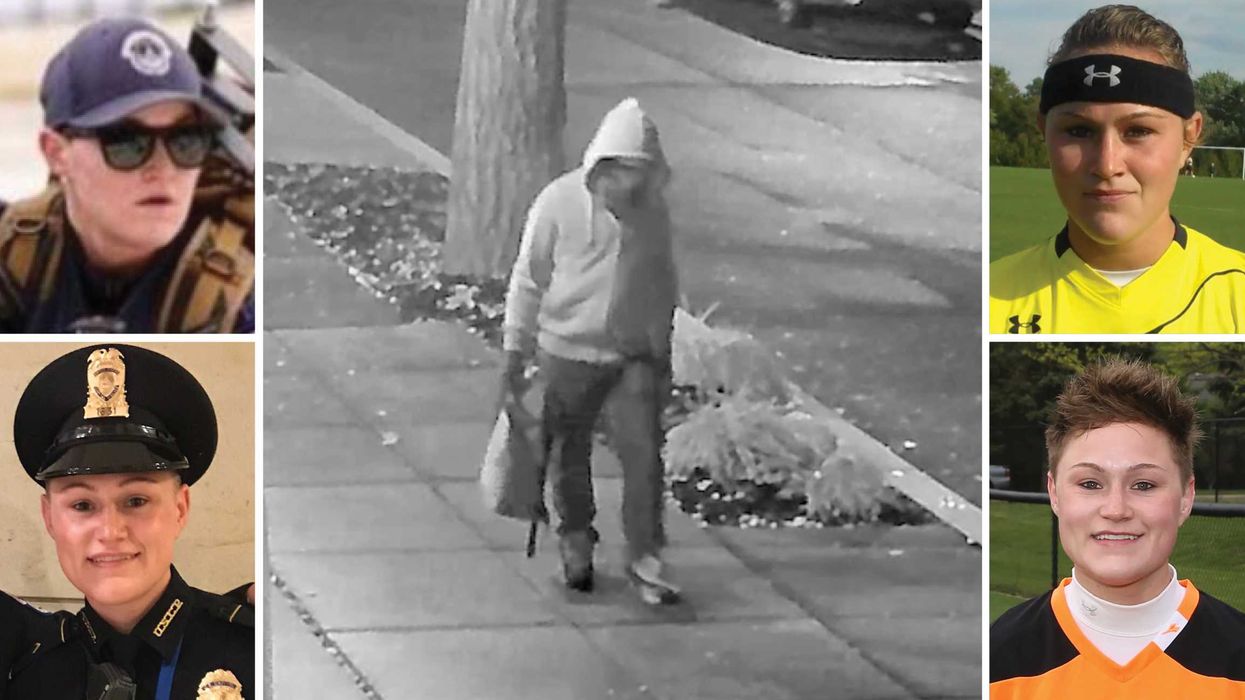
A forensic analysis of a female former U.S. Capitol Police officer’s gait is a 94%-98% match to the unique stride of the long-sought Jan. 6 pipe-bomb suspect, according to a Blaze News investigation confirmed by several intelligence sources.
A source close to a congressional investigation of Jan. 6 additionally told Blaze News evidence has emerged recently that pointed toward law enforcement possibly being involved in the planting of the pipe bombs.
‘They were f**king in on it.’
A software algorithm that analyzes walking parameters including flexion (knee bend), hip extension, speed, step length, cadence, and variance rated Shauni Rae Kerkhoff, 31, of Alexandria, Va., as a 94% match to the bomb suspect shown on video from Jan. 5, 2021. The veteran analyst who ran the analysis for Blaze News said that based on visual observations the program can struggle with, he personally pegged the match at closer to 98%.
Kerkhoff, who was a Capitol Police officer for four and a half years, left the department in mid-2021 for a security detail at the Central Intelligence Agency, sources told Blaze News.
In that job, she reportedly serves on dignitary protection teams for officials including CIA Director John Ratcliffe and others, sources told Blaze News.
Kerkhoff’s residence in Alexandria, Va., appeared to be under the watch of law enforcement officers on Friday night. Blaze News editor in chief Christopher Bedford was pulled over by local police after stopping to observe the home. He was then allowed to leave.
Close to bomb suspect
The FBI, which failed to solve the case in nearly five years of investigation but indicated that it was closing in after Blaze News brought its investigation to intelligence sources, was feet from the Falls Church address of the pipe bomb suspect days after Jan. 6, according to the Blaze News investigation.
Former FBI Special Agent Kyle Seraphin realized Friday that he was doing surveillance next door to the woman now suspected of being the Jan. 6 pipe bomber.
“The FBI put us one door away from the pipe bomber within days of January 6, and we were deliberately pulled away for no logical or logically investigative reason,” Seraphin told Blaze News Friday. “And everything about that tells me that they were involved in a cover-up and have been since day one.
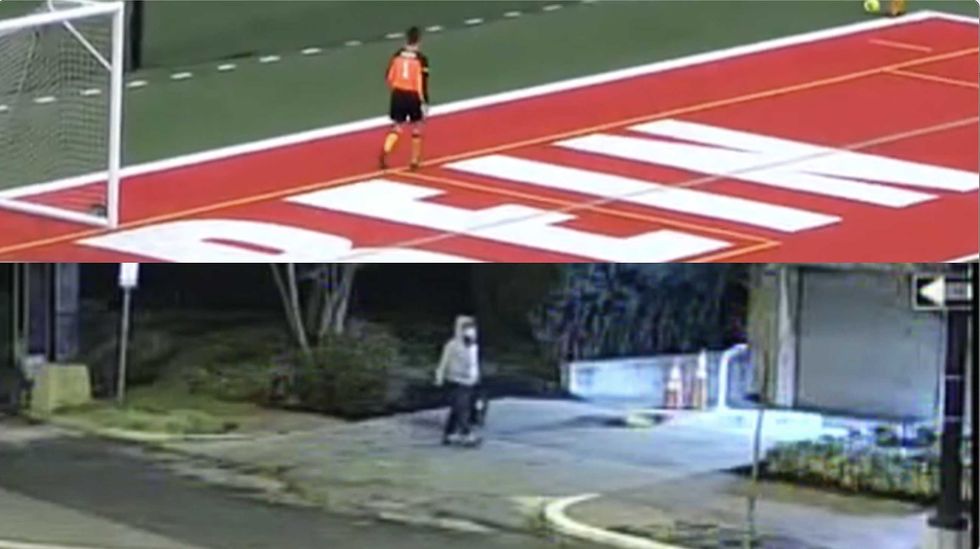 Former Capitol Police Officer Shauni Kerkhoff (above) playing soccer in Columbus, Ohio. The pipe bomb suspect approaches the Democratic National Committee building on Jan. 5, 2025.Columbus Eagles FC, U.S. Capitol Police
“They were f**king in on it,” Seraphin said.
Seraphin proposed doing a “knock and talk” at the door of an Air Force civilian employee whose address was tied to a vehicle that picked up the bomb suspect in Falls Church, Va., on Jan. 5, 2021.
Seraphin’s team spent two days watching the man, but Seraphin’s request to go face-to-face with the person of interest was denied. The team was pulled off the case the same night, he said.
Seraphin said he has given the same details publicly since 2021.
“There’s a personal reaction to it, which is the complete vindication that the things I’ve been saying and my recollection of being briefed on this stuff has been accurate for years and I’ve never changed my tune,” he said.
The FBI tied a DC Metrorail SmarTrip card allegedly used by the pipe-bomb suspect to an Air Force civilian employee but determined that while the man purchased the card, he did not use it. The suspect allegedly used the card to travel from D.C. to a stop in Falls Church after planting the pipe bombs. The Air Force civilian employee had purchased the SmarTrip card a year earlier.
Gait analysis
The forensic study, arranged by Blaze News, revealed that Kerkhoff is up to a 98% match to the gait of the pipe-bomb suspect. The findings were confirmed by several current intelligence sources who viewed the study results.
The source who did the comparison said the software rated the match at 94%. He put the figure at closer to a 96%-98% match, including a combination of human intelligence and the software analysis.
Samples of Kerkhoff’s gait were taken from Jan. 6 Capitol Police CCTV security video and compared to unedited video of the hoodie-wearing suspect walking through an alley near C Street to place an alleged pipe bomb behind the Capitol Hill Club about 8:16 p.m. on Jan. 5.
Two other sources familiar with gait analysis who viewed the video comparison and the software analysis told Blaze News they concurred that the video samples matched the gait of the gray-hoodie-wearing suspect.
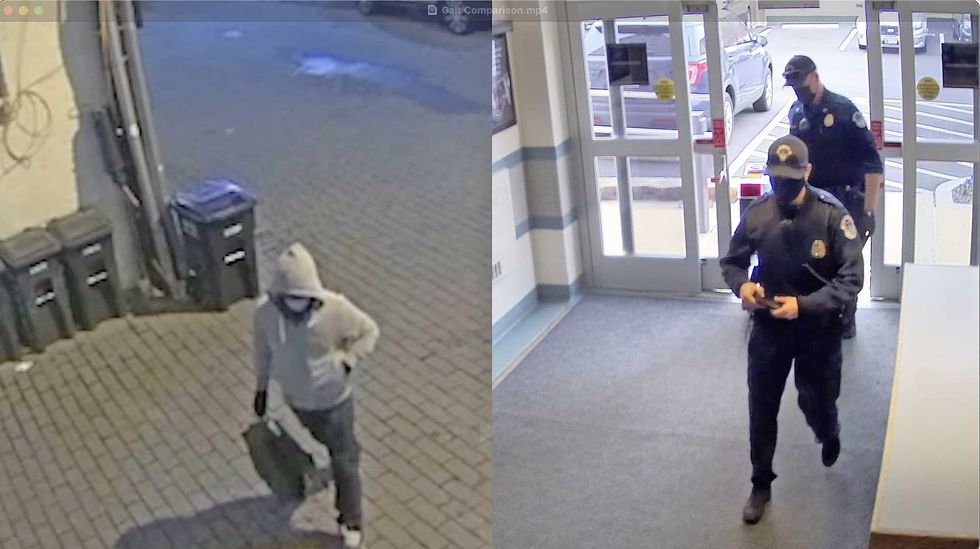 An expert in gait analysis used a computer algorithm to compare the gait of the pipe-bomb suspect (left) to that of Officer Shauni Rae Kerkhoff and obtained a 94% match.FBI/U.S. Capitol Police
The mystery of the pipe bombs has hung over Jan. 6 for nearly five years. The FBI said an unknown subject placed pipe bombs under a park bench at the DNC and the Capitol Hill Club near the Republican National Committee building between 7:54 and 8:16 p.m. the night before the riot.
Discovery of the devices between 12:40 and 1:05 p.m. respectively on Jan. 6 drew already depleted police resources away from the Capitol just as a huge crowd breached the grounds at 12:53 p.m. A joint session of Congress convened at 1 p.m. to take up challenges to the certification of the Electoral College vote from the 2020 presidential election.
Kerkhoff was a Capitol Police officer from 2018 until mid-2021. She was a member of the department’s Civil Disturbance Unit and a training officer on the use of “less-lethal” crowd-control weapons that were extensively used on the Jan. 6 crowds.
Using lethal force Jan. 6
Blaze News reported Wednesday on Capitol Police surveillance video showing Kerkhoff and other CDU officers repeatedly using lethal force on the Jan. 6 crowd using “less-lethal” weapons. At least 16 members of the early crowd on the Capitol’s West Plaza were shot above the waistline with kinetic-impact projectiles fired from above on the Lower West Terrace.
Blaze News approached numerous intelligence officials two weeks ago with questions about findings from its investigation, which suggested that Kerkhoff matched the description and behavior of the suspected bomber, based on her distinctive walk, slight limp, 5’7″ frame, and other factors.
‘We have conducted all logical investigative steps.’
Footage of the pipe-bomb suspect walking with a backpack on the night of Jan. 5 was compared to Jan. 6 security video of Officer Kerkhoff in various places on Capitol grounds and footage of her playing professional soccer in Columbus, Ohio, in 2017.
The pipe-bomb video that Blaze News used in its analysis was not the footage released by the FBI. A video sleuth who embarked on a more than yearlong investigation told Blaze News the footage made public by the FBI was manipulated to downsample the frame rate. Although it shows the same scene as the FBI video, the clip used by Blaze News came from another source and is demonstrably clearer with much smoother motion.
Former Capitol Police Chief Steven Sund told Blaze News he is eager to learn the results of the pipe-bomb investigation. But he said he had no awareness of any Capitol Police officer involvement in the pipe-bomb planting.
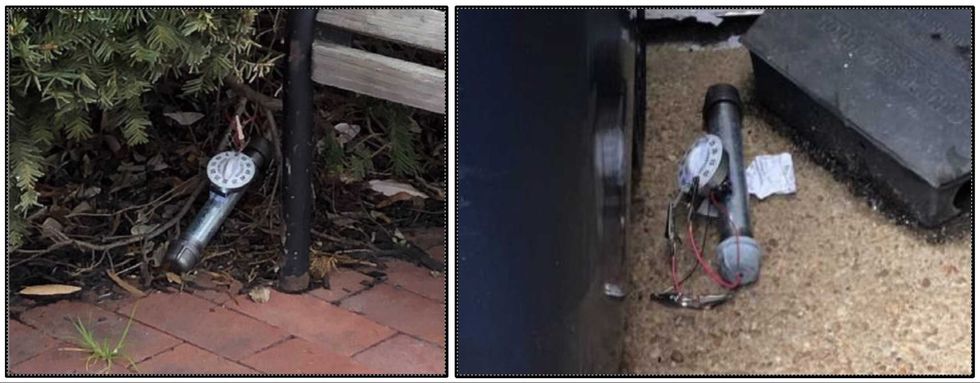 The pipe bombs were placed near the Democratic National Committee building (left) and the Capitol Hill Club (right). The bombs were discovered on Jan. 6, 2021.FBI photos
“I had no knowledge that it was being carried out, nor were they carrying it out with any authorization from the chief’s office,” Sund said. “I’m unaware of any legitimate reason that any Capitol Police or other law enforcement officer would be involved in the planting of those pipe bombs.”
The possible solution to the pipe-bomb mystery could have far-reaching reverberations.
Several officials familiar with the government’s investigative efforts said a new work is urgently needed to determine whether there were co-conspirators who aided and abetted the crimes, and to learn if federal agencies or employees knew who was involved in the bomb hoax and participated in a nearly five-year cover-up.
The FBI has faced questions over its failure to make meaningful investigative progress despite offering a $490,000 reward with the ATF, along with a $10,000 reward from the Metropolitan Police Department. Former FBI Director Christopher Wray claimed the bureau conducted an exhaustive investigation.
In congressional testimony, Wray said Jan. 6 was an indictment of right-wing domestic violent extremists. He said white-supremacy-fueled domestic violent extremism is one of the major threats to the nation.
The prospect of a Capitol Police officer being the perpetrator, if confirmed, could recast the entire story of Jan. 6. It could start to unravel the carefully crafted, zealously defended Democrat narrative that massive crowds of Trump supporters stormed the Capitol as part of an insurrection to keep Trump in office and deny Joseph R. Biden Jr. the presidency.
At the same time the FBI was not solving the pipe-bomb mystery, it was carrying out the largest investigation in its history to hunt down the thousands of Americans who went to the Capitol after Trump’s Jan. 6 speech at the Ellipse. The FBI under Wray worked in concert with the Biden Department of Justice to put hundreds of Trump supporters in prison.
Secret Service reaction to bomb
The U.S. Secret Service response to discovery of the pipe bomb under a park bench at the Democratic National Committee building drew fire from congressional investigators and the Department of Homeland Security Inspector General.
Speculation that the Secret Service knew the DNC pipe bomb was a dud began when U.S. Rep. Thomas Massie (R-Ky.) released Capitol Police security footage showing agents acting nonchalantly after a Capitol Police counter-surveillance officer informed them that he found a pipe bomb in the bushes behind the DNC building.
Agents stayed in their SUV eating lunch for two minutes before getting out to investigate. They stood feet from the suspected bomb and allowed pedestrians to walk past and vehicles to continue driving within feet of the device. Commuter trains that pass directly next to the DNC building continued to run.
‘The FBI put us one door away from the pipe bomber within days of January 6.’
Two weeks ago, Blaze News reported on the yearlong investigation of a video sleuth who found evidence he said showed the FBI was misleading the American public about the pipe bombs.
A user known as Armitas on social media said the videos released by the FBI had been manipulated to reduce the frame rate. He also provided evidence that the pipe bomber first tried to plant the devices outside the Congressional Black Caucus Institute and a congressional rooming house on C Street the evening of Jan. 5.
Shortly after Blaze News’ report on his findings, the FBI released higher-quality footage of the pipe-bomb suspect.
Armitas said he believes the device planted next to a bench in some bushes at the DNC building at 7:54 p.m. Jan. 5 was retrieved at 4:40 a.m. on Jan. 6 and replaced shortly before or nearly simultaneously to discovery of the bomb at 1:05 p.m. The device appears to have been broken by the bomb suspect outside the Congressional Black Caucus Institute on Jan. 5.
Much public discussion in the case dealt with the rare Nike Air Max Speed Turf sneakers the suspect wore — and whether the person was familiar with the areas around the DNC building and Capitol Hill Club.
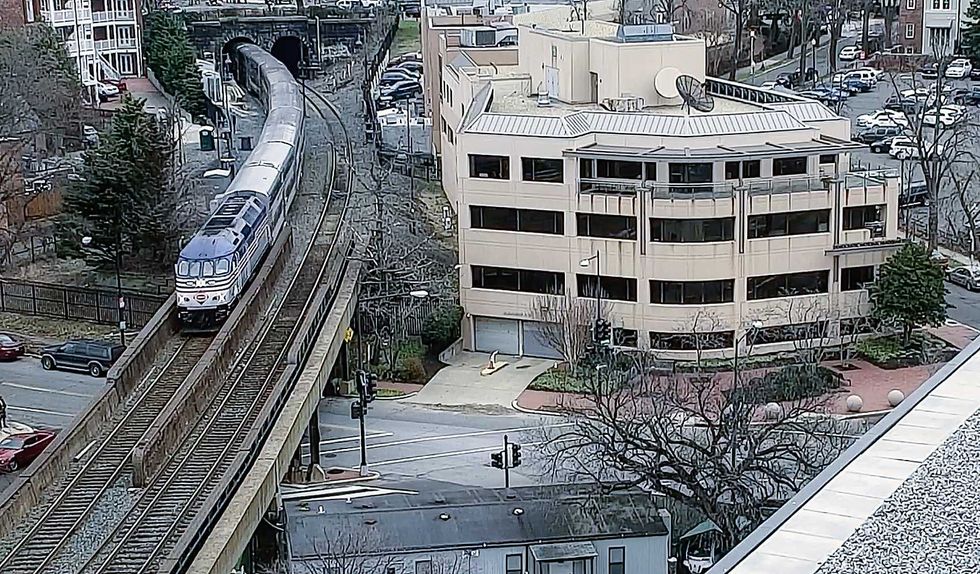 A commuter train runs past the Democratic National Committee building on Jan. 6, 2021, while a pipe bomb rests under a park bench behind the DNC.U.S. Capitol Police
Armitas said he believes the suspect knew to take a mini-shortcut at the corner of 1st and C streets and escaped through a well-hidden church garden gate after planting the second device behind the Capitol Hill Club.
Gait analysis software can get accurate results even if the subject is walking at a faster-than-normal speed. It can also recognize gait on video shot from a long distance. It does not require the kind of video resolution needed for facial recognition, the analyst said. The bombing suspect’s head was covered by a hoodie and a COVID-19 face mask on Jan. 5.
The jerky motion seen on video released by the FBI would normally make gait analysis more difficult, the analyst said.
Long-stalled investigation
The FBI’s lack of progress in solving the pipe-bombs case drew increasing criticism from Republican members of Congress. In a July 2023 hearing, Massie grilled Wray about video Massie unearthed showing the man who apparently discovered the bomb at the DNC building.
Blaze News later learned that person was a plainclothes Capitol Police counter-surveillance officer.
“Have you interviewed that person?” Massie asked.
“We have conducted all logical investigative steps and interviewed all logical individuals at this point,” Wray replied.
Wray repeatedly stated that he would not discuss details of an active investigation, which prompted a rebuke from Massie.
“We can handle classified information and we fund your department, and so you need to provide that,” Massie said.
“Nine hundred days ago is when this happened, and you said you had total confidence we’d apprehend a subject,” Massie said. “We’ve found video that looks like somebody, a passerby, miraculously found this pipe bomb at the DNC and then notified the police. Miraculously, I say, because it was specifically the same, the precise time, to cause the maximum distraction from the events going on at the Capitol.”
Wray replied, “Well, again, I don’t want to speculate about specific individuals. I will tell you that we have done thousands of interviews, reviewed something like 40,000 video files, of which this is one. Assessed 500-something tips.”
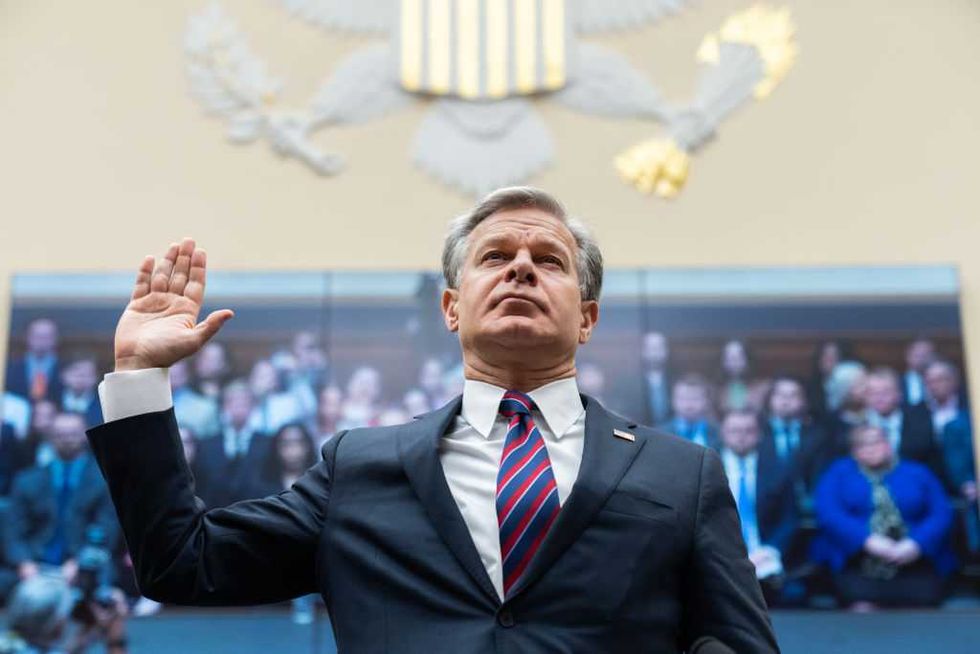 FBI Director Christopher Wray was heavily criticized by members of Congress for not being more forthcoming with Jan. 6 pipe-bomb information. Tom Williams/CQ-Roll Call Inc. via Getty Images
In May 2024, Massie grilled Steven Dettelbach, then-director of the Bureau of Alcohol, Tobacco, Firearms and Explosives, for not providing information about the pipe bombs or what ATF agents did on Jan. 6.
“Are you willing to confirm that the pipe bombs planted at the Capitol Hill Club and the DNC on January 6 couldn’t have gone off with the 60-minute kitchen timer if they were placed the day before?” Massie asked.
“Respectfully, Congressman, I do believe that this does go into the area of the investigation, which is ATF is supporting, the FBI is leading that investigation, and I cannot comment,” Dettelbach said.
Dettelbach would not answer which ATF official was the incident commander for the pipe bombs or whether the devices were planted as part of some training exercise.
In an interview with the House Committee on the Judiciary on June 7, 2023, the head of the FBI Washington Field Office said it would be “Investigation 101” to interview whoever found the pipe bomb at the DNC.
‘That’s just Investigation 101.’
“In any investigation, whoever discovers the device is somebody you need to talk to, right, because they could be the one that planted the device in the first place,” said Steven D’Antuono, assistant FBI director. “You know, so that’s just Investigation 101. So, but I am not aware of that video. I’m not aware of that person.”
Thirteen months before taking office as FBI director, Kash Patel seemed to raise the possibility that the pipe bombs were fakes.
“If the allegations [about the bomber] aren’t true,” Patel said on “The Benny Show,” “or there was some government ruse, or some FBI rogue source or whatever, I don’t know because I don’t have the case files, then there’s another corruption scandal on and around an election-time narrative.”
Ohio soccer star
Kerkhoff was born in November 1993 in Hamilton, Ohio, the youngest of three daughters of Brandt James Kerkhoff and the former Patricia Marie Hennin. Patricia Kerkhoff died in August 2024 after a long battle with pancreatic cancer.
Among her skills, Shauni Kerkhoff said she can solve a Rubik’s Cube in less than a minute. She completed the 2018 Boston Marathon in 3 hours, 34 minutes, 9 seconds.
Kerkhoff attended Olentangy Orange High School in Lewis Center, Ohio, about 20 miles north of the capital city of Columbus. She was a soccer standout and top academic achiever who earned National Honor Society membership. She was the starting varsity goalie all four years.
She earned second-team All-State honors in 2011 and first-team All-Conference her junior and senior years. She allowed only 12 goals in her senior season. Kerkhoff was also goalie for the Blast FC Girls Academy in Delaware, Ohio, for six years.
She went on to play goalie for the Division 1 Temple Owls in Philadelphia. She started nine games as a freshman and recorded the highest save percentage in the Atlantic 10 Conference. She started in the next 45 games across three seasons. She also won academic honors, including the Philadelphia Inquirer Academic All-Area Women’s Soccer Team.
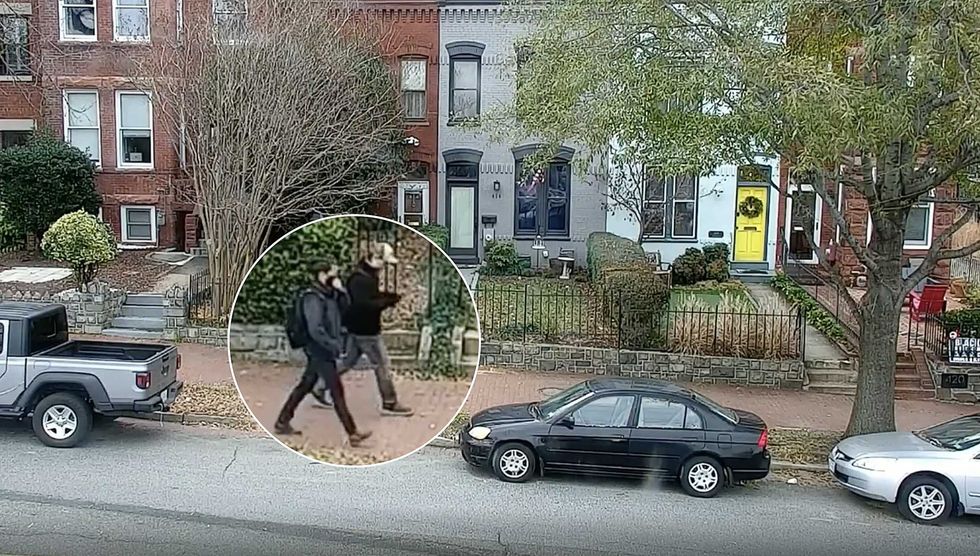 Two U.S. Capitol Police counter-surveillance officers walk toward the Democratic National Committee building on Jan. 6, 2021. One of the officers would discover a pipe bomb under a park bench behind the DNC.U.S. Capitol Police
In the sixth game of her senior season in 2015, she collided hard with University of Pennsylvania midfielder Allie Trzaska and went down face-first in the grass.
“To hear someone scream like that, I knew instantly it had to be something serious,” teammate Shannon Senour told the Temple News.
Kerkhoff underwent five hours of surgery at the University of Pennsylvania for a broken tibia, one of the two bones running from the knee to the ankle. Her mother, Patti, later said that when she saw her daughter’s face turn “beet red” on the field, it could not be good. Once she saw Shauni on the sidelines, “I knew it was probably over.”
The American Athletic Conference Preseason Goalkeeper of the Year suddenly faced the end of her college soccer days. The injury and surgical repair left Kerkhoff with a slight limp in her right leg. That would become a fateful thing a decade later, when investigators studied her movements on Jan. 5 and 6, 2021.
The season-ending injury ended up being a blessing in disguise, Kerkhoff said. She had long been interested in Temple’s ProRanger program, a partnership with the National Park Service to produce park ranger law enforcement officers. Weeks after her broken leg, she was offered an accelerated track in the program.
Kerkhoff played a season in the Women’s Premier Soccer League with the Columbus Eagles Football Club.
“This is going to sound so demented when I say this, but I’m grateful that I broke my leg,” Kerkhoff told the Temple News. “Because had I not, I wouldn’t have pursued my dream job.”
Kerkhoff was hired by the Capitol Police in 2018. She testified in a Jan. 6 criminal trial that she applied for her current job before Jan. 6 and left the United States Capitol Police in good standing.
The Capitol Police did not respond to Blaze News’ request for comment on the pipe-bombs case. Blaze News also reached out to the FBI and DOJ, but did not get a reply by time of publication.
Like Blaze News? Bypass the censors, sign up for our newsletters, and get stories like this direct to your inbox. Sign up here!