Category: Maha
The Supreme Court can protect families or protect corporate cover-ups

When you get pregnant, doctors warn you to avoid everything from coffee to deli meat. When you build a home — as a spouse, parent, or homeowner — you make careful choices about what comes through the front door, onto your table, and into your yard.
But what if those precautions don’t matter? What if the food you serve, the lawn your kids play on, or the weeds you spray carry a poison approved through fraud, sold without warnings, and protected from accountability by the Supreme Court?
We ask parents to obsess over lunch meat. We can demand at least as much honesty about what gets sprayed on the yard.
That isn’t paranoia. It’s the situation Americans may soon face.
The Supreme Court last week agreed to hear Monsanto Co. v. Durnell, a case pushed aggressively by Bayer, the German pharmaceutical giant that bought Monsanto in 2018. The justices will decide one narrow but decisive question this term: Does federal pesticide law block state failure-to-warn lawsuits when the Environmental Protection Agency has not required a cancer warning on the label?
Bayer wants the answer to be yes. It wants federal pre-emption — a legal shield that turns an EPA-approved label into immunity. If Bayer wins, state juries could lose the ability to hold companies accountable even when families prove they used a product as directed, got sick, and never received a warning.
That outcome would reward the very behavior the law should punish.
Juries across the country have already heard evidence in Roundup cases and awarded billions to plaintiffs who developed cancer after using the herbicide. Yet Roundup still sells without a cancer warning. Now Bayer wants the Supreme Court to slam the courthouse door on future victims for good.
Consider what that means in human terms.
Pregnant mothers avoid raw fish and unpasteurized cheese to protect their children, yet millions of families unknowingly expose themselves to chemicals linked in research to non-Hodgkin’s lymphoma and other cancers. A major meta-analysis published in the journal Pediatrics found that children exposed to residential pesticides face significantly higher risks of leukemia and lymphoma. Another peer-reviewed 2019 meta-analysis linked glyphosate-based herbicides to an increased risk of non-Hodgkin’s lymphoma.
We get lectures about sushi, but weed killer gets a pass.
This fight should feel familiar. During COVID, Americans were told to trust emergency approvals as official guidance shifted rapidly. Those who raised concerns often got mocked or sidelined. Only later did many learn the story was more complicated than the public was allowed to hear.
We can’t undo that confusion. We can refuse to repeat it.
The evidence here does not revolve around a single labeling dispute. The deeper allegation is deception. Critics claim Monsanto relied on ghostwritten research and buried evidence to convince regulators glyphosate was safe — and that those approvals then became the foundation for selling Roundup without a cancer warning.
RELATED: The fruit of the US pesticide industry is poison
 Firn via iStock/Getty Images
In late 2025, a key study used for years to defend glyphosate was retracted over serious ethical concerns and undisclosed corporate influence. That retraction matters because it goes to the heart of Bayer’s argument: that the government approved the label, so the company should be protected.
Pre-emption should not become a reward for fraud.
If the Supreme Court sides with Bayer, the fallout will spread far beyond Roundup. The ruling could shield tens of thousands of pesticides from meaningful liability so long as companies point to federal “compliance” — even when compliance was built on manipulated research, regulatory capture, or withheld evidence. Families could lose their best tool for accountability: state courts and state juries.
That isn’t pro-business; it’s regulatory capture. In fact, it’s immunity for wrongdoing.
The court should reject this power-grab. Federal minimum standards should not erase state-level accountability, especially when the federal process can be gamed. Americans deserve warnings when products pose real risks. Families deserve the ability to seek justice when corporations hide dangers and regulators fail to act.
We ask parents to obsess over lunch meat. We can demand at least as much honesty about what gets sprayed on the yard.
The Supreme Court has a choice: protect public health, or protect corporate cover-ups. The country should insist that it choose public health — for our families and for generations yet unborn.
Ozempic no replacement for willpower when it comes to weight loss

A new meta-study — a study of studies — reveals an inconvenient truth about weight loss itself: Willpower still matters. Manufacturers of GLP-1 injectables like Wegovy and Ozempic would prefer we forget that, since forgetting it is profitable.
The counter-claim — that diets and exercise are no match for our genes and environment — is one fat-positivity influencers have pushed for years. Now it has been eagerly adopted by companies like Novo Nordisk and Eli Lilly to market their new, lizard-venom-derived blockbuster drugs.
People who stop taking weight-loss drugs regain weight at an average rate of 0.4 kilograms per month — roughly 10 pounds per year.
Business is booming. One in eight American adults have taken a weight-loss drug at one time — and this is only the beginning. Uptake remains far below its theoretical ceiling: More than 70% of U.S. adults are overweight or obese, including roughly 40% who are clinically obese.
Shred-pilled?
What comes next is obvious. Adoption will surge as delivery methods improve, especially pills. People don’t like needles. Pills are much easier to swallow.
Just before Christmas, the Food and Drug Administration approved a pill version of Wegovy, imaginatively branded the Wegovy Pill. Pill versions of competing drugs, including Mounjaro, are expected to follow this year.
Some time ago, I predicted that a weight-loss drugmaker would become the largest company in the world within a decade. I made that prediction when Novo Nordisk — the Danish maker of Wegovy and Ozempic — became Europe’s most valuable company, with a market capitalization of roughly $570 billion, more than $200 billion greater than Denmark’s entire GDP. (It has since fallen a few spots.) I now refine that forecast: The pharmaceutical company that perfects the weight-loss pill — balancing results, side effects, and cost — will be the largest company on Earth.
There are already more than one billion obese people worldwide. There is no obvious reason why every one of them couldn’t be prescribed a daily pill.
RELATED: Fat chance! Obese immigrants make America sicker
 Gilles Mingasson/Getty Images
Chubby checkers
Which brings us back to the meta-study. One of the central unanswered questions surrounding these drugs is what happens when patients stop taking them. Does the weight stay off — or does it return?
In practice, many people don’t stay on them long. Roughly half of users discontinue weight-loss drugs within a year, most often citing cost and side effects, which can include severe gastrointestinal distress, vision problems, and — in rare cases — death.
What happens after discontinuation matters enormously. If the weight returns, many users will be forced to remain on these drugs indefinitely — possibly for decades — to avoid relapse. Pharmaceutical executives have generally been reluctant to acknowledge this implication, though some have done so candidly.
Habit-forming
The researchers behind the new meta-study asked a sharper question still: How does stopping weight-loss drugs compare with stopping traditional interventions like diet and exercise?
The answer is stark. People who stop taking weight-loss drugs regain weight at an average rate of 0.4 kilograms per month — roughly 10 pounds per year. That is four times faster than the weight regain seen in people who stop exercising and restricting calories.
Four times.
The explanation is not mysterious. Pills do not build habits. Diet and exercise do. With drugs, appetite suppression is outsourced to chemistry rather than cultivated through discipline. Remove the compound, and users are left with the same reserves of willpower they had before. Evidence so far suggests that changes to brain chemistry, hormone signaling, and metabolism fade along with the drug itself.
Even when people who diet and exercise relapse, the habits they developed tend to soften the fall. That counts for something.
None of this is to deny that weight-loss drugs can be a valuable tool. For many severely obese people, they may represent the only realistic chance of meaningful weight reduction. If we want to reduce the burden of chronic disease, drugs like Wegovy will have a role to play.
But their rise should not excuse the abandonment of harder truths. Sustainable weight loss still depends on choices, habits, and character — and on reshaping a food environment that makes bad choices effortless and good ones rare. Pharmaceuticals may assist that work. They cannot replace it.
Finally: Vaccine guidelines that make sense for parents
Filmmaker and mother Jessica Solce was frustrated by the difficulty of finding healthy, all-natural products for herself and her family. To make it easier, she created the Solarium, which curates trusted, third-party-tested foods, clothing, beauty products, and more — all free of seed oils, endocrine disruptors, carcinogens, and other harmful additives.
In this occasional column, she shares recommendations and research she has picked up during her ongoing education in health and wellness.
On Wednesday, the CDC moved six childhood vaccines out of the “recommended for all” schedule.
For those of us advocating for the right to oversee our own children’s health, it was a day we thought would never come. It is a moment of triumph, but also a reminder of the fear and pressure we have had to overcome.
When my child was just three days old, I was yelled at and expelled from a pediatrician’s office for simply asking about delayed vaccination.
I joined the fight in 2009, not long after becoming pregnant with my first child. My parents brought me up to question and test everything; as I prepared to become a parent myself, this tendency quickly found a new target: childhood vaccinations.
While many mothers-to-be were already signing their future babies up for preschools, summer camps, and Mandarin lessons, I was staying up at night immersed in research that challenged conventional wisdom about children’s health. In 2009, that kind of information was far harder to track down than it is today.
Mother lode
But track it down I did. That’s how I found the work of the Weston A. Price Foundation, as well as the writings of Dr. Lawrence Palevsky. I began reading with the intention of writing a kind of thesis paper — something rigorous enough to convince myself and honest enough to defend to my family.
At the time I encountered his work, Dr. Palevsky was not what most people would call “anti-vaccine.” He recommended delaying vaccination until age two, avoiding live-virus vaccines except for smallpox, spacing doses by six months, and administering only one vaccine at a time.
This seemed reasonable to me.
Brain drain
Why? [Checks 2009 notes.] Based on Dr. Palevsky’s work, I believed that vaccines could activate microglia — the brain’s specialized immune cells — and that closely spaced vaccinations might overstimulate this system during early brain development.
The most rapid period of brain development begins in the third trimester and continues through the first two years of life. Vaccinating children under two, according to this line of thinking, could increase the risk of neurological issues, asthma, allergies, autoimmune conditions, and chronic inflammation. By age two, the brain is roughly 80% developed, and the view then was that certain vaccines could be introduced very slowly after that point.
So I weighed risk and reward. With a healthy baby in my care, why would I take what I believed to be a neurological risk?
That was enough to harden my resolve. I armed myself for what became a 10-year battle in New York City.
Dr. Doomer
When my child was just three days old, I was yelled at and expelled from a pediatrician’s office for simply asking about delayed vaccination. I had printed multiple copies of my small “thesis paper,” like a diligent student, and in a moment of panic and adrenaline shoved them into office drawers as I held my newborn and was escorted out.
But the doctor’s tirade — invoking her intelligence, her own vaccinated children, and her authority as a physician, all while calling me an idiot — only strengthened my resolve. To me, it suggested someone constrained by her own choices, guilt, and lack of curiosity.
Even my father, a physician himself, was initially stunned when I began laying out my reasoning. But through heated debate, shared papers, and real discussion — the healthy kind — he eventually reflected on his own training and acknowledged that he had been taught to comply, not to question.
RELATED: Trump administration overhauls childhood vax schedule. Here’s the downsized version.
 Photo by Kevin Dietsch/Getty Images
Hold the formaldehyde
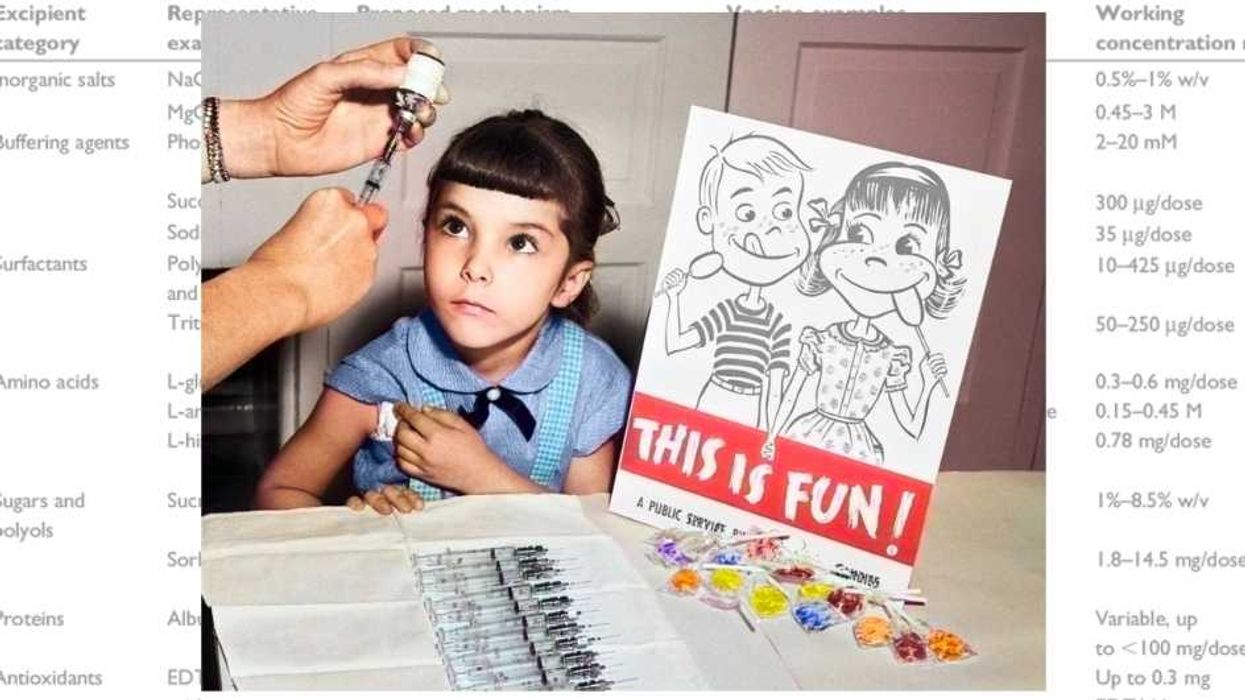
For anyone ready to do some research of their own, I recommend starting with the CDC’s Vaccine Excipient Summary, which lists the inactive ingredients contained in licensed vaccines. Perhaps you’ll ask yourself, as I did, whether you want substances like formaldehyde, aluminum phosphate, polysorbate 80, β-propiolactone, neomycin, and polymyxin B injected into your child’s developing body.
Once I began asking that question, it was impossible not to look at how vaccine policy had evolved. A major inflection point, in my view, came in 1986 with the passage of the National Childhood Vaccine Injury Act, which shielded vaccine manufacturers from direct liability and moved injury claims into a federal compensation system. After that, vaccine development accelerated.
Today I’m in a celebratory mood, despite how long it has taken to get here. I don’t regret the fight for a second; I only wish I had had more courage and stamina at times. Still, I rejoice in every freedom of choice returned to parents in the United States.
Let’s go, MAHA. Now do the EPA.
‘Eat real food’: Trump administration flips ‘corrupt food pyramid,’ encourages meat and veggies over bread and oatmeal

In the ongoing effort to make America healthy again, Health and Human Services Secretary Robert F. Kennedy Jr. and other members of the Trump administration gathered for a special press conference on Wednesday to announce a major overhaul of dietary guidelines
The guidelines, promoted under the simple command to “eat real food,” introduce a “new pyramid” that prioritizes protein, dairy, healthy fats, and fruits and vegetables over whole grains, which is essentially an upside-down version of the conventional food pyramid most people are familiar with.
‘These guidelines replace corporate-driven assumptions with common-sense goals and gold-standard scientific integrity.’
“These guidelines replace corporate-driven assumptions with common-sense goals and gold-standard scientific integrity,” Kennedy said at the press conference.
He added that they will “revolutionize our nation’s food culture and make America healthy again.”
RELATED: Trump administration overhauls childhood vax schedule. Here’s the downsized version
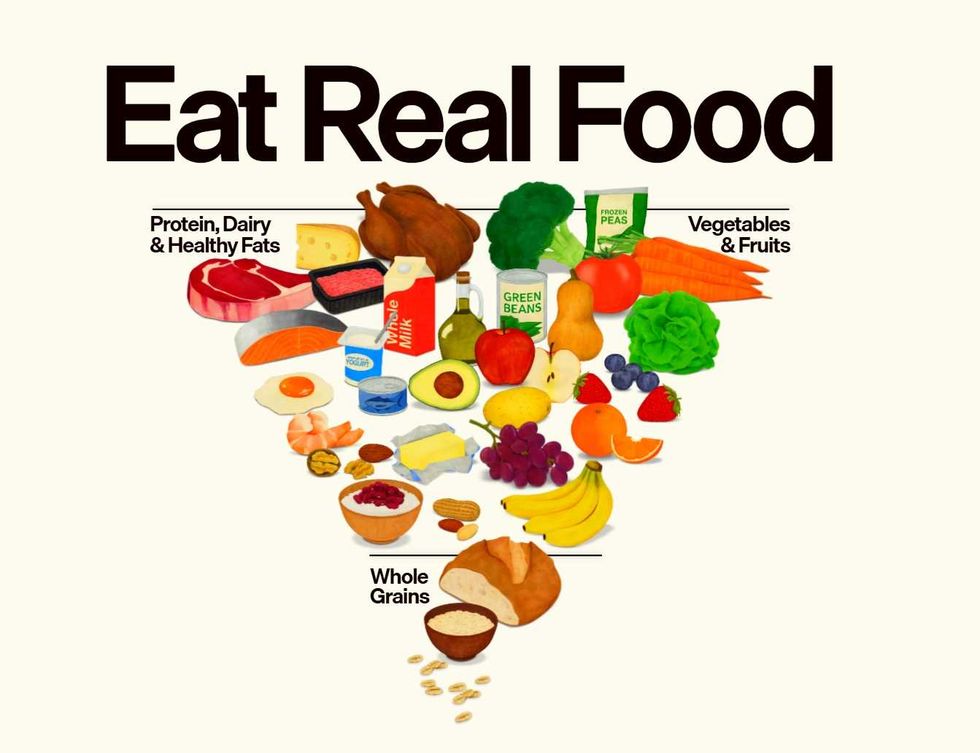 Screenshot of government website
“For decades, we’ve been fed a corrupt food pyramid that has had a myopic focus on demonizing natural healthy saturated fats, telling you not to eat eggs and steak, and ignoring a giant blind spot: refined carbohydrates, added sugars, ultra-processed food,” Food and Drug Administration Commissioner Dr. Marty Makary said.
Secretary of Agriculture Brooke Rollins said, “A healthy meal is within reach for all American families. These new dietary guidelines are a framework which is meant to be customized to meet the needs, the preferences, and the financial status of all American families.”
The inverted pyramid is the result of many studies conducted by the government to challenge the current paradigm and address our nation’s health problems. The guidelines were published in multiple documents, including a series of appendices that is over 400 pages long.
Some users on social media joked that HHS was copying a “South Park” bit in which scientists, at the behest of character Eric Cartman, “flip the pyramid” to reveal the “true” nutritional standards.
The old food pyramid originated in Sweden in the 1970s and was later adapted by the United States Department of Agriculture in 1992.
Like Blaze News? Bypass the censors, sign up for our newsletters, and get stories like this direct to your inbox. Sign up here!

Trump’s Pivot Could Make Health Care Affordable Again
President Donald Trump sent out a surprising statement on Truth Social last week. Though it applied to a specific policy…

Make America Healthy Again: Restoring the Republic’s Vitality
Health Secretary Robert F. Kennedy Jr. and President Donald Trump may not have been obvious allies — one hailing from…
It’s the testosterone, stupid!

It was with great interest that I read Matthew Gasda’s latest essay, on the state of men in 2025, “Masculinity at the End of History.”
Gasda has a lot of things to say that are germane to my new book, “The Last Men: Liberalism and the Death of Masculinity” (out December 16), not least of all whether America — and indeed the Western world as a whole — exhibits what could be called a “crisis of masculinity” in the first place.
We have reams of data showing what can only be described as a civilizational decline in testosterone levels, a decline that may have no parallel in history.
There are plenty of observers — writers, social scientists, journalists, politicians, celebrity psychologists — who think so.
A crisis in need of a crisis
Gasda disagrees. In fact, he believes the absence of a crisis is precisely what’s ailing America’s young men. Men need crises in order to be men. Without crises, their mettle isn’t tested, they have no higher aspirations to direct themselves toward, and so they fall into a listless state, an aimless state, a kind of suspended adolescence.
Porn. Pot. Video games. Social media. Processed food. Logging on and dropping out. We all know what it looks like.
“Masculinity is desperate for a crisis,” Gasda writes in the opening paragraphs of his essay.
It is docile, unsure, and formless. At most, it is at the germinal phase of crisis, lacking a catalytic agent to propel it to its full-blown state, which at least can be registered and reckoned with. After all, crisis implies that something is happening, that something is at stake. The uncatalyzed proto-crisis, or the noncrisis, of American masculinity is repressed, unexpressed, yet omnipresent.
It’s a typical literary switcheroo — Gasda is a playwright, after all — but he’s not wrong. Nor is he the first to say that what men really need is a crisis — read: something extraordinary — to give full form to their potential.
Declaring ‘war’
Back in 1910, the pragmatist philosopher William James, brother of the novelist Henry, wrote an essay called “The Moral Equivalent of War.” A committed socialist and pacifist, James nevertheless regretted the march of progress and with it the (apparent) decline of war, because he recognized war’s power to form young men and inculcate in them the highest possible virtues. War teaches men to subordinate themselves and their needs to those of the collective, to pursue a higher goal, and, if need be, to give their lives for it. War teaches men courage, service, self-sacrifice, stoicism, and patriotism, and all of these things are necessary for a properly functioning nation in peace.
But war is also a terrible, terrible thing — and it was rapidly becoming much worse, though just how much worse James could not have foreseen. What we need, James argues, is a “moral equivalent” of war, a substitute that could teach men the same lessons without the enormous destructive cost.
James’ proposal is quite clever: Rather than a war against each other, we need a war with nature. Young men should be enlisted into a national struggle to conquer and tame nature and to revolutionize the means of production. Send boys off to build railroads and skyscrapers and ships, and they’ll return as men, ready to lead families and the nation.
Manufacturing manhood
This isn’t too different, actually, from what Gasda advocates in his new essay, when he says a national project in which all or many men could participate might be a great spur to masculine revival.
If the objective of America in the years ahead is to reclaim global leadership in industrial production, that is, in the making of things in the real-world economy, as opposed to just in the realm of bits and pixels, then new avenues for masculine exertion, discipline, creativity, and camaraderie may arise from such a project.
There’s much to like in Gasda’s essay and much to agree with. He’s right about how the breakdown of communities and the loss of tradition have hindered the transmission of masculine ideals across the generations. He’s right about the need for rites of passage to confer status on men. Countless anthropological studies have shown the crucial role, in virtually every kind of society except our own, of tests of courage and fortitude at key moments in life, and psychologists have demonstrated how pain and trauma bond people together and provide a sense of shared identity.
He’s also right to argue that Americans must “historicize” masculinity. That is, they must understand its peculiar focus on strenuous exertion and relentless self-making in its particular historical context: a masculine ideal developed in conflict with a frontier, both the physical frontier of western expansion and the social and moral frontiers of a new national identity.
And he’s right, obviously, that we live in an age that’s fundamentally hostile to expressions of masculinity and that we can’t simply return to the past and past ideals, as so many simple-minded critics of the modern world, especially on social media, seem to believe.
That’s all to the good. But there are also serious problems.
No country for men
For one thing, it’s not clear just how much American men really could get behind a drive to, in Gasda’s words, “reclaim global leadership in industrial production.”
If America does return to industrial pre-eminence, most if not nearly all manufacturing is going to be high-tech and automated — hardly the kind of gigantic Soviet five-year plan that could simply swallow up millions of men and give them jobs in factories or even give them jobs at all.
It’s not just manufacturing that is on the verge of making human labor largely a thing of the past. Whole swaths of industry and even white-collar fields are undergoing the same revolutionary changes. Librarians and lawyers and proofreaders and doctors will be replaced by AI and large language models too.
The testosterone decline
A far graver problem, from my perspective, is that like the vast majority of the so-called “crisis of masculinity” literature that he derides, Gasda fails to take seriously, or even acknowledge, the biological changes that are throwing men’s masculinity into doubt — in particular, a headlong decline in testosterone, the master male hormone that’s responsible for making men men and not women.
Testosterone is not just responsible for sexual differentiation — for the physical characteristics that define boys, beginning in the womb and proceeding through infancy and the teenage years into adulthood — but it also governs male mood, motivation, libido, and even things like political attitudes.
Although we should be careful not to say testosterone determines political views, social psychology experiments reveal that a testosterone boost will make a man more likely to defend his position even when he’s outnumbered by people who disagree with him; it will make him more likely to continue fighting against a much stronger opponent; it will make him more accepting of hierarchy and inequality; it will make him more generous to his in-group — his own people — and more aggressive toward his out-group — potential enemies.
In short, testosterone and its effects are complex, but they work in ways that obviously tend toward behavior we associate with traditional masculinity. The less of it men have, the less masculine they become, as a basic rule.
Aggressively overlooked
Open a best-selling book like Richard Reeves’ “Of Boys and Men,” head to the index, and look for “testosterone,” and you’ll find a poverty of references. Reeves talks about testosterone for just a few pages, but only to dispel the notion that boys “are their hormones,” meaning boys aren’t doomed to be aggressive because they have more testosterone (pop science’s “aggression hormone”) than girls. That’s it. Apparently, biology just isn’t important when we’re talking about the serious problems with men today.
It’s a strange oversight. We have reams of data showing what can only be described as a civilizational decline in testosterone levels, a decline that may have no parallel in history. We know what this decline entails, and if we don’t, we really should try to find out.
RELATED: All-natural tallow: Everything your skin needs — without the hormone disruptors
 North Idaho Tallow Company
Compelling evidence
The first real herald of a civilizational decline in testosterone levels was the Massachusetts Male Aging Study, a gold-standard double-blind controlled study of men in the Boston area. The study took place over a period of around 20 years, from the end of the 1980s to the early 2000s. Men of all ages were selected at random and given a battery of tests at regular intervals. When the testosterone data was finally analyzed in 2007, it showed testosterone levels were declining year over year at a rate of about 1%.
That might not sound like much, but over a period of 20 years, that’s 20%, or one-fifth. On a longer timeline, say 50 years, that’s half of all testosterone — gone.
Researchers in other countries, including Finland and Israel, wanted to see whether the same trend was happening in their countries. In Finland, where male reproductive parameters are generally better than in the U.S., the researchers believed the Boston trend would not be replicated. Guess what? The trend was actually worse, and the researchers showed it was taking place over a much longer period of time. The results of the MMAS were replicated in Israel, too, and in other American studies.
Quantifying maleness
It’s hard to quantify exactly how many men have low testosterone, in large part because nobody agrees on exactly how little testosterone counts as low. Ask one doctor and he’ll give you one figure; another will tell you it’s half or double that amount.
Symptomology is generally the best way to go looking for low testosterone, and what we see, everywhere we turn, is men who look and behave like they have low testosterone.
In Japan today, there are millions of hikikomori, or extreme social recluses — young men who simply refuse to participate in society. They hide themselves away at home, often with their parents, and play video games, eat junk food, and just “rot,” to use a current term.
At least one expert believes there may be as many as 10 million hikikomori, in a nation of 120 million people — that’s one in 12 people. Unsurprisingly — to me at least — research has shown young Japanese men are at significantly greater risk of becoming hikikomori if they have low testosterone.
America has its hikikomori too, although they aren’t called that. Maybe as many as 6 million, by some estimates.
Some of them congregate in special subforums on the website Reddit, like r/lowT, where they discuss what it’s like to be a man with low testosterone: how they have no motivation, no libido, can’t sleep, can’t get an erection, are developing gynecomastia — man boobs — and are overweight and anxious all the time.
Many of these men also describe the miraculous effects of increasing their testosterone, more often than not through a doctor’s prescription of testosterone in gel or injectable form.
Spermageddon?
What’s even more worrying about this decline is that it’s part and parcel of a broader decline in reproductive health parameters among men.
This isn’t a surprise: If men’s testes aren’t functioning properly and producing enough testosterone, they’re unlikely to be producing enough of other important things either. Sperm counts and sperm quality — a measure of sperm’s ability to swim properly and do their job — are declining so rapidly that one expert, Professor Shanna Swan, is predicting a “spermageddon” scenario, in which humans are unable to reproduce by natural means.
Swan made this the subject of a 2021 book, “Count Down.” Simply by extrapolating the data for sperm-count decline, Swan has shown that by around 2050, the median man will have a sperm count of zero. One half of all men will produce no sperm at all, and the rest will produce so few that they might as well produce none, because they won’t be able to get a woman pregnant, try as they might.
What’s causing these changes? It’s lots of different things, a whole range of lifestyle factors — lack of exercise, smoking, bad diets, poor sleep, stress — but also widespread exposure to harmful chemicals known as “endocrine disruptors,” for their negative effects on the body’s hormonal (endocrine) system.
From low-T to trans
When I say endocrine disruptors are everywhere, I mean it: They’re in the food, the air, the water, the clothes we wear, our bedding and furniture, the deodorants and fragrances we put on our bodies, the little scented trees we put in our cars, anything that’s made from plastic.
A significant proportion of these harmful chemicals directly or indirectly mimic the effects of the hormone estrogen, interfering with the body’s crucial hormonal balance (more testosterone and less estrogen for men, the opposite for women). This is a nightmare for both sexes. As well as reducing testosterone and fertility in men, exposure to endocrine disruptors can lead to genital abnormalities, weight gain, and metabolic issues and even certain kinds of cancer.
New research has linked exposure to endocrine disruptors during gestation to transgenderism. French boys exposed to the chemical diethylstilbestrol, which used to be given to mothers at risk of miscarriage, had a massively increased risk — perhaps as much as a hundredfold — of undergoing gender transition later in life. On paper, it was always plausible that exposure to endocrine disruptors should be linked to gender dysphoria, but since transgenderism is such a toxic issue politically, there’s been little desire, until now, to pursue research into the link.
In a very real sense, then, not only have we created a society where masculinity is ridiculed, dragged through the mud, and denounced as retrograde, we’ve also created one where the biological constituents of masculinity, its very building blocks, are under direct attack at the same time. It’s a complicated problem, and it’s viciously circular. Biology and society exist in feedback loops, with negative effects reinforcing each other, deepening the spiraling decline.
While Gasda, like William James before him, may be right that men need a crisis to bring out the best in them, the very real danger today is that when one finally comes, men won’t have the energy or enthusiasm or desire to put down the controller, stand up, and answer its call. And if that really is the case, testosterone — the lack of it — will be to blame.