Category: Make america healthy again
Ozempic no replacement for willpower when it comes to weight loss

A new meta-study — a study of studies — reveals an inconvenient truth about weight loss itself: Willpower still matters. Manufacturers of GLP-1 injectables like Wegovy and Ozempic would prefer we forget that, since forgetting it is profitable.
The counter-claim — that diets and exercise are no match for our genes and environment — is one fat-positivity influencers have pushed for years. Now it has been eagerly adopted by companies like Novo Nordisk and Eli Lilly to market their new, lizard-venom-derived blockbuster drugs.
People who stop taking weight-loss drugs regain weight at an average rate of 0.4 kilograms per month — roughly 10 pounds per year.
Business is booming. One in eight American adults have taken a weight-loss drug at one time — and this is only the beginning. Uptake remains far below its theoretical ceiling: More than 70% of U.S. adults are overweight or obese, including roughly 40% who are clinically obese.
Shred-pilled?
What comes next is obvious. Adoption will surge as delivery methods improve, especially pills. People don’t like needles. Pills are much easier to swallow.
Just before Christmas, the Food and Drug Administration approved a pill version of Wegovy, imaginatively branded the Wegovy Pill. Pill versions of competing drugs, including Mounjaro, are expected to follow this year.
Some time ago, I predicted that a weight-loss drugmaker would become the largest company in the world within a decade. I made that prediction when Novo Nordisk — the Danish maker of Wegovy and Ozempic — became Europe’s most valuable company, with a market capitalization of roughly $570 billion, more than $200 billion greater than Denmark’s entire GDP. (It has since fallen a few spots.) I now refine that forecast: The pharmaceutical company that perfects the weight-loss pill — balancing results, side effects, and cost — will be the largest company on Earth.
There are already more than one billion obese people worldwide. There is no obvious reason why every one of them couldn’t be prescribed a daily pill.
RELATED: Fat chance! Obese immigrants make America sicker
 Gilles Mingasson/Getty Images
Chubby checkers
Which brings us back to the meta-study. One of the central unanswered questions surrounding these drugs is what happens when patients stop taking them. Does the weight stay off — or does it return?
In practice, many people don’t stay on them long. Roughly half of users discontinue weight-loss drugs within a year, most often citing cost and side effects, which can include severe gastrointestinal distress, vision problems, and — in rare cases — death.
What happens after discontinuation matters enormously. If the weight returns, many users will be forced to remain on these drugs indefinitely — possibly for decades — to avoid relapse. Pharmaceutical executives have generally been reluctant to acknowledge this implication, though some have done so candidly.
Habit-forming
The researchers behind the new meta-study asked a sharper question still: How does stopping weight-loss drugs compare with stopping traditional interventions like diet and exercise?
The answer is stark. People who stop taking weight-loss drugs regain weight at an average rate of 0.4 kilograms per month — roughly 10 pounds per year. That is four times faster than the weight regain seen in people who stop exercising and restricting calories.
Four times.
The explanation is not mysterious. Pills do not build habits. Diet and exercise do. With drugs, appetite suppression is outsourced to chemistry rather than cultivated through discipline. Remove the compound, and users are left with the same reserves of willpower they had before. Evidence so far suggests that changes to brain chemistry, hormone signaling, and metabolism fade along with the drug itself.
Even when people who diet and exercise relapse, the habits they developed tend to soften the fall. That counts for something.
None of this is to deny that weight-loss drugs can be a valuable tool. For many severely obese people, they may represent the only realistic chance of meaningful weight reduction. If we want to reduce the burden of chronic disease, drugs like Wegovy will have a role to play.
But their rise should not excuse the abandonment of harder truths. Sustainable weight loss still depends on choices, habits, and character — and on reshaping a food environment that makes bad choices effortless and good ones rare. Pharmaceuticals may assist that work. They cannot replace it.
Finally: Vaccine guidelines that make sense for parents
Filmmaker and mother Jessica Solce was frustrated by the difficulty of finding healthy, all-natural products for herself and her family. To make it easier, she created the Solarium, which curates trusted, third-party-tested foods, clothing, beauty products, and more — all free of seed oils, endocrine disruptors, carcinogens, and other harmful additives.
In this occasional column, she shares recommendations and research she has picked up during her ongoing education in health and wellness.
On Wednesday, the CDC moved six childhood vaccines out of the “recommended for all” schedule.
For those of us advocating for the right to oversee our own children’s health, it was a day we thought would never come. It is a moment of triumph, but also a reminder of the fear and pressure we have had to overcome.
When my child was just three days old, I was yelled at and expelled from a pediatrician’s office for simply asking about delayed vaccination.
I joined the fight in 2009, not long after becoming pregnant with my first child. My parents brought me up to question and test everything; as I prepared to become a parent myself, this tendency quickly found a new target: childhood vaccinations.
While many mothers-to-be were already signing their future babies up for preschools, summer camps, and Mandarin lessons, I was staying up at night immersed in research that challenged conventional wisdom about children’s health. In 2009, that kind of information was far harder to track down than it is today.
Mother lode
But track it down I did. That’s how I found the work of the Weston A. Price Foundation, as well as the writings of Dr. Lawrence Palevsky. I began reading with the intention of writing a kind of thesis paper — something rigorous enough to convince myself and honest enough to defend to my family.
At the time I encountered his work, Dr. Palevsky was not what most people would call “anti-vaccine.” He recommended delaying vaccination until age two, avoiding live-virus vaccines except for smallpox, spacing doses by six months, and administering only one vaccine at a time.
This seemed reasonable to me.
Brain drain
Why? [Checks 2009 notes.] Based on Dr. Palevsky’s work, I believed that vaccines could activate microglia — the brain’s specialized immune cells — and that closely spaced vaccinations might overstimulate this system during early brain development.
The most rapid period of brain development begins in the third trimester and continues through the first two years of life. Vaccinating children under two, according to this line of thinking, could increase the risk of neurological issues, asthma, allergies, autoimmune conditions, and chronic inflammation. By age two, the brain is roughly 80% developed, and the view then was that certain vaccines could be introduced very slowly after that point.
So I weighed risk and reward. With a healthy baby in my care, why would I take what I believed to be a neurological risk?
That was enough to harden my resolve. I armed myself for what became a 10-year battle in New York City.
Dr. Doomer
When my child was just three days old, I was yelled at and expelled from a pediatrician’s office for simply asking about delayed vaccination. I had printed multiple copies of my small “thesis paper,” like a diligent student, and in a moment of panic and adrenaline shoved them into office drawers as I held my newborn and was escorted out.
But the doctor’s tirade — invoking her intelligence, her own vaccinated children, and her authority as a physician, all while calling me an idiot — only strengthened my resolve. To me, it suggested someone constrained by her own choices, guilt, and lack of curiosity.
Even my father, a physician himself, was initially stunned when I began laying out my reasoning. But through heated debate, shared papers, and real discussion — the healthy kind — he eventually reflected on his own training and acknowledged that he had been taught to comply, not to question.
RELATED: Trump administration overhauls childhood vax schedule. Here’s the downsized version.
 Photo by Kevin Dietsch/Getty Images
Hold the formaldehyde
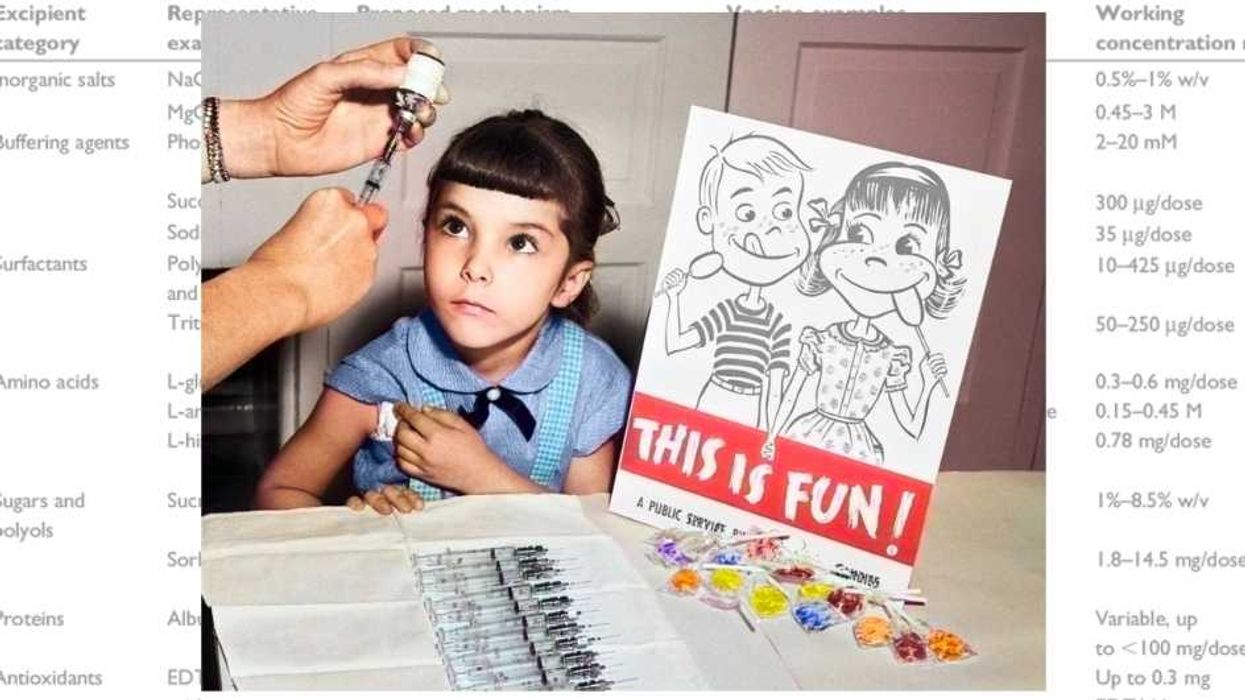
For anyone ready to do some research of their own, I recommend starting with the CDC’s Vaccine Excipient Summary, which lists the inactive ingredients contained in licensed vaccines. Perhaps you’ll ask yourself, as I did, whether you want substances like formaldehyde, aluminum phosphate, polysorbate 80, β-propiolactone, neomycin, and polymyxin B injected into your child’s developing body.
Once I began asking that question, it was impossible not to look at how vaccine policy had evolved. A major inflection point, in my view, came in 1986 with the passage of the National Childhood Vaccine Injury Act, which shielded vaccine manufacturers from direct liability and moved injury claims into a federal compensation system. After that, vaccine development accelerated.
Today I’m in a celebratory mood, despite how long it has taken to get here. I don’t regret the fight for a second; I only wish I had had more courage and stamina at times. Still, I rejoice in every freedom of choice returned to parents in the United States.
Let’s go, MAHA. Now do the EPA.
3 healthy habits to bring you closer to God in 2026

As Christians, when we consider New Year’s resolutions, we often think about reading the Bible more, praying more often, or maybe getting more involved in our church. Those are all wonderful things worthy of pursuing.
Rather than taking time to expound on those, however, I’d like to commend three other resolutions that may not make the usual lists.
Our bodies and souls are integrally connected, and each significantly influences the other.
These are practical — maybe even commonsensical — but given the times in which we live, they’re easy to neglect, with the result that we flourish less than we could.
1. Practice attention management
We hear a great deal about time management these days, but rarely about attention management. Americans spend multiple hours each day on their phones, with teens devoting more than nine hours(!) and adults more than four hours daily. We’re awash in a sea of texts, emails, videos, games, and alerts. If we’re not careful, these can become an endless series of distractions that divert our attention from more important things.
They can also subtly mold us in the shape of the secular culture that produces much of what we consume. As theologian Jason Thacker writes, “Following Jesus in a digital age requires … having our eyes wide open and seeing how technology is subtly shaping us in ways often contrary to our faith. We need to learn how to ask the right questions about our relationship with technology, examining it with clear eyes grounded in the Word of God.”
It takes some intentionality to guard our hearts from the often counter-Christian messages coming through our screens, but we have to make it a priority because “everything [we] do flows from” our hearts (Proverbs 4:23). We can use technology in many beneficial ways, but we must also “examine everything” and “hold firmly to that which is good” (1 Thessalonians 5:21) while avoiding obstacles to our spiritual growth.
2. Get more sleep
There’s an old saying among pastors that “sometimes the most spiritual thing you can do is take a nap.” After all, we’re not just souls or minds, but also physical beings, by God’s design. Christians are sometimes tempted to view our physical nature in a negative light, but this reflects a Gnostic view that sees the spiritual as good and the material as bad or inferior. This is alien to Scripture, however, which tells us that we are “fearfully and wonderfully made” (Psalm 139:14). As John W. Kleinig argues in his book “Wonderfully Made: A Protestant Theology of the Body”:
The body matters much more than we usually imagine it does. It matters because it locates us in time and space here on earth. It matters because we live in it and with it. It matters because through it we interact with the world around us, the people who coexist with us, and the living God who keeps us physically alive in it.
Our bodies are temples of the Holy Spirit (1 Corinthians 6:19). In order to keep them healthy and functioning properly, adults need between seven and nine hours of sleep each day. A lack of sufficient sleep can lead to heart disease, hormonal imbalances, reduced immune response, and a lack of mental focus, among other problems.
Since blue light from our phone and computer screens can make it harder to get deep, restful sleep, this is another good reason to limit screen time, especially close to bedtime.
Get enough sleep, and you’ll likely notice greater energy, optimism, and an increased capacity to exhibit the fruit of the Spirit (Galatians 5:22-23). Our bodies and souls are integrally connected, and each significantly influences the other.
3. Cultivate friendships
Even before the Covid-19 pandemic, half of U.S. adults reported feelings of loneliness, with 58% worrying that no one in their life knows them well. We live in a hyper-individualistic society that often views other people as obstacles to our personal agendas. Yet God designed us to live in close connection with other humans, especially fellow believers. The writer of Hebrews instructed his readers not to give up “meeting together, as some are in the habit of doing, but encouraging one another” (Hebrews 10:25). Like Christians in the early church, we should “[devote ourselves] to … fellowship” (Acts 2:42).
Since we’ve been noting how some of these resolutions affect our physical health, it’s remarkable that chronic loneliness is more dangerous than smoking 15 cigarettes a day! Thus, author Justin Earley observes that “friendship will make or break your life.” We can see the wisdom of God’s statement in Genesis that “it is not good for the man to be alone” (Genesis 2:18).
RELATED: 6 ways I’m using 2026 to deepen my relationship with God
 Heritage Images/Getty Images
The quality of our friendships also makes a big difference. We’ve all seen groups of people sitting together in some public place, not interacting with one another, but engrossed in their phones. “This is what community often looks like in the digital age,” writes pastor Jay Kim. “Lonely individuals falling prey, over and over again, to the great masquerade of digital technology” that lulls us “into a state of isolation via the illusion of digital connection.”
As Kim goes on to note, while we can communicate digitally, we can only commune in person. Communication is about the exchange of information, while communing involves the exchange of presence. Communing is the more difficult task because it “requires more of us: more of our attention, empathy, and compassion.”
So this year, I encourage you to practice attention management, get enough sleep, and intentionally look for opportunities to begin new friendships and deepen old ones. It will take some deliberate effort, and every relationship will have growing pains, but the greater depth of fellowship will be worth it. As a saying often attributed to 18th-century evangelist George Whitefield goes, “No man is the whole of himself. His friends are the rest of him.”
A version of this essay originally appeared in the Worldview Bulletin Substack.