

Category: Mark carney

The Spectacle Ep. 319: Exploring Venezuela’s Crisis and Canada’s Chinese Influence
A couple of weeks have gone by since the U.S. captured Venezuelan dictator Nicolás Maduro, leaving the country’s future potential…
Carney puts America last at Davos; Trump hits back
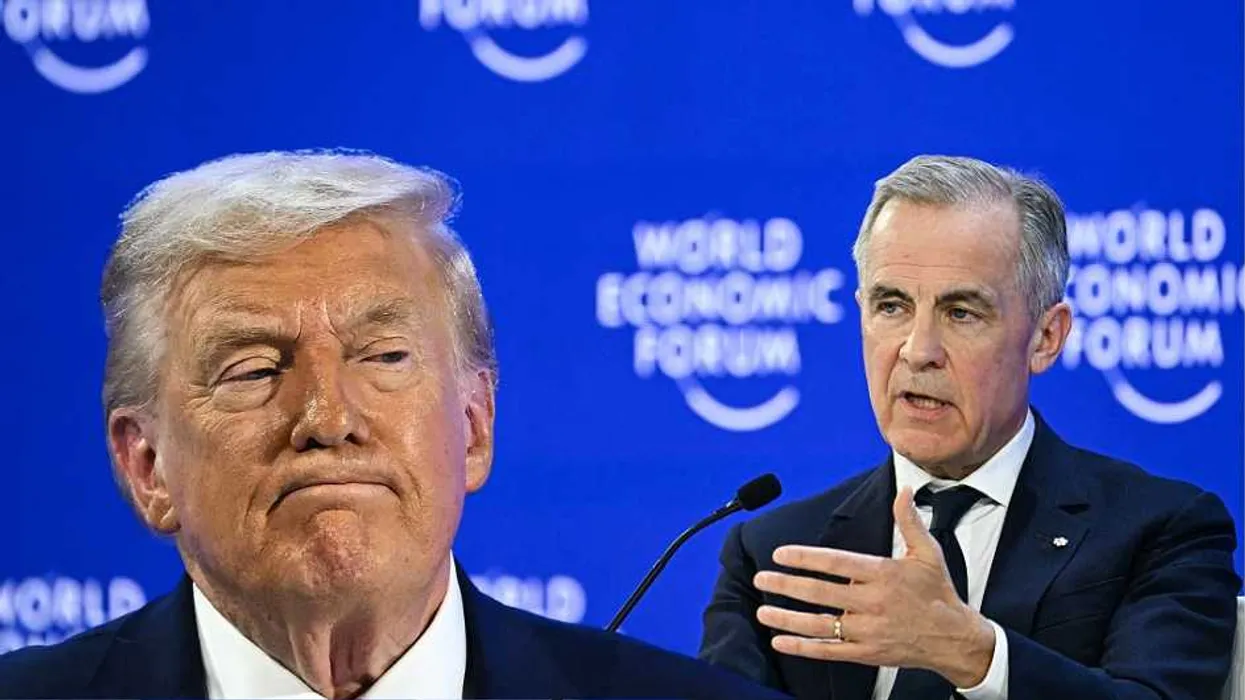
The World Economic Forum’s annual meeting in Davos offered a picture-perfect illustration of the clash between globalism and America First.
Canadian Prime Minister Mark Carney — a longtime advocate of globalist policies, whether as governor of the Bank of England or as a United Nations goodwill ambassador for climate change — delivered a speech that electrified woke forces around the world.
‘Canada lives because of the United States. Remember that, Mark, the next time you make your statements.’
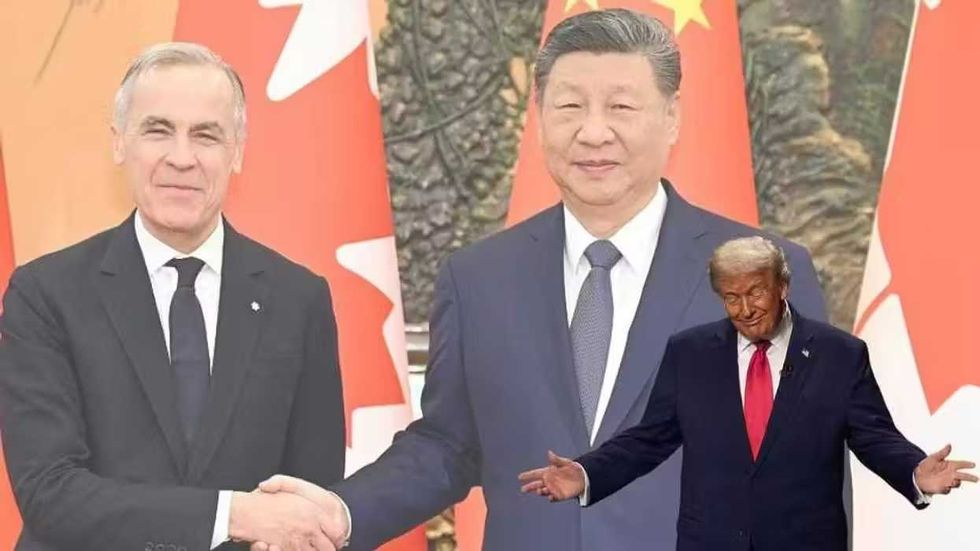
Yet while Carney proclaimed a kind of independence from U.S. economic and military hegemony, many seemed to forget that he had just signed a trade deal with China — against the backdrop of his declaration that Canada was joining Beijing’s “new world order.”
Past tense
Carney’s address waved a red flag at the United States and President Donald Trump, though he lacked the courage to name either directly. Instead, he spoke of America in the past tense, obliquely warning that the “rules-based international order,” under which “countries like Canada prospered,” was finished.
“We joined its institutions. We praised its principles. We benefited from its predictability,” Carney said.
And because of that, we could pursue values-based foreign policies under its protection.
We knew the story of the international rules-based order was partially false — that the strongest would exempt themselves when convenient, that trade rules were enforced asymmetrically. And we knew that international law applied with varying rigor depending on the identity of the accused or the victim. This fiction was useful, and American hegemony in particular helped provide public goods: open sea lanes, a stable financial system, collective security, and support for frameworks for resolving disputes.
Then came the line that sent globalist acolytes into rapture.
“This bargain no longer works. Let me be direct. We are in the midst of a rupture, not a transition.”
But isn’t Carney himself the author — and perhaps the finisher — of that rupture? For years, he has worked against the natural alliance between Canada and its largest trading partner and closest military ally. As we have pointed out before, Carney has labored to replace the United States with China as the world’s economic engine.
RELATED: Trump not worried about Canada’s China-centric ‘new world order’
 Brad Smith/ISI Photos/Xinhua News Agency/Getty Images
A little gratitude
Trump was listening — or at least was promptly briefed. During his own address to Davos, the president castigated both Carney and Canada for taking America for granted. Referring to the development of the Golden Dome defense system, Trump noted that it would, “by its very nature,” defend Canada as well.
“Canada gets a lot of freebies from us, by the way,” Trump said. “They should be grateful also, but they’re not. I watched your prime minister yesterday. He wasn’t so grateful.
“Canada lives because of the United States. Remember that, Mark, before you make your statements.”
By Friday morning, Trump had gone farther, withdrawing Carney’s invitation to join his proposed “Board of Peace.”
Trump spent much of his Davos remarks ridiculing the globalist “Green New Scam” and questioning why the United States continues to belong to NATO when it derives so little benefit from the arrangement.
Windbag
But his most biting remarks were reserved for the fantasy that green energy can power a modern economy.
China, Trump noted, makes “a fortune selling the windmills.”
“They’re shocked that people continue to buy those damn things,” he continued. “They kill the birds. They ruin your landscapes. Other than that, I think they’re fabulous, by the way. Stupid people buy them.”
Trump’s rejection of globalist orthodoxy was reinforced by Commerce Secretary Howard Lutnick.
“Globalization has failed the West and the United States of America,” Lutnick said. “It’s a failed policy. It is what the WEF has stood for, which is export, offshore, far-shore, find the cheapest labor in the world. … In reality, it has left America behind. It has left the American workers behind.”
“America First,” he continued, “is a different model — one that we encourage other countries to consider, which is that our workers come first. … Sovereignty is your borders. You’re entitled to have borders.”
All of this carries enormous implications for any renegotiation of the U.S.-Mexico-Canada agreement.
And Carney appears to have been left with no cards to play. China has already seen his hand.
Trump not worried about Canada’s China-centric ‘new world order’
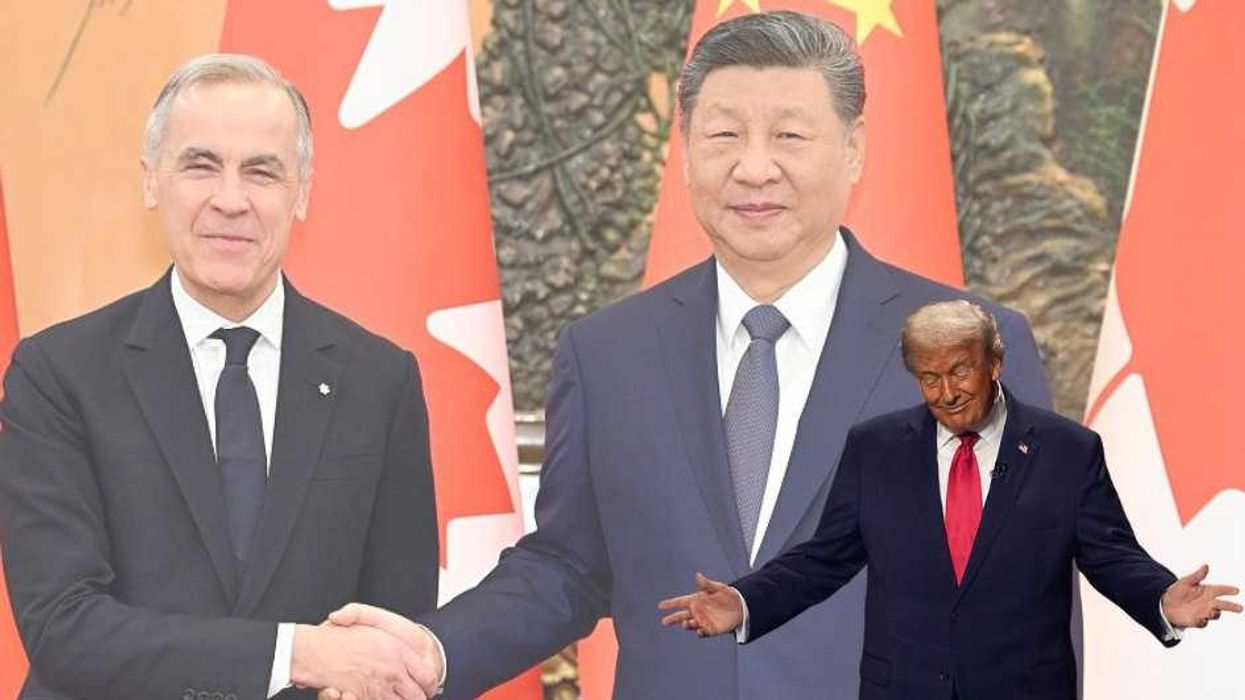
Try explaining this one: President Donald Trump’s relaxed — almost insouciant — response to news that Canadian Prime Minister Mark Carney pledged allegiance to a China-centered “new world order.”
Why did Trump appear to shrug off Carney’s insistence that Canada’s future lies more with China than with the United States?
Carney’s favorable assessment of China’s role in climate and green finance is not an isolated remark.
Perhaps it has something to do with Greenland and Canada being viewed as components of Trump’s broader Western Hemisphere security plan.
Cue the black helicopters
Not long ago, “new world order” belonged firmly in the vocabulary of conspiracy theorists. But in Beijing last week, Carney elevated the phrase into an official Liberal talking point.
So what did Carney say? Plenty.
Mine is the first visit of a Canadian prime minister to China in nearly a decade. The world has changed much since that last visit, and I believe the progress that we have made in the partnership sets us up well for the new world order.
Trump did not respond immediately. Instead, he waited until the end of the news day last Friday before offering his reaction.
“That’s what he should be doing, and it’s a good thing for him to sign a trade deal. If you can get a deal with China, you should do that,” Trump said.
Not the response many expected from a president who has urged countries in the Western Hemisphere to distance themselves from Beijing.
World order word salad
Pressed on what he meant by a “new world order,” Carney responded with his characteristic blend of abstraction and deflection.
So the question is, what gets built in that place? How much of a patchwork is it? How much is it just on a bilateral basis? Or where do like-minded countries in certain areas? So like-minded countries, just to be clear, doesn’t mean you agree on everything. So aspects, for example, on digital trade or agricultural trade, climate finance as another area to move into areas of geo-strategy, geo-security, you will have different coalitions that are formed. So what this partnership does is in areas, for example, of clean energy, conventional energy, agriculture, as we were just talking about, and financial services, which we have talked less about, but the evolution of the global financial system.
Trump’s nonchalance was not shared by conservative commentators, who sharply criticized Carney’s remarks.
Alex Jones, for one, described Carney as “a Klaus Schwab acolyte” and warned: “You are about to see the globalist prime minister of Canada pledge allegiance to the communist dictator in China, Xi Jinping.”
RELATED: What does Trump see in Canada’s pro-China prime minister?
 Chip Somodevilla/Dave Chan/Getty Images
China guy
So far, Carney’s new world order with China has produced a trade agreement allowing up to 49,000 electric vehicles to be imported into Canada annually at a reduced tariff of 6.1%. In return, China is expected to lower tariffs on Canadian agricultural exports — most notably canola oil, a key cash crop for Canadian farmers — to roughly 15%.
But there is nothing new about Carney’s deference to China.
After leaving the Bank of England in 2020, Carney became vice chairman of the board of Bloomberg L.P., the privately held financial data and media company founded by Michael Bloomberg. During the same period, he also served as co-chair of the U.N.-backed Glasgow Financial Alliance for Net Zero, working alongside Bloomberg in his separate capacity as the United Nations’ Special Envoy on Climate Ambition and Solutions.
In that capacity, Carney consistently praised the alleged environmental stewardship of China, somehow locating a deep commitment to fighting climate change in a country that continues to power its economy with coal-fired plants.
Take Carney’s March 2024 visit to China, during which he told a reporter for the Chinese business outlet 21st Century Business Herald (English translation via Google Translate):
China has made a huge contribution to the fight against climate change, not only in terms of its massive investment in clean technologies and exporting them to other countries, but also in actively developing the financial system needed for the green transition.
Yuan to grow on
Carney’s favorable assessment of China’s role in climate and green finance is not an isolated remark. It aligns with a broader argument he has advanced in recent years: that global economic leadership should become more multipolar, with China playing a larger role alongside — rather than beneath — U.S. dominance.
That worldview extends to currency and finance. At the 2019 Jackson Hole Economic Symposium, Carney argued that the world should reduce its dependence on the U.S. dollar by exploring a new “synthetic hegemonic currency,” a framework designed to dilute the dominance of any single national currency.
Carney did not explicitly call for the Chinese yuan to replace the U.S. dollar outright. But his proposal would, by design, weaken the centrality of the dollar and expand the influence of non-U.S. currencies and financial systems.
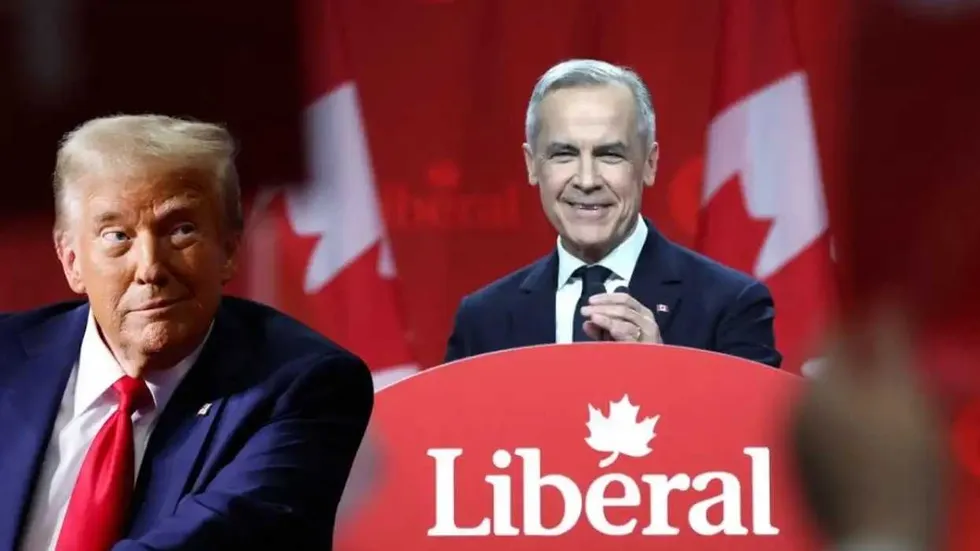
Trump, for his part, has twice endorsed Carney during Canadian federal elections. Their relationship — particularly during Oval Office meetings — has been described as friendly, though it may be better understood as Trump indulging a leader he views as temporary.
Why does Trump consistently give Carney a pass?
Perhaps because Trump sees Carney less as a lasting architect of global order than as a passing phenomenon — unlikely to impede the president’s broader aim of reinforcing American economic primacy, regardless of how warmly Carney speaks of China’s place in the world.
CRUDE AWAKENING: Canada’s pipeline paralysis fumbles American oil market
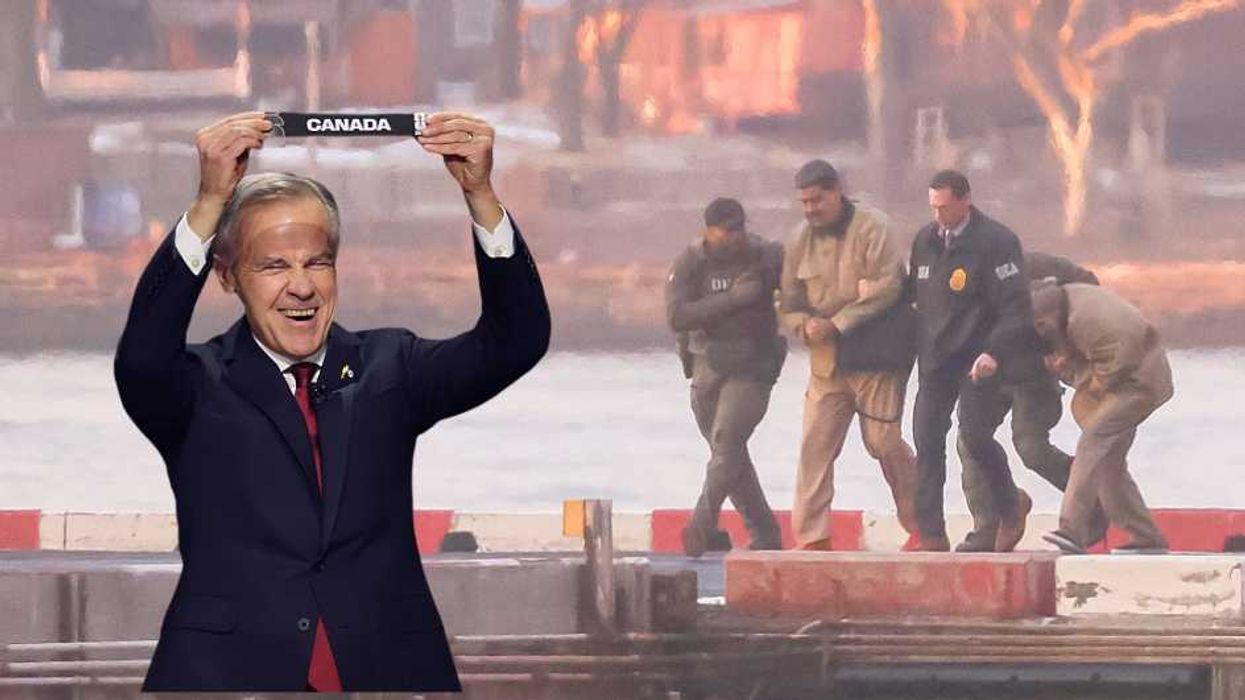
Canada has exactly the kind of oil the United States needs. But when it comes to investing in the infrastructure to move it, America’s ally to the north is beginning to look as risky — and as politically hostile — as Venezuela.
That, Dan McTeague of Canadians for Affordable Energy tells Align, reflects a perverse governing philosophy towards the country’s energy abundance: “keep it in the ground.”
Carney can talk about buying China’s ‘windmills and solar panels,’ or he can ask whether China wants to buy oil — ‘because we got a pipeline.’
Canada’s self-inflicted pipeline paralysis is eroding its position in the U.S. market just as alternatives like Venezuelan oil come back online.
Oil, oil everywhere
Nowhere is that risk clearer than in Alberta, home to the vast majority of Canada’s oil production, where years of stalled pipeline projects have left the country’s most valuable energy asset effectively landlocked.
Canadian oil is the same kind Venezuela produces: heavy crude, high in sulfur, and ideal for making diesel fuel. Most U.S. refineries are designed specifically to process this type of petroleum, which is essential not just for transportation, but for agriculture, mining, manufacturing, and national defense.
Alberta has long sought to build a pipeline to the West Coast, primarily to secure reliable, long-term access to the U.S. market — while also giving Canada leverage to reach other buyers if American demand weakens or politics intervenes.
That project remains stalled, despite Liberal Prime Minister Mark Carney — who has spent much of his career championing green energy and opposing pipelines — recently signing a memorandum of understanding with Alberta that is supposed to clear the way for construction. Alberta Premier Danielle Smith is now demanding that pipeline construction begin by fall 2026.
Carbon crunch
In practice, the MOU changes little. It grants no approvals, streamlines no federal reviews, resolves no indigenous or legal challenges, and commits no public capital. By tying any future pipeline to rising carbon tax and decarbonization requirements, it arguably worsens the investment case — leaving no private sponsor willing to move first.
While the United States remains Canada’s natural customer, a West Coast outlet still matters. It gives producers pricing power, optionality, and insurance against sudden policy shifts in Washington — precisely the kind now emerging as Venezuela re-enters the picture.
The question is who would build such a pipeline — and whether it could be completed before the United States turns to cheaper Venezuelan oil to fill the gap.
Venezuela of the north?
President Donald Trump has floated asking oil companies for $100 billion to build infrastructure in Venezuela capable of moving oil north. Exxon’s CEO rejected the idea, calling Venezuela “uninvestable” because of its history of asset seizures and nationalization. Trump, however, could choose to push the project forward with public funds.
McTeague — himself a former Liberal member of Parliament — says Canada has made itself similarly unattractive to investors. He argues that policy choices — not geology — are the problem.
Canada, he says, is “blessed with abundance of resources,” but has embraced a governing narrative that tells producers to “keep it in the ground.” He adds that few countries would treat their most important economic output that way.
That mindset, McTeague argues, has frightened off private capital and left Ottawa with little choice but to build a pipeline itself. It also raises the stakes of Carney’s upcoming trip to China — not as a pivot away from the U.S., but as leverage.
Tilting at windmills
When Carney arrives in Beijing, McTeague says, he faces a choice. He can talk about decarbonization and buying China’s “windmills and solar panels,” or he can ask whether China wants to buy oil — “because we got a pipeline.”
The point, McTeague stresses, is not that China should replace the United States as Canada’s primary customer, but that Canada needs credible alternatives if it wants to be taken seriously by either.
McTeague also criticizes the MOU’s requirement that the industrial carbon tax rise sharply in coming years, arguing that it “defies economics and the realities of the marketplace.” In his view, decarbonization mandates are irrelevant to investors deciding whether a pipeline is worth building.
Time, he warns, is running out. Federal debt continues to grow, and Canada’s fiscal credibility is beginning to erode. Without pipelines, he says, the country risks running out of economic runway.
RELATED: The truth behind Trump’s Venezuela plan: It’s not about Maduro at all
 Chip Somodevilla/Getty Images
Over a barrel
McTeague also disputes the claim that the United States is energy-independent. While America produces roughly 12 to 13 million barrels of oil per day, it consumes about 21 million — leaving it dependent on imports.
Canada’s value, he argues, lies not just in volume, but in the type of oil it produces. U.S. shale oil is well suited for gasoline, but not for diesel, which he calls the global workhorse of modern economies — critical to transportation, agriculture, industry, and defense.
That is precisely the fuel Venezuela is now offering, potentially at a lower cost than Canadian oil burdened by carbon taxes and regulatory constraints.
Canada now finds itself between a rock and a hard place: Venezuelan oil threatening to undercut U.S. demand for Alberta crude, plus the political and logistical reality of building a major pipeline through British Columbia — on a timetable that is rapidly running out.
In energy terms, Canada is doing the unthinkable: choosing to be bypassed.
Rally Round the Flag, Jihadis
On Nov. 17, the Palestinian flag was raised for the first time in front of Toronto’s city hall. There had…
JD Vance to Canada: Stop blaming Trump for your decline
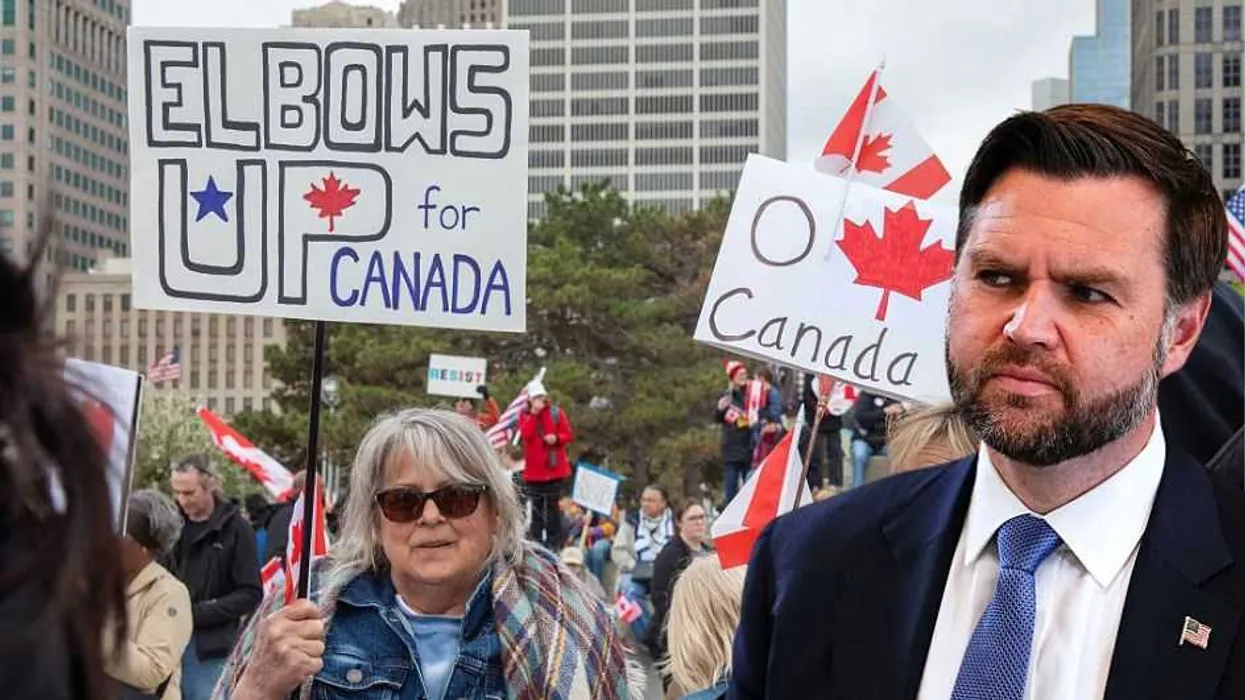
Vice President JD Vance did something remarkable last week: He described Canada more honestly than most of its own political leaders.
In a short series of posts on X, Vance captured the two anxieties that now define Canadian life — mass immigration and a refusal to take responsibility for national decline.
The deeper problem is leadership that seems consistently more focused on the fortunes of global capital than the welfare of Canadians.
“While I’m sure the causes are complicated,” he wrote, “no nation has leaned more into ‘diversity is our strength, we don’t need a melting pot we have a salad bowl’ immigration insanity than Canada. It has the highest foreign-born share of the population in the entire G7 and its living standards have stagnated.”
Vance continued, “And with all due respect to my Canadian friends, whose politics focus obsessively on the United States: your stagnating living standards have nothing to do with Donald Trump or whatever bogeyman the CBC tells you to blame. The fault lies with your leadership, elected by you.”
Truth hurts
Those comments struck a nerve because they describe a reality that Canadians live with every day. Immigration levels have soared to historic highs. Canada’s population is closing in on 40 million, with roughly 23% foreign-born in the 2021 census — and likely much higher today, given the recent revelation that 42% of babies born in 2025 will have foreign-born mothers. For years, political and media elites insisted that this was a sign of national strength. Ordinary people can now see the strain everywhere: stagnant wages, collapsing services, unaffordable housing, and infrastructure buckling under the load.
Vance’s second point was equally accurate. Canadian politicians — especially Liberal ones — have long relied on Trump as a universal scapegoat. No matter the problem, the reflexive response has been to point south and blame “American extremism” for Canada’s failures. It was a convenient distraction from the consequences of their own policies.
Man with no plan
Prime Minister Mark Carney was a master of this blame-shifting. Before entering politics, he spent years burnishing his reputation as a global technocrat. Yet when he ran for prime minister, he adopted an almost paranoid tone toward the United States, claiming in one speech: “President Trump is trying to break us so that America can own us. … We need a plan to deal with this new reality.” His “plan,” as it turned out, was simply to win power — and once in office, Carney abandoned the rhetoric even as he continued neglecting basic economic and security interests.
Nowhere has that neglect been clearer than in defense procurement. Ottawa is reportedly considering scrapping the F-35 fighter jet program in favor of Sweden’s Gripen — an aircraft incompatible with the F-35s flown by every branch of the U.S. military and central to NORAD’s interoperability. As U.S. Ambassador Pete Hoekstra has warned repeatedly, such a move would be sheer folly, undermining both North American defense and Canada’s most vital alliance.
The deeper problem is leadership that seems consistently more focused on the fortunes of global capital than the welfare of Canadians. Brookfield Asset Management — the firm Carney chaired before deciding to seek the leadership of the Liberal Party of Canada and replacing Justin Trudeau as prime minister — recently surfaced in headlines for its involvement in an $80 billion agreement with the Trump administration to produce nuclear reactors. That deal may be good business, but it has only reinforced public suspicion that Carney’s loyalties were formed long before he stepped into elected office.
RELATED: Is this the end of Canada?
 Dave Chan/Getty Images
Soft authoritarianism
Meanwhile, Canada’s once-vaunted bureaucracy is looking increasingly ideological, unaccountable, and hostile to the people it purports to serve. The Canadian Food Inspection Agency’s ongoing occupation of a family farm — and its insistence on slaughtering hundreds of healthy ostriches despite nearly a year without symptoms of avian flu — has alarmed Canadians across the political spectrum. It is the kind of aggressive, unrestrained government action that would have been unthinkable a generation ago.
All of this is unfolding as the Liberal government pursues sweeping censorship and surveillance legislation, from online speech controls to broad new powers for federal regulators. The United Kingdom has already slid into a soft authoritarianism that polices “offensive” speech through arrests and intimidation. Canada appears determined to follow the same path.
This is what Vance was speaking to: a country drifting into economic stagnation, cultural fragmentation, bureaucratic overreach, and political corruption. A country that no longer seems capable of telling itself the truth about what is happening. A country that responds to national crises not with reform, but with scapegoats — whether Donald Trump, American conservatives, or anyone who challenges the official narrative.
Canada is not yet lost. But it is undeniably breaking, and the political class shows little interest in repairing it.
As Vance noted, the ultimate responsibility lies with Canadians themselves. They elected the leadership that brought the country to this point. Whether Canada recovers will depend on whether they are willing to demand something better.





