

Category: Media
How the DC media machine actually works
It’s a running joke in the Beltway that defense contractors put up billboards advertising, say F-35s, at the Pentagon City metro station. Your everyday commuter, even in Washington, isn’t picking up fighter jets off the shelf at Costco on Sundays. But a chunk of the people who work on defense contracts will pass through the Pentagon’s metro stop, and Lockheed Martin knows this.
In practice, Beltway newsletters are funded to the hilt by the businesses they cover.
In theory, the same logic fuels D.C.’s media business. In the last two decades, the capital city has become dominated by a constellation of powerful media outlets that deliver niche, social-media-based coverage of the federal government. Think Politico, Semafor, Punchbowl News, and Axios.
These publications produce insider email newsletters that cover the daily pulse of Capitol Hill, foreign affairs, and the White House and are written specifically for staffers, journalists, and lobbyists. Web 2.0 made this business model possible, and it’s only grown as mass media flails.
Typically a reader will see at the top of each day’s newsletter some version of “Sponsored by” or “Brought to you by” followed by the name of a major corporation or interest group. Sponsor ads will be inserted sparingly, with political motivations ranging from explicit to subtle. Examples of corporate sponsors include Meta, BlackRock, Microsoft, and many, many more.
Anthropic, for example, sponsored Politico’s Playbook newsletter immediately after its high-level negotiations with the Pentagon fizzled in March. The ads didn’t have much to do with defense, focusing mostly on children, learning, and Claude’s efficiency.
The goal instead was to buy goodwill — to make powerful people think nice thoughts about Claude as they read the news.
This is all supposed to be aboveboard because, as ever, advertising departments insist they maintain a strong firewall that keeps journalists unaware of business decisions. Some news outlets, for what it’s worth, are very disciplined about this, but many aren’t.
And nothing prevents the latent affection that can bloom between journalists and their frequent sponsors, who also regularly work with their sources and subjects.
During COVID, one reporter friend of mine shared warm feelings about a major tech company precisely because that company kept its employees working during hard times. Imagine the hypothetical dilemma of a local paper forced to choose whether to blow the whistle on a family-owned landscaping business that also happens to be one of the publication’s most faithful advertisers.
Then scale that up to the international level.
In practice, Beltway newsletters are funded to the hilt by the businesses they cover. The system is not comparable to D.C.’s metro system — getting some advertiser cash from RTX for a few square feet of a dirty wall. The D.C. newsletter model is thoroughly corrupting.
RELATED: America has a spending problem Congress refuses to fix
 DNY59/Getty Images
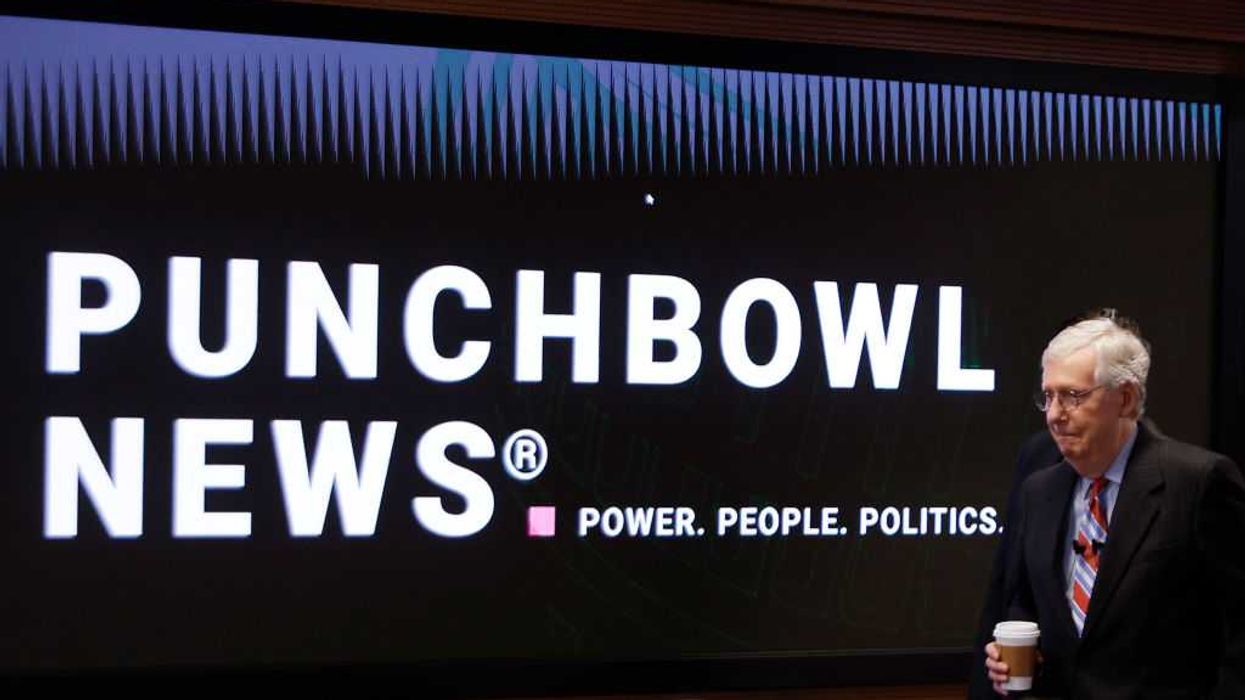
This is because news outlets are becoming increasingly brazen about corporate partnerships. It was somewhat amusing to see DataRepublican recently pick up on a report my colleagues at “Breaking Points” produced last year about Punchbowl News.
DataRepublican, a relentless investigator of political money trails, noticed the outlet had been flamboyantly defensive of Senate Majority Leader John Thune (R-S.D.). Many of Thune’s donors also happen to sponsor Punchbowl.
Last year, a source leaked one of Punchbowl’s latest pitch decks for corporate advertisers to “Breaking Points.” The document offered editorial influence for cash. Granted, Punchbowl dressed the offer up in corporate language, but its invitation was unmistakable. Corporations can pay them to cover a “mutually agreed upon topic” in podcast series, “editorial deep dives,” and events.
The pitch deck even included a sample of Punchbowl’s work with Google on “custom content.”
This is undeniably a breach of basic journalistic ethics. But nobody in D.C. bats an eye. Jake Sherman and Anna Palmer, the founders of Punchbowl, are beloved in Washington. They are called upon for sober analysis, win awards, and lecture others on journalism.
What’s funny is that D.C. reporters honestly do not believe these dishonorable financial relationships influence their coverage. This is a common — and entirely reasonable — misconception about how Washington works.
The wall between Washington and the world grows taller. An insular city becomes more insular, and the citizens it serves become more distant.
Corporations and their lobbyists do not approach journalists and say, “Here’s $20,000, write something nice about the F-35 Lightning.”
A famous 1996 BBC interview sheds light on what’s really going on. Journalist Andrew Marr asked Noam Chomsky, “How can you know that I’m self-censoring?” “I don’t say you’re self-censoring,” Chomsky replied. “I’m sure you believe everything you’re saying. But what I’m saying is that if you believed something different, you wouldn’t be sitting where you’re sitting.”
This is the way the system actually functions. Sherman, Palmer, and their peers in the business see themselves as genuine shoe-leather reporters, covering politics without fear or favor.
The perception of the “facts” and of right and wrong just happens to fall within the same range of beliefs shared by their subjects and sponsors.
Why might John Thune, the leader of the Senate GOP, share donors with a center-left Beltway rag? Thune and Punchbowl are cogs in the same machine, and the corporate cash is the grease on its wheels. Some of those wheels get a bit squeaky at times, but the machine never stops.
Meta can pay a newsletter to host a breakfast on internet safety where journalists will exchange cards and conversation with executives and lobbyists. They won’t meet the parents who say Meta failed to protect their child from sex predators. Those stakeholders are typically not organized or wealthy enough to pay for face time with executives.
RELATED: Tax-exempt hospitals are not putting their patients first
 David M. Levitt/Bloomberg/Getty Images
As a consequence, the wall between Washington and the world grows taller. An insular city becomes more insular, and the citizens it serves become more distant.
One reporter who spent years working at one of the Beltway rags put it this way:
It’s important to understand that corporate sponsorships are central to the business model. Honestly, the newsroom at Politico is only about half of the actual company. They have an entire floor in their Rosslyn office for business operations. When you have that level of financial interdependence, it inevitably spills into the newsroom. Even if there’s not an explicit bias in reporter stories or Playbook it still creates an institutional alignment with corporate interests and priorities that runs afoul of what we expect from a truly adversarial or accountability-driven press.
This story isn’t as sexy as cash being exchanged for coverage in some back-alley deal. The problem is much worse than that. It’s the final form of the American media’s shared worldview with its powerful subjects. They’re in control, and the rabble must be tempered.
The interests of politicians and journalists used to look like a Venn diagram: divergent with small overlap. Now that picture is just a circle.
Editor’s note: This article was originally published in the American Mind.





