Category: North sea
Fishing with my dying father
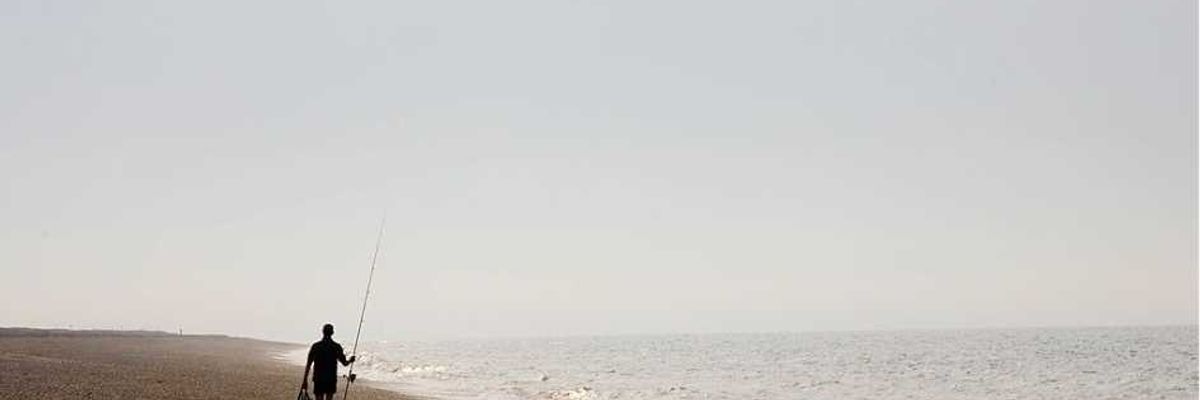
On the North Norfolk coast, dawn is more sensory than visual.
Sea lavender and samphire engulf you before the bite of the wind reminds you of nature’s power. As the sun rises above the horizon, my father and I cross the salt marshes, the light revealing tidal creeks winding through the mudflats. This time, though, I know it is our last trip together.
In angling, the tippet is the thinnest section of line, the point most likely to fail.
Every step is taken with the knowledge that these rituals — these early mornings, the scent of salt and wildflowers, the quiet companionship — are being performed for the final time.
Silence as stewardship
This is not just a landscape but a stage on which the story of my family unfolds. Each tradition echoes those who came before and those still to come. This place, and these shared customs repeated year after year, have woven our family history together — each visit another stitch in a tapestry stretched across generations.
There is no better place for solitude than Stiffkey, an idyllic village nestled in the Norfolk countryside. For miles around, the only sounds are wood pigeons cooing in the trees and the distant thunder of the sea. It is still very early — five in the morning — when we break this peace with the rhythmic punch of a shovel digging into saturated sand. My father and I do not speak as we work. Ours is a silence filled with meaning, a language shaped by years of tradition and respect for the world around us.
The rhythm of these mornings — the shared labor, the quiet companionship — blurs the boundaries between past and present, between father and son, creating a continuous thread running through my memory. Growing up, my father and I mainly communicated through the tension of a fishing line. Our family has never been big on talking; we are like frayed strings, bound and spliced together by tradition.
In the modern world, silence between two men is often treated as a void to be filled with noise. But on this stretch of coastline, silence is a form of stewardship. To be quiet is to respect the natural world. To be quiet together is to acknowledge a bond that does not require speech.
Here time folds in on itself — my father’s footsteps merging with his father’s, and mine with both of theirs.
Stiffkey blues
My father brought us to Stiffkey every year for our family holiday. For decades, this was his parish. He moved through the shifting terrain with the confidence of a man who knew the tide’s schedule like the back of his hand.
This time, watching him navigate the narrow ravines in the soft morning light, I see not the man who first guided me to the water 20 years earlier but his shadow. His light has dimmed — but it is still bright enough to guide us.
The lessons of Stiffkey are as much about patience, respect, and inheritance as they are about fishing. Each action — from digging bait to laying lines — forms a thread in the fabric of our shared history.
Laying fishing lines is a skill. The tide’s timing and direction determine how the lines must be slanted to catch fish. Digging your own bait matters too; no competent angler wants to carry unnecessary weight from home.
You take only what you need, while respecting the land and sea. From an early age, this was the lesson my father taught me: We are merely guardians, entrusted with care until it is time to pass things on.
“The ragworms aren’t biting,” I would tell him. He would approach with his antalgic gait, quietly move my shovel a few feet, and say, softly but with conviction, “Dig between the holes — that’s where they live.” Ten minutes later, the plastic bucket would overflow.
These moments bridge generations, passing down not just skill but belonging. This was where my grandfather taught my father to fish. Decades later, my father stood here teaching me.
A disused sewage pipe stretches northward, its end disappearing beneath the waves of the North Sea, marked only by a lone orange buoy. With an upturned wooden rake slung over my shoulder, its worn teeth piercing an old onion sack, I would walk the length of the pipeline. I can still feel the chill of rusted metal beneath my bare feet and my father’s watchful eyes — stern yet generous — urging me on. Together we raked the mudflats for cockles, the famed “Stiffkey blues,” once plentiful, now sought like hidden treasure.
RELATED: How I rediscovered the virtue of citizenship on a remote Canadian island
 Buddy Mays/Getty Images
The cycle of care
Every sensory detail — the cold pipeline, the mudflats, the weight of the rake — anchors memory to place, making past and present inseparable.
Trust and love, learned in my father’s shadow, now guide me as I support him. The cycle of care turns gently but inexorably.
My father’s name is Peter. As his name suggests, he was always my rock — my moral guide — and I followed him with a child’s absolute confidence. Now the roles have quietly reversed. I lead; he leans on my shoulder.
The symbolism of the tippet — its fragility and strength — mirrors this transfer of responsibility. In angling, the tippet is the thinnest section of line, the point most likely to fail. As I watch my father struggle with the nylon — his hands, calloused by 50 years of labor, unable to tie the hook — it becomes clear that we are in the tippet phase of our relationship.
I take over, tying a grinner knot. He has taught me this a thousand times, but today feels different. As I pull the knot tight, I feel the weight of his legacy. He is handing over the keys to his kingdom.
The weight of a soul
At daybreak the following morning, we set off with the same excitement I once felt as a 5-year-old. His unspoken lesson had always been that disappointment should be met with patience. Then there it is: a solitary bass, glistening in the early sun. His hands tremble as he holds it up, smiling. On the walk back to the car, we laugh as seagulls swoop in, trying to steal our catch.
As our roles shifted, so did my understanding. Fishing became a meditation on acceptance, mortality, and shared silence. Fishing with a dying father reminds you that life is finite. It shows that the boundary between this world and the next is as thin as a fishing line — fragile, transparent, yet strong enough to bear the weight of a soul.
Even after loss, the rituals persist. Each return to Stiffkey is both goodbye and renewal. The year after his death, I returned to scatter his ashes. As the wind carried him out to sea, I understood that life’s true tippet strength is not measured by where it breaks but by what it can hold before it does.