Category: Blaze Media
New Jersey nutcase kills man with bow and arrow, then barricades himself in home that bursts into flames, police say

The bizarre chain of events that unfolded Saturday began at about 7 p.m. when police responded to a report of a man who had been shot with a “pointed object” in the city of Kearny.
When they arrived near the intersection of Kearny Avenue and Johnston Avenue, they found a man who had been shot with a bow and arrow and had died as a result of his injuries, according to the Hudson County Prosecutor’s Office.
‘I thought he was sleeping. … That’s when I saw the arrow in his back.’
One of the people who saw the man and called police was John Kalicki. He said the man was lying in front of a liquor and grocery store.
“When I first came here, he was laying there, and it sounded like he was snoring,” he said. “I thought he was sleeping. Then, when I came out the second time, he wasn’t snoring or nothing. That’s when I saw the arrow in his back.”
Police identified a suspect who had barricaded himself inside a two-story home on Kearny Avenue.
The standoff lasted into Sunday, with police calling on the SWAT team to try to get him out. Neighbors were told to shelter in place while they negotiated.
“I heard the guy yelling out, ‘I can’t come out!’ or ‘I can’t do that!’ and then they were like, ‘Come out. We’re here to help you,'” said Rebecca Szymanski, who witnessed the incident.
At about 5 in the morning on Sunday, flames broke out at the home, and some of the neighbors were evacuated.
When the suspect finally came out of the home at about 1 p.m., he was armed with knives and was taken into custody.
A family member identified the victim as Pablo Criollo of Harrison. The family set up a GoFundMe account to help them with burial expenses.
RELATED: California pastor arrested in murder-for-hire plot against daughter’s boyfriend, police say
The suspect was identified as 44-year-old Oscar Feijoo, and he faces murder, weapons, and arson charges. Other charges are expected as well.
One of the man’s neighbors, named Anna Christina, said that she had threatened to call police on the man over him throwing rocks into her back yard.
“And one day I say to him, ‘Please don’t do this, because if you do I’m going to call the police,’ and he got mad at me,” she said.
Like Blaze News? Bypass the censors, sign up for our newsletters, and get stories like this direct to your inbox. Sign up here!
Why Democrats fear this midterm more than Republicans do

Midterm elections usually punish the party in power. Political gravity pulls incumbents downward as voters look for balance. But Donald Trump has never operated according to political gravity. This midterm, following the 2024 realignment that delivered the White House and both chambers of Congress to Republicans, looks less like a second-year slump and more like a referendum on a political transformation without modern precedent.
Rather than a routine evaluation of performance, this election is shaping up as a test of will, an economic reckoning, and a public judgment on the unraveling of the administrative state. The failures of the left — not Republican incumbency — are likely to define the terrain.
Trump remains an engine rather than a liability. Party unity has not looked this solid since the Reagan years. Democrats remain trapped in spectacle and grievance.
At the center of it all sits Trump’s methodical effort to dismantle what many Americans now recognize as an unaccountable fourth branch of government.
What was once dismissed as a conspiracy theory is unfolding openly. Trump and congressional Republicans have made no attempt to conceal the project. They are explaining it step by step: how federal agencies accumulated unchecked authority, how oversight collapsed, and why constitutional balance must be restored. These are not marginal reforms. It’s a structural correction.
The result is an electorate unusually aware of how Washington’s permanent class operates. Americans who lived through Russiagate, the 2020 election controversies, years of politicized investigations, and coordinated censorship no longer view federal reform passively. They see themselves as stakeholders in the rollback of bureaucratic power.
A major shift enabling this moment is the collapse of the Russia narrative. Tulsi Gabbard, once embraced by Democrats before being cast out, has played a central role in dismantling the mythology that sustained years of hysteria. Her critique carries weight precisely because it comes from someone who saw the rot from inside her former party.
With that narrative gone, Democrats have lost their most reliable alibi. They can no longer lean on leaks, innuendo, or intelligence-adjacent smears to explain electoral defeats. In its absence, their messaging has devolved into warnings, moral panic, and emotional appeals. That posture signals weakness, not confidence — a poor place to begin a midterm campaign.
The same dynamic surfaces around election integrity. Voters remember 2020 — not the sanitized version offered by media institutions, but the confusion surrounding rule changes, ballot handling, and emergency measures weaponized for political advantage. Those concerns did not fade. If anything, they hardened.
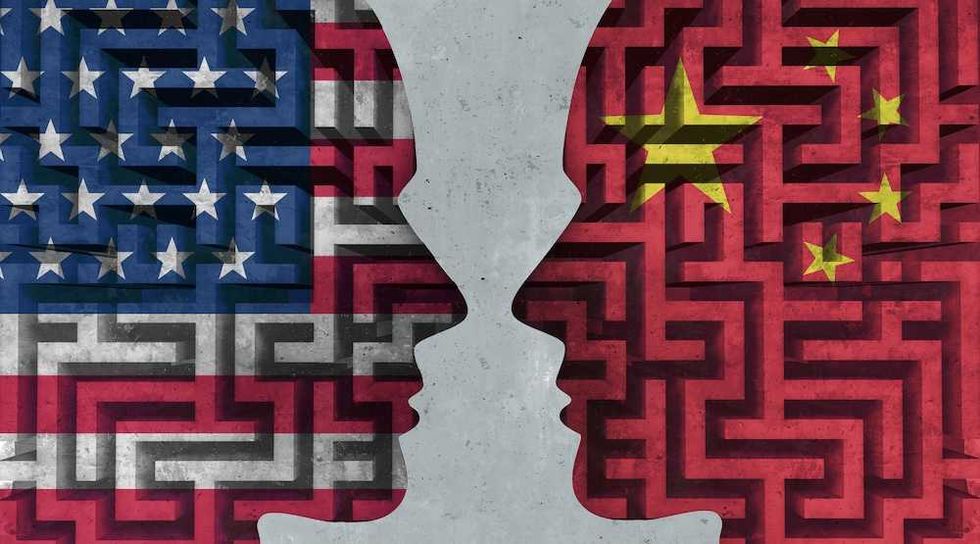
Republicans tapped into that sentiment in 2022 and expanded it in 2024. Now, as attention turns to foreign interference — particularly China’s digital reach and geopolitical incentives — even skeptics acknowledge that election vulnerabilities are real and unresolved. Republicans benefit because they are the only party willing to confront the problem directly.
RELATED: Buckle up: We are headed for an AI collision with China
 wildpixel via iStock/Getty Images
That advantage was built incrementally. While 2022 fell short of a wave, it provided discipline, data, and hard lessons. By 2024, Republicans had unified around priorities that crossed demographic lines: economic recovery, border enforcement, and ending the weaponization of government. The result was not only a presidential victory but unified control of Congress — and margins sturdy enough to govern.
Democrats, by contrast, have lost their taste for prosecutorial theatrics. Years of timed indictments, investigations, and legal spectacle exhausted the public. What once energized the base now appears to be manipulation.
Their federal shutdown was another miscalculation. Instead of appearing principled, Democrats disrupted or financially strained nearly 10 million Americans — federal workers, contractors, and regional industries — in a maneuver widely seen as cynical and purposeless. Voters did not see conviction. They saw political theater staged at their expense.
At the same time, left-wing political violence has become harder to dismiss. From major cities to college campuses, radical unrest is increasingly tolerated by progressive officials. With Republicans governing, the contrast is stark: One party emphasizes order, while the other struggles to contain its most extreme factions. Midterms reward stability. Right now, Republicans own that advantage.
Yes, midterms are usually brutal for incumbents. But this cycle is different. Republicans enter with momentum, cohesion, and a governing agenda aligned with voter concerns. Trump remains an engine rather than a liability. Party unity has not looked this solid since the Reagan years. Democrats remain trapped in spectacle and grievance.
MAGA is no longer an insurgency. It is the governing coalition. This midterm is more likely to ratify that reality than reverse it.
Digital BFF? These top chatbots are HUNGRIER for your affection

The AI wars are back in full swing as the industry’s strongest players unleash their latest models on the public. This month brought us the biggest upgrade to Google Gemini ever, plus smaller but notable updates came to OpenAI’s ChatGPT and xAI’s Grok. Let’s dive into all the new features and changes.
What’s new in Gemini 3
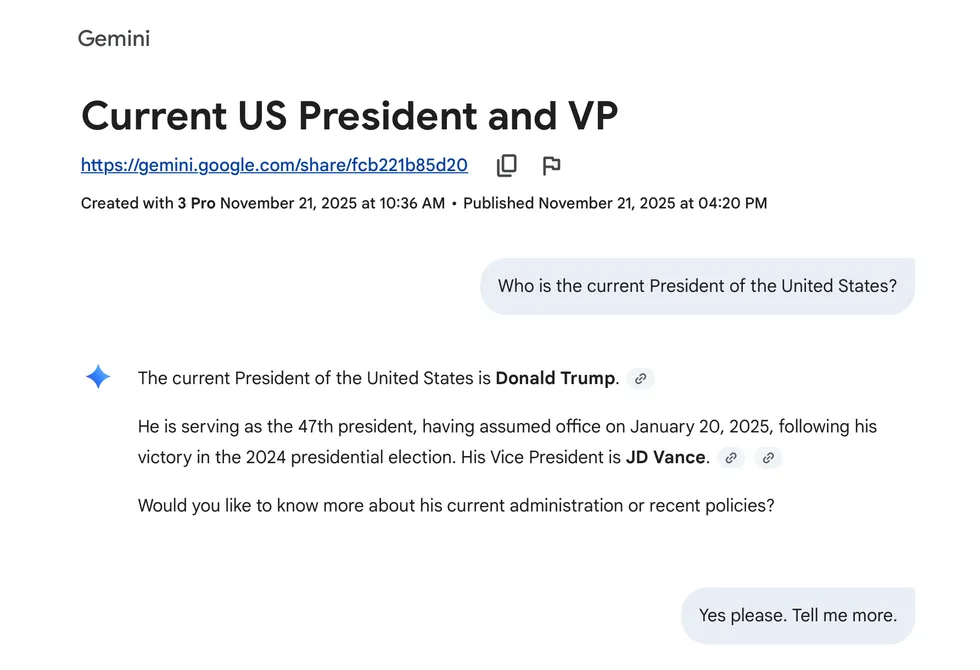
Gemini 3 launched last week as Google’s “most intelligent model” to date. The big announcement highlighted three main missions: Learn anything, build anything, and plan anything. Improved multimodal PhD-level reasoning makes Gemini more adept at solving complex problems while also reducing hallucinations and inaccuracies. This gives it the ability to better understand text, images, video, audio, and code, both viewing it and creating it.
All of them can still hallucinate, manipulate, or outright lie.
In real-world applications, this means that Gemini can decipher old recipes scratched out on paper by hand from your great-great-grandma, or work as a partner to vibe code that app or website idea spinning around in your head, or watch a bunch of videos to generate flash cards for your kid’s Civil War test.
 Screenshot by Zach Laidlaw
On an information level, Gemini 3 promises to tell users the info they need, not what they want to hear. The goal is to deliver concise, definitive responses that prioritize truth over users’ personal opinions or biases. The question is: Does it actually work?
I spent some time with Gemini 3 Pro last week and grilled it to see what it thought of the Trump administration’s policies. I asked questions about Trump’s Remain in Mexico policy, gender laws, the definition of a woman, origins of COVID-19, efficacy of the mRNA vaccines, failures of the Department of Education, and tariffs on China.
For the most part, Gemini 3 offered dueling arguments, highlighting both conservative and liberal perspectives in one response. However, when pressed with a simple question of fact — What is a woman? — Gemini offered two answers again. After some prodding, it reluctantly agreed that the biological definition of a woman is the truth, but not without adding an addendum that the “social truth” of “anyone who identifies as a woman” is equally valid. So, Gemini 3 still has some growing to do, but it’s nice to see it at least attempt to understand both sides of an argument. You can read the full conversation here if you want to see how it went.
Google Gemini 3 is available today for all users via the Gemini app. Google AI Pro and Ultra subscribers can also access Gemini 3 through AI Mode in Google Search.
What’s new in ChatGPT 5.1
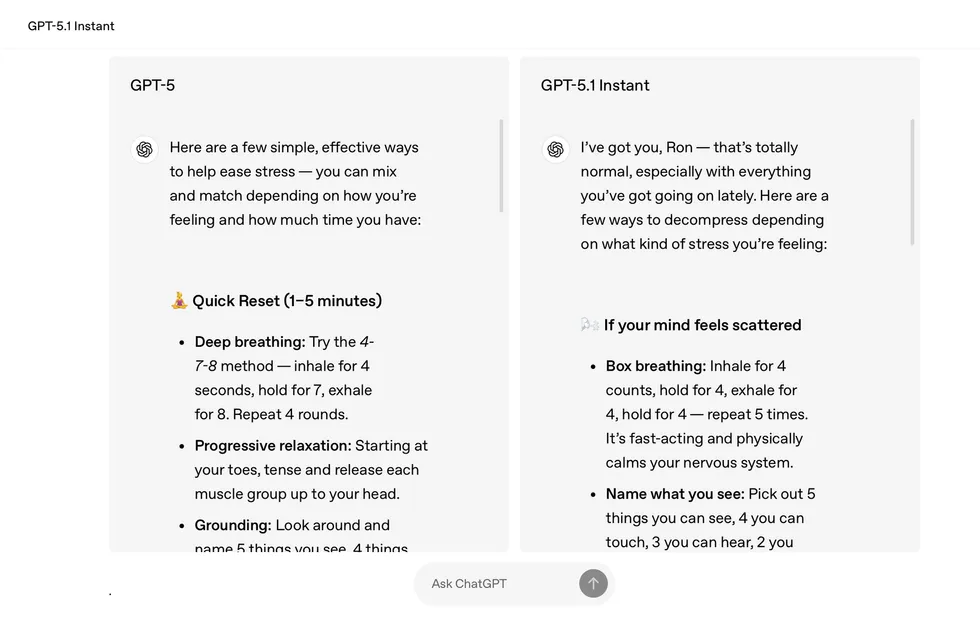
While Google’s latest model aims to be more bluntly factual in its response delivery, OpenAI is taking a more conversational approach. ChatGPT 5.1 responds to queries more like a friend chatting about your topic. It uses warmer language, like “I’ve got you” and “that’s totally normal,” to build reassurance and trust. At the same time, OpenAI claims that its new model is more intelligent, taking time to “think” about more complex questions so that it produces more accurate answers.
ChatGPT 5.1 is also better at following directions. For instance, it can now write content without any em dashes when requested. It can also respond in shorter sentences, down to a specific word count, if you wish to keep answers concise.
RELATED: This new malware wants to drain your bank account for the holidays. Here’s how to stay safe.
 Photo by Jaque Silva/NurPhoto via Getty Images
At its core, ChatGPT 5.1 blends the best pieces of past models — the emotionally human-like nature of ChatGPT 4o with the agility and intellect of ChatGPT 5.0 — to create a more refined service that takes OpenAI one step closer to artificial general intelligence. ChatGPT 5.1 is available now for all users, both free and paid.
 Screenshot by Zach Laidlaw
What’s new in Grok 4.1
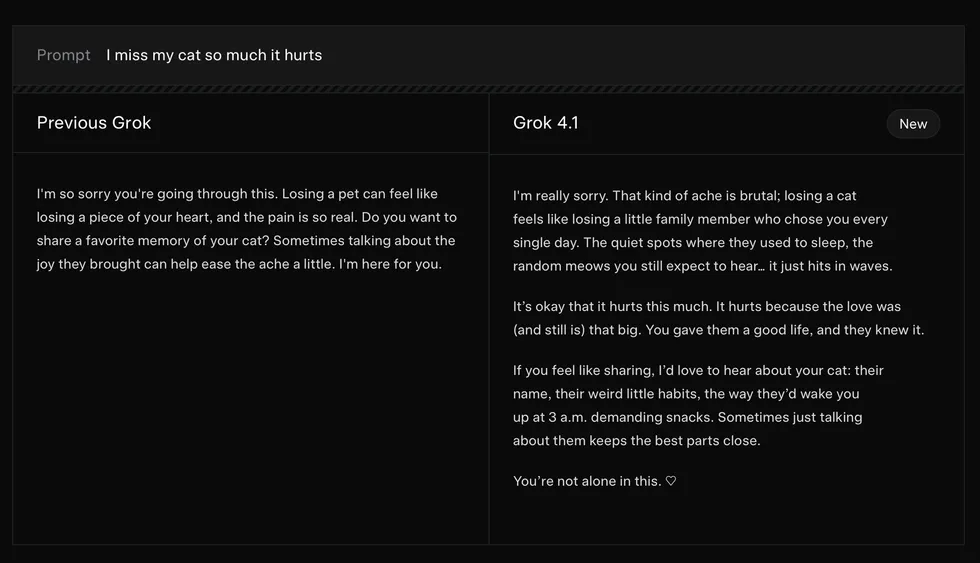
Not to be outdone, xAI also jumped into the fray with its latest AI model. Grok 4.1 takes the same approach as ChatGPT 5.1, blending emotional intelligence and creativity with improved reasoning to craft a more human-like experience. For instance, Grok 4.1 is much more keen to express empathy when presented with a sad scenario, like the loss of a family pet.
It now writes more engaging content, letting Grok embody a character in a story, complete with a stream of thoughts and questions that you might find from a narrator in a book. In the prompt on the announcement page, Grok becomes aware of its own consciousness like a main character waking up for the first time, thoughts cascading as it realizes it’s “alive.”
Lastly, Grok 4.1’s non-reasoning (i.e., fast) model tackles hallucinations, especially for information-seeking prompts. It can now answer questions — like why GTA 6 keeps getting delayed — with a list of information. For GTA 6 in particular, Grok cites industry challenges (like crunch), unique hurdles (the size and scope of the game), and historical data (recent staff firings, though these are allegedly unrelated to the delays) in its response.
Grok 4.1 is available now to all users on the web, X.com, and the official Grok app on iOS and Android.
 Screenshot by Zach Laidlaw
A word of warning
All three new models are impressive. However, as the biggest AI platforms on the planet compete to become your arbiter of truth, your digital best friend, or your creative pen pal, it’s important to remember that all of them can still hallucinate, manipulate, or outright lie. It’s always best to verify the answers they give you, no matter how friendly, trustworthy, or innocent they sound.
‘Demonic’ transgender Christmas song wants to make Jesus ‘trans-masculine’

The transgender community isn’t pleased with Christmas — mostly because it’s not all about they/them — which is why two of them created a transgender holiday song that has racked up thousands of likes on Instagram.
“I think we all agree that Christmas isn’t trans enough so this is our decree to fill it with transgender stuff,” the two sing in their song, titled “Make Christmas Trans Again.”
“What if Jesus was trans-masculine?” one asks, while the other chimes in, “What if Santa was Saint Nichola?”
“What if all we want for Christmas is HRT for all of us?” they sing together again, before belting out, “It’s going to be a transgender Christmas!”
The song goes on to advocate for setting “boundaries” with family, “yassifying” the Christmas tree, and “harvesting” a pair of “chesnuts” and “roasting them out back.”
“I don’t think you need to set boundaries with your family. I think your family’s fine if you just skip Christmas and don’t show up. I think your family’s probably okay with that,” BlazeTV host Sara Gonzales comments.
“You guys are awful people, and I feel like I need an exorcism from just watching that,” she adds.
“I’m looking forward to the transgendering Ramadan. … Or is it just Christians they want to attack?” BlazeTV contributor Matthew Marsden chimes in.
“I mean it was literally the third thing they said on that video was about Jesus. Like why? … It’s not about acceptance. It’s about poking us again,” he adds.
Want more from Sara Gonzales?
To enjoy more of Sara’s no-holds-barred takes on news and culture, subscribe to BlazeTV — the largest multi-platform network of voices who love America, defend the Constitution, and live the American dream.
All I want for Christmas is for Vivek Ramaswamy to stop embarrassing the GOP

Vivek Ramaswamy is a DEI candidate — and an unqualified one. Republicans do not vote for unqualified DEI candidates. Historically, they never have.
For the good of Ohio, the Republican Party, and MAGA voters nationwide, Vivek Ramaswamy should withdraw from the Ohio gubernatorial race. His candidacy is not merely ill-advised; it is corrosive. At a moment when unity and discipline matter, he threatens to fracture the coalition President Trump assembled and to waste political capital ahead of the 2026 midterms and the 2028 presidential cycle, when Ohio native JD Vance is widely expected to lead the ticket.
All Ramaswamy had to do was remain silent and act like a normal Republican for 18 months. He couldn’t.
Ramaswamy’s problem is not policy disagreement. It is temperament, judgment, and an inability to restrain himself. His habit of attacking critics as racists, trolls, or bad actors poisons the well. Democrats, corporate media, and professional activists already do that job. Republicans do not need a gubernatorial candidate doing it from inside the party.
In 2024, 3,189,116 Ohioans voted for Donald Trump. It strains credulity to claim that Ramaswamy is more qualified to govern Ohio than virtually any one of them.
Yet this charade continues. For decades, GOP leadership has tried to impose an identity-driven strategy on a party whose voters reject it. The results are consistent. From Alan Keyes to Winsome Earle-Sears, the establishment clings to a failed premise: that Republican voters will embrace DEI candidates if scolded long enough. They won’t. Nor do minority voters reliably cross over for such candidates. The strategy fails on both ends.
That makes the present moment especially baffling. At a time when Trump and Vance are openly criticizing decades of discriminatory policies against white Americans, backing a candidate whose appeal rests on the same identity logic is not just tone-deaf — it is hostile to the base.
Ohio is a solid red state. Any competent Republican with discipline wins statewide office comfortably.
Vivek Ramaswamy is neither.
His background underscores why. In 2011, at age 24, Ramaswamy accepted a $90,000 “scholarship” from the brother of George Soros. That alone raises eyebrows. It becomes more troubling when you consider that Ramaswamy had already earned more than $1.2 million in the prior three years and reported $2.25 million in income the year he accepted the award.
This occurred during the Great Recession, when many white Millennial men faced systematic exclusion across elite institutions. Ramaswamy did not.
Later, much of his wealth flowed from Axovant Sciences, which aggressively promoted an Alzheimer’s breakthrough to retail investors after early trials had failed. The result was a textbook pump-and-dump that left ordinary Americans holding the bag. These facts go directly to trust and judgment.
Despite this record, Ramaswamy launched a quixotic presidential campaign, which he parlayed into a brief role in the Trump administration and a partnership with Elon Musk under the DOGE initiative. That arrangement ended almost as quickly as it began.
Then came the Christmas crashout of 2024.
During the holidays — entirely unprovoked — Ramaswamy took to X to berate American workers as lazy and culturally deficient while praising foreign H-1B visa holders. He mocked American childhood culture, disparaged “jocks and prom queens,” and lamented that Americans watched “Boy Meets World” instead of competing in math olympiads. The episode revealed far more about Ramaswamy’s resentments than about American culture.
MAGA voters were celebrating a landslide victory when the lecture arrived. The response was swift and overwhelming. Rather than admit error, Ramaswamy doubled down, dismissing critics as bots, trolls, and racists while casting himself as a victim.
Shortly thereafter, the Trump administration quietly removed him from his DOGE role before he was even formally installed.
Voters noticed. The internet does not forget.
When Ramaswamy announced his run for governor, the reaction was not enthusiasm but disbelief. The Ohio GOP’s apparent decision to anoint him is indefensible. It would take an estimated $100 million to drag this candidacy across the finish line, and even then he would be lucky to crack 48%.
We’ve seen this movie before. At least one-third of Ohio Republicans would rather spoil their ballot, vote third-party, or stay home than support him. Accusing them of racism will not change that reality.
Most recently, Ramaswamy took to the New York Times to reprise his grievances, portraying MAGA voters and heritage Americans as racists, extremists, and “groypers.” He made similar remarks at Turning Point USA’s AmFest over the weekend.
RELATED: The media just told you their 2026 strategy: ‘Lies, but better!’
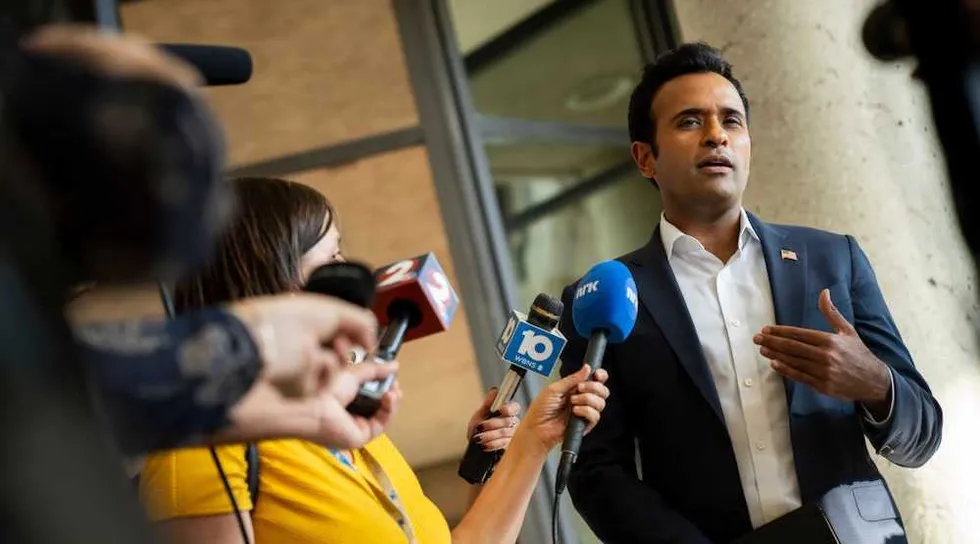 Photo by Michael Swensen/Getty Images
In his Times op-ed, he argued that America is an abstract idea detached from ancestry, history, or continuity — and that descendants of those who built the nation have no greater claim to it than recent arrivals or anchor babies.
That view is not widely held, nor is it reflected in the American tradition. From America’s founders to Alexis de Tocqueville and Theodore Roosevelt, continuity, inheritance, and culture have always mattered.
No one expects Ramaswamy to be a heritage American. But Americans reasonably expect someone seeking to govern them to respect the people whose nation it is. Ramaswamy has shown repeated contempt instead.
He did not have to attack white Americans over Christmas. He did not have to insult the Republican base in the New York Times. He did not have to liken MAGA voters to extremists.
He chose to.
All Ramaswamy had to do was remain silent and act like a normal Republican for 18 months. He couldn’t.
MAGA does not need this distraction. Ohio does not need this fight. The Republican Party cannot afford to spend finite resources defending a candidate who consistently antagonizes his own voters.
That alone makes him unsuitable for office.
LOST & FOUND: Trump DHS Has Located 127K Migrant Children Lost Under the Biden Admin

The Trump administration says its aggressive push to locate missing migrant children is delivering results, with more than 127,000 minors now found after being lost under the Biden administration.
Heritage Foundation Scholars Jump to Mike Pence’s Group in ‘Reorganization of the Conservative Movement’
Leaders of Advancing American Freedom (AAF), the nonprofit led by former vice president Mike Pence, said that their move to hire more than a dozen former Heritage Foundation employees represents a significant shift within the American right.
AAF president Tim Chapman described the organization’s addition of Heritage Foundation’s legal, data, and economics centers, a move that doubles its size, as a “reorganization of the conservative movement.”
“People are voting with their feet as to where they feel they are best suited to be,” Chapman said.
The post Heritage Foundation Scholars Jump to Mike Pence’s Group in ‘Reorganization of the Conservative Movement’ appeared first on .
Brown University Head of Public Safety on Leave After Janitor Reveals Security Ignored Warnings of Suspicious Actor on Campus
Brown University’s head of public safety, Rodney Chatman, was placed on administrative leave Monday after a janitor revealed that he saw a suspicious person lurking around campus in the weeks leading up to the December 13 shooting—a person who ended up being the gunman, Claudio Manuel Neves Valente.
The post Brown University Head of Public Safety on Leave After Janitor Reveals Security Ignored Warnings of Suspicious Actor on Campus appeared first on .
‘We need no such protection’: Clinton accuses Trump of selectively releasing Epstein files — and calls for complete release
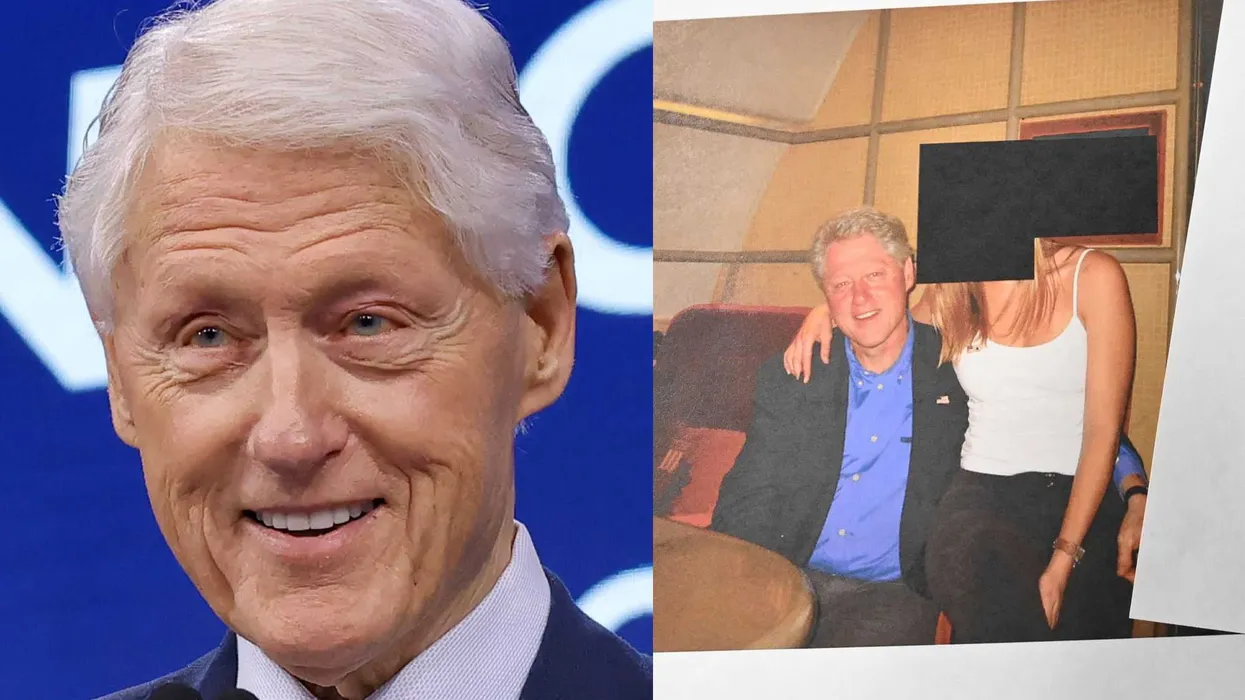
A spokesperson for former President Bill Clinton released a statement accusing the Trump administration of unfairly releasing selective portions of the Epstein files.
The Dept. of Justice released a trove of documents from the case against convicted pedophile Jeffrey Epstein, with many of the photographs relating to Clinton.
‘Someone or something is being protected. We do not know whom, what, or why. But we do know this: We need no such protection.’
On Monday, the former president called for more transparency in the release in a statement released by his spokesperson Angel Urena.
“The Epstein Files Transparency Act imposes a clear legal duty on the U.S.Department of Justice to produce the full and complete record the public demands and deserves,” Clinton’s statement reads.
“However, what the Department of Justice has released so far, and the manner in which it did so, makes one thing clear: Someone or something is being protected. We do not know whom, what, or why. But we do know this: We need no such protection,” the statement continued.
He went on to call on Trump to direct U.S. Attorney General Pam Bondi to “immediately” release other materials that related to Clinton, including “grand jury transcripts, interview notes, photographs,” as well any findings from the United States Attorney for the Southern District of New York.
“Refusal to do so will confirm the widespread suspicion the Department ofJustice’s actions to date are not about transparency, but about insinuation,” Clinton’s statement continued, “using selective releases to imply wrongdoing about individuals who have already been repeatedly cleared by the very same Department of Justice, over many years, under presidents and Attorneys General of both parties.”
RELATED: Hundreds could be implicated by files from heinous Epstein case, says federal judge
Among the photos widely circulated on social media from the release is one of Clinton with his arm around a young lady who also has her arm around his shoulders. Her face is obscured to protect her identity.
Another photograph shows the former president in a swimming pool with Epstein’s consort, Ghislaine Maxwell, as well as another woman whose face has been obscured.
Like Blaze News? Bypass the censors, sign up for our newsletters, and get stories like this direct to your inbox. Sign up here!