

Category: Blaze Media
Congress strips merit from the military and shackles the president in one bill

The Trump administration recently released an extremely promising National Security Strategy — but the same cannot be said about the proposed National Defense Authorization Act for the 2026 fiscal year.
The House and Senate’s compromise NDAA appears to be in tension with the goals of the administration’s strategy. While the National Security Strategy prioritizes a hemispheric defense of the American homeland, the NDAA locks decision-makers into maintaining unnecessary overseas troop levels. Despite President Trump’s stated strategic aims, Congress seems intent on safeguarding the national security priorities and infrastructure of previous eras.
The NDAA represents the ‘deep state,’ a combination of entrenched interests, committees, lobbies, and bureaucracies that value continuity over strategy and reform.
Restricting the drawdown of troops stationed overseas, increasingly murky foreign entrenchment through legally binding efforts to sell arms, and dubious clauses requiring congressional approval at every turn, all serve to bind the commander in chief’s hands. All of this reeks of a shadowy order desperately trying to maintain the status quo at the expense of the will of the people who elected Donald Trump in 2024.
This cannot stand.
Section 1249 of the NDAA states that U.S. forces in Europe cannot fall below 76,000 for more than 45 days without presidential certifications to Congress. This is supposed to ensure that troop reductions present no threat to NATO partners or U.S. national security. (Absurdly, the bill requires the U.S. to consult with every NATO ally and even “relevant non-NATO partners.”) But stripping the president of essential discretion through ludicrous legislative roadblocks categorically subverts his authority under the Constitution.
Section 1255 states that troop levels cannot dip below 28,500 in the Korean Peninsula, nor can wartime operational control be transferred without an identical trial by fire of congressional approvals and national-security certifications.
Shifting our military focus to our own backyard was a stated goal of the National Security Strategy. If this vision is to be implemented, Congress cannot serve as a bureaucratic middleman that hinders deployment flexibility through pedantic checklists.
Americans need to understand that the NDAA would obstruct the execution of President Trump’s agenda. As written, it functions as a deliberate statutory barrier to presidential decision-making. This denotes a redistribution of war powers from the elected executive to a sprawling and unaccountable institutional structure.
The NDAA represents what Americans call the “deep state,” a combination of entrenched interests, committees, lobbies, and bureaucracies that value continuity over strategy and reform.
This continuity becomes clear when you look at what the House and Senate didn’t include in the compromise NDAA. The Senate’s original bill contained a provision barring the use of DEI in service-academy admissions — a measure that would have required merit-only standards and prevented racial profiling. Congress stripped that section out. The final bill includes a few weak gestures toward limiting DEI, but none of them meet President Trump’s goal of a military that rejects race and sex as factors altogether.
RELATED: Mexico has cartel armies. Blue America has cartel politics.
 Photo by Chip Somodevilla/Getty Images
As written, the NDAA gives a future Democratic president the opportunity to reintroduce woke indoctrination in the military with the stroke of a pen. And laws favoring DEI at our nation’s most vital institutions could resurface on a whim, using typical “diversity is our strength” platitudes.
Despite its name, the NDAA functions less like a defense bill and more like the legal backbone of America’s global posture. Whatever promises the National Security Strategy makes, they cannot be realized so long as the current NDAA pulls in the opposite direction. Strategy should shape institutions — not the other way around.
In Washington jargon, the NDAA is treated as “must-pass” legislation. That label has no legal or constitutional basis. And even if it must pass, no one claims it must be signed.
The National Security Strategy reflects the will of voters; the NDAA reflects bureaucratic inertia. That is why the Trump administration cannot, in good conscience, approve this bill. Our escape from stagnation, mediocrity, and endless foreign entanglements depends on rejecting it — and time is running out.
Editor’s note: A version of this article was published originally at the American Mind.
Person of interest detained after deadly shooting at Brown University — but very little has been shared about the individual
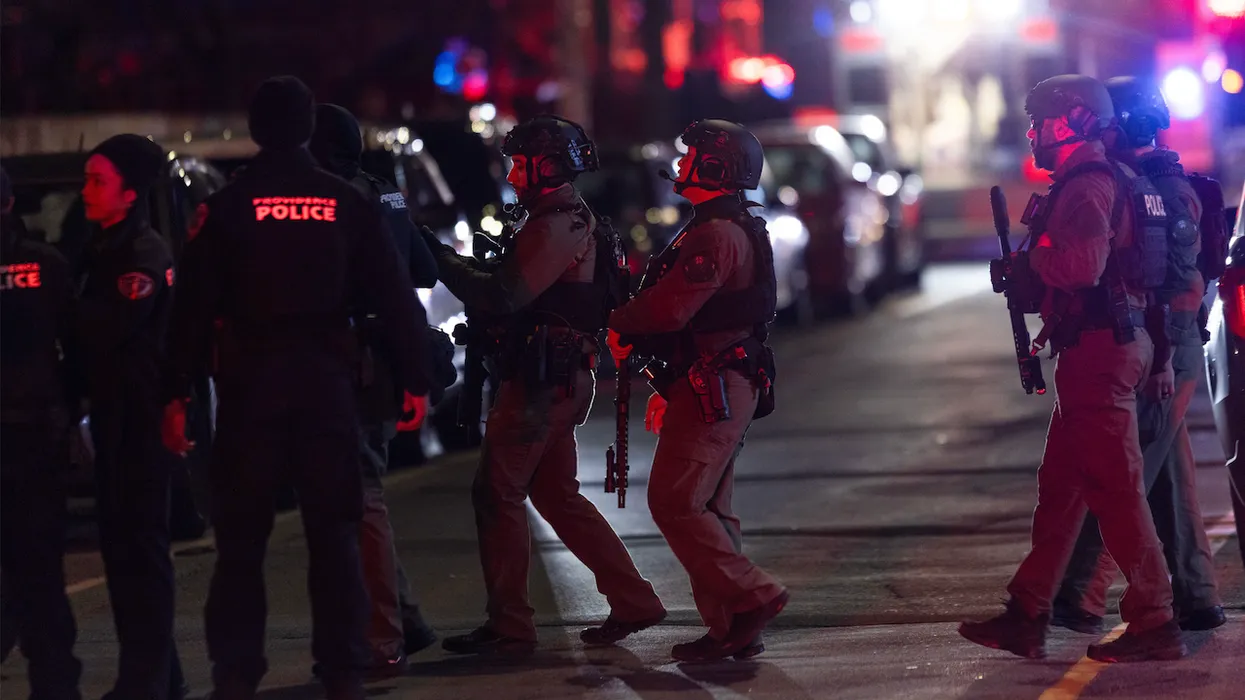
A person of interest has been detained in connection with Saturday’s deadly shooting at Brown University in Providence, Rhode Island, the Associated Press reported.
However, the outlet added that “key questions remained unanswered” following the attack that killed two students and wounded nine others at the Ivy League campus during final exams.
‘Everybody’s reeling, and we have a lot of recovery ahead of us.’
Col. Oscar Perez, chief of the Providence police, said Sunday afternoon that the person in custody is in the 20s age range and that no one has been charged yet, the AP reported. Perez earlier said the person is in the 30s age range and that no one else was being sought; Perez declined to say if the detained person had any connection to Brown, the outlet noted.
The New York Times reported Saturday that the shooter was described as a man dressed in black. Police released surveillance video late Saturday night that they said showed the person of interest. The AP said the individual in the clip was walking from the scene of the shooting.
RELATED: At least 2 killed, more wounded in shooting at Brown University
The person of interest was taken into custody at a Hampton Inn hotel in Coventry, Rhode Island, which is about 20 miles from Providence, the AP said, adding that police officers and FBI agents remained there Sunday, blocking off a hallway with crime scene tape while searching the area.
College President Christina Paxson told the AP that one of the nine wounded students had been released from the hospital while seven others were in critical but stable condition and one was in critical condition.
Investigators told the AP they weren’t immediately sure how the shooter got into the first-floor classroom in the Barus & Holley building, a seven-story complex that houses the School of Engineering and the physics department.
Providence Mayor Brett Smiley said the building’s outer doors were unlocked, but rooms reserved for final exams required badge access, the AP added.
More from the AP:
The gunman opened fire inside a classroom in the engineering building, firing more than 40 rounds from a 9 mm handgun, a law enforcement official told The Associated Press. As of Sunday morning, authorities had not recovered a firearm but did find two loaded 30-round magazines, the official said. The official was not authorized to discuss the investigation publicly and spoke to AP on the condition of anonymity.
Brown canceled all remaining classes, exams, papers, and projects for the semester, the AP said, and told students they were free to leave campus.
Paxson teared up while describing her conversations with students both on campus and in the hospital, the AP said: “They are amazing, and they’re supporting each other. There’s just a lot of gratitude.”
“Everybody’s reeling, and we have a lot of recovery ahead of us,” she added, according to the AP. “Our community’s strong and we’ll get through it, but it’s devastating.”
This is a developing story; updates may be added.
Like Blaze News? Bypass the censors, sign up for our newsletters, and get stories like this direct to your inbox. Sign up here!
The AI apocalypse no one wants to talk about: College grad → degree expired upon arrival

America is free falling into an AI abyss. Entire industries are on the verge of becoming fully automated. Robots are rendering flesh and blood obsolete. College diplomas are looking increasingly like worthless pieces of paper.
And it’s just beginning. We are on the precipice of living in an AI-dominant world.
Are we ready for it?
Glenn Beck says we’re absolutely not ready. But there are some smart moves young people can make to help soften the blow that’s coming.
“I’m begging my kids, trade school, trade school, trade school, trade school because those are the jobs of the future,” he says.
Unless someone is interested in entering the medical field, which is safe for now but ultimately on track for eventual automatization, a generic college degree will likely end up being a waste of time and money.
Glenn’s head writer and researcher Jason Buttrill says he’s begging his son to consider electrician school instead of college, but anytime he brings the topic of AI dominance up, his son shuts down.
“There’s this weird apathy,” he tells Glenn.
Glenn’s co-host Stu Burguiere acknowledges that it’s a deeply depressing topic for emerging adults. Not only are they entering the adult world — degree or not — with the economic odds stacked heavily against them, but “not everybody wants to be a plumber or electrician.”
Nobody wants to be “the bad parent in the after-school special, like, ‘Screw your dreams, go be a plumber!”’ he laughs.
But Glenn says there are other paths young people can take to avoid wasting resources on a useless college degree. He uses his daughter, who wants to be an actress, as an example.
Instead of agreeing to send her to a “viper’s nest” acting school in New York, he helped “design a school” tailored specifically to her through a series of private lessons that will still hone the skills she needs to pursue her dreams.
“When they are driven for something, you don’t have to say, ‘Be a plumber.’ You can say, ‘Let’s find ways for you to learn this in a better way,”’ says Glenn.
On the flip side, for dreamers with big ideas, AI might actually make success possible. As a creative visionary, Glenn says AI has helped him actualize ideas he’s had for years.
But just as some kids have zero interest in blue-collar work, not everyone has big entrepreneurial ambitions. Many just want the longstanding path of earning a degree and climbing the corporate ladder.
So when they hear that that’s no longer a viable option, it sinks their spirits.
Jason explains it like this: Younger generations are stuck in a vicious cycle where AI has been pitched as the solution that will create explosive economic growth and reinvigorate the American dream for young people. Except it’s also going to destroy the jobs they want.
“They’re in that circle, and they’re like, ‘I’m screwed.’ … None of the math adds up,” he says.
To hear more of the conversation, watch the video above.
Want more from Glenn Beck?
To enjoy more of Glenn’s masterful storytelling, thought-provoking analysis, and uncanny ability to make sense of the chaos, subscribe to BlazeTV — the largest multi-platform network of voices who love America, defend the Constitution, and live the American dream.
The country that mocks America’s ‘culture of death’ has embraced one of its own

Canada loves to lecture America about compassion. Every time a shooting makes the headlines, Canadian commentators cannot wait to discuss how the United States has a “culture of death” because we refuse to regulate guns the way enlightened nations supposedly do.
But north of our border, a very different crisis is unfolding — one that is harder to moralize because it exposes a deeper cultural failure.
A society that no longer recognizes the value of life will not long defend freedom, dignity, or moral order.
The Canadian government is not only permitting death, but it’s also administering, expanding, and redefining it as “medical care.” Medical assistance in dying is no longer a rare, tragic exception. It has become one of the country’s leading causes of death, offered to people whose problems are treatable, whose conditions are survivable, and whose value should never have been in question.
In Canada, MAID is now responsible for nearly 5% of all deaths — 1 out of every 20 citizens. And this is happening in a country that claims the moral high ground over American gun violence. Canada now records more deaths per capita from doctors administering lethal drugs than America records from firearms. Their number is 37.9 deaths per 100,000 people. Ours is 13.7. Yet we are the country supposedly drowning in a “culture of death.”
No lecture from abroad can paper over this fact: Canada has built a system where eliminating suffering increasingly means eliminating the sufferer.
Choosing death over care
One example of what Canada now calls “compassion” is the case of Jolene Bond, a woman suffering from a painful but treatable thyroid condition that causes dangerously high calcium levels, bone deterioration, soft-tissue damage, nausea, and unrelenting pain. Her condition is severe, but it is not terminal. Surgery could help her. And in a functioning medical system, she would have it.
But Jolene lives under socialized medicine. The specialists she needs are either unavailable, overrun with patients, or blocked behind bureaucratic requirements she cannot meet. She cannot get a referral. She cannot get an appointment. She cannot reach the doctor in another province who is qualified to perform the operation. Every pathway to treatment is jammed by paperwork, shortages, and waitlists that stretch into the horizon and beyond.
Yet the Canadian government had something else ready for her — something immediate.
They offered her MAID.
Not help, not relief, not a doctor willing to drive across a provincial line and simply examine her. Instead, Canada offered Jolene a state-approved death. A lethal injection is easier to obtain than a medical referral. Killing her would be easier than treating her. And the system calls that compassion.
Bureaucracy replaces medicine
Jolene’s story is not an outlier. It is the logical outcome of a system that cannot keep its promises. When the machinery of socialized medicine breaks down, the state simply replaces care with a final, irreversible “solution.” A bureaucratic checkbox becomes the last decision of a person’s life.
Canada insists its process is rigorous, humane, and safeguarded. Yet the bureaucracy now reviewing Jolene’s case is not asking how she can receive treatment; it is asking whether she has enough signatures to qualify for a lethal injection. And the debate among Canadian officials is not how to preserve life, but whether she has met the paperwork threshold to end it.
This is the dark inversion that always emerges when the state claims the power to decide when life is no longer worth living. Bureaucracy replaces conscience. Eligibility criteria replace compassion. A panel of physicians replaces the family gathered at a bedside. And eventually, the “right” to die becomes an expectation — especially for those who are poor, elderly, or alone.
 Photo by Graham Hughes/NurPhoto via Getty Images
The logical end of a broken system
We ignore this lesson at our own peril. Canada’s health care system is collapsing under demographic pressure, uncontrolled migration, and the unavoidable math of government-run medicine.
When the system breaks, someone must bear the cost. MAID has become the release valve.
The ideology behind this system is already drifting south. In American medical journals and bioethics conferences, you will hear this same rhetoric. The argument is always dressed in compassion. But underneath, it reduces the value of human life to a calculation: Are you useful? Are you affordable? Are you too much of a burden?
The West was built on a conviction that every human life has inherent value. That truth gave us hospitals before it gave us universities. It gave us charity before it gave us science. It is written into the Declaration of Independence.
Canada’s MAID program reveals what happens when a country lets that foundation erode. Life becomes negotiable, and suffering becomes a justification for elimination.
A society that no longer recognizes the value of life will not long defend freedom, dignity, or moral order. If compassion becomes indistinguishable from convenience, and if medicine becomes indistinguishable from euthanasia, the West will have abandoned the very principles that built it. That is the lesson from our northern neighbor — a warning, not a blueprint.
Not all feelings are valid: Why parents need to teach resilience over emotional indulgence

While most parents simply want to protect their kids, stepping in too fast can prevent them from developing problem-solving skills — which is why licensed therapist RaQuel Hopkins rejects the feel-good “protect your peace” culture of today.
One of the most popular phrases to come out of this has been “all feelings are valid.”
“I have heard that phrase so much … and I just think about the word. I always like to think about defining my terms. And valid means there’s truth to it. Like, if something is valid, that is representative of a reality, but that’s not really true when it comes to our feelings, ” BlazeTV host Allie Beth Stuckey tells Hopkins.
“I even talked to someone who’s head of SEL at a school, and she was saying that she teaches these kindergartners that all feelings are valid. And I’m like, ‘Well, I don’t know that I want, you know, my 5-year-old to hear that her jealousy of her sister, her anger that she has to share, is valid,” she continues.
“I would agree,” Hopkins says. “I mean, I don’t teach my children that either. I teach them to be able to express themselves. Learning to figure out what you have internalized to figure out how you want to actually move forward.”
Hopkins believes that children are actually much easier to teach to think and react this way, because opportunities to teach them are “always presenting themselves.”
“Whether it’s your kid comes home and says that someone picked on me, the first thing is not to say, ‘Oh my gosh, I’m so sorry. You didn’t deserve that,’” she tells Stuckey, pointing out that when her son first came home complaining that he was being picked on, she had an entirely different approach.
“I didn’t get wrapped up on, ‘I acknowledge that it hurts when people are not saying what you consider to be nice things.’ But it was also, ‘Son, you have to learn to live with what God has blessed you with,’” she continues.
And this is what Hopkins believes is missing from most mental health conversations today.
“The spirituality part is missing,” Hopkins says.
“If I am made in His image, or fearfully and wonderfully made,” she tells Stuckey, “there are some things that you’re going to have to learn to accept about your own lived realities, and that’s not always coupled with compassion.”
Want more from Allie Beth Stuckey?
To enjoy more of Allie’s upbeat and in-depth coverage of culture, news, and theology from a Christian, conservative perspective, subscribe to BlazeTV — the largest multi-platform network of voices who love America, defend the Constitution, and live the American dream.
Ted Nugent’s loud protest is the wake-up call Western elites want to ignore

Ted Nugent is known for many things. Subtlety isn’t one of them.
This is a man who treats volume knobs the way toddlers treat bedtime: with open defiance. So when a mosque in his Michigan town began broadcasting the early-morning call to prayer over loudspeakers, Nugent reacted in the way only Nugent would. He turned his back yard into a launchpad for a one-man rock assault.
You don’t need to be religious to see the problem. You only need to have ears.
Excessive? Perhaps. But it tapped straight into a frustration millions feel but rarely voice — not loudly, anyway.
The early-morning Islamic call to prayer echoing through American suburbs isn’t “diversity” or a charming cultural detail. It’s noise — loud, sudden, inescapable noise. It jolts families awake, spooks pets, startles infants, and demands that the entire block adapt.
Nugent’s counterattack may have been a little over the top, but beneath the distortion pedals sits a simple point: Public peace matters. In a free country, quiet hours come first. And no imported custom, however sacred to some, earns an automatic exemption.
Richard Dawkins once called the Islamic call to prayer “hauntingly beautiful.” This from a man who spent decades explaining that God doesn’t exist. It’s a strange kind of aesthetic tourism: Romanticize a religious ritual while rejecting the very religion that produced it. Dawkins was wrong about the existence of God, and he is equally wrong about the Islamic call to prayer.
The call to prayer wasn’t designed as background music, and it wasn’t conceived for multicultural suburbs where everyone keeps different hours and believes different things. It was forged in a seventh-century society where faith and authority were fused, where religion structured public life down to the minute, and where submission — literal, explicit submission — wasn’t merely encouraged but expected.
Islam’s founding worldview assumed a unified religious community, a shared legal and moral order, and a sharp distinction between believers and nonbelievers. That distinction shaped status, obligation, and allegiance.
In the Muslim context, the adhan makes perfect sense. It is a public summons for a public faith, a declaration of dominance over the rhythm of the day, and reminder that life moves according to Allah’s schedule — not yours. It reminds everyone, believer or not, that the community’s obligations take precedence over the individuals’ preferences.
But transplant it into America (or any predominantly Christian society), and it makes zero sense. The operating systems and expectations are different. The very idea of a faith dictating the morning routine of people who don’t share it runs directly against the grain of Western life.
RELATED: Why progressives want to destroy Christianity — but spare Islam
 AlxeyPnferov/iStock/Getty Images Plus
This is the part Dawkins missed entirely when he praised the adhan.
It’s easy to romanticize a sound when you encounter it on holiday, filtered through distance, novelty, and sand-warm nostalgia. It’s quite another when it is broadcast at 5 a.m. into a neighborhood that never agreed to have its eardrums shattered before the coffee even brews.
Dawkins hears melody, but he ignores meaning. He praises the tune while overlooking the text, which was never written for pluralism. It was written for a social order in which Islam set the terms — and nonbelievers either complied or faced the consequences.
You don’t need to be religious to see the problem. You only need to have ears.
The adhan doesn’t float gently on the breeze. It is projected through megaphones with the explicit purpose of commanding attention. It is designed to override the soundscape of daily life. Barking dog? Buried. Garbage truck? Drowned. Your alarm clock? Irrelevant. The Islamic call to prayer cuts through everything because that is precisely what it was built to do.
And that is where the first collision occurs. In America, no foreign religion should be granted the right to reorder everyone’s routine. Christianity, which most readers know intimately, offers a useful contrast. Church bells ring, yes, but briefly and symbolically. They don’t deliver multi-minute recitations meant to summon or correct anyone.
But with fewer bells ringing, other sounds inevitably move in to fill the void. These include ones far louder, far longer, and far less rooted in America’s traditions.
There’s a difference between freedom of religion and freedom to dominate the public square.
In a predominantly Christian society, faith is personal, chosen, and interior. Prayer happens inside churches, inside homes, inside hearts — not broadcast across rooftops as compulsory ambience. The Western idea of worship is reflective and voluntary. The call to prayer, by contrast, is commanding and public by design.
Sound, as Ted Nugent knows well, is anything but neutral. A community’s soundscape shapes its psychology. People become anxious, irritable, exhausted, and far more prone to accidents when their sleep is disrupted. After all, we prosecute noisy neighbors for far less.
Yet Western elites recoil at the idea that a religious practice might be subject to the same standards as the guy who revs his motorcycle at midnight. If anything, a more intrusive and more extended ritual deserves more examination — not less.
Although I truly dislike what Islam represents, this isn’t about hatred. It is about the delicate, daily compromises a pluralistic nation depends on. When one group insists on broadcasting its obligations to everyone else, the common ground cracks, the social contract comes apart, and people start to feel like strangers on their own streets.
The call to prayer has no place in polite society. There’s a difference between freedom of religion and freedom to dominate the public square. One belongs in America. The other never will.
It’s not politics, it’s spiritual war — and the church is still sitting on the sidelines
Never has it been more obvious that politics are spiritual in nature. The partisan battles over authority, morality, justice, life, and truth can no longer mask the supernatural war raging between good and evil in the unseen realm.
Although the great war has already been won through Christ, the forces of good often lose earthly battles because Christians refuse to enter the fray. Progressives have a zeal and commitment to their doctrine more ferocious than the majority of Christians these days.
We’re “dealing with a rival religion,” says Steve Deace, BlazeTV host of the “Steve Deace Show.”
“If you aren’t as convicted in yours, you cannot defeat [your progressive opponents]. They’ll just keep beating you.”
So what needs to happen in order to flip the script?
To explore this query, Deace spoke with former U.S. senator, author, and devout Christian Jim DeMint.
“The great divide in Washington and across America really comes down to whether or not you believe the Bible is true. Our whole culture, all of Western civilization, is built on Judeo-Christian ideas that come from the Bible,” says DeMint. “Everything from the moral laws that we see in the Old Testament to how families are formed to marriage, concepts of compassion and charity — everything we take for granted as a country is derived from the Bible.”
Twenty-five years ago, both parties acknowledged and respected this reality, he says. But today, that isn’t true. One party has departed so far from any sort of moral standard that it fights for nationwide abortion through all three trimesters, equating the barbaric murder of babies to essential health care.
When these progressive policies are successful, it’s a win for Team Satan, but Christians at large tend to just shrug and hope for better days.
But they need to pick up their sword and fight. “Pastors and Christian leaders and folks who call themselves Christians [need] to step out of the shadows and start to participate more in deciding how we’re governed as a nation,” says DeMint.
DeMint has a brand-new book out that tackles this subject. Titled “What the Bible Really Says: About Creation, End Times, Politics, and You,” it dives into how centuries of theological misinterpretation and church tradition have neutralized the Bible’s explosive political power, leaving Christians defenseless in today’s spiritual war. It also argues that returning to the plain, unfiltered text of Scripture can re-arm believers to fight and win the battles over authority, life, marriage, justice, and truth that now define our culture.
Today’s churches are often too “watered down,” “lukewarm,” and “you-centered” to be effective in the political sphere, Deace adds.
But if Christians got biblically serious, they’d see that Washington’s war is God’s war.
“Republicans have their flaws, and I spent most of my time in the House and the Senate criticizing Republicans for not doing what they said they were going to do, [but] their platform is built on Judeo-Christian concepts. But the Democrat platform is not,” say DeMint.
But while political victories should be important to Christians, they aren’t the end-all, be-all. “We can’t win the battle that way,” says DeMint.
The real battle remains in each individual heart, where people must finally settle the question DeMint keeps asking: Is the Bible actually true — or isn’t it? Because until we bet our lives that every word is God-breathed, we’ll keep losing the culture to a rival religion that is far more convinced of its own lies.
To hear more of Deace and DeMint’s conversation, watch the episode above.
Want more from Steve Deace?
To enjoy more of Steve’s take on national politics, Christian worldview, and principled conservatism with a snarky twist, subscribe to BlazeTV — the largest multi-platform network of voices who love America, defend the Constitution, and live the American dream.
The courage we lost is hiding in the simplest places

If you’ll indulge one more cabin story, it’s only because remodeling an unlevel structure may be the clearest metaphor for the challenges caregivers face — and, I suspect, for the condition of America itself.
Out here in rural Montana, you learn quickly that when a project needs doing, you can pay a lot for it, wait a long time, use duct tape, or learn to do it yourself. Usually it’s some combination of the four. And while I’ve adapted to that reality, certain home-improvement tasks still give me the willies — mainly anything with a blade spinning fast enough to launch lumber toward Yellowstone National Park.
There is something life-giving about facing the hard thing in front of us instead of avoiding it.
Who knew you needed a helmet to cut boards?
I’ve been a pianist longer than I’ve been a caregiver, and since my hands pay the bills, I prefer to keep all my fingers intact. Let’s just say that when it comes to carpentry, I can really play the piano.
Recently we removed an old door in our cabin and needed to rebuild the wall. Help was delayed, so I decided to tackle it myself. The wall wasn’t the problem. The miter saw was. When I noticed the blade catching the afternoon light, it looked downright smug.
It knew.
Still I’ve met many builders in our county, and only one is missing a finger. Thankfully none answer to “Lefty.” If they can keep their body parts, maybe I can too. My rule is simple: Measure 17 times, cut once — and do it slowly.
So I got to work. In an old cabin nothing is plumb, so my level and I argued for quite a while. Even so, the studs went in, something close to square took shape, and despite a few caregiving interruptions, the wall was framed by sundown.
I was proud of myself. I took pictures. I bragged a little. Some builders may roll their eyes, but I’d do the same if they bragged about playing “Chopsticks.”
But it wasn’t really the blade. It was the fear behind it — the fear of getting something wrong, of creating a problem I couldn’t undo. And that fear isn’t limited to carpentry. When we let fear or anxiety keep us from picking up the tool and learning, whole parts of our lives remain unfinished.
We live in half-built cabins — studs exposed, projects stalled, confidence untested because we never moved toward the thing that intimidates us.
America was built by people who weren’t afraid to try hard things. They carved farms out of wilderness. Built railroads with crude tools. Raised barns without safety manuals. When something broke, they fixed it; when they didn’t know how, they learned anyway. Imperfectly, but persistently.
That spirit carried us for generations. Today we struggle to find it.
We’ve created a culture that treats effort as optional and discomfort as a crisis. We warn people not to push themselves. We offer labels and excuses instead of encouragement. We outsource everything, including our resilience. Hard things are treated as unsafe instead of character-building.
Many believe our greatest dangers are political, economic, or global. Maybe. But something quieter may be worse: We are losing the courage to try.
I say that as someone who has spent 40 years as a caregiver. Disease, trauma, addiction, aging — none of it yields to effort or skill. Day after day, fighting a battle you cannot win wears down confidence. Caregiving rarely gives you the satisfaction of a finished job or something tangible you can hold in your hands.
RELATED: My crooked house made me rethink what really needs fixing
 kudou via iStock/Getty Images
But tackling something you can finish, even if it makes the hair on your neck stand up, pushes back against that erosion of self-reliance. There is courage in doing the thing we’d rather avoid. When we take on something small but intimidating, we rediscover a steadiness we thought we’d lost — not bravado, not swagger, just the quiet certainty that we can still learn, grow, and accomplish something in a world that feels increasingly out of control.
And sometimes the payoff is simple. It’s something you can point to. That framed doorway in my cabin isn’t perfect, but it stands as proof that I stepped toward something unfamiliar and did it anyway. In a culture that avoids discomfort, even one small visible victory becomes fuel for courage. It tells you that you can do the next thing too.
As Emerson put it, a person who is not every day conquering some fear has not learned the secret of life. There is something life-giving about facing the hard thing in front of us instead of avoiding it.
That is the spirit America needs again — not bluster or political chest-thumping, but ordinary people choosing to try the hard thing right in front of them.
I will probably always be nervous around saws, but that doorway reminds me that courage often appears in the quiet places where we decide to try.
And there is absolutely no shame in wearing a helmet.
At least 2 killed, more wounded in shooting at Brown University
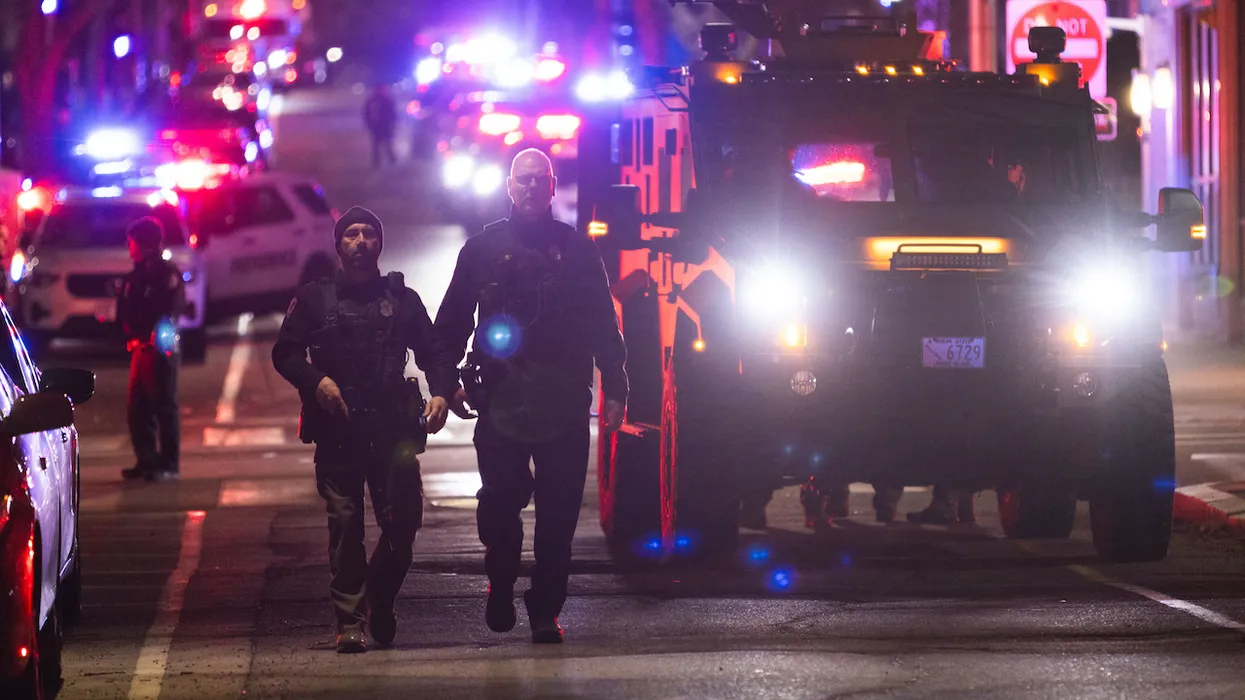
At least two are dead and others were wounded after a shooting Saturday at Brown University in Providence, Rhode Island, the New York Times reported.
An active shooter was reported just after 4:30 p.m. near the Barus and Holley engineering building on Hope Street, officials at the Ivy League college said, according to Fox News. Police were still searching for the shooter, who was described as a man dressed in black, the Times said.
‘It is imperative that all members of our community remain sheltered in place.’
Providence Mayor Brett Smiley told CNN that the doors of the engineering building where the shooting took place were unlocked since numerous final exams were being held there, according to the Times: “Based on what we heard from officials at Brown, anybody could have accessed the building at that time.”
Providence Fire Chief Derek Silva told the Times that two of the shooting victims were found dead at the scene.
Eight other shooting victims were being treated at Rhode Island Hospital, a spokeswoman told the Times, adding that six were in critical but stable condition, one was in critical condition, and another was in stable condition.
However, Smiley later announced that a ninth injured victim was identified, the Times said in a subsequent update, and that victim suffered non-life-threatening injuries from “fragments” related to the gunfire.
Smiley declined to provide any information about the victims, including whether they were Brown students, the Times said.
Brown University officials said just before 8:30 p.m. that the “campus continues to be in lockdown, and it is imperative that all members of our community remain sheltered in place,” the Times added.
Providence Deputy Police Chief Timothy O’Hara said police believe they are looking for a single gunman, the Times also said, adding that no weapon had been recovered and officials did not know what type of gun was used.
Rhode Island Gov. Dan McKee (D) said he spoke to FBI Director Kash Patel and that local, state, and federal officers were all searching for the gunman, the Times reported: “Everyone is working under the same goal right now — to keep everybody in that area safe and also to pursue” the attacker, McKee added to the paper.
This is a developing story; updates may be added.
Like Blaze News? Bypass the censors, sign up for our newsletters, and get stories like this direct to your inbox. Sign up here!
From Defending Rape to Excusing 9/11: 10 Statements That Define Mainstream Media Darling Hasan Piker
Hasan Piker, the popular online streamer, seems to be everywhere these days—at Zohran Mamdani’s election night party, palling around with Rep. Alexandria Ocasio-Cortez (D., N.Y.), sharing a stage with Republican-turned-Bulwark operative Tim Miller, and in splashy media profiles. Especially the media profiles.
The post From Defending Rape to Excusing 9/11: 10 Statements That Define Mainstream Media Darling Hasan Piker appeared first on .





