Category: Blaze Media
Take back your health care: A Christian model that puts families first

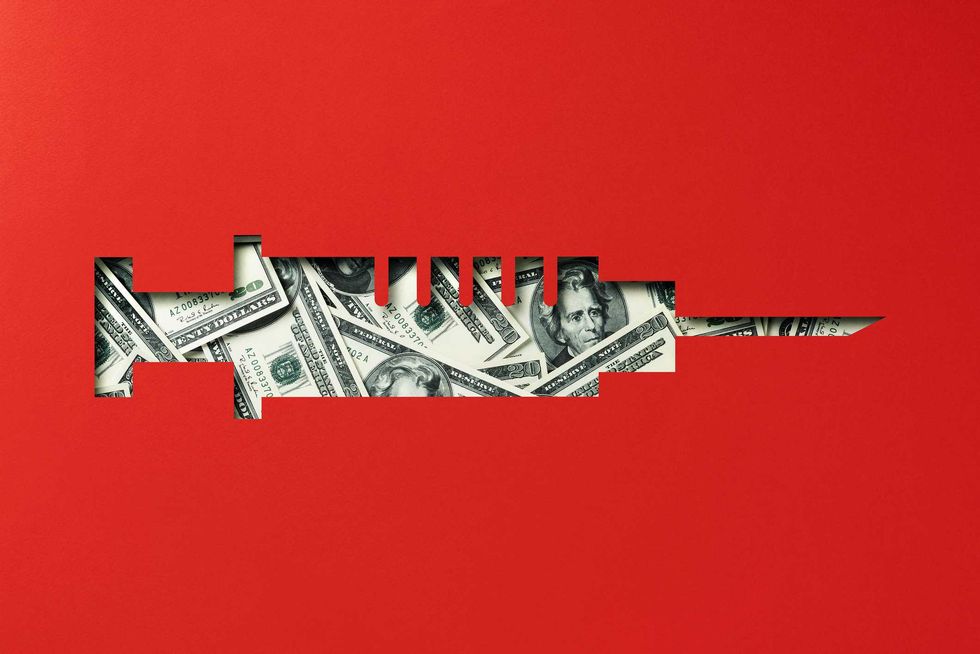
Presidio Healthcare recently made history by launching the nation’s first pro-life, Christian health insurance option in Texas at a time when many families are experiencing both historic rate increases and decreasing subsidies in the Obamacare marketplace.
While the heart of our mission focuses on serving families with an affordable option that protects both their values and their financial security, the vision for how we accomplish that aim rests on a lesser-known Christian principle that I believe provides a road map for reforming our broken health care system.
Health care policy should focus on expanding options for families while empowering them to own their own health insurance.
That principle is called “subsidiarity,” which represents a system of values that puts families first — in contrast to our current system that ignores the individualized needs of Americans.
The Christian principle of subsidiarity states “that matters ought to be handled by the smallest, lowest, or least centralized competent authority rather than by a higher and more distant one, whenever possible.”
The latest debate over Obamacare subsidies serves as a great example of how our current system prioritizes the higher and more distant authority (i.e., Washington, D.C.) over the least centralized authority (i.e., American families).
The Obamacare market was designed to provide subsidies for low-income Americans, which by itself does not inherently violate the principle of subsidiarity. Rather, the problem lies with the insistence that this one federally controlled market should serve as a one-size-fits-all solution for everyone, including middle-income Americans who do not qualify for adequate subsidies.
The centralized answer that Democrats offer requires the Obamacare market to be propped up inefficiently with more subsidies. The subsidiarity answer would propose decentralizing the market by allowing alternative risk pools regulated at the state level to serve the middle-income Americans with products designed for their needs.
To summarize the principle for a broader application: Health care policy should focus on expanding options for families while empowering them to own their own health insurance.
In a decentralized system, Americans would become smarter consumers of health care as they bear the responsibility of owning and paying for their own health care expenses. The impact would reach beyond the economic. The key benefit to subsidiarity is its preservation of each of our relationships to God through our individual decision-making responsibility.
If tomorrow’s health care shoppers were individuals and families (instead of governments and employers), private insurance markets would be forced to serve the Christian and pro-life values of families, as opposed to our current system of serving government agendas and large employer needs. Presidio is building toward that tomorrow and starting now in Texas.
RELATED: Medical ‘experts’ want to jab a needle through your God-given rights
 EKIN KIZILKAYA/iStock/Getty Images Plus
Unfortunately, there is a major roadblock to this future.
Ironically, the employer-sponsored marketplace and the single-payor Medicare program — two markets that conservatives often support — in many ways violate the principle of subsidiarity to a greater degree than the much smaller Obamacare individual market.
We need to be consistent if we want to reform our health care system. Employers control the health insurance decisions for close to 150 million Americans, and all of us are forced to pay into a federally centralized Medicare program that exhibits some of the worst elements of socialism, such as dictating prices that distort our entire system.
The spiritual impact is evident through the contraceptive mandate and employer decisions that force millions of Christians to be insured on products that cover abortion, abortifacients, contraception, and other immoral services. Through Medicare, we have collectively forfeited our health care autonomy to Washington, D.C., when we turn 65, creating problematic scenarios that could prioritize our federal budget over dignified treatment for end-of-life care.
We need to do more than just talk about Obamacare — and we need take action now.
The good news is that health care policymakers need to look no farther than to what the private market is already doing.
Presidio is part of a decades-long movement in the health care industry to launch innovative alternative services that serve families directly. This includes affordable non-Obamacare alternatives, health-sharing ministry plans, and, more recently, “ICHRA” benefit platforms that are moving employers out of the business of purchasing health insurance and into a defined contribution model where employees purchase and own their own insurance.
The road map is there. Government and employers can assist families in purchasing health insurance rather than purchasing it for them. Private market innovations would follow.
At Presidio, we are building toward a future where subsidiarity replaces centrally controlled markets and the pro-life values of Christian Americans drive pro-life health insurance options that help fund life-affirming care. We do not take federal subsidies, and we do not want your employer forcing you to have Presidio coverage.
As in all authentic Christian movements, we rely on individual families to help build Presidio, and we look forward to serving your needs while we expand our vision of a health care system in America founded on the principle of subsidiarity.
GOD-TIER AI? Why there’s no easy exit from the human condition
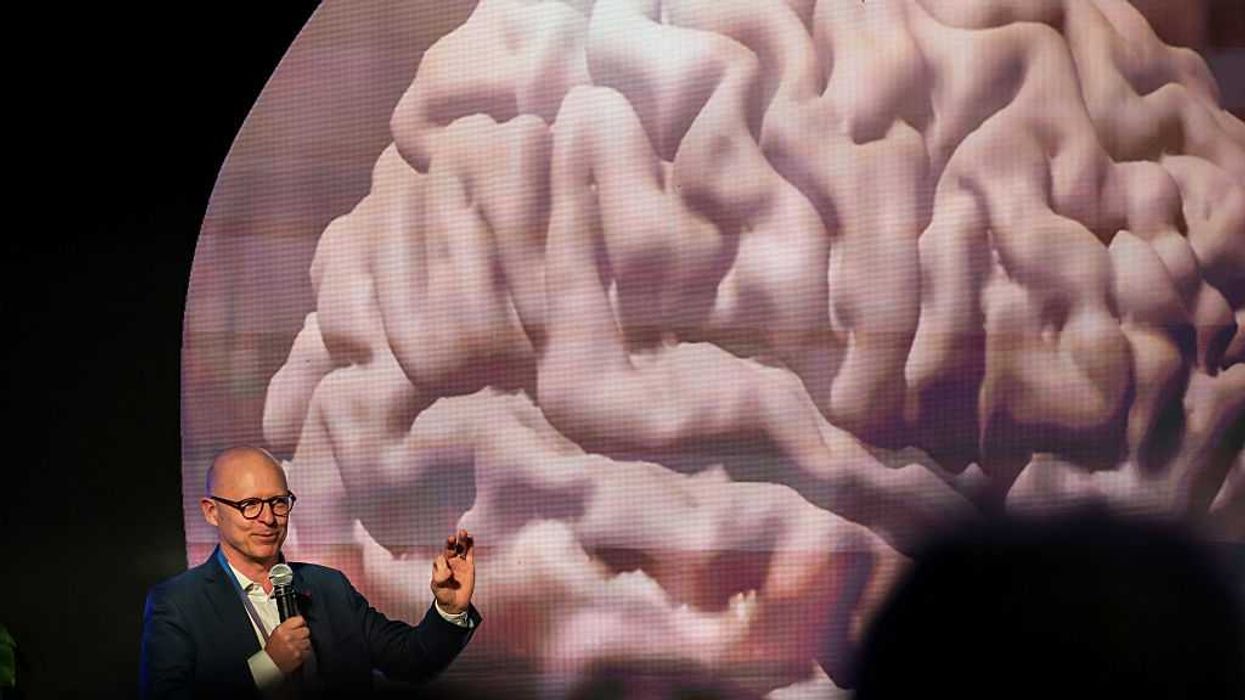
Many working in technology are entranced by a story of a god-tier shift that is soon to come. The story is the “fast takeoff” for AI, often involving an “intelligence explosion.” There will be a singular moment, a cliff-edge, when a machine mind, having achieved critical capacities for technical design, begins to implement an improved version of itself. In a short time, perhaps mere hours, it will soar past human control, becoming a nearly omnipotent force, a deus ex machina for which we are, at best, irrelevant scenery.
This is a clean narrative. It is dramatic. It has the terrifying, satisfying shape of an apocalypse.
It is also a pseudo-messianic myth resting on a mistaken understanding of what intelligence is, what technology is, and what the world is.
The world adapts. The apocalypse is deferred. The technology is integrated.
The fantasy of a runaway supermind achieving escape velocity collides with the stubborn, physical, and institutional realities of our lives. This narrative mistakes a scalar for a capacity, ignoring the fact that intelligence is not a context-free number but a situated process, deeply entangled with physical constraints.
The fixation on an instantaneous leap reveals a particular historical amnesia. We are told this new tool will be a singular event. The historical record suggests otherwise.
Major innovations, the ones that truly resculpted civilization, were never events. They were slow, messy, multi-decade diffusions. The printing press did not achieve the propagation of knowledge overnight; its revolutionary power was in the gradual enabling of the secure communication of information, which in turn allowed knowledge to compound. The steam engine unfolded over generations, its deepest impact trailing its invention by decades.
With each novel technology, we have seen a similar cycle of panic: a flare of moral alarm, a set of dire predictions, and then, inevitably, the slow, grinding work of normalization. The world adapts. The apocalypse is deferred. The technology is integrated. There is little reason to believe this time is different, however much the myth insists upon it.
The fantasy of a fast takeoff is conspicuously neat. It is a narrative free of friction, of thermodynamics, of the intractable mess of material existence. Reality, in contrast, has all of these things. A disembodied mind cannot simply will its own improved implementation into being.
 Photo by Arda Kucukkaya/Anadolu via Getty Images
Any improvement, recursive or otherwise, encounters physical limits. Computation is bounded by the speed of light. The required energy is already staggering. Improvements will require hardware that depends on factories, rare minerals, and global supply chains. These things cannot be summoned by code alone. Even when an AI can design a better chip, that design will need to be fabricated. The feedback loop between software insight and physical hardware is constrained by the banal, time-consuming realities of engineering, manufacturing, and logistics.
The intellectual constraints are just as rigid. The notion of an “intelligence explosion” assumes that all problems yield to better reasoning. This is an error. Many hard problems are computationally intractable and provably so. They cannot be solved by superior reasoning; they can only be approximated in ways subject to the limits of energy and time.
Ironically, we already have a system of recursive self-improvement. It is called civilization, employing the cooperative intelligence of humans. Its gains over the centuries have been steady and strikingly gradual, not explosive. Each new advance requires more, not less, effort. When the “low-hanging fruit” is harvested, diminishing returns set in. There is no evidence that AI, however capable, is exempt from this constraint.
Central to the concept of fast takeoff is the erroneous belief that intelligence is a singular, unified thing. Recent AI progress provides contrary evidence. We have not built a singular intelligence; we have built specific, potent tools. AlphaGo achieved superhuman performance in Go, a spectacular leap within its domain, yet its facility did not generalize to medical research. Large language models display great linguistic ability, but they also “hallucinate,” and pushing from one generation to the next requires not a sudden spark of insight, but an enormous effort of data and training.
The likely future is not a monolithic supermind but an AI service providing a network of specialized systems for language, vision, physics, and design. AI will remain a set of tools, managed and combined by human operators.
To frame AI development as a potential catastrophe that suddenly arrives swaps a complex, multi-decade social challenge for a simple, cinematic horror story. It allows us to indulge in the fantasy of an impending technological judgment, rather than engage with the difficult path of development. The real work will be gradual, involving the adaptation of institutions, the shifting of economies, and the management of tools. The god-machine is not coming. The world will remain, as ever, a complex, physical, and stubbornly human affair.
Country music’s MOST popular song is AI-generated

The number one country song in America isn’t sung by a human. Instead it was generated entirely by AI — which may have devastating implications for music, creativity, and the very definition of humanity.
The song “Walk My Walk” is by AI artist Breaking Rust and features lyrics like, “Every scar’s a story that I survived / I’ve been through hell, but I’m still alive.”
“They say slow down, boy, don’t go too fast / But I ain’t never been one to live in the past,” croons the AI artist.
“If you look at some of the lyrics of this song, I mean it talks about how he’s been dragged through the mud. He’s, you know, had to really stand. I mean, it doesn’t know any of this stuff. None of it is real. And yet it is assembling it in a way that is so appealing, it’s number one on the Billboard country music chart,” Blaze Media co-founder Glenn Beck says on “The Glenn Beck Program.”
“The whole world is about to change,” he continues. “You know, I just heard Elon Musk say that in five years, there’s not going to be phones or apps. It will just be some sort of a box or device that you kind of carry around with you and it’s listening. It’s anticipating. It’s AI.”
“And it will know what you want to hear, what you want, and it will create the music you want to hear. It will create the podcast you want to hear. It will do all this stuff for you. So we will be in our own universe even more than we are right now,” he adds.
This has led Glenn to ask some serious introspective questions like, “If AI can fake being a human and sing soulfully while not having a soul, what does it mean to be human?”
“I think a lot of people won’t care,” BlazeTV host Stu Burguiere chimes in. “Like, people won’t care if it is made by humans or not if they like it. And they seem to like it.”
While both Glenn and Stu agree AI will likely take over the arts, Glenn believes that “handmade is going to come back into style at some point.”
“Human-made will come back into style,” he says. “But … we’re going to go through a period where it’s going to get really scary.”
Want more from Glenn Beck?
To enjoy more of Glenn’s masterful storytelling, thought-provoking analysis, and uncanny ability to make sense of the chaos, subscribe to BlazeTV — the largest multi-platform network of voices who love America, defend the Constitution, and live the American dream.
The radical nonprofit that is destroying state education

For decades, U.S. education has been dominated by the American left. Its stranglehold was highly visible during the Biden administration, with countless stories about wildly inappropriate books in school libraries, critical race theory being taught in classrooms, and national associations calling for parents to be designated domestic terrorists.
How did our public school systems — including those in red states, from Iowa to Alaska — become infected with radical leftist ideology? The answer is education consulting groups.
As long as Republicans continue to outsource their governance and expertise to thinly veiled activist groups, nothing will change.
Most Americans don’t realize that every aspect of governance, from parks and wildlife departments to the curriculum in kids’ schools, has been outsourced to a coalition of nameless, faceless NGO consulting groups that are funded by millions of taxpayer dollars funneled through the government. One of the worst offenders is the American Institutes for Research.
AIR is currently under contract with at least 25 states, with the majority involving contracts to develop state standards. For those unfamiliar with education policy, standards determine what students need to learn and when they need to learn it. Lesson plans, curriculum, and textbooks are required by law to be aligned with standards.
AIR’s tentacles stretch from D.C. into health care and counseling policy — and education. It has long been entrenched in most red-state education departments to “facilitate” standards revisions. Take its influence in Alaska as a recent example.
Alaska has had multiple contracts with the nonprofit, including the School Climate and Connectedness Survey, which focuses on social-emotional learning and adult education content standards. AIR is also cited as a teaching resource for curriculum implementation.
On the Alaska Department of Education’s social studies website, AIR is listed as a source multiple times, including in the HQIM Rubric and in a PowerPoint presentation that was given to the state board, which was co-presented with an AIR employee. The presenters insisted that standards must have an equity focus and touted a shift from learning about social studies to student activism, or “action civics.”
These standards were implemented in Alaska’s new social studies curriculum, and the results are predictably a mess. Developed by a panel selected by race rather than merit, the standards are chock-full of land acknowledgments and other progressive claptrap. Alaska is now training its kids to be activists rather than teaching them about the American founding.
Worse yet, Alaska is also a partner with AIR for its Indigenous Student Identification Project, headed by Nara Nayar. On her LinkedIn account, she proudly lists her work “on comprehensive sexuality education for elementary and middle school students.”
This is where Alaskan taxpayer dollars are going: equity education, activism training, and filling the pockets of far-left education consultants who teach sex ed to elementary students.
Turning to the Midwest, Iowa’s social studies overhaul is in consultation with Stefanie Wager, a former AIR employee who is a glorified activist. She lists “racial justice, equity, and inclusion” as top priorities. Wager has an extensive list of extremist views that influence her work as an education consultant.
Wager was once president of the National Association for the Social Studies, a left-wing outfit that has shaped red-state history instruction. She has also worked as the education partner manager for Bill Gates’ personal office. Wager began as an AIR employee embedded within the Iowa Department of Education. When news broke about her involvement, she left AIR and joined the Iowa Department of Education full-time.
These aren’t just one-off examples — they are emblematic of the reach and influence of shadow consultant organizations that control public education. Peruse nearly any state department of education, and you will find rubrics with equity focuses, social studies curriculum full of progressive ideology, and AIR-linked content on state websites. Nebraska, for example, contracted AIR for a social studies report that is spotlighted on AIR’s website.
RELATED: Trump admin takes major step toward dismantling the Department of Education
 Aaron Schwartz/Bloomberg via Getty Images
The worst part is that state taxpayers are unknowingly funding all of this. South Dakota signed a nearly quarter-million-dollar contract with AIR to facilitate work-group meetings to revise the state’s social studies standards, which produced standards laced with wokeness. The blowback was so swift that then-Gov. Kristi Noem (R) had to intervene and force South Dakota’s Education Department to restart its standards revision work from scratch.
The result was some of the best standards in the country.
Alaska has likely paid millions for its various studies and surveys, but the cost of only one project, at $350,000, is publicly available. Iowa awarded AIR a $31 million contract for testing assessments. This is a patronage scheme using taxpayer dollars to fund pet leftist programs. To make matters worse, most red states keep all of this hidden. In Alaska, you have to pay the state for a contract to be disclosed.
As long as Republicans continue to outsource their governance and expertise to thinly veiled activist groups, nothing will change. Schools will continue to be breeding grounds for left-wing extremism, school libraries will be filled with radical propaganda — and taxpayers will keep funding all of it.
Red-state legislatures and governors need to look to trusted alternative providers that reflect their states’ values. They should create and fund parallel structures that put outcomes above partisan dogma and properly vet each person to whom they give their constituents’ money. This is the only way to begin countering the efforts of the shadow government in our states.
Editor’s note: A version of this article appeared originally at the American Mind.
Exposing the dark truth: Communism, Satan, and government power
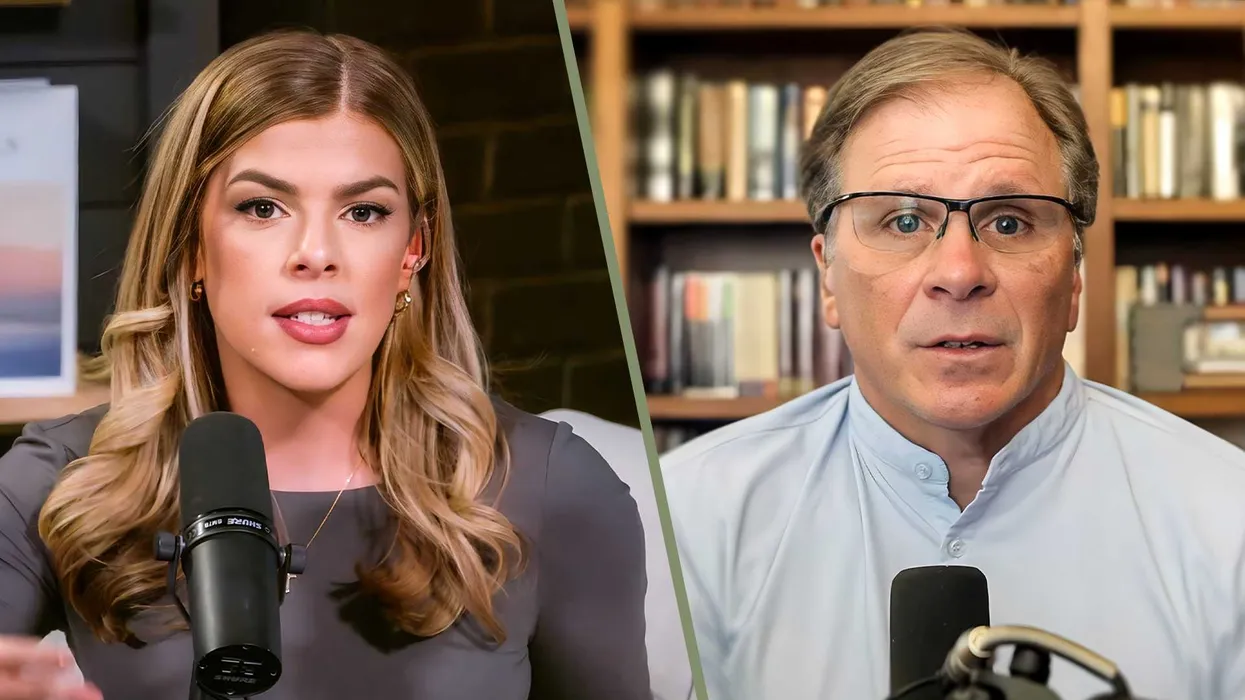
The government has one biblical purpose: to protect the innocent and punish evil. But America’s leaders have abandoned this duty, as many have done in the past.
And Dr. Frank Turek points out to BlazeTV host Allie Beth Stuckey that instead of protecting the people from evil, corrupt governments often wield evil.
“It’s interesting, Allie. Our mutual friend James Lindsay is an agnostic atheist, and about a year before Charlie died, he texted Charlie and he said, ‘Charlie, I’m starting to believe in Satan,’” Turek tells Stuckey.
Turek recalled Lindsay explaining that this happened when he dove into the history of communism.
“And so Charlie texted him back, ‘If Satan, then God,’ and James texted back, ‘That would follow,’” he says.
“In other words, it’s the point that if there’s evil, there has to be good because evil is not a thing in itself. It’s a lack in a good thing. It’s like cancer,” he continues.
And in order to prevent evil from rapidly spreading and hurting them, people trust the government to help stop it.
“We need a force to protect innocent people from evil and to punish wrongdoers,” he says. “And when governments cease to do that, they cease to become legitimate governments.”
Want more from Allie Beth Stuckey?
To enjoy more of Allie’s upbeat and in-depth coverage of culture, news, and theology from a Christian, conservative perspective, subscribe to BlazeTV — the largest multi-platform network of voices who love America, defend the Constitution, and live the American dream.
Justice Alito delivers win to Texas GOP, temporarily restores Republican congressional map

U.S. Supreme Court Justice Samuel Alito delivered Texas Republicans some good news on Friday, temporarily reinstating the Republican-friendly congressional map they passed in August.
After Texas Republicans surmounted weeks of obstruction by their Democratic colleagues, Texas Gov. Greg Abbott ultimately signed the “One Big Beautiful Map into law” on Aug. 29, leaving the Lone Star Sate with a congressional map that could net the GOP five extra seats in the midterm elections.
‘Radical left-wing activists are abusing the judicial system to derail the Republican agenda and steal the U.S. House.’
However, the adoption of the new map prompted hand-wringing among liberals and a successful Democratic gerrymandering campaign in California — as well as a legal challenge from several race-based groups of plaintiffs led by the League of United Latin American Citizens.
The plaintiffs alleged in their complaint that the map was the result of unconstitutional racial gerrymandering and asked a three-judge panel of the U.S. District Court for the Southern District of Texas to block use of the map for the 2026 elections.
The court on Tuesday ruled 2-1 in favor of the liberal advocacy groups, finding that the challengers likely would be able to prove that it was racially gerrymandered.
RELATED: Yet another state’s districts found to be racist, resulting in new map for 2026 midterms
 Photo by Brandon Bell/Getty Images
“The public perception of this case is that it’s about politics,” wrote Judge Jeffrey Brown in the ruling. “To be sure, politics played a role in drawing the 2025 Map. But it was much more than just politics. Substantial evidence shows that Texas racially gerrymandered the 2025 Map.”
California Gov. Gavin Newsom (D) was among the liberals who celebrated the ruling, noting that “Donald Trump and Greg Abbott played with fire, got burned — and democracy won. This ruling is a win for Texas, and for every American who fights for free and fair elections.”
But the celebration proved premature as Abbott and other Texas officials promptly appealed the decision to the Supreme Court.
Texas Attorney General Ken Paxton said in a statement, “Radical left-wing activists are abusing the judicial system to derail the Republican agenda and steal the U.S. House for Democrats. I am fighting to stop this blatant attempt to upend our political system.”
Justice Alito stayed the lower court’s ruling Friday and gave GOP map opponents until Monday to respond to his order.
The Republican map is back in play pending the outcome of the state’s appeal before the high court.
Like Blaze News? Bypass the censors, sign up for our newsletters, and get stories like this direct to your inbox. Sign up here!
Islamist groups in Texas rake in $13M in taxpayer-funded grants amid Abbott’s battle against Sharia law
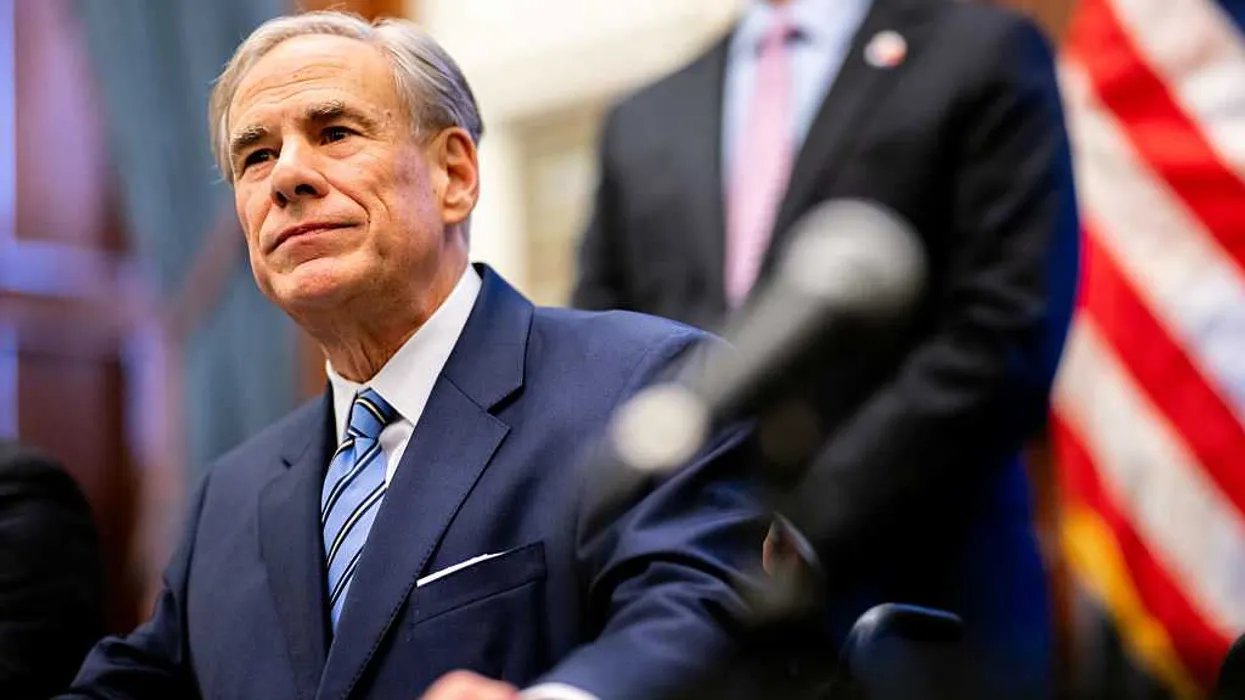
Texas Gov. Greg Abbott (R) has taken aggressive action this week against Sharia law, the Muslim Brotherhood, and the Council on American-Islamic Relations. Yet critics are demanding to know why, during his time in office, millions in taxpayer-funded grants have been allocated to alleged Islamist organizations based in Texas.
Abbott announced on Tuesday that he had designated the Muslim Brotherhood and CAIR as foreign terrorist and transnational criminal organizations. The following day, Abbott urged local district attorneys to investigate potential Sharia “courts” operating in Texas and defying state and federal laws to push Islamic codes.
‘Unlike the previous administration, recipients of grants will no longer be permitted to use federal funds to … empower radical organizations with unseemly ties that don’t serve the interest of the American people.’
Despite Abbott’s recent actions, some have faulted the governor for allowing taxpayer dollars to be used to fund the uptick in Islamic mosques in Texas, citing a June report from the Middle East Forum. The article claimed Texas gave “over $13 million of federal and state monies to mosques and community groups aligned with Islamist movements such as Hamas, the Muslim Brotherhood, and Jamaat-e-Islami, as well as hostile foreign regimes.”
Of the 18 organizations that received funds, a dozen were said to have “extremist links.”
“While a few thousand dollars in the state government’s data consists of the return of escheated funds, the vast majority of the millions spent appear to be the result of direct state grants, subsidy programs, and federal sub-awards managed by the Texas state government,” the Middle East Forum wrote.
The Texas governor’s office told Blaze News that the funding referenced in the Middle East Forum’s report was not state tax dollars but rather federal funds distributed by the Department of Homeland Security and the Federal Emergency Management Agency’s Nonprofit Security Grant Program.
As part of that program, since 2016, roughly $63 million in federal funds have passed through Texas to nonprofit organizations, including $55 million to churches and synagogues, and a smaller portion went to mosques, according to Abbott’s office.
RELATED: Secret Sharia ‘courts’ in Texas may be quietly overriding state law — Abbott calls for investigation
 Photo by RONALDO SCHEMIDT/AFP via Getty Images
The governor’s office contended that organization-vetting for this DHS and FEMA grant program is performed by these federal agencies, not by the state.
Sam Westrop, the director of Islamist Watch and the author of the Middle East Forum report, disputed this claim, arguing that the state was responsible for screening these grant applications and had the authority to exclude applicants.
Westrop told Blaze News that “only a small number” of the $13 million came from the DHS’ Nonprofit Security Grant Program.
“However, many of the grants we identified, while not all from DHS, were in fact paid for from federal funds; and are thus subawards,” Westrop stated. “But by serving as the primary grantee, the Texas state government is required by the federal government to vet and assess risk. Subawards are discretionary, and the primary grantee may exclude a subawardee.”
“So these grants may be financed by federal dollars, but the monies are distributed through and at the discretion of the Texas state government, much by the governor’s office itself,” Westrop added.
The Nonprofit Security Grant Program seeks to provide financial support to nonprofit organizations that are considered “high risk” of a terrorist attack. These nonprofits can include places of worship, educational facilities, and medical facilities, among other 501(c)(3) organizations. The funds are intended to support security enhancements, such as installing cameras, alarms, and fences. The grant can also be used toward security planning and training, as well as cybersecurity.
RELATED: No Sharia law in Texas: Abbott draws a hard line against radical Islam
 Photo by Ilana Panich-Linsman for The Washington Post via Getty Images
According to FEMA, the State Administrative Agency in each state is “the only eligible applicant” for this grant and “responsible for handling the federal award.” Therefore, churches and other places of worship seeking funds through the Nonprofit Security Grant Program are “subapplicants that must apply through the SAA in the state or territory where the applying facility is physically located.” The nonprofits cannot apply directly to FEMA.
The applications are first “scored by the SAA in coordination with its state.” Then the SAA submits “a prioritized list of [investment justifications] with all scores to FEMA.”
FEMA notes that a facility’s local SAA may have its own requirements to apply for the grant. Texas’ SAA contact is the Homeland Security Grants Division under the Texas Office of the Governor.
These now-archived grant opportunities from Texas’ eGrants website state that the “Office of the Governor will screen all applications to ensure that they meet the requirements included in the funding announcement.” However, it notes that FEMA “makes final funding decisions.”
While it remains disputed whether Texas could have blocked these grants from going to alleged Islamist organizations, FEMA has made it clear that the DHS, under Secretary Kristi Noem, has significantly increased the vetting at the federal level.
“Under Secretary Noem’s leadership, FEMA conducted a critical evaluation of all grant programs and recipients to root out waste, fraud, and abuse and deliver accountability for the American taxpayer,” a FEMA spokesperson told Blaze News. “For Fiscal Year 2025 grant awards, DHS and FEMA worked together to vet grant recipients and ensure that every dollar spent strengthens the nation’s resilience.”
“Unlike the previous administration, recipients of grants will no longer be permitted to use federal funds to house illegal immigrants at luxury hotels, fund climate change pet projects, or empower radical organizations with unseemly ties that don’t serve the interest of the American people,” the spokesperson added.
Like Blaze News? Bypass the censors, sign up for our newsletters, and get stories like this direct to your inbox. Sign up here!
Marjorie Taylor Greene calls it quits after ‘traitor’ branding by Trump
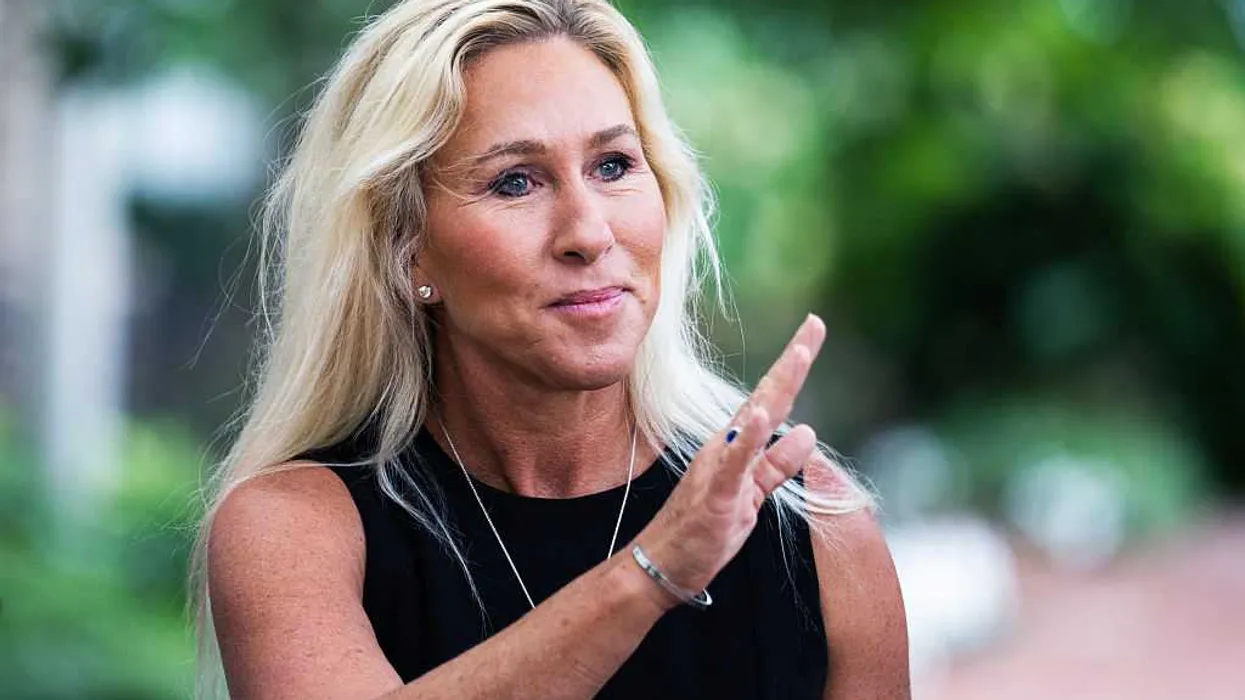
Georgia U.S. Rep. Marjorie Taylor Greene (R) announced her resignation Friday night, citing a desire to spare her family from further danger and her district from a “hurtful and hateful” Republican primary.
While her current term does not end until Jan. 3, 2027, Greene indicated she will instead leave office on Jan. 5, 2026.
In both her video and written statements, Greene highlighted her historic support for President Donald Trump, her conservative voting record — the New Americans’ Freedom Index gives her a lifetime rating of 97% and the Conservative Review’s Liberty Score gave her a 100% rating — and her subjection over the years to constant “personal attacks, death threats, lawfare, ridiculous slander, and lies.”
‘All I see ‘Wacky’ Marjorie do is COMPLAIN, COMPLAIN, COMPLAIN!’
“When the common American people finally realize and understand that the Political Industrial Complex of both parties is ripping this country apart, that not one elected leader like me is able to stop Washington’s machine from gradually destroying our country, and instead the reality is that they, common Americans, The People possess the real power over Washington,” wrote Greene, “then I’ll be here by their side to rebuild it.”
Her resignation announcement comes just days after Greene suggested that the latest series of threats against her life were due to her recent loss of favor with Trump.
The president noted in a lengthy Nov. 14 post on Truth Social that he was withdrawing his support for the “ranting lunatic” Georgia congresswoman and would give “unyielding” support to whomever opposes her in next year’s primary.
“All I see ‘Wacky’ Marjorie do is COMPLAIN, COMPLAIN, COMPLAIN! It seemed to all begin when I sent her a Poll stating that she should not run for Senator, or Governor, she was at 12% and didn’t have a chance (unless, of course, she had my Endorsement — which she wasn’t about to get!),” wrote Trump.
RELATED: Marjorie Taylor Greene says she has received violent threats — and blames Trump
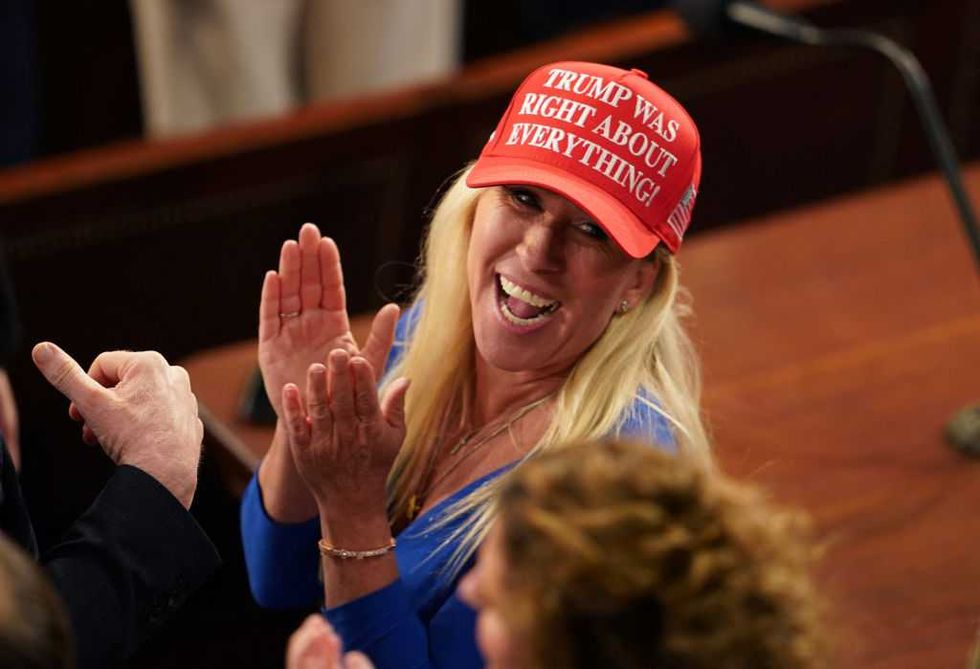 Photo by ALLISON ROBBERT/AFP via Getty Images
When asked days later about the threats against Greene — the Rome Police Department confirmed in an emailed statement to Blaze News that they received reports about them — Trump told reporters, “Marjorie ‘Traitor’ Greene. I don’t think her life is in danger. … Frankly, I don’t think anybody cares about her.”
Greene subsequently noted, “President Trump’s unwarranted and vicious attacks against me were a dog whistle to dangerous radicals that could lead to serious attacks on me and my family.”
Since taking office in 2021, Greene has been the victim of numerous swatting attacks — attacks that various lawmakers have suggested are tantamount to attempted murder and domestic terrorism.
The congresswoman alleged that whereas the swatting attacks and death threats she had previously experienced came from the left, she said Trump labeling her a “traitor” made her a target for attacks by individuals on the right.
‘Many common Americans have been cast aside and replaced as well.’
“… President Trump has called me a traitor, which is absolutely untrue and horrific,” wrote Greene, adding that “this puts blood in the water and creates a feeding frenzy. And it could ultimately lead to a harmful or even deadly outcome.”
The response to the news that Greene is leaving office has been mixed.
Trump — whom Greene criticized in recent months for his June airstrikes on Iran and his Justice Department’s handling of the Epstein files — told ABC News’ Rachel Scott, “I think it’s great news for the country. It’s great.”
Trump commented further Saturday morning — calling her “Marjorie ‘Traitor’ Brown” — and saying Greene “has decided to call it ‘quits'” due to “PLUMMETING Poll Numbers, and not wanting to face a Primary Challenger with a strong Trump Endorsement (where she would have no chance of winning!) …”
After Trump also dinged Kentucky Republicans U.S. Sen. Rand Paul and U.S. Rep. Thomas Massie — and suggested Greene “went BAD” because he didn’t return her phone calls — the president thanked the Georgia congresswoman for her service.
Laura Loomer — who has advocated for the ouster of various elements of Trump’s 2024 coalition in recent months — tweeted that “Traitor Greene is a terrible person. I get a lot of joy in watching my enemies fall.”
Shawn Harris, a Democrat hoping to flip Greene’s seat in the midterm election, also welcomed the news, writing, “Get ready Georgia! Teachers, farmers, veterans, EVERYONE, I need your support.”
But some politicos expressed displeasure with Greene’s resignation announcement.
Former Cobb County GOP Chairwoman Salleigh Grubbs said she was “heartbroken,” noting that Greene “put it all on the line time after time. She fought for her district and put America First. What more could anyone have wanted? A sad day in America.”
Indiana Rep. Victoria Spartz (R) said “there’s a lot of truth to what Marjorie had to say” and added that she can’t “blame her for leaving this institution that has betrayed the American people.”
Cenk Uygur, the far-left CEO of the Young Turks, wrote the following to Greene: “I would have never imagined saying this, but … don’t go. Stay and fight. Even though we still disagree on so many things, you were one of the very few honest people in Congress. Stay and fight!”
But Greene noted in her Friday statement, “I refuse to be a ‘battered wife’ hoping it all goes away and gets better. If I am cast aside by MAGA Inc and replaced by Neocons, Big Pharma, Big Tech, Military Industrial War Complex, foreign leaders, and the elite donor class that can’t even relate to real Americans, then many common Americans have been cast aside and replaced as well.”
The disenchanted Republican added, “There is no ‘plan to save the world’ or insane 4D chess game being played.”
Like Blaze News? Bypass the censors, sign up for our newsletters, and get stories like this direct to your inbox. Sign up here!
Is a tariff a tax?
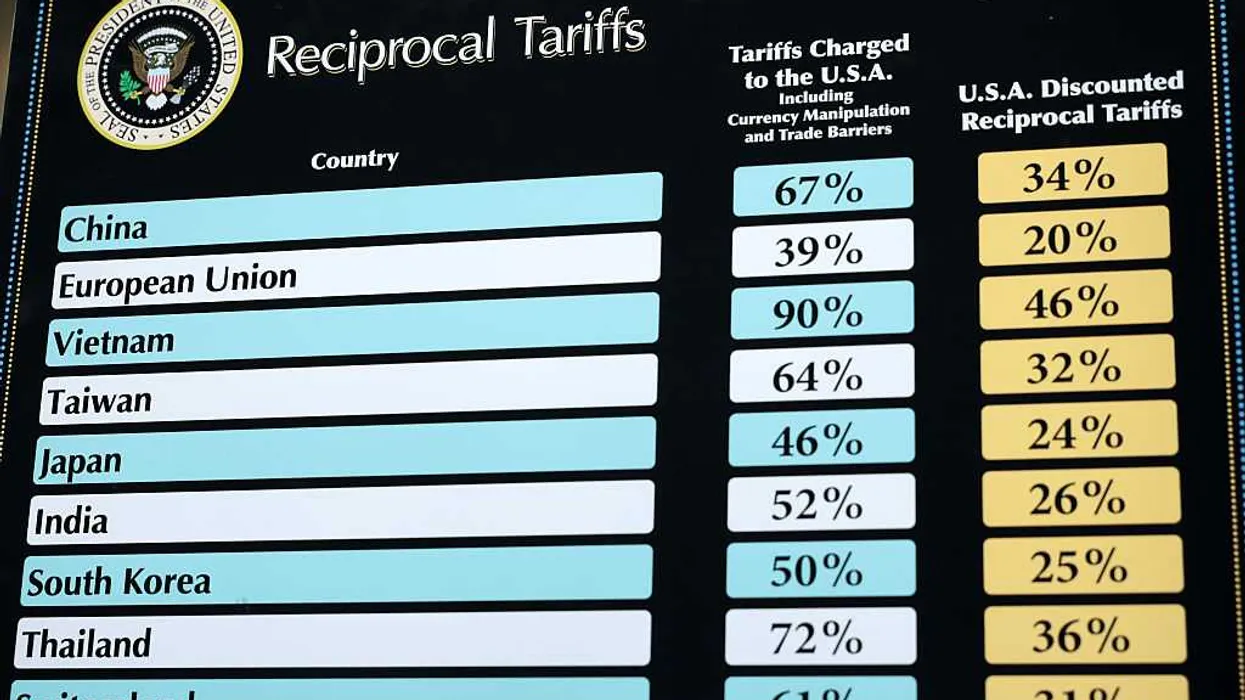
Is a tariff a tax? Many Americans have forgotten that this question, which has been in the news more or less all year, was fundamental to the American Revolution. And among American Patriots, or Whigs, meaning those who supported the colonists’ claims against Parliament, there was almost universal consensus that they were different things, constitutionally speaking.
Throughout the Imperial Crisis of 1763 to 1776, the consensus among the colonists was that Parliament had the right to regulate trade in the British Empire but had no right to tax the colonists. And they recognized that a regulation of trade might take the form of a duty imposed upon, for example, molasses imported from French colonies to favor molasses imported from British colonies.
The founding generation believed in the separation of powers.
In the colonists’ view, the Sugar Act of 1764 was an unconstitutional innovation. The Act was quite explicit, stating at the top that it was passed for the purpose of “applying the produce of such duties, and of the duties to arise by virtue of the said act, towards defraying the expences of defending, protecting, and securing the said colonies and plantations.” It was the first trade act to do that.
Townshend’s overreach
The Stamp Act of 1765, and the reaction to it, made the protest against the 1764 Sugar Act less conspicuous. The result of the actions taken against the Stamp Act was that many in Parliament did not grasp the American argument against the Sugar Act. Hence, Parliament passed the Townshend Acts in 1767, imposing duties on lead, glass, paper, paint, and tea to raise revenue. When the colonists complained, many in Parliament accused the colonists of moving the goalposts.
The charge was not accurate, but it did reflect what they believed. And, like many today, many members of Parliament were unable to grasp the difference between a duty imposed for the purpose of trade regulation and a duty imposed for the purpose of raising revenue.
The most famous criticism of the Townshend Acts, and the most popular writing of the era until Thomas Paine published “Common Sense” in January 1776, was John Dickinson’s “Letters from a Farmer in Pennsylvania.” In the second letter, Dickinson made the consensus Patriot argument logically, clearly, and eloquently.
There is another late act of parliament, which appears to me to be unconstitutional, and as destructive to the liberty of these colonies, as that mentioned in my last letter; that is, the act for granting the duties on paper, glass, etc.
The parliament unquestionably possesses a legal authority to regulate the trade of Great Britain, and all her colonies. Such an authority is essential to the relation between a mother country and her colonies; and necessary for the common good of all …
I have looked over every statute relating to these colonies, from their first settlement to this time; and I find every one of them founded on this principle, till the Stamp Act administration.* All before, are calculated to regulate trade, and preserve or promote a mutually beneficial intercourse between the several constituent parts of the empire. … The raising of a revenue thereby was never intended. … Never did the British parliament, till the period above mentioned, think of imposing duties in America for the purpose of raising a revenue. …
Here we may observe an authority expressly claimed and exerted to impose duties on these colonies; not for the regulation of trade; not for the preservation or promotion of a mutually beneficial intercourse between the several constituent parts of the empire, heretofore the sole objects of parliamentary institutions; but for the single purpose of levying money upon us.
This I call an innovation; and a most dangerous innovation.* It may perhaps be objected, that Great Britain has a right to lay what duties she pleases upon her exports.
That so many people today don’t seem to understand this distinction is a sign that the American bar seems to have gone Tory. The founding generation’s way of thinking about tariffs, and perhaps law in general, is in danger of being rendered foreign to our public policy discussion, perhaps even to constitutional discussion, even among people who mistakenly think of themselves as originalists.
This way of thinking, of course, says little about the current case, as the purpose of the law itself must be understood in light of the thinking of the men who passed it. But it is also true that the way of thinking that Dickinson represented, and which was broadly shared in the founding generation, might have something to say here.
Delegation’s limits
The founding generation believed in the separation of powers. The founders recognized, as “The Federalist” notes, that in practice the powers will inevitably overlap and sometimes clash. But they did operate within a way of legal and constitutional thinking that took it as a given that in order to guard the separation of powers, any delegation of legislative powers to the executive had to be limited and focused.
There is a difference between a reasonable and an unreasonable delegation of powers, just as there is between a tax and a regulation of trade, even if, in both cases, money is raised at customs houses. The kind of delegation the Trump administration is asserting in this case is difficult, perhaps impossible, to reconcile with the practice of separation of powers. Congress has no right to abdicate its obligation to set trade policy via legislation.
RELATED: Read it and weep: Tariffs work, and the numbers prove it
 Photo by Spencer Platt/Getty Images
The Trump administration’s assertion that it has the right to set tariffs worldwide, claiming unlimited emergency power based on a law designed to delegate to the president a narrow emergency power, resembles the kind of expansive, arbitrary interpretation that the founders’ legal heroes fought.
In the 1630s, King Charles claimed the right to collect “ship money” throughout England. By tradition, the king had the right to raise money, without Parliament’s consent, in port towns in time of war, or if war was imminent.
King Charles asserted a living constitution interpretation: Given modern circumstances, he claimed a general right to raise taxes if a war emergency was imminent. Dickinson mentioned the case in the first Farmer’s Letters, suggesting there was a connection between the logic of the one argument and the other.
Our difficulty recognizing the limits of the nondelegation doctrine — and our confusion about the difference between a duty imposed to raise revenue and one imposed to regulate trade — shows how much work remains if we want to understand the Constitution as the framers did. That understanding requires grappling with the ideas about human nature, government, and law that justified ratification in the first place and that still anchor our constitutional order.
Editor’s note: This article was originally published by RealClearPolitics and made available via RealClearWire.
Video: Female bully towers over and beats up elderly woman on Florida bus. Victim is left ‘battered and bruised’: Sheriff.

Law enforcement in Florida is looking for a female seen on video inside a bus beating up an elderly passenger last month.
A 70-year-old woman on Oct. 21 took a seat in the disabled section of a transit bus, the Broward County Sheriff’s office said, adding that “her ride would end with her battered and bruised after being attacked by a fellow bus rider.”
‘This is repulsive. This is something that should never happen; it should not happen in any type of civilized society. What this woman did is absolutely unacceptable.’
Detectives said the attacker, who was standing, bumped into the victim several times due to the movement of the bus, officials said.
The victim asked the attacker to give her some space, officials said, after which a verbal argument ensued.
With that, officials said the attacker “intentionally and forcefully pushed her body into the victim several times. The attacker then grabbed a grocery bag and struck her in the face with it.”
At one point during the assault, video appears to show the feisty elderly woman issuing a middle finger to her attacker.
The sheriff’s office said the victim used her cane to defend herself, and the attacker punched the victim multiple times in the head.
Officials said several bystanders on the bus came to the victim’s defense and separated her from the attacker.
The bus driver saw the incident and stopped the bus in the 4100 block of West Oakland Park Boulevard in Lauderdale Lakes, officials said, and that’s where the attacker and a woman with her fled.
The victim suffered bruising on her forehead but declined to be transported to the hospital, officials said.
“Fortunately the victim did not suffer any major injuries. She was treated on scene,” sheriff spokesperson Carey Codd told WFOR-TV.
Codd added, “This is repulsive. This is something that should never happen; it should not happen in any type of civilized society. What this woman did is absolutely unacceptable.”
Broward Sheriff’s Office Violent Crimes Unit detectives released video of the attack in hopes of identifying the woman who pestered the elderly woman before punching her repeatedly. You can view the sheriff’s office video here.
Those with information on the identity of the attacker or the woman with her are asked to contact BSO Violent Crimes Unit Detective Andres Lopez at 954-321-4915 or submit a tip through the SafeWatch app, officials said.
Those wishing to remain anonymous and be eligible for a cash reward can contact Broward Crime Stoppers at 954-493-TIPS (8477), submit a tip online at browardcrimestoppers.org, or dial **TIPS (8477) from any cell phone in the United States. If your tip leads to an arrest in this case, you are eligible for a reward of up to $5,000, officials said.
Like Blaze News? Bypass the censors, sign up for our newsletters, and get stories like this direct to your inbox. Sign up here!