

Category: Blaze Media
Tim Walz may be done — but impeachment is just the beginning

Four articles of impeachment have been filed against Minnesota Democrat Governor Tim Walz, and BlazeTV host Sara Gonzales believe not only that it has been a long time coming, but that far more needs to be done to rectify his actions.
“A person whose name is always synonymous with Somali fraud, it seems — sorry, I guess legally I have to say, like, ‘allegedly,’ seems like things are coming back to bite him,” Gonzales says on “Sara Gonzales Unfiltered.” “Of course, I’m talking about Minnesota Governor Tim Walz.”
“Now, I would say, if the left wants to constantly impeach Donald Trump over nothing, we should probably impeach all of them over the things that they did that are actually crimes,” she continues.
The four articles that have been filed against Tim Walz include Article I: Violation of Oath of Office through Concealment of Fraud; Article II: Interference with Oversight and Investigations; Article III: Prioritizing Political Considerations Over Lawful Administration; and Article IV: Failure to Steward Public Funds.
“The only way in which he gets away with this is that it’s Democrat-run in Minnesota and the Democrats just won’t ever do this to one of their own. That’s the only way, because all the receipts we’ve gone over ad nauseum, like, the receipts are there that he did all of these things,” Gonzales says.
Walz has also dropped out of the next gubernatorial race, which he claimed he was doing to get to the bottom of the fraud.
“Tim Walz is like, ‘I’m dropping out to help get to the bottom of’ why he was such a facilitator to fraud, I guess,” Gonzales mocks, before playing a clip of Walz making the excuse.
“Every minute that I spend defending my own political interest would be a minute I can’t spend defending the people of Minnesota against the criminals who prey on our generosity and the cynics who want to prey on our differences,” Walz announced.
“So I’ve decided to step out of this race, and I’ll let others worry about the election while I focus on the work that’s in front of me for the next year,” he added.
“Oh, okay. It’s all the other people who are the problem,” Gonzales says.
“Now, obviously, I think Tim Walz should be impeached. I actually like President Trump’s idea better, which is that he just needs to be hauled away in handcuffs, which is what he posted on Truth Social,” she laughs.
“That is my president,” she adds.
Want more from Sara Gonzales?
To enjoy more of Sara’s no-holds-barred takes on news and culture, subscribe to BlazeTV — the largest multi-platform network of voices who love America, defend the Constitution, and live the American dream.
Florida Panthers praise Trump during White House visit: ‘Nothing beats this’
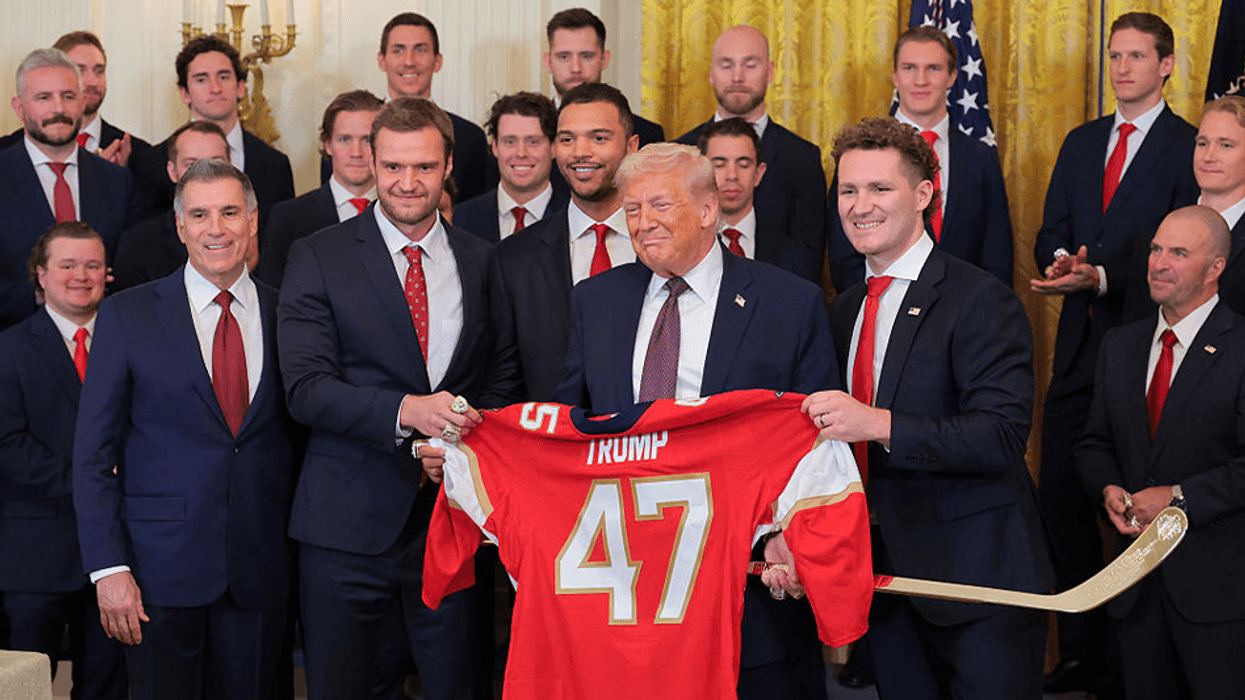
The Stanley Cup champions were not shy about showing their support for President Trump.
The Florida Panthers visited the White House to celebrate their second-straight league championship over the Edmonton Oilers.
‘I’m so proud to be an American, and I’m so proud to be here with you.’
Trump praised the team on Thursday, shaking hands and listing accomplishments as he remarked that many of the players and staff would be participating in the 2026 Winter Olympics in Italy, many of them representing the United States.
Before accepting gifts from the players, the president introduced team owner and billionaire Vincent Viola, who made the Panthers’ support for the administration indisputable.
“I’m going to make it pretty clear that we are honored to be here, we are honored to be here with you as the president,” Viola said, keeping his words short.
Then star player Matthew Tkachuk took the podium to relish being an American at the White House.
“I want to say on behalf of the whole organization, mainly the players, we are so honored to be here. Being an American … nothing beats this, I’m so proud to be an American, and I’m so proud to be here with you,” Tkachuk said, motioning to Trump.
RELATED: Video: Golfer attacks NHL fighter, learns valuable lesson: ‘You’re not a tough guy!’
Tkachuk noted the pain and effort that is required to win a Stanley Cup, stating, “Winning, it takes a toll, you pay a price for it.”
The 28-year-old certainly relished the moment and said he looked forward to wearing the red, white, and blue at the Winter Olympics.
“Representing you and the millions back here, next month at the Olympics, will be one of the highlights of my life as well,” he told the president.
Defenseman Seth Jones then presented President Trump with a Stanley Cup ring, captain Aleksander “Sasha” Barkov gave the president a No. 47 jersey, and Tkachuk presented Trump with a golden hockey stick.
As the team dispersed, an orchestral version of “We Are the Champions” by Queen played as Trump walked off the stage.
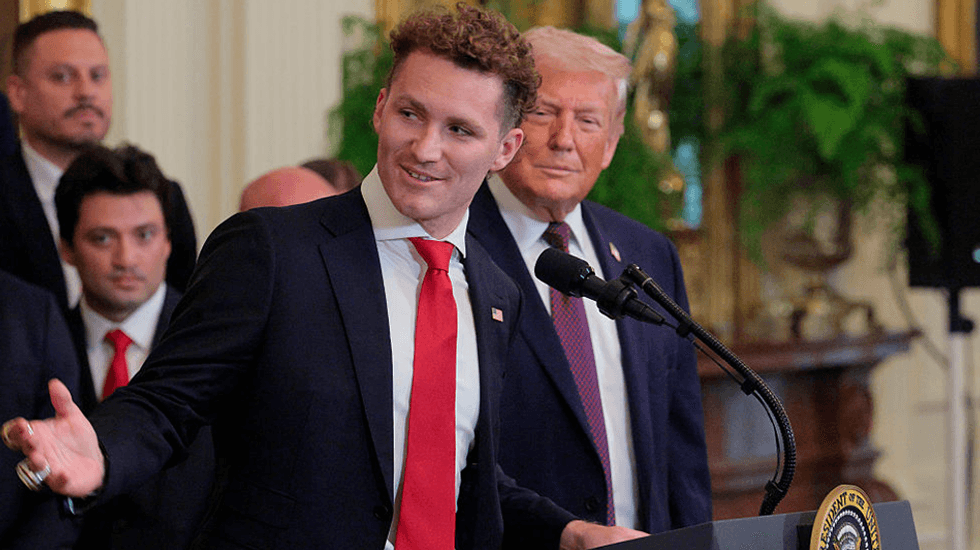 Photo by Chip Somodevilla/Getty Images
The Panthers kept the Stanley Cup out of the hands of Canadian teams for yet another year with their second-straight win over the Oilers and their third-straight appearance in the finals.
No Canadian team has won the cup since the 1993 Montreal Canadiens. Interestingly Florida’s other team, the Tampa Bay Lightning, appeared in three-straight finals before the Panthers and won two also.
Oilers captain Connor McDavid, who is widely regarded as the best player in the world, has split fans in recent years for defending the highly controversial gay pride nights in the NHL.
“It’s not my call, but obviously it’s disappointing,” he said in 2023. “I certainly can’t speak for every organization. … I know in Edmonton, we were one of the first teams to use the Pride tape,” the star boasted.
Like Blaze News? Bypass the censors, sign up for our newsletters, and get stories like this direct to your inbox. Sign up here!
Venezuelan freedom fighter honors Trump: Machado insists ‘he deserves’ Nobel Prize after capture of dictator Maduro

While there have been mixed reactions to the January 3 capture of Venezuelan dictator Nicolas Maduro by the U.S., few have shown greater support for the move than opposition leader Maria Corina Machado.
On Thursday, Machado visited President Donald Trump at the White House and presented him with her Nobel Peace Prize, which she won in October.
‘María presented me with her Nobel Peace Prize for the work I have done.’
When asked in a Fox interview why she gave her medal to the president of the United States, Machado had a simple answer: “Because he deserves it.”
“It was a very emotional moment. I decided to present the Nobel Peace Prize medal on behalf of the people of Venezuela.”
 Photo by Drew ANGERER/AFP via Getty Images
The medal was presented to Trump in a large golden frame with text that reads: “To President Donald J. Trump in Gratitude for Your Extraordinary Leadership in Promoting Peace Through Strength.” The text further calls the award a “Personal Symbol of Gratitude on behalf of the Venezuelan People.”
After the meeting, Trump wrote on Truth Social: “María presented me with her Nobel Peace Prize for the work I have done. Such a wonderful gesture of mutual respect. Thank you María!”
A White House official confirmed to CNBC that Trump intends to keep the medal.
Like Blaze News? Bypass the censors, sign up for our newsletters, and get stories like this direct to your inbox. Sign up here!
Renee Good had 4 gunshot wounds, including in the head, new report shows

New information has surfaced regarding the January 7 death of Renee Nicole Good, who was shot by an Immigration and Customs Enforcement officer after obstructing a deportation operation and ultimately endangering the officers’ lives.
The Minnesota Star Tribune reported that Good suffered four gunshot wounds, contradicting earlier reports of the January 7 incident that said she had three gunshot wounds.
Good was brought out of the vehicle to a snowbank and then the sidewalk to get ‘separation from an escalating scene involving law enforcement and bystanders.’
Citing the Minneapolis Fire Department’s incident report acquired through a state Data Practices Act request, the Tribune reported that paramedics found Good unresponsive, not breathing, and with an “inconsistent” and “irregular” pulse.
Good was brought out of the vehicle to a snowbank and then the sidewalk to get “separation from an escalating scene involving law enforcement and bystanders,” the Tribune wrote.
RELATED: ‘That’s what the Bible tells us’: Renee Good’s former in-law surprises CNN host with his message
 Photo by CHARLY TRIBALLEAU / AFP via Getty Images
According to the Star Tribune, the incident report said that Good had two gunshot wounds to her right chest, one on her left forearm, and one “with protruding tissue on the left side of [her] head.”
Blood was flowing out of her left ear, according to the outlet’s summary of the report.
Lifesaving efforts were given at the scene of the shooting, in the ambulance on the way to the hospital, and at the hospital, Hennepin County Medical Center. These efforts were stopped around 10:30 a.m.
Like Blaze News? Bypass the censors, sign up for our newsletters, and get stories like this direct to your inbox. Sign up here!
Why your aunt hates ICE: A spiritual analysis of liberal women

Are American women experiencing a deeper spiritual crisis beneath today’s political chaos?
BlazeTV host Allie Beth Stuckey believes so, arguing that the most extreme strains of progressive activism are not driven by the majority of women — who largely identify as conservative or moderate — but by a smaller, highly intense subset channeling their natural nurturing instincts into politics.
And the liberal media’s new darling — the perceived victim of the recent ICE shooting in Minneapolis, Renee Nicole Good — is an example of the stereotypical woman who could be identified as having had a spiritual crisis.
“She’s kind of the stereotype of this liberal, white woman. Is this characterization of older, white women as unstable social justice activists accurate? I would argue yes and no. So if we look at the political demographics of the white woman in America, 36% of white women identify as conservative,” she says.
“Most white women don’t actually identify as liberal: 33% is moderate, 28% as liberal. That is still a large percentage, but that is a lower percentage of progressives in our demographic than any other demographic of women in America. So white women are actually the most conservative female demographic in America,” she continues.
However, as Stuckey points out, the women who identify as liberal are “extremely intense.”
“I think it has to do with this idea of misplaced mothering. And this is not just for white women. This is just for women in general,” she explains.
Misplaced mothering is when women — who have a natural biological instinct to nurture children — instead put that instinct into pets, plants, politics, or their profession.
“This kind of disordered channeling of the nurturing, beautifying, cultivating, mothering instinct creates a kind of inner discord and disorder that lends itself to bitterness and can lend itself to instability and lends itself to outsized passion when it comes to social justice projects and social justice causes,” Stuckey explains.
“The illegal alien becomes your child, or the gangbanger becomes your child, or this man who thinks that he’s caught in the wrong body and just wants to go into the girls’ locker room becomes your child. These causes become your children, the perceived victim in these causes become your children,” she continues.
“And this is all triggered by what I call toxic empathy,” she says, pointing out that the more empathetic a person is, the more likely they are to be radicalized.
“The more highly empathetic someone is, actually, the meaner they can be to those that they don’t perceive as the victim. If you perceive this one person as the oppressed … you’re putting all your feelings in how they feel. Everyone that you see as oppressing that victim becomes your enemy, and you become absolutely ruthless to them,” she explains.
This is why so many highly empathetic women are going to bat for Renee Nicole Good, when if you scroll through their social media history, they’re dancing on the grave of Charlie Kirk.
“She feels like she is like a mother and protector of all of these supposedly marginalized groups,” Stuckey says, “Everyone that she sees as the oppressor becomes the enemy, and she is cruel towards them, and she will fight them tooth and nail.”
Want more from Allie Beth Stuckey?
To enjoy more of Allie’s upbeat and in-depth coverage of culture, news, and theology from a Christian, conservative perspective, subscribe to BlazeTV — the largest multi-platform network of voices who love America, defend the Constitution, and live the American dream.
Did Trump use the ‘Havana syndrome’ weapon on Venezuela?

A Venezuelan security guard, speaking to the New York Post after the January 3 raid that captured Nicolás Maduro, described American forces using some kind of directed-energy weapon that left hundreds of defenders bleeding from their noses, vomiting blood, and unable to stand. According to this account, about 20 U.S. troops from roughly eight helicopters took down hundreds of Venezuelan soldiers without a single American death.
The basic facts are wild enough without the sci-fi angle. Delta Force conducted Operation Absolute Resolve in the predawn hours, capturing Maduro and his wife from Fort Tiuna in Caracas. More than 200 special operations forces participated, supported by about 150 aircraft that disabled Venezuelan air defenses and extracted Maduro to New York to face narco-terrorism charges. Venezuela reported over 100 casualties, with only seven U.S. troops injured.
That’s already one of the most audacious military operations since the bin Laden raid.
Trump wants adversaries, particularly in Latin America, to believe the US has these capabilities.
But then comes the guard’s testimony, shared publicly by White House press secretary Karoline Leavitt on X. He describes radar systems simultaneously shutting down, swarms of drones, and then this mysterious weapon that made his “head feel like it was exploding from the inside.” Mass collapse. Internal bleeding. Complete incapacitation.
To those of us with long memories, it sounded strangely familiar, hearkening back to the “Havana syndrome” attacks on American personnel starting in Havana in 2016. Those attacks were suspected to have been caused by a secret energy weapon. Now, the United States has its own.
Whether we actually used that weapon or the White House just wants you to believe it did, either way, the strategic effect is the same.
The Havana syndrome connection
Starting in late 2016, U.S. diplomats and CIA officers in Cuba began experiencing bizarre symptoms: sudden onset of severe headaches, hearing strange sounds, vertigo, cognitive issues, and what appeared to be actual brain injuries. Over the next several years, hundreds of American personnel reported similar incidents in China, Russia, Austria, and even Washington, D.C.
The National Academies of Sciences concluded in 2020 that “pulsed electromagnetic energy” was the most plausible explanation for at least some cases. Multiple intelligence panels agreed: Directed-energy weapons were the leading theory. In 2024, investigative reporting linked Russia’s GRU Unit 29155 to research on “non-lethal acoustic weapons.”
For years, American officials have suspected, but couldn’t prove, that hostile actors used these weapons against U.S. personnel. The attacks hit diplomats inside embassy compounds, in hotels, and even at home. Invisible, deniable, and devastating.
Now fast-forward to the January 3, 2026, raid and its darkly ironic twist: 32 Cuban military advisers were killed defending Maduro’s compound, possibly hit with the same type of weapon that may have been used against Americans in Cuba.
If true, it sends a message: We know what you did to our people in Havana, and now you’ve experienced it yourselves.
The Pentagon just bought the Havana syndrome weapon
CNN reported on January 13 that Homeland Security Investigations acquired a device through an undercover operation for tens of millions of dollars in the waning days of the Biden administration, using Pentagon funding. The backpack-size device produces pulsed radio waves and contains Russian components.
That portability matters. One of the long-standing questions about Havana syndrome was how you could make a weapon powerful enough to cause brain injuries that’s also portable enough to deploy against specific targets in embassy compounds, hotels, and homes.
The Pentagon tested it for more than a year and considered it serious enough to brief the House and Senate Intelligence Committees in late 2024. There’s still debate within the government about its actual link to Havana syndrome cases, but the acquisition has, according to CNN, “reignited a painful and contentious debate” about whether foreign adversaries have been attacking U.S. officials with directed-energy weapons.
Marc Polymeropoulos, a former CIA officer who went public about injuries he sustained in what he believes was an attack in Moscow in 2017, told CNN: “If the [U.S. government] has indeed uncovered such devices, then the CIA owes all the victims a f**king major and public apology for how we have been treated as pariahs.”
This news breaks days after Venezuelan guards described similar symptoms during the Maduro raid. Interesting timing.
RELATED: Polymarket bettors RAGE as the app says Maduro’s capture doesn’t count as ‘invasion’
 Michael Nagle/Bloomberg via Getty Images
But did they actually use it?
The Venezuelan guard’s account describes mass nosebleeds, vomiting blood, and hundreds incapacitated simultaneously. These are more extreme than documented Havana syndrome cases, which typically involved headaches, vertigo, and cognitive issues rather than acute internal bleeding. Could blast overpressure from conventional explosives cause similar effects? Yes. Could shrapnel, concussive force, and chemical irritants from 150 aircraft’s worth of ordnance produce these symptoms? Absolutely.
Here’s what makes me skeptical: Both Maduro and his wife claimed injuries, but they survived and appeared in a Manhattan courtroom days later. The injuries reported (Maduro falling while fleeing, his wife struck in the head) sound like conventional combat trauma, not internal organ damage from directed energy.
And the biggest tell: The White House press secretary amplified this story. The Pentagon just spent tens of millions on a device they suspect is behind Havana syndrome attacks, briefed Congress, and now CNN is reporting on it publicly. If U.S. special forces had actually deployed a classified weapons system and some guard blew the secret, the response would be aggressive operational security and plausible deniability. Instead, we’re getting transparency.
That’s not how you handle a genuine security breach. That’s how you handle a psychological operation.
Why ambiguity is the weapon
The Trump administration wants adversaries, particularly in Latin America, to believe the U.S. has these capabilities. And here’s the brilliance: The technology is real (we have the receipts), but whether it was used remains ambiguous. Venezuela can’t prove it didn’t happen. The U.S. won’t confirm or deny. Adversaries now have to plan for worst-case scenarios.
This is the modern version of Reagan’s Star Wars program. Most scientists knew it couldn’t work as advertised, but the Soviets spent billions trying to counter it anyway. Sometimes the belief in a capability is more valuable than the capability itself.
The United States just demonstrated it can reach into a fortified compound in a hostile capital, extract a head of state, and fly him to New York to face trial, all while suffering minimal casualties. That capability needs no embellishment. But the embellishment serves a purpose: forcing every tin-pot dictator and mid-level drug trafficker in the Western Hemisphere to wonder if they’re next and whether their security forces can protect them from weapons they can’t see or hear.
And for anyone involved in Havana syndrome attacks, whether Cuban, Russian, or anyone else, there’s now a very clear message: If you hit our people with invisible weapons, don’t be surprised when we return the favor. The 32 dead Cuban advisers make that point unmistakably clear, regardless of what weapon actually killed them.
Power projection isn’t just about what you can do; it’s about what others believe you can do.
The bottom line
The truth about Venezuela is probably somewhere in the middle. Electronic warfare to knock out radar and communications? Almost certainly. That’s standard doctrine. Directed-energy weapons causing mass internal bleeding? The technology exists, but the extreme symptoms described don’t match documented effects. Whether they were actually used? Strategically ambiguous.
And that’s the point. The ambiguity itself is the weapon. If they used it, adversaries know America will deploy it. If they didn’t, adversaries still believe they might next time, and uncertainty is often more powerful than certainty.
Here’s a story: Cuba helps Russia attack American diplomats with invisible weapons starting in 2016. Years later, Cuban advisers die defending a dictator when the U.S. raids his compound with technology that sounds awfully familiar. Whether that’s coincidence, retaliation, or just good storytelling doesn’t really matter. The message landed.
That’s worth understanding because we’re going to see more of it in this fifth generation of warfare. The age of warfare where you could independently verify what happened on the battlefield is over. In the era of psychological operations, classified capabilities, and information warfare, the story about the battle matters as much as the battle itself.
Maybe more.
Trump promised ‘retribution.’ Congress keeps funding the machine.

Courts can block executive action, so Congress must cut funding. Yet Republicans refuse, leaving the Justice Department and FBI with the same tools Democrats will use again.
That gap between rhetoric and action now threatens to erase everything President Trump promised. In March 2023, he vowed, “For those who have been wronged and betrayed, I am your retribution,” and pledged to “obliterate the deep state” and fire the bureaucrats who turned federal law enforcement into a political weapon. Those words land with force. Appropriations decide whether they mean anything.
Trump’s ‘retribution’ pledge will collapse into another campaign slogan if Republicans keep funding the same Department of Justice and FBI they claim to oppose.
But if Trump relies on executive action alone, courts will block key moves and the next Democrat in the White House will reverse the rest. Only structural reforms written into law can stop the next round of weaponization.
That reality hits hardest at the Department of Justice and the FBI. A Congress that keeps funding these agencies under the Biden-era architecture keeps the weaponization machine intact.
Yet Republicans just pushed through a Justice funding bill that drew more Democrat support than conservative support.
That vote captures the GOP Congress since 2017. Leadership passes budget bills with less resistance from Democrats than from Republicans. Spending is the battlefield. Everything else fades fast. If your own side opposes your funding bills more than the other side, you are not changing the country. You are managing the status quo.
Here’s the brutal truth: Congress has not structurally defanged the Justice Department’s weaponization or taken a sledgehammer to the FBI’s open-ended mandate. The same deep-state actors who drove January 6 abuses, FACE Act prosecutions of pro-life activists, and FBI operations like Arctic Frost still collect paychecks.
Republicans had one last chance to shrink this machinery before Democrats likely regain the House. The final Justice Department appropriations bill should have cut off funding for the most abusive programs and permanently reduced the department’s ability to target Americans. Instead, Republicans passed a status quo bill that effectively codifies Biden’s DOJ.
The vote breakdown exposes the scam. All but six House Democrats supported the minibus package that included full-year DOJ funding. Meanwhile, 22 House conservatives opposed it.
The package included three appropriations bills: Commerce-Justice-Science; Energy and Water Development; and Interior and Environment. Freedom Caucus pressure forced leadership to hold a separate vote on the Commerce-Justice-Science portion first, and even then, it drew 40 Republican “no” votes. Leadership tried to quiet the revolt by swapping out a $1 million earmark for a Somali-led nonprofit after a welfare fraud scandal in that state. That move changed nothing about the bill’s core failures.
RELATED: The ‘blue-slip block’ is GOP cowardice masquerading as tradition
 Photo by Chip Somodevilla/Getty Images
Democrats voted for this bill despite calling Trump a dictator because the bill left the regime’s tools in place. On the issues that matter most, it stayed silent.
It did not:
- Bar funding for future January 6 prosecutions.
- Bar funding for FACE Act prosecutions of pro-life activists.
- Address the FBI’s Arctic Frost overreach.
- Defund sanctuary cities, even though sanctuary policies endanger federal agents and courts have repeatedly blocked Trump’s efforts to punish them. If Congress refuses to codify enforcement policy, courts will keep neutralizing it.
- Cut off grants to NGOs that help illegal aliens evade deportation. Other appropriations bills even fund refugee resettlement contractors.
- End incentives for blue states to implement red-flag laws. The bill keeps the $740 million slush fund that bribes states to expand them. It also fails to defund Biden’s pistol brace ban, the “engaged in the business” rule, and the Justice Department’s Office of Gun Violence Prevention.
- Fund an Election Integrity Office to implement Trump’s executive order on election integrity, even while the bill keeps money flowing to offices that persecute Americans.
- Rein in the Office of Inspector General, which receives $139 million despite lacking an appointed inspector general and operating under an acting career bureaucrat.
The FBI budget barely took a haircut from its record Biden-era levels. Keep the scale in mind: The bureau has more than 35,000 employees, yet only 138 have been fired so far.
Republicans also promised fiscal discipline. This minibus package totals roughly $180 billion and rejects steeper cuts conservatives proposed in committee. It includes nearly $5.6 billion in earmarks for 3,030 projects. Leadership found room for parochial spending while refusing to squeeze the agencies that turned federal power against the public.
Congress holds one real lever to change the regime without begging courts for permission: the power of the purse. If Republicans won’t pass transformative legislation, they must at least defund odious policies through appropriations.
Trump’s “retribution” pledge will collapse into another campaign slogan if Republicans keep funding the same Department of Justice and FBI they claim to oppose. When Democrats vote happily to fund the very departments that targeted Americans under Biden, the conclusion writes itself. Washington will not dismantle the machine. It will keep it humming until Democrats take power again and aim it at us with even fewer restraints.
California’s abortion ‘trauma’ sanctuary: Newsom refuses to extradite accused doctor to ‘pro-life’ Louisiana

Louisiana Attorney General Liz Murrill (R) blasted California officials this week for refusing to extradite a doctor facing abortion charges.
Murrill said that it was “appalling” to see Gov. Gavin Newsom (D) and California Attorney General Rob Bonta (D) “openly admitting that they will protect an individual from being held accountable for illegal, medically unethical, and dangerous conduct that led to a woman being coerced into terminating the life of her unborn child.”
Remy Coeytaux was charged on Jan. 8 in St. Tammany Parish with criminal abortion by means of abortion-inducing drugs, a crime that carries a maximum sentence of 50 years of hard labor.
‘The trauma of my chemical abortion still haunts me.’
Murrill announced on Tuesday — several months after indicating that she would “pursue anyone and use any legal means available” to hold accountable those who distribute abortion pills in the Bayou State — that a criminal arrest warrant had been signed for Coeytaux and his name had been entered into the National Crime Information Center.
Roughly an hour later, Republican Gov. Jeff Landry indicated that he was “signing the extradition paperwork to bring this California doctor to justice.”
“Louisiana has a zero tolerance policy for those who subvert our laws, seek to hurt women, and promote abortion,” said Landry. “I know Gavin Newsom supports abortion in all its forms, but that doesn’t work in Louisiana. We are unapologetically pro-life.”
 Shuran Huang for the Washington Post via Getty Images
Newsom said in response that “Louisiana’s request is denied.”
“We will not allow extremist politicians from other states to reach into California and try to punish doctors based on allegations that they provided reproductive health care services. Not today. Not ever,” said Newsom. “We will never be complicit with Trump’s war on women.”
Newsom suggested that this frustration of Louisiana justice was consistent with his 2022 executive order directing California to decline extradition requests for doctors accused of providing or facilitating abortions.
Nancy Northup, the president and chief executive of the Center for Reproductive Rights, which is representing Coeytaux in a separate civil case, told the New York Times that the allegations “are unproven and should not be reported as fact.”
“Women should also be able to get safe and legal abortion care in their own state,” added Northup. “Thousands of women seek abortion pills via mail every year because abortion is banned in their state, and that will not change until abortion is legal everywhere.”
While characterized as safe, abortion pills not only kill unborn children but endanger women’s lives. The Ethics and Public Policy Center noted in a report last year that over 10% of women “experience sepsis, infection, hemorrhaging, or another serious adverse event within 45 days following a mifepristone abortion.”
Coeytaux is accused in a federal lawsuit of sending abortion pills to a Louisiana woman in 2023 — a woman who has indicated she was pressured to take the drugs and is now “haunt[ed]” by her chemical abortion.
Rosalie Markezich, the recipient of the drug and now suffering from the fallout of the abortion, claimed in a September court filing that despite initially celebrating her pregnancy, her boyfriend “soon changed his mind,” then used her personal email address and mailing address to obtain mifepristone and misoprostol “from an online provider that his sister has used multiple times before.”
A few days after allegedly forwarding to Coeytaux the $150 her boyfriend sent her, Markezich received the drugs by mail.
According to her declaration, Markezich changed her mind about killing her child, but her boyfriend, who “had anger issues and a criminal record,” allegedly coerced her into taking them — and she proved unable to throw them back up.
“The trauma of my chemical abortion still haunts me,” said Markezich.
Coeytaux is also named in a civil complaint filed in July with the federal court for the Southern District of Texas. The Texas complaint alleges that a woman, Kendal Garza, was pressured by her estranged husband to use abortion drugs allegedly obtained from Coeytaux “to murder” Garza’s unborn child by another man.
Texas Attorney General Ken Paxton (R) ordered Coeytaux on Aug. 14 to cease and desist from mailing abortion drugs into the state of Texas and indicated such conduct not only violates Texas state law but the federal Comstock Act of 1873, which prohibits the mailing of abortion-related drugs.
Like Blaze News? Bypass the censors, sign up for our newsletters, and get stories like this direct to your inbox. Sign up here!
‘I killed Daddy’: Adopted 11-year-old boy killed his father for taking away his Nintendo game, police say

A wife sleeping next to her husband said she was awakened by a loud noise and heard some liquid dripping before turning on the light and finding out it was blood, according to Pennsylvania police.
Court documents say 42-year-old Douglas Dietz was shot and killed by their adopted son, an 11-year-old boy, over a Nintendo Switch gaming console.
He allegedly described opening the safe, removing the gun, and walking to his father’s side of the bed.
Even more shocking, the incident occurred after the family celebrated the boy’s birthday.
Police said they responded to the home on South Market Street in the borough of Duncannon early on Tuesday morning at about 3:20 a.m. They found Dietz dead from a shot in the head in his bedroom.
Police noted that the parents’ bedroom was connected through a closet to their son’s bedroom.
Dietz’s wife told them she had smelled a strong scent like fireworks when she awoke to discover her husband shot after turning on the lights.
Their son, Clayton Dietz, allegedly entered the room and said, “Daddy’s dead.”
Police also reported that they heard the boy say, “I killed Daddy,” to their mother.
When police questioned him, he said that the family had a good time but that he grew angry at his father when he was told to go to bed.
“He admitted that he had someone in mind whom he was going to shoot, whom he identified as his father,” police wrote in their report.
The boy said that he found the key to their gun safe when he was looking for his Nintendo Switch that had been previously taken away. He allegedly described opening the safe, removing the gun, and walking to his father’s side of the bed.
“He pulled back the hammer and fired the gun at his father,” police said.
The boy faces homicide charges.
RELATED: Man admitted to killing his mother and then beheading her, South Dakota police say
A neighbor named Jesse Weldon told WGAL-TV that he was shocked by the incident.
“They’re very kind. I mean, I didn’t talk to them much. They, you know, kept to themselves over there and just seemed pretty nice. I didn’t expect this,” Weldon said.
The boy was booked into the Perry County Prison, where he is being held without bail.
The couple adopted the boy in 2018, when he would have been about 3 years old.
Like Blaze News? Bypass the censors, sign up for our newsletters, and get stories like this direct to your inbox. Sign up here!
Foreign-born ‘trans’ fraudster BUSTED: Man posing as woman likely to be deported after stealing nearly $1M in COVID cash

A native Salvadoran faces likely deportation after pleading guilty in connection with nearly $1 million in COVID-related fraud.
On Tuesday, a man who calls himself a woman and prefers the name Ruby Corado learned that he will have to spend 33 months behind bars followed by two years of supervised release. Corado pled guilty to one count of wire fraud back in July 2024.
Corado was previously charged with bank fraud, wire fraud, laundering of monetary instruments, monetary transactions in criminally derived proceeds, and failure to file a report of a foreign bank account. Prosecutors dropped the other charges in exchange for the guilty plea.
‘You betrayed this country.’
In 2020, Corado applied for two federal COVID-relief loans on behalf of Casa Ruby, the now-defunct nonprofit he founded in Washington, D.C., ostensibly to help homeless LGBTQ+ youth. An Economic Injury Disaster Loan and a Paycheck Protection Program loan, both from the Small Business Administration and totaling $956,215, were then deposited directly into a Casa Ruby account, according to a defense sentencing memorandum.
However, Corado instead wired at least some of those funds overseas and hid them from the IRS, prosecutors claimed, according to NBC Washington. Corado also escaped to El Salvador in 2022, apparently to evade federal authorities.
Prior to sentencing, Corado submitted a statement to the court, admitting to funneling at least $200,000 to El Salvador. He claimed he had hopes of establishing Casa Ruby services there
“I am sorry that my mistake impacted my work,” he told the court.
RELATED: Transvestite founder of LGBT group caught 2 years after fleeing country; faces federal fraud charges
 Photo by Linda Davidson/Washington Post/Getty Images
In his statements during the sentencing hearing on Tuesday, D.C. District Judge Trevor McFadden issued a scathing rebuke of Corado.
“You betrayed this country,” McFadden said, according to WUSA9. “You spotted an opportunity to defraud the American people.”
McFadden also professed himself “very dubious” that Corado tried to bring Casa Ruby to El Salvador, noting that the defense offered no evidence that Corado had attempted to establish any nonprofit there.
McFadden also ordered Corado to pay back the SBA in full.
The defense had argued for leniency, requesting that Corado, who identifies as a “transgender woman,” be able to serve his sentence at a local jail or perhaps even at home out of fear that the Trump DOJ will place him in a men’s facility in accordance with his “biological sex”:
DOJ policy has moved to align federal detention practices with directives rejecting gender identity in favor of “biological sex,” resulting in transgender women being transferred into men’s facilities and in efforts to curtail gender-affirming medical care. Attorneys representing transgender women in BOP custody have described these shifts as placing their clients in “incredibly dangerous” situations, effectively emboldening predators and exposing inmates to foreseeable harm. As one longtime advocate explained, the signals sent by these policies can determine “whether a person lives or dies.”
Whether Corado will be housed in a men or women’s facility remains unclear, though he was incarcerated in a men’s jail after his arrest in March 2024. What is clear is that Corado will likely be deported back to El Salvador after his sentence is concluded.
“Your deportation is likely if not certain,” Judge McFadden said.
Corado also faces a civil suit regarding alleged failure to pay Casa Ruby employees. Though that suit was paused pending the criminal proceeding, it may soon resume now that Corado has been convicted.
Like Blaze News? Bypass the censors, sign up for our newsletters, and get stories like this direct to your inbox. Sign up here!





