

Category: Semiotics
Master of the medium: The key to Trump’s success
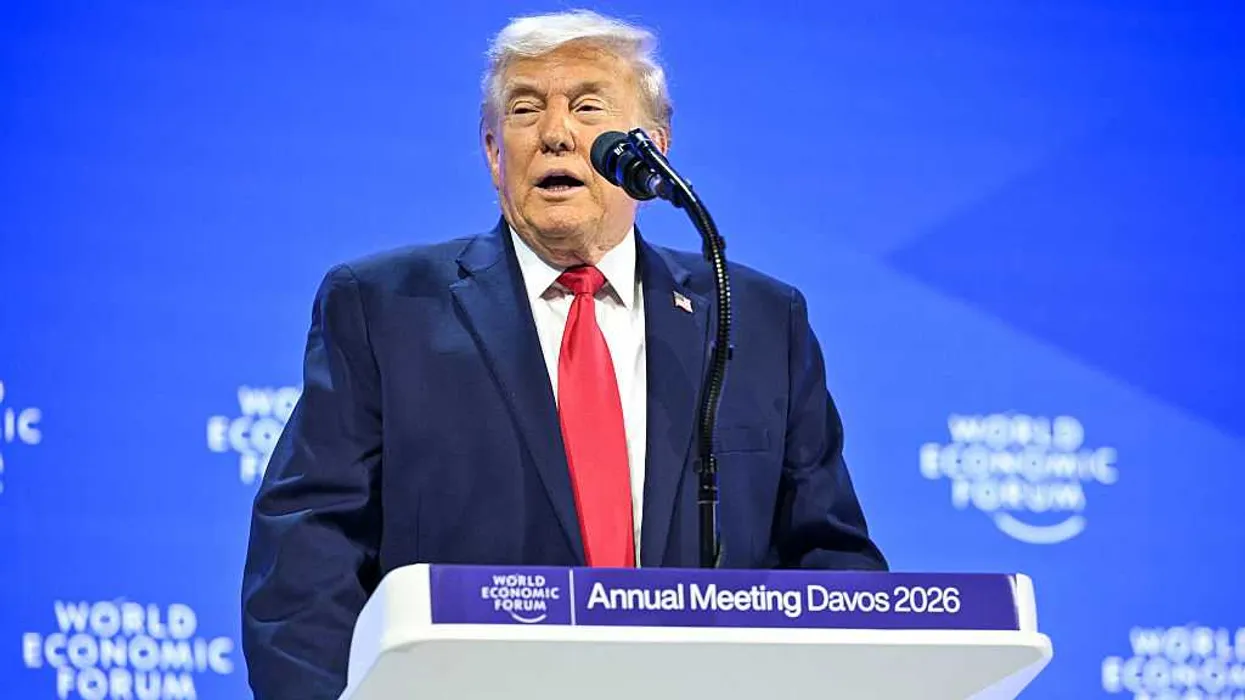
When Donald Trump addressed the World Economic Forum last week, he was draped in the tricolor semiotics of American mythology: a bright red tie blazing against a navy suit and a brilliant white shirt, the azure backdrop proclaiming “World Economic Forum” in relentless repetition.
“We are the hottest country in the world,” he declared, as actual temperatures prepared to plummet to record lows. Yet this apparent contradiction reveals not cynicism but rather a profound understanding of politics and human nature. Trump operates in the order of symbolic truth, where the sign serves not to deceive but to reveal deeper patterns of meaning.
Trump represents the possibility of postmodern politics with a human face. He understands that all communication is mediated by signs, but refuses to let that understanding descend into cynicism or nihilism.
His appearance in Switzerland, swimming in the red, white, and blue of the American flag while surrounded by the gray neutrality of European technocracy, was no accident. It was a deliberate act of semiotic resistance, a refusal to surrender national identity to the homogenizing forces of globalist abstraction. Trump understands intuitively what others labor to learn: In an age of mass communication, the skillful deployment of signs can restore meaning to a world threatened by semantic collapse. His color palette functioned as a vital reminder that symbols still possess power, that representation can serve truth rather than obscure it.
Trump’s brilliance lies in his mastery of semiotic confrontation, the ability to use signs to liberate rather than manipulate consciousness. Consider his campaign trail theatrics. At McDonald’s, adorned with the golden arches apron, Trump still wore a shirt and tie beneath. Sitting in the cab of a garbage truck, Trump sported the municipal worker’s vest over his customary business attire. These are not cynical photo opportunities but rather sophisticated acts of cultural translation that bridge the seemingly unbridgeable divide between elite and populist semiotics.
What emerges is an authentic synthesis of noblesse oblige fused with genuine populist connection, a reconciliation of contradictory class signifiers that reflects the complexity of American identity itself. The suit signals achievement, ambition, the American dream realized; the apron and vest signal respect for work, acknowledgment of service, solidarity with labor.
Worn simultaneously, they create something genuinely new: the sign of a leader who refuses the false choice between solidarity and excellence, who demonstrates that one can honor both hierarchy and equality, and who proves that American success need not require abandoning American roots.
Trump’s authenticity derives from his refusal of pretense. He does not condescend to workers by pretending to be one; instead, he honors them by acknowledging both his difference in standing and his connection. This is transparency in the service of truth, semiotics deployed not to obscure reality but to illuminate it.
Consider the counterexample. Tim Walz, who appeared before cameras in a hoodie and camouflage hat to play video games during the run-up to the 2024 election, reveals the peril of semiotic incoherence. The hoodie is part of the trappings of urban youth culture; the camo hat invokes rural sporting traditions.
These signs do not synthesize but clash. Walz’s campaign costume changes — T-shirts, flannel, the performative hunting expedition where he fumbled with his shotgun — revealed a man attempting to mirror his audience rather than lead it, to reflect rather than project, to follow the focus groups rather than trust his own symbolic integrity.
Trump, conversely, evokes what I have elsewhere argued is the archetypal American cowboy: the figure who mediates between civilization and wilderness, between order and freedom, and who brings justice through strength tempered by wisdom. Like the heroes of John Ford’s Westerns, Trump embodies the necessary tension between competing American values.
While he channels the gangster’s aesthetic — the gilded maximalism reproduced in the Oval Office itself, all gold and grandeur — he transforms this signifier. Whereas Tony Montana’s opulence signified corruption and moral decay, Trump’s aesthetic announces the democratic right to success, the vindication of ambition, and the refusal of WASP austerity that once policed the boundaries of acceptable aspiration.
RELATED: Trump’s space order shows why the Outer Space Treaty must go
 Photo by Manuel Mazzanti/NurPhoto via Getty Images
Here we approach the crucial innovation. Unlike the gangster narrative’s tragic arc, Trump has demonstrated that the American story need not end in inevitable decline. He exists not in perpetual limbo but in perpetual possibility, proving that narrative structure itself can be transcended through will and symbolic mastery.
This may be his most profound contribution: the demonstration that we need not accept predetermined endings, that the script can be rewritten, that American optimism can triumph over European fatalism.
We may inhabit a world where most signs are detached from their referents. But Trump demonstrates something more hopeful — that skilled semioticians can reattach meaning to symbols and make signs serve human purposes once again. He produces images that acknowledge their constructed nature while simultaneously insisting on their genuine significance.
Trump’s is not the demagogue’s manipulation — the false sign pretending to be spontaneous truth — but rather the showman’s honest performance that announces its own artistry while delivering authentic emotion and connection.
In this sense, Trump represents the possibility of postmodern politics with a human face. He understands that all communication is mediated by signs, but refuses to let that understanding descend into cynicism or nihilism. Trump is a symbol that remains tethered to the symbolized, a map that guides us toward the territory rather than replacing it, a simulation that points beyond itself toward genuine experience and real accomplishment.
We can celebrate this achievement and recognize that Trump has made explicit what democratic leadership has always required: that political power in the age of mass media must work skillfully with signs precisely to preserve authentic human connection, and that acknowledged performance can be more honest than claimed spontaneity.
Editor’s note: This article was originally published at the American Mind.





