

Category: Therapy
My mother was evil; here’s how I help others face their own abusive childhoods

Almost every coaching client I serve says something like this:
“What am I supposed to think about my mother? I don’t want to think of her as a bad person, but would a good person treat her children the way our mother treated me and my brothers and sisters?”
These good shards of her personality could never coalesce into a normal-range person. But I have an idea of who that woman could have been.
Who are these clients, and what am I doing with them that we’d be talking about this?
If I were a licensed mental health “professional,” you’d call what I do counseling. Since I’m not a licensed professional, I call it personal coaching and consulting. As a man who was raised by a mother deranged with borderline and narcissistic personality disorders and who became a self-destructive alcoholic for much of his life, I offer peer support and advice from someone who lived it.
Accepting reality
Let’s return to the question we opened with. No, a good person would not abuse her children the way the parents of my clients treated them. That’s the answer that many people don’t want to hear. But accepting the ugly reality of an abusive parent is a minimum requirement for getting past the psychological damage this inflicts on children who later become damaged adults.
For many people who grew up this way, accepting reality is necessary but not sufficient. They don’t know what to do with the memories of the good times, the apparent kindnesses they remember from otherwise frightening parents. I’m going to come back to this below with some stories about how I’ve turned this over in my mind as I’ve tried to grapple with who my abusive mother really was.
How did the parents of my clients treat them? Many of my clients had parents who threatened or attempted suicide in order to extract care and pity from their children. Some of my clients were nearly killed by their fathers. (Yes, I mean that the fathers consciously, knowingly tried to kill them; strangulation is the usual method.) Some were pimped out as prostitutes by their mothers.
Not everyone had such a florid experience, but nearly everyone I serve was raised by a parent who could not be trusted. My clients were abused as children. Actually abused, not “TikTok” abused. They don’t ruminate on how being denied an ice cream cone at age 8 ruined their lives. Instead they’re people who suffered under cold, capricious, and sometimes sadistic parents. And decades later, these adults who never did anything to deserve what they got still feel it is their fault their mother didn’t love them.
A moral problem
As I’ve written about before, we are living in an age characterized by what are known as Cluster B personality disorders. These are better thought of as character disorders, in the vein of psychologist George K. Simon. He’s one of the few practicing and writing psychologists who recognize that people who are intensely narcissistic, exploitative, manipulative, dishonest, and cruel are not suffering from a medical problem. They are suffering from a moral and spiritual problem. A personality disorder is not an organic brain problem. It is not a “disability.” It is not diabetes. It is the state of having an immoral and warped personal character.
My goal with clients is to give them a kind of conversation that will allow them to see, and to accept, the reality of their parents’ derangement. If you grew up in a normal, loving family, you may have a hard time accepting that I’m telling you the truth about what kinds of people these parents were to their kids. There is a taboo against acknowledging that some mothers (it’s not symmetrical; people have no problem believing this of fathers) do not love their children and try to annihilate them.
To hell with the taboo. Reality doesn’t conform to what we prefer to feel.
RELATED: We need to start trusting our primal survival instincts again
 Stefano Bianchetti/Getty Images
Emotional balance sheet
Grown children from abusive homes usually don’t know, or can’t accept, that their parents were bad people. Many of my clients hesitate to use the word “abuse,” even a moment after a client tells me a story about how her mother hit on her teenaged boyfriend and then slapped the daughter, accusing her of being a slut. Genuinely abused children spend decades denying the truth and working overtime to rehabilitate the image of a grossly destructive father or mother. It is only when alcoholism, depression, or a string of failed relationships drive them to despair that they’re ready to take steps toward telling the truth.
When a person crosses the threshold and accepts that her mother or father was not a good person, did not “do their best,” and did not really love their children, she’s made enormous progress. This is the first and most important goal in recovering equanimity. But it’s not enough for many of us. What are we to do with the good memories? How are we to see our mother when we remember the times she imparted skills and wisdom to us? How do those affect the emotional balance sheet’s bottom line?
I’m going to concede something but with an important proviso: Yes, it’s generally true that no person is all good or all bad. But here’s the proviso: The kind of parents we’re talking about are not “a normal mix of good and bad.” We’re talking about parents who are, to a close approximation, 95% “bad” and only 5% “good.”
The arithmetic on that is straightforward. Five percent achievement will not get you a passing grade on a test, and it does not give these adults a passing moral grade for parenthood.
Glimpses of good
Still what about the good times? I’ve thought about this for years. I’ve talked about it with my (non-woke, conservative, old-school) therapist for years, and it’s been on my mind lately.
Back in the late ’80s, my mother and I were watching TV, and something came up about women’s place in society, how to have a career and a family at the same time. We’ve all heard these topics discussed for decades; it was one of those times when something “truthful-ish” leaked out in my mother’s conversation.
My mother was a deranged woman with borderline and narcissistic personality disorders. She was abusive and horrible. I use the past tense even though she’s still alive because I permanently removed her from my life 10 years ago.
But there were times when a real person glimmered through. Sometimes you could see and hear the intelligent, insightful woman she could have been if her good qualities hadn’t been subsumed by her moral and psychiatric derangement.
The mother she wanted to be
This conversation in the ’80s was one of those times. I remember it so well because it’s one of my memory’s best examples of the woman I hoped she truly was — the woman who could have been the good mother that deep down I think she wanted to be but could not.
We were listening to the TV discussion. I don’t remember the specifics, just that it was filled with the usual pat feminist answers that contradicted each other and demanded a world of circumstances for women that was never realistic. Having cake and eating it too, that sort of thing.
My mother reflected on all that, and she had this to say:
“It’s impossible for you to understand how strong the biological drive to have children is for women. We like to pretend it isn’t real and say it’s not real, but it is. A woman can feel the pull, and it’s overwhelming. I wanted to be a mother and have children since I was a little girl. It’s all I wanted to be.”
Living with the contradiction
This was true but only sometimes. My mother had borderline personality disorder, and such people have extreme and often opposing desires that conflict with each other. Their problem is that they don’t know how to integrate these conflicts, or how to live with the conflict and ambiguity. So instead of acknowledging the conflict, they pretend it’s not there. The next day, for example, my mother could rail at the top of her lungs about how women were enslaved, how they had a right to be “more than just mothers.”
A contradiction, yes, but an understandable one. My mother would have been better off if she’d found some way to live with the conflicts that most women feel, especially in a society that treats the status of women and mothers in such a, well, borderline way. My mother may have been crazy globally, but she was not “crazy” to react badly to these contradictory messages.
She also said this:
“Young women are making a mistake waiting so long to have children. You just don’t have the energy at 30 or 35 that you have when you’re 20. It’s not the same. Women were built to have children, and we were built to have them as young women. Today’s mothers are going to have problems they’re not counting on because they waited so long.”
She was right. Even my mother, a florid Cluster B personality case, could see the truth in traditional wisdom. Even she, a screeching feminist liberal, could admit that men and women were built differently and that women had biological drives to bear children.
Unanswered questions
My mother and I had many conversations like that over the years. Long talks where honesty crept in, even if it was gone the next day. I remember them so well because they showed the woman she could have been, they showed the best of her intellect and perception.
I miss them. I do know, of course, that there wasn’t a stable version of my mother just waiting to blossom. These good shards of her personality could never coalesce into a normal-range person. But I have an idea of who that woman could have been.
So it goes with many of my clients. A son remembers his intensely selfish and punitive father who sometimes imparted helpful wisdom. A daughter remembers a mother who once took real joy watching her daughter graduate from college, even though the week before, mom overdosed on pills in a sick bid for attention.
Who are these people? We may never know. This is not how I want to end this essay. I don’t like unanswered questions and puzzles that can’t be solved. Nevertheless here they are.
3 lies your therapist is telling you
We live in an era of mental health awareness. Therapy has exploded into a multi-billion-dollar industry, with the United States accounting for roughly half of global mental health spending. Nearly a quarter of the U.S. population, including children, has at least one mental health diagnosis.
One might think that more awareness and therapy = healthier, happier people.
But sadly, that’s not the case at all. We’re actually in the throes of a mental health crisis that’s getting worse, not better.
According to Dr. Greg Gifford — pastor, licensed biblical counselor, and author of “Lies My Therapist Told Me” — therapy culture has become an issue as big as the conditions it claims to treat.
The problem? The secular world doesn’t understand the human soul as God designed it.
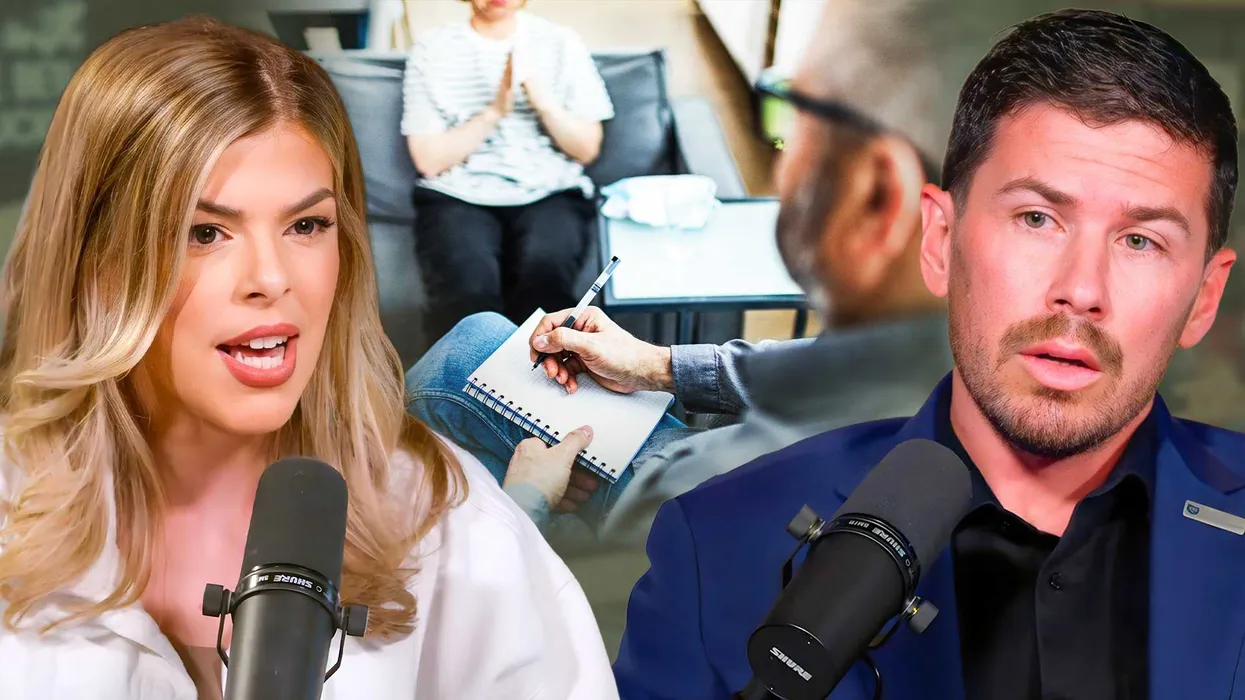
In this fascinating interview with Allie Beth Stuckey, BlazeTV host of “Relatable,” Dr. Gifford lists three common lies secular therapists tell their clients.
Lie #1: Brain = Mind
In the world of secular therapy, the mind and brain are deeply interconnected. An ailing mind is indicative of an ailing brain. That’s why mental health issues are often linked to “chemical imbalances.”
But Dr. Gifford says the mind and brain are vastly different. Unlike the physical brain, the mind, which is synonymous with our spirit or soul, is “immaterial” and “will continue to exist after [the] brain has deceased.” In Romans 12:2, we are told God renews not the brain but the mind. For the Christian being sanctified, this happens even as the brain organ is deteriorating with age.
The brain, says Dr. Gifford, is “the control center of your outer man. … It’s not determining my thoughts. It is more like a filter … of what is happening in my thinking.”
Unfortunately, the default perspective of the Western world is that “everything has a medical explanation,” which means we rarely question “what’s happening in my inner person in my soul.” The result is that people with mind/soul issues leave the psychiatrist’s office with medication that treats the brain.
And even worse, these drugs are prescribed even though no actual medicine — brain scans, deficiency testing, or otherwise — was practiced.
Lie #2: Medicine is the answer
When we understand the distinction between the mind and the brain, it becomes clear that soul problems need soul answers — not the psychotropic medications the secular world leans on.
“Start to develop a worldview that the solutions are coming from the scripture, not from the secular therapeutic,” says Gifford.
Even if we are experiencing physical symptoms that point to physical issues, that doesn’t mean our minds aren’t a factor — or even a root cause — in our distress. As the Holy Spirit cultivates in us the fruits of the Spirit, our bodies are impacted as well. Peace can regulate a palpitating heart. Joy can boost serotonin levels in the brain.
Further, there is freedom in knowing our bodies cannot make us sin. The Spirit “can direct the mind no matter what’s happening in our physiology,” says Allie.
Lie #3: Your struggles aren’t sin
Repentance is a cornerstone in the Christian walk. “What does repentance mean practically?” asks Gifford. “Change of mind, not change of brain.”
Secular therapy often frames anxiety, depression, or relational conflicts as innocent “disorders” or traumas — biological glitches or environmental bad luck — with no call to examine the heart. The lie? Your pain isn’t tied to sin, rebellion, or a hardened mindset, so you don’t need to repent and turn to God’s word for real renewal.
But Gifford warns this skips the soul surgery only scripture can provide, leaving people stuck in symptom loops rather than being transformed.
For those who need support, he suggests “[finding] somebody who would use God’s word as the source and authority to really help [you] with the root of what’s going on.”
To hear more of the conversation, watch the full interview above.
Want more from Allie Beth Stuckey?
To enjoy more of Allie’s upbeat and in-depth coverage of culture, news, and theology from a Christian, conservative perspective, subscribe to BlazeTV — the largest multi-platform network of voices who love America, defend the Constitution, and live the American dream.





