

Category: Tiktok
TikTok and Snapchat dodge trial on harm-to-kids lawsuit
TikTok will no longer be on trial when it comes to a lawsuit that claims Instagram, Snapchat, TikTok, and YouTube have platforms that are addicting and harmful to children.
The lawsuit, which involves a 19-year-old plaintiff going only by KGM, says the social networks caused her to become addicted to the apps and led to depression and suicidal thoughts.
‘New families every day … are speaking out and bringing Big Tech to court for its deliberately harmful products.’
TikTok has reportedly decided to settle and agreed in principle just hours before jury selection started in Los Angeles this week. Bloomberg Law reported that along with TikTok, Snap Inc. — owner of Snapchat — also reached a confidential settlement with the woman on January 20.
“Plaintiff KGM and defendant TikTok have reached an agreement in principle to settle her case,” Joseph VanZandt, the woman’s attorney, reportedly said in a statement.
The trial, which will continue with the other social media companies later this year, is just one of many that claim the sites are harmful, addictive, and otherwise have failed to protect children.
RELATED: Google’s new motto: Don’t be Christian
While this is the first case to go to trial, there are thousands of complaints from users and families that have sparked other lawsuits in Santa Fe, New Mexico, New York City, and the Northern District of California.
For example, in the Northern District of California, Instagram, Snapchat, TikTok, and YouTube were accused of “relentlessly” pursuing growth and “recklessly” ignoring the impacts their products have on children’s mental health.
In that case, Instagram’s former head of safety and well-being testified that Meta had a “17x” strike policy toward those who reportedly engaged in “trafficking of humans for sex.”
“You could incur 16 violations for prostitution and sexual solicitation, and upon the 17th violation, your account would be suspended,” the former employee claimed, citing internal documents.
Meta strongly denied the claims, stating, “We strongly disagree with these allegations, which rely on cherry-picked quotes and misinformed opinions in an attempt to present a deliberately misleading picture.”
“The full record will show that for over a decade, we have listened to parents, researched issues that matter most, and made real changes to protect teens,” Meta went on.
RELATED: Matt Damon: Netflix dumbs down movies for attention-impaired phone addicts
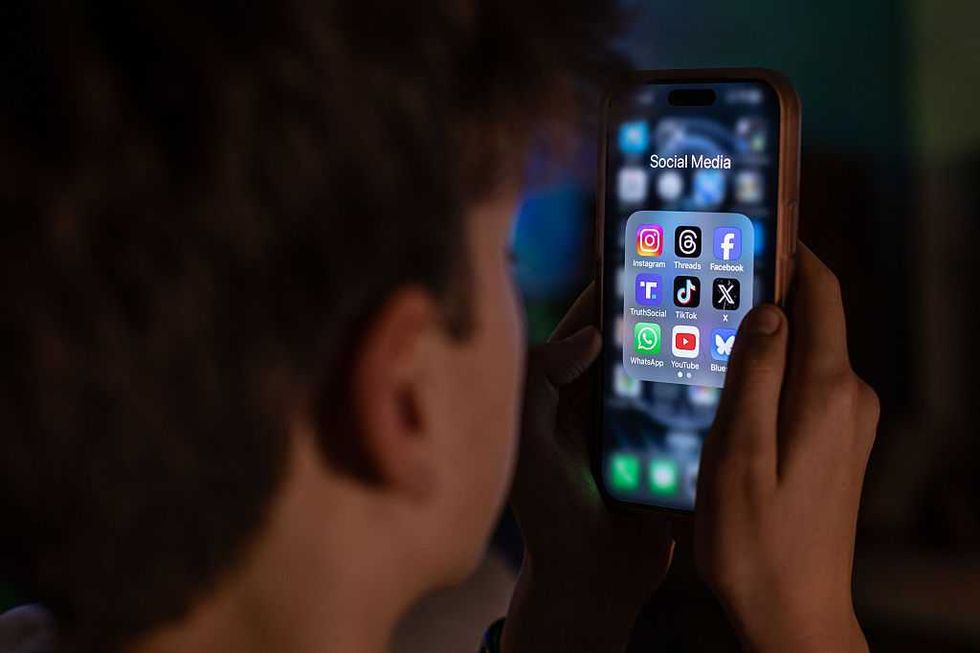 Photo by Matt Cardy/Getty Images
The settlement between TikTok and KGM should come as no surprise, said Sacha Haworth, executive director of the Tech Oversight Project.
“This was only the first case — there are hundreds of parents and school districts in the social media addiction trials that [have started], and sadly, new families every day who are speaking out and bringing Big Tech to court for its deliberately harmful products,” she said in a statement provided to Blaze News.
If social media apps are found guilty in these trials, it could set a huge precedent for high-value settlements and possibly lead to sweeping regulation for how the sites handle youth accounts.
Like Blaze News? Bypass the censors, sign up for our newsletters, and get stories like this direct to your inbox. Sign up here!
TikTok finalizes deal, creates US venture
TikTok said Thursday that it has established a new U.S. venture as part of an agreement to allow the popular social media platform to continue operating in the U.S. The deal brings to a close a lengthy saga for the app, which faced a ban if it failed to divest from its Chinese parent company…
AI can fake a face — but not a soul
The New York Times recently profiled Scott Jacqmein, an actor from Dallas who sold his likeness to TikTok for $750 and a free trip to the Bay Area. He hasn’t landed any TV shows, movies, or commercials, but his AI-generated likeness has — a virtual version of Jacqmein is now “acting” in countless ads on TikTok. As the Times put it, Jacqmein “fields one or two texts a week from acquaintances and friends who are pretty sure they have seen him pitching a peculiar range of businesses on TikTok.”
Now, Jacqmein “has regrets.” But why? He consented to sell his likeness. His image isn’t being used illegally. He wanted to act, and now — at least digitally — he’s acting. His regrets seem less about ethics and more about economics.
The more perfect the imitation, the greater the lie. What people crave isn’t flawless illusion — it’s authenticity.
Times reporter Sapna Maheshwari suggests as much. Her story centers on the lack of royalties and legal protections for people like Jacqmein.
She also raises moral concerns, citing examples where digital avatars were used to promote objectionable products or deliver offensive messages. In one case, Jacqmein’s AI double pitched a “male performance supplement.” In another, a TikTok employee allegedly unleashed AI avatars reciting passages from Hitler’s “Mein Kampf.” TikTok removed the tool that made the videos possible after CNN brought the story to light.
When faces become property
These incidents blur into a larger problem — the same one raised by deepfakes. In recent months, digital impostors have mimicked public figures from Bishop Robert Barron to the pope. The Vatican itself has had to denounce fake homilies generated in the likeness of Leo XIV. Such fabrications can mislead, defame, or humiliate.
But the deepest problem with digital avatars isn’t that they deceive. It’s that they aren’t real.
Even if Jacqmein were paid handsomely and religious figures embraced synthetic preaching as legitimate evangelism, something about the whole enterprise would remain wrong. Selling one’s likeness is a transaction of the soul. It’s unsettling because it treats what’s uniquely human — voice, gesture, and presence — as property to be cloned and sold.
When a person licenses his “digital twin,” he doesn’t just part with data. He commodifies identity itself. The actor’s expressions, tone, and mannerisms become a bundle of intellectual property. Someone else owns them now.
That’s why audiences instinctively recoil at watching AI puppets masquerade and mimic people. Even if the illusion is technically impressive, it feels hollow. A digital replica can’t evoke the same moral or emotional response as a real human being.
Selling the soul
This isn’t a new theme in art or philosophy. In a classic “Simpsons” episode, Bart sells his soul to his pal Milhouse for $5 and soon feels hollow, haunted by nightmares, convinced he’s lost something essential. The joke carries a metaphysical truth: When we surrender what defines us as human — even symbolically — we suffer a real loss.
For those who believe in an immortal soul, as Jesuit philosopher Robert Spitzer argues in “Science at the Doorstep to God,” this loss is more than psychological. To sell one’s likeness is to treat the image of the divine within as a market commodity. The transaction might seem trivial — a harmless digital contract — but the symbolism runs deep.
Oscar Wilde captured this inversion of morality in “The Picture of Dorian Gray.” His protagonist stays eternally young while his portrait, the mirror of his soul, decays. In our digital age, the roles are reversed: The AI avatar remains young and flawless while the human model ages, forgotten and spiritually diminished.
Jacqmein can’t destroy his portrait. It’s contractually owned by someone else. If he wants to stop his digital self from hawking supplements or energy drinks, he’ll need lawyers — and he’ll probably lose. He’s condemned to watch his AI double enjoy a flourishing career while he struggles to pay rent. The scenario reads like a lost episode of “Black Mirror” — a man trapped in a parody of his own success. (In fact, “The Waldo Moment” and “Hang the DJ” come close to this.)
RELATED: Cybernetics promised a merger of human and computer. Then why do we feel so out of the loop?
 Photo by imaginima via Getty Images
The moral exit
The conventional answer to this dilemma is regulation: copyright reforms, consent standards, watermarking requirements. But the real solution begins with refusal. Actors shouldn’t sell their avatars. Consumers shouldn’t support platforms that replace people with synthetic ghosts.
If TikTok and other media giants populate their feeds with digital clones, users should boycott them and demand “fair-trade human content.” Just as conscientious shoppers insist on buying ethically sourced goods, viewers should insist on art and advertising made by living, breathing humans.
Tech evangelists argue that AI avatars will soon become indistinguishable from the people they’re modeled on. But that misses the point. The more perfect the imitation, the greater the lie. What people crave isn’t flawless illusion — it’s authenticity. They want to see imperfection, effort, and presence. They want to see life.
If we surrender that, we’ll lose something far more valuable than any acting career or TikTok deal. We’ll lose the very thing that makes us human.





