

Category: Usa
Venezuela was the stage. China was the target.
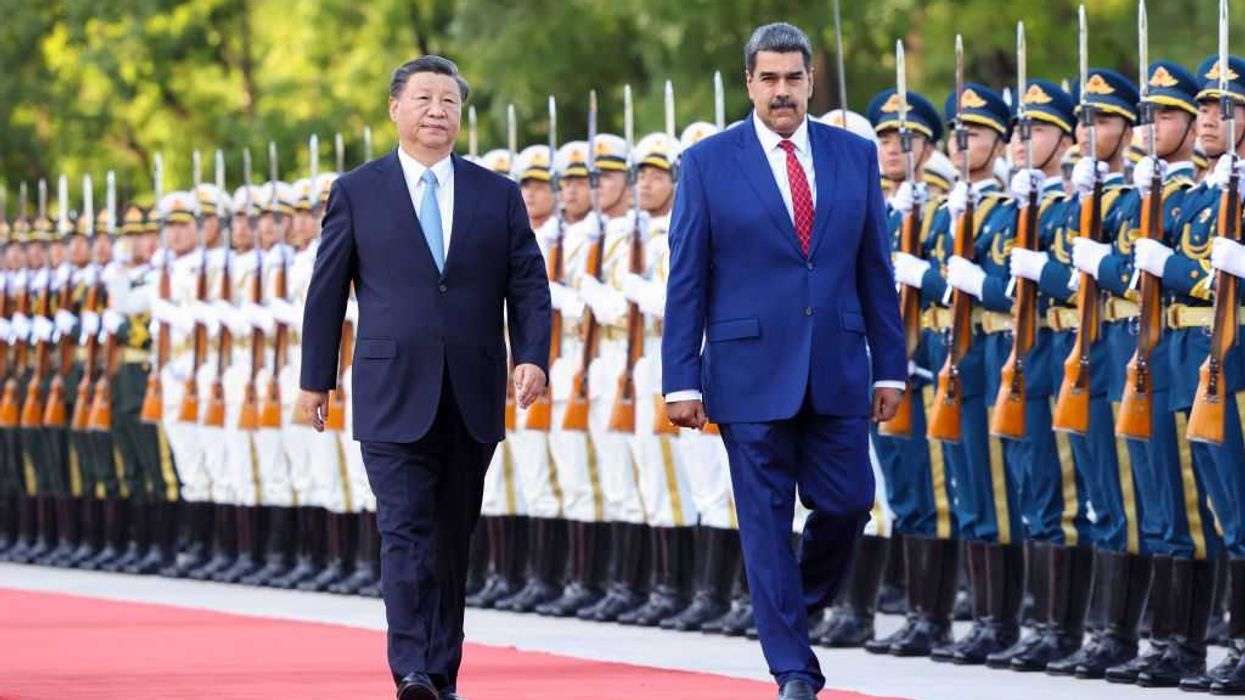
Last weekend’s Caribbean live-fire exercise in and around the suburbs of Caracas delivered a steady stream of tactical messages to the Western Hemisphere. We don’t like narco-terrorists, wannabe communists, bloated dictators, or people who supply oil to our adversaries.
But that wasn’t the real message.
Message to Xi: There’s a new sheriff in town. He isn’t ‘Sleepy Joe.’ And his call sign is FAFO.
The love note was addressed to China, and it read: We are awake now. Our game is FAFO.
America’s 36-year slumber on the Monroe Doctrine — “Stay out of the Western Hemisphere or else” — began after Panama in 1990. The Gulf War and the Global War on Terrorism followed, and Washington became dangerously myopic about threats in America’s own backyard.
Then came the turning point. When Bill Clinton signed off on communist China’s entry into the World Trade Organization in 2000, Beijing rapidly surged into a world-class economic power. Along with that rise came a succession of Chinese leaders who openly advanced the idea of global Chinese hegemony.
Oddly enough, many of those ideas came from an American — my late friend Alvin Toffler.
Toffler’s book “The Third Wave” so impressed Deng Xiaoping and Zhao Ziyang in 1984 that millions of bootleg Chinese translations were distributed — without royalties — throughout the People’s Liberation Army. The same thing happened after Toffler published “War and Anti-War.” Once again, millions of pirated copies circulated, and Beijing began integrating his ideas into military doctrine.
In the late 1990s, PLA Major General Qiao Liang and Colonel Wang Xiangsui wrote “Unrestricted Warfare,” borrowing heavily from Toffler while laying out a strategy to defeat the United States.
In hindsight, it should have been titled “Slow Motion War.”
The book focuses on perceived weaknesses in American character and American war-making. The United States remains a nation of quarterly earnings reports and election cycles. We change political leadership every two or four years. The Chinese think in generational time frames.
From their perspective, Americans only go to war when facing a “clear and present danger.”
The genius of “Unrestricted Warfare” lies in exploiting what happens when a threat is clear but not present — like cancer from long-term smoking — or present but not clear, like the slow poisons Lucrezia Borgia allegedly used on her enemies.
Qiao and Wang proposed a slow, steady pressure campaign against the four pillars of American national power: diplomatic, information, military, and economic — the DIME.
Examples abound. Diplomatic and economic leverage through the Belt and Road Initiative. Tight control of information inside China paired with aggressive information warfare abroad through platforms such as TikTok. A decades-long military buildup aimed at surpassing U.S. power. And a long trail of currency manipulation.
(And then there’s this gem from page 191 of “Unrestricted Warfare”: “Can special funds be set up to exert greater influence on another country’s government and legislature through lobbying?” Eric Swalwell might find that line interesting.)
RELATED: From Monroe to ‘Donroe’: America enforces its back yard again
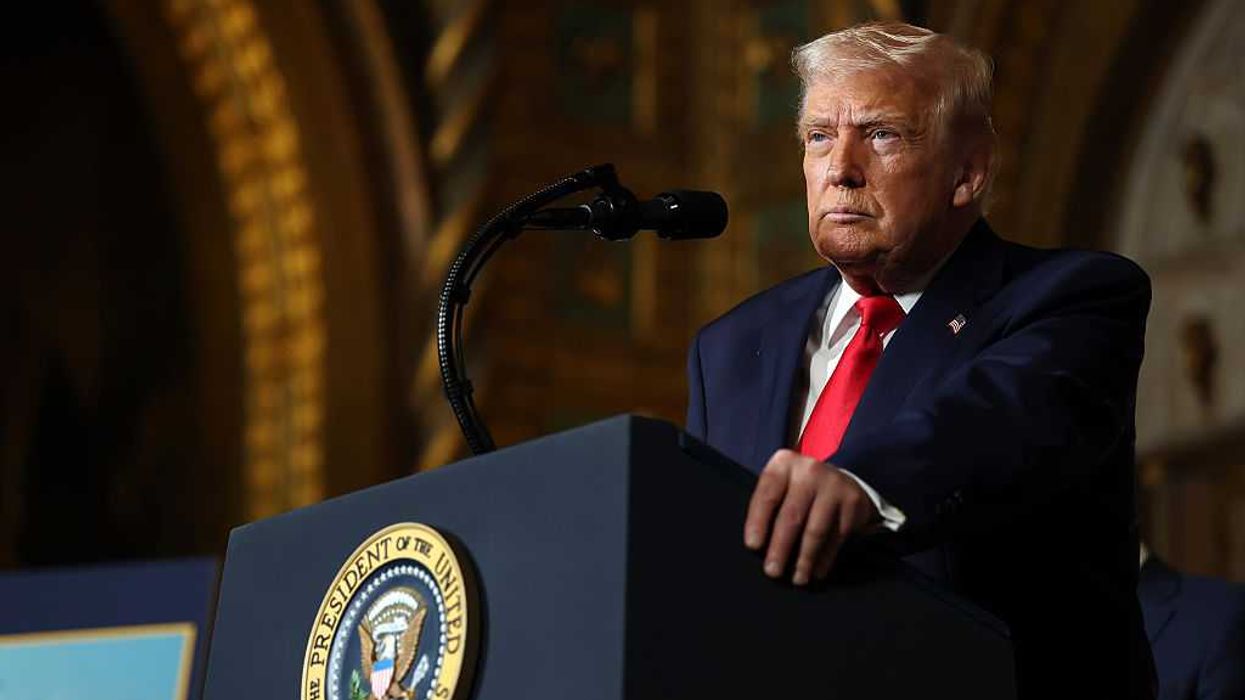 Photo by Tasos Katopodis/Getty Images
While America fixated on the Middle East, China quietly embedded itself throughout Latin America. In Panama, Beijing gained control of port management at both ends of the Panama Canal and began upgrading the system. In Costa Rica — which has no army — China donated 3,500 police cars and built a national stadium in San José, free of charge. It also cut sweetheart deals involving hundreds of Chinese fishing trawlers. Colombia saw similar treatment.
Then came Orange Man Bad.
Donald Trump is the first president to grasp that China isn’t a Red Godzilla stomping cities with napalm breath and a scything tail. China is more like the Blob — and Trump is Steve McQueen.
Venezuela, Maduro, oil, and narco-terrorism were all subsets.
China was the target. Xi Jinping was the bullseye.
Zero hour wasn’t set by the weather. It was set by the departure of Chinese envoy Qiu Xiaoqi, who had just wrapped up discussions on future ties with Venezuela. Unfortunately for Beijing, Delta Force snagged and bagged Nicolás Maduro and his wife and had them sitting in a Brooklyn jail before the envoy even made it home.
Message to Xi: There’s a new sheriff in town. He isn’t “Sleepy Joe.” And his call sign is FAFO.
Any questions?
Do not pass the plow: The danger of declaring a golden age without repentance

I live in Montana. Driving in snow is simply part of life here.
When the storm is heavy and the road is bad, you do not pass the snowplow. You go at its speed. You let it clear the way. Trying to rush past does not make the road safer or the journey faster. It only increases the risk.
Does God wink at sin in order to bless a nation — or does Scripture teach the opposite?
I have watched people try anyway. Confidence surges, patience thins, and effort begins to feel like wisdom. Some get away with it. Some do not. Either way, the plow keeps moving — unhurried and unmoved by urgency.
The rush to declare victory
As we approach a new year, I find myself thinking about that lesson while listening to Christians talk about the future of our country.
Some are already calling 2026 a coming “golden age of America.” Others argue that Christian nationalism offers the corrective path forward — that the nation must reclaim explicitly Christian leadership, laws, and identity. Christians, they say, must take the reins.
Christians should care deeply about their culture. Scripture calls us to be salt and light. Many believers already serve faithfully in the highest offices of the state, and we should encourage and equip more to do so. The question is not whether Christians should serve, but what posture we bring with us when we do.
Scripture is remarkably clear about order. In 2 Chronicles, healing and restoration are promised only after God’s people humble themselves, pray, seek His face, and turn from their ways. The sequence is not optional. Humbling comes before healing.
So why does the language of a coming golden age seem so detached from the language of repentance?
There is no denying that our culture has lost moral traction. Christians are not imagining the collapse. And more than 60 million abortions since 1973 are not a statistic a nation simply absorbs and leaves behind. Scripture never treats the shedding of innocent blood lightly.
Outrage is easy. Obedience is harder.
When sin is not merely tolerated but established as policy, what is the response of the people of God?
Outrage may be understandable. Indignation is certainly warranted. Resistance, in some form, may be necessary. But resistance to what — and by what means?
Scripture tells us plainly that we do not wrestle against flesh and blood. We say we believe that. The question is whether we act like it. If the battle is spiritual, why do so many of our responses rely almost entirely on human strength, political leverage, and cultural power?
If we are not fighting flesh and blood, why would we expect victory through our own understanding rather than by seeking God’s? And how can we presume upon His wisdom while bypassing the very repentance Scripture says must come first?
Where is the snowplow in this moment?
Prosperity is often treated as evidence of God’s blessing, but Scripture never makes that equation automatic. Drug cartels are prosperous. Entire industries built on sexual exploitation generate staggering wealth. So the question is not whether something flourishes, but why.
Does prosperity always signal God’s approval — or can it also reflect restraint removed, a people being given over to what they insist on pursuing? If abundance alone proves blessing, how do we account for how easily sin thrives?
Invoking God does not obligate Him
We frequently say, “God bless America,” but what do we mean when we invoke God’s name publicly? In 2013, a sitting U.S. president closed a speech to Planned Parenthood by saying, “God bless Planned Parenthood, and God bless America.”
That raises a serious question for Christians. When a national leader invokes God’s blessing in that way, does the language function merely as personal sentiment, or as representative speech? And more importantly, can those appeals be reconciled biblically? Can the same God who condemns the shedding of innocent blood be invoked to bless both its defenders and the nation at large without contradiction?
Does God wink at sin in order to bless a nation — or does Scripture teach the opposite?
This question is not aimed at unbelievers, who feel no obligation to repent. It is aimed squarely at the church.
Throughout Scripture, when God’s people finally grasped the weight of their sin, the response was not triumphal language or claims of destiny. It was confession. Leaders did not announce renewal. They acknowledged guilt. Only then did rebuilding begin.
So why does so much talk of a coming golden age contain so little talk of repentance?
The passages often cited to support Christian political dominance proclaim Christ’s authority. That authority is not in dispute. What is less often examined is how Christ exercises it. Jesus said His kingdom was not of this world. The early church did not secure influence through force or control, but through obedience, suffering, prayer, and faithful witness.
And through that path, it changed the world.
Conservatism is not holiness. Holiness runs deeper than alignment, platforms, or policy wins. Scripture places the deepest problem of any nation not in its laws, but in the human heart. Legislation may restrain behavior, but it cannot regenerate souls. That work belongs to the gospel.
RELATED: Christmas without Katie — and without accountability
 Photo by: Philippe Lissac/Godong/Universal Images Group via Getty Images
God is not in a hurry
As a caregiver, I have learned the hard way that effort is not the same as health. When the pressure is high and the outcome uncertain, urgency can feel responsible. Control can masquerade as diligence.
But we do not get credit for effort if it lands us in a ditch. Trying to pass the plow does not create progress. It creates wreckage.
God is not rushed. He moves at His pace, not ours.
Repentance is not the abandonment of influence; it is the only ground on which influence survives.
If God is who He says He is, what wisdom is there in rushing ahead of Him?
Which leaves a final question for the people of God: Are we asking the Lord to bless what we refuse to repent of?
Scripture’s order has not changed. Humility precedes healing. Repentance comes before restoration. And when we declare a golden age without repentance, we should not be surprised if what we have built turns out to be a golden calf.





