

Category: Warner bros.
Trump is right: Netflix’s merger would create a woke media monster
Popular entertainment has always shaped the public mind in ways politicians can only envy.
Percy Bysshe Shelley once called poets the “unacknowledged legislators of the world.” The idea surfaces memorably in the 1984 Best Picture winner “Amadeus,” where Emperor Joseph II appears more invested in micromanaging Vienna’s opera scene than governing his empire.
Modern technology has magnified that cultural power. Today, many young Americans absorb more of their moral instruction from Netflix than from teachers, pastors, or even parents.
Now Netflix wants to expand that influence dramatically by acquiring Warner Bros. Discovery, a media conglomerate that includes HBO, DC Studios, and franchises such as “Harry Potter” and “Game of Thrones.” The combined entity would control roughly a third of the streaming market and wield unprecedented cultural power.
Democrats understand that politics flows downstream from culture. Allowing Netflix to absorb Warner Bros. would give that worldview control over even more cultural territory.
The scale of the proposed merger raised concerns even for President Donald Trump, who warned last month that it “could be a problem” and confirmed his administration would take an active role in reviewing the deal.
Given the stakes, the question is not abstract. How does Netflix use the power it already holds?
Consider the company’s recent headline-grabbing film, “Queen of Coal,” described as the story of “a trans woman who dreams of working the coal mines” and must battle a town defined by “superstition and patriarchy.”
Inspiring stuff.
Or recall Netflix’s 2020 release of “Cuties,” a French film centered on 11-year-old girls twerking. The filmmakers claimed the movie criticized the sexualization of children. Perhaps that was their intent. Netflix’s marketing department missed the point entirely, replacing the original poster with one featuring preteen actresses in sexualized poses. Public outrage followed, and Netflix eventually apologized.
After George Floyd’s death in 2020, Netflix declared on social media, “To be silent is to be complicit. Black lives matter,” and then set about race-swapping characters across its catalog.
Zoom out further. A report by Concerned Women for America found that nearly half of Netflix’s children’s programming pushes LGBT themes.
Taken together, the pattern is unmistakable. Netflix uses its platform to advance a radical progressive agenda, and scrutiny only confirms it.
The company’s internal culture reinforces the point. Even by Big Tech standards, Netflix skews sharply left. In 2020, 98% of its political donations went to Democrats, compared with 84% at Apple and 77% at Facebook.
CEO Reed Hastings, Netflix’s co-founder and longtime chief executive, donated $7 million in 2024 to a pro-Kamala Harris super PAC and $2 million to California’s redistricting effort last year. In 2017, Hastings told fellow billionaire Peter Thiel that his support for Trump reflected such “catastrophically bad judgment” that it called into question Thiel’s fitness to remain on Facebook’s board.
Hastings has made clear that conservative ideas do not merely deserve debate. In his view, they disqualify those who hold them from serious consideration.
Then comes the revolving door between Netflix and Democratic power.
RELATED: Netflix wants a monopoly on your mind
 Photo by Mario Tama/Getty Images
In 2018, Netflix signed a deal with former President Barack Obama reportedly worth tens of millions of dollars. The results included a slate of progressive documentaries and an apocalypse thriller featuring the line, “Trust should not be doled out easily, especially to white people” — a sentiment both racist and badly written.
Susan Rice offers another example. After serving as Obama’s U.N. ambassador and national security adviser, she joined Netflix’s board during Trump’s first term, left to lead Biden’s Domestic Policy Council, and has now returned to the company.
Democrats understand that politics flows downstream from culture. Allowing Netflix to absorb Warner Bros. would give that worldview control over even more cultural territory.
President Trump has signaled that he understands what is at stake. He has warned that the $82.7 billion deal must undergo rigorous antitrust scrutiny.
As Rep. Darrell Issa (R-Calif.) noted, the merged company would exceed the 30% market-share threshold traditionally viewed as “presumptively problematic” under antitrust law.
But Trump’s concern goes deeper. As an entertainer himself, he grasps the importance of the arts. That understanding explains his hands-on approach to reforming the previously ultra-woke Kennedy Center. It explains his plan to commission 250 classical sculptures for a National Garden of American Heroes. It explains his appointment of Jon Voight, Mel Gibson, and Sylvester Stallone as special ambassadors to Hollywood.
And it explains why he should not allow Netflix to build a woke media monopoly capable of doing more long-term damage to the country than any single election cycle.
Netflix wants a monopoly on your mind
Netflix has announced an $80-plus billion plan to buy Warner Bros. Discovery — a move that would give the streaming giant control of some of the biggest entertainment franchises in America. Executives celebrated the deal, promising consumers “more of what they love.” In reality, the merger would create a monopolistic monster. For millions of Americans already frustrated with Netflix’s ideology and influence, this feels like a bridge too far.
This isn’t some routine corporate merger. It is an attempt to build an unstoppable cultural behemoth. Netflix is already the largest streaming platform in the country. Absorbing Warner Bros. — one of Hollywood’s oldest and most important studios — would allow the company to tower over its competitors and control a massive share of American storytelling.
The Netflix-Warner Bros. merger would confer unprecedented cultural and economic authority on a company already mired in national controversy.
Antitrust concerns are obvious and bipartisan. Lawmakers in both parties have called the deal an antitrust “nightmare.” Consumers have already filed a class-action lawsuit arguing that the merger would gut competition. But there is another reason conservatives in particular are sounding the alarm: the cultural power Netflix has accumulated — and how it intends to use it.
The culture-war dimension
In recent years, Netflix has dominated the streaming world and, by extension, much of the debate over ideological influence in entertainment. The company has been at the center of national fights over gender, sexuality, race, and the politicization of children’s programming.
Elon Musk triggered a viral backlash when he urged millions of followers to cancel Netflix, accusing the platform of pushing a “woke agenda” into entertainment and slipping social messaging into children’s content. Musk tapped into a widespread, simmering frustration: the belief that major corporations no longer reflect the values of ordinary American families.
Netflix’s programming choices have not eased those concerns. The company has showcased transgender and nonbinary themes in children’s shows, celebrated DEI ideology internally, and proudly curated LGBTQ+ collections “for families.” Sometimes this yields unintentional comedy — like a new show about a transgender coal miner — but other times, the messaging feels more deliberate and invasive.
Now imagine giving the company control of Warner Bros. The concern isn’t only economic. It’s cultural. A combined Netflix-Warner empire would shape what stories get made, which values get promoted, and what kind of entertainment future generations will inherit.
What happens to theaters, communities, and creators?
Warner Bros. has long been a pillar of American cinema. Local theaters depend on major studios to draw families out of their homes and into shared cultural experiences — some of the last common spaces in American life. Netflix, by contrast, has built its kingdom on isolation: individual screens, algorithmic curation, the slow erosion of communal entertainment.
If Netflix takes control of Warner Bros., expect shorter theatrical windows, more straight-to-streaming releases, and a slow decline in the local theaters that hold American communities together. The result: fewer choices, weaker alternatives, and consumers trapped paying whatever the merged company demands.
Netflix insists this won’t happen. History suggests otherwise.
Creators and workers see what’s coming
Hollywood’s creative class understands the danger. Director James Cameron has warned that the merger would flatten artistic diversity and silence competing voices. Industry unions fear that a single corporation controlling both production and distribution will decide which projects get funded, which careers move forward, and which ideas make it to the screen.
A company with that much power can shape the entire pipeline of culture.
RELATED: Can conservatives reclaim pop culture?
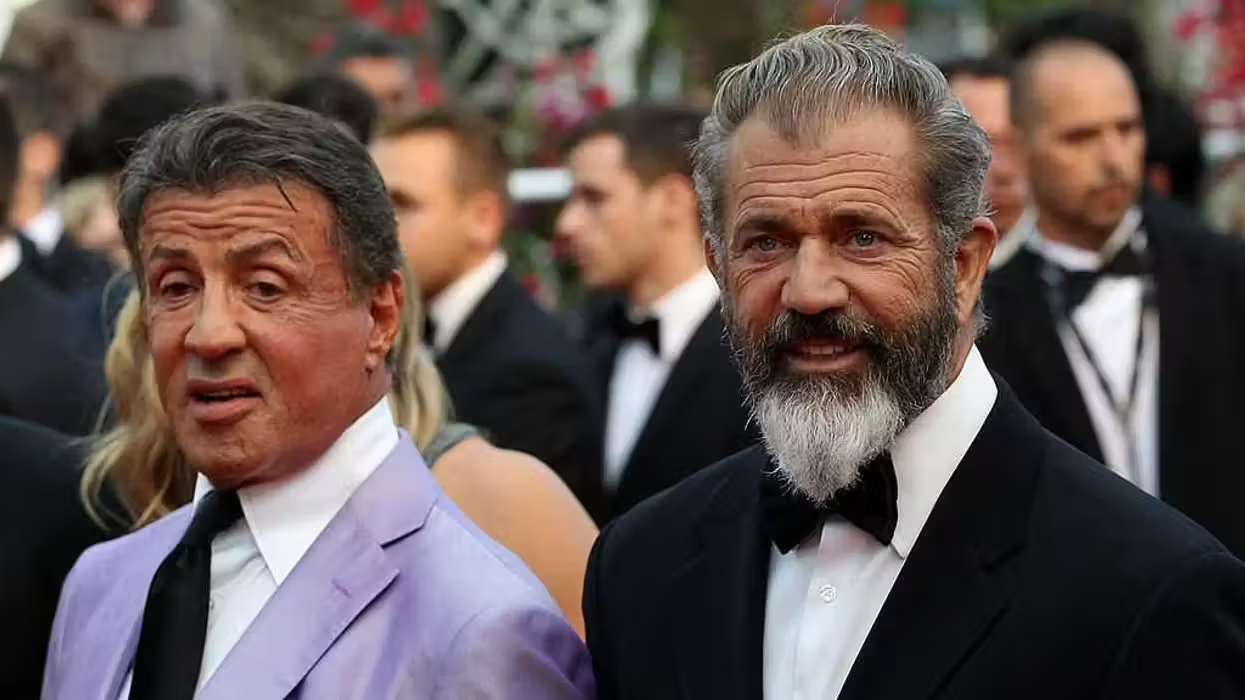 Photo by Danny Martindale/FilmMagic
The government must stop this
Regulators have noticed. President Trump has expressed concern that the combined company would wield too much market power. The Department of Justice and consumer advocates are preparing for an aggressive antitrust review. Critics across the political spectrum warn that prices will rise, competition will collapse, and consumers will lose.
Americans want competition — not cultural empires run by a handful of executives who impose ideological agendas while claiming neutrality. They want storytellers who reflect a diversity of values and views, not corporate gatekeepers who see entertainment primarily as a delivery system for political messaging.
The Netflix-Warner Bros. merger threatens all of this. It would confer unprecedented cultural and economic authority on a company already mired in national controversy.
The Trump administration should block the merger.
Americans are tired of corporations that profit from their attention while ignoring their concerns. Allowing one company to dominate such a massive share of American entertainment would weaken the industry and harm the country.
The government must stop this power grab before the damage becomes irreversible.
Amazon wants Warner Bros. so it can rule your screen
Last month, Warner Brothers Discovery put itself up for sale, triggering what could become a bidding war for one of America’s most iconic studios. Days later, reports emerged that Amazon plans to make a run at the company, immediately raising the stakes.
Consumers and regulators should treat every Big Tech bidder with skepticism, but Amazon’s interest demands special scrutiny. The world’s largest online retailer has a long record of distorting markets, crushing rivals, and cozying up to foreign adversaries — most notably China. Letting Amazon absorb yet another major media asset would tighten its grip on an entertainment industry already buckling under corporate consolidation.
Why would antitrust officials hand Amazon even more power in a sector already suffocating under concentration?
Amazon may be a household name, but it is not an America-first company. It bullies smaller retailers, copies their ideas, and funnels profits and supply-chain leverage through China. That behavior undermines the ingenuity and fair competition that built the U.S. economy.
Amazon already wields enormous influence over media. Last year, Prime Video topped U.S. streaming charts for the third straight year. Amazon controls a sprawling production studio, reinforced by its 2022 purchase of MGM. It holds high-dollar sports rights, including “Thursday Night Football” and an 11-year deal with the NBA.
Amazon doesn’t need Warner Brothers Discovery to survive. It wants the company to force more Americans into its digital universe, dominate an even larger share of the market, and use that dominance to trap users and raise prices. Buying competitors beats out-competing them — a classic monopolist playbook that burdens consumers and smothers innovation.
A Warner Brothers takeover would give Amazon exactly what it wants: a massive content library, the third-largest streaming platform, and a lineup of lucrative cable properties. With the deal sealed, Amazon would control more than a third of the streaming video on demand market — roughly 50% more than its nearest rival.
Why would antitrust officials hand Amazon even more power in a sector already suffocating under concentration? They likely won’t.
FTC Chairman Andrew Ferguson and the Justice Department’s antitrust chief, Gail Slater, have made clear that they intend to protect small businesses and consumers from predatory corporate behavior.
The Trump administration has backed those promises with action. Within nine months of taking office, the FTC forced Amazon to pay $2.5 million for trapping customers in Prime subscriptions. Ferguson’s vow to ensure that “Amazon never does this again” shows that this White House will not give repeat offenders a free pass.
RELATED: Stop feeding Big Tech and start feeding Americans again
 Lexi Critchett/Bloomberg via Getty Images
The regulatory terrain also looks dramatically different from 2022, when Amazon bought MGM — an acquisition the Biden administration should have challenged and likely would challenge today. After that merger, the FTC rewrote its merger and acquisition guidelines to strengthen oversight. President Trump kept those rules and appears ready to use them.
Some critics claim Amazon earned goodwill with the administration by contributing to White House renovation projects. That accusation doesn’t survive contact with the facts. Candidate Trump warned about Amazon’s “huge antitrust problem” as early as 2016. The company has grown eightfold since then. Trump hasn’t softened.
And Amazon hardly functioned as a friend of the right. The company backed Joe Biden heavily in 2020, donating nearly $2.3 million to his campaign. Biden’s FTC did not treat Amazon kindly either, suing the company for “anticompetitive and unfair strategies to illegally maintain its monopoly power.” That case remains unresolved.
The sale of Warner Brothers Discovery will shape the future of American media — either by giving the company a fighting chance to innovate and compete, or by cementing Big Tech control over what Americans watch, read, and hear. If Amazon tries to tighten that grip, I expect the Trump administration to step in.
Let’s hope the sale doesn’t force the administration’s hand.





