Category: Breitbart
Dinesh D’Souza’s new documentary faces anti-Zionism head-on

I must admit to having a complicated relationship with Dinesh D’Souza’s documentaries.
As much as I have enjoyed several of them, I find that they falter in a few ways: They often lack staying power, offering little incentive to return to them after the moment has passed; they are too self-referential — filtering every issue through D’Souza’s own perspective; and they are preoccupied with energizing sympathetic audiences rather than persuading skeptical ones.
Where the film is likely to receive its fiercest pushback is on the subject of eschatology — the theology of the end times.
This last flaw is especially frustrating. Catering to the conservative base is easy, but with D’Souza’s resources and backing, his films could be far sharper — and far more enduring — if they focused on timeless themes rather than re-litigating the 2020 election or attacking whoever happens to be running for president that year.
Chasing the ‘Dragon’
It was with this in mind that I went into D’Souza’s newest effort, “The Dragon’s Prophecy.” A loose adaptation of the Jonathan Cahn book of the same name, the Angel Studios production examines the fallout of the October 7 terrorist attacks and the subsequent two-year war between Israel and Hamas (which effectively ended with a ceasefire on October 10).
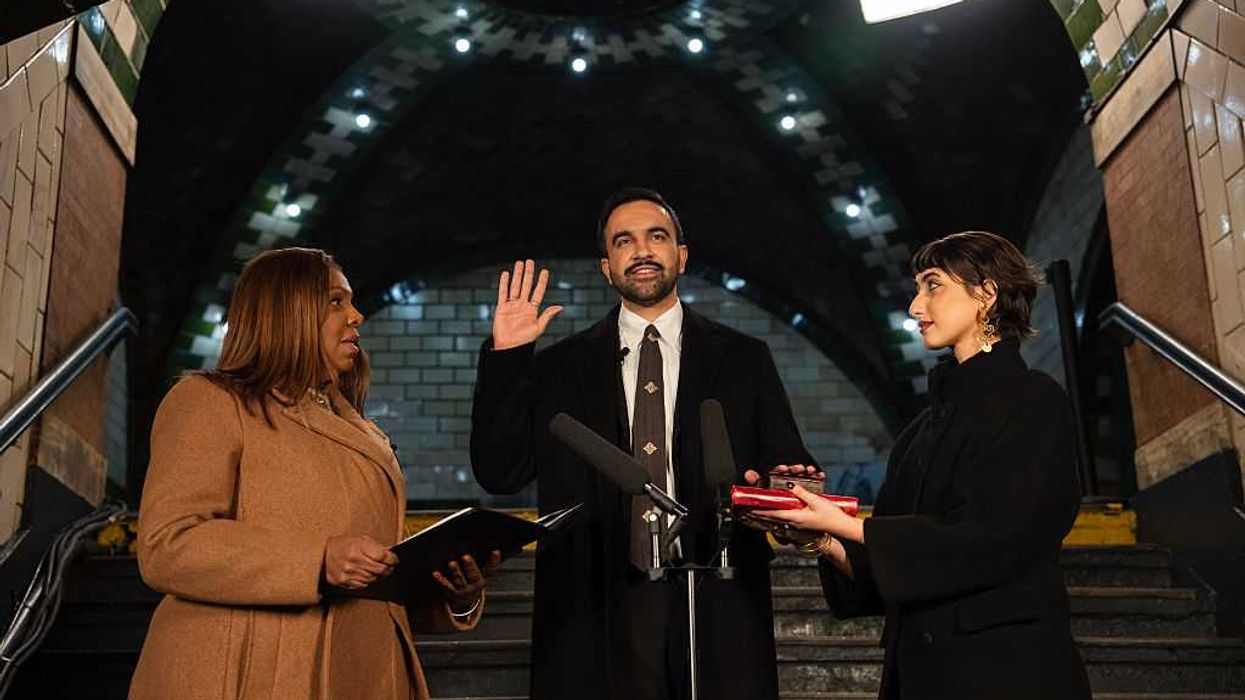
Sharpness, at least, is not a problem this time. The film arrives at a harrowing moment. Tucker Carlson is condemning “Christian Zionism” as heresy; New York City has just elected a mayor who wants to arrest the prime minister of Israel; and bipartisan resentment toward American Jews hasn’t been this pronounced since Pat Buchanan implicitly blamed them for supporting the Gulf War.
Anti-Zionism — and its adjacent anti-Semitism — is enjoying a fashionable resurgence, while support for the Israeli government sits at an all-time low.
D’Souza confronts these trends head-on. He calls out Carlson — as well as the far-left bloc of House Democrats known as “the Squad” — by name, even integrating footage from Carlson’s combative June interview with Ted Cruz. The result is a forthright defense of Israel, one that bluntly characterizes Hamas as rapists, murderers, and terrorists — and depicts the group’s atrocities in unflinching detail, including phone calls in which militants boast to their parents about their killings.
Intentional shock
It’s a grisly watch. The film includes insurgents shooting dogs and civilians, and it lingers on the aftermath of violence. But the shock is intentional. As Ambassador Mike Huckabee tells D’Souza, the war is “an eternal battle between good and evil,” with Israel on the side of the angels and Hamas aligned with “the Dragon.”
Amid this devastation, D’Souza wanders the Holy Land and laments that Israel is a place where “nothing is ever solved or resolved,” a region with “no solutions and no idea what the problems even are.” Yet his moral clarity never wavers. He even calls the construction of the Islamic Dome of the Rock on the Temple Mount “the true colonialism.”
His mission is to locate meaning in the conflict. To that end, he speaks with Jewish victims, archeologists uncovering evidence of ancient Israelite history, and Prime Minister Benjamin Netanyahu, who uses the occasion to swat at his American critics and to praise Donald Trump.
Disputed dispensation
Where the film is likely to receive its fiercest pushback is on the subject of eschatology — the theology of the end times.
Because D’Souza’s target audience is predominantly Christian, the most vocal critics may be anti-dispensationalists, whose views have become increasingly common among Catholics and mainline Protestants. They correctly note that dispensationalism is a 19th-century American theological development and that the popular notion of a “rapture” is relatively recent.
As the Protestant theologian Brian Mattson writes, “In the grand historical sweep of Christian theology, Dispensationalism is a new arrival.” He explains that its architects argued that salvation unfolds across distinct dispensations, meaning that God’s promises to Israel remain intact for ethnic Jews even as the New Testament opens salvation to Gentiles. “God has two separate ‘tracks’ for the salvation of humanity,” he writes. Thus the national promises to Israel persist in perpetuity.
This is the framework behind the “Left Behind” franchise — 16 books and five films — and it places the modern state of Israel at the center of Revelation in a way that traditional Christian readings do not.
There are legitimate biblical critiques of dispensationalism, just as there are bad-faith motives for attacking it. Mattson notes that many Gen Z “America First” Catholic converts now regard Israel as an unnecessary “foreign entanglement,” while others deploy “heresy” language as a thin veil for anti-Semitism.
RELATED: Haunting play ‘October 7’ lets Hamas terror survivors speak
Phelim McAleer
End-times evidence
Still, D’Souza’s film is thoroughly dispensationalist. Israel’s present turmoil is portrayed as evidence that the end times are near, that evil is intensifying, and that God is making Himself more visible through signs and miracles. The fate of Israel, in this reading, is inseparable from the fate of the world.
The film’s second half is a series of interviews with Israeli archeologists who discuss evidence for figures like King David and Pontius Pilate, treating their discoveries as confirmations of Scripture. When combined with commentary from a Messianic Jew such as Jonathan Cahn, the Israeli-Gaza conflict becomes a mystical drama between cosmic good and cosmic evil.
That argument rests on a contested theological system. However one responds to the film’s defense of Israel, it must be filtered through the angular lenses of American dispensationalism — a hurdle many viewers may be unwilling to clear.
Centrist appeal
There are smaller criticisms as well: The film appears to lean heavily on AI-generated imagery, which raises its own questions about execution. But in the main, the film is preaching to the broad American center — those who support Israel without belonging to either extreme.
Despite these theological quirks, the film ultimately does something I have long wished D’Souza’s documentaries would do: It speaks clearly and with conviction about an issue that possesses lasting moral weight.
Israel will remain a defining struggle for decades. October 7 is only one chapter of that broader conflict. In taking it on, D’Souza presents a moral argument to a conservative audience that is increasingly drifting from him. Whether one agrees with his conclusions or not, he is operating on the level of enduring questions of faith rather than the transitory skirmishes of electoral politics. For once, he isn’t simply preaching to the choir.
Culture’s great subversion machine has broken down at last

Netflix just announced its next animated children’s film, “Steps,” a Cinderella inversion in which the evil stepsisters are the real heroes. Shocking, I know. The platform is also releasing “Queen of Coal,” a film about a “transgender woman” overcoming the patriarchy in his small Argentinian town.
Reports of the demise of wokeness were premature. Its adherents remain committed to pushing it across every domain of society. What’s notable is how boring it has all become. Deconstruction has been the default mode of modern culture, but it is running out of things to deconstruct. The transgression has lost its power as the taboo fades, and in that exhaustion, something new — perhaps something true — stirs.
The revolution brought destruction, but its exhaustion brings new possibilities.
Some call Friedrich Nietzsche the first postmodernist for announcing that “God is dead.” Whether he was a precursor or ground zero, the genealogy of the movement clearly flows from his work. You can argue about whether he unleashed several horrors into the world or merely acknowledged their arrival, but Nietzsche at least understood the seriousness of his claim. He understood that having the blood of God on your hands was not a clever academic parlor trick — it was monstrous.
With the creator of the universe declared dead, modern man felt free to dismantle the order that once bound him. The sacred bonds of hierarchy were shattered. Postmodernism launched its assault on the good, the beautiful, and the true. And breaking sacred bonds releases immense energy. The leftist revolution that consumed the West drank deeply from it.
The church, the community, the family, marriage, gender roles, gender itself — each time the left destroyed one of these natural structures, it seized the power trapped inside and wielded it against its enemies.
Deconstruction reaches its natural end
But deconstruction has a natural end point. Transgression requires something sacred to violate. As I have written before, you eventually reach the point where there is nothing left to transgress.
When every movie, show, novel, game, and song “subverts” the traditional Christian norm, the subversion becomes the norm. That’s why these Netflix offerings feel so lifeless: They all follow the same trajectory toward the same inversion.
Fifty years ago, critics complained that stories were predictable because the squeaky-clean hero always triumphed. Today they are predictable because the villain is always a misunderstood victim of bigotry who deserves to win. The inversion isn’t clever or subversive. It’s the boring status quo.
The death of who?
So what happens when postmodernism has inverted every hierarchy, mocked every sacred symbol, and squeezed the last drop of power out of attacking Christianity?
The philosopher Alexander Dugin offers a compelling answer. If modernity was the death of God, the end of postmodernism is the exhaustion of subversive secular culture. At that point, new possibilities appear. Instead of proclaiming that “God is dead,” people start asking, “The death of who?” The old order fades so completely that secular man forgets what he was rebelling against.
Meanwhile, the promise of becoming like gods and remaking the world in our own image begins to sour. We see the consequences of rejecting the good, the beautiful, and the true — and find them unbearable.
A postmodern moral wasteland
Postmodern man has lived his entire life in a world re-engineered from the top down by “experts.” When he cast God from His throne, man imagined he would shape the world through his own individual will. But the modern secular man discovers instead a moral wasteland. He finds that he is captive not to his own liberated self, but to darker forces once held at bay by the divine order he dismantled.
He no longer remembers what that order looked like — or why he rebelled against it. And in that moment, the opportunity to rediscover the spiritual returns.
RELATED: We’re not a republic in crisis. We’re an empire in denial.
Blaze Media Illustration
The revolution brought destruction, but its exhaustion brings new possibilities. People have forgotten the object of their rebellion, and now they look at the miserable world secular man has made. They crave something more.
Order, duty, faith, meaning. These begin to look far more promising than the ugly, pointless chaos modern man created for himself. People once again thirst for a world where the good guy wins and God reigns.
God never died — modernity did
The truth is that God never died. Christ died and rose again. Modern man tried to replace the divine with science and reason, but the Lord is the source of reason itself. He cannot be dethroned by His own creations.
As deconstruction loses its revolutionary energy and becomes stale, the desire to re-embrace sacred order returns. J.R.R. Tolkien captured this when he wrote: “Evil cannot create anything new. It can only spoil and destroy what good forces invented or created.” Eventually evil runs out of things to spoil. A barren, thirsty culture begins searching for the living water only divine truth can provide.
Ready for revival
Modern culture is bankrupt, and everyone feels it. The attempts at transgression now read as hollow conformity to a corrupted system. We are not the masters of our own world or our own truth — and thank God for that.
We do not have to live in the nihilistic abyss we created. The natural order waits just beneath the surface, ready to re-emerge in a cultural revival.
The creative future will not come from a relativistic Hollywood clinging to the corpse of deconstruction. It will come from those willing to embrace the transcendent — from those who understand that the world is held together not by our will to power, but by the truth and beauty of our Creator.
Haribo made the best smartphone power bank. Then the dangerous defects emerged.

You know the old saying: If it’s too good to be true, then it probably is. You know Haribo, the gummy bear brand? It turns out that the company also sells gummy bear-themed electronics, and its power banks went viral this year for delivering an absurd amount of battery life in a cheap, lightweight package. Backpackers especially loved them because they were so lightweight, and I bought one to try it for myself. But as you can guess, it turned out to be too good to be true.
The Haribo 20,000mAh power bank showed up on Amazon sometime in early 2025, made by a Hong Kong company called DC Global and licensed under the Haribo brand. It had three things going for it: It was light (286 grams), it was cheap ($22-$25), and it had a little fake gummy bear dangling off the USB-C cable.
Ultralight backpackers lost their minds. For years, the gold standard had been Nitecore batteries that weighed significantly more and cost five times as much. The Haribo undercut them both on weight and price while supposedly matching their specs. Reviews poured in praising the thing. I read several before buying mine, and they all said the same thing: This is too good to be true, but it actually works.
Then Amazon suddenly pulled them in November for unspecified safety issues. Two weeks later, CT scans revealed what the problem likely was: dangerous defects.
Structural defects increase the risk of thermal runaway, the technical term for when a battery decides to become a flamethrower.
Meanwhile, I’m still here, and my bag hasn’t burst into flames. The thing works exactly as advertised. Which doesn’t mean the concerns aren’t real, but it does mean we need to talk about what’s actually happening here, not just what the headlines say.
What the CT scans actually show
Jon Bruner at Lumafield published his findings in late November, and they’re not good. The battery cells inside the Haribo power bank show misaligned electrodes. In other words, the layers that should stack neatly are instead wavy, bulging, and shifted. In lithium-ion batteries, this kind of manufacturing sloppiness creates conditions for lithium plating and dendrite growth, which can eventually lead to internal shorts. Internal shorts mean fires.
The scans also revealed irregular geometry and poor edge alignment, suggesting weak quality control throughout the manufacturing process. These aren’t minor cosmetic issues. These are structural defects that increase the risk of thermal runaway, which is the technical term for when a battery decides to become a flamethrower.
Bruner’s post went viral: 4.4 million views on X. Amazon quietly canceled existing orders and pulled the listings, citing “potential safety or quality issues.” No official government recall, just a quiet removal.
The problem with ‘dangerous’
So here’s where it gets complicated. Is the Haribo power bank dangerous? Yes, in the sense that it has manufacturing defects that increase risk. But how dangerous? That’s harder to say.
Lithium-ion batteries fail all the time. Samsung had to recall millions of Galaxy Note 7 phones in 2016. Anker recalled over a million PowerCore 10000 units just this year. Belkin, ESR, and half a dozen other companies have pulled products for overheating risks. The CPSC recalls portable batteries practically every month. It’s not unique to Haribo, and it’s not unique to cheap batteries.
The truth is that most defective batteries never catch fire. They degrade faster, lose capacity, or just stop working. The fires are rare but catastrophic, which is why we treat them seriously. But “rare but catastrophic” doesn’t mean every unit is a ticking time bomb.
The other ugly truth is that these high-capacity lithium-ion batteries are small bombs in disguise.
RELATED: Here’s how to get the most annoying new update off of your iPhone
Photo by: Nano Calvo/VW Pics/Universal Images Group via Getty Images
And eventually, they all go bad. Leave a laptop sitting for long enough, and the battery will swell. iPhones catch on fire all the time. But usually, they don’t, and the small risk is something that we as a society have decided to accept.
I have been using my Haribo battery for months. It has charged my phone maybe 50 times. It has been in my truck, in my backpack, sitting on my desk. No heat. No swelling. No weird behavior. Does that prove it is safe? No. Does it mean I’m an idiot for still using it? Maybe. But it does mean that the risk isn’t as immediate as the headlines suggest.
The real problem: Trust and transparency
The bigger issue here isn’t just the Haribo power bank. It’s that we have no way of knowing which products are actually safe and which ones are cutting corners until something goes wrong.
DC Global, the Hong Kong manufacturer behind the Haribo, won’t tell you what’s inside its batteries. Neither will most companies. You’re buying on faith — faith in brand reputation, faith in Amazon’s vetting, faith that someone, somewhere is checking these things. And that faith is often misplaced.
Amazon pulled the Haribo on November 12, citing vague “safety or quality” concerns but offering no specifics. Two weeks later, Lumafield published its CT scan investigation, revealing exactly what those concerns likely were. We still don’t know what tipped Amazon off in the first place. Customer complaints? Internal testing? We’re left guessing.
What we do know is that it took an independent company with expensive CT scanning equipment to show the public what was actually hiding inside a plastic shell with a gummy bear on it. Without Lumafield’s investigation, we would still be in the dark about why these disappeared.
How many other products have similar issues that we just don’t know about yet?
What you should actually do
If you own a Haribo power bank, should you get rid of it?
That’s up to you. I’m still using mine, but I’m watching it. I’m not leaving it charging overnight. I’m not throwing it loose in a bag with other batteries. I’m treating it like what it is: a cheap Chinese import with questionable quality control.
If you do decide to dispose of it, don’t just toss it in the trash. Lithium-ion batteries are hazardous waste and can cause fires in garbage trucks and landfills. Take it to a proper recycling center — places like Home Depot, Best Buy, and other retailers have Call2Recycle drop-off locations. Discharge it fully first, tape over the terminals with electrical tape, and put it in a plastic bag. You can find a location near you at call2recycle.org/locator.
Should you buy one? No. It has been pulled from Amazon anyway. But even if it comes back or you find one on eBay, don’t. Not because it is guaranteed to explode, but because the uncertainty isn’t worth it.
Are there perfect alternatives? No. Anker just recalled over a million units. Nitecore costs five times as much. Every lithium-ion battery carries some risk. But at least with established brands, there is a recall process. There is accountability. There is someone to contact when things go wrong.
With the Haribo, you get none of that. Just a disappeared Amazon listing and a manufacturer that has gone silent.
The Haribo was appealing because it was cheap, light, kind of funny. But cheap comes with costs you can’t always see until someone with a CT scanner shows you.
A cautionary tale
The Haribo power-bank story is a perfect example of how modern consumer products work. A company in Hong Kong slaps a candy brand on a battery, ships it through Amazon, gets praised by reviewers, goes viral on social media, and then quietly disappears when something raises red flags.
No accountability. No transparency. No consequences. Just a listing that vanishes and thousands of units still sitting in people’s bags.
Amazon knew enough to pull it but won’t say why. Lumafield’s scans showed us the structural problems, but only after the fact. There is no official recall, no manufacturer statement, no clear guidance for the people who bought these things in good faith — just a void where answers should be.
The regulatory system should not ban everything that poses a risk. But we deserve to know what we’re buying. We deserve manufacturing standards that mean something. We deserve companies that don’t hide behind licensing deals and overseas production to dodge responsibility. And we deserve regulatory agencies that can move faster than a thread on X.
DEPORTING IN DROVES: Millions of Illegal Immigrants Leave US in Record-Breaking Year: Report
According to a recently released DHS report, illegal immigrants have left the U.
Jack Smith Partners with Trump Lawfare Thugs to Form a Law Firm
Former Special Counsel Jack Smith, failed leader of President Joe Biden’s Justice Department efforts to convict Donald Trump, is partnering with other leading figures in the lawfare against Trump to create a law firm.
The post Jack Smith Partners with Trump Lawfare Thugs to Form a Law Firm appeared first on Breitbart.
Tech CEOs Detail U.S. Investment Commitments During Roundtable with Trump
WASHINGTON–Tech CEOs joined President Donald Trump at the White House on Wednesday, where they shared their investment commitments over the coming years.
The post Tech CEOs Detail U.S. Investment Commitments During Roundtable with Trump appeared first on Breitbart.
Breitbart Business Digest: Why Markets Aren’t Panicking About Fed Independence
A Trumpier Fed Isn’t An Inflation Threat The financial press has been trying its best for months to gin up a panic over the independence of the Federal Reserve. We’ve had a number of dress rehearsals for the supposed death
The post Breitbart Business Digest: Why Markets Aren’t Panicking About Fed Independence appeared first on Breitbart.
U.S. Seizes Cuba-Bound Oil Tanker Off Venezuelan Coast
President Donald Trump on Wednesday afternoon announced that the United States has seized an oil tanker bound for Cuba as it was sailing off the coast of Venezuela.
The post U.S. Seizes Cuba-Bound Oil Tanker Off Venezuelan Coast appeared first on Breitbart.
Erika Kirk Pushes Back on Conspiracies About Husband’s Death: ‘Stop’
Wednesday on Fox News Channel’s “Outnumbered,” Erika Kirk, the Turning Point USA CEO and widow of assassinated conservative activist Charlie Kirk, addressed online conspiracies around her husband’s murder.
The post Erika Kirk Pushes Back on Conspiracies About Husband’s Death: ‘Stop’ appeared first on Breitbart.
search
categories
Archives
navigation
Recent posts
- Andrea del Rosario, hangad na magkakaroon din ng reunion show ang Viva Hot Babes gaya ng Sexbomb Girls January 13, 2026
- BoA parts ways with SM Entertainment after 25 years January 13, 2026
- Ejae on Golden Globes win: ‘Everything happens for a reason’ January 13, 2026
- Kylie Jenner shares snaps holding Timothée Chalamet”s Golden Globes trophy January 13, 2026
- Filipinos in Iran advised to minimize movements amid protests January 13, 2026
- Alex Eala set for rematch vs. Donna Vekic in Kooyong Classic January 13, 2026
- NBA: Kawhi Leonard, James Harden carry Clippers past Hornets January 13, 2026