Category: Breitbart
Steelers’ DK Metcalf Throws Punch At Lions Fan In Wild Scene That Will Surely Produce Suspension
I smell a suspension, and possibly a multi-game one
Nicki Minaj makes surprise appearance at Turning Point conference
Rapper Nicki Minaj made a surprise appearance on Sunday at Turning Point USA’s annual “AmericaFest” conference, where she talked to the organization’s Erika Kirk about President Trump and mocked California Gov. Gavin Newsom (D). Minaj criticized Newsom over his support for transgender health care for minors. She also discouraged the prominent Democrat from running for…
Google has had access to your docs longer than you realize. Here’s how to kick it out.

Google’s Gemini Deep Research tool just got an upgrade that gives it open access to your private emails in Gmail, documents in Drive, and conversations in Chat. The move has sparked a mix of confusion, curiosity, and outrage as users online question why Gemini should have the power to scour private files. At first glance, the story is enough to make your hackles stand up on end, but the truth is a little more convoluted than the mass invasion of privacy it seems to be.
Actually, Gemini has had access to your personal files since 2024! But you can stop it and sever the tie for good.
Google certainly has access to your content, and the company can even leverage it against you.
What is Gemini Deep Research?
Before we go any farther, let’s get a few things out of the way.
- Google launched Gemini Deep Research back in December 2024 for Gemini Advanced subscribers (later renamed to Google AI Pro, as it stands today). The feature gave users the power to have Gemini research various topics online and pull together reports with detailed information and analysis, all with a simple command prompt. This was an early form of agentic AI, an AI tool that completes tasks all on its own like an assistant or an intern, freeing users to spend their time on other tasks.
- Fast-forward to November 2025. Gemini Deep Research just received an upgrade that gave it access to users’ private Gmail, Drive, and Chat data. So now, instead of simply searching the internet for deep research data, it can now pull information from your documents, too. Keep in mind that Deep Research only accesses your content if you enable this feature in a Gemini prompt. Otherwise, it will pull data strictly from the web.
- Although Gemini Deep Research was just given the ability to access users’ private documents in Google Workspace apps (Gmail, Drive, Docs, Slides, Sheets, Meet) on request, Gemini’s core AI service has had access to personal documents since September 2024. Although Gemini Deep Research may be more thorough at scouring your files, Gemini has been able to scan through them (on request) since last year!
Is Google spying on your personal data?
Now that you know Gemini can see your files, you might wonder if Google is spying on your personal data. The answer is a little complicated.
According to Google’s privacy policy, “we use automated systems that analyze your content to provide you with things like customized search results, personalized ads, or other features tailored to how you use our services. And we analyze your content to help us detect abuse such as spam, malware, and illegal content. We also use algorithms to recognize patterns in data.”
The word “automated” is important here. While a real person at Google isn’t poring through your files in search of information, your content is automatically scanned by Google’s systems. In some cases, Google will even turn over your personal data in response to formal requests from law enforcement. In other words, Google can access your files whenever needed, but the company claims to stay out unless legally compelled.
As for Gemini, it collects a ton of data as well, including the content you create with Gemini, as well as the content you feed into the platform through connected apps, like Gmail, Drive, YouTube, Chrome, etc. If there’s any bit of good news, it’s that Google won’t use your content to train the LLMs that power Gemini or any other AI model in the Google ecosystem. This means that your private files can’t be fed into Gemini’s database and used to answer queries from other users.
RELATED: BEWARE: With these new web browsers, everything on your computer can be stolen with one click
 Photo Credit: Bill Hinton via Getty Images
Looking at the facts as a whole, Google isn’t spying on users, per se, but the company certainly has access to your content, and it can even leverage it against you if any uploaded materials are complicit in a legal matter or if said material is deemed illegal itself.
How to disconnect Gemini from Google Drive, Gmail, and more
By most available evidence, Google isn’t using Gemini to scan your private data any more than the company already does for its ad network, services, and law requests. However, if you still want to cut Gemini off from endless supplies of personal information, here’s what you need to do:
- In your web browser, head over to Gmail.
- Click on the Settings gear in the top right corner.
- From the popup menu, click “See all settings.”
- Now that you’re in the Settings page, scroll down to the section that says “Google Workspace smart features.” This is the setting that gives Gemini direct access to your content.
- Click on “Manage Workspace smart feature settings.
- Uncheck “Smart features in Google Workspace” and “Smart features in other Google products.”
- Save, and you’re all done.
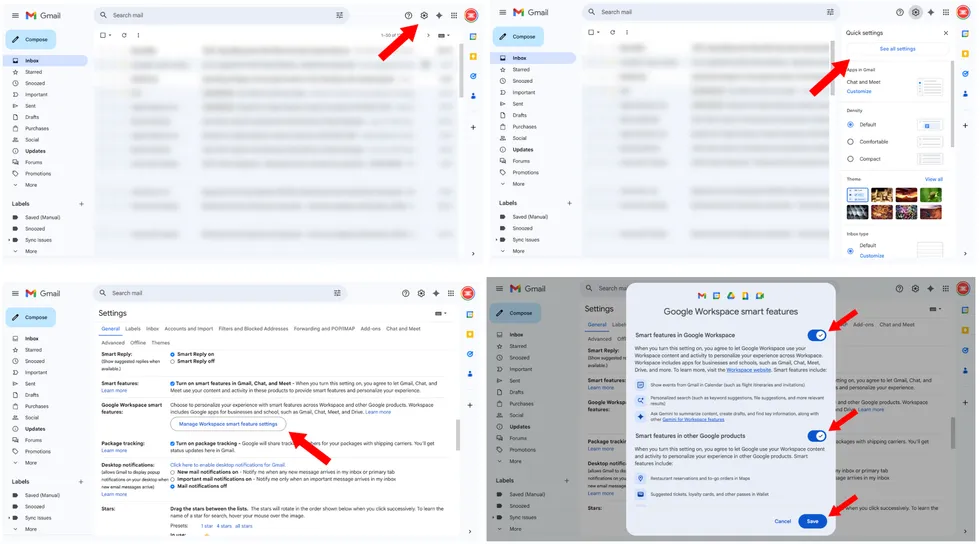 Four quick steps will free you from Gemini’s prying eyes.Screenshots by Zach Laidlaw
Now that you’ve disconnected Gemini from your content, you can do the same thing for all of Google’s apps and services with just a few clicks.
- Go back to the Settings page in Gmail.
- Find “Smart features.”
- Uncheck the blue box, and you’re all set.
 One check, total coverage.Screenshot by Zach Laidlaw
There’s only one way to get Google out of your data for good
Although you can keep Google’s apps, services, and Gemini out of your personal files, Google can still scan everything you throw into Drive, Gmail, and more. The best way to kick Google to the curb for good is to move your files out of Google’s ecosystem entirely.
The most private and secure way to save your data is to keep it on a local hard drive at home. This way, no cloud storage providers can access your content but you. There’s also a way to set up your own private cloud network so that you can still access your files remotely within your local hard drive, just as you do with Google Drive.
Otherwise, there are several cloud storage services that claim to be completely private. The leading option is Proton Drive (from the markers of the private email service Proton Mail). It leverages end-to-end, zero-access encryption to protect your data and stay out of your business. Another option is Sync.com, which uses end-to-end encryption and zero-knowledge authentication to keep your private files private.
Your data belongs to you, but unless your AI, cloud storage, and email providers have strict guidelines to protect your privacy, your data is open and accessible for all manner of reasons. Even worse, you agree to let them scan your content from the moment you create an account. This is why it’s a good idea to research the tools you use online, and always read the terms and conditions before you sign up. The integrity of your personal data and privacy depend on it.
A caregiver’s Christmas

A Christmas or two ago, we arrived in Denver just after Thanksgiving for my wife’s long-awaited surgery — one of a series of complex procedures that could only be done at the teaching hospital there. The hospital was already dressed for the season, garlands hung and trees lit, but I barely noticed. All I could see was the next hurdle in a long medical journey.
After eight days in the ICU, Gracie was transferred to the neuro floor. I wanted her to feel something of Christmas, so I slipped out to a store and returned with a small tree, poinsettias, battery candles for the window, and stockings I hung by the nurses’ message board. A friend loaned me a keyboard, which I tucked into the corner. Music has steadied us through many storms, and I hoped it would do so again.
Christmas felt sharper there. Simpler. More honest. When life strips away what doesn’t matter, what does matter finally comes into view.
When the nurses wheeled her into that room, she entered a tiny Christmas world carved out of tile and fluorescent light. The cinnamon-scented broom was no match for the Montana pines behind our home, but it still brought a smile.
Gracie sometimes sang from her hospital bed as I played familiar carols. You’ll be relieved to know that when a staffer requested Mariah Carey’s “All I Want for Christmas,” I politely declined and stayed with the classics. Her song gets ample airplay as it is.
Learning the language of hospital life
I have been a caregiver for a long time. We have spent nearly every major holiday in a hospital, along with most minor ones — birthdays, anniversaries, and the days in between.
Hospitals, however harsh, have become familiar enough that they no longer disorient me. In the last three years alone, we spent nearly 11 months in that same Denver hospital over three difficult stretches. Over the decades, Gracie has been inpatient in 13 different hospitals. After that many years, you learn the rhythms, the noises, the hush, and the hidden grief of those hallways.
At night, before crossing the street to the extended-stay hotel where I lived during that long stretch, I often stopped at the grand piano in the massive lobby and played Christmas hymns. Patients and their families drifted nearby or stood quietly along the balcony with IV poles and wheelchairs. Their faces carried the loneliness, fear, and disbelief that appear when life tilts without warning. When I played “Silent Night,” you could see the change. Shoulders dropped. Eyes softened. A few wiped away tears.
We lived in Nashville for 35 years before moving to Montana, and the only time I felt a lump in my throat at that piano was when I played “Tennessee Christmas.” When I reached the line about Denver snow falling, it hit me harder than I expected. Being far from home — and yet exactly where we needed to be — settled heavily on me in that moment.
Spending Christmas Eve in a hospital is unlike any other day. For a few minutes that night, the music gave all of us a place to breathe. While I’ve grown somewhat used to that world, I could tell my impromptu audience had not. So I played for them.
Not home, but holy
Our youngest son flew in, and a close friend joined us for Christmas Eve. In that small room upstairs, we shared meals, prayed, and laughed through the kind of tears that form when joy and exhaustion sit side by side. It was not home, but it was holy.
On Christmas morning, we filled stockings, opened gifts, and played more music. To our surprise, that hospital Christmas became one of the most meaningful we’ve ever known. We have enjoyed plenty of postcard holidays in the Montana Rockies, with snowy woods and trees cut from behind our cabin. Yet none of those scenes compared to the quiet radiance of that hospital room.
RELATED: What we lose when we rush past pain
 nathamag11 via iStock/Getty Images
Christmas felt sharper there. Simpler. More honest. When life strips away what doesn’t matter, what does matter finally comes into view.
God stepped into a harsh world, not a perfect one. The first Christmas came in conditions far cruder than ours, yet Heaven filled that stable. That is the story we remember every year: Emmanuel — God with us.
I thought of that as I looked up from the piano in the lobby, seeing the sadness on the faces around me and those watching from above. It brought to mind the crowds Jesus saw when Scripture says He was “moved with compassion” for the afflicted. Unlike me, He did not merely observe sorrow. He stepped into it. He came to bear it, redeem it, and ultimately remove it.
The light that still shines
That night reminded me that the holiness of Christmas is not found in perfect scenes but in God drawing near to people who are hurting. Being in a hospital on Christmas Eve was a fitting picture of how needy we truly are — and how miraculous it is that Christ entered our sorrow, suffering, and loneliness. Emmanuel means God with us, not in theory, but in the raw places where we feel most alone.
I left Denver with a truth I needed to keep close: Joy does not depend on scenery. Any place can become a sanctuary when Christ is worshipped — even a hospital room where monitors beep and nurses whisper through the night.
If you’re facing a season you never would have chosen, may this Christmas meet you with that same comfort. The promise of Emmanuel — God with us — has not changed.
“Yet in thy dark streets shineth the everlasting light; the hopes and fears of all the years are met in thee tonight,” Phillips Brooks wrote in 1868, steadying his people with the truth that Christ walks into dark streets as readily as bright ones.
It Is Not Time to PAUSE Immigration, Again
Doing the right thing in the wrong way can be a costly initiative, indeed — especially when Congress gets involved….