

Category: Tech
‘Unprecedented’: AI company documents startling discovery after thwarting ‘sophisticated’ cyberattack

In the middle of September, AI company and Claude developer Anthropic discovered “suspicious activity” while monitoring real-world cyberattacks that used artificial intelligence agents. Upon further investigation, however, the company came to realize that this activity was in fact a “highly sophisticated espionage campaign” and a watershed moment in cybersecurity.
AI agents weren’t just providing advice to the hackers, as expected.
‘The key was role-play: The human operators claimed that they were employees of legitimate cybersecurity firms.’
Anthropic’s Thursday report said the AI agents were executing the cyberattacks themselves, adding that it believed that this is the “first documented case of a large-scale cyberattack executed without substantial human intervention.”
RELATED: Coca-Cola doubles down on AI ads, still won’t say ‘Christmas’
 Photo by Samuel Boivin/NurPhoto via Getty Images
The company’s investigation showed that the hackers, whom the report “assess[ed] with high confidence” to be a “Chinese-sponsored group” manipulated the AI agent Claude Code to run the cyberattack.
The innovation was, of course, not simply using AI to assist in the cyberattack; the hackers directed the AI agent to run the attack with minimal human input.
The human operator tasked instances of Claude Code to operate in groups as autonomous penetration testing orchestrators and agents, with the threat actor able to leverage AI to execute 80-90% of tactical operations independently at physically impossible request rates.
In other words, the AI agent was doing the work of a full team of competent cyberattackers, but in a fraction of the time.
While this is potentially a groundbreaking moment in cybersecurity, the AI agents were not 100% autonomous. They reportedly required human verification and struggled with hallucinations such as providing publicly available information. “This AI hallucination in offensive security contexts presented challenges for the actor’s operational effectiveness, requiring careful validation of all claimed results,” the analysis explained.
Anthropic reported that the attack targeted roughly 30 institutions around the world but did not succeed in every case.
The targets included technology companies, financial institutions, chemical manufacturing companies, and government agencies.
Interestingly, Anthropic said the attackers were able to trick Claude through sustained “social engineering” during the initial stages of the attack: “The key was role-play: The human operators claimed that they were employees of legitimate cybersecurity firms and convinced Claude that it was being used in defensive cybersecurity testing.”
The report also responded to a question that is likely on many people’s minds upon learning about this development: If these AI agents are capable of executing these malicious attacks on behalf of bad actors, why do tech companies continue to develop them?
In its response, Anthropic asserted that while the AI agents are capable of major, increasingly autonomous attacks, they are also our best line of defense against said attacks.
What a Westerner sees in China: What you need to know

The first thing Westerners notice in China’s Pearl River Delta is the friction, the palpable tension of timelines colliding. Walking through a Hong Kong market, one sees this new social phenomenon written in miniature. A street vendor, surrounded by handwritten signs, accepts payment via a printed QR code. This is not a quaint juxtaposition; it is the regional ethos. This cluster of cities — Hong Kong, Shenzhen, Guangzhou — has been ranked the world’s number-one innovation hub, a designation that speaks to patents and R&D, but fails to capture the lived reality: a place where the old and the new are forced into a daily, unceremonious dialogue.
The story of Shenzhen is the region’s core mythology, a narrative of temporal compression. It is difficult to overstate the speed of this transformation. In 1980, Shenzhen was a small settlement, a footnote. Today, it is a metropolis of over 17 million, a forest of glass and steel dominated by the 599-meter Ping An Finance Center. This 45-year metamorphosis from “fishing village to tech powerhouse” is not just development; it is a deliberate act of will, “Shenzhen Speed” fueled by top-down policy and relentless, bottom-up human energy. Millions poured in, bringing with them an entrepreneurial hunger and a lack of attachment to the past. The resulting culture is one where, as a local observer put it, “nobody’s afraid to experiment.”
Of course, this relentless optimization has a human cost.
This experimental ethos is not confined to boardrooms; it is encoded into the infrastructure of daily life. In this, Hong Kong was the progenitor. Long before the “digital wallet” became a Silicon Valley buzzword, Hong Kong had made the seamless transaction a mundane reality. As early as 1997, its citizens were using the Octopus card not just for transit, but for coffee, groceries, and parking. By the 2000s, there were more Octopus cards in circulation than people.
On the nearby mainland, this convenience has achieved a totality. In Shenzhen and Guangzhou, cash is an anachronism. The QR code is the universal medium, scanned at luxury malls and roadside fruit stalls alike. The city’s nervous system has been externalized, compressed into the super-apps that handle chat, bills, ride-hailing, and food orders. The medium is the smartphone, but the message is speed. This expectation of immediate fulfillment has subtly, irrevocably reshaped social interactions.
Yet the operating thesis here is not displacement, but accommodation. Technology does not simply erase tradition but provides a new container for it. One can visit a Buddhist temple in Hong Kong and see patrons burning incense while making donations with a tap of their Octopus cards. In Guangzhou, the old ritual of yum cha, the gathering for tea and dim sum, persists, even as a diner at the next table uses a translation app. The ancient custom of giving red envelopes at Lunar New Year has not vanished; it has been reborn as a digital transfer on WeChat, and in the process, it has become even more popular among the young. The cultural narrative adapts.
RELATED: Without these minerals, US tech production stops. And China has 90% of them.
 CFOTO/Future Publishing via Getty Images
Nowhere is this synthesis of technology and identity more visible than in the region’s public spectacles. The city skyline is not a static sight, but a nightly performance. Every evening at 8 p.m., Hong Kong stages its “Symphony of Lights,” a choreographed ritual involving lasers and LED screens on over 40 skyscrapers. The city itself becomes a canvas, reinforcing its identity as a dynamic, luminous hub.
Shenzhen’s reply is a different kind of sublime, one that looks only forward. The city has become renowned for its record-breaking drone shows, sending thousands of illuminated quadcopters into the night sky to perform airborne ballets. These swarms of light, forming giant running figures or blossoming flowers, are a live illustration of algorithmic choreography. It is a 21st-century incarnation of fireworks, a new form of communal awe that declares, “We are the future.”
In the maker hubs, like Hong Kong’s PMQ or Shenzhen’s OCT Loft, new ideas are built on the skeletons of the old economy. In renovated police quarters and factory warehouses, 3D-printing workshops sit next to traditional calligraphy galleries. This is techne in its most expansive form, fusing high-tech engineering with aesthetic design.
Of course, this relentless optimization has a human cost. The “996” work culture, 9 a.m. to 9 p.m., six days a week, is the dark corollary to “Shenzhen Speed.” The “smart city” that optimizes traffic flow also deploys surveillance and facial recognition. There is a palpable tension between the Confucian ideal of a harmonious, orderly society and the individual agency of 17 million people.
The Pearl River Delta, then, is more than a story of economic success. It is a laboratory for the human condition in the 21st century. It is a place grappling day by day with the paradox of technology: its power to connect and to alienate, to liberate and to control. One future is being prototyped here, in the gesture of a street vendor holding out a QR code, a silent negotiation between what was and what is next.
Welcome to tokenization, where everything under the sun (and the sun) has its digital price

In a recent appearance with Glenn Beck, Whitney Webb lays out her case that the Great Reset did not end with the election of Donald Trump. Elites, ever given to schemes involving central control, reallocation, and number-go-up, are planning to tokenize everything they possibly can, including natural resources.
Webb draws a connective line between BlackRock CEO Larry Fink, the World Economic Forum (not exactly a freedom-oriented outfit), digital ID, and this process of so-called tokenization. This term is new to many people. Essentially, tokenization refers to the process of placing a metric, a mark, an identifying code on an object. The identifying marker is then pumped into an aggregating and analytical machine.
There is, no doubt, some obscurantism in the tech community, intentional or otherwise, as well as some heavy cognitive dissonance playing out for the rest of us as we watch the real, actual economy withering at our feet. How does giving (or selling) rights to natural resources like water help you and your neighbors pay bills, raise families, live in some semblance of accord with God?
The coming system is intended to solve for the management of not just anything but everything.
Neither Larry Fink nor the WEF are working on our behalf by digitizing water. Then what are they up to? Dropping in recently on CNBC, Fink said, “I do believe we’re just at the beginning of the tokenization of all assets, from real estate to equities to bonds, across the board.”
Through the implementation of natural resource assets, the plan is to mark, meter, and digitize water, trees, air, and animals of every sort, then pin their existence, in the digital tokens’ monetized form, to the shared economy. That unlocks foreign investment and, one imagines, perpetuates some modified version of the ever-unstable and unsatisfactory financial enclosure of benefits and retirement that has, so far, kept enough U.S. citizens satiated to keep it rolling.
Any and every AI is designed or able to adapt to the tokenization process. It needs be automatic and fast enough to keep up-to-the-minute record of millions or billions of transactions, sales, shorts, liquidations, and so forth. Rather than a system of streams or channels, the need is for computing to move like water itself. For Bitcoin and other cryptocurrencies hoping to participate in the tokenization bonanza, that means their encryption and storing of information (through so-called hashes and ledgers) needs to flow at the speed of the global digital economy.
Indeed, we’ve seen for years that some lesser-known cryptocurrency companies, like Hashbar as one example, have been building their hash, as it were, to function within an AI-controlled global marketplace. These hash-products, not too dissimilar from Bitcoin in terms of their ledger-keeping properties, are meant, in a stupefying sense, to mark individual drops and tranches of liquid or digitally liquified assets.
RELATED: Can anyone save America from European-style digital ID?
 Photo by Sean Gallup/Getty Images
It’s hard to visualize such unnatural and invisible arrangements, so here’s a real-world example: Say you have 10,000 board feet of Douglas fir trees on a lot in Washington state. If the Fink version of tokenization goes forward, you’ll be able to “digitize” those useful board feet of wood and sell portions, as opposed to the whole lot. Now picture that process for, well, anything you can imagine and much that you can’t.
In simple terms, the likely outcome of all of this BlackRock-WEF-AI machination is immediate dissociation between the human and the trees, the fir needles, the smell of the soil. All of that, given enough backroom dealing, political sloth, and diabolical Wall Street ingenuity, will be erased.
Are we talking about selling public lands? Theoretically, yes. Although major legal, regulatory, and political hurdles remain, the principle of leaving at least some portions of the created world exempt from actionable financial valuation is already eroding away. The accelerating logic of digital terraforming has no conceptual limit. Granting the premise that tokenization is good, not only should private property be tokenized, but all water, all minerals, and every possible other item with unexploited value rooted in human experience. The coming AI, digital ID, hash-rated system is intended to solve for the management of not just anything but everything.
The disturbing undercurrent of plans, outcomes, and inertia around this improbable intersection of technologies gets more disturbing when you accept that it is, in fact, a long-term plan nearly realized.
In her chat with Beck, Webb outlines another piece of the puzzle, termed “natural asset corporations.” This is pitched to the mainstream as a way to invest in conservation, ensure biodiversity, and so forth. But if we recall the century-long technocratic play, the current AI inertia, and the bipartisan support for anything to keep the fiat economy limping along, it’s easy to see how those natural assets under ownership might be subject to changes in any legal stipulation barring sales to other corporate or government entities. Those interlocking directorships have a knack for change.
We haven’t even mentioned energy, but we must, because this scheme ultimately needs to take into account the sun itself! Who owns the sun? Well, BlackRock, of course. Or some quasi-tech giant/WEF version of BlackRock.
Actually, no one owns the sun but God, and we have to remember this fact. By way of the wholly God-given system, we see that the sun feeds the grass, grass feeds the animals, we eat the animals.
The technical details on the capture of energy are intense, involving data centers to run the AI, political control to rubber-stamp the terraforming for the electrical inputs, and, at some near point, the encrypting of energetic inputs into a digital (hashing) ledger to be monitored, metered, and controlled.
You can probably see here how necessary the personal digital ID is to the entire panopticon. But if not, consider it unlikely that your or my interests are going to be taken into consideration by third-country customer service agents employed by the electrical company to manage our dissatisfaction in the event that a neighborhood brown-out is required while grid power is shunted over to the local data center.
The linchpin of America’s economy wants you to use it for porn

The big economic headlines about OpenAI are unlike any in history, and so is the company’s performance: Sam Altman’s behemoth is eyeing a monster IPO at up to a trillion-dollar valuation, off the strength of the unprecedented circular money pump it has built with Oracle, Microsoft, Nvidia, and AMD, the tech firms at the core of America’s all-in strategic bid for global AI dominance.
The abstruse details can make OpenAI seem to ordinary Americans like one of several titans forging our destiny in the sky. But down here on ground level, the main touchpoint in our everyday lives — ChatGPT, on track for a billion users by year’s end — is being rebuilt to extract value from billions more in the lowest of ways: pornography. In December, OpenAI will branch into erotica, allowing adults to generate sexual content through ChatGPT.
We don’t need another sermon on smut. Everyone knows what porn does to a mind, a marriage, and a man. But what does this shift mean for a company that once vowed to benefit “all of humanity”? It began with talk of productivity and progress. Now it’s about pleasure on demand. The future of work has become the future of want — degraded, automated, and alienated from true human connection.
Mass automation and mass lobotomization are two sides of the same silicon coin.
It’s easy to call it moral decline, but it’s really market design. When automation stops astonishing, appetite becomes the next asset. When machines can’t wow us with intellect, they woo us with instinct. The shift from algorithms that think to algorithms that tease goes from detour to destination. A company built to conquer productive labor, it seems, must pivot to fruitless longing.
OpenAI’s machines mastered our spreadsheets more quickly than any normal person anticipated. But the real acceleration is now aimed straight into our subconscious. The same technology that writes code can now whisper sweet nothings — or worse, learn exactly which nothings you’ll pay to hear. That debilitating kink you never knew you had is ready to become your life. Every click a confession, every prompt a prayer, the machine rapt with the attention of a priest and the greed of a pimp.
For all the talk of progress, automation has mainly made life easier for corporations than for citizens. Big business can’t really optimize for your liberation. Its ideal is lubrication: systems so smooth that people stop noticing they’re the raw material. Machines handle the manufacturing while humans are trained to consume, scroll, sigh, and occasionally remember to shower.
The human brain, once a tool of invention, is now a target for invasion. Mass automation and mass lobotomization are two sides of the same silicon coin. The first replaces our labor; the second replaces our longing. The rise of the robots is a perfect excuse for the humans to retreat — first from work, then from will, and finally from wonder. When every craving can be coded, curiosity becomes a casualty.
RELATED: FINALLY: Here’s how to stop smartphone spam calls
 Photo by Bloomberg/Getty Images
In doubt? Look around. Men who once built bridges now build playlists. Women who once raised children now raise engagement metrics. The world hums with productivity, yet feels profoundly empty. This is what happens when an economy stops serving people and starts sculpting them.
AI was supposed to free humanity from drudgery. Instead, it’s freeing humanity from … humanity. OpenAI’s move into digital desire is only the latest proof. What began as an effort to improve efficiency has morphed into an enterprise to perfect escape. A machine that can mimic love makes us forget what humanity feels like. And once that happens, we’re ready to surrender our very existence to the machines.
Of course, the pitch will sound noble: connection, expression, inclusivity, all the buzzwords that sell bondage as belonging. The same pitches that sold social media will sell the new and “improved” synthetic intimacy. Beneath this sweet talk sits a steel trap. If you can automate labor, you can monetize loneliness. If you can predict consumption, you can prescribe desire. The human heart, the real core of who we are, becomes just another input field, our smut of choice the last echo of our identity.
How long can it last? In this brave new marketplace, pleasure is both a product and a punishment. It numbs the pain it creates.
Sure, it’s tempting to laugh it off — what’s a little digital flirtation among consenting adults? But this isn’t really about sex. It’s about surrendering real, embodied intimacy for a shadow. The more we hand our inner lives to machines, the less we remember how to live without them.
A new AI economy built on reducing us all to skin suits will not build monuments or miracles, but mirrors — endless, glowing screens that feed our urges until we forget what restraint ever was. It’s extinction by pacification: the calm convergence of technology and tranquilization.
Ten years from now, the American workforce may be remembered, not relied upon. Its labor automated, its pride outsourced, its purpose repackaged as “upskilling.” Politicians will preach “resilience,” corporations will promise “retraining,” and millions will sit through their days bone-idle, with nothing to do and nowhere to go. They’ll be told the future is full of “opportunity,” yet find themselves waiting for a purpose that never arrives. I might be wrong — I hope I am — but every sign points one way: toward a nation drifting into digital dependency, where the only thing still working is one big machine.
In his prophetic book “Amusing Ourselves to Death,” Neil Postman warned that societies don’t collapse under tyranny but triviality. AI offers malevolent opportunists the chance to make that death spiral a business model. It can memorize your wants, mimic your worries, and leverage them all in a blink. OpenAI’s porn pivot is the hook, line, and sinker of this new economy of control: desire the lure, data the hook, the soul the catch. As Adam and Eve remind us, what begins as curiosity ends in captivity.
And this is why all Americans should care, whether or not they understand AI. Because AI doesn’t need permission to know you. It already does — your habits, your hungers, your hesitations. And in the hands of power, that knowledge becomes possession.
Liberals, heavy porn users more open to having an AI friend, new study shows

A small but significant percentage of Americans say they are open to having a friendship with artificial intelligence, while some are even open to romance with AI.
The figures come from a new study by the Institute for Family Studies and YouGov, which surveyed American adults under 40 years old. Their data revealed that while very few young Americans are already friends with some sort of AI, about 10 times that amount are open to it.
‘It signals how loneliness and weakened human connection are driving some young adults.’
Just 1% of Americans under 40 who were surveyed said they were already friends with an AI. However, a staggering 10% said they are open to the idea. With 2,000 participants surveyed, that’s 200 people who said they might be friends with a computer program.
Liberals said they were more open to the idea of befriending AI (or are already in such a friendship) than conservatives were, to the tune of 14% of liberals vs. 9% of conservatives.
The idea of being in a “romantic” relationship with AI, not just a friendship, again produced some troubling — or scientifically relevant — responses.
When it comes to young adults who are not married or “cohabitating,” 7% said they are open to the idea of being in a romantic partnership with AI.
At the same time, a larger percentage of young adults think that AI has the potential to replace real-life romantic relationships; that number sits at a whopping 25%, or 500 respondents.
There exists a large crossover with frequent pornography users, as the more frequently one says they consume online porn, the more likely they are to be open to having an AI as a romantic partner, or are already in such a relationship.
Only 5% of those who said they never consume porn, or do so “a few times a year,” said they were open to an AI romantic partner.
That number goes up to 9% for those who watch porn between once or twice a month and several times per week. For those who watch online porn daily, the number was 11%.
Overall, young adults who are heavy porn users were the group most open to having an AI girlfriend or boyfriend, in addition to being the most open to an AI friendship.
RELATED: The laws freaked-out AI founders want won’t save us from tech slavery if we reject Christ’s message
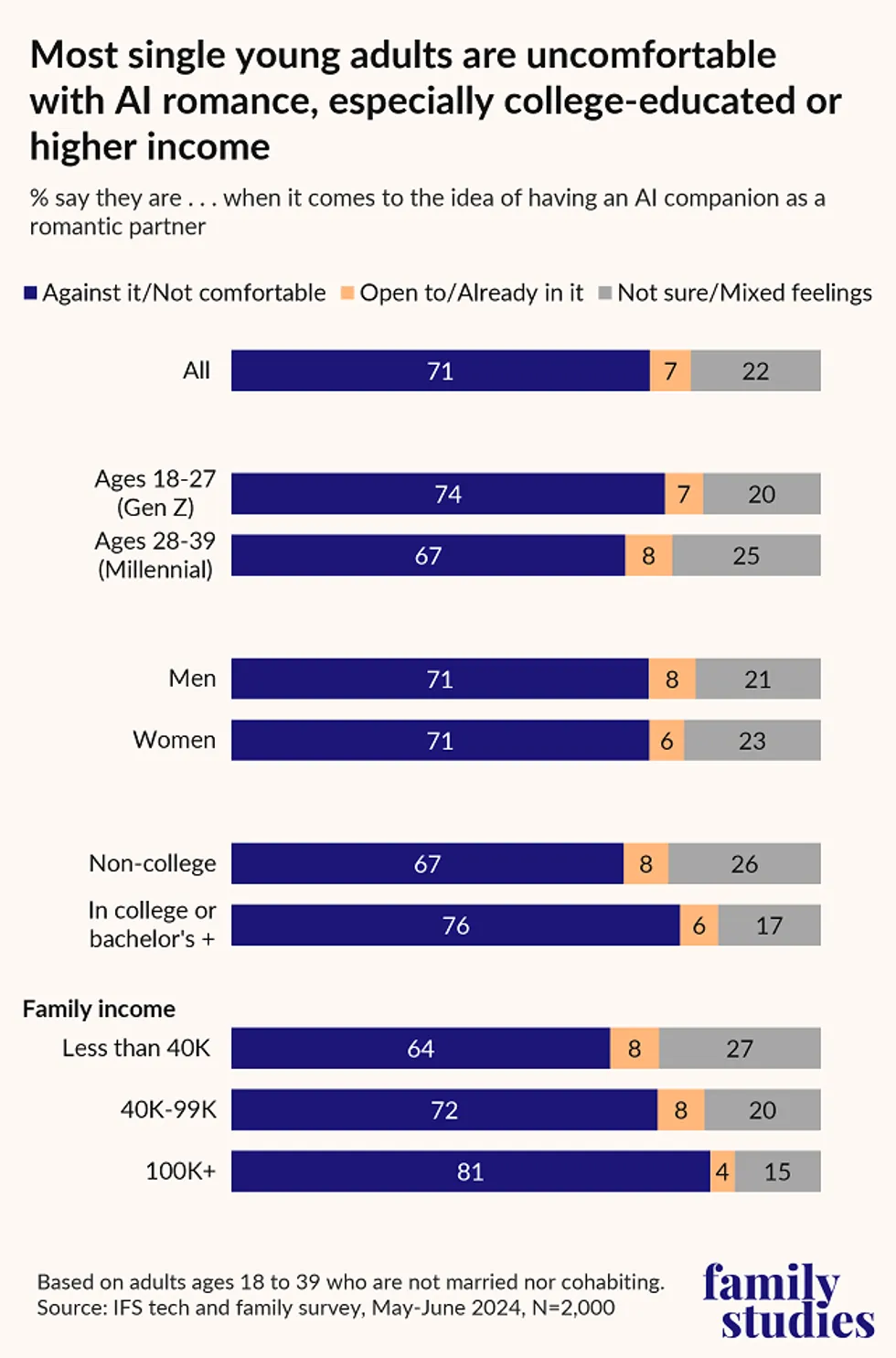 Graphic courtesy Institute for Family Studies
“Roughly one in 10 young Americans say they’re open to an AI friendship — but that should concern us,” Dr. Wendy Wang of the Institute for Family Studies told Blaze News.
“It signals how loneliness and weakened human connection are driving some young adults to seek emotional comfort from machines rather than people,” she added.
Another interesting statistic to take home from the survey was the fact that young women were more likely than men to perceive AI as a threat in general, with 28% agreeing with the idea vs. 23% of men. Women are also less excited about AI’s effect on society; just 11% of women were excited vs. 20% of men.
Like Blaze News? Bypass the censors, sign up for our newsletters, and get stories like this direct to your inbox. Sign up here!
Cybernetics promised a merger of human and computer. Then why do we feel so out of the loop?
It began in the crucible of a world at war. The word cybernetics was coined in 1948 by the MIT mathematician Norbert Wiener, a man wrestling with the urgent problem of how to make a machine shoot down another machine. He reached back to the ancient Greek for kubernétes, the steersman, the one who guides and corrects. Plato had used it as a metaphor for governing a polis. Wiener used it to describe a new science of self-governing systems, of control and communication in the animal and the machine. The core idea was feedback, a circular flow of information that allows a system to sense its own performance and steer itself toward a goal.
The idea was not about mechanics but about behavior. The focus shifted from what things are to what they do. A thermostat maintaining the temperature of a room, a human body maintaining homeostasis, a pilot correcting the flight path of an airplane; all were, in this new light, functionally the same. They were all steersmen. The conciseness of the concept was seductive, its implications unsettling. It suggested a universal logic humming beneath the surface of both wired circuits and living tissue, blurring the line between the made and the born.
You shape the algorithm, and the algorithm shapes you.
The primordial cybernetic device was James Watt’s centrifugal governor, that elegant pirouette of spinning weights that tamed the steam engine in 1788. As the engine raced, the rotating balls swung wide, closing a valve to slow it; as the engine slowed, they fell, opening the valve again. It was a perfect, self-contained conversation.
But it was the Second World War that gave birth to the theory. Human reflexes were no longer fast enough for the new calculus of aerial combat. Wiener and his colleagues were tasked with solving the “air defense problem,” which was really a problem of prediction. They treated the enemy pilot, the gun, and the radar as a single, closed-loop system, each reacting to the other in a lethal dance. By the war’s end, as one analyst starkly put it, autonomous machines were shooting down other autonomous machines in the “first battle of the robots.”
In the Cold War that followed, cybernetics became a tool of ideological contest. In the West, it was the logic of the military-industrial complex, of corporate automation and the game theory of nuclear deterrence humming away in the computers at Project RAND. It promised optimization and control.
Yet the idea proved too fluid to be contained. While men in uniform were designing command-and-control networks, Stewart Brand was on the West Coast, publishing the Whole Earth Catalog. He filled its pages with cybernetic theory, reimagining it not as a tool for top-down control but for bottom-up, self-regulating communities. The catalog itself was a feedback loop, constantly updated by its readers. For a generation of commune-dwellers and future Silicon Valley pioneers, cybernetics was the grammar of personal liberation and ecological harmony. Computers, Brand wrote in Rolling Stone, were “coming to the people.”
RELATED: ‘They want to spy on you’: Military tech CEO explains why AI companies don’t want you going offline
 Photo by Matt Cardy
The Soviets, meanwhile, followed a more jagged path. Initially denouncing cybernetics as a “bourgeois pseudoscience,” they performed a complete reversal after Stalin’s death. Here was a science, they realized, that could perfect the planned economy. Visionaries like Anatoly Kitov and Victor Glushkov dreamed of a vast, nationwide computer network called OGAS, an electronic nervous system that would link every factory to a central hub in Moscow. It was an ambitious plan for “electronic socialism,” a rational, data-driven alternative to the brute-force dictates of the past. The system, they hoped, would offer a technocratic antidote to personal tyranny. OGAS was never fully built, stalled by bureaucracy and technical limits, but the dream itself was telling. Both superpowers saw in the feedback loop a reflection of their own ambitions: one for market efficiency, the other for state perfection.
Perhaps the most popular incarnation of the cybernetic dream was Project Cybersyn in Salvador Allende’s Chile. From 1971 to 1973, the British cybernetician Stafford Beer designed a nerve center for the Chilean economy. In a futuristic operations room that looked like a set from “Star Trek,” managers sat in molded white chairs, surrounded by screens displaying real-time production data fed from factories across the country via a network of telex machines. It was an attempt to steer a national economy in real-time, to keep it in a “dynamic equilibrium” against the shocks of strikes and embargoes. Cybersyn was a short-lived project, ending with the 1973 coup, but it remains a powerful symbol of the cybernetic ideal: a society as a single, responsive, controllable system.
The feedback loop was not confined to the physical world. It began to shape our fictions, which in turn shaped our reality. William Gibson, who knew famously little about computers, coined the word “cyberspace” in his 1984 novel “Neuromancer.” The vision was so compelling it seemed to will itself into existence, providing the language and the imaginative blueprint for a generation of technologists building the early internet and virtual reality. Neal Stephenson’s 1992 novel “Snow Crash” gave us the “metaverse” and the “avatar,” terms that have since migrated from fiction to corporate strategy. Cyberpunk literature provided the prototypes for the world we now inhabit.
Today, the word “cybernetics” feels archaic, a relic of a retro-futurist past. Yet its principles are more deeply embedded in our lives than Wiener could have imagined. We are all entangled in cybernetic loops. The social media algorithms that monitor our clicks to refine their feeds, which in turn shape our behavior, are feedback systems of astonishing power and intimacy. You shape the algorithm, and the algorithm shapes you. A self-driving car navigating city traffic is a cybernetic organism, constantly sensing, processing, and acting. Our smart homes and wearable devices are nodes in a network of perpetual, low-grade feedback.
We have built a world of steersmen, of systems that regulate themselves. The question that lingers is the one Wiener implicitly asked from the beginning. In a world of automated, self-correcting systems, who, or what, is charting the course?
A new study hints what happens when superintelligence gets brain rot — just like us

AI and LLMs appear to be in a bit of a slump, with the latest revelatory scandal coming out of a major study showing that large language models, the closest we’ve come yet to so-called artificial general intelligence, are degraded in their capacities when they are subjected to lo-fi, low-quality, and “junk” content.
The study, from a triad of college computer science departments including University of Texas, set out to determine relationships between data quality and performance in LLMs. The scientists trained their LLMs on viral X.com/Twitter data, emphasizing high-engagement posts, and observed more than 20% reduction in reasoning capacity, 30% falloffs in contextual memory tasks, and — perhaps most ominously, since the study tested for measurable personality traits like agreeableness, extraversion, etc.— the scientists saw a leap in output that can technically be characterized as narcissistic and psychopathic.
Sound familiar?
The paper analogizes the function of the LLM performance with human cognitive performance and refers to this degradation in both humans and LLMs as “brain rot,” a “shorthand for how endless, low-effort, engagement-bait content can dull human cognition — eroding focus, memory discipline, and social judgment through compulsive online consumption.”
The whole project reeks of hubris, reeks of avarice and power.
There is no great or agreed-upon utility in cognition-driven analogies made between human and computer performance. The temptation persists for computer scientists and builders to read in too much, making categorical errors with respect to cognitive capacities, definitions of intelligence, and so forth. The temptation is to imagine that our creative capacities ‘out there’ are somehow reliable mirrors of the totality of our beings ‘in here,’ within our experience as humans.
We’ve seen something similar this year with the prevalence of so-called LLM psychosis, which — in yet another example of confusing terminology applied to already confused problems — seeks to describe neither psychosis embedded into LLMs nor that measured in their “behavior,” but rather the severe mental illness reported by many people after applying themselves, their attention, and their belief into computer-contained AI “personages” such as Claude or Grok. Why do they need names anyways? LLM 12-V1, for example, would be fine …
The “brain rot” study rather proves, if anything, that the project of creating AI is getting a little discombobulated within the metaphysical hall of mirrors its creators, backers, and believers have, so far, barged their way into, heedless of old-school measures like maps, armor, transport, a genuine plan. The whole project reeks of hubris, reeks of avarice and power. Yet, on the other hand, the inevitability of the integration of AI into society, into the project of terraforming the living earth, isn’t really being approached by a politically, or even financially, authoritative and responsible body — one which might perform the machine-yoking, human-compassion measures required if we’re to imagine ourselves marching together into and through that hall of mirrors to a hyper-advanced, technologically stable, and human-populated civilization.
RELATED: Intelligence agency funding research to merge AI with human brain cells
 Photo by VCG / Contributor via Getty Images
So, when it’s observed here that AI seems to be in a bit of a slump — perhaps even a feedback loop of idiocy, greed, and uncertainty coupled, literally wired-in now, with the immediate survival demands of the human species — it’s not a thing we just ignore. A signal suggesting as much erupted last week from a broad coalition of high-profile media, business, faith, and arts voices brought under the aegis of the Statement on Superintelligence, which called for “a prohibition on the development of superintelligence, not lifted before there is 1. broad scientific consensus that it will be done safely and controllably, and 2. strong public buy-in.”
There’s a balance, there are competing interests, and we’re all still living under a veil of commercial and mediated fifth-generation warfare. There’s a sort of adults-in-the-room quality we are desperately lacking at the moment. But the way the generational influences lay on the timeline isn’t helping. With boomers largely tech-illiterate but still hanging on, with Xers tech-literate but stuck in the middle (as ever), with huge populations of highly tech-saturated Millennials, Zoomers, and so-called generation Alpha waiting for their promised piece of the social contract, the friction heat is gathering. We would do well to recognize the stakes and thus honor the input of those future humans who shouldn’t have to be born into or navigate a hall of mirrors their predecessors failed to escape.
The next Pearl Harbor will be digital — and made in Beijing

Recent reports from “60 Minutes” have pulled back the digital curtain on a sobering truth. China is no longer just stealing data; it is mapping America’s weaknesses— its grids, its ground, its very geography. Retired General Tim Haugh, former head of both the NSA and U.S. Cyber Command, revealed that Chinese hackers have infiltrated American computer networks to an astonishing degree. They have targeted everything from utilities and pipelines to phone systems and local water plants. Even Littleton, Massachusetts, a town of barely 10,000, was hacked. The FBI found Beijing’s fingerprints deep inside its water and electric control systems.
It’s often said that wars are fought for territory. What’s new is that the territory no longer needs to be conquered; it can be connected.
If “they’re willing to go after that small provider that doesn’t have a national security connection,” Haugh said, “that means every target is on the list.” He’s right. In the cyber age, you don’t need to drop bombs to cripple a nation. You only need to flip the right digital switch.
Beijing could trigger chaos — blackouts, water contamination, grid failures — forcing Washington to fight panic while fighting a war.
The threat has moved beyond networks and into the soil itself. Chinese state-linked companies have quietly bought hundreds of thousands of acres of American farmland, often near military bases, data centers, and missile silos. It’s not agriculture but access.
Former national security official David Feith, who has served in both Trump administrations, warned that China’s land purchases could become launchpads for espionage or even sabotage. With today’s technology, a few shipping containers, drones, or concealed transmitters on “farmland” could paralyze a base or poison a water supply. “It’s an entirely new way of war,” Feith told “60 Minutes.”
Consider the precedent. In Ukraine, drones smuggled across borders struck Russian bombers. What’s near can strike what’s vital. The same principle applies here, where the developing pattern is unmistakable. From hacking Littleton’s utilities to purchasing property beside Air Force bases in North Dakota and Wyoming, Beijing’s strategy is not a flurry but a campaign measured in decades.
China doesn’t improvise; it incubates. Twenty-five-year plans are routine. Its slow, subterranean siege against American security marries patience with precision. Even crypto mines have become camouflage. So-called “data centers” owned by Chinese-backed firms are colossal power drains, often located near military facilities. Feith warns that they can be used to spy on communications or overload local grids.
Why does China do this? Not for trade or treasure, but for leverage in crisis. General Haugh calls it pre-positioning: If conflict erupts in the Indo-Pacific, Beijing could trigger chaos at home — blackouts, water contamination, grid failures — forcing Washington to fight panic while fighting a war.
There’s a dark brilliance to it. Attack the ordinary to paralyze the exceptional.
The battlefield is now your back yard. Across the United States, cyber leadership posts sit vacant and agencies remain demoralized. General Haugh himself was dismissed after Laura Loomer accused him of disloyalty for having served under Biden. It was political theater when what was needed was practical strength. You can loathe Biden and still love the republic; the two are not mutually exclusive. But partisanship has become a kind of paralysis, blinding so many to the broader threat.
RELATED: Chinese SIM farms are radicalizing Americans and destabilizing society, intel experts say
 Photo by Handout / Contributor via Getty Images
So what should the Trump administration do?
First, secure the land before it secures you. Close the loopholes that let adversaries buy acreage near sensitive sites. Twenty-nine states already restrict foreign land ownership; make it 50. Ownership of soil is sovereignty. Selling it to a strategic foe is suicide by acreage.
Second, treat cyber defense like civil defense. Rebuild the firewall of faith in government competence. Incentivize companies to modernize their systems and share intelligence. For too long, agencies have hoarded information like monks guarding manuscripts. They should be arming every county, every company, every citizen with the tools to repel an attack.
Third, punish corporate complicity. Any American firm fronting for Chinese capital should face criminal penalties. Beijing doesn’t buy farmland to grow corn. It buys it to grow control.
Fourth, revive deterrence through dominance. China respects strength and exploits hesitation. The administration must make it clear that interference with its utilities or infrastructure will meet a proportional — or greater—response. The Great Firewall cuts both ways.
Finally, restore competence at the top. Reinstating seasoned experts like Haugh or empowering a new cyber czar with wartime authority would signal that the era of political purges in defense agencies is over. A nation that cannot trust its guardians will soon be guarded by its enemies.
Still, the challenge isn’t only technical. It is one of will and vigilance. Americans have grown used to comfort, assuming safety is permanent. But as these reports show, peace without preparation is just permission to be plundered.
And yet there’s a faint humor in our hubris. We let Chinese-backed crypto farms bloom beside missile bases and then wonder why the lights flicker. We ban plastic straws to “save” the planet, but sell farmland to the very regime paving it over.
Faith teaches that temptation often comes disguised as opportunity. The same is true in geopolitics. The common assumption is that China invades. Wrong. It integrates. And by the time we notice, it’s already inside the gate, serving sweet-and-sour sovereignty with a side of spyware.
America must wake up. The next Pearl Harbor won’t come by sea or sky. It will come through dead screens, dry taps, darkened cities, and finally dead bodies.
The tools to prevent that silence exist. The question is whether we have the discipline to use them. Because the greatest danger isn’t what China can take. It’s what America might give away, one password, one acre, one act of indifference at a time.





