Category: Conservative Review
Federal Reserve obliges Trump, cuts interest rates for the third time this year
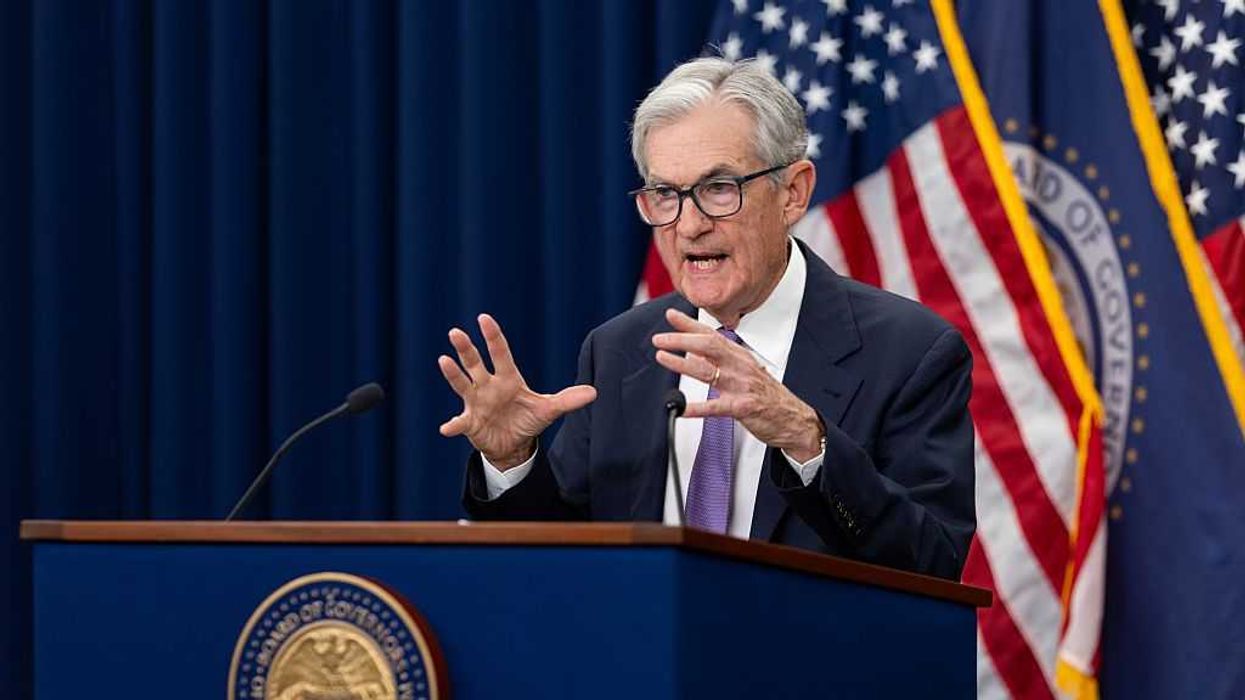
In a move championed by President Donald Trump, the Federal Reserve cut its key interest rate by 0.25% to a range of 3.5% to 3.75% on Wednesday, the third cut this year, lowering borrowing costs and giving some lift to a flagging job market.
Only three members of the Federal Reserve Board of Governors voted against the cut: Stephen Miran, who wanted to lower the target range for the federal funds rate by 0.5%, and Austan Goolsbee and Jeffrey Schmid, who both figured it was presently best not to have any cuts at all.
‘Available indicators suggest that economic activity has been expanding at a moderate pace.’
Joseph Brusuelas, chief economist for the financial services firm RSM US, noted in a Tuesday analysis that the Fed was faced with the “difficult choice of either aggressively fighting inflation or hoping to revive a sluggish labor market and slowing economic activity when it meets on Tuesday and Wednesday.”
Rate cuts can help boost the stock market — encouraging spending, investing, and business activity by lowering savings rate and borrowing costs. However, by increasing the supply of money, they can also exacerbate inflation.
The annual inflation rate was around 3% for the 12 months ending September, according to U.S. Labor Department data. The Fed’s inflation target is 2% over the longer run — hence the resistance to another cut by some policymakers.
“The [Federal Open Market Committee] seeks to achieve maximum employment and inflation at the rate of 2 percent over the longer run. Uncertainty about the economic outlook remains elevated,” the Fed said in a statement on Wednesday. “The Committee is attentive to the risks to both sides of its dual mandate and judges that downside risks to employment rose in recent months.”
In light of its goals and “the shift in the balance of risks,” the FOMC determined that a drop in the rate by 0.25% was worthwhile.
“Available indicators suggest that economic activity has been expanding at a moderate pace. Job gains have slowed this year, and the unemployment rate has edged up through September,” the Fed noted further. “Inflation has moved up since earlier in the year and remains somewhat elevated.”
The rate-cut decision on Wednesday comes months after the Fed similarly lowered its benchmark interest rate by 25 basis points in September to a range of 4% to 4.25%, and after weeks of disagreement on the central bank’s 12-member policy committee regarding the prudent way forward.
Chris Brigati, chief investment officer at the financial services company SWBC, told the Financial Post ahead of the announcement that the Federal Reserve was divided on how to proceed with rate cuts in 2026 “given the delicate balance between job market weakness and still-elevated inflation.”
“There is also uncertainty about the new Fed chair, and that may also add to the central bank’s reluctance to make any major rate moves in the months leading up to Chair Powell’s term ending,” Brigati added.
 Photo by Chip Somodevilla/Getty Image
In search of someone suitable to replace Fed Chairman Jerome Powell, whose term ends in May, the president has been interviewing various candidates, including Christopher Waller and Michelle Bowman, both members of the Federal Reserve Board of Governors; former Fed governor Kevin Warsh; and BlackRock fixed-income chief Rick Rieder. Top White House economic adviser Kevin Hassett is, however, reportedly regarded as the frontrunner.
The president told reporters on Air Force One on Tuesday, “We’re going to be looking at a couple of different people, but I have a pretty good idea who I want.”
When asked in his interview with Politico the previous day whether it is “a litmus test that the new chair lower interest rates immediately,” Trump said yes and noted, “We’re fighting through interest rates.”
The Federal Reserve also released on Wednesday its regional bank presidents and governors’ quarterly set of economic projections. They anticipate a rise in the unemployment rate from 4.4% in September to 4.5% by year’s end; the GDP to grow by 2.3% in 2026; and inflation to sink, but nowhere below their 2% target.
Like Blaze News? Bypass the censors, sign up for our newsletters, and get stories like this direct to your inbox. Sign up here!
New York teacher compelled 7th graders to view deranged pornographic images, damning lawsuit claims

The conservative legal outfit American Center for Law and Justice filed a federal lawsuit on Monday against a public school district in New York after a teacher allegedly subjected seventh graders to pornographic materials on multiple occasions.
The complaint, filed on behalf of two parents and their minor children, alleges that “under the guise of an art lesson,” Bridgette Gates — a teacher with the Watertown City School District who “resigned as an art teacher, … was rehired as an English teacher, and remains on administrative leave,” according to Syracuse.com — intentionally exposed around 100 students to “pornographic and sexually explicit imagery over a two-week period in September 2025, without providing any advance notice to parents or offering an opportunity to opt out.”
‘It’s almost criminal.’
According to the complaint, Gates directed her students at Case Middle School to visit the gallery on the Keith Haring Foundation website using their school-issued Chromebooks during class time.
At the time of publication, the gallery contained various sexually explicit images and images of bodily mutilation, including multiple cartoons and paintings depicting men masturbating; a cartoon depicting a man with a fist-tipped penis; a cartoon depicting a man being choked by his penis; a painting mocking the martyrdom of St. Sebastian, depicting him with an erection and impaled by multiple airplanes; a painting of a character with a mouth in the place of an anus; and a painting of a penis wearing a wig.
The deviant agitprop was created by Keith Haring, a hallucinogenic drug-abusing homosexual activist who died of AIDS-related complications in 1990.
A spokesperson for the Haring Foundation told Artnet that it is aware of the conservative group’s response to the alleged incident at the school and acknowledged that some of Haring’s images may be inappropriate for some audiences.
The lawsuit alleges that Gates acknowledged that “some of the images were inappropriate” yet told her 12- and 13-year-old students to “ignore them and be mature.” Gates allegedly continued showing the images to kids despite signs of unease and resistance.
RELATED: Elementary school teacher allegedly possessed thousands of files of child sex abuse material
 Photo by Adam Glanzman/Bloomberg via Getty Images
After learning of the content in late September, concerned parents contacted the teacher, school administrators, and local law enforcement.
Stephanie Boyanski, a plaintiff as well as the parent of one of the plaintiff students, told WWNY-TV in September, “It’s almost unbelievable.”
“It’s almost criminal,” said Heather Trainham, another parent.
Plaintiff parent Jessy Roberts noted that her son “knew it was inappropriate, but he wasn’t sure if he should speak out or not, because they’re of authority.”
‘Schools are not free to override that authority or to “correct” the family’s moral instruction.’
In the face of parental backlash and concerns raised at school-board meetings, Gates was reportedly placed on paid administrative leave, the assignment link was removed from Google Classroom, and the district admitted to parents that students had “come across inappropriate content.” There was, however, no apology from the district.
The ACLJ sent a letter on Nov. 21 to Larry Schmiegel, superintendent of the school district, stating that “because of the District’s lax monitoring of its curriculum and teachers, and its deliberate choice to shield the teacher from accountability, the harm done to Mses. Boyanski and Roberts’ children is irreparable and ongoing.”
The legal group demanded that Gates be issued a formal reprimand; that the school adopt a policy not to show children sexually explicit content without parental notification and to provide an opt-out if future curriculum includes such content; and to provide counseling for kids impacted by the images — and provided the district with a Dec. 1 deadline to act.
The lawsuit filed this week requests that the U.S. District Court for the Northern District of New York declare that the school violated parents’ First and 14th Amendment rights; bar the district from repeating its error; require the district to implement age-appropriate safeguards; and award damages for the alleged constitutional violations.
The district did not respond to Blaze News’ request for comment.
“Parents should not be forced to choose between public education and their family’s values. The Constitution draws a bright line: Parents, not the state, decide how and when their children are introduced to sexual content,” the ACLJ said in a release. “Schools are not free to override that authority or to ‘correct’ the family’s moral instruction through compulsory exposure to explicit material. When officials discard that line, the courts must restore it.”
Like Blaze News? Bypass the censors, sign up for our newsletters, and get stories like this direct to your inbox. Sign up here!
Digital tyrants want your face, your ID … and your freedom

Thomas Sowell’s warning fits the digital age with brutal precision: There are no solutions, only trade-offs. When governments regulate technology, they seize your privacy first. Every “safety” mandate becomes an excuse to collect more personal data, and the result is always the same. Bureaucrats claim to protect you while making you more vulnerable.
Age-verification laws illustrate this perfectly. Discord’s recent breach — more than 70,000 stolen government ID photos taken from a third-party vendor — shows how quickly privacy collapses once platforms are forced to gather sensitive data.
Millions of citizens should not be forced to trade away privacy because policymakers refuse to acknowledge the risks.
To comply with the U.K.’s new Online Safety Act, Discord began collecting users’ documentation. That data became a target, and once breached, attackers reportedly demanded a multimillion-dollar ransom and threatened to publish the stolen IDs. Discord failed to monitor its vendor’s security practices, and thousands paid the price.
Age-verification mandates require digital platforms to confirm a user’s age before granting access to specific content or services. That means uploading government IDs or submitting to facial scans. The stated goal is child safety. The actual effect is compulsory data surrender. These laws normalize the idea that governments can force citizens to hand over sensitive information just to use the internet.
Centralized data collection creates a jackpot for cybercriminals. As the Discord breach proves, one compromise exposes thousands — or millions — of users. Criminals can sell this information, reuse it for identity theft, or weaponize it for blackmail. The problem isn’t a one-off failure. It is structural. Age verification mandates require platforms to create consolidated databases of personally identifying information, which become single points of catastrophic failure.
The libertarian Cato Institute captures the problem: “Requiring age verification creates a trove of attractive data for hackers that could put broader information about users, particularly young users, at risk.”
Governments may insist that the Discord breach was an outlier. It wasn’t. Breaches of sensitive information are predictable in systems designed to aggregate it. Even if the motives behind the U.K.’s age-verification regime were noble, undermining privacy to advance those aims is a trade-off free societies should reject. That is why the Online Safety Act triggered an outcry far beyond the U.K.
And, as usual, legislative mandates fail to achieve their stated goals. Days after the OSA took effect, VPN downloads surged as users — including children — bypassed verification systems. Laura Tyrylyte, Nord Security’s head of public relations, told Wired that “whenever a government announces an increase in surveillance, internet restrictions, or other types of constraints, people turn to privacy tools.” Predictably, age-verification laws encourage evasion instead of compliance.
RELATED: The UK wants to enforce its censorship laws in the US. The First Amendment begs to differ.
 mikkelwilliam via iStock/Getty Images
The pattern is simple: Age-verification laws degrade privacy, heighten the risk of identity theft, and fail to keep minors off restricted platforms. They make the internet less safe for everyone.
Meanwhile, policymakers remain determined to spread these mandates in the name of protecting children. The U.K. pioneered the model. Many other governments followed. Twenty-five U.S. states have adopted similar laws. The list grows each month.
But governments cannot treat data breaches as acceptable collateral damage. Millions of citizens should not be forced to trade away privacy because policymakers refuse to acknowledge the risks. The result of this approach will be more surveillance, more breaches, more stolen personal data, and a steady erosion of civil liberties.
Privacy is the backbone of liberty in a digital world. Thomas Jefferson’s warning deserves repetition: “The natural progress of things is for government to gain ground and for liberty to yield.”
Age-verification mandates accelerate that progress — and citizens pay the price.
Dozens of teenagers loot 7-Eleven in brazen flash-mob robbery — and post video on social media

Police are trying to identify dozens of teenagers who looted a 7-Eleven convenience store in downtown Los Angeles in broad daylight.
The clerk of the store hit the panic alarm Saturday to alert police after someone walked into the store and pointed a gun at him. That’s when a mob of teens started stealing items from the business on Beverly Boulevard.
‘They feel like they can get away with anything — and from the looks of it, they can.’
Video posted on social media showed the laughing teens happily ransacking the store.
One of the teens can be heard boasting on the video: “Bro, it’s worth it because it ain’t got my face on it.”
The teen flash mobs have targeted several convenience stores in California in numerous incidents in recent years, and they often post videos of their crimes on social media.
“Nobody respects anything or anyone,” said Erik Albizures, a resident of L.A., to KTTV-TV. “They feel like they can get away with anything — and from the looks of it, they can.”
KTTV reported that no one had been arrested yet, despite numerous surveillance cameras capturing video at the intersection.
“How do we get this to stop? I don’t even know,” said Aaliyah Robinson, another resident. “Kids don’t listen in general, but maybe if parents start teaching their kids to be more respectful.”
RELATED: Security video shows deputy walk in on 4 thugs robbing 7-Eleven in California
At least one resident actually tried to say economic pressures forced the teens into looting.
“They probably don’t have the money for food,” Malcolm McBride said. “If you go up that block, there are so many homeless people. It’s a systemic issue, and I don’t think California is doing a good job at that. I’d start there.”
Like Blaze News? Bypass the censors, sign up for our newsletters, and get stories like this direct to your inbox. Sign up here!
‘THIS IS A CARTOON CHARACTER’: Concha Predicts Crockett Crash & Burn, Says She Will End Up Co-Hosting The View [WATCH]
![‘THIS IS A CARTOON CHARACTER’: Concha Predicts Crockett Crash & Burn, Says She Will End Up Co-Hosting The View [WATCH]](https://hannity.com/wp-content/uploads/2025/12/Concha-300x165.png "Concha")
This week, Fox News contributor Joe Concha criticized Rep.
When Fighting Antisemitism Becomes a Spectacle
Confronted by competition in harmony with the festive season, I see a watchdog pressured to be a crowd-puller in a…
Anti-Israel Celebrities Accept Major Saudi Payday To Attend Jeddah Film Festival

Some of Hollywood’s most ardent anti-Israel activists are flocking to Saudi Arabia this week for a government-sponsored film festival—and the kingdom is compensating them well for their time.
The post Anti-Israel Celebrities Accept Major Saudi Payday To Attend Jeddah Film Festival appeared first on .