

Category: Venezuela
Colombian president says he gave Trump list of major drug ‘kingpins’ during meeting
Colombian President Gustavo Petro said Tuesday he gave President Trump a list of major drug “kingpins” that both countries should work on arresting around the world. “Their capital is outside Colombia, and they must be pursued jointly through coordinated intelligence work across many sectors of the world,” Petro told reporters during a press conference at…

The Spectacle Ep. 319: Exploring Venezuela’s Crisis and Canada’s Chinese Influence
A couple of weeks have gone by since the U.S. captured Venezuelan dictator Nicolás Maduro, leaving the country’s future potential…
The Nobel Prize Trump Didn’t Earn
“Vanity made the Revolution; liberty was only a pretext,” is a quote widely attributed to Napoleon Bonaparte — and germane…
America SOARs at Night
Delta Force captured Maduro, and SEAL Team Six shot Bin Laden, but it was the “Night Stalkers” of the U.S….
Venezuelan Oil May Not Come Easy
Despite all the congratulations and fanfare, the capturing of Maduro and wife may not have produced the effect many have…
Venezuelan freedom fighter honors Trump: Machado insists ‘he deserves’ Nobel Prize after capture of dictator Maduro
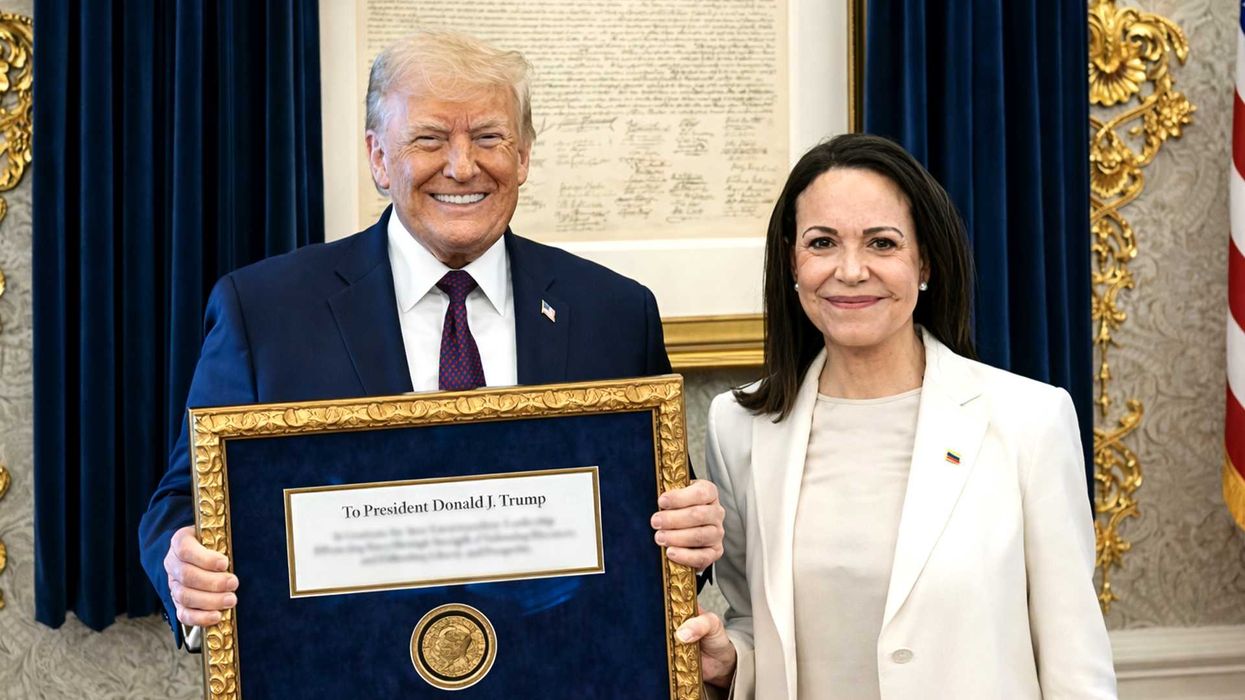
While there have been mixed reactions to the January 3 capture of Venezuelan dictator Nicolas Maduro by the U.S., few have shown greater support for the move than opposition leader Maria Corina Machado.
On Thursday, Machado visited President Donald Trump at the White House and presented him with her Nobel Peace Prize, which she won in October.
‘María presented me with her Nobel Peace Prize for the work I have done.’
When asked in a Fox interview why she gave her medal to the president of the United States, Machado had a simple answer: “Because he deserves it.”
“It was a very emotional moment. I decided to present the Nobel Peace Prize medal on behalf of the people of Venezuela.”
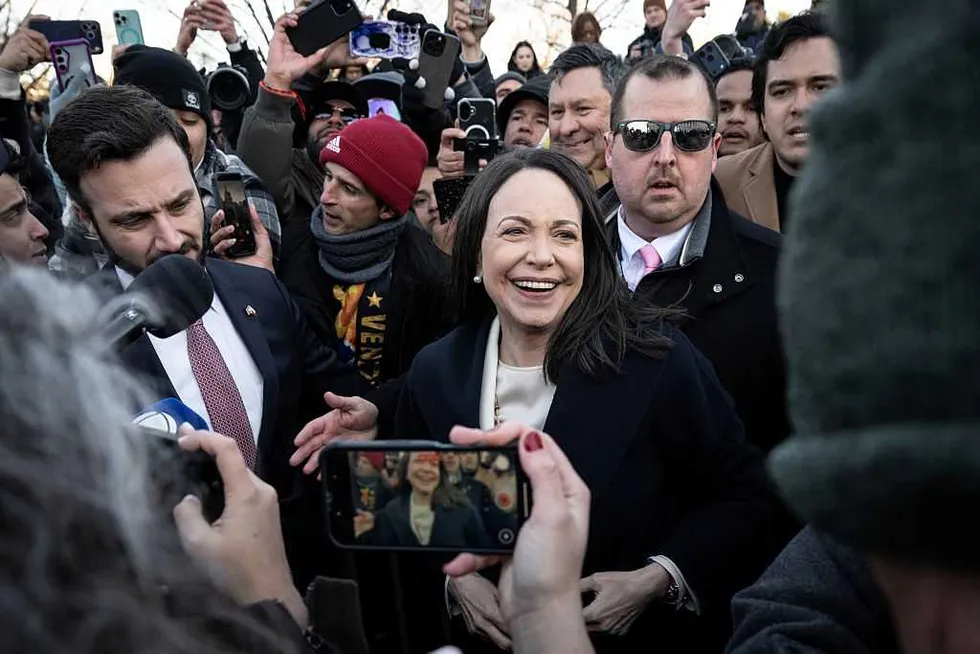 Photo by Drew ANGERER/AFP via Getty Images
The medal was presented to Trump in a large golden frame with text that reads: “To President Donald J. Trump in Gratitude for Your Extraordinary Leadership in Promoting Peace Through Strength.” The text further calls the award a “Personal Symbol of Gratitude on behalf of the Venezuelan People.”
After the meeting, Trump wrote on Truth Social: “María presented me with her Nobel Peace Prize for the work I have done. Such a wonderful gesture of mutual respect. Thank you María!”
A White House official confirmed to CNBC that Trump intends to keep the medal.
Like Blaze News? Bypass the censors, sign up for our newsletters, and get stories like this direct to your inbox. Sign up here!
Did Trump use the ‘Havana syndrome’ weapon on Venezuela?
A Venezuelan security guard, speaking to the New York Post after the January 3 raid that captured Nicolás Maduro, described American forces using some kind of directed-energy weapon that left hundreds of defenders bleeding from their noses, vomiting blood, and unable to stand. According to this account, about 20 U.S. troops from roughly eight helicopters took down hundreds of Venezuelan soldiers without a single American death.
The basic facts are wild enough without the sci-fi angle. Delta Force conducted Operation Absolute Resolve in the predawn hours, capturing Maduro and his wife from Fort Tiuna in Caracas. More than 200 special operations forces participated, supported by about 150 aircraft that disabled Venezuelan air defenses and extracted Maduro to New York to face narco-terrorism charges. Venezuela reported over 100 casualties, with only seven U.S. troops injured.
That’s already one of the most audacious military operations since the bin Laden raid.
Trump wants adversaries, particularly in Latin America, to believe the US has these capabilities.
But then comes the guard’s testimony, shared publicly by White House press secretary Karoline Leavitt on X. He describes radar systems simultaneously shutting down, swarms of drones, and then this mysterious weapon that made his “head feel like it was exploding from the inside.” Mass collapse. Internal bleeding. Complete incapacitation.
To those of us with long memories, it sounded strangely familiar, hearkening back to the “Havana syndrome” attacks on American personnel starting in Havana in 2016. Those attacks were suspected to have been caused by a secret energy weapon. Now, the United States has its own.
Whether we actually used that weapon or the White House just wants you to believe it did, either way, the strategic effect is the same.
The Havana syndrome connection
Starting in late 2016, U.S. diplomats and CIA officers in Cuba began experiencing bizarre symptoms: sudden onset of severe headaches, hearing strange sounds, vertigo, cognitive issues, and what appeared to be actual brain injuries. Over the next several years, hundreds of American personnel reported similar incidents in China, Russia, Austria, and even Washington, D.C.
The National Academies of Sciences concluded in 2020 that “pulsed electromagnetic energy” was the most plausible explanation for at least some cases. Multiple intelligence panels agreed: Directed-energy weapons were the leading theory. In 2024, investigative reporting linked Russia’s GRU Unit 29155 to research on “non-lethal acoustic weapons.”
For years, American officials have suspected, but couldn’t prove, that hostile actors used these weapons against U.S. personnel. The attacks hit diplomats inside embassy compounds, in hotels, and even at home. Invisible, deniable, and devastating.
Now fast-forward to the January 3, 2026, raid and its darkly ironic twist: 32 Cuban military advisers were killed defending Maduro’s compound, possibly hit with the same type of weapon that may have been used against Americans in Cuba.
If true, it sends a message: We know what you did to our people in Havana, and now you’ve experienced it yourselves.
The Pentagon just bought the Havana syndrome weapon
CNN reported on January 13 that Homeland Security Investigations acquired a device through an undercover operation for tens of millions of dollars in the waning days of the Biden administration, using Pentagon funding. The backpack-size device produces pulsed radio waves and contains Russian components.
That portability matters. One of the long-standing questions about Havana syndrome was how you could make a weapon powerful enough to cause brain injuries that’s also portable enough to deploy against specific targets in embassy compounds, hotels, and homes.
The Pentagon tested it for more than a year and considered it serious enough to brief the House and Senate Intelligence Committees in late 2024. There’s still debate within the government about its actual link to Havana syndrome cases, but the acquisition has, according to CNN, “reignited a painful and contentious debate” about whether foreign adversaries have been attacking U.S. officials with directed-energy weapons.
Marc Polymeropoulos, a former CIA officer who went public about injuries he sustained in what he believes was an attack in Moscow in 2017, told CNN: “If the [U.S. government] has indeed uncovered such devices, then the CIA owes all the victims a f**king major and public apology for how we have been treated as pariahs.”
This news breaks days after Venezuelan guards described similar symptoms during the Maduro raid. Interesting timing.
RELATED: Polymarket bettors RAGE as the app says Maduro’s capture doesn’t count as ‘invasion’
 Michael Nagle/Bloomberg via Getty Images
But did they actually use it?
The Venezuelan guard’s account describes mass nosebleeds, vomiting blood, and hundreds incapacitated simultaneously. These are more extreme than documented Havana syndrome cases, which typically involved headaches, vertigo, and cognitive issues rather than acute internal bleeding. Could blast overpressure from conventional explosives cause similar effects? Yes. Could shrapnel, concussive force, and chemical irritants from 150 aircraft’s worth of ordnance produce these symptoms? Absolutely.
Here’s what makes me skeptical: Both Maduro and his wife claimed injuries, but they survived and appeared in a Manhattan courtroom days later. The injuries reported (Maduro falling while fleeing, his wife struck in the head) sound like conventional combat trauma, not internal organ damage from directed energy.
And the biggest tell: The White House press secretary amplified this story. The Pentagon just spent tens of millions on a device they suspect is behind Havana syndrome attacks, briefed Congress, and now CNN is reporting on it publicly. If U.S. special forces had actually deployed a classified weapons system and some guard blew the secret, the response would be aggressive operational security and plausible deniability. Instead, we’re getting transparency.
That’s not how you handle a genuine security breach. That’s how you handle a psychological operation.
Why ambiguity is the weapon
The Trump administration wants adversaries, particularly in Latin America, to believe the U.S. has these capabilities. And here’s the brilliance: The technology is real (we have the receipts), but whether it was used remains ambiguous. Venezuela can’t prove it didn’t happen. The U.S. won’t confirm or deny. Adversaries now have to plan for worst-case scenarios.
This is the modern version of Reagan’s Star Wars program. Most scientists knew it couldn’t work as advertised, but the Soviets spent billions trying to counter it anyway. Sometimes the belief in a capability is more valuable than the capability itself.
The United States just demonstrated it can reach into a fortified compound in a hostile capital, extract a head of state, and fly him to New York to face trial, all while suffering minimal casualties. That capability needs no embellishment. But the embellishment serves a purpose: forcing every tin-pot dictator and mid-level drug trafficker in the Western Hemisphere to wonder if they’re next and whether their security forces can protect them from weapons they can’t see or hear.
And for anyone involved in Havana syndrome attacks, whether Cuban, Russian, or anyone else, there’s now a very clear message: If you hit our people with invisible weapons, don’t be surprised when we return the favor. The 32 dead Cuban advisers make that point unmistakably clear, regardless of what weapon actually killed them.
Power projection isn’t just about what you can do; it’s about what others believe you can do.
The bottom line
The truth about Venezuela is probably somewhere in the middle. Electronic warfare to knock out radar and communications? Almost certainly. That’s standard doctrine. Directed-energy weapons causing mass internal bleeding? The technology exists, but the extreme symptoms described don’t match documented effects. Whether they were actually used? Strategically ambiguous.
And that’s the point. The ambiguity itself is the weapon. If they used it, adversaries know America will deploy it. If they didn’t, adversaries still believe they might next time, and uncertainty is often more powerful than certainty.
Here’s a story: Cuba helps Russia attack American diplomats with invisible weapons starting in 2016. Years later, Cuban advisers die defending a dictator when the U.S. raids his compound with technology that sounds awfully familiar. Whether that’s coincidence, retaliation, or just good storytelling doesn’t really matter. The message landed.
That’s worth understanding because we’re going to see more of it in this fifth generation of warfare. The age of warfare where you could independently verify what happened on the battlefield is over. In the era of psychological operations, classified capabilities, and information warfare, the story about the battle matters as much as the battle itself.
Maybe more.
Battleships and Beyond: How To Stop China From Dominating the High Seas
The effects of Nicolás Maduro’s sudden downfall are now rippling far beyond the Caribbean basin. To wit, the U.S. military toppling the Venezuelan dictator without breaking a sweat is a humiliation for the Chinese Communist Party, which cannot dominate even its immediate neighborhood because of American armed might. Xi Jinping seeks not only to drive our military out of the Western Pacific, but also to build his own globe-spanning forces. If he succeeds, China will inhibit America’s ability to defend its interests even close to its shores.
The post Battleships and Beyond: How To Stop China From Dominating the High Seas appeared first on .





