

Category: Nicolas Maduro
Canada Looks an Awful Lot Like Venezuela. And Trump Has Noticed.
Recently, the United States of America (USA) successfully completed Operation: Absolute Resolve and, thereby, liberated the Venezuelan people from Nicolás…
Venezuelan Oil May Not Come Easy
Despite all the congratulations and fanfare, the capturing of Maduro and wife may not have produced the effect many have…
Venezuelan freedom fighter honors Trump: Machado insists ‘he deserves’ Nobel Prize after capture of dictator Maduro
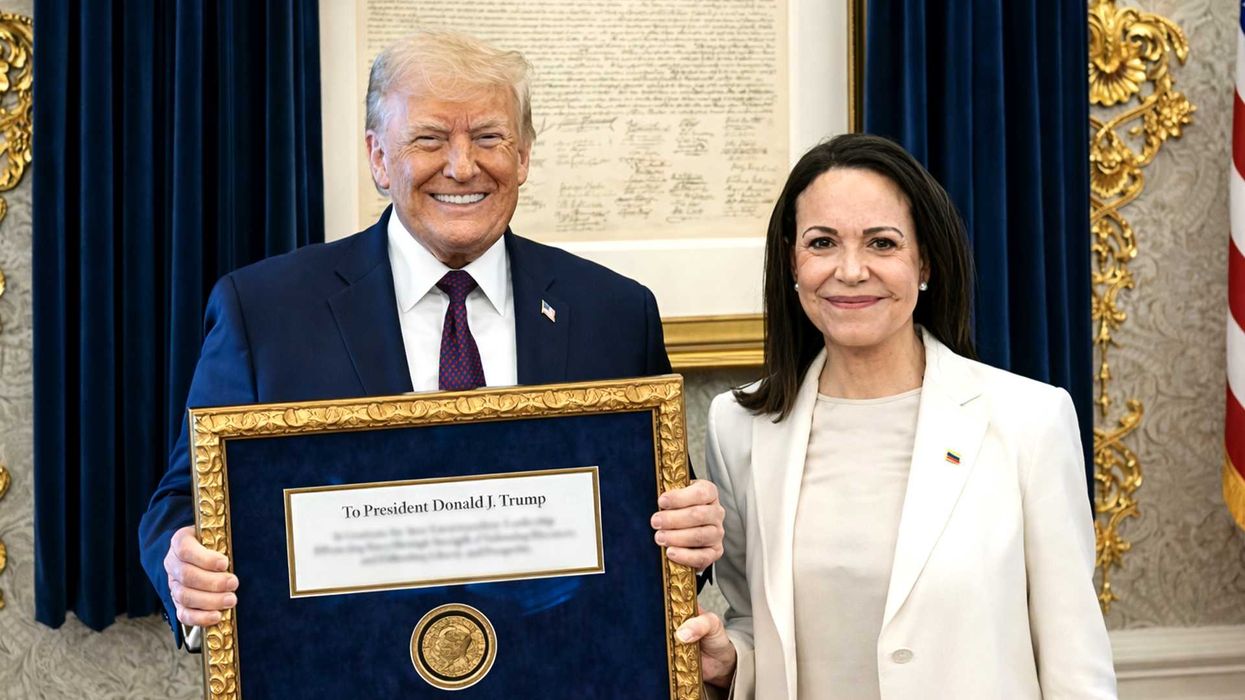
While there have been mixed reactions to the January 3 capture of Venezuelan dictator Nicolas Maduro by the U.S., few have shown greater support for the move than opposition leader Maria Corina Machado.
On Thursday, Machado visited President Donald Trump at the White House and presented him with her Nobel Peace Prize, which she won in October.
‘María presented me with her Nobel Peace Prize for the work I have done.’
When asked in a Fox interview why she gave her medal to the president of the United States, Machado had a simple answer: “Because he deserves it.”
“It was a very emotional moment. I decided to present the Nobel Peace Prize medal on behalf of the people of Venezuela.”
 Photo by Drew ANGERER/AFP via Getty Images
The medal was presented to Trump in a large golden frame with text that reads: “To President Donald J. Trump in Gratitude for Your Extraordinary Leadership in Promoting Peace Through Strength.” The text further calls the award a “Personal Symbol of Gratitude on behalf of the Venezuelan People.”
After the meeting, Trump wrote on Truth Social: “María presented me with her Nobel Peace Prize for the work I have done. Such a wonderful gesture of mutual respect. Thank you María!”
A White House official confirmed to CNBC that Trump intends to keep the medal.
Like Blaze News? Bypass the censors, sign up for our newsletters, and get stories like this direct to your inbox. Sign up here!
Did Trump use the ‘Havana syndrome’ weapon on Venezuela?
A Venezuelan security guard, speaking to the New York Post after the January 3 raid that captured Nicolás Maduro, described American forces using some kind of directed-energy weapon that left hundreds of defenders bleeding from their noses, vomiting blood, and unable to stand. According to this account, about 20 U.S. troops from roughly eight helicopters took down hundreds of Venezuelan soldiers without a single American death.
The basic facts are wild enough without the sci-fi angle. Delta Force conducted Operation Absolute Resolve in the predawn hours, capturing Maduro and his wife from Fort Tiuna in Caracas. More than 200 special operations forces participated, supported by about 150 aircraft that disabled Venezuelan air defenses and extracted Maduro to New York to face narco-terrorism charges. Venezuela reported over 100 casualties, with only seven U.S. troops injured.
That’s already one of the most audacious military operations since the bin Laden raid.
Trump wants adversaries, particularly in Latin America, to believe the US has these capabilities.
But then comes the guard’s testimony, shared publicly by White House press secretary Karoline Leavitt on X. He describes radar systems simultaneously shutting down, swarms of drones, and then this mysterious weapon that made his “head feel like it was exploding from the inside.” Mass collapse. Internal bleeding. Complete incapacitation.
To those of us with long memories, it sounded strangely familiar, hearkening back to the “Havana syndrome” attacks on American personnel starting in Havana in 2016. Those attacks were suspected to have been caused by a secret energy weapon. Now, the United States has its own.
Whether we actually used that weapon or the White House just wants you to believe it did, either way, the strategic effect is the same.
The Havana syndrome connection
Starting in late 2016, U.S. diplomats and CIA officers in Cuba began experiencing bizarre symptoms: sudden onset of severe headaches, hearing strange sounds, vertigo, cognitive issues, and what appeared to be actual brain injuries. Over the next several years, hundreds of American personnel reported similar incidents in China, Russia, Austria, and even Washington, D.C.
The National Academies of Sciences concluded in 2020 that “pulsed electromagnetic energy” was the most plausible explanation for at least some cases. Multiple intelligence panels agreed: Directed-energy weapons were the leading theory. In 2024, investigative reporting linked Russia’s GRU Unit 29155 to research on “non-lethal acoustic weapons.”
For years, American officials have suspected, but couldn’t prove, that hostile actors used these weapons against U.S. personnel. The attacks hit diplomats inside embassy compounds, in hotels, and even at home. Invisible, deniable, and devastating.
Now fast-forward to the January 3, 2026, raid and its darkly ironic twist: 32 Cuban military advisers were killed defending Maduro’s compound, possibly hit with the same type of weapon that may have been used against Americans in Cuba.
If true, it sends a message: We know what you did to our people in Havana, and now you’ve experienced it yourselves.
The Pentagon just bought the Havana syndrome weapon
CNN reported on January 13 that Homeland Security Investigations acquired a device through an undercover operation for tens of millions of dollars in the waning days of the Biden administration, using Pentagon funding. The backpack-size device produces pulsed radio waves and contains Russian components.
That portability matters. One of the long-standing questions about Havana syndrome was how you could make a weapon powerful enough to cause brain injuries that’s also portable enough to deploy against specific targets in embassy compounds, hotels, and homes.
The Pentagon tested it for more than a year and considered it serious enough to brief the House and Senate Intelligence Committees in late 2024. There’s still debate within the government about its actual link to Havana syndrome cases, but the acquisition has, according to CNN, “reignited a painful and contentious debate” about whether foreign adversaries have been attacking U.S. officials with directed-energy weapons.
Marc Polymeropoulos, a former CIA officer who went public about injuries he sustained in what he believes was an attack in Moscow in 2017, told CNN: “If the [U.S. government] has indeed uncovered such devices, then the CIA owes all the victims a f**king major and public apology for how we have been treated as pariahs.”
This news breaks days after Venezuelan guards described similar symptoms during the Maduro raid. Interesting timing.
RELATED: Polymarket bettors RAGE as the app says Maduro’s capture doesn’t count as ‘invasion’
 Michael Nagle/Bloomberg via Getty Images
But did they actually use it?
The Venezuelan guard’s account describes mass nosebleeds, vomiting blood, and hundreds incapacitated simultaneously. These are more extreme than documented Havana syndrome cases, which typically involved headaches, vertigo, and cognitive issues rather than acute internal bleeding. Could blast overpressure from conventional explosives cause similar effects? Yes. Could shrapnel, concussive force, and chemical irritants from 150 aircraft’s worth of ordnance produce these symptoms? Absolutely.
Here’s what makes me skeptical: Both Maduro and his wife claimed injuries, but they survived and appeared in a Manhattan courtroom days later. The injuries reported (Maduro falling while fleeing, his wife struck in the head) sound like conventional combat trauma, not internal organ damage from directed energy.
And the biggest tell: The White House press secretary amplified this story. The Pentagon just spent tens of millions on a device they suspect is behind Havana syndrome attacks, briefed Congress, and now CNN is reporting on it publicly. If U.S. special forces had actually deployed a classified weapons system and some guard blew the secret, the response would be aggressive operational security and plausible deniability. Instead, we’re getting transparency.
That’s not how you handle a genuine security breach. That’s how you handle a psychological operation.
Why ambiguity is the weapon
The Trump administration wants adversaries, particularly in Latin America, to believe the U.S. has these capabilities. And here’s the brilliance: The technology is real (we have the receipts), but whether it was used remains ambiguous. Venezuela can’t prove it didn’t happen. The U.S. won’t confirm or deny. Adversaries now have to plan for worst-case scenarios.
This is the modern version of Reagan’s Star Wars program. Most scientists knew it couldn’t work as advertised, but the Soviets spent billions trying to counter it anyway. Sometimes the belief in a capability is more valuable than the capability itself.
The United States just demonstrated it can reach into a fortified compound in a hostile capital, extract a head of state, and fly him to New York to face trial, all while suffering minimal casualties. That capability needs no embellishment. But the embellishment serves a purpose: forcing every tin-pot dictator and mid-level drug trafficker in the Western Hemisphere to wonder if they’re next and whether their security forces can protect them from weapons they can’t see or hear.
And for anyone involved in Havana syndrome attacks, whether Cuban, Russian, or anyone else, there’s now a very clear message: If you hit our people with invisible weapons, don’t be surprised when we return the favor. The 32 dead Cuban advisers make that point unmistakably clear, regardless of what weapon actually killed them.
Power projection isn’t just about what you can do; it’s about what others believe you can do.
The bottom line
The truth about Venezuela is probably somewhere in the middle. Electronic warfare to knock out radar and communications? Almost certainly. That’s standard doctrine. Directed-energy weapons causing mass internal bleeding? The technology exists, but the extreme symptoms described don’t match documented effects. Whether they were actually used? Strategically ambiguous.
And that’s the point. The ambiguity itself is the weapon. If they used it, adversaries know America will deploy it. If they didn’t, adversaries still believe they might next time, and uncertainty is often more powerful than certainty.
Here’s a story: Cuba helps Russia attack American diplomats with invisible weapons starting in 2016. Years later, Cuban advisers die defending a dictator when the U.S. raids his compound with technology that sounds awfully familiar. Whether that’s coincidence, retaliation, or just good storytelling doesn’t really matter. The message landed.
That’s worth understanding because we’re going to see more of it in this fifth generation of warfare. The age of warfare where you could independently verify what happened on the battlefield is over. In the era of psychological operations, classified capabilities, and information warfare, the story about the battle matters as much as the battle itself.
Maybe more.
CRUDE AWAKENING: Canada’s pipeline paralysis fumbles American oil market
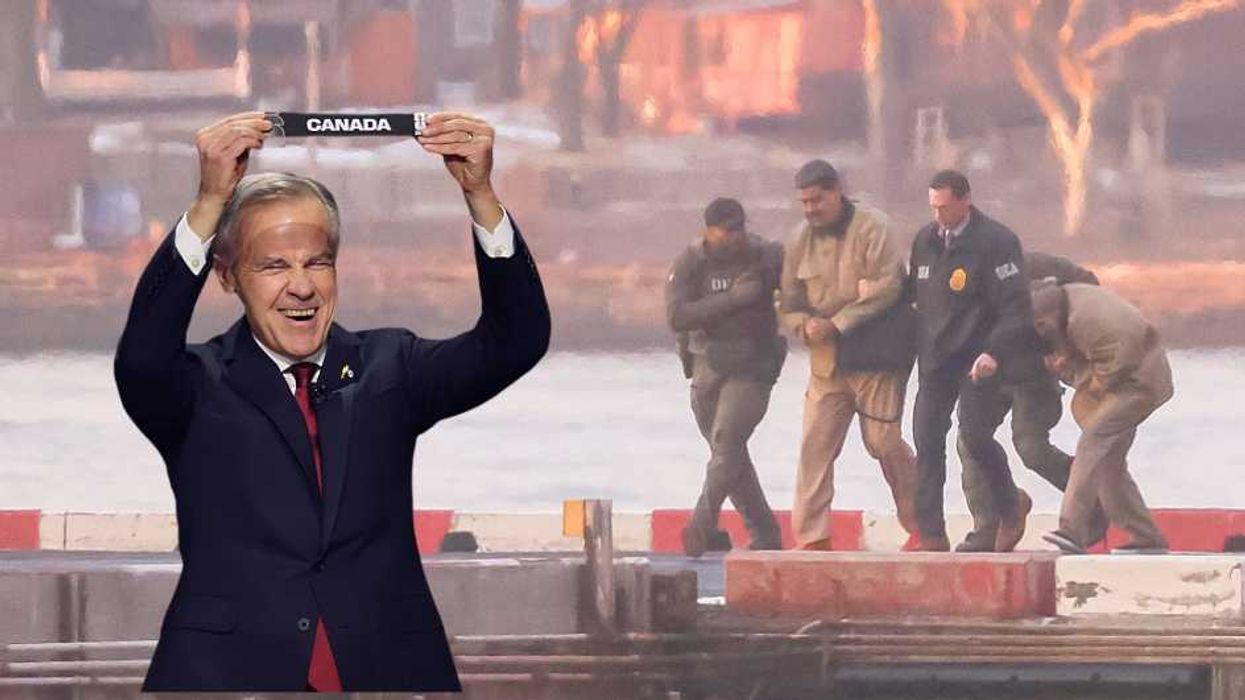
Canada has exactly the kind of oil the United States needs. But when it comes to investing in the infrastructure to move it, America’s ally to the north is beginning to look as risky — and as politically hostile — as Venezuela.
That, Dan McTeague of Canadians for Affordable Energy tells Align, reflects a perverse governing philosophy towards the country’s energy abundance: “keep it in the ground.”
Carney can talk about buying China’s ‘windmills and solar panels,’ or he can ask whether China wants to buy oil — ‘because we got a pipeline.’
Canada’s self-inflicted pipeline paralysis is eroding its position in the U.S. market just as alternatives like Venezuelan oil come back online.
Oil, oil everywhere
Nowhere is that risk clearer than in Alberta, home to the vast majority of Canada’s oil production, where years of stalled pipeline projects have left the country’s most valuable energy asset effectively landlocked.
Canadian oil is the same kind Venezuela produces: heavy crude, high in sulfur, and ideal for making diesel fuel. Most U.S. refineries are designed specifically to process this type of petroleum, which is essential not just for transportation, but for agriculture, mining, manufacturing, and national defense.
Alberta has long sought to build a pipeline to the West Coast, primarily to secure reliable, long-term access to the U.S. market — while also giving Canada leverage to reach other buyers if American demand weakens or politics intervenes.
That project remains stalled, despite Liberal Prime Minister Mark Carney — who has spent much of his career championing green energy and opposing pipelines — recently signing a memorandum of understanding with Alberta that is supposed to clear the way for construction. Alberta Premier Danielle Smith is now demanding that pipeline construction begin by fall 2026.
Carbon crunch
In practice, the MOU changes little. It grants no approvals, streamlines no federal reviews, resolves no indigenous or legal challenges, and commits no public capital. By tying any future pipeline to rising carbon tax and decarbonization requirements, it arguably worsens the investment case — leaving no private sponsor willing to move first.
While the United States remains Canada’s natural customer, a West Coast outlet still matters. It gives producers pricing power, optionality, and insurance against sudden policy shifts in Washington — precisely the kind now emerging as Venezuela re-enters the picture.
The question is who would build such a pipeline — and whether it could be completed before the United States turns to cheaper Venezuelan oil to fill the gap.
Venezuela of the north?
President Donald Trump has floated asking oil companies for $100 billion to build infrastructure in Venezuela capable of moving oil north. Exxon’s CEO rejected the idea, calling Venezuela “uninvestable” because of its history of asset seizures and nationalization. Trump, however, could choose to push the project forward with public funds.
McTeague — himself a former Liberal member of Parliament — says Canada has made itself similarly unattractive to investors. He argues that policy choices — not geology — are the problem.
Canada, he says, is “blessed with abundance of resources,” but has embraced a governing narrative that tells producers to “keep it in the ground.” He adds that few countries would treat their most important economic output that way.
That mindset, McTeague argues, has frightened off private capital and left Ottawa with little choice but to build a pipeline itself. It also raises the stakes of Carney’s upcoming trip to China — not as a pivot away from the U.S., but as leverage.
Tilting at windmills
When Carney arrives in Beijing, McTeague says, he faces a choice. He can talk about decarbonization and buying China’s “windmills and solar panels,” or he can ask whether China wants to buy oil — “because we got a pipeline.”
The point, McTeague stresses, is not that China should replace the United States as Canada’s primary customer, but that Canada needs credible alternatives if it wants to be taken seriously by either.
McTeague also criticizes the MOU’s requirement that the industrial carbon tax rise sharply in coming years, arguing that it “defies economics and the realities of the marketplace.” In his view, decarbonization mandates are irrelevant to investors deciding whether a pipeline is worth building.
Time, he warns, is running out. Federal debt continues to grow, and Canada’s fiscal credibility is beginning to erode. Without pipelines, he says, the country risks running out of economic runway.
RELATED: The truth behind Trump’s Venezuela plan: It’s not about Maduro at all
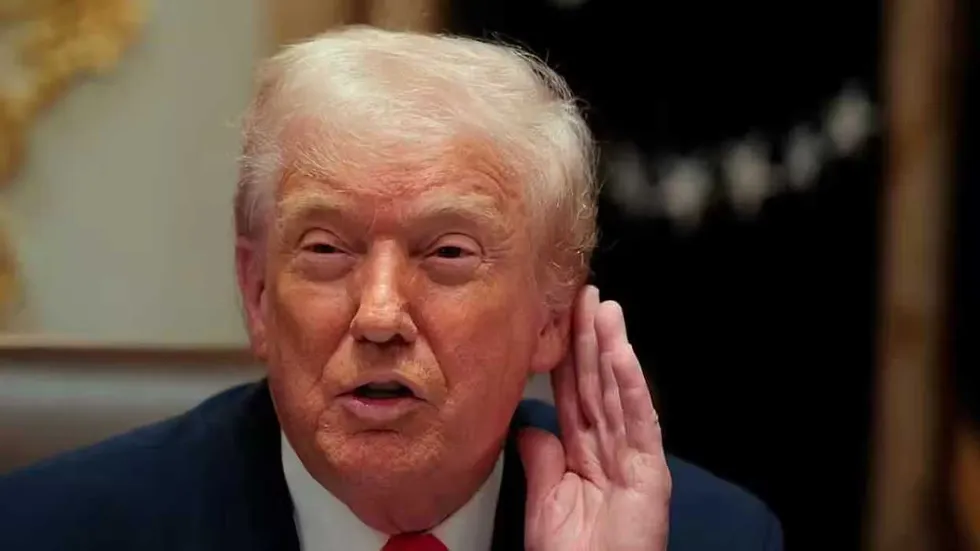 Chip Somodevilla/Getty Images
Over a barrel
McTeague also disputes the claim that the United States is energy-independent. While America produces roughly 12 to 13 million barrels of oil per day, it consumes about 21 million — leaving it dependent on imports.
Canada’s value, he argues, lies not just in volume, but in the type of oil it produces. U.S. shale oil is well suited for gasoline, but not for diesel, which he calls the global workhorse of modern economies — critical to transportation, agriculture, industry, and defense.
That is precisely the fuel Venezuela is now offering, potentially at a lower cost than Canadian oil burdened by carbon taxes and regulatory constraints.
Canada now finds itself between a rock and a hard place: Venezuelan oil threatening to undercut U.S. demand for Alberta crude, plus the political and logistical reality of building a major pipeline through British Columbia — on a timetable that is rapidly running out.
In energy terms, Canada is doing the unthinkable: choosing to be bypassed.

China Sucks. Even Their Propaganda Makes America Look Awesome.
The American raid to capture Venezuelan dictator Nicolás Maduro was deeply embarrassing for Red China. The third-world communist thugs had provided much of the military equipment designed to protect Maduro’s regime from foreign intervention. It proved utterly useless against U.S. forces, who snatched Maduro just hours after his meeting with a delegation of Chinese officials.
The post China Sucks. Even Their Propaganda Makes America Look Awesome. appeared first on .

The Spectacle Ep. 312: Venezuela: Enemies Foreign and Domestic, Part II
The Democrats continue to sympathize with Nicolás Maduro’s arrest, such as Rep. Delia Ramirez condemning the U.S. intervention in Venezuela…
It’s Time to Rename January After Donald Trump
Historians may quibble over the sequencing, but no serious person can deny that Donald Trump will be remembered—alongside George Washington and Abraham Lincoln—as one of America’s greatest presidents. Some might argue it’s too early to start naming things after Trump while he’s still alive and in office, but those people are fools.
The post It’s Time to Rename January After Donald Trump appeared first on .

The Spectacle Ep. 311: Venezuela: Enemies Foreign and Domestic, Part I
2026 is off to an explosive start, with President Trump’s arrest of Venezuelan dictator Nicolás Maduro. (READ MORE: The Toppling…





