

Category: Cartels
Scathing Indictment Claims Nicolás Maduro Orchestrated Drug-Fueled ‘Culture Of Corruption’ Which Plagued Entire Region
‘shipping low-quality cocaine to New York’
Mexico has cartel armies. Blue America has cartel politics.
Detroit is synonymous with autos, Los Angeles with motion pictures, and Texas with oil. Pittsburgh still conjures steel. When a product or service anchors a region’s economy, that sector has power. Politicians court industry. Industry demands representation and, ideally, protection.
What’s true regionally is just as true nationally. That’s why K Street exists and lobbyists make big bucks. Fortunes rise and fall, but if our GDP slips even 3%, the usual talking heads sprint to the cameras to declare the American economy on the verge of collapse — and always under whichever Republican is in office. When a Democrat presides over a faltering economy, the political media prefers to drive the getaway car.
Harassing users did nothing to stop the poison. Blowing up supply at sea does. Every sunken shipment dents the cartels’ profits. Every explosion represents a tangible loss.
If any of us invented a product that added 3% to national GDP, we’d enjoy the influence over policy and legislation that naturally comes with living in a representative republic with a market economy. Innovation and competition fuel prosperity.
So here’s a question the blue-city, blue-state establishment doesn’t want asked: What percentage of its GDP comes from narcotics trafficking?
Recently a member of our self-styled House of Lords, Sen. Jack Reed of Rhode Island, erupted in outrage over the Pentagon’s lethal targeting of drug traffickers in the Caribbean. He said he was “deeply disturbed” by these operations. Was Reed ever equally disturbed by narcotics deaths in Providence or Pawtucket?
Some Democrats insist the traffickers are “impoverished fishermen.” Reed himself defended them on the grounds that “they are just trying to make money,” as if they weren’t waging chemical warfare on our civilian population. And he reassured us that the men killed weren’t running fentanyl — only cocaine. As though cocaine were some kind of civic improvement!
By any honest analysis, an overnight eradication of drug addiction in America would collapse an entire NGO ecosystem — along with the payrolls of the consultants, therapists, and bureaucrats who perpetually “mitigate” our crises of addiction, alcoholism, and dereliction. Given the nature of addiction, that blessed day will never come.
Look south. By my estimation, two-thirds of Mexico’s economy is directly or indirectly tied to narcotics. No, that’s not the Wall Street Journal’s number; nobody has the real statistics because the books are kept on scraps of paper known in DEA argot as “Pay/Owe” sheets. My estimate comes from observing the level of protection the trade enjoys at every tier of Mexican governance — local, rural, national. Narcotics are so economically essential that cartels decide who can run in elections with preordained outcomes. Their influence rivals that of the Democratic Party’s super delegates, if you’ll pardon the comparison.
Big Narco commands private armies, armored vehicles, anti-tank missiles, machine guns, uniforms, rules, and courts. The narcotics sector has effectively stalled Mexico’s political maturation.
And it’s affecting us too.
RELATED: Trump cracks the Caracas cartel code
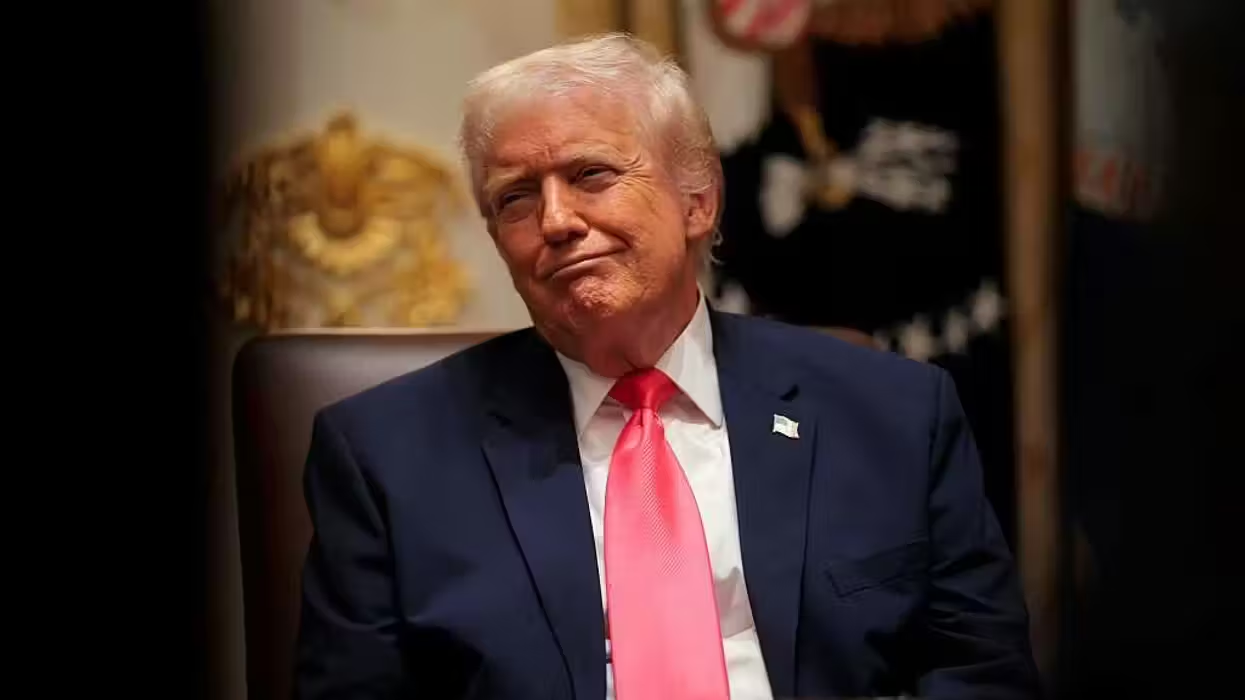 Photo by Chip Somodevilla/Getty Images
In past administrations, the so-called war on drugs looked more like a war on addicts and their families, with only token strikes on the international criminal organizations moving the product. The Trump administration has reversed that. Secretary of War Pete Hegseth is hitting the cartels directly. Harassing users did nothing to stop the poison. Blowing up supply at sea does. Every sunken shipment dents the cartels’ profits. Every explosion represents a tangible loss.
The hysterics from Jack Reed and others suggest these interdictions are hurting the economies of blue cities and states more than they care to admit. You’d think the destruction of cocaine, heroin, and fentanyl — inflicting daily carnage — would spark celebration. In Los Angeles County alone, the coroner processes six dead Americans per day from overdoses. Last year, it was eight. Fathers, mothers, runaway teens, derelict addicts — Americans, dead every day.
And yet Gov. Gavin Newsom (D) — raw with presidential ambition — insists the leading cause of death for young Californians is firearms. This is false of course. But to blue-city politicians, gun control makes for better PR than confronting thousands of overdose deaths. Meanwhile Sacramento’s ruling cabal has passed a thicket of laws, regulations, and policies that effectively protect narcotics trafficking in the Golden State.
Guns hardly register in California’s GDP. Big Narco does.
Trump cracks the Caracas cartel code
Democrats deny what mountains of evidence have long shown: Terrorist groups traffic in illegal drugs.
Rep. Jim Himes (D-Conn.) recently insisted, “There is no such thing as a narco-terrorist,” as he defended his opposition to the Trump administration’s war on narco-terrorism in the Caribbean. He accused the administration of trying “to make this look like it’s ISIS or Al-Qaeda,” ignoring that ISIS, Al-Qaeda, Hezbollah, and similar groups have long run profitable drug operations with local and transnational cartels. These alliances increased revenue, financed attacks, fueled violence, and deepened existing conflicts.
Maduro’s narco-terrorist regime threatens regional stability and US national security. Trump’s war on narco-terrorism meets that threat head-on.
Narco-terrorism did not originate with the Trump administration. It was the subject of my 1990 book, which documented how governments around the world used the drug trade to fund and advance terrorist activity. For more than three decades, Washington looked away. That era has ended.
On November 16, the U.S. Treasury designated Venezuela’s Cártel de los Soles — run by Venezuela President Nicolás Maduro and key figures in his illegitimate regime — along with Tren de Aragua and the Sinaloa Cartel, as foreign terrorist organizations. Treasury should have added Colombia’s National Liberation Army (Ejército de Liberación Nacional, or ELN), a Marxist paramilitary and major drug-trafficking force that controls both sides of the border and works closely with Maduro.
When I began researching narco-terrorism in 1986, I assumed political groups across the spectrum could use terror and drug trafficking to advance their aims. The evidence showed otherwise. Marxist-Leninist and Islamist regimes, movements, and militias initiated, expanded, and ultimately dominated this trade.
Venezuela’s slide into narco-terrorism dates to 2005, when Hugo Chávez expelled the U.S. Drug Enforcement Administration. After Chávez died in 2013, Maduro took control of both the government and the drug enterprise, tightening his partnership with Iran and its Lebanese proxy, Hezbollah, under the so-called Axis of Resistance. The goal is to counter U.S. influence in Latin America and the Middle East while enriching the regime.
Maduro’s alliance with Iran and Hezbollah runs deep. He offers sanctuary and support for their narcotics networks, money laundering, weapons pipelines, and terrorist smuggling throughout the region.
RELATED: Turns out that Hegseth’s ‘kill them all’ line was another media invention
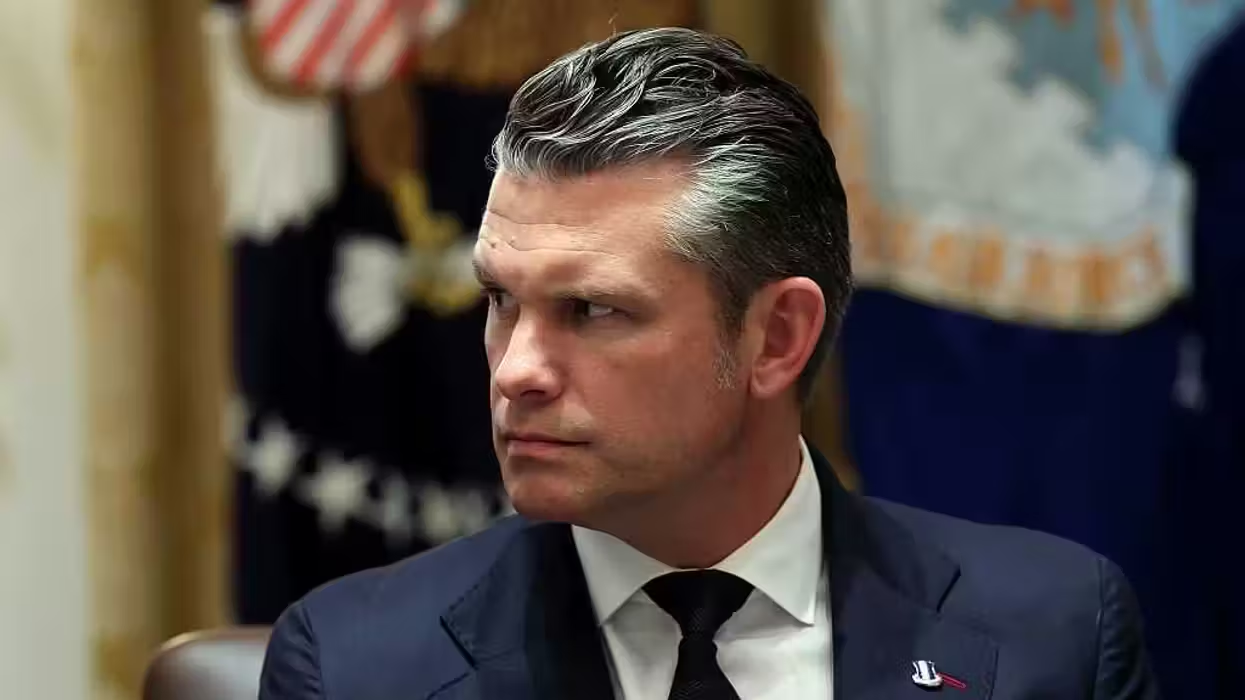 Photo by Anna Moneymaker/Getty Images
Hugo “El Pollo” Carvajal — a former three-star Venezuelan general under Chávez and Maduro and a former member of Cártel de los Soles — described the strategy bluntly in a letter to President Trump. “The purpose of this organization is to weaponize drugs against the United States,” he wrote. “The drugs that reached your cities through new routes were not accidents of corruption nor just the work of independent traffickers; they were deliberate policies coordinated by the Venezuelan regime against the United States.”
This collaboration, built over decades, helped millions of Americans fall into addiction and contributed to hundreds of thousands of deaths.
Maduro’s narco-terrorist regime threatens regional stability and U.S. national security. Trump’s war on narco-terrorism meets that threat head-on and is perfectly just.
‘THIS WILL SAVE LIVES’: Kash Patel Provides Update on Fentanyl Fight, New Agreement With China [WATCH]
![‘THIS WILL SAVE LIVES’: Kash Patel Provides Update on Fentanyl Fight, New Agreement With China [WATCH]](https://hannity.com/wp-content/uploads/2025/11/GettyImages-2245821070-300x200.jpg "US-POLITICS-BRIEFING-LEAVITT")
Progress in the fight against fentanyl.





