Category: America
‘A direct path to Citizenship’: Trump announces official launch of Trump Gold Card visa program
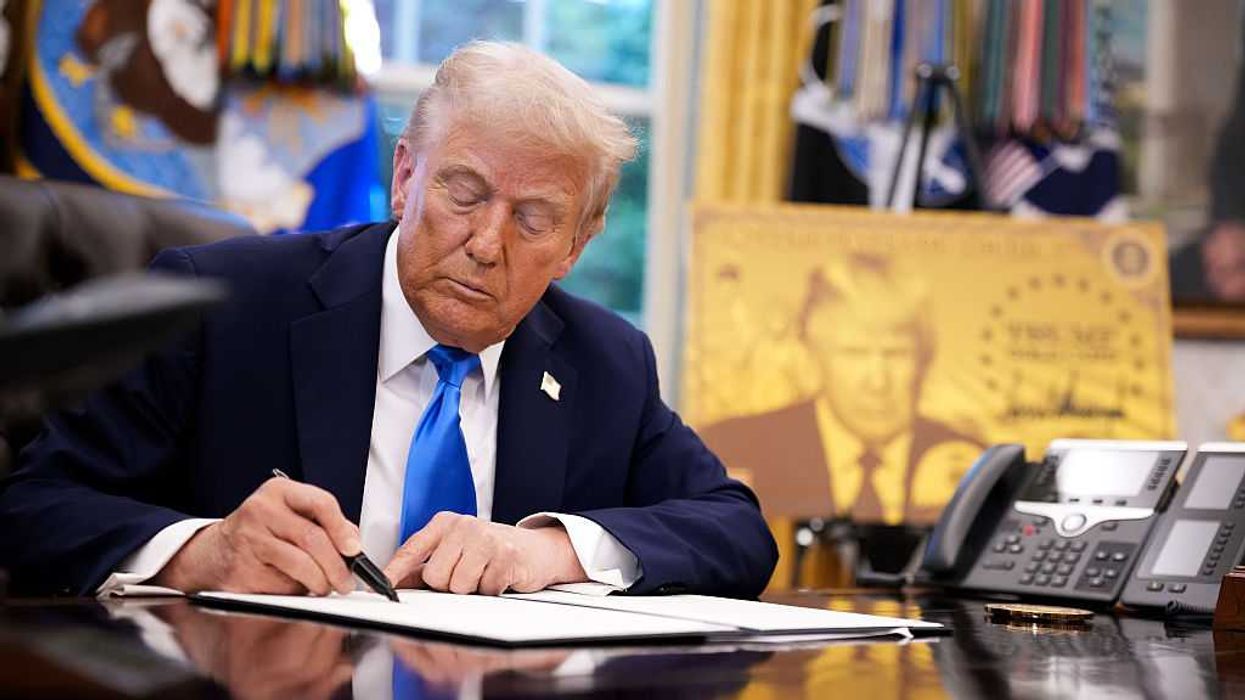
The Trump administration has announced a brand-new visa package that is expected to help some of America’s biggest companies keep their foreign talent.
On Wednesday, President Donald Trump announced the launch of the Trump Gold Card, an expedited pathway to U.S. residence and even citizenship for a premium price.
‘This landmark program fulfills President Trump’s promise to attract the world’s most successful entrepreneurs and investors to America while guaranteeing they have skin in the game.’
On Truth Social, Trump said, “THE UNITED STATES GOVERNMENT’S TRUMP GOLD CARD IS HERE TODAY! A direct path to Citizenship for all qualified and vetted people. SO EXCITING! Our Great American Companies can finally keep their invaluable Talent.”
The program has multiple tiers. Individuals can pay a fee of $1 million to receive U.S. residency in “record time” as part of the Trump Gold Card.
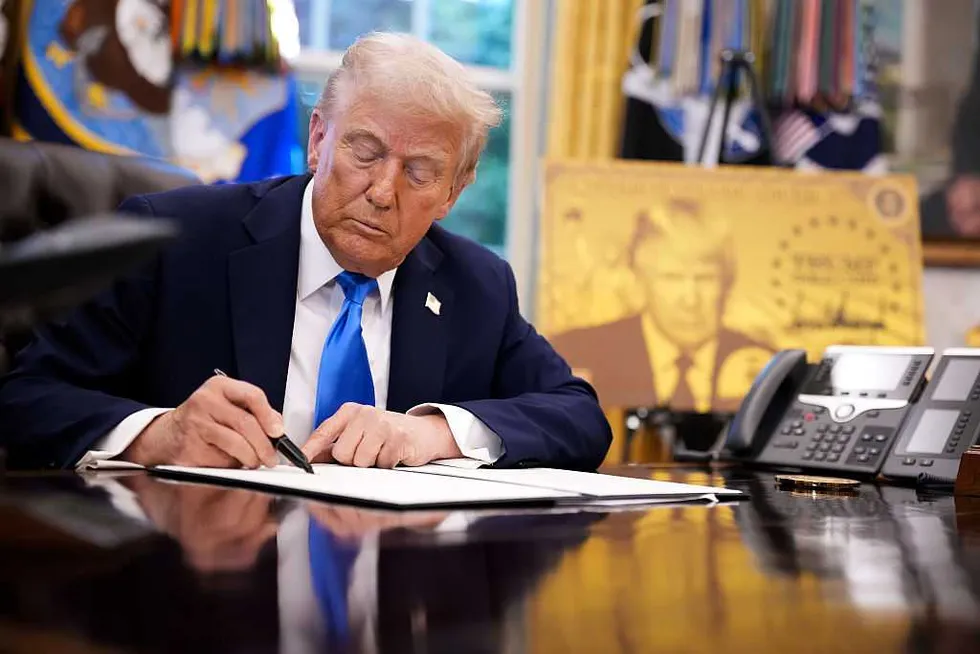
Photo by ANDREW CABALLERO-REYNOLDS / AFP via Getty Images
The Trump Corporate Gold Card functions similarly but has a fee of $2 million that the company will pay.
The Trump Platinum Card, which the website says is “coming soon,” costs $5 million and will allow foreigners to live in the United States for 270 days “without being subject to U.S. taxes on non-U.S. income.”
Commerce Secretary Howard Lutnick explained how companies can use this program: “The company can keep them here, and they have a path to citizenship. Obviously, they have to be perfect people in America. And having passed the vetting, after five years, they’ll be available to become citizens, and then the corporation puts someone else on the card.”
Lutnick added that the proceeds of this expensive program will function as a “gift to the United States.”
All applications also require a $15,000 processing fee as part of the vetting process.
The Trump Gold Card functions as a lottery through EB-1 and EB-2 visas, which filter for extraordinary ability in various fields.
“This landmark program fulfills President Trump’s promise to attract the world’s most successful entrepreneurs and investors to America while guaranteeing they have skin in the game,” Homeland Security Secretary Kristi Noem said on X in light of the announcement.
Trump ordered the creation of the Trump Gold Card program on the same day that he ordered the $100,000 fee for new H-1B visa applications, a popular move that addresses some of the abuses with the H-1B program without canceling it entirely.
The Gold Card office did not respond to a request for comment from Blaze News.
Like Blaze News? Bypass the censors, sign up for our newsletters, and get stories like this direct to your inbox. Sign up here!
Anti-Israel Celebrities Accept Major Saudi Payday To Attend Jeddah Film Festival

![]()
Some of Hollywood’s most ardent anti-Israel activists are flocking to Saudi Arabia this week for a government-sponsored film festival—and the kingdom is compensating them well for their time.
The post Anti-Israel Celebrities Accept Major Saudi Payday To Attend Jeddah Film Festival appeared first on .
CAIR’s Political Arm Has Operated Without Legal Authority Across US, Watchdog Report Finds
The Council of American-Islamic Relations’s (CAIR) political advocacy arm, CAIR Action, is operating “without the licenses, registrations, or legal authority required in any of the 22 states where it raises money or conducts political activity,” an investigation shared with the Washington Free Beacon states. According to a watchdog group, CAIR’s nationwide political machine has systematically evaded state and federal regulators in what may amount to an illicit fundraising scheme.
The post CAIR’s Political Arm Has Operated Without Legal Authority Across US, Watchdog Report Finds appeared first on .
Trump makes America dangerous again — to our enemies
For the first time in years, the world once again views the United States as a force for strength, order, and peace. Clear, consistent American leadership backed by resolve is restoring the U.S. role as the world’s stabilizing power. That clarity is already reshaping some of the most entrenched conflicts, from the Middle East to Eastern Europe.
The breakthrough in Gaza illustrates the shift. What looked like a permanent cycle of bloodshed has given way to a ceasefire, the safe return of hostages, and the growing global isolation of Hamas — a terrorist group that has long thrived on regional instability. The success rests on American influence, quiet coordination with regional partners, and the renewed credibility that comes from a White House that means what it says.
After years of drift and decline, the world once again knows where America stands.
The same seriousness is now visible in Europe. Ukrainian President Volodymyr Zelenskyy’s recent visit to Washington may lead to a negotiated end to a devastating conflict that has killed hundreds of thousands and destabilized global energy and food markets. Zelenskyy described his meetings as a “big chance” to finish the war.
President Trump’s peace plan to end the Russia-NATO war in Ukraine will stop the bleeding, enable reconstruction, and reduce the strain on U.S. ammunition stocks at a moment when the Pentagon must prepare for a potential conflict with China.
US diplomacy regains stature
Strength backed by diplomacy — not drift or apology — is what puts the United States in high esteem with much of the world again. Nations respect a country willing to confront aggression and equally willing to help broker reconciliation.
That same clarity guides the administration’s approach to economics and trade. When America projects strength abroad, it must also defend economic interests at home.
Rebuilding America’s economic strength
After years of watching U.S. innovation shipped overseas, the administration has signaled that America will build, produce, and lead from within. That principle drove President Trump’s deal with Australia to break China’s grip on rare earth minerals — metals essential to everything from fighter jets and missiles to smartphones and electric vehicles.
For years, Beijing used its near-monopoly on mining and refining these materials as leverage, threatening to cut off supplies whenever the U.S. challenged its aggression. The deal with Australia strengthens both nations’ capacity to mine and process these strategic resources, allowing the U.S. to build advanced technology and military systems without bowing to Chinese pressure. It’s another example of President Trump converting economic strength into national security strength.
America’s return to Central Asia
Last week, President Trump hosted a meeting of the C5+1 — the United States and the five Central Asian republics: Kazakhstan, the Kyrgyz Republic, Tajikistan, Turkmenistan, and Uzbekistan. Founded in 2015, the group has rarely received presidential-level attention. That changed with Trump’s direct engagement.
Trump emphasized access to Central Asia’s vast reserves of rare and strategic minerals. Turkmenistan emerged as a potential transit hub for processing and exporting these resources to America. Airlines from Kazakhstan, Tajikistan, and Uzbekistan signed agreements to purchase 37 Boeing aircraft. The president also announced the Trump Route for International Peace and Prosperity, a new trade corridor designed to boost connectivity and economic integration across the region.
Leaders reaffirmed commitments to counterterrorism cooperation, energy security, and balancing regional influence from Russia and China.
RELATED: America’s addiction to Chinese money runs deeper than we care to admit
Photo Illustration by Sheldon Cooper/SOPA Images/LightRocket via Getty Images
Strength in technology policy
The administration’s posture on technology sends a message as unmistakable as a carrier group in the Pacific: America will defend its industries from predatory foreign dominance.
The recent approval of the Hewlett Packard Enterprise-Juniper Networks merger reflects that stance. The decision, made in consultation with national security officials, counters the global reach of China’s state-controlled telecom giant Huawei and strengthens U.S. data networks in an era defined by artificial intelligence and 5G. The move also signals that America will no longer sabotage its own companies to satisfy globalists or Beltway bureaucrats.
Predictably, Democratic attorneys general led by Colorado’s Phil Weiser — joined by congressional voices such as Sens. Cory Booker (D-N.J.) and Elizabeth Warren (D-Mass.) — denounced the decision. But their reflexive criticism doesn’t alter the administration’s commitment to peace-through-strength policies that protect American interests.
A world steadied by American resolve
When the U.S. leads with confidence, the world responds with respect. Whether confronting turmoil in the Middle East, pressing for stability in Europe, or rebuilding supply chains and industries essential to national security, American strength has produced a safer, more stable international environment.
After years of drift and decline, the world once again knows where America stands.
Peace through strength brought the world back to the table. Strength through accountability will keep it there. That is the kind of respect no adversary can test — and no ally will forget.
Our forefathers prayed on Thanksgiving. We scroll.

There was a time when Thanksgiving pointed toward something higher than stampedes for electronics or a long weekend of football. At its root, Thanksgiving was a public reminder that faith, family, and country are inseparable — and that a free people must recognize the source of their blessings.
Long before Congress fixed the holiday to the end of November, colonies and early states observed floating days of thanksgiving, prayer, and fasting. These were civic acts as much as religious ones: moments when communities asked God to protect them from calamity and guide their families and their nation.
Grounded in gratitude
The Continental Congress issued the first national Thanksgiving proclamation in 1777, drafted by Samuel Adams. The delegates called on Americans to acknowledge God’s providence “with Gratitude” and to implore “such farther Blessings as they stand in Need of.”
Twelve years later, President George Washington proclaimed the first federal day of thanksgiving under the Constitution. He asked citizens to gather in public and private worship, to seek forgiveness for “national and other transgressions,” and to pray for the growth of “true religion and virtue.”
Our problems — social, fiscal, and moral — are immense. But they are not greater than the God our ancestors trusted.
Other presidents followed suit. During rising tensions with France in 1798, John Adams declared a national day of “solemn humiliation, fasting, and prayer,” arguing that only a virtuous people could sustain liberty. The next year he called for another day of thanksgiving, urging citizens to set aside work, confess national sins, and recommit themselves to God.
For generations, this was the American understanding: national strength flowed from moral character, and moral character flowed from religious conviction.
The evolution of a holiday
In 1863, President Abraham Lincoln — responding to years of lobbying by Sarah Josepha Hale — established the last Thursday in November as a permanent national Thanksgiving. Hale saw the holiday as a unifying civic ritual that strengthened families and reminded Americans of their shared heritage.
Calvin Coolidge echoed this tradition in 1924, observing that Thanksgiving revealed “the spiritual strength of the nation.” Even as technology transformed daily life, he insisted that the meaning of the day remain unchanged.
But as the country drifted from an agricultural rhythm and from public expressions of faith, the holiday’s original purpose faded. The deeper meaning — gratitude, repentance, unity — gave way to distraction.
When a nation forgets
Today, America marks Thanksgiving with a national character far removed from the one our forebears envisioned. The founders believed public acknowledgment of God’s authority anchored liberty. Modern institutions increasingly treat religious conviction as an obstacle.
Court rulings have redefined marriage, narrowed the space for religious conscience, and removed long-standing religious symbols from public grounds. Citizens have been fined, penalized, or jailed for refusing to violate their beliefs. The very freedoms early Americans prayed to preserve are now treated as negotiable.
At the same time, other pillars of national life — family stability, civic order, border security, self-government — erode under cultural and political pressure. As faith recedes, government fills the void. The founders warned that a people who lose their internal moral compass invite external control.
Former House Speaker Robert Winthrop (Whig-Mass.) put it plainly in 1849: A society will be governed “either by the Word of God or by the strong arm of man.”
A lesson from history
The collapse of religious conviction in much of Europe created a vacuum quickly filled by ideologies hostile to Western values. America resisted this trend longer, but the rising influence of secularism and identity ideology pushes our society toward the same drift: a nation less confident in its heritage, less united by a common purpose.
Ronald Reagan saw the warning signs decades ago. In his 1989 farewell, he lamented that younger generations were no longer taught to love their country or understand why the Pilgrims came here. Patriotism, once absorbed through family, school, and culture, had been replaced by fashionable cynicism.
Thanksgiving offers the antidote Reagan urged: a return to gratitude, history, and shared purpose.
RELATED: Why we need God’s blessing more than ever
Photo by Barney Burstein/Corbis/VCG via Getty Images
Thanksgiving was meant to be the clearest expression of a nation united by faith, family, and patriotism. It rooted liberty in gratitude and gratitude in God’s providence.
Reagan captured that spirit in 1986, writing that Thanksgiving “underscores our unshakable belief in God as the foundation of our Nation.” That conviction made possible the prosperity and freedom Americans inherited.
Today’s constitutional conservatives must lead in restoring that heritage — not by nostalgia, but by example. Families who teach gratitude, faith, and national purpose build the civic strength the founders believed essential.
A return to gratitude
Thanksgiving calls each of us to humility: to recognize that national renewal begins with personal renewal. Our problems — social, fiscal, and moral — are immense. But they are not greater than the God our ancestors trusted.
That confidence is the heart of Thanksgiving. It is why the Pilgrims prayed, why Congress proclaimed days of fasting and praise, why Lincoln unified the holiday, and why generations of Americans pause each November to give thanks.
Editor’s note: A version of this article first appeared at Conservative Review in 2015.
When America feared God: The bold Thanksgiving prayer they don’t teach any more

Thanksgiving is an annual reminder of our nation’s Christian roots and our godly heritage. Although Virginia proclaims that the first Thanksgiving was in Jamestown in 1619 — not in Plymouth in 1621 — the Plymouth one became the prototype of our annual celebrations.
George Washington was the first president under the Constitution to declare a national day of thanksgiving, and President Lincoln was the first to declare Thanksgiving an annual holiday.
‘It is the indispensable Duty of all Men to adore the superintending Providence of Almighty God; to acknowledge with Gratitude their Obligation to him for Benefits received, and to implore such further Blessings as they stand in Need of …’
However, Samuel Adams, with the help of two other continental congressmen, was the first to declare a National Day of Thanksgiving for America as an independent nation.
The time was the fall of 1777. Overall, it seemed that things were not going well for the United States. Americans lost the Battle of Brandywine on September 11, which Dr. Peter Lillback notes was our “first 9/11.”
George Washington saw that the Brandywine defeat meant the impending fall of Philadelphia, our nation’s capital at the time, into the hands of the British.
So Congress had to flee westward, first to Lancaster and then to York, Pennsylvania. Washington and his troops had to flee westward also. They ended up in a place called Valley Forge. The worst was yet to come with the brutal winter there.
Meanwhile, on October 7, 1777, there was a victory at Saratoga, New York. Samuel Adams of Boston, a key leader in American independence, saw that we as a nation could rejoice in this act of divine Providence. So — with the help of fellow Continental Congressmen Rev. John Witherspoon of New Jersey and Richard Henry Lee of Virginia — Samuel Adams wrote our country’s first thanksgiving declaration as an independent nation.
This is what they wrote in that First National Thanksgiving Proclamation, November 1, 1777: “It is the indispensable Duty of all Men to adore the superintending Providence of Almighty God; to acknowledge with Gratitude their Obligation to him for Benefits received, and to implore such further Blessings as they stand in Need of.”
As humans, as Christians, we should be grateful. They continue, “And it having pleased him in his abundant Mercy, not only to continue to us the innumerable Bounties of his common Providence; but also to smile upon us in the Prosecution of a just and necessary War, for the Defense and Establishment of our unalienable Rights and Liberties; particularly in that he hath been pleased, in so great a Measure, to prosper the Means used for the Support of our Troops, and to crown our Arms with most signal success.”
I think it’s fair to say that Adams, Witherspoon, and Lee were looking for the good news (the Saratoga victory) in a sea of bad news (American setbacks, the latest of which was the defeat at Brandywine).
They continue: “It is therefore recommended to the legislative or executive Powers of these UNITED STATES to set apart THURSDAY, the eighteenth Day of December next, for SOLEMN THANKSGIVING and PRAISE.”
And what were the Americans to do during that day of Thanksgiving and praise? To confess “their manifold sins … that it may please GOD through the Merits of JESUS CHRIST, mercifully to forgive and blot them out of Remembrance; That it may please him graciously to afford his Blessing on the Governments of these States respectively, and prosper the public Council of the whole.”
RELATED: That we may all unite in rendering unto our Creator our sincere and humble thanks
Interim Archives/Getty Images
If someone prayed like this in Congress today, people might try to drive him out of town on a rail — like the leftist members of Congress who blew a gasket when California minister Jack Hibbs prayed in the name of Jesus in Congress in early 2024.
Writing on behalf of Congress, Adams, Witherspoon, and Lee continue: “To inspire our Commanders, both by Land and Sea, and all under them, with that Wisdom and Fortitude which may render them fit Instruments, under the Providence of Almighty GOD, to secure for these United States, the greatest of all human Blessings, INDEPENDENCE and PEACE.”
They also prayed for God “to prosper the Trade and Manufactures of the People,” as well as the farmers, for success of the crops. They also asked for God’s help in the schools, which they note are “so necessary for cultivating the Principles of true Liberty, Virtue and Piety, under his nurturing Hand; and to prosper the Means of Religion, for the promotion and enlargement of that Kingdom, which consisteth ‘in Righteousness, Peace and Joy in the Holy Ghost.’”
This prayer proclamation is no namby-pamby type of prayer such as we might hear from Congress these days. These are bold proclamations of faith, showing the pro-Christian side of the founding fathers that we rarely hear about these days.
This article is adapted from an essay originally published at Jerry Newcombe’s website.
China is arming itself with minerals America refuses to mine

The global energy system is buckling under the weight of its own contradictions. Electricity demand keeps rising, yet policymakers insist that renewables alone can carry the load. Artificial intelligence, electric vehicles, and a wave of reindustrialization are driving consumption far faster than today’s grid can support. Nowhere is that tension more visible than in the United States, where soaring demand collides with aging infrastructure and unrealistic clean-energy mandates.
America stands at a crossroads. One path deepens dependence on foreign supply chains dominated by China. The other rebuilds domestic energy strength, restores industrial capacity, and creates high-wage jobs. The question isn’t whether a green transition will happen — it is who will own the minerals, the infrastructure, and the economic power behind it.
Energy dominance is not a slogan. It is the practical foundation of American greatness.
Electricity demand jumped nearly 4% in 2024, almost double the decade’s average. Data centers, electrified transport, and manufacturing growth are reshaping the energy landscape. The International Energy Agency projects global data-center power use will more than double by 2030, approaching 1,000 terawatt-hours. In the U.S., these facilities alone could soon account for 10% of national consumption.
Without major investment in reliable, affordable energy, this surge will strain the grid and weaken American competitiveness.
We have already seen the danger of relying on foreign suppliers. While Western governments debated climate rhetoric, China quietly secured control over the minerals the modern economy runs on — lithium, nickel, cobalt, graphite, and rare-earths. Beijing now refines more than 70% of the global supply.
These materials aren’t optional. They are the foundation of EV batteries, grid storage, wind turbines, solar panels, and the defense systems that protect U.S. interests. Allowing China to dominate them puts both the economy and national security in a vulnerable position.
President Trump recognized that threat early. His energy-dominance agenda expanded domestic production, cut regulatory barriers, and revived investment in mining and industrial infrastructure. That legacy now forms the basis for a renewed push to bring extraction, processing, and refining back to U.S. soil.
The economic impact is substantial. Every new lithium mine, copper refinery, or processing plant means high-wage jobs, stronger rural communities, and a revived manufacturing base.
Private enterprise is already moving faster than any government program. BGN International — one of the world’s most dynamic energy and commodities firms — has expanded its American operations in liquefied natural gas and liquefied petroleum gas, the fuels that underpin grid reliability. BGN is also moving aggressively into critical minerals, supplying copper, aluminum, and rare-earth elements essential for the grid, clean-energy systems, and the emerging AI economy.
By linking American producers to global demand, BGN strengthens domestic supply chains and ensures that the value stays in the United States.
Meanwhile, Energy Transfer continues to expand its network of pipelines and terminals that move oil, natural gas, and the feedstocks needed for mineral processing and clean-tech manufacturing. Together, companies like Energy Transfer and BGN form the quiet engine of America’s comeback — building the infrastructure that powers the future, from LNG terminals to mineral-supply hubs in the Midwest.
This is what a real energy transition looks like: not offshoring, not dependence, but American innovation paired with American resources and American workers. The shift to cleaner energy can either hollow out the country or rebuild it. The difference lies in where we source, refine, and transport the materials that make it possible.
RELATED: ‘Reminiscent of the Manhattan Project’: Trump administration launches massive next-gen AI program
Nelson Ching/Bloomberg via Getty Images
Every ton of copper or rare-earth minerals refined at home is another step toward energy security — and another paycheck for an American worker.
America’s shale reserves, its underdeveloped mineral deposits, and its unmatched private-sector capacity give it every advantage in this new industrial age. What the country needs is leadership that understands the link between energy independence, manufacturing strength, and national power.
By investing in the fuels, minerals, and infrastructure that keep the lights on and the factories running, the United States can secure both its prosperity and its freedom.
Energy dominance is not a slogan. It is the practical foundation of American greatness. The world is entering an era in which whoever controls energy and critical-mineral supply chains controls the global economy. By unleashing its entrepreneurs and trusting its workers, America can lead that era on its own terms.
The next American century will not be powered by dependence or bureaucratic mandates but by free enterprise, industrial competence, and the spirit of self-reliance. Critical minerals and energy independence are not merely economic issues. They are matters of national pride, national security, and American leadership.
Founder of ‘America First’ AIPAC Tracker Is Self-Proclaimed Marxist Who Lives in Germany
A founder of Track AIPAC, a group that accuses pro-Israel U.S. politicians of being “foreign agents,” is a self-proclaimed Marxist who lives in Germany.
The post Founder of ‘America First’ AIPAC Tracker Is Self-Proclaimed Marxist Who Lives in Germany appeared first on .
Vance Urges Republicans To ‘Have Our Debates’ But ‘Focus on the Enemy’
![]()
Vice President J.D. Vance addressed the ongoing fights within the Republican Party in an interview on Thursday, giving his lengthiest answer to date on the debates raging on the right about whether to welcome racists and anti-Semites traditionally marginalized by the GOP into the coalition. While Vance encouraged debate, he also urged the GOP to focus on unity against opponents on the left.
The post Vance Urges Republicans To ‘Have Our Debates’ But ‘Focus on the Enemy’ appeared first on .
Glenn Beck’s blueprint for true conservatism in 2026 and beyond

Too many right-wingers today equate conservatism with opposing the left, voting for Republicans, or trying to get back to the “good ol’ days.”
But being a true conservative is none of those things, says Glenn Beck. Conservatism isn’t about reacting to the left, obsessing over policies, or worshipping the past. “It’s really about principles,” he says. “And that’s why we’ve lost our way because we’ve lost our principles.”
So what are the principles that undergird conservatism?
In this episode of “The Glenn Beck Program,” Glenn delivers an unflinching monologue that reminds us not only what being a conservative is really about, but why recovering true conservatism is critical for the nation’s survival.
1. Stewardship
“Being a conservative has to mean stewardship — the stewardship of a nation, of a civilization, of a moral inheritance that is too precious to abandon,” says Glenn.
This begins with understanding that the word “conserve” means to “stand guard” — in this case to “defend what the founders designed: the separation of powers, the rule of law, [and] the belief that our rights come not from kings or from Congress but from the creator Himself.”
Right now, our founders’ brilliant blueprint for our government is treated like “a museum piece” instead of “a living covenant between the dead, the living, and the unborn,” says Glenn.
2. Confronting reality
“This chapter of conservatism must confront reality: economic reality, global reality, and moral reality,” says Glenn.
Just being against things, like high taxes and runaway inflation, isn’t going to cut it, he warns. We have to be for something — things like “economic sovereignty,” the “right to produce and to innovate,” “fiscal prudence,” and national independence.
“Being a conservative today means you have to rebuild an economy that serves liberty, not one that survives by debt,” says Glenn.
3. Recovering America’s soul
In our current “age of dislocation,” family, faith, and objective truth have all taken a massive hit. The results have been catastrophic. Depression and suicide are rampant. People feel like their lives are meaningless. Millions fill the emptiness with technology and other mind-numbing activities.
“If you want to be a conservative, then you have to become the moral compass that reminds a lost people that liberty cannot survive without virtue, that freedom untethered from moral order is nothing but chaos, and that no app, no algorithm, no ideology is ever going to fill the void where meaning used to live,” says Glenn.
In order to do this, we have to “rebuild competence,” “champion innovation,” “reclaim education, not as propaganda, but as the formation of the mind and the soul,” “harness technology in defense of human dignity,” and above all “restore local strength” through families, schools, churches, and charities.
Drawing these threads together, Glenn paints a vivid portrait of the conservative’s role in the years ahead: “A conservative in 2025-26 is somebody who protects the enduring principles of American liberty and self-government while actively stewarding the institutions, the culture, the economy of this nation for those who are alive and yet to be born.”
“We have to be a group of people that are not anchored in the past or in rage, but in reason and morality, realism, and hope for the future. We’re the stewards. We’re the ones that have to relight the torch,” he pleads.
To hear more, watch the video above.
Want more from Glenn Beck?
To enjoy more of Glenn’s masterful storytelling, thought-provoking analysis, and uncanny ability to make sense of the chaos, subscribe to BlazeTV — the largest multi-platform network of voices who love America, defend the Constitution, and live the American dream.
search
categories
Archives
navigation
Recent posts
- Pope Leo calls out ‘inclusive’ language as a painful, ‘Orwellian’ movement in the West January 10, 2026
- How a pro-life law in Kentucky lets mothers get away with murder January 10, 2026
- Young white Americans want their own identity politics now — and conservatives shouldn’t be surprised January 10, 2026
- House to vet Madriaga”s claims vs VP Sara, says Ridon January 10, 2026
- Iranian hospitals overwhelmed with injuries as protests rage across Islamic Republic January 10, 2026
- Trump answers on whether he’d order a mission to capture Putin January 10, 2026
- US military launches airstrikes against ISIS targets in Syria, officials say January 10, 2026