

Category: Christian Nationalism
Do not pass the plow: The danger of declaring a golden age without repentance

I live in Montana. Driving in snow is simply part of life here.
When the storm is heavy and the road is bad, you do not pass the snowplow. You go at its speed. You let it clear the way. Trying to rush past does not make the road safer or the journey faster. It only increases the risk.
Does God wink at sin in order to bless a nation — or does Scripture teach the opposite?
I have watched people try anyway. Confidence surges, patience thins, and effort begins to feel like wisdom. Some get away with it. Some do not. Either way, the plow keeps moving — unhurried and unmoved by urgency.
The rush to declare victory
As we approach a new year, I find myself thinking about that lesson while listening to Christians talk about the future of our country.
Some are already calling 2026 a coming “golden age of America.” Others argue that Christian nationalism offers the corrective path forward — that the nation must reclaim explicitly Christian leadership, laws, and identity. Christians, they say, must take the reins.
Christians should care deeply about their culture. Scripture calls us to be salt and light. Many believers already serve faithfully in the highest offices of the state, and we should encourage and equip more to do so. The question is not whether Christians should serve, but what posture we bring with us when we do.
Scripture is remarkably clear about order. In 2 Chronicles, healing and restoration are promised only after God’s people humble themselves, pray, seek His face, and turn from their ways. The sequence is not optional. Humbling comes before healing.
So why does the language of a coming golden age seem so detached from the language of repentance?
There is no denying that our culture has lost moral traction. Christians are not imagining the collapse. And more than 60 million abortions since 1973 are not a statistic a nation simply absorbs and leaves behind. Scripture never treats the shedding of innocent blood lightly.
Outrage is easy. Obedience is harder.
When sin is not merely tolerated but established as policy, what is the response of the people of God?
Outrage may be understandable. Indignation is certainly warranted. Resistance, in some form, may be necessary. But resistance to what — and by what means?
Scripture tells us plainly that we do not wrestle against flesh and blood. We say we believe that. The question is whether we act like it. If the battle is spiritual, why do so many of our responses rely almost entirely on human strength, political leverage, and cultural power?
If we are not fighting flesh and blood, why would we expect victory through our own understanding rather than by seeking God’s? And how can we presume upon His wisdom while bypassing the very repentance Scripture says must come first?
Where is the snowplow in this moment?
Prosperity is often treated as evidence of God’s blessing, but Scripture never makes that equation automatic. Drug cartels are prosperous. Entire industries built on sexual exploitation generate staggering wealth. So the question is not whether something flourishes, but why.
Does prosperity always signal God’s approval — or can it also reflect restraint removed, a people being given over to what they insist on pursuing? If abundance alone proves blessing, how do we account for how easily sin thrives?
Invoking God does not obligate Him
We frequently say, “God bless America,” but what do we mean when we invoke God’s name publicly? In 2013, a sitting U.S. president closed a speech to Planned Parenthood by saying, “God bless Planned Parenthood, and God bless America.”
That raises a serious question for Christians. When a national leader invokes God’s blessing in that way, does the language function merely as personal sentiment, or as representative speech? And more importantly, can those appeals be reconciled biblically? Can the same God who condemns the shedding of innocent blood be invoked to bless both its defenders and the nation at large without contradiction?
Does God wink at sin in order to bless a nation — or does Scripture teach the opposite?
This question is not aimed at unbelievers, who feel no obligation to repent. It is aimed squarely at the church.
Throughout Scripture, when God’s people finally grasped the weight of their sin, the response was not triumphal language or claims of destiny. It was confession. Leaders did not announce renewal. They acknowledged guilt. Only then did rebuilding begin.
So why does so much talk of a coming golden age contain so little talk of repentance?
The passages often cited to support Christian political dominance proclaim Christ’s authority. That authority is not in dispute. What is less often examined is how Christ exercises it. Jesus said His kingdom was not of this world. The early church did not secure influence through force or control, but through obedience, suffering, prayer, and faithful witness.
And through that path, it changed the world.
Conservatism is not holiness. Holiness runs deeper than alignment, platforms, or policy wins. Scripture places the deepest problem of any nation not in its laws, but in the human heart. Legislation may restrain behavior, but it cannot regenerate souls. That work belongs to the gospel.
RELATED: Christmas without Katie — and without accountability
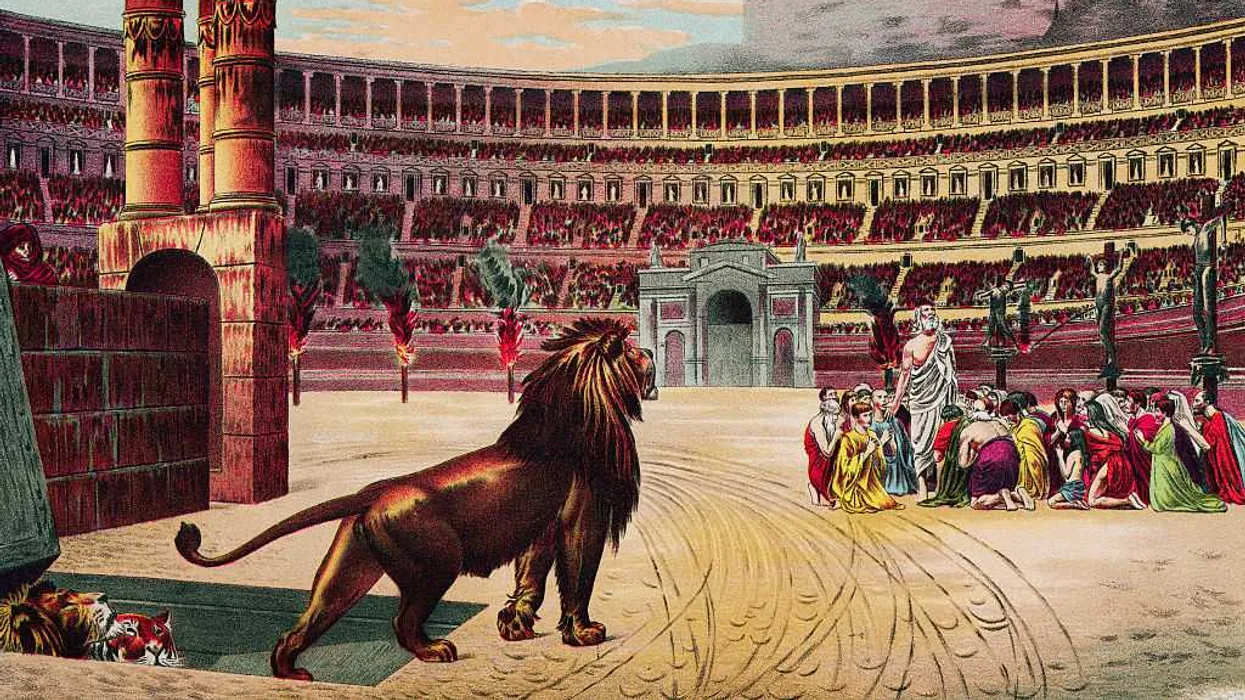
 Photo by: Philippe Lissac/Godong/Universal Images Group via Getty Images
God is not in a hurry
As a caregiver, I have learned the hard way that effort is not the same as health. When the pressure is high and the outcome uncertain, urgency can feel responsible. Control can masquerade as diligence.
But we do not get credit for effort if it lands us in a ditch. Trying to pass the plow does not create progress. It creates wreckage.
God is not rushed. He moves at His pace, not ours.
Repentance is not the abandonment of influence; it is the only ground on which influence survives.
If God is who He says He is, what wisdom is there in rushing ahead of Him?
Which leaves a final question for the people of God: Are we asking the Lord to bless what we refuse to repent of?
Scripture’s order has not changed. Humility precedes healing. Repentance comes before restoration. And when we declare a golden age without repentance, we should not be surprised if what we have built turns out to be a golden calf.
Why real Christianity terrifies the elites — and they’re right to worry
Much like gas-station sushi, David Brooks is hard to stomach at the best of times.
But his latest New York Times essay is the kind that makes you reach for the sick bag. He opens with the usual routine: an exasperated sigh, a long, self-important pause, and the unmistakable air of a man convinced he has cracked the cosmos — again.
A hidden faith saves no one, a timid faith shapes nothing, and a faith that folds under pressure is closer to cheap furniture than conviction.
He quotes a Czech priest, hints at deep wells of wisdom, and then meanders toward the real purpose of the piece: explaining, with mild exasperation, why Christians are once again disappointing him. This is nothing new. It’s a ritual at this point — a complaint that returns like spam you swore you unsubscribed from.
To be fair, Brooks isn’t stupid. He knows how to spin a story, how to climb onto the moral high ground without looking like he’s climbing, and how to crown himself the lone voice of reason in an age he insists is losing its mind.
But there is no missing the tone that hangs over almost every line he writes about believing Americans: a thin mist of condescension, settling somewhere between pastoral concern and a parent-teacher conference. He talks about everyday Christians the way a pretentious barista talks about someone ordering regular coffee — uncultured, embarrassing, and in need of enlightenment. And the tone, more than any point he makes, gives him away instantly.
Brooks claims to fear “rigid” or “pharisaical” Christianity. Yet the only certainties that radiate from his essay are his own. He divides the world into two armies — Christian nationalists on one side and “exhausted” secular humanists on the other — and then steps forward as the lone oracle who claims to see a path out of the fog.
Christians who vote for borders, who cherish the nation that shaped their churches, or who think culture is worth defending are waved off with his familiar, weary flick of the wrist. They’re told they practice a “debauched” version of the faith.
No evidence needed. Brooks’ opinion is treated as its own proof.
His description of these believers always follows the same script. They are angry, dangerous, and obsessed with power. They clutch their creed like a makeshift weapon, ready to wallop anyone who wanders too close.
In his telling, they never act from devotion, duty, or gratitude. They never look around their communities and see an America they love slipping away. They never mourn the millions taken before they drew a breath, the cracking of our shared foundation, or the slow burial of the sacred.
Instead, Brooks tells us they operate from “threat more than hope,” as if the country’s cultural decay were some far-fetched tale told for effect, rather than something families watch unfold every day in their schools, in their cities, and on their screens.
Brooks then pivots to his preferred theological register: the poetry of longing. He praises yearning, doubts, desires, and pilgrimages — all worthwhile themes.
But he uses them the way an interior decorator uses throw pillows: scattered for mood, never for structure. His spiritual reflections float past in soft, airy phrases that never touch the ground. This isn’t the faith of the Gospels, anchored in sacrifice and truth. It’s faith as fragrance — atomized cosmetic, evaporating faster than one of his metaphors. It asks nothing, risks nothing, and confronts nothing, which may be why Brooks finds it so comforting.
RELATED: Exposing the great lie about ‘MAGA Christianity’ — and the truth elites hate
 jokerpro/iStock/Getty Images Plus
Throughout his essay, Brooks holds up a small circle of “wise people” as models of the faith America needs — Tomas Halík, Rowan Williams, and a handful of theologians who speak in clichés and move through the world like contemplative shadows. Their calm inspires him. Their pluralism delights him. Brooks treats their quietism as the apex of Christian maturity, as if the holiest life is lived at arm’s length, murmuring about mystery while the roof caves in.
What he never admits is what these figures actually represent: a brand of Christianity that thrives in seminar rooms, academic conferences, and anemic interfaith panels — spaces far removed from the daily battles most Christians face. Halík writes beautifully about longing. Rowan Williams writes elegantly about humility. But neither man spent his life in the trenches defending children from ideological capture in schools, or standing up to governments intent on shredding the family, or speaking plainly about sin in a culture that now calls sin a civil right.
Brooks misreads their vocation as the universal Christian posture when it is, at best, one posture among many.
The heart of the essay is its barely disguised contempt for ordinary Christians who believe their faith should shape the societies they inhabit. This is the point he never states outright but gestures toward with every paragraph.
Faith, to Brooks, is primarily personal, private, and utterly toothless. The moment it concerns the fate of a nation or the moral trajectory of a culture, he calls it nationalism. If a Christian speaks of stricter immigration policies, he hears xenophobia. If a parent protects his child from the cultural free-for-all, he calls it regression.
Brooks leans heavily on the aforementioned Czech priest and philosopher, Tomáš Halík, as if Halík were handing him a permission slip for a diluted Christianity. Halík writes movingly about interior struggle and authentic witness, ideas rooted in his years serving an underground church under communist rule.
But Brooks treats Halík’s reflections on the inner life as a blanket command for Christians to withdraw from the outer one. Halík speaks of sincerity; Brooks hears surrender. Halík points to the vast, ungraspable side of faith; Brooks converts it into a polite memo urging believers to stay in their lane.
And so Brooks gets the entire lesson backward. Halík survived a regime that tried to erase Christianity from public life. He never argued for Christians to silence themselves or retreat from cultural battles. Yet Brooks uses him as cover to criticize anyone who won’t float along with the cultural current.
What Brooks never admits is that what he calls “Christian nationalism” is not the fringe menace he imagines. For many believers, it is simply the instinct to guard the faith that built their communities. It isn’t a hunger for domination, but a love for the inheritance passed down to them. It isn’t outright hostility toward outsiders but gratitude for the civilization that formed them.
Brooks conveniently sidesteps all of this and builds a caricature he can berate, warning of a “creeping fascism” that lives entirely in his own mind.
The self-anointed sage wants Christians to trade their armor for aroma, to swap vigilance for vague platitudes, and to follow his favorite tastemakers into a future where faith survives only behind closed doors.
But Christians know better. A hidden faith saves no one, a timid faith shapes nothing, and a faith that folds under pressure is closer to cheap furniture than conviction. Brooks will disagree, naturally. He always does.
As so many times before, the smug sexagenarian takes a swing at American Christians. And once again, he misses the target by a mile.
David Brooks Can’t Hide His Contempt for Ordinary Americans
David Brooks has always fancied himself a kind of moral chiropractor for middle-class souls: Half preacher, half therapist, all smug…..





