

Category: Gen Z

‘Like Do We Have a Game Plan To Turn This Around?’: Inside ‘Gen Z for Crockett,’ the Group Chat Where Jasmine Crockett’s Most Committed Supporters Are Questioning Her Strategy
Left-wing Texas Senate candidate Jasmine Crockett has collaborated with a group of her youngest and most enthusiastic supporters, Gen Z for Crockett, in flashy campaign videos and fundraising appeals. Inside Gen Z for Crockett’s group chat, however, members aren’t so convinced by Crockett’s campaign, spending much of their time complaining that Crockett appears directionless with no clear policy positions or core message.
The post ‘Like Do We Have a Game Plan To Turn This Around?’: Inside ‘Gen Z for Crockett,’ the Group Chat Where Jasmine Crockett’s Most Committed Supporters Are Questioning Her Strategy appeared first on .
The American dream lives where people still choose to build
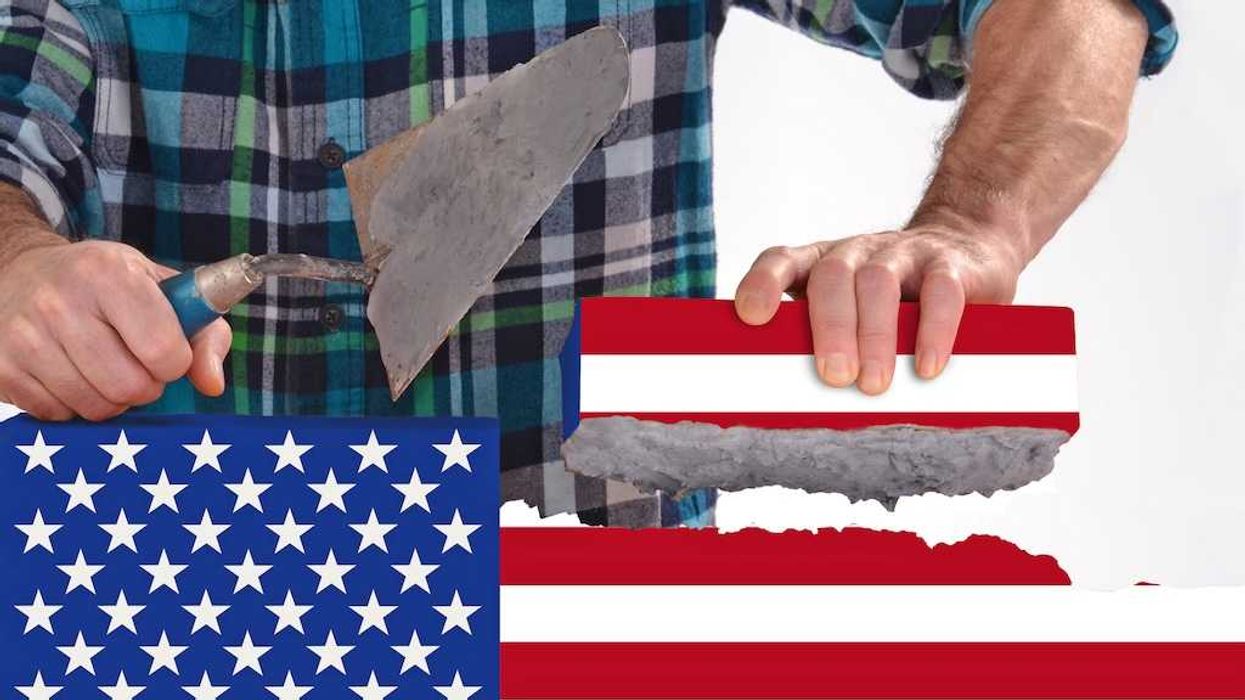
“For many, the American dream has become a nightmare,” Sen. Bernie Sanders (I-Vt.) has said, capturing a sentiment that has become common on the political left and across modern culture.
That line now travels far beyond politics. Scroll social media for five minutes, and you’ll see the same message repeated in endless variations: Owning a home is impossible. Raising a family is irresponsible. Work doesn’t pay. The system is rigged. The future is closed.
The American dream was never a promise of ease or comfort by age 25. It was an invitation to build something meaningful over time through responsibility and perseverance.
This message is everywhere, and it is doing real damage.
Harder lives, false conclusions
Life has become harder in tangible ways. Housing costs have surged. College has grown bloated and expensive. Inflation punished families already living close to the margins. Young adults feel delayed, uncertain, and anxious about the future.
Those frustrations are real. The conclusion being pushed alongside them is not.
The lie is not that things are harder. The lie is that effort no longer matters.
That lie spreads quickly online because it feels validating. A 30-second video declaring the system broken beyond repair asks nothing of the viewer except agreement. Building a life requires patience, sacrifice, and time. One goes viral. The other happens quietly.
Much of this shift comes from where young Americans now form their beliefs. For many in Generation Z, ideas about money, marriage, and the future are no longer shaped primarily by parents, churches, employers, or local communities. They are shaped by algorithm-driven platforms like TikTok and X, where extremity is rewarded with attention.
In those spaces, online figures routinely dismiss the American dream as a scam and portray starting a family as a trap rather than a source of meaning or stability. Cynicism is marketed as realism. Detachment is framed as wisdom. A generation looking for guidance is taught to expect failure before it ever tries.
Why despair is profitable
This narrative didn’t arise by accident. It feeds on real pain, but it’s also profitable. Political movements gain leverage by convincing voters that only sweeping control from the top can fix a hopeless system. Media companies thrive on pessimism because fear keeps people watching. Online grievance entrepreneurs build massive followings by telling young people that nothing they do will ever be enough.
If Americans stop believing they can build a future, someone else will gladly build power over them.
History keeps disproving this story.
Tell the generation that survived the Great Depression that the American dream was dead. Tell the men who returned from World War II, many wounded and broke, who used the GI Bill to buy homes and start families, that the climb was too steep. Tell the children of factory workers who grew up without air conditioning, college degrees, or safety nets — but still built middle-class lives through work and sacrifice — that the odds were unfair.
Tell the families of the 1950s and 1960s who lived modestly, saved slowly, and delayed gratification for decades that life was easy. Tell the Americans who endured oil crises, layoffs, and double-digit inflation in the 1970s and early 1980s that the system was designed for their comfort.
The dream was never easy
Life has never been easy. The climb has always been steep. The American dream was never built on convenience. It was built on resilience.
The truth is less dramatic — and far more hopeful. The American dream didn’t disappear. It changed shape.
It was never a promise of ease or comfort by age 25. It was an invitation to build something meaningful over time through responsibility and perseverance. For generations, it rested on a simple foundation: Work hard, form families, contribute locally, and invest in something bigger than yourself.
That path was never easy. What changed is not the dream, but our tolerance for effort and our patience for delayed reward.
The quiet math of real life
Despite the noise, the American dream remains visible in places social media rarely celebrates. It shows up in the quiet math of real life.
Research from the Institute for Family Studies finds that stably married Americans approaching retirement hold, on average, more than $640,000 in household assets, compared with roughly $167,000 for divorced or never-married adults — even after accounting for age, education, and race. That gap reflects decades of shared sacrifice, income pooling, planning, and commitment.
These stories don’t trend online. They play out quietly every day.
Ironically, many of the loudest voices declaring the dream dead are doing quite well selling that message. Entire online brands are built on telling people that life is impossible — while generating substantial revenue and influence in the process. Despair has become an industry.
RELATED: Christmas is worth celebrating, even if your family is fractured
 Chris Ratcliffe/Bloomberg via Getty Images
What truly threatens the American dream is not capitalism, competition, or even inequality. It’s a culture that encourages permanent adolescence. A culture that treats commitment as a burden, delays adulthood indefinitely, and then wonders why people feel anxious and untethered.
The American dream doesn’t die because life is hard. It dies when people are convinced that hard things aren’t worth doing.
Too many young Americans are told that marriage can wait, children are optional, faith is outdated, and roots are restrictive. They’re promised freedom through detachment and fulfillment through endless choice — then wake up years later with more options than ever and less meaning than expected.
Builders still have the advantage
This isn’t a policy argument. It’s a cultural one. No law can manufacture purpose. No program can force optimism. But a nation that teaches its citizens the dream is dead shouldn’t be surprised when fewer people try to live it.
The American dream has always belonged to builders of families, businesses, and communities. It never belonged to those waiting for perfect conditions or guaranteed outcomes.
The American dream isn’t dead. But telling Americans that it is has become fashionable, profitable, and politically useful.
The question is whether we continue to accept that story — or choose, once again, to build.
At Three Mile Island, the lights flip on — and a generation sees its destiny
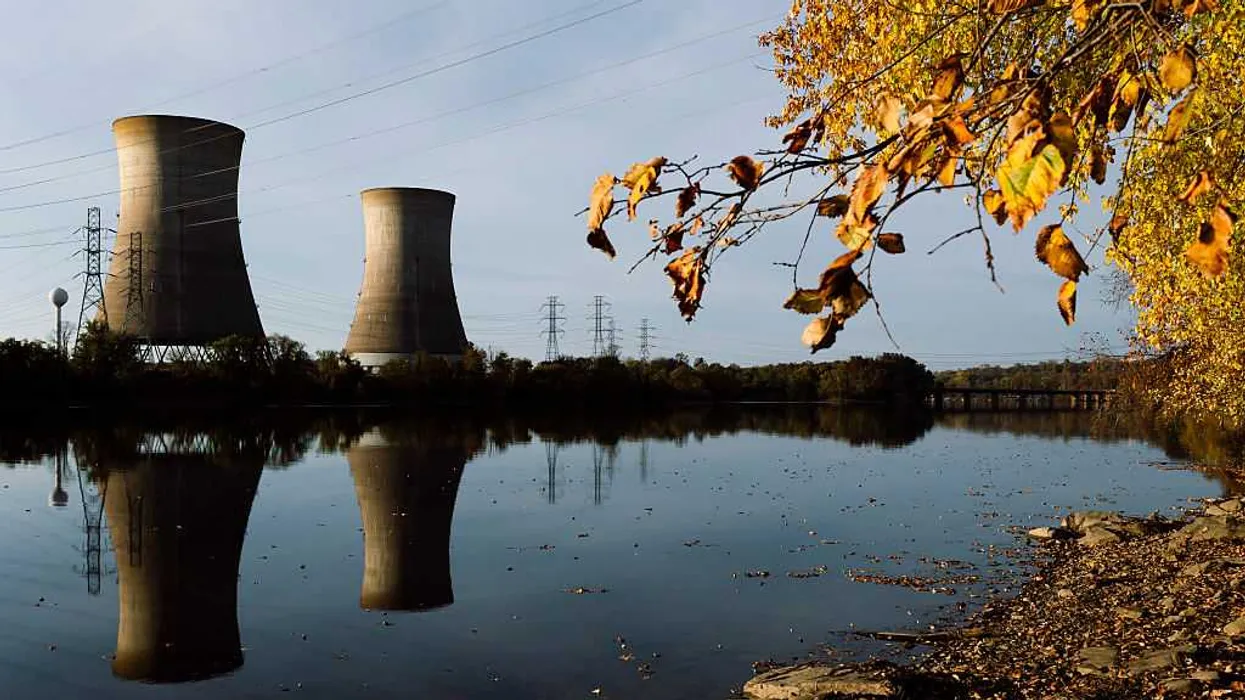
Just over a year ago, the headlines were everywhere: Three Mile Island Unit 1 was coming back online as the Crane Clean Energy Center. A site that once defined an entire industry’s future has done it again, this time as a symbol of hope, optimism, and unity as we move toward a reliable and clean energy future.
For us, young professionals in the nuclear industry, this moment showed what’s possible when communities come together. From union members and business leaders to viral social media posts and major media outlets, everyone celebrated the announcement of the restart. In a society often defined by polarization, this was a rare moment of shared pride and common purpose.
We know that America’s ability to deliver reliable, emissions-free energy will define the nation that Gen Z will lead tomorrow — politically, economically, and environmentally.
As 2025 draws to a close, nuclear energy sits at the center of a new national conversation — one driven by optimism, innovation, and a shared commitment to a cleaner future. Public support for nuclear energy is at historic highs, with six in 10 Americans in favor of its expansion. Companies that defined Gen Z’s childhood, like Meta, Google, and Amazon, are partnering with nuclear producers to power the data centers that keep our digital lives running. For Gen Z, this isn’t just about keeping the lights on: It’s about building a future where clean energy powers our ambitions, our communities, and our planet.
Growing up, many of us felt politics was a binary choice — two parties, two options, and endless division. But today, nuclear energy stands out as something different: a safe haven for young people across the political spectrum. It’s one of the few issues drawing support from both sides, with the Biden and Trump administrations both advancing policies that strengthen nuclear energy’s role in America’s energy mix.
For Gen Z, that bipartisanship represents progress, not politics. We know that America’s ability to deliver reliable, emissions-free energy will define the nation that Gen Z will lead tomorrow — politically, economically, and environmentally.
Now it’s up to all of us to seize this unique opportunity and recognize nuclear power’s potential to redefine America’s energy conversation. Nuclear energy is more than a technology — it’s a catalyst for unity, resilience, and innovation. It can deliver on our generation’s hopes for a cleaner, fairer, and more sustainable world.
Nuclear power doesn’t just create reliable, emissions-free energy: It offers countless societal benefits. Generating stations do more than generate electricity. They can also support system add-ons that produce clean water through desalination and help yield valuable medical materials for diagnosing heart disease and providing crucial cancer care.
When we think back to history class, we learned about iconic generational causes like the space race and the wonders that could be unlocked in the internet age. Each generation had something tangible to rally around, something that brought people together to move the world forward. For Gen Z, that unifying cause can be nuclear energy: a reliable, emissions-free solution that defines progress for our time.
RELATED: 5 truths the climate cult can’t bury any more
 Photo by Joe Sohm/Visions of America/Universal Images Group via Getty Images
We’ve seen it firsthand. We both took the leap to work in the nuclear industry, and more specifically, on a historic nuclear restart. Three Mile Island Unit 1 in Dauphin County, Pennsylvania, closed for economic reasons in 2019, hurting hundreds of families whose livelihoods depended on it.
Yet as energy demands surged, the world rediscovered nuclear energy’s critical role. This momentum led to the announcement of the unit’s restart exactly five years after being shut down.
We are both at the beginning of our careers and hope the momentum we’re seeing now will carry forward for future generations. Being part of the nuclear renaissance, which is turning into a national movement, has filled our young careers with pride and purpose.
Whether you are Gen Z or not, clean nuclear energy can be a uniting force in a divided world. The bipartisan support, private investment, and widespread public acceptance happening today didn’t happen by coincidence — it happened because people came together to focus on what works. We can’t afford to lose that momentum. Let’s build on it to create the next-generation cause: a nuclear energy-powered future.
Editor’s note: This article was originally published at RealClearWire.
Gen Z in the Age of Digital Polyculture
Americans often say the 1960s marked the height of monoculture, but that moment was really the midpoint of a broader…
Why the kids are not all right — and Boomers still pretend nothing’s wrong
Here’s a message Baby Boomers need to hear: The America you were born into no longer exists.
A rising tide of young Americans are embracing socialism at a pace this country has never seen. Boomers often assume that it’s about handouts. It isn’t. Beneath the surface is a decades-long campaign so destructive to middle-class mobility that it threatens to push the nation toward civil conflict. The more you study it, the more coordinated it looks.
A people dependent upon ‘gimme gimme’ socialism is an easily managed population. A demoralized middle class keeps the ruling class secure.
In a way, it was.
Short-term profit-maximizing globalists on Wall Street teamed up with the K Street lobbying blob to drown Americans in cheap Chinese goods while saddling them with student debt, consumer debt, and medical debt.
Young people are being priced out of the American dream.
My urgent message to Boomers — especially those who want to keep influence: The kids are not all right.
The America your kids and grandkids know is not the America you knew. Most Boomers were born in the 1950s, when the country was booming — united by postwar optimism, American industrial strength, shared national institutions, Walter Cronkite on one television in every home, full-fat milkshakes, and Elvis shaking up the culture.
Today, we live in a golden age of technological revolution. We are making remarkable advances in space travel, tech, and medicine — increasingly led by the private sector and unapologetic capitalists. But on the basics — housing, health, education — we’re failing the next generation.
In 1955, the median homebuyer was in his late 20s. In 2025, it’s 56. A minimum-wage worker in the 1950s needed roughly seven years of pay to buy a modest home without a mortgage. Today, it’s around 27.
In 1955, a student could pay college tuition by working a few hours a day at minimum wage. Today, that same student would need to work about six hours a day. If a kid wants Yale or any Ivy League school, he would have to work 26.4 hours a day — an impossible figure that illustrates how detached elite education has become from reality.
Here’s a frightening divide: 93% of Boomers say political violence is never justified; 44% of Gen Z say it “sometimes” is.
Ninety-nine percent of kids are not out for blood, but 100% of them face a massive relative disadvantage. The upward mobility Boomers took for granted has been hollowed out by globalist and left-wing policies sold as progress but experienced as decline.
We spent trillions of American dollars on foreign wars, foreign infrastructure, and foreign elections. We borrowed recklessly. Now the dollar is frail. We allowed millions of illegal migrants to enter the country, fueling crime and pushing Americans out of jobs. Young households are buried in debt — not mortgage debt that builds equity, but consumer debt used to numb the anxiety left by a collapse in community and faith.
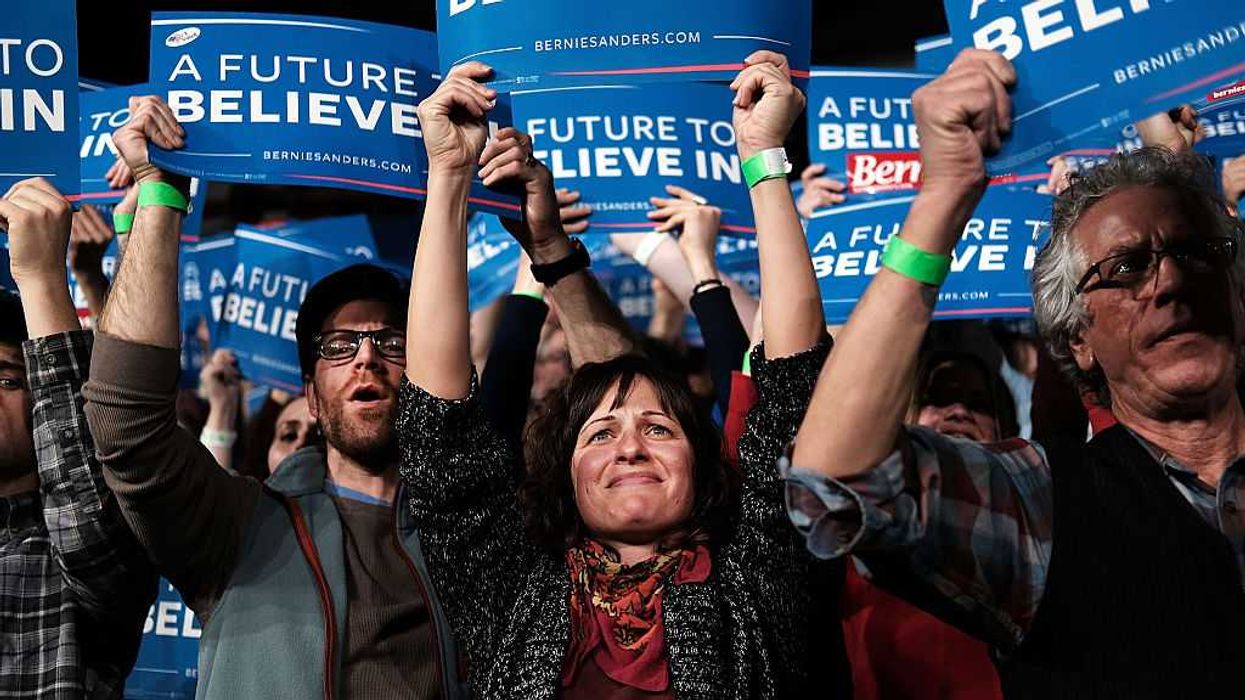
Here’s the truth: The populist right and the socialist left agree on the diagnosis. Listen to the first half of Bernie Sanders’ interview with Joe Rogan in June. For an hour, Bernie describes America’s economic troubles. Most people, right or left, would nod along.
Then comes the pivot: Socialism is the cure.
This is the left’s great deceit. Progressives’ proposed “solutions” hurt the very people they claim to help.
RELATED: We built abundance and lost the thing that matters
 Photo by Spencer Platt/Getty Images
Take restrictive zoning and rent regulations — blue-state staples designed to “create” affordable housing. In reality, they choke supply and drive rents higher. Or look at no-cash bail. The neighborhoods hit hardest by serially released offenders are the same minority communities progressives claim to champion. The examples pile up.
So why do left-wing billionaires back these ideas? Simple: Socialism, communism, and their logical end point — fascism — are excellent for entrenched oligarchs. A people dependent upon “gimme gimme” socialism is an easily managed population. A demoralized middle class keeps the ruling class secure.
There is another path.
We must reverse the policies that got us here. Strengthen education outcomes, lower health care costs, rebuild domestic supply chains, expand American energy generation, and restore competence to the workforce.
Boomers, if you don’t lead this shift, your influence will vanish before your next Social Security check arrives. Moderate Democrats already know the socialist tide is rising. They’re afraid to say it out loud.
The Gen Z and Millennial voting bloc will dominate the 2028 election. They are demanding change. Moderates — in both parties — are being replaced by extremists.
You have a choice: Allow yourselves to be absorbed into the socialist machine, or correct the mistakes of the last two decades, return power to citizens, and rebuild access to the American dream.
America’s new lost generation is looking for home — and finding the wrong ones

A friend who works with high school students recently said to me, “I overheard a group of boys talking about ‘international Jewry.’” He was in disbelief to hear these seemingly mild-mannered kids express views that, not 20 years ago, would have been considered taboo.
What is going on with Gen Z?
I have written elsewhere that Gen Z is experiencing a kind of church resurgence. That remains true. But at the same time, Gen Z is one of the most polarized generations in American history.
Social systems that seek to reorient reality by means of uprooting history and tradition will ultimately create a rootless and disaffected class in search of belonging.
In 2024, Gen Z — led in part by young activists like Charlie Kirk and Scott Presler — shifted toward Donald Trump. He won 46% of Gen Z voters — 56% of young men and 40% of young women. This led many to expect that a younger, more populist generation would shift the country rightward. But now in 2025, the self-proclaimed Democratic Socialist Zohran Mamdani won 78% of the youth vote in New York City — 67% of young men and 84% of young women. Far from being locked into any one existing political party, young people are more divided than ever.
One cause of this is what I call “nomadic progressivism.” Kids born between, say, 1997 and 2012 have been thoroughly inundated with progressivism and identity politics from birth. They came of age amid several key developments that shaped their moral and social formation:
- The Supreme Court’s Obergefell v. Hodges decision in 2015 and the legalization of same-sex marriage.
- The killing of Trayvon Martin and the rise of Black Lives Matter.
- The surge of transgender activism that dominated headlines in the early 2020s.
- The appearance of Greta Thunberg and the new climate movement.
- The explosive growth of Facebook, Twitter, Snapchat, Instagram, and Vine.
We could list hundreds of others, but these movements captured Gen Z’s moral imagination. Each sought, in the name of justice or progress, to undermine the inherited order, replacing the inherited structures of culture with moral and social uncertainty.
Gen Z grew up bullied by progressive ideology, and until the shocking election of Donald Trump in 2016, there was no visible reaction. Society appeared to be marching unopposed toward progressive utopia. But Trump’s election broke the spell. His first term was marked by protests, the rise of transgender ideology, and a wave of social revolt.
Then came COVID-19. As the left preached “safety,” Gen Z was locked inside, immersed in a digital environment, and wracked by depression and anxiety. Created for engagement and real community, young people were instead sent to their rooms and told to stay there.
This, I believe, is the key: Progressivism prepared the soil for radicalization. It removed the roots — churches, families, communities — that once grounded Gen Z’s moral life. It left young people searching for belonging in a barren landscape.
The philosopher and novelist Simone Weil wrote in “The Need for Roots” that “human beings have roots by virtue of their real, active, and natural participation in the life of a community, which preserves in living shape particular treasures of the past and particular expectations for the future.” When that participation is stripped away, people search for roots elsewhere.
For Gen Z women, that search often led to Instagram and other social media platforms. They heard celebrities and influencers denounce the status quo. They were told marriage was oppressive, men were vile, and independence was the highest good. But that “empowerment” was often just loneliness in disguise.
RELATED: Young, broke, and voting blue: 2025’s harsh lesson for the right
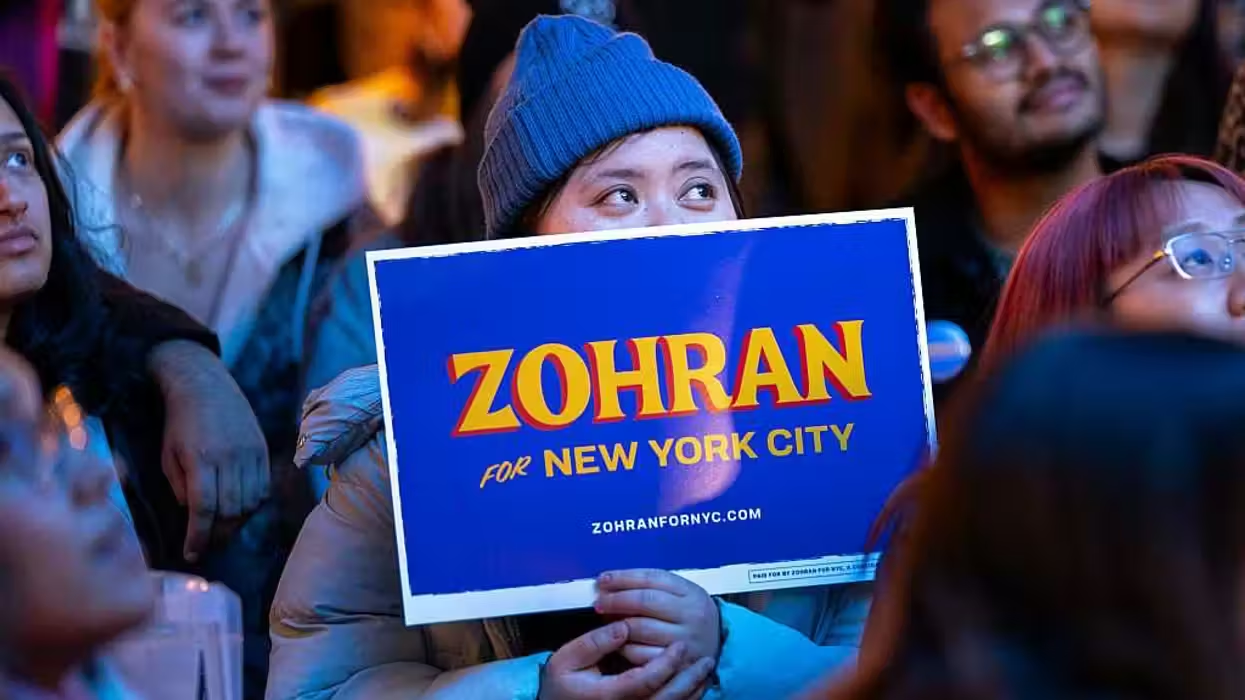 Photo by Jeremy Weine/Getty Images
As for Gen Z men, constant ridicule and belittlement left them disoriented. Why invest in a society that despises you? Why build what the world condemns? In this vacuum arose the “manosphere.” Figures like Andrew Tate offered refuge. They told men it was OK to be men — and as they were among the only ones saying so, they had free rein to define what it meant. If honor, discipline, and respectful courtship were only going to get you mocked and condemned, manosphere influencers reasoned that you might as well double down on boorishness, lust, and aggression.
As distrust of the government and institutions grew, young men turned elsewhere for truth. In gnostic fashion, figures like Nick Fuentes promised to reveal “how things really are.” But as Christopher Rufo has noted, it is a ruse. Fuentes exploits the crisis of masculinity to peddle resentment and historical denialism. Progressive Gen Z women, seeking fulfillment in the depths of the online space, are little different from the young men seeking connection and meaning from those like Fuentes.
Gen Z is a generation longing for roots. Its members are trying to find them on the fringes of society, since their own roots were dug out years ago. Progressivism creates nomads. Social systems that seek to reorient reality by means of uprooting history and tradition will ultimately create a rootless and disaffected class in search of belonging. And they will find it in dark places.
The men and women of Gen Z are not uniquely radical. They are uniquely rootless. They have inherited a moral landscape stripped of shared meaning, through which they drift amid ideologies that promise belonging but deliver only bitterness. The progressive order unmoored them; now the reactionary order recruits them. And unless a deeper renewal of faith, family, and community takes root, this generation will continue to wander — searching for the very home that modernity taught them to forget.
Editor’s note: A version of this article appeared originally at the American Mind.
Today’s Teens: The Generation We’ve Totally Annoyed
One of the great thrills of adolescence is that you start liking girls. And they, in turn, like boys. But…
The GenZ Case Against the Property Tax
The signs are clear that a new tax revolt is brewing in America, this time to finally put an end…





