

Category: Higher Education

Qatar Is Pushing for ‘Social Justice’ Lessons and Arabic Classes in US K-12 Schools
Foreign rulers should not have a say in what children learn in our nation’s K-12 schools, which is why we should be alarmed by the state of Qatar’s under-the-radar activities in American primary and secondary education.
Public documents from Georgia reveal that Qatar Foundation International (QFI), the Qatari royal family’s charity arm in the United States, is funding multiple education initiatives in the Peach State: K-12 teacher trainings, Arabic textbooks for young students, and student trips to Qatar.
The post Qatar Is Pushing for ‘Social Justice’ Lessons and Arabic Classes in US K-12 Schools appeared first on .
A Different Midterm Milestone
Redistricting measures in Texas and California have all eyes on the Nov. 3 midterm election. That contest also marks 30…
A Different Midterm Milestone
Redistricting measures in Texas and California have all eyes on the Nov. 3 midterm election. That contest also marks 30…
The Problem Isn’t That Plato Is Woke
There’s a sense of triumphalism in the headlines. “Texas A&M is banning Plato, citing his ‘gender ideology,’” one caption at…
A Bag of Rocks for $400,000?
On a social media site the other day, someone posted a single sentence to the effect that he’d tried once…
The Spectator P.M. Ep. 182: Elite Colleges Are Back on Top for Job Recruiters
A growing number of job recruiters are returning to relying heavily on elite colleges to find top applicants, a Veritas…
Universities treated free speech as expendable in 2025
The fight over free expression in American higher education reached a troubling milestone in 2025. According to data from the Foundation for Individual Rights and Expression, efforts to censor speech on college campuses hit record highs across multiple fronts — and most succeeded.
Let’s start with the raw numbers. In 2025, FIRE’s Scholars Under Fire, Students Under Fire, and Campus Deplatforming databases collectively tracked:
- 525 attempts to sanction scholars for their speech, more than one a day, with 460 of them resulting in punishment.
- 273 attempts to punish students for expression, more than five a week, with 176 of these attempts succeeding.
- 160 attempts to deplatform speakers, about three each week, with 99 of them succeeding.
That’s 958 censorship attempts in total, nearly three per day on campuses across the country. For comparison, FIRE’s next-highest total was 477 two years ago.
The 525 scholar sanction attempts are the highest ever recorded in FIRE’s database, which spans 2000 to the present. Even when a large-scale incident at the U.S. Naval Academy is treated as just a single entry, the 2025 total still breaks records.
The common denominator across these censorship campaigns is not ideology — it’s intolerance.
Twenty-nine scholars were fired, including 18 who were terminated since September for social media comments about Charlie Kirk’s assassination.
Student sanction attempts also hit a new high, and deplatforming efforts — our records date back to 1998 — rank third all-time, behind 2023 and 2024.
The problem is actually worse because FIRE’s data undercounts the true scale of campus censorship. Why? The data relies on publicly available information, and an unknown number of incidents, especially those that may involve quiet administrative pressure, never make the public record.
Then there’s the chilling effect.
Scholars are self-censoring. Students are staying silent. Speakers are being disinvited or shouted down. And administrators, eager to appease the loudest voices, are launching investigations and handing out suspensions and dismissals with questionable regard for academic freedom, due process, or free speech.
RELATED: Liberals’ twisted views on Charlie Kirk assassination, censorship captured by a damning poll
 Deagreez via iStock/Getty Images
Some critics argue that the total number of incidents is small compared to the roughly 4,000 colleges in the country. But this argument collapses under scrutiny.
While there are technically thousands of institutions labeled as “colleges” or “universities,” roughly 600 of them educate about 80% of undergraduates enrolled at not-for-profit four-year schools. Many of the rest of these “colleges” and “universities” are highly specialized or vocational programs. This includes a number of beauty academies, truck-driving schools, and similar institutions — in other words, campuses that aren’t at the heart of the free-speech debate.
These censorship campaigns aren’t coming from only one side of the political spectrum. FIRE’s data shows, for instance, that liberal students are punished for pro-Palestinian activism, conservative faculty are targeted for controversial opinions on gender or race, and speaking events featuring all points of view are targeted for cancellation.
The two most targeted student groups on campus? Students for Justice in Palestine and Turning Point USA. If that doesn’t make this point clear, nothing will.
The common denominator across these censorship campaigns is not ideology — it’s intolerance.
RELATED: Teenager sues high school after tribute to Charlie Kirk was called vandalism
 rudall30 via iStock/Getty Images
So where do we go from here?
We need courage: from faculty, from students, and especially from administrators. It’s easy to defend speech when it’s popular. It’s harder when the ideas are offensive or inconvenient. But that’s when it matters most.
Even more urgently, higher education needs a cultural reset. Universities must recommit to the idea that exposure to ideas and speech that one dislikes or finds offensive is not “violence.” That principle is essential for democracy, not just for universities.
This year’s record number of campus censorship attempts should be a wake-up call for campus administrators. For decades, many allowed a culture of censorship to fester, dismissing concerns as overblown, isolated, or a politically motivated myth. Now, with governors, state legislatures, members of Congress, and even the White House moving aggressively to police campus expression, some administrators are finally pushing back. But this pushback from administrators doesn’t seem principled. Instead, it seems more like an attempt to shield their institutions from outside political interference.
That’s not leadership. It’s damage control. And it’s what got higher education into this mess in the first place.
If university leaders want to reclaim their role as stewards of free inquiry, they cannot act just when governmental pressure threatens their autonomy. They also need to be steadfast when internal intolerance threatens their mission. A true commitment to academic freedom means defending expression even when it is unpopular or offensive. That is the price of intellectual integrity in a free society.
Editor’s note: This article was originally published by RealClearPolitics and made available via RealClearWire.
Brown Lawyers Up After Bungled Response to Mass Shooting, Retaining Former US Attorney
Brown University has retained former federal prosecutor Zachary Cunha as it bolsters its legal team in the aftermath of last week’s mass shooting that killed two students and wounded nine others.
The post Brown Lawyers Up After Bungled Response to Mass Shooting, Retaining Former US Attorney appeared first on .
Buyer Beware: The College Edition
Buyer beware. Seems like common sense. We’re wary when we buy a power tool on Facebook Marketplace. We don’t assume…
Trump takes a wrecking ball to the woke campus economy
To the far-left loons and anti-American activists who dominate large swaths of the nation’s four-year college campuses, a reminder: Donald Trump is your president. And whether you like it or not, he now functions as your college dean.
The title may be unofficial, and no one expects Trump to hand out diplomas, but the reality is unavoidable. Through executive orders and funding decisions, Trump is now calling the shots in higher education. His administration is dismantling a long list of Obama-Biden-era policies that entrenched DEI bureaucracies, racial discrimination, radical gender ideology, and other woke orthodoxies that turned college campuses into centers of political indoctrination rather than education.
Faculty lounges and administrative offices dominated by liberal orthodoxy have failed students for too long.
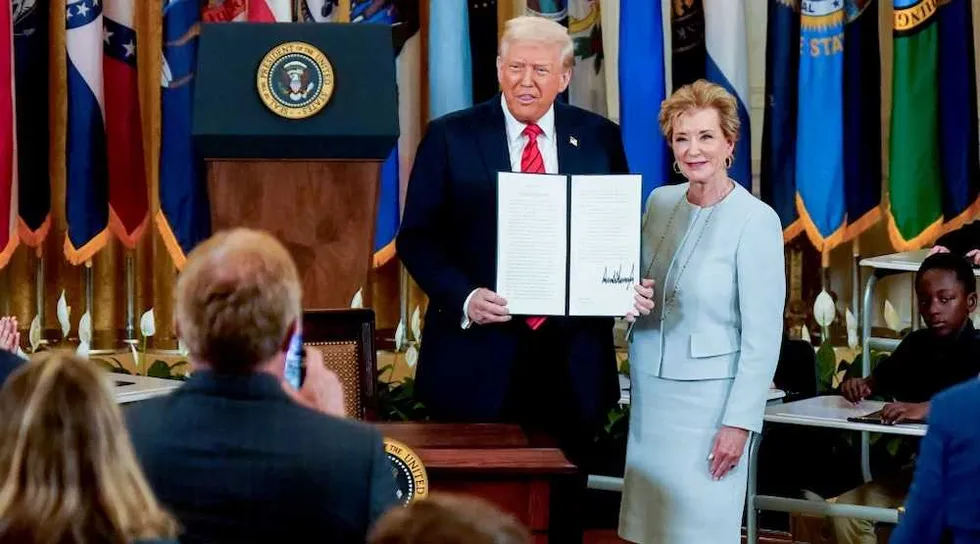
Trump, alongside Education Secretary Linda McMahon, is not only shrinking the Department of Education’s bureaucratic footprint but demanding that universities deliver measurable value to students. For the first time in years, outcomes matter again.
End this discriminatory rule
That shift should become unmistakable this month, when the Department of Education launches the Accountability in Higher Education and Access through Demand-driven Workforce Pell Committee negotiated rulemaking. Trump’s One Big Beautiful Bill Act directs the department to establish new accountability measures tied directly to student outcomes, including a uniform earnings premium standard for all colleges and universities.
This reform creates an opportunity to finally eliminate the Gainful Employment Rule, a discriminatory relic of the Obama and Biden administrations’ radical education agenda. Under Trump’s approach, earnings standards would apply across the board, regardless of an institution’s tax status or curriculum.
The goal is straightforward: Colleges should prepare students for productive careers. Programs will be evaluated by comparing graduates’ median earnings to those of working adults with only a high-school diploma — or, in the case of graduate programs, a bachelor’s degree. Programs whose graduates fail to outperform those benchmarks for two out of three years would lose access to federal student aid.
That standard exposes the true purpose of the GER under Democrat administrations. It was never about protecting students. It was about punishing institutions disfavored by the academic establishment — especially career colleges and faith-based schools — while shielding traditional four-year universities from scrutiny.
Biden’s war on for-profit schools
Obama and Biden applied the GER almost exclusively to proprietary schools, even though public and nonprofit universities enroll the vast majority of students. A Wall Street Journal analysis found that if the Biden administration’s debt-to-earnings metrics were applied evenly, nearly 80% of failing programs would be housed at public and nonprofit institutions.
The left sees no problem saddling students with six-figure debt for degrees in fashionable but economically useless fields. But students training to become construction managers, electricians, or caterers must be “protected” from choice — even though they typically graduate with far less debt and far better job prospects.
Selective enforcement reveals the real agenda. By targeting career colleges while exempting elite institutions, Democrat administrations sought to limit educational choice and justify mass student loan forgiveness. The system was designed to funnel students into four-year degree programs regardless of whether those programs matched their skills, interests, or career goals.
RELATED: Christian students are pushing back — and universities are cracking
 Kent Nishimura/Bloomberg via Getty Images
Reversing the damage
It is no coincidence that public confidence in higher education collapsed during this same period. By 2023, a majority of Americans said a four-year degree was no longer worth the cost. Only about 30% of recent graduates found entry-level jobs in their field of study, and roughly two-thirds of Gen Z graduates say they would reconsider attending college if given the chance.
The AHEAD committee now has an opportunity to reverse that damage. By repealing the Gainful Employment Rule and implementing a single, fair accountability standard, it can restore value to higher education and respect the diversity of educational paths students choose.
Higher education should foster intellectual growth, opportunity, and freedom — not ideological conformity or lifelong debt. Faculty lounges and administrative offices dominated by liberal orthodoxy have failed students for too long. Americans should welcome a president who not only recognizes the problem but is finally doing something about it.





