

Category: Canada
Nathan MacKinnon Makes Hilarious Implication Canada Is ‘Better Team’ After Taking Big Fat L Against Team USA
LMAO … we completely broke Canada’s spirit
Team USA Men’s, Women’s Hockey Lands Free Crabcakes For Life After Bringing Home Gold Medals
Plain and simple, America dominated Olympic hockey in 2026
Canada Looks an Awful Lot Like Venezuela. And Trump Has Noticed.
Recently, the United States of America (USA) successfully completed Operation: Absolute Resolve and, thereby, liberated the Venezuelan people from Nicolás…

The Spectacle Ep. 319: Exploring Venezuela’s Crisis and Canada’s Chinese Influence
A couple of weeks have gone by since the U.S. captured Venezuelan dictator Nicolás Maduro, leaving the country’s future potential…
While Canada Cozies Up to China, Mexico Imposes Harsh Tariffs Due to Chinese Auto Dumping
In an attempt to figuratively poke Donald Trump and the United States in the eye, Canadian Prime Minister Mark Carney…
Trump not worried about Canada’s China-centric ‘new world order’
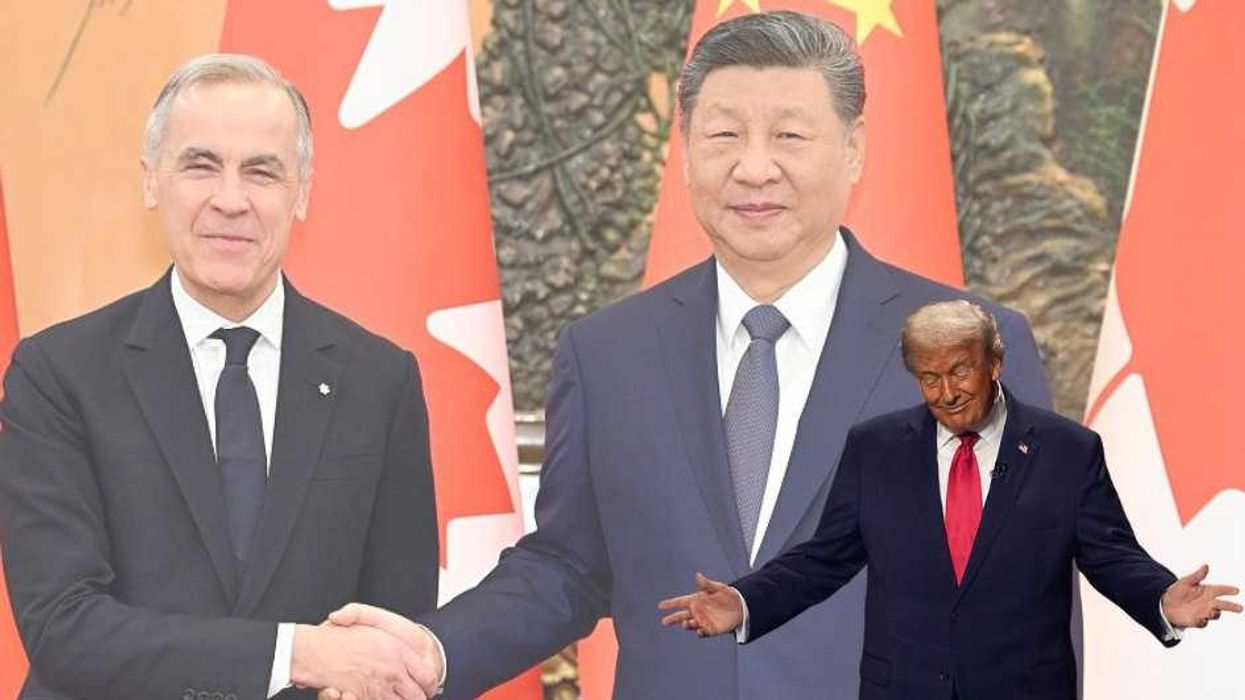
Try explaining this one: President Donald Trump’s relaxed — almost insouciant — response to news that Canadian Prime Minister Mark Carney pledged allegiance to a China-centered “new world order.”
Why did Trump appear to shrug off Carney’s insistence that Canada’s future lies more with China than with the United States?
Carney’s favorable assessment of China’s role in climate and green finance is not an isolated remark.
Perhaps it has something to do with Greenland and Canada being viewed as components of Trump’s broader Western Hemisphere security plan.
Cue the black helicopters
Not long ago, “new world order” belonged firmly in the vocabulary of conspiracy theorists. But in Beijing last week, Carney elevated the phrase into an official Liberal talking point.
So what did Carney say? Plenty.
Mine is the first visit of a Canadian prime minister to China in nearly a decade. The world has changed much since that last visit, and I believe the progress that we have made in the partnership sets us up well for the new world order.
Trump did not respond immediately. Instead, he waited until the end of the news day last Friday before offering his reaction.
“That’s what he should be doing, and it’s a good thing for him to sign a trade deal. If you can get a deal with China, you should do that,” Trump said.
Not the response many expected from a president who has urged countries in the Western Hemisphere to distance themselves from Beijing.
World order word salad
Pressed on what he meant by a “new world order,” Carney responded with his characteristic blend of abstraction and deflection.
So the question is, what gets built in that place? How much of a patchwork is it? How much is it just on a bilateral basis? Or where do like-minded countries in certain areas? So like-minded countries, just to be clear, doesn’t mean you agree on everything. So aspects, for example, on digital trade or agricultural trade, climate finance as another area to move into areas of geo-strategy, geo-security, you will have different coalitions that are formed. So what this partnership does is in areas, for example, of clean energy, conventional energy, agriculture, as we were just talking about, and financial services, which we have talked less about, but the evolution of the global financial system.
Trump’s nonchalance was not shared by conservative commentators, who sharply criticized Carney’s remarks.
Alex Jones, for one, described Carney as “a Klaus Schwab acolyte” and warned: “You are about to see the globalist prime minister of Canada pledge allegiance to the communist dictator in China, Xi Jinping.”
RELATED: What does Trump see in Canada’s pro-China prime minister?
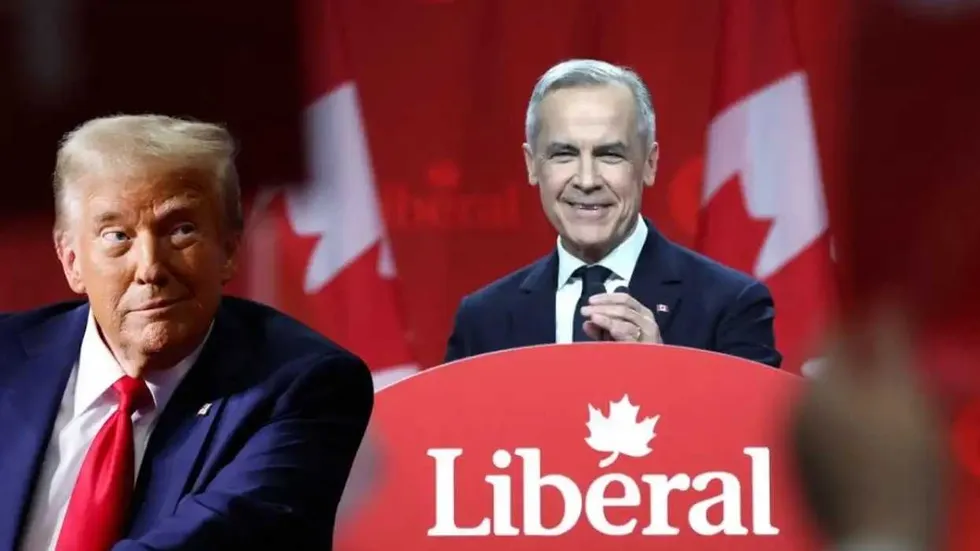 Chip Somodevilla/Dave Chan/Getty Images
China guy
So far, Carney’s new world order with China has produced a trade agreement allowing up to 49,000 electric vehicles to be imported into Canada annually at a reduced tariff of 6.1%. In return, China is expected to lower tariffs on Canadian agricultural exports — most notably canola oil, a key cash crop for Canadian farmers — to roughly 15%.
But there is nothing new about Carney’s deference to China.
After leaving the Bank of England in 2020, Carney became vice chairman of the board of Bloomberg L.P., the privately held financial data and media company founded by Michael Bloomberg. During the same period, he also served as co-chair of the U.N.-backed Glasgow Financial Alliance for Net Zero, working alongside Bloomberg in his separate capacity as the United Nations’ Special Envoy on Climate Ambition and Solutions.
In that capacity, Carney consistently praised the alleged environmental stewardship of China, somehow locating a deep commitment to fighting climate change in a country that continues to power its economy with coal-fired plants.
Take Carney’s March 2024 visit to China, during which he told a reporter for the Chinese business outlet 21st Century Business Herald (English translation via Google Translate):
China has made a huge contribution to the fight against climate change, not only in terms of its massive investment in clean technologies and exporting them to other countries, but also in actively developing the financial system needed for the green transition.
Yuan to grow on
Carney’s favorable assessment of China’s role in climate and green finance is not an isolated remark. It aligns with a broader argument he has advanced in recent years: that global economic leadership should become more multipolar, with China playing a larger role alongside — rather than beneath — U.S. dominance.
That worldview extends to currency and finance. At the 2019 Jackson Hole Economic Symposium, Carney argued that the world should reduce its dependence on the U.S. dollar by exploring a new “synthetic hegemonic currency,” a framework designed to dilute the dominance of any single national currency.
Carney did not explicitly call for the Chinese yuan to replace the U.S. dollar outright. But his proposal would, by design, weaken the centrality of the dollar and expand the influence of non-U.S. currencies and financial systems.
Trump, for his part, has twice endorsed Carney during Canadian federal elections. Their relationship — particularly during Oval Office meetings — has been described as friendly, though it may be better understood as Trump indulging a leader he views as temporary.
Why does Trump consistently give Carney a pass?
Perhaps because Trump sees Carney less as a lasting architect of global order than as a passing phenomenon — unlikely to impede the president’s broader aim of reinforcing American economic primacy, regardless of how warmly Carney speaks of China’s place in the world.
NORAD: Aircraft will soon arrive in Greenland for ‘long-planned,’ ‘routine’ military activities
North American Aerospace Defense Command (NORAD) aircraft will soon be in Greenland for “long-planned” activities, even as President Trump pushes for U.S. control of the Arctic territory. Along with aircraft operating from bases in the U.S. and Canada, NORAD aircraft at Pituffik Space Base, Greenland, will “support various long-planned NORAD activities, building on the enduring…
The country that mocks America’s ‘culture of death’ has embraced one of its own
Canada loves to lecture America about compassion. Every time a shooting makes the headlines, Canadian commentators cannot wait to discuss how the United States has a “culture of death” because we refuse to regulate guns the way enlightened nations supposedly do.
But north of our border, a very different crisis is unfolding — one that is harder to moralize because it exposes a deeper cultural failure.
A society that no longer recognizes the value of life will not long defend freedom, dignity, or moral order.
The Canadian government is not only permitting death, but it’s also administering, expanding, and redefining it as “medical care.” Medical assistance in dying is no longer a rare, tragic exception. It has become one of the country’s leading causes of death, offered to people whose problems are treatable, whose conditions are survivable, and whose value should never have been in question.
In Canada, MAID is now responsible for nearly 5% of all deaths — 1 out of every 20 citizens. And this is happening in a country that claims the moral high ground over American gun violence. Canada now records more deaths per capita from doctors administering lethal drugs than America records from firearms. Their number is 37.9 deaths per 100,000 people. Ours is 13.7. Yet we are the country supposedly drowning in a “culture of death.”
No lecture from abroad can paper over this fact: Canada has built a system where eliminating suffering increasingly means eliminating the sufferer.
Choosing death over care
One example of what Canada now calls “compassion” is the case of Jolene Bond, a woman suffering from a painful but treatable thyroid condition that causes dangerously high calcium levels, bone deterioration, soft-tissue damage, nausea, and unrelenting pain. Her condition is severe, but it is not terminal. Surgery could help her. And in a functioning medical system, she would have it.
But Jolene lives under socialized medicine. The specialists she needs are either unavailable, overrun with patients, or blocked behind bureaucratic requirements she cannot meet. She cannot get a referral. She cannot get an appointment. She cannot reach the doctor in another province who is qualified to perform the operation. Every pathway to treatment is jammed by paperwork, shortages, and waitlists that stretch into the horizon and beyond.
Yet the Canadian government had something else ready for her — something immediate.
They offered her MAID.
Not help, not relief, not a doctor willing to drive across a provincial line and simply examine her. Instead, Canada offered Jolene a state-approved death. A lethal injection is easier to obtain than a medical referral. Killing her would be easier than treating her. And the system calls that compassion.
Bureaucracy replaces medicine
Jolene’s story is not an outlier. It is the logical outcome of a system that cannot keep its promises. When the machinery of socialized medicine breaks down, the state simply replaces care with a final, irreversible “solution.” A bureaucratic checkbox becomes the last decision of a person’s life.
Canada insists its process is rigorous, humane, and safeguarded. Yet the bureaucracy now reviewing Jolene’s case is not asking how she can receive treatment; it is asking whether she has enough signatures to qualify for a lethal injection. And the debate among Canadian officials is not how to preserve life, but whether she has met the paperwork threshold to end it.
This is the dark inversion that always emerges when the state claims the power to decide when life is no longer worth living. Bureaucracy replaces conscience. Eligibility criteria replace compassion. A panel of physicians replaces the family gathered at a bedside. And eventually, the “right” to die becomes an expectation — especially for those who are poor, elderly, or alone.
 Photo by Graham Hughes/NurPhoto via Getty Images
The logical end of a broken system
We ignore this lesson at our own peril. Canada’s health care system is collapsing under demographic pressure, uncontrolled migration, and the unavoidable math of government-run medicine.
When the system breaks, someone must bear the cost. MAID has become the release valve.
The ideology behind this system is already drifting south. In American medical journals and bioethics conferences, you will hear this same rhetoric. The argument is always dressed in compassion. But underneath, it reduces the value of human life to a calculation: Are you useful? Are you affordable? Are you too much of a burden?
The West was built on a conviction that every human life has inherent value. That truth gave us hospitals before it gave us universities. It gave us charity before it gave us science. It is written into the Declaration of Independence.
Canada’s MAID program reveals what happens when a country lets that foundation erode. Life becomes negotiable, and suffering becomes a justification for elimination.
A society that no longer recognizes the value of life will not long defend freedom, dignity, or moral order. If compassion becomes indistinguishable from convenience, and if medicine becomes indistinguishable from euthanasia, the West will have abandoned the very principles that built it. That is the lesson from our northern neighbor — a warning, not a blueprint.
Pritzker Signs Law Welcoming State-Sanctioned Suicide To Illinois
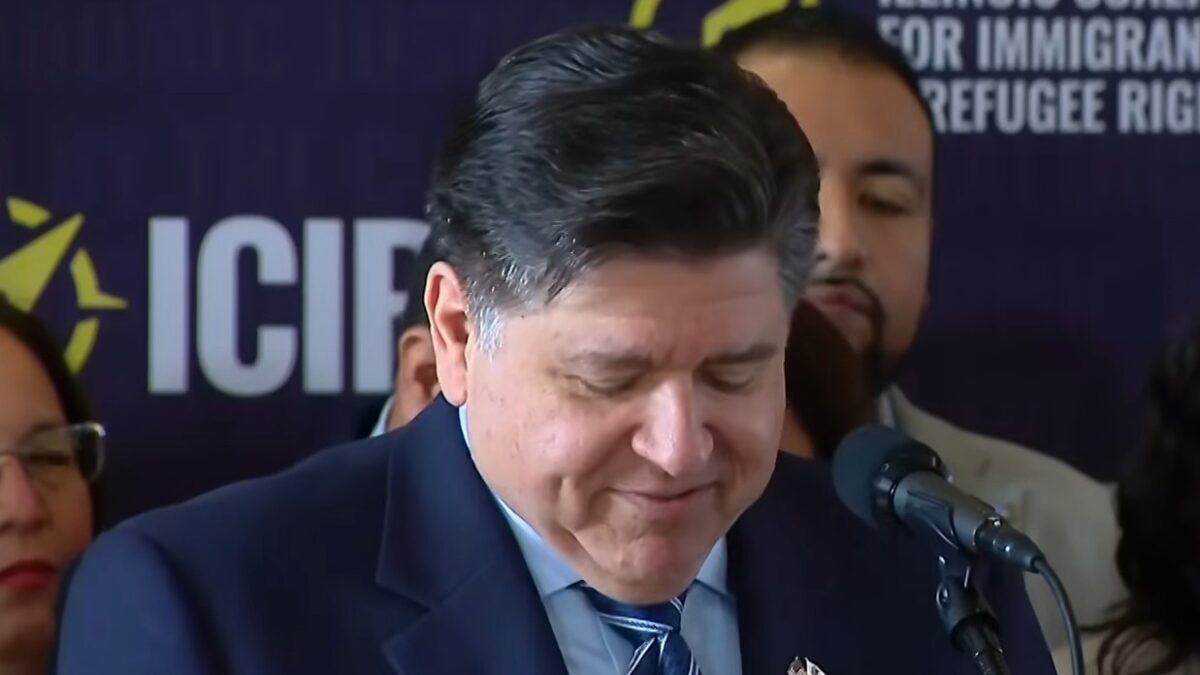 State-sanctioned euthanasia not only pressures patients to choose suicide, but also inevitably ends in health care systems forcing suicide on patients.





