

Category: Donald Trump
Killing drug ads won’t lower prices — it will kill innovation

The United States is one of the few countries that allows prescription drugmakers to speak directly to patients. That simple fact now fuels political calls to “ban the ads.” But restricting direct-to-consumer advertising would do more than change what runs during football games. It would shrink the flow of information to patients and push our system toward the bureaucratic throttling that has turned other countries into innovation laggards.
Advertising is part of a dynamic market process. Entrepreneurs inform consumers about new products, and when profits are high, firms have every incentive to improve quality and expand access.
The pattern is clear: The more Washington intervenes, the fewer cures Americans get.
New, cheaper treatments need to be brought to consumers’ attention. Otherwise, people stay stuck with older, more expensive options, and competition falters. Banning pharmaceutical advertising would hobble innovative firms whose products are not yet known and leave those seeking medical care less informed.
Critics warn that “a growing proliferation of ads” drives demand for costly treatments, even when less expensive alternatives exist. Yet a recent study in the Journal of Public Economics finds that exposure to pharmaceutical ads increases drug utilization across the board — including cheaper generics and non-advertised medications. In short, advertising pushes people who need care to make better, more informed decisions.
A market-based system rewards risk-taking and innovation. Despite the many flaws in American health care, the United States leads the world in medical breakthroughs — from cancer immunotherapies to vaccines developed in record time. That success wasn’t created by government decree. It came from competition: firms communicating openly about their products, fighting for patients, and reinvesting earnings into the next generation of lifesaving discoveries.
Sure, some regulations are adopted with good intentions. But drug ads are already heavily regulated, and a full ban would create serious unintended consequences — including the unseen cost of innovative drugs that will never reach patients because firms won’t invest in developing treatments they are barred from promoting.
American health care is now regulated to the point of satisfying no one. Patients face rising costs. Physicians navigate a Kafkaesque maze of top-down rules. Taxpayers foot the bill for decisions made by distant bureaucracies. Measures associated with socialized medicine continue creeping into the marketplace.
Price controls in the Inflation Reduction Act are already cutting into pharmaceutical research and development. One study estimates roughly 188 fewer small-molecule treatments in the 20 years after its enactment. The pattern is clear: The more Washington intervenes, the fewer cures Americans get.
RELATED: Trump faces drugmakers that treat sick Americans like ATMs
 Photo by Andrew Harnik/Getty Images
The answer to the problems in American health care isn’t more government. It’s less. Expected profitability drives investment in biomedical research. Imposing new advertising bans or European-style price controls would mean lower-quality care, higher mortality, and the erosion of America’s leadership in medical innovation.
The United Kingdom offers a warning. Once a global leader, it drove investment offshore through overregulation and rigid price controls. Today, only 37% of new medicines are made fully available for their licensed uses in Britain. Americans spend more, but they also live longer: U.S. cancer patients outlive their European counterparts for a reason.
Discovering new drugs is hard. Every breakthrough begins with the freedom to imagine, to compete, and to communicate. Strip companies of the ability to inform patients, and you strip away the incentive to develop the next cure. Competitive markets — not centralized control — will fuel tomorrow’s medical miracles.
Sleepy Donald Trump? Umm, No, He’s Not Joe Biden.
WASHINGTON — President Donald Trump, the very man who branded former President Joe Biden “Sleepy Joe” during the 2020 and…
What’s in Trump’s new national security strategy?
Welcome to The Hill’s Defense & NatSec newsletter {beacon} Defense &National Security Defense &National Security The Big Story What’s in Trump’s new national security strategy? President Trump has released his national security strategy (NSS) with a focus on building up a larger military presence in the Western Hemisphere, balancing global trade, tightening up border…
A Dem House Candidate Mandated the COVID Vaccine for County Employees—Then Gave Them Taxpayer-Funded Gift Cards as a Reward for Getting the Jab
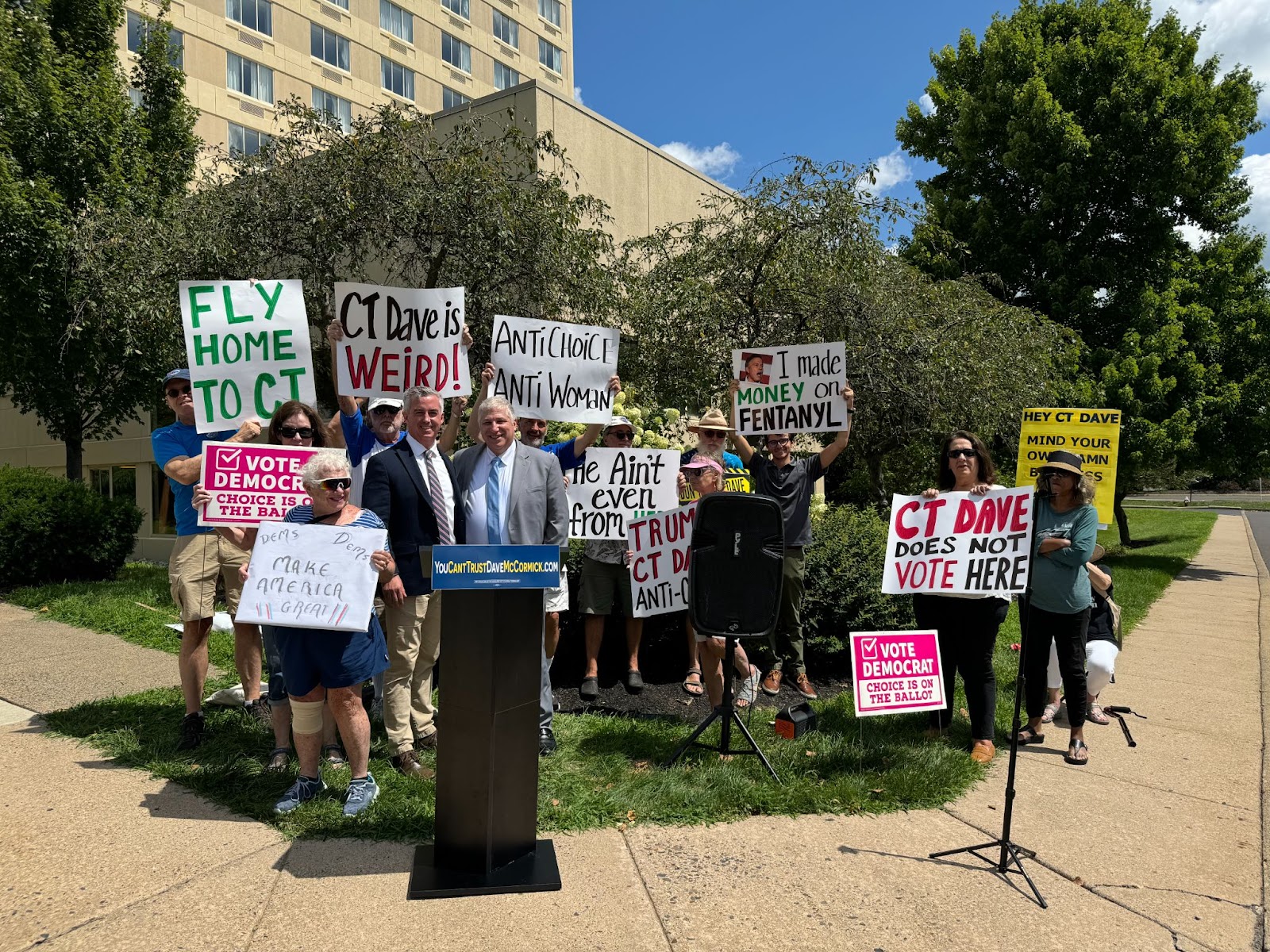
Bucks County, Pa., commissioner Bob Harvie (D.), who is running to unseat Rep. Brian Fitzpatrick (R., Pa.), required 2,300 county employees to get the COVID-19 vaccine or lose their jobs during the pandemic. He then spent more than $115,000 in taxpayer funds on gift cards that rewarded staff who got the mandatory jab.
The post A Dem House Candidate Mandated the COVID Vaccine for County Employees—Then Gave Them Taxpayer-Funded Gift Cards as a Reward for Getting the Jab appeared first on .
Washington’s new favorite lie: ‘Most migrants are safe’

If anyone from a backward and unstable country could be vetted for anti-American hostility, it would have been someone like Rahmanullah Lakanwal, the Afghan national who allegedly shot two National Guardsmen in Washington, D.C., the day before Thanksgiving. He had been vetted by the CIA, worked with our military in Afghanistan, and was later approved for asylum alongside his wife and five children.
And still, he turned his gun on the very country that took him in. How many more reminders do we need before we shut off the spigot?
Tackling America’s economic challenges will be tricky. But an immigration shutoff is easy. Trump can — with the stroke of a pen — halt all entries that threaten national security.
In response to the attack, President Trump vowed to “permanently pause migration from all third world countries.” Many Americans hoped this meant fulfilling the pledge he made nearly a decade ago: “A total and complete shutdown of Muslims entering the United States until our country’s representatives can figure out what the hell is going on.”
On Thanksgiving Day, U.S. Citizenship and Immigration Services Director Joseph Edlow announced a “full-scale, rigorous reexamination of every green card” holder from “every country of concern.” When pressed, Edlow pointed to the 19 countries listed in Trump’s June 4 proclamation, “Restricting the Entry of Foreign Nationals to Protect the United States from Foreign Terrorists and Other National Security and Public Safety Threats.”
That June order established two tiers of restrictions.
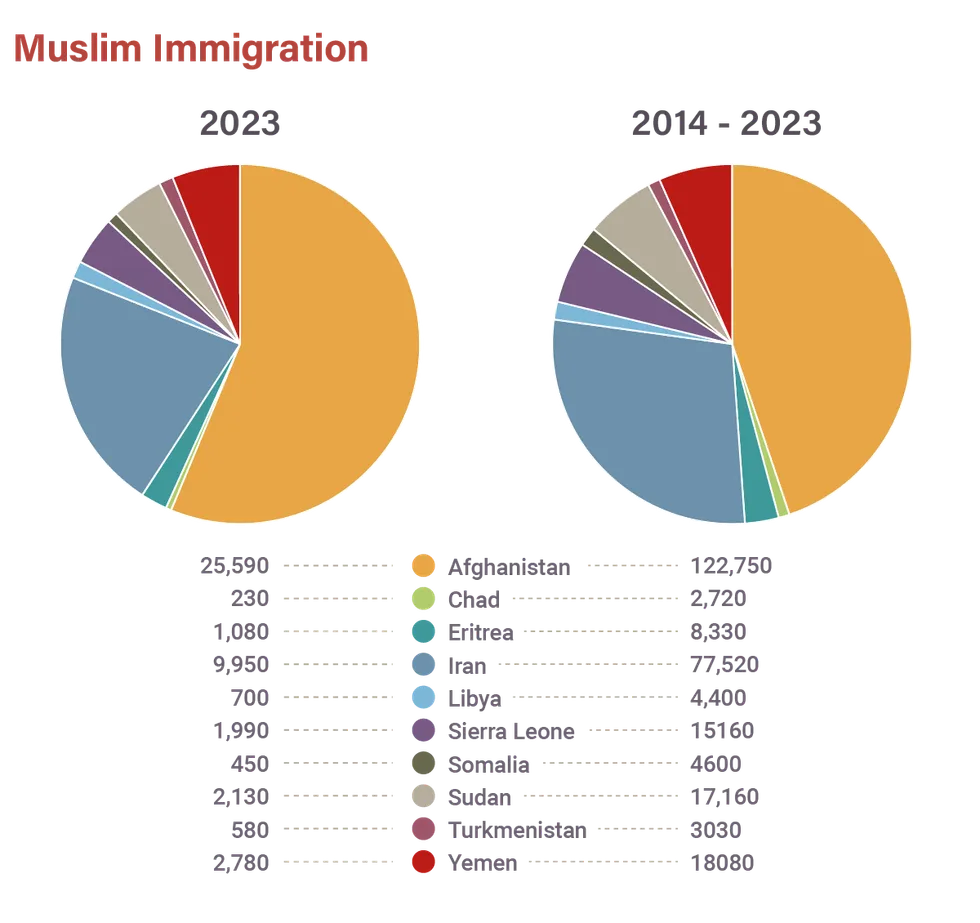
Full restriction: Afghanistan, Burma, Chad, Republic of the Congo, Equatorial Guinea, Eritrea, Haiti, Iran, Libya, Somalia, Sudan, Yemen.
Partial restriction: Burundi, Cuba, Laos, Sierra Leone, Togo, Turkmenistan, Venezuela.
This week, the White House announced its intention to pause all immigration from all 19 countries and freeze naturalization applications from nationals already here.
It’s a start. But it doesn’t address the larger reality: Even a total shutdown of these 19 countries barely dents the scale of Islamic-world migration into the United States.
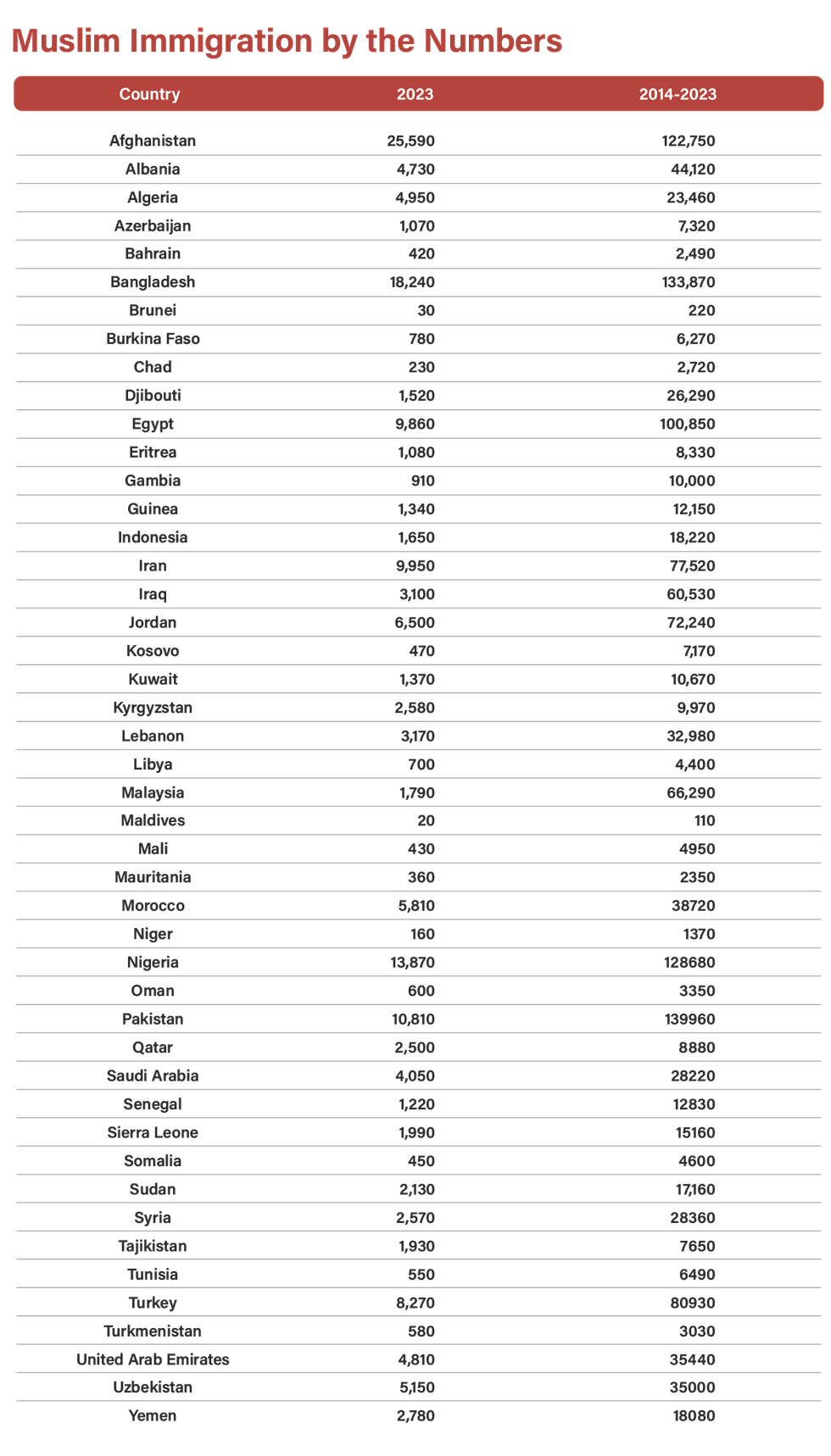
By my calculations, these countries account for only 27% of Muslim-origin immigration in 2023 — and just 18% of our intake from the Islamic world over the past decade.
Ten of the 19 targeted countries are majority-Muslim. But there are 39 other majority-Muslim countries — most overwhelmingly Muslim — from which we admit well over 100,000 green-card recipients each year.
Here is the updated breakdown of immigration from all majority-Muslim countries in 2023 and over the prior 10 years:
 Blaze Media
This is a numbers game. You simply cannot import roughly 175,000 Muslim migrants every year — not counting tens of thousands more on student and temporary visas — without replicating the social unraveling we have seen in Europe.
Trump’s expanded ban would block about 47,000 of these arrivals annually. But it leaves massive sending countries — Bangladesh, Egypt, Turkey, Lebanon, Syria, Saudi Arabia, Jordan, Iraq, Uzbekistan — effectively untouched.
 Blaze Media
The problem with limiting the moratorium to these 10 Islamic countries (plus nine other hostile or unstable states) isn’t just numerical. It’s philosophical. The order implies that we are only concerned with countries that have poor diplomatic relations or inadequate data-sharing with the United States.
But the challenge of Islamic migration has never been solely about vetting. Most individuals who embrace Sharia supremacism, support suicide attacks, or reject Western norms are not sworn members of al-Qaeda or Hezbollah. The issue is ideological — a form of unreformed Islam that never passed through the Enlightenment and remains fundamentally incompatible with liberal Western society.
For decades, small-scale migration masked this reality. But we have admitted roughly 3 million Muslims since 9/11. They cluster, build Qatari-funded or Muslim Brotherhood-affiliated mosques, and reproduce the same ideological ecosystem from which they emigrated. High-volume flows reinforce the problem exponentially.
And contrary to the foreign-policy establishment’s assumptions, hostility does not only come from “enemy” states. In fact, migrants from “friendly” governments often pose greater risks. Regimes such as Egypt and Jordan suppress their own Islamist movements. Uzbekistan bans full beards. These governments contain radicalism at home — and we import the very people they fear.
We’ve seen the consequences repeatedly. A sampling:
- Akayed Ullah, who arrived from Bangladesh in 2011, detonated a pipe bomb in the Port Authority Bus Terminal, declaring support for ISIS. Bangladesh now sends more than 18,000 immigrants annually.
- Sayfullo Saipov, who came from Uzbekistan in 2010 on a diversity visa, murdered eight people in a truck attack in Manhattan while shouting “Allahu Akbar.”
- Dilkhayot Kasimov, Abdurasul Juraboev, Abror Habibov, all Uzbeks, conspired to support ISIS, discussed attacking President Obama, and scouted U.S. military targets. We continue admitting over 5,000 Uzbeks per year through the Diversity Visa Lottery — a program Trump should end immediately.
- Muhammad Khair Alabid, a student from Egypt, plotted a Fourth of July vehicle-bomb attack in Cleveland.
- Mohamed Sabry Soliman, also from Egypt, firebombed a pro-Israel rally in Boulder in 2025, killing one and injuring 12. He and his family were admitted by the Biden administration and overstayed. We have issued more than 100,000 green cards to Egyptian nationals in the past decade.
- Muhammad El-Sayed, admitted from Jordan on a diversity visa, built an ISIS-linked terror cell in Minneapolis, scouting military bases and Jewish centers.
- Abdullah Muhammad Zain-ul-Abideen, a student visa-holder from Jordan, provided material support in the Garland, Texas, terrorist attack on the “Draw Muhammad” event.
 Photo by Cindy Ord/Getty Images for BAFTA
The most glaring case of false security is Mohammed Saeed Alshamrani, a Saudi military trainee brought here on an A-2 visa. In 2019, he murdered three American service members at Naval Air Station Pensacola. He was here because our government trusted Saudi vetting.
This is the pattern: Working with a regime is not the same as trusting its people. In many cases, these governments fear their own populations. Yet we continue importing those populations at scale.
For example: The United States and Israel prop up the Hashemite monarchy in Jordan precisely because its people are more radical than their rulers. Yet we have brought in over 72,000 Jordanians in the past decade. If those populations are too dangerous for their own government, why do we assume they are safe for ours?
When it comes to transformational immigration policy, there is no such thing as “lukewarm hell.” Trump should impose a full moratorium on all Islamic-majority countries and abolish the Diversity Visa Lottery entirely.
Tackling America’s economic challenges ahead of the midterms will be tricky. But an immigration shutoff is easy. Under Section 212(f) of the Immigration and Nationality Act, Trump can — with the stroke of a pen — halt all entries that threaten national security.
He has already done it for 19 countries. He has no reason not to finish the job.





