Category: Foreign Policy
Trump Resolves the Maduro Problem
![]()
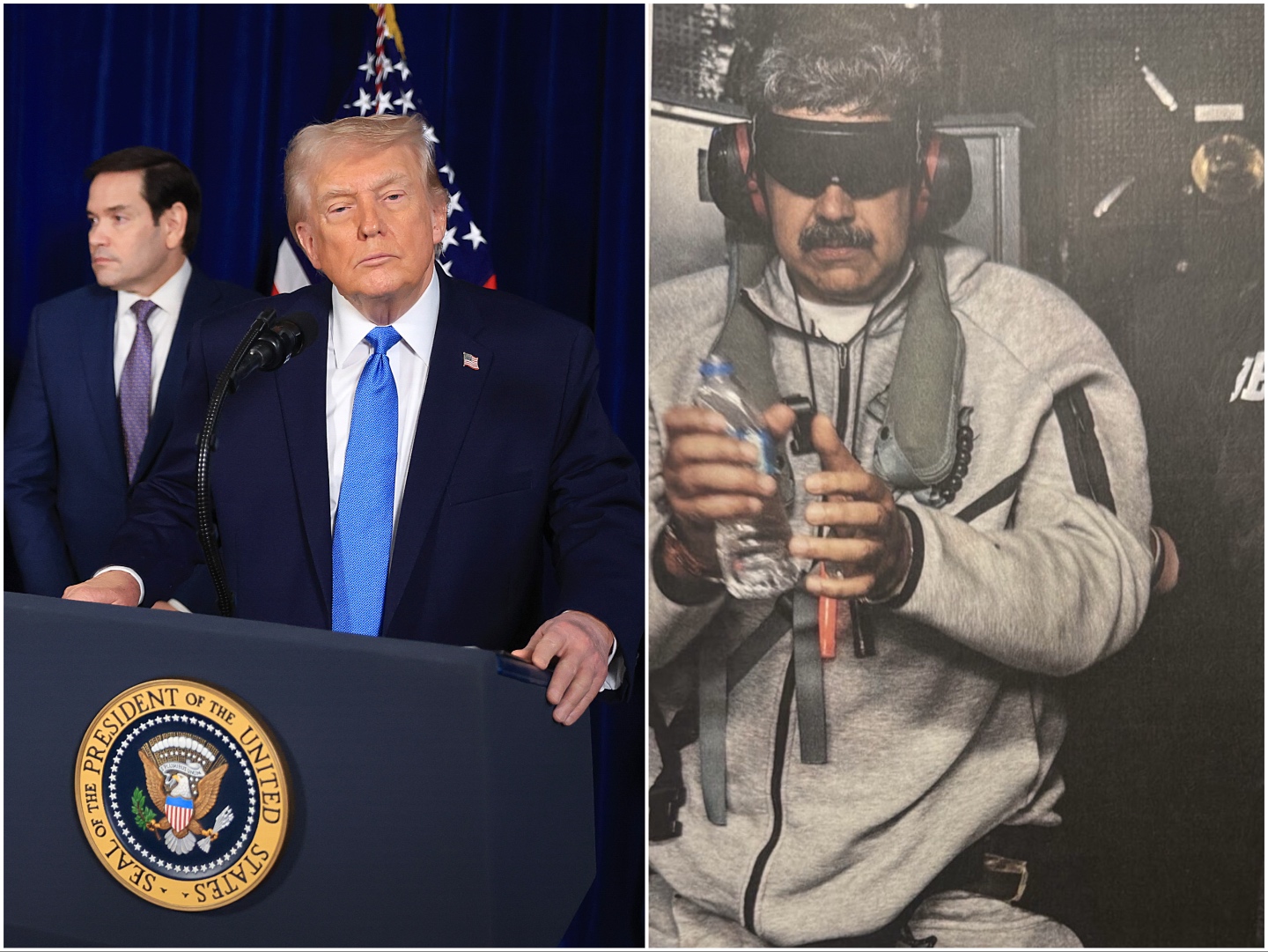
Donald Trump waited barely two days before fulfilling a major new year resolution. Early Saturday morning, U.S. warplanes filled the skies above Caracas while Delta Force commandos swooped in on the ground. Venezuelan dictator Nicolás Maduro and his wife didn’t even have time to escape their bedroom before being arrested. By nightfall, they had arrived in New York City to begin processing for narcotrafficking and other charges.
The post Trump Resolves the Maduro Problem appeared first on .
Here’s What Trump Means By Calling For ‘Peace Through Strength’


Peace through strength, defined by ‘hard-nosed realism’ over the ‘utopian idealism’ of a bygone era, is poised to yield both a popular and durable American defense policy.
The Weary Atlas
I At 11:37 in the morning of Nov. 20, 2025, Eastern European Time, the United States Embassy in Kyiv’s X…
Don’t Go Wobbly on China
As the sun rises on a new Trump-era geopolitical chapter, Washington confronts a defining choice: Will America view the People’s…
Big Tech CEOs should leave policy to the politicians

President Donald Trump’s latest comments on semiconductor exports sounded almost conciliatory — until they weren’t. Speaking recently on “60 Minutes,” the president said he would let Nvidia “deal with China” but drew a bright red line: Beijing could buy chips, just not the “most advanced” ones. The message was calibrated for maximum effect: permissive enough to please markets, hawkish enough to claim toughness. Nvidia’s stock jumped immediately — but China did not get what it wanted.
Days later, in a Financial Times interview, Nvidia’s CEO, Jensen Huang, warned that if the U.S. blocked his company from selling more of its advanced chips to China, it would “lose” the AI race. The argument was astonishing in its candor: Cut us off, Beijing wins.
As grateful as America should be for breathtaking innovations, an irreconcilable tension exists between national interest and fiduciary duty.
The comparison between a president sounding measured and a CEO trying to sound indispensable captures a dangerous inversion of power. Nvidia has become more than America’s most valuable company. It’s attempting to become its policymaker, shaping the boundaries of what Washington thinks possible in its competition with China.
To understand how one company reached that position, it helps to revisit what happened in Washington just days before Trump met Xi Jinping in South Korea.
Nvidia called it a GPU Technology Conference. Yet the event felt less like a developer’s conference and more like a tech-bro-meets-MAGA jamboree: free swag and a booming video hymn to American genius — from Thomas Edison to Donald J. Trump. Huang, leather jacket gleaming, strode out like a preacher to proclaim that the age of reindustrialization had arrived.
The D.C. version of GTC was not the San Jose GTC tech insiders have come to know. For the first time, Nvidia brought a full-blown edition of its developers’ confab to the capital, a strategic choice. The company does not merely want to sit at the table where policy is made — it wants to own it.
After hours of Super Bowl-style buildup — financiers whispering, tech CEOs hinting — attendees were herded into a dimly lit hall, where Huang unveiled a cascade of partnerships. The headline act that made sleeves roll up on both the policy bench and the brokerage floor was the Vera Rubin Superchip, billed as made in America and spoken of with the gravity reserved for national monuments.
It’s a dazzling feat of engineering: silicon that can be waved before a crowd as proof that America can still design, assemble, and scale. Expected to debut next year, the chip is music to policy wonks’ ears, a gleaming symbol of reindustrialization, and perhaps a psychological hedge against the fragility of Taiwan. For investors, it’s manna. As robots increasingly take charge, building chips in the U.S. will keep the supply chain close to home and safeguard companies against the whims of geopolitics.
Then, with the applause fading, an undercurrent of tension lingered, one that perhaps only the wonks could fully register. After that opening montage, capped by Jensen’s almost rhetorical question, “Was that video amazing?” the subtext became harder to ignore. And when he closed his remarks by thanking the audience “for your service and for making America great again,” it was impossible not to think of what the financiers were murmuring on the next stage over.
“Nvidia will — or should — ship more GPUs to China.” “Jensen’s flying straight to Korea after GTC to meet Trump.” “A deal’s coming.”
Those were among the refrains traded by figures like Cantor Fitzgerald’s C.J. Muse and Altimeter Capital’s Brad Gerstner. All this, of course, is contrary to the prevailing consensus among China-watchers that the notion of rendering Beijing dependent on Nvidia’s chips is fantasy. Cultivating indigenous capability by acquiring American technology by legal or illicit means has long been Beijing’s modus operandi.
Huang knows this. Still, his company has long worked to blunt export controls and push China-specific versions of its flagship Blackwell chip, the so-called B20. It’s a familiar playbook: First came the H100, then its “export-compliant” cousins, the H800 and H20. Each time, Washington tightens the rules; each time, Nvidia finds a workaround. But this must stop.
RELATED: Big Tech’s AI boom hits voters hard — and Democrats pounce
Photo by Ron Jenkins/Getty Images
The dilemma is simple but corrosive. As grateful as America should be for breathtaking innovations, an irreconcilable tension exists between national interest and fiduciary duty. Huang may sound bullish on “betting on America,” but the reality is starker: If his company could power the AI revolutions of both superpowers at once, it would add trillions to its market cap. He is pragmatic and coldly arithmetic. Build the best chips, profit from ubiquity. You don’t get where he is without knowing your math.
At GTC, I saw the divide play out in miniature. As Altimeter’s Brad Gerstner floated the idea that “logic is on the side of letting Nvidia compete with China,” I turned to a biotech researcher. Blunt and unamused, he said: “Bulls**t.” He went on to explain that, in his field especially, China’s ascent has been a wholesale rejection of the “make China dependent” fantasy. He wasn’t wrong: Under Xi Jinping, the Made in China 2025 agenda has rendered such dependency theories delusional.
Huang tries to thread the needle gracefully, extolling U.S. manufacturing while signaling an embrace of Chinese developers. As an American, it’s hard not to be charmed by his all-American chip. As a realist, however, one leaves with questions no press release can answer. In a way, the release of this patriot-approved superchip was meant to suggest, “See, now we can sell some Blackwells to China.” As charmed as one can be, the answer is still no.
One could have told the Roosevelt administration that cutting Germany off from nuclear materials would stifle innovation. Yet we did exactly that during the Manhattan Project. And we won. It may not sound like it, but this is the same choice we face today — only this race has even greater implications for the future of civilization.
The goal can’t be attempting to trap Beijing in “dependency.” The stakes are too high. The most prudent approach is to focus on surpassing them in innovation while closing loopholes that let Beijing do what it has mastered: Learn from us, then try to replace us.
Jensen Huang has every right to fight for his company’s profits. But foreign policy shouldn’t run on a corporate playbook. The U.S. needs innovators — not influencers — setting the terms of technological rivalry.
Editor’s note: A version of article appeared originally at the American Mind.
Why the Ukraine Peace Plan May Be Pointless
President Trump’s latest Ukraine peace offensive took the world by storm. The 28-point plan and Thanksgiving deadline set off a diplomatic frenzy on both sides of the Atlantic. The Ukrainian government and European negotiators rushed to connect with their U.S. counterparts, and the Russians passive-aggressively threatened to veto any proposal emanating from these talks. As of this writing, 19 points are now on the table—and peace is nowhere in sight. Amid this week’s zigs and zags, three dynamics stood out as the most important factors affecting the fate of Ukraine: Trump is determined not to be dragged in any further, but he wants to be at the center of anything that happens, and none of the other powers are strong enough to change his mind or meaningfully alter facts on the ground.
The post Why the Ukraine Peace Plan May Be Pointless appeared first on .
US Foreign Assistance as a Means of Soft Power
The Marshall Plan to rebuild post-World War II Europe has been acclaimed as the most successful foreign assistance program in…
Europeans want US missiles to defend them, not America — and Rubio’s had enough of their hypocrisy

Secretary of State Marco Rubio called out European officials on Wednesday for criticizing America’s self-defense while expecting the U.S. to provide military support for their own.
The Trump administration has obliterated at least 19 alleged narco-terrorist drug boats since Sept. 2 with the stated aim of “protecting the homeland and killing these cartel terrorists who wish to harm our country and its people.”
‘I don’t think that the European Union gets to determine … how the United States defends its national security.’
President Donald Trump has suggested that each drug boat vaporized by U.S. fighter jets, AC-130J gunships, and drones amounts to 25,000 American lives saved.
A day after War Secretary Pete Hegseth announced that the U.S. had sunk an additional two boats in the Eastern Pacific, altogether killing six alleged narco-terrorists, French foreign minister Jean-Noel Barrot joined the chorus of foreign dignitaries who have been complaining about the strikes.
Barrot reportedly said at the G7 summit on Tuesday, “We have observed with concern the military operations in the Caribbean region, because they violate international law and because France has a presence in this region through its overseas territories, where more than a million of our compatriots reside.”
RELATED: ‘Begin repatriating’: German chancellor admits it’s time to give Syrian migrants the boot
Photo by Omar Zaghloul/Anadolu via Getty Images
When confronted with questions about the U.S. maritime strikes during a meeting with Latin American leaders last week, the European Union’s foreign policy chief Kaja Kallas said that the EU upholds international law and “international law is very clear on that. You can use force for two reasons: one is self-defense, the other one is the U.N. Security Council resolution.”
Rubio addressed the European pearl-clutching on Wednesday, politely suggesting to reporters that the continentals should pound sand.
“I don’t think that the European Union gets to determine what international law is, and what they certainly don’t get to determine is how the United States defends its national security,” said Rubio. “The United States is under attack from organized criminal narco-terrorists in our hemisphere, and the president is responding in the defense of our country.”
After indicating that the Europeans are out of their depth, Rubio hammered America’s allies across the Atlantic for their apparent hypocrisy.
“I do find it interesting that all these countries want us to send, you know, and supply, for example, nuclear-capable Tomahawk missiles to defend Europe, but when the United States positions aircraft carriers in our hemisphere where we live, somehow that’s a problem,” said the secretary of state.
Rubio added, “The president ordered it in defense of our country. It continues. It’s ongoing. It can stop tomorrow if [terrorist cartels] stop sending drug boats.”
Like Blaze News? Bypass the censors, sign up for our newsletters, and get stories like this direct to your inbox. Sign up here!
Meet the American Educational Organization Accrediting CCP Bureaucrats
In 2018, the sole accrediting body for public service programs in the United States held a workshop for schools seeking accreditation. Diversity and inclusion were all the rage in higher education, and the Network of Schools of Public Policy, Affairs, and Administration (NASPAA) spent much of the workshop explaining how schools were expected to pursue those ideals, which it described as “public service values.”
The post Meet the American Educational Organization Accrediting CCP Bureaucrats appeared first on .
America can’t afford to lose Britain — again

The Labour government that rules the United Kingdom is hardly a year old, but its time is already coming to an end. Its popular legitimacy has collapsed, and it is visibly losing control of both the British state and its territories.
Every conversation not about proximate policy is about the successor government: which party will take over, who will be leading it, and what’s needed to reverse what looks to be an unalterable course. What is known, however, is that the next government will assume the reins of a fading state after what will likely be the final election under the present, failed dispensation.
We should equip our friends on the other side of the Atlantic with the lessons of the new right’s ascendancy and of a nation-first government in America.
The Britain birthed by New Labour three decades ago, deracinated and unmoored from its historic roots, is unquestionably at its end. Its elements — most especially the importation of malign Americanisms like propositional nationhood — have led directly to a country that is, according to academics like David Betz of King’s College London, on the precipice of something like a civil war. That’s the worst-case scenario.
The best case is that a once-great nation made itself poor and has become wracked with civil strife, including the jihadi variety. It is a prospect that will make yesteryear’s worst of Ulster seem positively bucolic.
American policymaking is curiously inert in the face of the dissolution of its closest historic ally. This is not because Britain’s decline is anything new: the slow-motion implosion of that nation’s military power has been known to the American defense establishment for most of the past 20 years. Ben Barry’s excellent new book, “The Rise and Fall of the British Army 1975–2025,” offers many examples to this end, including the 2008 fighting in Basra in which American leadership had to rescue a failing British effort.
The knowledge that Britain is facing a regime-level crisis has remained mostly confined to the establishment. Outside of it, the American right has mostly dwelled on an admixture of Anglophilia and special-relationship nostalgia, obscuring the truth of Britain’s precipitous decline.
The American left, of course, entirely endorses what the British regime has done to its citizenry — from the repression of entrepreneurialism and the suppression of free speech to the ethnic replacement of the native population — and regards the outcomes as entirely positive.
It is past time for that inertia to end. The last election will redefine the United Kingdom — and therefore America’s relationship with it. Even before it comes, the rudderless and discredited Labour government has placed Britain into a de facto ungoverned state that may persist for years to come.
The United States has an obligation to protect its own citizenry from the consequences of this reality. It also has what might be called a filial duty to assert conditions for Britain to reclaim itself.
That duty means taking a series of actions, including denying entry to the United States to British officials who engage in the suppression of civil liberties. American security and intelligence should focus on the threats posed by Britain’s burgeoning Islamist population. The U.S. should give preferential immigration treatment to ethnic English, Scottish, Welsh, and Northern Irish who are seeking to escape misgovernance or persecution in the United Kingdom.
Furthermore, the United States should make it clear that the robust Chinese Communist Party penetration and influence operations in U.K. governance will result in a concurrent diminishment of American trust and cooperation.
Also necessary is the American government’s engagement with pro-liberty and pro-British elements within the U.K. This means working with Reform U.K., which presently looks to gain about 400 parliamentary seats in the next election. Its unique combination of a dynamic leader in Nigel Farage, intellectual heavyweights like James Orr and Danny Kruger, and operational energy in Zia Yusuf makes it a compelling and increasingly plausible scenario.
RELATED: Cry ‘God for England’
Photo by Christopher Furlong/Getty Images
Although the Tories are polling poorly and have had their reputations battered by their substandard record in government over the past decade, they nonetheless merit American engagement.
America’s role here is not to endorse, and still less to select, new leadership for Britain, which would be both an impossibility and an impropriety. However, we should equip our friends on the other side of the Atlantic with the lessons of the new right’s ascendancy and of a nation-first government in America.
In the fraught summer of 1940, the American poet Alice Duer Miller wrote, “In a world where England is finished and dead, I do not wish to live.” The island nation has not feared its own end at foreign arms for a thousand years. But its crisis today is from within, carrying existential stakes.
The current British regime is nearing its end, and the last election is coming. So too is our decision on how to engage it in the years ahead.
Editor’s note: A version of this article appeared originally at the American Mind.
search
categories
Archives
navigation
Recent posts
- MEDIA MOB MALPRACTICE! Press Sec. Blasts Reporters for ‘Smearing’ ICE Agent After New Vid Drops — ‘Media Trust at All-Time Low!’ January 10, 2026
- ‘REVOLTING LIES’: CNN Refers to Suspected Gangmembers in DHS Confrontation as ‘Married Couple’ [WATCH] January 10, 2026
- FOOTAGE RELEASED: Cellphone Video Shows POV of Minneapolis ICE Agent Moments Before Shooting [WATCH] January 10, 2026
- RADICAL RHETORIC: DHS Blasts Sanctuary Politicians for ‘Unprecedented’ Spike in Assaults Against ICE Agents January 10, 2026
- ANTISEMITISM IN THE BIG APPLE: Protesters Chant ‘We Support Hamas’ Outside NYC Synagogue [WATCH] January 10, 2026
- Khamenei Blames Trump for Iran Protests as Regime Kills Dozens of Demonstrators January 10, 2026
- Trump’s Venezuela Operation Deals Blow to Another Dangerous Trade: Iranian Drones January 10, 2026