






Don't miss...
University of Oklahoma removes professor for alleged discrimination related to TA who gave Christian student 0
OU professor accused of viewpoint discrimination for excusing certain protesters but denying same benefit to conservative counter-protesters on campus.
Minnesota fraud scheme unearths millions in luxury property, cars: DOJ
Tens of millions of dollars in stolen funds remains tied up as a result of the “Feeding Our Future” fraud scheme in Minnesota.
NFL fans clamor for Colin Kaepernick to get another chance as Colts’ quarterback situation spirals
NFL fans called for Colin Kaepernick to get another shot at playing football as Philip Rivers was reportedly working out for the Indianapolis Colts.
Our Weird Politics
Politics, particularly for a nation as wealthy and well-situated as ours, is often more about opinion and personality than it is about capability and good, better, best. When a nation struggles it needs people that do the job well, when times are basically good, things get silly. It is not unlike picking the teams for the college football playoffs where there are a lot of teams arguably better than the ones that got in. Things other than football ability are involved. But there is one indisputable fact about the CFP – Indiana University beat Ohio State for the Big Ten Championship, earning the number one seed in the tournament along with the conference championship – much to the host’s chagrin. But back to our politics of government, not football. Three recent stories tell an interesting tale.
The post Our Weird Politics appeared first on The Hugh Hewitt Show.
Trading cubicles for crops: One couple’s ‘Exit’ from the corporate grind
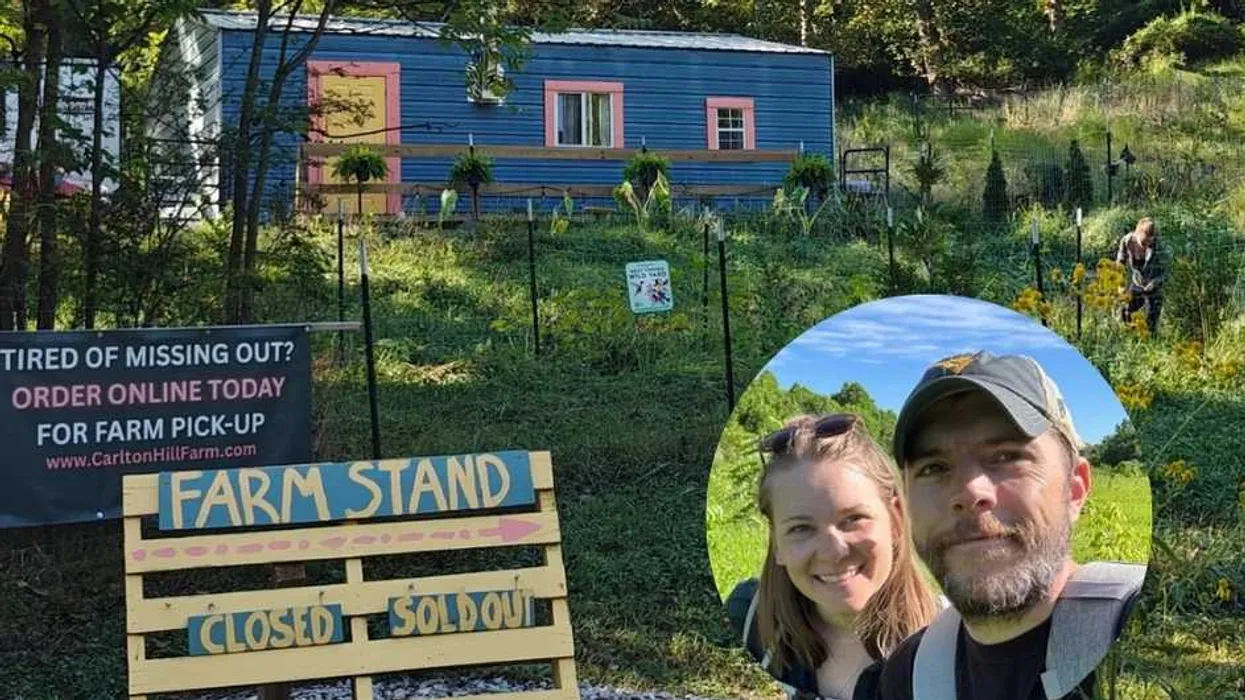
An estimated 80% of people hate their jobs. They fantasize about quitting in a blaze of glory, hurling their lanyards across the office like a frisbee, and riding off into the sunset to raise goats, bake sourdough, or at least remember what eight hours of sleep feels like.
Sean Carlton was one of them.
‘Nobody wakes up one morning ready to raise animals and turn them into food.’ Change begins with one thing you can actually change. Lower one bill. Learn one skill.
The difference is that he didn’t stay. Two years ago, he and his wife, Alexys, walked away from their corporate careers and bought an acre of land in West Virginia. The experience also prompted Carlton to write “Exit Farming: Starving the Systems That Farm You” — a book that reads like both a confession and a call to arms.
The Carltons didn’t step into a new job, but into a new way of being. They rolled the dice with no promise of a soft landing, and in doing so they exposed something uncomfortable: Many of us aren’t trapped by circumstance so much as by the stories we tell ourselves about what we are allowed to want.
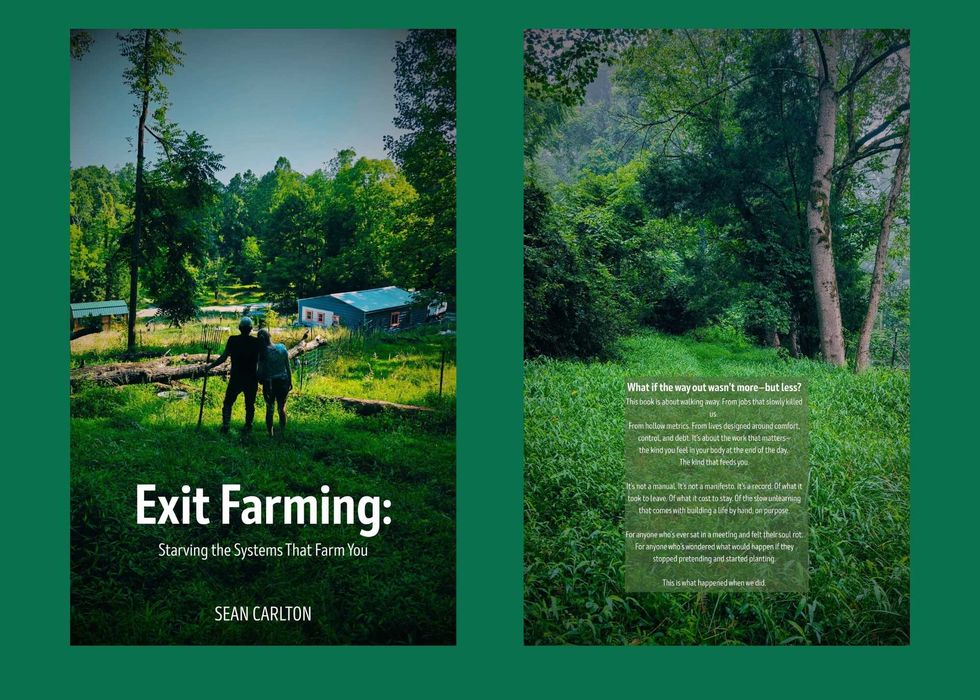 Sean Carlton
Questioning ‘normal’
Carlton is no professional commentator or pundit. “Exit Farming” is a cri de coeur from the American cubicle.
So when asked what exactly he means by “systems that farm you,” he doesn’t reach for theory. He answers with the simplicity of a man who finally recognized the shape of his own confinement.
“Systems farm people by taking more from you than they give back while convincing you this arrangement is normal,” he says.
Work dictates your hours. Debt dictates your decisions. Health care dictates your fears. Even your phone becomes, in his words, “the delivery system for apps that track you, profile you, and sell what they learn.”
It might sound melodramatic. It isn’t. It’s simply Monday morning in America, with millions waking up already weary of the hours ahead.
Slow and steady
But Carlton insists the way out is rarely a dramatic jailbreak. It’s the slow, steady act of starving the system’s influence. You “bring one thing at a time back under your control.” Lower an expense. Learn a skill. Build a sliver of income that doesn’t depend on a single institution. These small shifts break the spell. Every small act of independence starves a machine that has grown used to feeding on your time, your attention, your identity, even your sanity.
Of course, independence comes with a price, and Carlton tallies it honestly and without self-pity. One of the most striking sections in the book addresses the loss of family once he stepped off the expected path. Not through screaming matches or slammed doors, but through slow erosion: “Phone calls got shorter. Conversations turned tense.”
Disapproval had less to do with the specifics of his life than the simple fact that he no longer fit the template.
When asked how Americans can balance honoring their families with refusing to, as he puts it, “participate in systems that drain your energy and compromise your values,” his answer is as clean as it is compelling: “If a relationship survives you making choices that improve your health, your time, or your stability, then it survives. If it falls apart the moment you stop living the way they prefer, then it was already conditional.”
It’s a hard truth, but Carlton refuses to dress it up. Long before any institution closes a door on us, we’ve already built the cell ourselves. The ancients understood this well: People cling to the comfort of captivity, obeying expectations set by those who would rather see them worn down than transformed.
RELATED: An artist and farmer cultivates creativity
 Stacy Tabb
Work with consequences
There’s also a spiritual undercurrent to his critique of modern work culture. Carlton never lapses into sermonizing, but his diagnosis reads like a measured moral warning. Modern work “follows you home,” he notes. It takes evenings, weekends, and whatever fragments of peace remain. It erodes sleep, attention, and the mental steadiness that previous generations recognized as the bedrock of a healthy life.
Americans worship productivity with almost religious devotion, even though the devotion always seems to cost them more than they can spare. Two-thirds of the workforce is burned out, but the cult of busyness marches on. Another day, another dollar … but also another headache, another email chain, and another reminder that coffee can only do so much.
When asked whether “exit farming” is a return to older ideas of work and stewardship, he rejects romantic myth-making. “Exit farming isn’t about finding something spiritual,” he says. “It’s about doing work where the consequences are real.” If you don’t feed the animals, “they suffer and then they die.” If you don’t tend the crops exactly as needed, the season is lost before it begins. Nothing waits for permission. Nothing reschedules itself for your convenience. This realism is its own kind of grounding. And you don’t need a farm to reclaim it, but only work that doesn’t demand the erosion of dignity as its hidden price of admission.
Grow one thing
The final question in the book’s conversation is the one most Americans are actively wrestling with: What about those who feel trapped? Trapped between institutions they no longer trust and a life of greater self-reliance that feels too big, too frightening, too foreign?
Carlton’s reply is the opposite of theatrical bravado. “Nobody wakes up one morning ready to raise animals and turn them into food.” Change begins with one thing you can actually change. Lower one bill. Learn one skill. Grow one thing you eat often. Build one dependable relationship. Reduce one vulnerability. These are small, almost humble acts. But they mark the beginning of a life that no longer runs on someone else’s terms.
Over time, he says, these small adjustments stop being adjustments. They become a different kind of life, one that is sturdy enough to withstand the failures of the systems around it.
That’s the heart of “Exit Farming.” It isn’t about rejecting society or romanticizing hardship, but about reclaiming stability in a country where stability has become a cruel joke. It’s not about storming out in some “Office Space” fantasia with a baseball bat.
It’s about one couple choosing a different path and showing that others could do it too. Not through dramatic destruction, but through the refusal to be drained of the very things that make a life worth living — time, purpose, and peace.
Trump cracks the Caracas cartel code
Democrats deny what mountains of evidence have long shown: Terrorist groups traffic in illegal drugs.
Rep. Jim Himes (D-Conn.) recently insisted, “There is no such thing as a narco-terrorist,” as he defended his opposition to the Trump administration’s war on narco-terrorism in the Caribbean. He accused the administration of trying “to make this look like it’s ISIS or Al-Qaeda,” ignoring that ISIS, Al-Qaeda, Hezbollah, and similar groups have long run profitable drug operations with local and transnational cartels. These alliances increased revenue, financed attacks, fueled violence, and deepened existing conflicts.
Maduro’s narco-terrorist regime threatens regional stability and US national security. Trump’s war on narco-terrorism meets that threat head-on.
Narco-terrorism did not originate with the Trump administration. It was the subject of my 1990 book, which documented how governments around the world used the drug trade to fund and advance terrorist activity. For more than three decades, Washington looked away. That era has ended.
On November 16, the U.S. Treasury designated Venezuela’s Cártel de los Soles — run by Venezuela President Nicolás Maduro and key figures in his illegitimate regime — along with Tren de Aragua and the Sinaloa Cartel, as foreign terrorist organizations. Treasury should have added Colombia’s National Liberation Army (Ejército de Liberación Nacional, or ELN), a Marxist paramilitary and major drug-trafficking force that controls both sides of the border and works closely with Maduro.
When I began researching narco-terrorism in 1986, I assumed political groups across the spectrum could use terror and drug trafficking to advance their aims. The evidence showed otherwise. Marxist-Leninist and Islamist regimes, movements, and militias initiated, expanded, and ultimately dominated this trade.
Venezuela’s slide into narco-terrorism dates to 2005, when Hugo Chávez expelled the U.S. Drug Enforcement Administration. After Chávez died in 2013, Maduro took control of both the government and the drug enterprise, tightening his partnership with Iran and its Lebanese proxy, Hezbollah, under the so-called Axis of Resistance. The goal is to counter U.S. influence in Latin America and the Middle East while enriching the regime.
Maduro’s alliance with Iran and Hezbollah runs deep. He offers sanctuary and support for their narcotics networks, money laundering, weapons pipelines, and terrorist smuggling throughout the region.
RELATED: Turns out that Hegseth’s ‘kill them all’ line was another media invention
 Photo by Anna Moneymaker/Getty Images
Hugo “El Pollo” Carvajal — a former three-star Venezuelan general under Chávez and Maduro and a former member of Cártel de los Soles — described the strategy bluntly in a letter to President Trump. “The purpose of this organization is to weaponize drugs against the United States,” he wrote. “The drugs that reached your cities through new routes were not accidents of corruption nor just the work of independent traffickers; they were deliberate policies coordinated by the Venezuelan regime against the United States.”
This collaboration, built over decades, helped millions of Americans fall into addiction and contributed to hundreds of thousands of deaths.
Maduro’s narco-terrorist regime threatens regional stability and U.S. national security. Trump’s war on narco-terrorism meets that threat head-on and is perfectly just.
Elementary school teacher allegedly possessed thousands of files of child sex abuse material

An elementary school teacher has been placed on administrative leave after police said they found thousands of files containing child sex abuse material in his possession.
Pleasantview Elementary teacher Martin Waskowski was arrested on Wednesday in Vermont after Border Patrol agents identified him as a suspect at the Highland port of entry.
One device contained more than 12,000 files appearing to be child sex abuse material, according to a preliminary review.
Waskowski was re-entering the U.S. from Canada when he was nabbed in a records check by law enforcement, according to a federal complaint.
A search of his cell phone allegedly revealed images and videos of adult men committing sexual acts with prepubescent boys.
Michigan State Police then searched his home, where they confiscated computers, hard drives, and an iPad.
One device contained more than 12,000 files appearing to be child sex abuse material, according to a preliminary review.
Waskowski had been a teacher at the elementary school in Eastpointe for three years and had been a long-term substitute as well.
He allegedly confessed to police that he had collected the child sex abuse material for approximately 20 years, and said that he knew the behavior was wrong, had tried to stop, but had not sought treatment to stop.
He was charged with possession and transportation of child exploitation materials. He was released under supervision and location monitoring.
District officials said they put him on administrative leave pending the outcome of the investigation.
RELATED: 29-year-old man charged with 196 felonies related to possession of child sex abuse material
“Prior to this formal notification, the District had no knowledge of, nor had it received any allegations related to, this individual,” reads the statement from the district.
Waskowski is scheduled for a preliminary court hearing on Dec. 23.
Eastpointe is a suburb of Detroit, with about 34,000 residents.
Like Blaze News? Bypass the censors, sign up for our newsletters, and get stories like this direct to your inbox. Sign up here!
Left melts down after learning babies aren’t at risk of hedonistic needle parties and don’t need hep B shot

In another massive win for MAHA, a federal vaccine advisory committee voted on Friday to end the recommendation that all U.S. babies get the hepatitis B vaccine within hours of birth.
“I try to thank God every day for RFK Jr. being in the position that he’s in as secretary of HHS. And today was one of many reasons why I am so grateful for his leadership,” BlazeTV host Sara Gonzales says on “Sara Gonzales Unfiltered.”
The birth dose will now only be recommended for infants whose mother has tested positive for hepatitis B.
However, the left is predictably freaking out.
“Contrary to the leftist hysteria that you undoubtedly are hearing on social media, they didn’t say you’re not allowed to give it to your baby. They didn’t say you should never give it to your baby. They simply suggested, instead of giving this to a minutes-old baby, you could just wait until the baby is 2 months old for the first dose,” Gonzales explains.
“That’s literally all that they are suggesting. … I feel like they should have gone further. So, it’s just funny to hear all of the leftist hysteria, like, ‘We want to vaccinate the babies when they’re seconds old. We don’t want to wait until they’re 2 months. Are you kidding? That’s a lifetime. We want to get them as soon as possible,’” she continues.
“It’s a weird cult. It’s cultish behavior,” she adds.
And Gonzales points out that it “seems very silly” when you realize that as a society, we’ve been OK with injecting “every minutes-old baby with a hepatitis B vaccine regardless of their exposure, risk, or anything like that.”
“Since 1991, they have had a universal hepatitis B vaccine recommendation for the first dose within 24 hours of birth,” she says, explaining that hepatitis B “spreads through contact with blood, semen, or other body fluids from an infected person.”
“Your risk [of] infection rises if you have sex without a condom with multiple sex partners or with someone who’s infected with hepatitis B; share needles during the use of drugs injected into a vein; are born male and have sex with men,” she explains.
“I don’t know about you guys — my babies are not going to, like, crazy drug orgies,” she adds.
Want more from Sara Gonzales?
To enjoy more of Sara’s no-holds-barred takes on news and culture, subscribe to BlazeTV — the largest multi-platform network of voices who love America, defend the Constitution, and live the American dream.
Zia, pumunta noon sa Serbia para matiyak na tunay na tao ang naging mister niya na nakilala niya online

Ikinuwento ni Zia Quizon na sa online niya nakilala ang kaniyang naging asawa na si Aleksa Rahul. At para matiyak na tunay na tao ang kausap niya online, pumunta pa si Zia sa Serbia kung saan nakatira ang binata.
Gladys Reyes on extreme reactions to ‘Cruz vs. Cruz” role: ‘Parang may death threat na eh”
_2025_12_09_17_26_28.jpg)
Gladys Reyes” portrayal of Hazel in “Cruz vs. Cruz” has drawn strong reactions from viewers, with the actress saying some comments have gone to unexpected extremes.





