

Day: April 21, 2026
Ohio State’s Carnell Tate wants to carry ‘Receiver U’ legacy as he eyes first-round NFL Draft pick
Carnell Tate can only be himself as he looks to become the next Ohio State wide receiver drafted in the first round of the 2026 NFL Draft.
Ella Langley fans rally to her defense after Morgan Wallen duet sparks political backlash
Ella Langley faced backlash over her Morgan Wallen collab, with critics accusing both of being MAGA, but fans rushed to defend the country stars.
Hegseth announces end to military flu vaccine requirement
Pete Hegseth announces the Pentagon’s flu vaccine mandate for U.S. troops is over, saying service members can now decide for themselves to opt in.
Sean Hannity, Riley Gaines shows among podcasts joining FOX One’s expanded streaming portfolio
FOX One launched curated podcast offerings with eight series including Sean Hannity’s podcast, the “Ruthless” podcast, “The Riley Gaines Show,” and more shows from Red Seat Ventures.
Trump attacks ‘Fake News CNN,’ accuses media of failing to credit US troops for Iran operation
President Trump ripped “Fake News CNN” on Truth Social, defending Operation Midnight Hammer and blasting media coverage of potentially extracting the uranium from Iran.
Cory Booker can’t decide if he’s a tough guy or Jesus follower
Sen. Cory Booker’s call for “foot soldiers of our democracy” at a Michigan event clashes with his self-avowed commitment to loving his enemies.
Brick By Brick
Roll Call yesterday carried a story about a case SCOTUS is about to hear. The essence – “AT&T and Verizon have contested determinations by the FCC that they violated consumer privacy rules and owed $57 million and $47 million, respectively. They argued that the FCC process, which Congress created in 1960, violated the constitutional right to a jury trial.” You bet your bottom dollar it did!
The post Brick By Brick appeared first on The Hugh Hewitt Show.
Victor Glover reminded us what an American is

With the Artemis II crew returning safely to Earth, Americans will celebrate the technological achievement. We should. Sending human beings beyond low Earth orbit and around the moon again is no small feat. It represents decades of engineering, discipline, and courage.
But one astronaut in particular offers more than a technological triumph. He offers a picture of American excellence.
Victor Glover did not arrive at that moment by accident.
What he did required a different kind of courage: not the physical courage of launch and re-entry, but moral courage.
He is not a symbol manufactured by a press office. He is not the product of a diversity initiative and a woke Marxist education. He is the result of something much older and much more demanding: hard work, discipline, intelligence, perseverance, and grit.
Glover trained as an engineer. That alone requires precision, patience, and a mind trained to see reality clearly. He then became a naval aviator and test pilot, both fields where failure is not theoretical. In that world, mistakes are measured in lives, not opinions. Thousands of flight hours, high-stakes missions, constant evaluation.
And still that was not the end.
In 2013, he was selected by NASA. But selection is not arrival. It took years, seven long years, before he would fly his first mission. Many would have grown restless. Many would have settled. Glover did not.
In 2020, he flew on SpaceX Crew-1 and spent six months aboard the International Space Station. Six months of isolation, pressure, and relentless responsibility. That mission alone would define a career for most. For Glover, it was preparation.
Because what defines him is not a single accomplishment, but a pattern: He does not quit.
In a culture obsessed with shortcuts, Glover represents something rare: grit. The kind of grit that shows up quietly, day after day, without applause. The kind that builds a character capable of flying beyond Earth and returning safely.
Naturally, in our current climate, that kind of excellence cannot simply be recognized for what it is. It must be reframed.
Glover is frequently asked about being “the first black astronaut” to achieve various milestones. But here again, he distinguishes himself. He refuses to reduce his work to categories imposed by modern DEI ideology. Instead, he consistently redirects the conversation to what unites us.
 Danielle Villasana/Getty Images
Humanity. Shared purpose. The wonder of exploration. That refusal pushes back, calmly and intelligently, against the narrowing of human achievement into demographic boxes. Glover does not deny history, but he does refuse to let it define the meaning of his work. And then there is something even more striking. He brings it all back to Christ.
At a moment when humanity once again turns its attention to the moon, when millions listen, watch, and wait, Glover did something that many in his position would avoid: He spoke openly about his faith.
Before losing radio contact on the far side of the moon, Glover quoted Jesus’ command to love God. In doing so, he joined a small but remarkable tradition of astronauts who understood that the greatest realities are not technological but theological.
It is impossible to hear that moment without recalling Apollo 8.
As that crew orbited the moon for the first time in 1968, one of the astronauts, Frank Borman, read from Genesis:
In the beginning God created the heaven and the earth.
And the earth was without form, and void; and darkness was upon the face of the deep.
And the Spirit of God moved upon the face of the waters.
And God said, Let there be light: and there was light.
That reading was broadcast to the entire world. It remains one of the most watched moments in human history. But it also sparked controversy. The reaction was swift. Legal pressure followed. And by the time Apollo 11 reached the moon, the environment had changed.
Buzz Aldrin, a Presbyterian elder, still took the Lord’s Supper, but he did so privately, inside the lunar module, before stepping onto the surface of the moon. His church had provided the elements. He didn’t bring public attention to it like Borman. It was not broadcast.
That contrast tells a story. The early openness to public expressions of faith gave way to pressure to keep religion quiet, especially in scientific contexts.
Victor Glover must have known that history. He knew the unspoken rule: faith belongs in private. And he rejected it.
What he did required a different kind of courage: not the physical courage of launch and re-entry, but moral courage. This is the courage to clearly speak the gospel when silence would be easier and the courage to affirm what is true about Jesus when others prefer ambiguity.
He did not rant. He did not posture. He simply spoke from his heart about his faith. He quoted the Bible. And in doing so, he reached millions.
That clarifies something many have forgotten: Science and faith are not enemies. The attempt to separate them, to exile God from the public square — from education, from exploration — is not neutrality. It is a philosophical choice to show bigotry toward Christians.
And it is one Glover quietly refused to accept. This is where his example extends beyond a single mission. Victor Glover represents a distinctly American synthesis: A man who works hard, who masters his craft, who pushes exploration to its limits.
How to bake your own bread — no gadgets, recipes, or kneading required
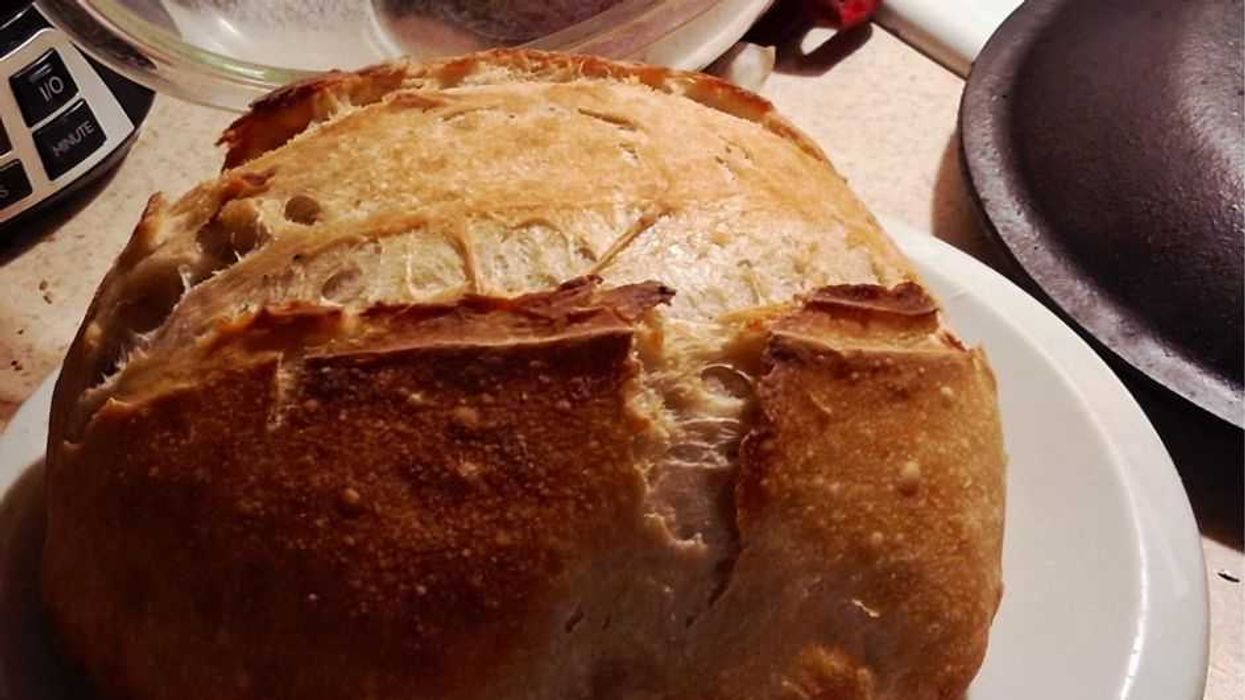
Do you know how easy it is to bake your own bread?
I didn’t, and now I do. And I want to share this knowledge with you.
Want homemade sandwich bread? Just replace the water with milk or half and half and add melted butter and a tablespoon of sugar.
Once you know, it will be harder to go back to the chemical-infused grain product the big, industrialized food manufacturers tell us is “bread.”
Especially since the real thing — what everyone understood as “bread” for all of human history until about 100 years ago — is cheaper, more nutritious, and doesn’t taste like Styrofoam.
Sourdough … for the rest of us
And don’t worry — we’re not going to ruin the fun by approaching it like neurotic, fussy “homesteading” influencers obsessed with buying shiny new equipment to make old-fashioned techniques “authentic.”
You’re not going to need a kitchen scale or a digital probe thermometer. You’re going to make something delicious and wholesome just the way your great-grandmother did, and she didn’t use any of these modern techno crutches.
With that out of the way, let’s talk about sourdough. I didn’t want to use the word before clearing the conceptual brush, because it’s contaminated with “lifestyle” associations. People imagine a complex “artisan” process that can only be achieved by some irritating guy from Minneapolis who talks in upspeak on YouTube.
A few months ago I wrote about cooking from scratch, by hand, without relying on gadgetry and GPS-style “turn by turn” directions. In that piece, I said I was going to learn to bake bread from a natural sourdough starter all by hand, with no scales, no metric-graduated beakers, and no obsessive feeding schedule.
I’ve done it. And it turned out as I thought it would. My hands now know what the right dough consistency feels like. My eyes can tell if the loaf has risen for long enough that it can be baked. The only tools I have relied on were cup measures and a glance at the clock so I know about how long the dough has been fermenting (rising). I don’t need directions or scales or thermometers because I own the knowledge in my hands and mind through direct practice.
The duds? Only about two or three loaves. My problem? Using a starter that was too weak; I hadn’t let it fully develop in the beginning culture stage before I started baking with it. Once I sorted that out, I ended up with this hearty specimen:
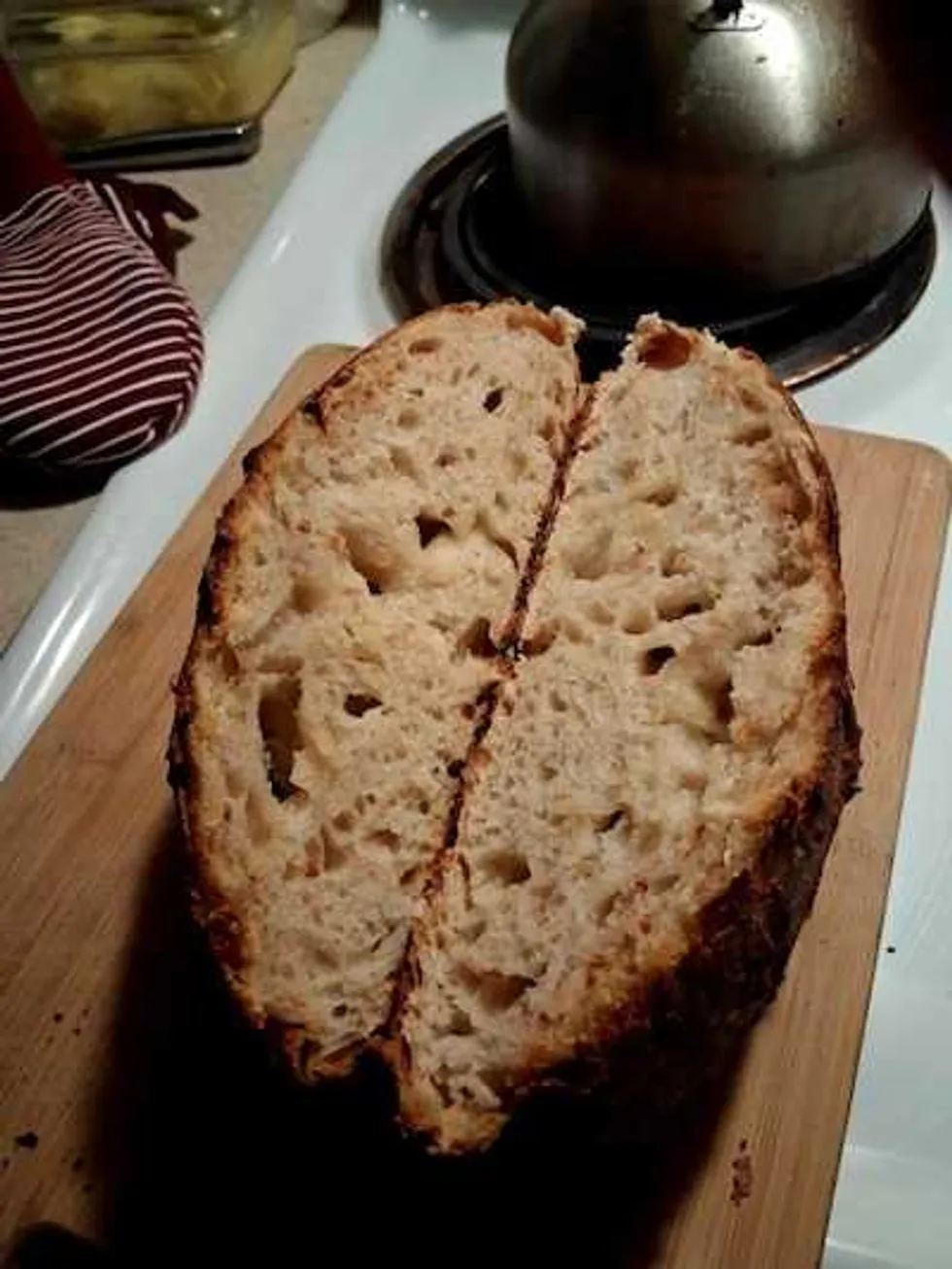 Josh Slocum
You’re going to make a loaf that good, and you’ll have it down by memory in one month.
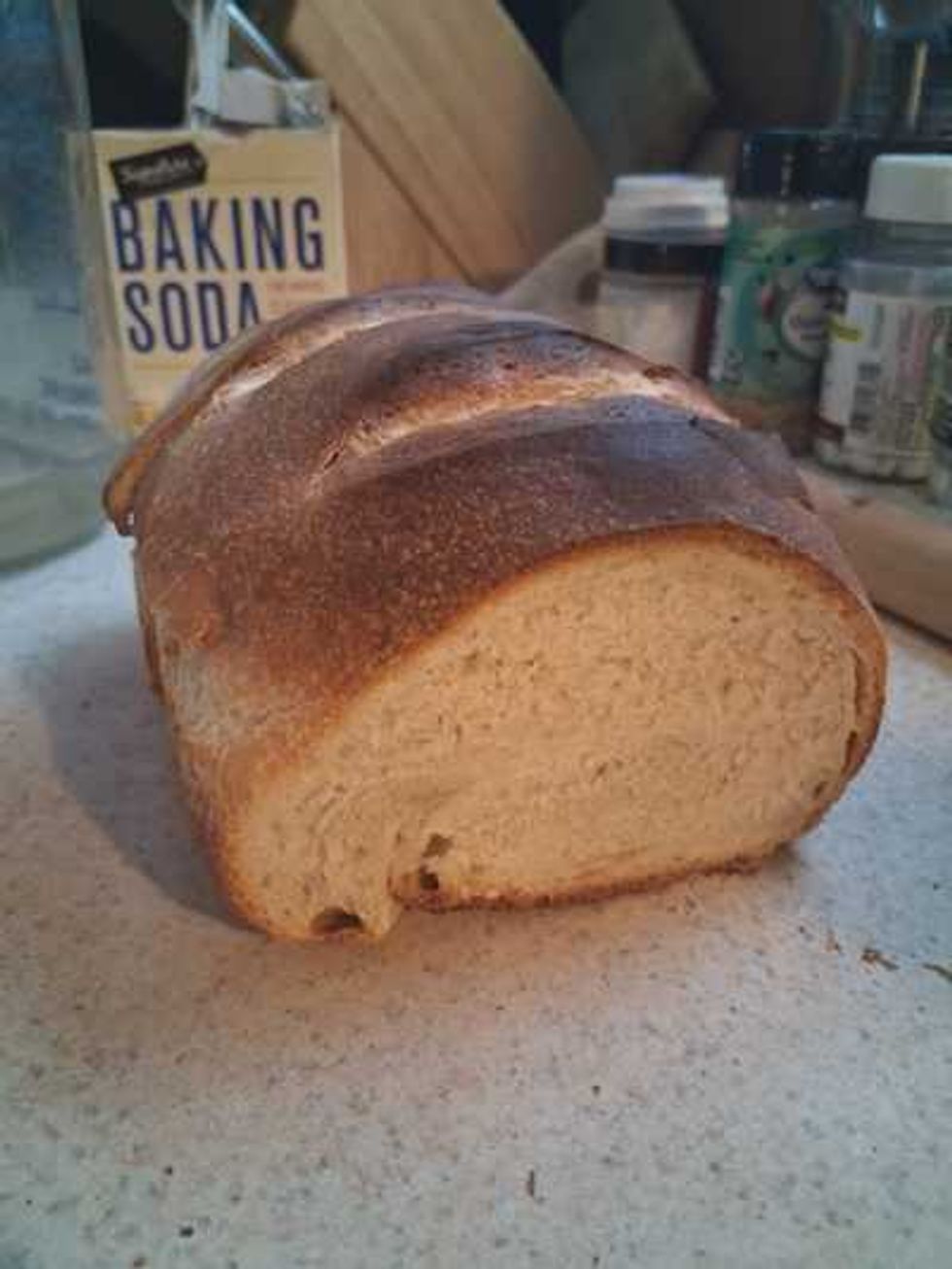
Then you’ll branch out into other kinds of bread. Want homemade sandwich bread? Just replace the water with milk or half and half and add melted butter and a tablespoon of sugar. That’s all I did. Here’s the result from my first try:
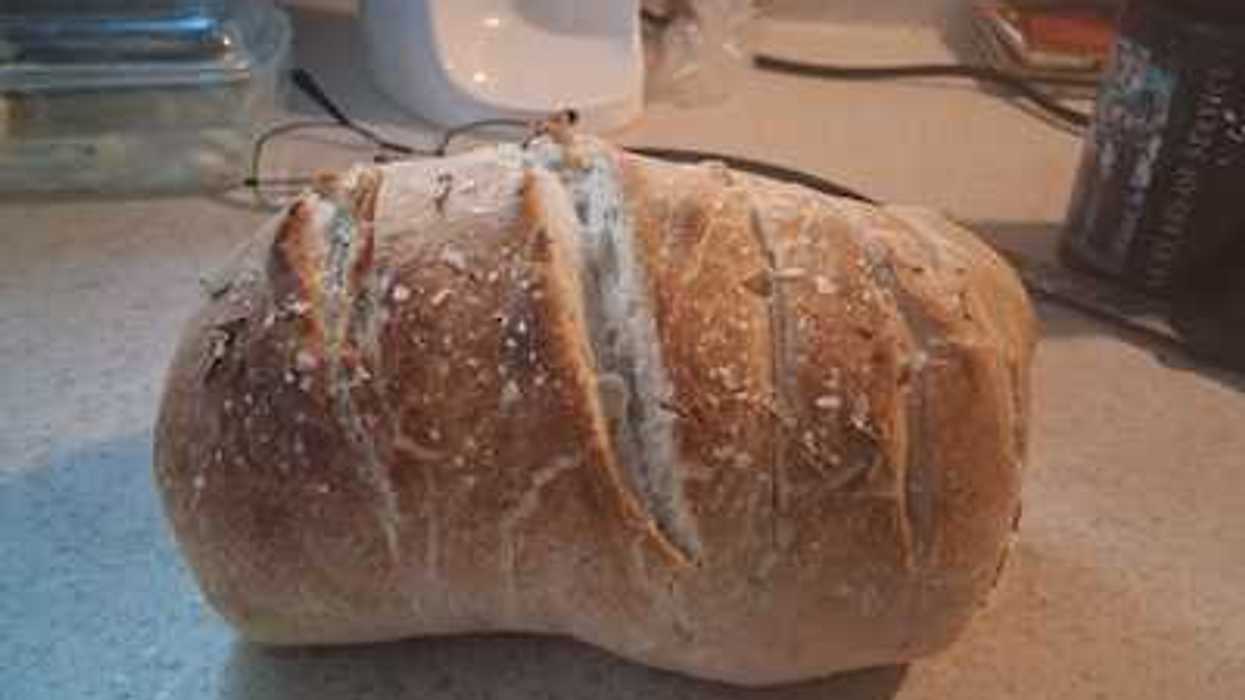
Then I wanted something fancier, something like the loaves I’ve been paying $9 for at a local bakery that does it the old-fashioned way with nothing but flour, water, culture, and salt. I just added olive oil and rosemary and put fancy salt on top:
Want to do it yourself?
As I mentioned, I’m not going to give you a recipe. At least, not in the modern-day sense of a set of precisely calibrated steps and measurements designed to produce the exact same outcome every time.
Instead I’m going to give you a basic outline that forces you to absorb the process physically and by instinct, rather than just memorizing turn-by-turn directions. If you’re not afraid of plunging your hands directly into the dough and making practice loaves until you get it right, you’ll be baking like this in a few weeks.
For the starter
You’re not going to buy a starter from any of those online marketplaces. You’re going to make your own. The yeast comes from the rye flour and from the air.
Ingredients
- Stone-ground whole rye flour. Yes, whole, and yes, rye, even if you don’t plan to make rye loaves. Rye is packed with natural yeast and bacteria that make starters get off the ground quicker than white flour.
- Water
- A jar
Method:
Take about a cup of whole rye flour and add enough room-temperature water to make a thick paste. And I do mean “paste” — something with the consistency of the stuff you remember using in school for papier-mâché volcanoes.
But don’t get neurotic. If it’s thinner or thicker than my paste, it’s still going to work.
Mix it well in the jar. Then take a rubber band and put it around the outside of the jar at the level where the starter is now. This is so you can see rise over time. Cover that jar loosely with a towel, cheesecloth, or a loose lid and put it in the oven with the light on. Leave it for 24 hours. Then discard half of it and add the same amount of rye flour and water back in, mix, and leave for another day.
You’re going to do this for at least seven days. After the first few days, you’ll see some bubbles. It’s not ready yet. Keep discarding and feeding. You may even notice it smells a little off the first few days. That’s normal.
By day seven (or a bit longer), you’ll notice that the starter smells sour, in a pleasant way, and yeasty. That’s what you want. At that point, you should also be seeing it double in size between feedings. If it’s not doing that, keep going with daily feedings.
Now you’ve got a stable starter. Stick it in the fridge. You can keep using rye to feed it for baking, or you can feed it white flour and convert it. I just use whatever flour I have handy because I don’t mind my loaves having mixed grains.
Your first loaf
So far we have used rye flour and water. Now to add our two final ingredients: white bread flour and salt.
Again, that’s white bread flour, not all-purpose. Bread flour has a higher protein ratio, which you need for building structure and rise.
First, take your starter out of the fridge and feed it flour and water. Put it in your oven with the light on. This gives it the perfect 80 degrees F temperature that it likes. Colder than that and it takes forever. Significantly hotter than that, and you may kill the yeast.
Wait for it to double in size, three to four hours.
Take it out and mix about a half-cup of starter into about a cup and a half of room-temperature water. Put the jar of starter back in the fridge. You only need to keep about a tablespoon of it — that will inoculate all the flour the next time you feed it for baking.
In a large bowl, put in about four and a half cups of bread flour and two teaspoons of salt. Mix the salt through the flour. Now add your wet mixture of water and starter. Stir or use your hands to mix until it all comes together and there are no more dry flour spots. It will be rough and shaggy.
RELATED: Cooking is easy; it’s our modern anxiety that makes it hard
 The Print Collector/Getty Images
Knead? No need
Guess what? You’re not going to knead. The reason most people knead is because we have used commercial yeast since it became available in the 1860s. Commercial yeast rises in just hours, too short a time for the yeast to build the bread structure, so you have to do it by hand to develop the gluten.
Not so with sourdough, using this method. Time is going to do everything kneading does and more.
Cover the dough and put it in a cold room or cellar if you have one. Somewhere between 40 and 50 degrees F. Let it sit 18-24 hours.
This is cold fermentation, which gives you the tang of sourdough, and it makes the bread more nutritious and long-lasting before it goes stale. If you don’t have a cold room, let your dough ferment for a few hours on the counter, then put it in the refrigerator overnight.
At the end of fermentation, you are ready to bake. Preheat a Dutch oven in your oven at 450 degrees for 45 minutes. Shape your dough into a ball or loaf, and put it in the Dutch oven. Cover, put back in the oven, and bake for 30 minutes, still at 450.
Remove the lid, turn the oven down to 400, then bake for about 10 to 15 more minutes to get a golden crust.
You have made bread that is miles above the plastic grotesquerie sold at grocery stores, for almost no money and for very little effort. No scales; no precise measuring. This is how your ancestors and all humans made bread for thousands of years before the late 19th century.
If your first few loaves aren’t great, keep going.
Don’t forget to slather it in butter.
New Jersey just sent a media-manufactured radical to Congress

The “Squad” is about to pick up a new member with Analilia Mejia, and it’s because the media won’t stop lying. Some politicians rise by appealing to voters’ sympathetic nature, making lofty promises of an easier life with less struggle. In doing so, they deliberately ignore the root causes of society’s problems and discredit any fixes that would diminish their own power.
The modern-day Democratic Party embraced radical ideologies and extreme rhetoric that will ultimately harm the American people, all while disguising those policies as compassion. Just look at media darlings like Alexandria Ocasio-Cortez and Rashida Tlaib.
Politicians who thrive on deception need gatekeepers to keep inconvenient truths from the public.
What’s worse, their deception is amplified by the mainstream media. Information is presented in such a biased way that the ill-informed voter is left believing that if they don’t vote the “correct” way, the United States will no longer exist.
This pattern is now so prevalent that political candidates who would never have been considered a legitimate threat 10 to 20 years ago are beginning to fill important political seats. These deceptions have helped far-left candidates like New Jersey Democrat Analilia Mejia rise to power.
Here are three key deceptions Mejia has exploited.
Iran, taqiya, and the pro-Palestine blind spot
Nowhere is the media’s selective blindness more dangerous than in its coverage of Iran. The regime is an Islamic theocracy that has never hidden its ambitions. It has pursued nuclear capability, funded terrorist proxies such as Hamas and Hezbollah, and embraced an ideology openly hostile to both Israel and the United States.
For years, Iran’s rulers have negotiated in bad faith while enriching uranium, arming proxies, and extending their influence across the region. Under those conditions, military options were no longer theoretical. Strikes on nuclear sites, missile infrastructure, and naval assets became necessary to prevent a far greater disaster.
Yet the same media that downplays Iran’s “Death to America” chants and its direct funding of Hamas portrays the conflict as Israeli overreach or American aggression. Mejia, a vocal pro-Palestine activist who has worn the keffiyeh and accused Israel of genocide, has built her platform on this distorted framing.
She either ignores or downplays the fact that Hamas is an Iranian proxy whose actions serve Tehran’s larger campaign against both Israel and the West. When politicians demand a ceasefire on terms that leave Iran and its proxies room to regroup, they do not move the region closer to peace. They shield the aggressor while pretending to restrain the war. The press helps them do it by burying Iran’s long record of deceit, terror sponsorship, and open threats beneath soft phrases like “regional tensions.”
Fraud, voter ID, and the ‘rights’ that protect the scam
The media’s coverage of election integrity and government fraud follows the same dishonest script. When Republican-led investigations and the work of independent journalists exposed massive Medicare and Medicaid scams in deep-blue states (hospice fraud in California potentially costing billions and Minnesota providers suspended after hundreds of millions in questionable claims), the story barely registered.
These schemes only came to light under renewed scrutiny from the current administration; Democratic states had little incentive to police their own. Yet the same outlets that yawn at taxpayer rip-offs scream that Republicans’ push for voter ID and stricter verification are “voter suppression.”
New Jersey provides fresh proof that fraud is real and corrosive. In January 2026, two Bergen County non-citizens were federally indicted for illegally voting in a U.S. election and lying on citizenship applications. In August of 2024, an ex-Plainfield mayoral candidate was charged with attempting to submit nearly 1,00 fraudulent voter registrations.
In 2025, county officials reported that homeless residents in Atlantic County were being solicited for fake messenger ballots. In 2024, James Devine pled guilty to submitting nearly 2,000 fake signatures on nominating petitions for the 2021 New Jersey gubernatorial primary. In 2022, Frederick Gattuso was convicted of tampering with public records when he voted twice using the registration of two people with similar names. These are not isolated “myths”; these are documented crimes that erode trust in the integrity of the electoral process.
Censorship and the Elon Musk exception
Mejia’s victory speech singled out Elon Musk as one of the “true radicals” subverting democracy. That line revealed a great deal. It showed exactly where she stands on speech, dissent, and who gets to control the public square.
During COVID, Democrats and allied Big Tech openly coordinated to suppress dissenting voices. The Hunter Biden laptop story was buried as “Russian disinformation” by 51 former intelligence officials, the lab leak theory was censored as a conspiracy, the Great Barrington Declaration on lockdowns was throttled, and vaccine skeptics were deplatformed. Government pressure on social media, revealed in the Twitter files, showed a clear pattern of state-backed censorship of conservative viewpoints.
Enter Elon Musk, who purchased Twitter (now X) precisely to restore free speech and end that collusion. Under his leadership, X became the only major platform where all sides could be heard. The media was complicit in the original censorship and now portrays Musk’s commitment to open discourse as dangerous “chaos.” Mejia’s anti-Musk stance is no surprise; politicians who thrive on deception need gatekeepers to keep inconvenient truths from the public.
Voters must see through the wolf in sheep’s clothing. Politicians like Analilia Mejia promise an easier life, compassion for the marginalized, and protection from “extremists,” all while leaning on a media echo chamber that distorts threats, buries successes, and censors dissent. They ignore root causes — Islamic terrorism sponsored by Iran, rampant fraud that wastes taxpayers’ dollars, politicized institutions that target reformers, and the slow erosion of open debate — because confronting those realities would shrink their power.
The result is not progress; it is a more divided, less secure, and less truthful America. New Jersey’s newest congresswoman and her ideological allies offer lofty rhetoric wrapped in deception. Americans who value security, prosperity, and liberty must reject the easy promises and demand the harder truths. The future of the Republic depends on it.





