

Category: Opinion & analysis
DOGE didn’t die — it moved to the states
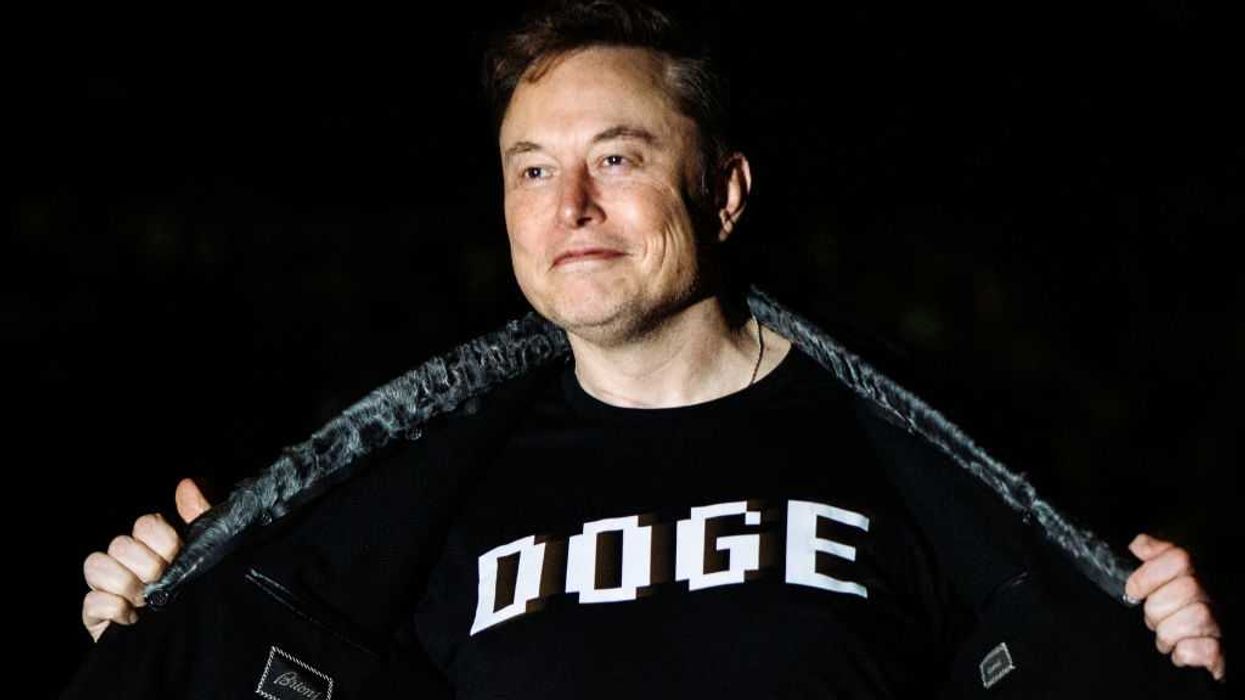
The media and conservative pundits may have buried the Department of Government Efficiency, but they have yet to carve a date of death on its tombstone. While DOGE in Washington may have appeared to insiders as a vanity project, voters saw it as a mandate — one that Republicans at the federal level have largely set aside in favor of politics as usual.
But activists have not forgotten. In red states across the country, they are still demanding accountability. And in Idaho, that pressure is finally producing results.
If Idaho can succeed and follow Florida’s lead, there is no serious reason other red states cannot do the same — unless they are prepared to admit they never intended to keep their promises.
For what appears to be the first time, state legislators serving on Idaho’s DOGE Task Force concluded their 2025 work with a meeting that departed from months of cautious, procedural discussion. Members asked harder questions, voiced long-simmering frustrations, and issued a recommendation that could reshape the state’s fiscal future: urging the full legislature to consider repealing Medicaid expansion, a costly policy that has drained taxpayers of millions.
Red states can’t stall forever
Idaho may not be Florida, where Republican Gov. Ron DeSantis’ DOGE-style reforms have produced consistent wins for fiscal sanity and limited government. But it is doing more than other red states, such as North Dakota, where a DOGE committee stacked with Democrats predictably ignored the voters’ mandate.
The Idaho meeting exposed growing dissatisfaction with the task force’s approach. Over the summer and fall, the committee — charged with identifying inefficiencies — repeatedly deferred to state agencies for suggestions on cuts. Unsurprisingly those agencies offered little beyond cosmetic changes.
Idaho state Rep. Heather Scott (R-LD2, Blanchard) gave voice to that frustration. “What is the goal of this committee?” she asked, pressing colleagues to offer recommendations that actually matter. “Twenty thousand here, 50,000 there, or removing old code is not meaningful efficiency,” Scott said. Repealing Medicaid expansion, she argued, would be one of the “best decisions” the state could make.
Nibbling at the edges
Scott’s experience on the Idaho task force stands in stark contrast to the early federal DOGE efforts, which moved aggressively to slash U.S. Agency for International Development’s workforce, freeze fraudulent payments, and cancel billions in corrupt contracts. By comparison, Idaho’s task force had mostly nibbled at the edges. This recommendation marked its first serious step toward substantive reform.
Another revealing moment came from co-chairman state Sen. Todd Lakey (R-Nampa), who read a letter from a small-business owner offering health insurance to employees. Workers routinely request schedules capped at 20 to 28 hours per week to preserve Medicaid expansion benefits — even though full-time work would require only a modest contribution toward employer-provided coverage.
The result is a perverse incentive structure: businesses struggle to find full-time workers while taxpayers subsidize underemployment. The government fuels workforce shortages through welfare, then spends more taxpayer dollars trying to fix the shortages it created. This welfare-workforce vortex is the opposite of efficiency, and it is spreading nationwide.
The meeting’s most explosive moment came from state Rep. Josh Tanner (R-Eagle), who described Idaho’s Medicaid reimbursement structure as resembling “money laundering.”
Citing analysis from the Paragon Health Institute, Tanner explained how provider assessment fees allow states to inflate Medicaid spending to draw down larger federal matching funds, cycling the money back through enhanced payments. Paragon has described these arrangements as “legalized money laundering” — schemes that shift costs to federal taxpayers while enriching connected providers or funding unrelated priorities.
Nationally supplemental payments now exceed $110 billion annually, siphoning hundreds of billions from taxpayers over a decade.
RELATED: Turn off the money; they’ll leave: Elon Musk nails the border truth
 Photo by Kevin Dietsch/Getty Images
DOGE’s second life
My sources tell me that hospital lobbyists went into panic mode after the meeting, urgently contacting Capitol officials to contain the fallout from Tanner’s remarks.
For the first time, the task force aired real frustrations, documented real harms, and named real abuses. That alone offers reason for cautious optimism.
Idaho now has committed conservatives in positions of influence. With the task force’s recommendation to revisit Medicaid expansion heading to the legislature, the state has an opportunity to govern as it campaigns — preserving liberty, restoring accountability, and expanding opportunity.
If Idaho can succeed and follow Florida’s lead, there is no serious reason other red states cannot do the same — unless they are prepared to admit they never intended to keep their promises in the first place.
The American dream lives where people still choose to build

“For many, the American dream has become a nightmare,” Sen. Bernie Sanders (I-Vt.) has said, capturing a sentiment that has become common on the political left and across modern culture.
That line now travels far beyond politics. Scroll social media for five minutes, and you’ll see the same message repeated in endless variations: Owning a home is impossible. Raising a family is irresponsible. Work doesn’t pay. The system is rigged. The future is closed.
The American dream was never a promise of ease or comfort by age 25. It was an invitation to build something meaningful over time through responsibility and perseverance.
This message is everywhere, and it is doing real damage.
Harder lives, false conclusions
Life has become harder in tangible ways. Housing costs have surged. College has grown bloated and expensive. Inflation punished families already living close to the margins. Young adults feel delayed, uncertain, and anxious about the future.
Those frustrations are real. The conclusion being pushed alongside them is not.
The lie is not that things are harder. The lie is that effort no longer matters.
That lie spreads quickly online because it feels validating. A 30-second video declaring the system broken beyond repair asks nothing of the viewer except agreement. Building a life requires patience, sacrifice, and time. One goes viral. The other happens quietly.
Much of this shift comes from where young Americans now form their beliefs. For many in Generation Z, ideas about money, marriage, and the future are no longer shaped primarily by parents, churches, employers, or local communities. They are shaped by algorithm-driven platforms like TikTok and X, where extremity is rewarded with attention.
In those spaces, online figures routinely dismiss the American dream as a scam and portray starting a family as a trap rather than a source of meaning or stability. Cynicism is marketed as realism. Detachment is framed as wisdom. A generation looking for guidance is taught to expect failure before it ever tries.
Why despair is profitable
This narrative didn’t arise by accident. It feeds on real pain, but it’s also profitable. Political movements gain leverage by convincing voters that only sweeping control from the top can fix a hopeless system. Media companies thrive on pessimism because fear keeps people watching. Online grievance entrepreneurs build massive followings by telling young people that nothing they do will ever be enough.
If Americans stop believing they can build a future, someone else will gladly build power over them.
History keeps disproving this story.
Tell the generation that survived the Great Depression that the American dream was dead. Tell the men who returned from World War II, many wounded and broke, who used the GI Bill to buy homes and start families, that the climb was too steep. Tell the children of factory workers who grew up without air conditioning, college degrees, or safety nets — but still built middle-class lives through work and sacrifice — that the odds were unfair.
Tell the families of the 1950s and 1960s who lived modestly, saved slowly, and delayed gratification for decades that life was easy. Tell the Americans who endured oil crises, layoffs, and double-digit inflation in the 1970s and early 1980s that the system was designed for their comfort.
The dream was never easy
Life has never been easy. The climb has always been steep. The American dream was never built on convenience. It was built on resilience.
The truth is less dramatic — and far more hopeful. The American dream didn’t disappear. It changed shape.
It was never a promise of ease or comfort by age 25. It was an invitation to build something meaningful over time through responsibility and perseverance. For generations, it rested on a simple foundation: Work hard, form families, contribute locally, and invest in something bigger than yourself.
That path was never easy. What changed is not the dream, but our tolerance for effort and our patience for delayed reward.
The quiet math of real life
Despite the noise, the American dream remains visible in places social media rarely celebrates. It shows up in the quiet math of real life.
Research from the Institute for Family Studies finds that stably married Americans approaching retirement hold, on average, more than $640,000 in household assets, compared with roughly $167,000 for divorced or never-married adults — even after accounting for age, education, and race. That gap reflects decades of shared sacrifice, income pooling, planning, and commitment.
These stories don’t trend online. They play out quietly every day.
Ironically, many of the loudest voices declaring the dream dead are doing quite well selling that message. Entire online brands are built on telling people that life is impossible — while generating substantial revenue and influence in the process. Despair has become an industry.
RELATED: Christmas is worth celebrating, even if your family is fractured
 Chris Ratcliffe/Bloomberg via Getty Images
What truly threatens the American dream is not capitalism, competition, or even inequality. It’s a culture that encourages permanent adolescence. A culture that treats commitment as a burden, delays adulthood indefinitely, and then wonders why people feel anxious and untethered.
The American dream doesn’t die because life is hard. It dies when people are convinced that hard things aren’t worth doing.
Too many young Americans are told that marriage can wait, children are optional, faith is outdated, and roots are restrictive. They’re promised freedom through detachment and fulfillment through endless choice — then wake up years later with more options than ever and less meaning than expected.
Builders still have the advantage
This isn’t a policy argument. It’s a cultural one. No law can manufacture purpose. No program can force optimism. But a nation that teaches its citizens the dream is dead shouldn’t be surprised when fewer people try to live it.
The American dream has always belonged to builders of families, businesses, and communities. It never belonged to those waiting for perfect conditions or guaranteed outcomes.
The American dream isn’t dead. But telling Americans that it is has become fashionable, profitable, and politically useful.
The question is whether we continue to accept that story — or choose, once again, to build.
What Christmas says to tyrants

As we come to the end of 2025, peace feels hard to find. We are surrounded by news of barbaric terrorism once again — most recently in Australia — erupting in violent displays of prideful, ethnic hatred. We watch regional wars grind on, prolonged by an implacable tyrant bent on self-glorification and the expansion of his own wealth and power.
At such a time, it is good to remember that 2,000 years ago, a child was born for whom there was no room at the inn — a child laid instead in a stable because there was nowhere else to go. Jesus spent his childhood in the simplest of households and his adulthood accounting for every penny, for the life of a carpenter brought little money.
Let us set aside the calamities of the world, if only for a moment, and celebrate the birth of the most extraordinary child ever born — the one who offers eternal love and shelter from the storm.
When Jesus left his home to serve the world, his life became unlike that of the foxes, who have dens, or the birds, who have nests. The Son of Man had no place to lay his head. He rejected the paths of wealth, power, and pride, choosing instead humility, love, and suffering.
His ministry began when he read from the prophet Isaiah: “The Spirit of the Lord is upon me, because he has anointed me to preach good news to the poor.” That good news was revolutionary. God was not, as the Greeks imagined, a distant and uncaring master of abstractions. Nor was he, as many expected, a cold and exacting judge.
The good news was that God is filled with love for humanity — and that was cause for celebration.
So Jesus’ first miracle was not an act of conquest or condemnation, but joy: the transformation of water into wine at a wedding in Cana.
When Jesus chose his companions, he chose people like himself — humble, ordinary, and yet extraordinary. He welcomed women into his ministry, from his mother Mary to Mary Magdalene, Joanna, Susanna, and many others, treating their womanhood as sacred. As F.R. Maltby observed, Jesus promised his followers three things: that they would be completely fearless, absurdly happy, and in constant trouble. Wherever they went, they brought hope, kindness, and cheer, and when Jesus spoke, his words carried the breath of heaven.
Jesus welcomed everyone he encountered — Jews and Romans, Greeks and Samaritans. He spoke with rabbis, tax collectors, and sinners alike. But he devoted his deepest attention to those who suffered: the blind, the deaf, the lame, the lepers. He touched those no one else would touch and loved those no one else would love.
When disciples of John the Baptist asked who he was, Jesus answered simply: “Tell John what you have seen and heard: the blind receive their sight, the lame walk, the lepers are cleansed, the deaf hear, the dead are raised, and the poor have good news brought to them” (Luke 7:22).
Even more radical was his teaching. “Love your enemies,” he said. “Bless those who curse you. Do good to those who hate you. Pray for those who mistreat you. As you would have others treat you, so must you treat them.”
And above all: “Love the Lord your God with all your heart, with all your soul, with all your strength, and with all your mind, and your neighbor as yourself” (Luke 10:27).
RELATED: The algorithm sells despair. Christmas tells the truth.
 Photo by Fine Art Images/Heritage Images/Getty Images
Jesus taught through parables, stories anyone could understand. Perhaps the most famous is that of the prodigal son — a young man who squandered his inheritance on gambling, drink, and excess, only to be welcomed home with celebration rather than condemnation. Jesus explained it this way: “If a man has a hundred sheep, and one of them has gone astray, does he not leave the ninety-nine on the mountains and go in search of the one that went astray?” (Matthew 18:12).
God, in his love, was searching for a lost humanity, and Jesus was the shepherd sent to bring it home.
When the Pharisees asked when the kingdom of God would come, Jesus answered, “The kingdom of God is within you” (Luke 17:21). It is entered freely — not by force, not by empire, not by the power of Caesar. There exists a realm where Caesar’s writ does not run, a domain belonging wholly to God.
To bring us into that kingdom of peace, Christ endured the cross — the only place on earth that finally made room for one so profoundly good.
Before he departed, he instructed his apostles to greet every home with a prayer for peace — a peace available only in the kingdom he builds within each of us.
So let us set aside the calamities of the world, if only for a moment, and celebrate the birth of the most extraordinary child ever born — the one who offers eternal love and shelter from the storm.
Merry Christmas.
Your laptop is about to become a casualty of the AI grift

Welcome to the techno-feudal state, where citizens are forced to underwrite unnecessary and harmful technology at the expense of the technology they actually need.
The economic story of 2025 is the government-driven build-out of hyperscale AI data centers — sold as innovation, justified as national strategy, and pursued in service of cloud-based chatbot slop and expanded surveillance. This build-out is consuming land, food, water, and energy at enormous scale. As Energy Secretary Chris Wright bluntly put it, “It takes massive amounts of electricity to generate intelligence. The more energy invested, the more intelligence produced.”
Shortages will hit consumers hard in the coming year.
That framing ignores what is being sacrificed — and distorted — in the process.
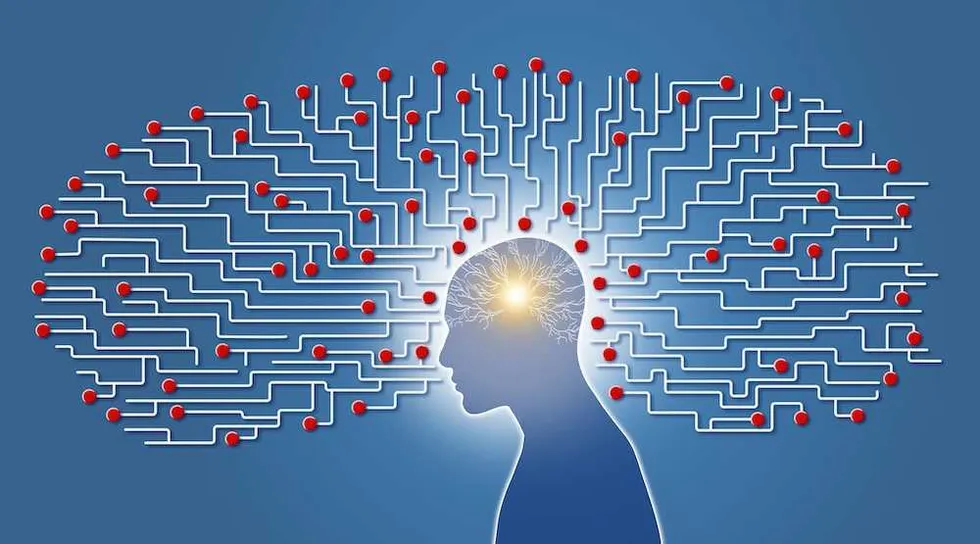
Beyond the destruction of rural communities and the strain placed on national energy capacity, government favoritism toward AI infrastructure is warping markets. Capital that once sustained the hardware and software ecosystem of the digital economy is being siphoned into subsidized “AI factories,” chasing artificial general intelligence instead of cheaper, more efficient investments in narrow AI.
Thanks to fiscal, monetary, tax, and regulatory favoritism, the result is free chatbot slop and an increasingly scarce, expensive supply of laptops, phones, and consumer hardware.
Subsidies break the market
For decades, consumer electronics stood as one of the greatest deflationary success stories in modern economics. Unlike health care or education — both heavily monopolized by government — the computer industry operated with relatively little distortion. From December 1997 to August 2015, the CPI for “personal computers and peripheral equipment” fell 96%. Over that same period, medical care, housing, and food costs rose between 80% and 200%.
That era is ending.
AI data centers are now crowding out consumer electronics. Major manufacturers such as Dell and Samsung are scaling back or discontinuing entire product lines because they can no longer secure components diverted to AI chip production.
Prices for phones and laptops are rising sharply. Jobs tied to consumer electronics — especially the remaining U.S.-based assembly operations — are being squeezed out in favor of data center hardware that benefits a narrow set of firms.
This is policy-driven distortion, not organic market evolution.
Through initiatives like Stargate and hundreds of billions in capital pushed toward data center expansion, the government has created incentives for companies to abandon consumer hardware in favor of AI infrastructure. The result is shortages that will hit consumers hard in the coming year.
Samsung, SK Hynix, and Micron are retooling factories to prioritize AI-grade silicon for data centers instead of personal devices. DRAM production is being routed almost entirely toward servers because it is far more profitable to leverage $40,000 AI chips than $500-$800 laptops. In the fourth quarter of 2025, contract prices for certain 16GB DDR5 chips rose nearly 300% as supply was diverted. Dell and Lenovo have already imposed 15%-30% price hikes on PCs, citing insatiable AI-sector demand.
The chip crunch
The situation is deteriorating quickly. DRAM inventory levels are down 80% year over year, with just three weeks of supply on hand — down from 9.5 weeks in July. SK Hynix expects shortages to persist through late 2027. Samsung has announced it is effectively out of inventory and has more than doubled DDR5 contract prices to roughly $19-$20 per unit. DDR5 is now standard across new consumer and commercial desktops and laptops, including Apple MacBooks.
Samsung has also signaled it may exit the SSD market altogether, deeming it insufficiently glamorous compared with subsidized data center investments. Nvidia has warned it may cut RTX 50 series production by up to 40%, a move that would drive up the cost of entry-level gaming systems.
Shrinkflation is next. Before the data center bubble, the market was approaching a baseline of 16GB of RAM and 1TB SSDs for entry-level laptops. As memory is diverted to enterprise customers, manufacturers will revert to 8GB systems with slower storage to keep prices under $999 — ironically rendering those machines incapable of running the very AI applications they’re working on.
Real innovation sidelined
The damage extends beyond prices. Research and development in conventional computing are already suffering. Investment in efficient CPUs, affordable networking equipment, edge computing, and quantum-adjacent technologies has slowed as capital and talent are pulled into AI accelerators.
This is precisely backward. Narrow AI — focused on real-world tasks like logistics, agriculture, port management, and manufacturing — is where genuine productivity gains lie. China understands this and is investing accordingly. The United States is not. Instead, firms like Roomba, which experimented with practical autonomy, are collapsing — only to be acquired by the Chinese!
This is not a free market. Between tax incentives, regulatory favoritism, land-use carve-outs, capital subsidies, and artificially suppressed interest rates, the government has created an arms race for a data center bubble China itself is not pursuing. Each round of monetary easing inflates the same firms’ valuations, enabling further speculative investment divorced from consumer need.
RELATED: China’s AI strategy could turn Americans into data mines
 Grafissimo via iStock/Getty Images
Hype over utility
As Charles Hugh Smith recently noted, expanding credit boosts asset prices, which then serve as collateral for still more leverage — allowing capital-rich firms to outbid everyone else while hollowing out the broader economy.
The pattern is familiar. Consider the Ford plant in Glendale, Kentucky, where 1,600 workers were laid off after the collapse of government-favored electric vehicle investments. That facility is now being retooled to produce batteries for data centers. When one subsidy collapses, another replaces it.
We are trading convention for speculation. Conventional technology — reliable hardware, the internet, mobile computing — delivers proven, measurable utility. The current investment surge into artificial general intelligence is based on hypothetical future returns propped up by state power.
The good old laptop is becoming collateral damage in what may prove to be the largest government-induced tech bubble yet.
Why Democrats fear this midterm more than Republicans do

Midterm elections usually punish the party in power. Political gravity pulls incumbents downward as voters look for balance. But Donald Trump has never operated according to political gravity. This midterm, following the 2024 realignment that delivered the White House and both chambers of Congress to Republicans, looks less like a second-year slump and more like a referendum on a political transformation without modern precedent.
Rather than a routine evaluation of performance, this election is shaping up as a test of will, an economic reckoning, and a public judgment on the unraveling of the administrative state. The failures of the left — not Republican incumbency — are likely to define the terrain.
Trump remains an engine rather than a liability. Party unity has not looked this solid since the Reagan years. Democrats remain trapped in spectacle and grievance.
At the center of it all sits Trump’s methodical effort to dismantle what many Americans now recognize as an unaccountable fourth branch of government.
What was once dismissed as a conspiracy theory is unfolding openly. Trump and congressional Republicans have made no attempt to conceal the project. They are explaining it step by step: how federal agencies accumulated unchecked authority, how oversight collapsed, and why constitutional balance must be restored. These are not marginal reforms. It’s a structural correction.
The result is an electorate unusually aware of how Washington’s permanent class operates. Americans who lived through Russiagate, the 2020 election controversies, years of politicized investigations, and coordinated censorship no longer view federal reform passively. They see themselves as stakeholders in the rollback of bureaucratic power.
A major shift enabling this moment is the collapse of the Russia narrative. Tulsi Gabbard, once embraced by Democrats before being cast out, has played a central role in dismantling the mythology that sustained years of hysteria. Her critique carries weight precisely because it comes from someone who saw the rot from inside her former party.
With that narrative gone, Democrats have lost their most reliable alibi. They can no longer lean on leaks, innuendo, or intelligence-adjacent smears to explain electoral defeats. In its absence, their messaging has devolved into warnings, moral panic, and emotional appeals. That posture signals weakness, not confidence — a poor place to begin a midterm campaign.
The same dynamic surfaces around election integrity. Voters remember 2020 — not the sanitized version offered by media institutions, but the confusion surrounding rule changes, ballot handling, and emergency measures weaponized for political advantage. Those concerns did not fade. If anything, they hardened.
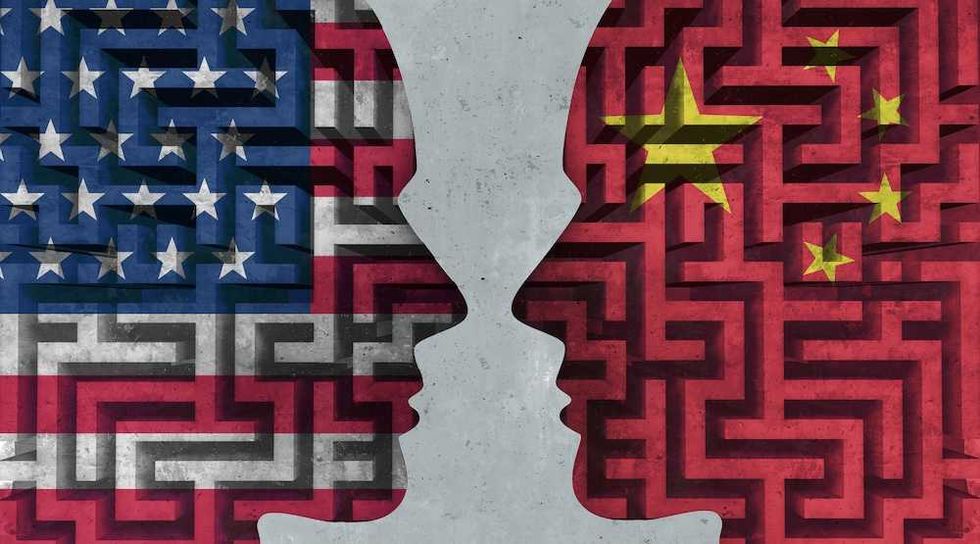
Republicans tapped into that sentiment in 2022 and expanded it in 2024. Now, as attention turns to foreign interference — particularly China’s digital reach and geopolitical incentives — even skeptics acknowledge that election vulnerabilities are real and unresolved. Republicans benefit because they are the only party willing to confront the problem directly.
RELATED: Buckle up: We are headed for an AI collision with China
 wildpixel via iStock/Getty Images
That advantage was built incrementally. While 2022 fell short of a wave, it provided discipline, data, and hard lessons. By 2024, Republicans had unified around priorities that crossed demographic lines: economic recovery, border enforcement, and ending the weaponization of government. The result was not only a presidential victory but unified control of Congress — and margins sturdy enough to govern.
Democrats, by contrast, have lost their taste for prosecutorial theatrics. Years of timed indictments, investigations, and legal spectacle exhausted the public. What once energized the base now appears to be manipulation.
Their federal shutdown was another miscalculation. Instead of appearing principled, Democrats disrupted or financially strained nearly 10 million Americans — federal workers, contractors, and regional industries — in a maneuver widely seen as cynical and purposeless. Voters did not see conviction. They saw political theater staged at their expense.
At the same time, left-wing political violence has become harder to dismiss. From major cities to college campuses, radical unrest is increasingly tolerated by progressive officials. With Republicans governing, the contrast is stark: One party emphasizes order, while the other struggles to contain its most extreme factions. Midterms reward stability. Right now, Republicans own that advantage.
Yes, midterms are usually brutal for incumbents. But this cycle is different. Republicans enter with momentum, cohesion, and a governing agenda aligned with voter concerns. Trump remains an engine rather than a liability. Party unity has not looked this solid since the Reagan years. Democrats remain trapped in spectacle and grievance.
MAGA is no longer an insurgency. It is the governing coalition. This midterm is more likely to ratify that reality than reverse it.
All I want for Christmas is for Vivek Ramaswamy to stop embarrassing the GOP

Vivek Ramaswamy is a DEI candidate — and an unqualified one. Republicans do not vote for unqualified DEI candidates. Historically, they never have.
For the good of Ohio, the Republican Party, and MAGA voters nationwide, Vivek Ramaswamy should withdraw from the Ohio gubernatorial race. His candidacy is not merely ill-advised; it is corrosive. At a moment when unity and discipline matter, he threatens to fracture the coalition President Trump assembled and to waste political capital ahead of the 2026 midterms and the 2028 presidential cycle, when Ohio native JD Vance is widely expected to lead the ticket.
All Ramaswamy had to do was remain silent and act like a normal Republican for 18 months. He couldn’t.
Ramaswamy’s problem is not policy disagreement. It is temperament, judgment, and an inability to restrain himself. His habit of attacking critics as racists, trolls, or bad actors poisons the well. Democrats, corporate media, and professional activists already do that job. Republicans do not need a gubernatorial candidate doing it from inside the party.
In 2024, 3,189,116 Ohioans voted for Donald Trump. It strains credulity to claim that Ramaswamy is more qualified to govern Ohio than virtually any one of them.
Yet this charade continues. For decades, GOP leadership has tried to impose an identity-driven strategy on a party whose voters reject it. The results are consistent. From Alan Keyes to Winsome Earle-Sears, the establishment clings to a failed premise: that Republican voters will embrace DEI candidates if scolded long enough. They won’t. Nor do minority voters reliably cross over for such candidates. The strategy fails on both ends.
That makes the present moment especially baffling. At a time when Trump and Vance are openly criticizing decades of discriminatory policies against white Americans, backing a candidate whose appeal rests on the same identity logic is not just tone-deaf — it is hostile to the base.
Ohio is a solid red state. Any competent Republican with discipline wins statewide office comfortably.
Vivek Ramaswamy is neither.
His background underscores why. In 2011, at age 24, Ramaswamy accepted a $90,000 “scholarship” from the brother of George Soros. That alone raises eyebrows. It becomes more troubling when you consider that Ramaswamy had already earned more than $1.2 million in the prior three years and reported $2.25 million in income the year he accepted the award.
This occurred during the Great Recession, when many white Millennial men faced systematic exclusion across elite institutions. Ramaswamy did not.
Later, much of his wealth flowed from Axovant Sciences, which aggressively promoted an Alzheimer’s breakthrough to retail investors after early trials had failed. The result was a textbook pump-and-dump that left ordinary Americans holding the bag. These facts go directly to trust and judgment.
Despite this record, Ramaswamy launched a quixotic presidential campaign, which he parlayed into a brief role in the Trump administration and a partnership with Elon Musk under the DOGE initiative. That arrangement ended almost as quickly as it began.
Then came the Christmas crashout of 2024.
During the holidays — entirely unprovoked — Ramaswamy took to X to berate American workers as lazy and culturally deficient while praising foreign H-1B visa holders. He mocked American childhood culture, disparaged “jocks and prom queens,” and lamented that Americans watched “Boy Meets World” instead of competing in math olympiads. The episode revealed far more about Ramaswamy’s resentments than about American culture.
MAGA voters were celebrating a landslide victory when the lecture arrived. The response was swift and overwhelming. Rather than admit error, Ramaswamy doubled down, dismissing critics as bots, trolls, and racists while casting himself as a victim.
Shortly thereafter, the Trump administration quietly removed him from his DOGE role before he was even formally installed.
Voters noticed. The internet does not forget.
When Ramaswamy announced his run for governor, the reaction was not enthusiasm but disbelief. The Ohio GOP’s apparent decision to anoint him is indefensible. It would take an estimated $100 million to drag this candidacy across the finish line, and even then he would be lucky to crack 48%.
We’ve seen this movie before. At least one-third of Ohio Republicans would rather spoil their ballot, vote third-party, or stay home than support him. Accusing them of racism will not change that reality.
Most recently, Ramaswamy took to the New York Times to reprise his grievances, portraying MAGA voters and heritage Americans as racists, extremists, and “groypers.” He made similar remarks at Turning Point USA’s AmFest over the weekend.
RELATED: The media just told you their 2026 strategy: ‘Lies, but better!’
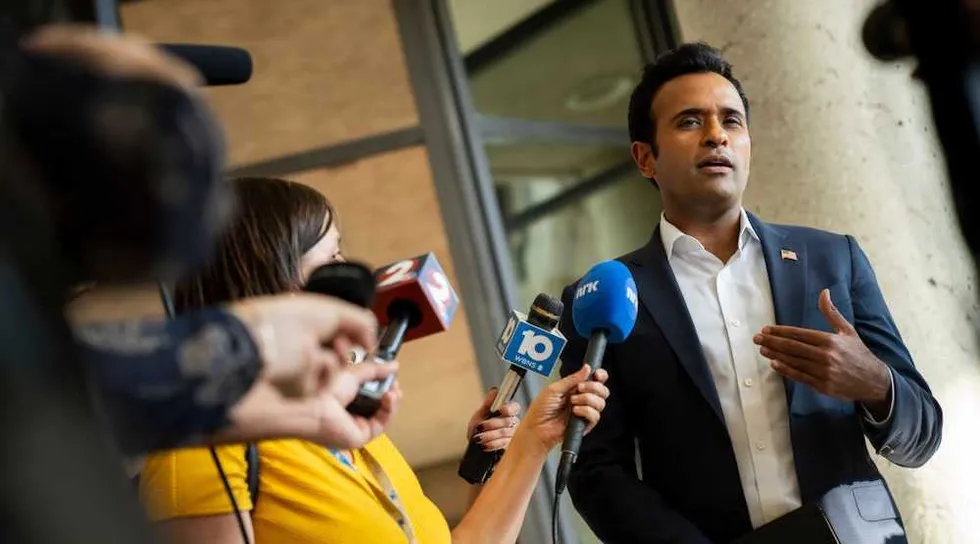 Photo by Michael Swensen/Getty Images
In his Times op-ed, he argued that America is an abstract idea detached from ancestry, history, or continuity — and that descendants of those who built the nation have no greater claim to it than recent arrivals or anchor babies.
That view is not widely held, nor is it reflected in the American tradition. From America’s founders to Alexis de Tocqueville and Theodore Roosevelt, continuity, inheritance, and culture have always mattered.
No one expects Ramaswamy to be a heritage American. But Americans reasonably expect someone seeking to govern them to respect the people whose nation it is. Ramaswamy has shown repeated contempt instead.
He did not have to attack white Americans over Christmas. He did not have to insult the Republican base in the New York Times. He did not have to liken MAGA voters to extremists.
He chose to.
All Ramaswamy had to do was remain silent and act like a normal Republican for 18 months. He couldn’t.
MAGA does not need this distraction. Ohio does not need this fight. The Republican Party cannot afford to spend finite resources defending a candidate who consistently antagonizes his own voters.
That alone makes him unsuitable for office.
Wake up and smell the Islamic invasion of the West

Over the course of a single day this month, a pattern repeated itself across the West. Two Muslims murdered at least 15 people at a Hanukkah celebration in Sydney. Five Muslims were arrested for plotting an attack on a Christmas market in Germany. French authorities canceled a concert in Paris due to credible threats of an Islamist terror attack. Two Iowa National Guardsmen in Syria were murdered by an Islamist while we play footsie with an illegitimate regime.
None of this represents an anomaly. It represents the accumulated failure of a strategy best summarized as “invade the Muslim world, invite the Muslim world.”
This conflict has never been about Jews alone. Jews are the first target, not the last. Islamist ideology ultimately targets all non-Muslims and any society that refuses submission.
That doctrine has produced neither peace abroad nor safety at home.
A contradiction the West refuses to resolve
Western governments spent the better part of a generation importing millions of migrants from unstable regions while simultaneously deploying their own soldiers to those same regions to manage sectarian civil wars.
The contradiction remains unresolved: We accept the risks of mass migration while risking our troops to contain the same ideologies overseas.
Islamist movements do not confine themselves to national borders. Whether Sunni or Shia, whether operating in Syria, Europe, or North America, the targets remain consistent: Jews, Christians, secular institutions, and Western civil society.
Yet our policy treats these threats as isolated incidents rather than the expression of a coherent ideology.
Strategic incoherence in Syria
Nowhere does this incoherence appear more starkly than in Syria.
On one hand, the Trump administration has moved toward normalizing relations with Syria’s new leadership. In June, President Trump signed an executive order terminating U.S. sanctions on Syria, including those on its central bank, in the name of reconstruction and investment. Last month, Syria’s new leader, Abu Mohammad al-Jolani — a former al-Qaeda figure rebranded as a statesman — visited the White House, where Trump publicly praised developments under the new regime and said he was “very satisfied” with Syria’s direction.
At the same time, Trump floated the idea of establishing a permanent U.S. military base in Damascus to solidify America’s indefensible presence and support the new government.
This would be extraordinary. The United States would be embedding troops deeper into one of the most volatile theaters on earth, effectively placing American soldiers at the mercy of a regime whose leadership and allies only recently emerged from jihadist networks — including factions accused of massacring Christians and Druze.
Simultaneously, the White House pressures Israel to limit its defensive operations in southern Syria, including its buffer-zone strategy along the Golan Heights, even as Israeli forces do a far more effective job degrading jihadist threats without sacrificing their own soldiers.
The result is perverse: America risks lives to stabilize an Islamist-adjacent regime while restraining the one ally actually capable of enforcing order.
Wars abroad, chaos at home
The contradiction deepens when immigration policy enters the picture.
Despite Syria remaining one of the world’s most unstable countries, with no reliable vetting infrastructure, the United States continues admitting Syrian migrants while maintaining roughly 800 troops inside Syria with no clear mission, no defined end, and no defensible supply lines.
Worse, U.S. forces increasingly find themselves aligned with terrorist factions tied to al-Jolani’s coalition to manage rival Islamist groups — placing American soldiers in the same position they occupied in Afghanistan, where “allies” repeatedly turned on them.
That dynamic produced deadly ambushes then. It is happening again.
Qatar’s fingerprints all over
The common thread running through Syria, Gaza, immigration policy, and Islamist indulgence is Qatar.
Qatar (along with our NATO “ally,” Turkey) invested heavily in Sunni Islamist factions during Syria’s civil war and backed networks tied to the Muslim Brotherhood for more than a decade. Qatar hosts Islamist leaders, bankrolls ideological infrastructure, and operates Al Jazeera, a media outlet that consistently amplifies anti-Western and anti-Israel narratives.
Yet Qatari preferences increasingly shape Western policy. We remain in Syria. We soften pressure on Islamist factions. We tolerate Muslim Brotherhood networks operating domestically. We allow Al Jazeera to function with broad access and influence inside the United States.
These choices do not occur in isolation. They align consistently with Qatari interests.
Unfettered immigration kills
Which brings us to the attack in Sydney that killed at least 15 people and wounded dozens more, when two Muslim terrorists opened fire on a Hanukkah celebration — using weapons supposedly banned in a country that prides itself on gun control, but not border control.
The alleged attackers, Sajid Akram and Naveed Akram, were a father-and-son pair of Pakistani origin. Sajid Akram entered Australia from Pakistan in 1998 on a student visa, converted it to a partner visa in 2001, and later received permanent residency through resident return visas.
In other words, this was not a transient or marginal figure. Akram was educated, had lived in Australia for more than 25 years, raised an Australian-born son, and still became radicalized enough to murder Jews in his adopted country.
Pakistan is one of the countries the Trump administration continues to treat as an ally, allowing large numbers of its nationals into the United States. Over the past decade, roughly 140,000 Pakistanis have received green cards, with tens of thousands more entering on student and work visas.
RELATED: Political Islam is playing the long game — America isn’t even playing
 Photo by Win McNamee/Getty Images
The same pattern appears elsewhere. In Germany, five terrorists arrested for plotting an attack on a Christmas market came from Morocco, Syria, and Egypt. In the U.S., we have issued green cards to approximately 38,000 Moroccans, more than 100,000 Egyptians, and over 28,000 Syrians.
This problem is not confined to ISIS or a handful of extremists in distant war zones. It is systemic. It explains why thousands took to the streets celebrating the Sydney massacre and why Islamist mobs now routinely surround synagogues in American cities, blocking worshippers and daring authorities to intervene.
The truth is, it doesn’t matter which Islamic country they hail from, how friendly that government may be to the West, or the tribal dynamics on the ground there. All of them, when they cluster in large numbers and form independent communities run by the Musim Brotherhood organizations, are incompatible with the West.
The problem is with Islam itself and the mass migration and Western subversion promoted by the Muslim Brotherhood through Qatari and Turkish gaslighting.
A choice we keep postponing
This conflict has never been about Jews alone. Jews are the first target, not the last. Islamist ideology ultimately targets all non-Muslims and any society that refuses submission.
The West must decide whether it intends to defend its civilization or continue subsidizing its erosion — through mass migration without assimilation, foreign entanglements without strategy, and alliances that demand silence in exchange for access.
Rather than building up Syria, risking the lives of our troops, and continuing to appease our enemies in Qatar, why not pull out, let Israel serve as the regional security force, while we focus on closing our border to the religion of pieces?
Protecting the country requires clarity. That means ending immigration from jihadist incubators, dismantling Islamist networks operating domestically, withdrawing troops from unwinnable sectarian conflicts, and empowering allies who actually fight our enemies.
Anything less is not “compassion” or sound foreign policy. It is criminal negligence.
Don’t be seduced by AI nostalgia — it’s a trap!

I don’t often argue with internet trends. Most of them exhaust themselves before they deserve the attention. But a certain kind of AI-generated nostalgia video has become too pervasive — and too seductive — to ignore.
You’ve seen them. Soft-focus fragments of the 1970s and 1980s. Kids on bikes at dusk. Station wagons. Camaros. Shopping malls glowing gently from within. Fake wood paneling! Cathode ray tubes! Rotary phones! A past rendered as calm, legible, and safe. The message hums beneath the imagery: Wouldn’t it be nice to go back?
Human nostalgia, as opposed to the AI-generated kind, eventually runs aground on grief, embarrassment, and the recognition that the past demanded something from us and took something in return.
Eh … not really, no. But I understand the appeal because, on certain exhausting days, it works on me too — just enough to make the present feel a little heavier by comparison.
And I don’t like it. Not at all. And not because I’m hostile to memory.
I was there, 3,000 years ago
I was born in 1971. I lived in that world. I remember it pretty well.
How well? One of my earliest, most vivid memories of television is not a cartoon or a sitcom. No, I’m a weirdo. It is the Senate Watergate hearings in 1973, broadcast on PBS in black and white. I was 2 years old.
I didn’t understand the words, but I sort of grasped the tone. The seriousness. The tension. The sense that something grave was unfolding in full view of the world. Even as a toddler, I vaguely understood that it mattered. The adults in ties and horn-rimmed glasses were yelling at each other. Somebody was in trouble. Before I knew anything at all, I knew: This was serious stuff.
A little later, I remember gas lines. Long ones. Cars waiting for hours on an even or odd day while enterprising teenagers sold lemonade. It felt ordinary at the time, probably because I hadn’t the slightest idea what “ordinary” meant. Only later did it reveal itself as an early lesson in scarcity and frustration.
The past did not hum along effortlessly. Sometimes — often — it stalled.
Freedom wasn’t safety
I remember my parents watching election returns in 1976 on network television. I was bored to tears — literally — but I remember my father’s disappointment when Gerald Ford lost to Jimmy Carter. And mind you, Ford was terrible.
This was not some cozy TV ritual. It was a loss of some kind, plainly felt. Big, important institutions did not project confidence. They produced arguments, resentment, and unease. It wasn’t long before people were talking seriously about an “era of limits.” All I knew was Dad and Mom were worried.
I remember a summer birthday party in the early 1980s at a classmate’s house. It was hot, but she had an awesome pool. I also remember my lungs ached. That day, Southern California was under a first-stage smog alert. The air itself was hazardous. The past did not smell like nostalgia. It smelled like exhaust with lead and cigarette smoke.
I don’t miss that. Not even a little bit.
Yes, I remember riding bikes through neighborhoods with friends. I remember disappearing for entire days. I remember my parents calling my name when the streetlights came on. I remember spending long stretches at neighbors’ houses without supervision. I remember watching old movies on Saturdays with my pal Jimmy. I remember Tom Hatten. I remember listening to KISS and Genesis and Black Sabbath. That freedom existed. It mattered. It was fun. But it lived alongside fear, not in its absence.
Innocence collides with reality
I don’t remember the Adam Walsh murder specifically, but I very much remember the network television movie it inspired in 1983. That moment changed American childhood in ways people still underestimate. It sure scared the hell out of me. Innocence didn’t drift into supervision — it collided with horror. Helicopter parenting did not emerge from neurosis. It emerged from bona fide terror.
And before all of that, my first encounter with death arrived without explanation. A cousin of mine died in 1977. She was 16 years old, riding on the back of a motorcycle with a man 11 years her senior. She wasn’t wearing a helmet. The funeral was closed casket. I was too young to know all the details. Almost 50 years on, I don’t want to know. The age difference alone suggests things the adults in my life chose not to discuss.
Silence was how they handled it. Silence was not ignorance — it was restraint.
RELATED: 1980s-inspired AI companion promises to watch and interrupt you: ‘You can see me? That’s so cool’
 seamartini via iStock/Getty Images
Memory is not withdrawal
This is what the warm and fuzzy AI nostalgia videos cannot possibly show. They have no room for recklessness that ends in funerals, or for freedom that edges into life-threatening danger, or for adults who withhold truth because telling it would damage rather than protect.
What we often recall as freedom often presented itself as recklessness … or worse.
None of this negates the goodness of those years. I’m grateful for when I came of age. I don’t resent my childhood at all. It formed me. It taught me how fragile stability is and how much of adulthood consists of absorbing uncertainty without dissolving into it.
That’s precisely why I reject the invitation to go back.
The new AI nostalgia doesn’t ask us to remember. In reality, it wants us to withdraw. It offers a sweet lullaby for the nervous system. It replaces the true cost of living with the comfort of atmosphere and a cool soundtrack. It edits out the smog, the scarcity, the fear, the crime, and the death, leaving only a vibe shaped like memory.
Here’s a gentler hallucination, it says. Stay awhile.
The cost of living, then and now
The problem, then, isn’t sentiment. The problem is abdication.
So the temptation today isn’t to recover what was seemingly lost but rather to anesthetize an uncertain present. Those Instagram Reels don’t draw their power from people who remember that era clearly but from people who feel exhausted, surveilled, indebted, and hemmed in right now — and are looking for proof that life once felt more human.
RELATED: Late California
 LPETTET via iStock/Getty Images
And who could blame them? Maybe it was more human. But not in the way people today would like to believe. Human experience has never been especially sweet or gentle.
Human nostalgia, as opposed to the AI-generated kind, eventually runs aground on grief, embarrassment, and the recognition that the past demanded something from us and took something in return. Synthetic nostalgia can never reach that reckoning. It loops endlessly, frictionless and consequence-free.
I don’t want a past without a bill attached. I already paid the thing. Sometimes I think I’m paying it still.
A warning
AI nostalgia videos promise relief without effort, feeling without action, memory without judgment.
That may be comforting, but it isn’t healthy, and it isn’t right.
Truth is, adulthood rightly understood does not consist of finding the softest place to lie down. It means carrying forward what we’ve lived through, even when it complicates our fantasies.
Certain experiences were great the first time, Lord knows, but I don’t want to relive the 1970s or ’80s. I want to live now, alert to danger, capable of gratitude without illusion, willing to bear the weight of memory rather than dissolve into it.
Nostalgia has its place. But don’t be seduced by sedation.
Editor’s note: A version of this article appeared originally on Substack.
The algorithm sells despair. Christmas tells the truth.

I recently did something that I usually avoid. I stayed up too late and wandered into the digital sewer we politely call “the conversation.” X, feeds, clips, comments, rage-bait. I knew it would not end well, but I kept scrolling anyway. By the time I finally shut it off, it was clear that the despair and resentment social media produces are not a bug — they are the feature.
The world you see online is a world stripped of context and proportion. Everything is framed as an emergency, everything demands outrage, nothing asks for wisdom. Human suffering is turned into ammunition, children are turned into slogans, and hatred is dressed up as moral clarity. If you sit with it long enough, you begin to feel foolish for believing in decency at all.
God is not dead. He is not asleep. And the story is not finished, no matter how much the algorithm wants you to believe otherwise.
It made me think of a poem I had not thought about for some time.
Henry Wadsworth Longfellow’s “Christmas Bells” is often quoted for its opening lines about peace on earth and goodwill toward men. That is usually where people stop.
But Longfellow wrote the poem in the middle of the Civil War. His country was fractured, his own son a casualty of the fighting, and his wife killed in a tragic accident. The poem is an honest look into the mind of a man laid low.
In the early stanzas, Longfellow describes hearing church bells repeat the old promise of peace. Then reality intrudes, cannons thunder, violence drowns out the song. He writes that it felt “as if an earthquake rent the hearthstones of a continent.” That is what civil war feels like from the inside.
That line has stayed with me for a very long time.
We are not there yet, but the pressure is mounting. Anti-Semitism has returned openly, not whispered, but justified. The Jewish people — history’s most reliable early warning system — are being threatened again, and too many voices respond with silence, excuses, or applause. We swore we would never allow this again. Now it is happening all over the West.
At the same time, the world is edging toward wider conflict. Alliances are hardening, borders matter again. But this time, there is no obvious force capable of stabilizing the chaos. America is busy devouring itself. Europe is exhausted. The rest of the world is watching to see what happens next.
This is the part of the poem most people skip.
Longfellow does not rush to hope. He admits his despair. “There is no peace on earth,” he writes, “for hate is strong, and mocks the song.” Honesty is not weakness. Pretending everything is fine when it is not is how civilizations collapse quietly.
But the poem does not end there.
The final stanza matters because it follows despair instead of denying it. Longfellow writes:
Then pealed the bells more loud and deep:
“God is not dead, nor doth He sleep;
The Wrong shall fail,
The Right prevail,
With peace on earth, good-will to men.”
That is not cheap optimism promising a quick end to suffering. It is a conviction insisting that evil does not get the last word.
That distinction matters a lot right now.
RELATED: Culture’s great subversion machine has broken down at last
 Blaze Media Illustration
Hope is not pretending the algorithm is wrong. It is recognizing that what trends is rarely what endures. The quiet courage that holds families together, the decency that stops violence when no camera is present, the faith that steadies people when institutions fail — those things do not go viral, but they do prevail. History does not turn on outrage. It turns on character.
Every civilization that survives a moment like this does so because enough people refuse to surrender their moral bearings. They do not deny the danger or excuse the evil. They do not outsource conscience to crowds or machines. They decide, quietly and stubbornly, to let their lives reflect the fact that truth still matters.
Longfellow had not yet seen the end of the war when he wrote that poem. He wrote it because despair was real and hope was necessary anyway. The bells did not silence the cannons overnight. But they reminded him — and us — that order is not an illusion and truth is not negotiable.
God is not dead. He is not asleep. And the story is not finished, no matter how much the algorithm wants you to believe otherwise.
A caregiver’s Christmas

A Christmas or two ago, we arrived in Denver just after Thanksgiving for my wife’s long-awaited surgery — one of a series of complex procedures that could only be done at the teaching hospital there. The hospital was already dressed for the season, garlands hung and trees lit, but I barely noticed. All I could see was the next hurdle in a long medical journey.
After eight days in the ICU, Gracie was transferred to the neuro floor. I wanted her to feel something of Christmas, so I slipped out to a store and returned with a small tree, poinsettias, battery candles for the window, and stockings I hung by the nurses’ message board. A friend loaned me a keyboard, which I tucked into the corner. Music has steadied us through many storms, and I hoped it would do so again.
Christmas felt sharper there. Simpler. More honest. When life strips away what doesn’t matter, what does matter finally comes into view.
When the nurses wheeled her into that room, she entered a tiny Christmas world carved out of tile and fluorescent light. The cinnamon-scented broom was no match for the Montana pines behind our home, but it still brought a smile.
Gracie sometimes sang from her hospital bed as I played familiar carols. You’ll be relieved to know that when a staffer requested Mariah Carey’s “All I Want for Christmas,” I politely declined and stayed with the classics. Her song gets ample airplay as it is.
Learning the language of hospital life
I have been a caregiver for a long time. We have spent nearly every major holiday in a hospital, along with most minor ones — birthdays, anniversaries, and the days in between.
Hospitals, however harsh, have become familiar enough that they no longer disorient me. In the last three years alone, we spent nearly 11 months in that same Denver hospital over three difficult stretches. Over the decades, Gracie has been inpatient in 13 different hospitals. After that many years, you learn the rhythms, the noises, the hush, and the hidden grief of those hallways.
At night, before crossing the street to the extended-stay hotel where I lived during that long stretch, I often stopped at the grand piano in the massive lobby and played Christmas hymns. Patients and their families drifted nearby or stood quietly along the balcony with IV poles and wheelchairs. Their faces carried the loneliness, fear, and disbelief that appear when life tilts without warning. When I played “Silent Night,” you could see the change. Shoulders dropped. Eyes softened. A few wiped away tears.
We lived in Nashville for 35 years before moving to Montana, and the only time I felt a lump in my throat at that piano was when I played “Tennessee Christmas.” When I reached the line about Denver snow falling, it hit me harder than I expected. Being far from home — and yet exactly where we needed to be — settled heavily on me in that moment.
Spending Christmas Eve in a hospital is unlike any other day. For a few minutes that night, the music gave all of us a place to breathe. While I’ve grown somewhat used to that world, I could tell my impromptu audience had not. So I played for them.
Not home, but holy
Our youngest son flew in, and a close friend joined us for Christmas Eve. In that small room upstairs, we shared meals, prayed, and laughed through the kind of tears that form when joy and exhaustion sit side by side. It was not home, but it was holy.
On Christmas morning, we filled stockings, opened gifts, and played more music. To our surprise, that hospital Christmas became one of the most meaningful we’ve ever known. We have enjoyed plenty of postcard holidays in the Montana Rockies, with snowy woods and trees cut from behind our cabin. Yet none of those scenes compared to the quiet radiance of that hospital room.
RELATED: What we lose when we rush past pain
 nathamag11 via iStock/Getty Images
Christmas felt sharper there. Simpler. More honest. When life strips away what doesn’t matter, what does matter finally comes into view.
God stepped into a harsh world, not a perfect one. The first Christmas came in conditions far cruder than ours, yet Heaven filled that stable. That is the story we remember every year: Emmanuel — God with us.
I thought of that as I looked up from the piano in the lobby, seeing the sadness on the faces around me and those watching from above. It brought to mind the crowds Jesus saw when Scripture says He was “moved with compassion” for the afflicted. Unlike me, He did not merely observe sorrow. He stepped into it. He came to bear it, redeem it, and ultimately remove it.
The light that still shines
That night reminded me that the holiness of Christmas is not found in perfect scenes but in God drawing near to people who are hurting. Being in a hospital on Christmas Eve was a fitting picture of how needy we truly are — and how miraculous it is that Christ entered our sorrow, suffering, and loneliness. Emmanuel means God with us, not in theory, but in the raw places where we feel most alone.
I left Denver with a truth I needed to keep close: Joy does not depend on scenery. Any place can become a sanctuary when Christ is worshipped — even a hospital room where monitors beep and nurses whisper through the night.
If you’re facing a season you never would have chosen, may this Christmas meet you with that same comfort. The promise of Emmanuel — God with us — has not changed.
“Yet in thy dark streets shineth the everlasting light; the hopes and fears of all the years are met in thee tonight,” Phillips Brooks wrote in 1868, steadying his people with the truth that Christ walks into dark streets as readily as bright ones.





