

Category: Opinion & analysis
The left’s ‘fascism’ routine is a permission slip for violence

The alternate reality Democrats have constructed is falling apart in real time. Rep. Alexandria Ocasio-Cortez (D-N.Y.) said the following when asked to comment on an Immigration and Customs Enforcement agent shooting a woman in Minneapolis who was attempting to run over the agent with her car: “What we saw today was a criminal, a criminal, murder a woman and shoot her in the head while she was trying to escape and flee for her life.”
She then called “disgusting” the “editorializing” of those who argue that the ICE agent was in front of the car as it was accelerating, just before he fired. “Watch it for yourself, watch it for yourself,” she concluded, with supreme confidence that any viewer would see with the same skew of her own lens.
A significant portion of the American media and popular culture has normalized the idea that totalitarians have taken over the government.
Minneapolis Mayor Jacob Frey (D) went even harder over the rhetorical cliff in responding to the shooting. He classified interpretations of the ICE officer’s action as self-defense as “bull***t” and demanded that ICE “get the f**k out of Minneapolis.” Mayor Zohran Mamdani (D) in New York followed suit, calling the event a “murder” and a “horror.”
It is a stark bit of evidence of how American society has been warped by the twisted rhetoric of the radical left regarding political conflict in our country.
The video from the officer who fired at the vehicle indicates clearly, however, that it was accelerating in his direction, with him close enough to touch the hood. How is it possible to watch video footage and see it as the “murder” of someone “flee[ing] for her life”? The vehicle was illegally blocking a law enforcement vehicle. Instead of complying with the demand to exit the vehicle as any sane person would do, the driver hit the gas, making contact with the law enforcement officer before being shot.
Are we to believe that ICE agents came there precisely to kill her?
The New York Times published a video analysis that supposedly debunks the claim that the agent fired in self-defense. How? Well, the wheels of the SUV turned to the right just in time to avoid hitting the agent. Never mind that the agent was standing just in front of the vehicle when it started to move forward quickly, and he moved to avoid it. By the Times’ logic, the agent would apparently have been justified to use force only after the SUV had hit him.
Minnesota Gov. Tim Walz (D) said he doubts an FBI investigation of the shooting could reach a “fair outcome.” He’s given no reason why he believes this. But of course, if your view is that all sides not directly aligned with you ideologically are Nazis, this is a logical conclusion.
One might first hypothesize that Ocasio-Cortez, Frey, Walz, Mamdani, and others who share their bizarre interpretation of the evidence are cognitively challenged in some way. We do not wholly discount this possibility.
But the more likely answer is that such things become possible when a significant portion of the American media and popular culture has normalized the idea that totalitarians have taken over the government and are actively looking to kill their opponents. In such a scenario, attempting to run over the totalitarians with your car might not only be an acceptable choice — it might be the most moral one.
The Department of Homeland Security Assistant Secretary Tricia McLaughlin connected the event to the language the far left has been using to describe ICE: “This is the direct consequence of constant attacks and demonization of our officers by sanctuary politicians who fuel and encourage rampant assaults on our law enforcement who are facing [a] 1,300% increase in assaults against them and an 8,000% increase in death threats.”
There is no doubt that political radicals have been foaming at the mouth about ICE and other aspects of the Trump administration’s policies in the most extremist language. They’ve justified using violence against them even since before the first Trump administration took office.
RELATED: Fraud thrived under Democrats’ no-questions-asked rule
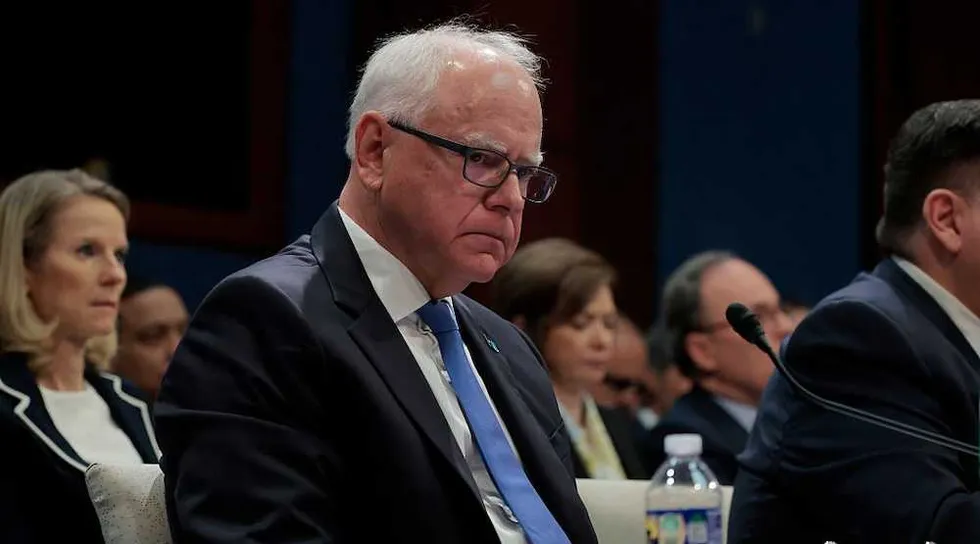 Photo by Anna Moneymaker/Getty Images
The alleged assassin who murdered Charlie Kirk in September, who was involved in a relationship with a transsexual, had come to believe that Kirk and other conservatives who criticized the overreach of trans radical activism were such a deadly threat that only lethal force was appropriate. He wrote anti-fascist messages on the casings of the bullets he used.
None of this is a surprise in a culture in which American nationalism is seen as the equivalent of Nazism and violent attacks against the Trump administration and its supporters are cheered on and encouraged. And it is not just the explicitly political media that embraces this insanity.
Witness the response to “One Battle After Another,” the recent film by Paul Thomas Anderson, loosely based on Thomas Pynchon’s novel “Vineland.” Starring Leonardo DiCaprio and Sean Penn, the film cheerleads for a radical anti-fascist terrorist organization as they wage war on American police and immigration forces. Penn is cast in a stupendously comical role as a caricature of which the left never tires: He is a military figure and a white supremacist who nonetheless is sexually attracted to nonwhites. All of the admirable figures in the film are revolutionary terrorists. The response by critics in the mainstream media has been a virtually unanimous cheer.
We are in a dangerous place. Leftist radicals are giving no indication of cooling their rhetoric — or their actions.
Buckle up. It is going to get rougher before it gets better.
Editor’s note: This article appeared originally at the American Mind.
When human worth becomes conditional, caregiving becomes impossible

Most people can care for an ill or disabled loved one for a week on compassion alone. Some can do it for a month. A few can make it a year or two.
But when care stretches into decades, compassion stops carrying the load. Emotion fades. Circumstances grind. What remains isn’t how someone feels about a life. What remains is whether they believe that life still matters.
When a culture treats reality as optional, action becomes dangerous and courage looks reckless. Without shared moral ground, bravery itself becomes suspect.
Caregiving strips life down to essentials. It forces a question our culture prefers to keep abstract: Why does this life still have value when it costs so much to sustain it?
C.S. Lewis warned that a society cannot survive if it mocks virtue while demanding its fruits. In “The Abolition of Man,” he described “men without chests” — people trained to think and desire but not to stand. Without a formed moral center, courage collapses. Duty feels suspect. Endurance looks irrational.
Caregivers learn this in a harsh classroom.
You cannot sustain decades of care if human worth is negotiable. You cannot rise day after day to guard the vulnerable if life’s value depends on productivity, independence, improvement, or the absence of suffering. Long care requires stewardship — the conviction that a life has been entrusted to us, not evaluated by us.
I once met a man who told me he was dating a woman in a wheelchair. He spoke with genuine enthusiasm about how good it made him feel to do everything for her. He sounded animated, even proud. He talked at length about his experience, his emotions, the satisfaction he drew from being needed.
He said very little about her.
I asked how long they’d been dating.
“Two weeks,” he said, beaming.
I smiled wearily and told him, “Get back to me in two decades.”
Care that depends on how it makes us feel rarely survives once feeling fades. What endures over decades isn’t the satisfaction of being needed. It’s settled clarity about the worth of the person being cared for, independent of what the caregiver receives in return.
RELATED: Christian, what do you believe when faith stops being theoretical?
 ImagineGolf via iStock/Getty Images
In that man’s excitement, everything centered on his emotions. What was missing was any recognition of her value apart from her condition — or apart from what caring for her did for him.
I didn’t hear, “I’m dating a woman,” or “I’ve met someone extraordinary.” I heard, again and again, “I’m dating a woman in a wheelchair.” The chair became the headline, not the person. He might as well have celebrated the better parking.
She had become useful to him. That’s not the same thing as being valued.
This way of thinking doesn’t stay confined to personal relationships. It scales.
The public reckoning surrounding Daniel Penny exposed it. He acted to protect others he believed were in danger — not because it felt good but because action was required. That kind of clarity now unsettles a society more comfortable with sentiment than obligation.
We claim we want people to intervene, to protect others, to act decisively when danger appears. Then someone does, and we hesitate. We second-guess. We prosecute. We distance ourselves.
We want courage but not conviction.
Lewis wouldn’t be surprised. When a culture treats reality as optional, action becomes dangerous and courage looks reckless. Responsibility suddenly feels threatening. Without shared moral ground, bravery itself becomes suspect.
Francis Schaeffer traced the path forward from that confusion. Once a culture detaches human worth from anything objective, it stops honoring life and starts managing it. Value becomes conditional. And conditions always change.
That logic now shows itself in plain view. When Gov. Kathy Hochul (D-N.Y.) pushes to legalize medical aid in dying in New York, the same fracture appears. We punish those who act as though life must be defended, while elevating leaders who treat life as something to administer and conclude.
Those aren’t separate debates. They’re the same belief, applied differently.
If life holds value only when it functions well, caregiving becomes irrational. If worth depends on autonomy, dependence becomes disposable. If suffering disqualifies, endurance becomes foolish.
And yet caregivers endure.
RELATED: Caregiving decisions begin in the bathroom
 MTStock Studio via iStock/Getty Images
That clarity came back to me during a conversation on my radio show. A man described a brief illness his wife had suffered. The house fell apart. Meals became takeout. Work got missed. Romance disappeared. He sounded exhausted just recalling it.
“What carried you through?” I asked.
He paused. “I guess … love.”
“How long did this last?” I said.
“Five days.”
“I guess … love” carried him through five days.
Uncertainty can survive a week. It cannot sustain 14,000 days.
He wasn’t wrong though. Love matters. But love that sustains five days must anchor itself in something deeper to sustain 40 years.
Caregivers may begin with compassion. They endure with conviction.
A life doesn’t become less valuable because it becomes harder to carry.
Caregiving isn’t a special category of moral life. It is a concentrated version of the human condition. What sustains caregivers over time is what sustains courage, faithfulness, and duty anywhere else.
Lewis reminded us that our feelings don’t create value. They respond to it. When we reverse that order, we don’t become more compassionate. We lose our bearings.
Treating human worth as conditional may flatter our emotions. It may even make us feel noble. But it trains us to prize how we feel over the people entrusted to our care.
Over time, that trade leaves us prosecuting men like Daniel Penny while electing leaders like Kathy Hochul.
It might soothe the heart for a moment.
It cannot sustain a society.
Scott Adams made Trump plausible before anyone else would

On the timeline of making America great again, two dates in 2015 stand out for anyone who backed Donald Trump before it was safe to do so.
On June 16, 2015, Trump came down the escalator in New York City and announced his run for president. The political class laughed. Conservative pundits mocked him. Commentators treated the whole thing as a stunt. A lifelong Democrat running as a Republican? A celebrity billionaire developer? Please. What a “clown.”
Scott understood something most people never learn: Bad reviews from bad people are good reviews. He also understood how to grieve with honor instead of self-pity.
Then came August 13, 2015.
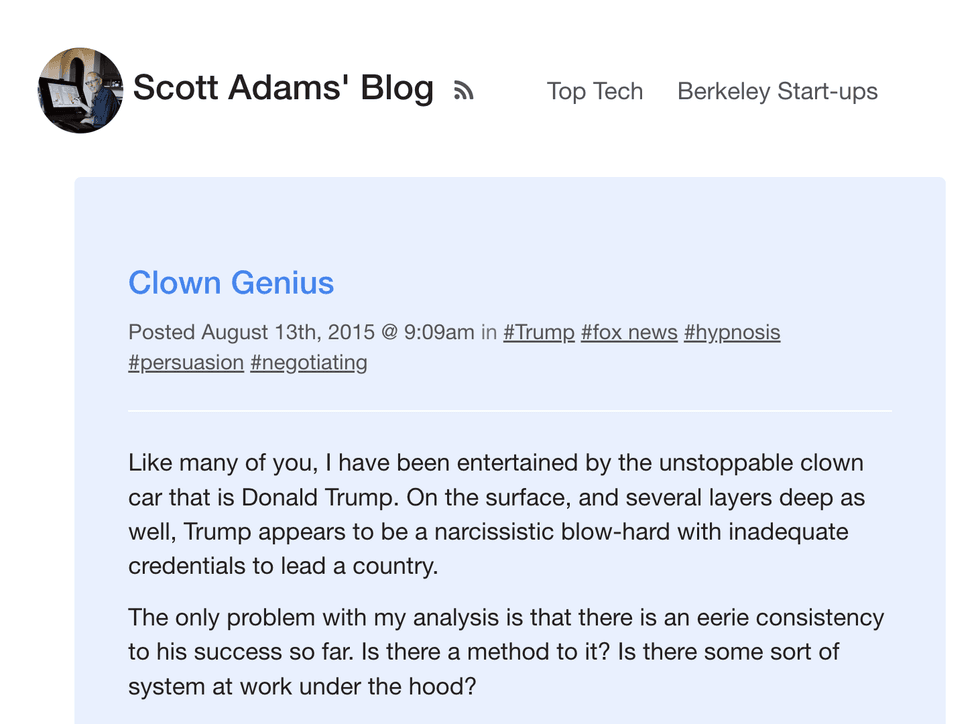
That day, Scott Adams — the creator of “Dilbert” and a best-selling personal development author — published a blog post that reframed the entire race in a single phrase:
Usual frame:
Donald Trump is a clown.
Reframe:
Donald Trump is a clown genius.
That was Adams’ title: “Clown Genius.” And his point was simple: Trump wasn’t improvising. He was persuading. Adams wrote that Trump’s “value proposition” was to “Make America Great,” which meant selling the world on America again — what Adams called “good brand management.”
It sounds obvious now. It didn’t sound obvious then.
Adams became one of the first major nonpolitical public figures to say out loud what millions of Americans were starting to suspect: Trump wasn’t a joke. The joke was the people pretending they couldn’t see what was happening.
 “Clown Genius” by Scott Adams, accessed via the Internet Archive
That post didn’t just defend Trump. It gave people permission. It gave tens of millions of everyday Americans cover to voice support for the one candidate the establishment of both parties hated more than anyone they had seen in decades. Adams called it before the polls did, and he kept calling it.
And, in the process, he helped change the course of human history.
He later packaged Trump’s persuasion methods into a book-length case study, “Win Bigly.” And famously, he assigned Trump a 98% chance of winning in 2016 — at a time when most of the media treated the idea as laughable.
Adams paid for that courage.
When he backed Trump in 2015, he didn’t just lose polite invitations. He lit his career on fire. He traded lavish speaking fees, safe corporate fame, and establishment approval for permanent exile from respectable opinion.
In October 2025, Adams described the price in stark terms:
When I decided … to back Trump … I sacrificed everything. I sacrificed my social life. I sacrificed my career. I sacrificed my reputation. I may have sacrificed my health. And I did that because I believed it was worth it. … I’m really happy I lived long enough to see it. It was worth it. … It was worth it to be right.
Independent journalist and filmmaker Mike Cernovich made the point even more bluntly. Adams could have kept quiet, kept the corporate speaking gigs, and died richer. Instead, he chose the lonely road and earned something bigger than money. He became a legend.
For millions, Scott Adams was more than a cartoonist or a commentator. Worldwide, listeners of Scott’s daily show, “Coffee with Scott Adams,” knew him as our “internet dad.” If Trump is the father of MAGA, Scott is its honorary stepfather.
People didn’t just read him. They listened to him. They learned from him. They built confidence from his willingness to say what others wouldn’t.
President Trump made America great again. Scott Adams made Candidate Trump plausible in the first place.
After a long, public battle with prostate cancer, Scott Adams died on Tuesday, January 13. He was 68.
President Trump responded with a tribute that said more than many will admit.
“Sadly, the Great Influencer, Scott Adams, has passed away. He was a fantastic guy, who liked and respected me when it wasn’t fashionable to do so. He bravely fought a long battle against a terrible disease. My condolences go out to his family, and all of his many friends and listeners. He will be truly missed. God bless you Scott!”
I’m one of those listeners and friends. More than that, I was Scott’s editor, and I remain the publisher of the Scott Adams library. He brought me on as a contributing editor for “Reframe Your Brain,” a book that has helped thousands of readers apply his signature “reframes” to work, money, relationships, and even faith.
As of this writing, “Reframe Your Brain” is the No. 1 best-seller on Amazon.
RELATED: Glenn Beck remembers Scott Adams: ‘A philosopher disguised as a stick-figure artist’
 Phil Velasquez/Chicago Tribune/Tribune News Service via Getty Images
Near the end of his life, Scott also made a quiet but meaningful choice. He accepted Pascal’s Wager — the simple risk-reward logic that faith in Jesus Christ is worth the bet. He pinned that profession to the top of his X.com profile in his final statement.
Scott was a father figure to me in the most practical sense. I asked his advice the way a son asks his dad. He was happy to oblige. That’s who he was: sharp, funny, and eager to be useful.
Now critics will rush in to re-litigate his controversies, including the 2023 livestream that helped get “Dilbert” pulled from newspapers. I wrote the truth for Newsweek at the time, after his remarks triggered an organized effort to kill his book deal and erase him from public life.
I worked with an author on a not-quite-banned book recently. Dilbert creator and bestselling author Scott Adams had his long-running comic strip ended by multiple newspapers and his forthcoming book contract canceled over some hyperbolic remarks on race that were intended to stir up discussion. Scott Adams’ books were twice banned, but Amazon reversed the decision. … Adams then went to his audience and let them know that there were people who didn’t want his book published, and they responded by buying it, en masse. Sales shot up.
Scott understood something most people never learn: Bad reviews from bad people are good reviews.
He also understood how to grieve with honor instead of self-pity. As he wrote in “Reframe Your Brain”:
When you experience the death of a loved one, your instincts push you into feeling tragedy, loss, and pain. Once you have had enough of that, and when you are ready, start tossing these five words around to release some of the pain: Gratitude. Respect. Honor. Privilege. Service.
Scott Adams lived those words. And now he belongs to the ages.
Scott won bigly.
Thank you, Scott.
Trump promised ‘retribution.’ Congress keeps funding the machine.

Courts can block executive action, so Congress must cut funding. Yet Republicans refuse, leaving the Justice Department and FBI with the same tools Democrats will use again.
That gap between rhetoric and action now threatens to erase everything President Trump promised. In March 2023, he vowed, “For those who have been wronged and betrayed, I am your retribution,” and pledged to “obliterate the deep state” and fire the bureaucrats who turned federal law enforcement into a political weapon. Those words land with force. Appropriations decide whether they mean anything.
Trump’s ‘retribution’ pledge will collapse into another campaign slogan if Republicans keep funding the same Department of Justice and FBI they claim to oppose.
But if Trump relies on executive action alone, courts will block key moves and the next Democrat in the White House will reverse the rest. Only structural reforms written into law can stop the next round of weaponization.
That reality hits hardest at the Department of Justice and the FBI. A Congress that keeps funding these agencies under the Biden-era architecture keeps the weaponization machine intact.
Yet Republicans just pushed through a Justice funding bill that drew more Democrat support than conservative support.
That vote captures the GOP Congress since 2017. Leadership passes budget bills with less resistance from Democrats than from Republicans. Spending is the battlefield. Everything else fades fast. If your own side opposes your funding bills more than the other side, you are not changing the country. You are managing the status quo.
Here’s the brutal truth: Congress has not structurally defanged the Justice Department’s weaponization or taken a sledgehammer to the FBI’s open-ended mandate. The same deep-state actors who drove January 6 abuses, FACE Act prosecutions of pro-life activists, and FBI operations like Arctic Frost still collect paychecks.
Republicans had one last chance to shrink this machinery before Democrats likely regain the House. The final Justice Department appropriations bill should have cut off funding for the most abusive programs and permanently reduced the department’s ability to target Americans. Instead, Republicans passed a status quo bill that effectively codifies Biden’s DOJ.
The vote breakdown exposes the scam. All but six House Democrats supported the minibus package that included full-year DOJ funding. Meanwhile, 22 House conservatives opposed it.
The package included three appropriations bills: Commerce-Justice-Science; Energy and Water Development; and Interior and Environment. Freedom Caucus pressure forced leadership to hold a separate vote on the Commerce-Justice-Science portion first, and even then, it drew 40 Republican “no” votes. Leadership tried to quiet the revolt by swapping out a $1 million earmark for a Somali-led nonprofit after a welfare fraud scandal in that state. That move changed nothing about the bill’s core failures.
RELATED: The ‘blue-slip block’ is GOP cowardice masquerading as tradition
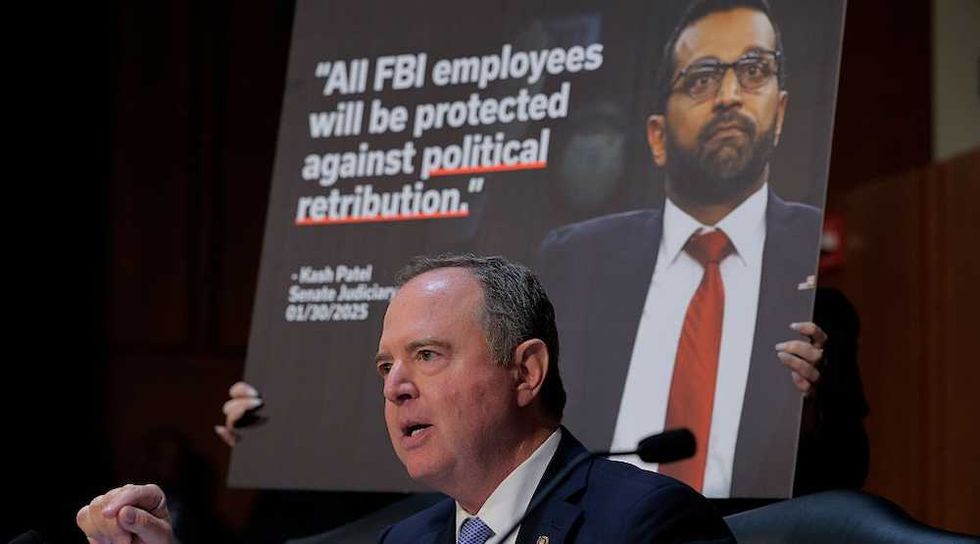 Photo by Chip Somodevilla/Getty Images
Democrats voted for this bill despite calling Trump a dictator because the bill left the regime’s tools in place. On the issues that matter most, it stayed silent.
It did not:
- Bar funding for future January 6 prosecutions.
- Bar funding for FACE Act prosecutions of pro-life activists.
- Address the FBI’s Arctic Frost overreach.
- Defund sanctuary cities, even though sanctuary policies endanger federal agents and courts have repeatedly blocked Trump’s efforts to punish them. If Congress refuses to codify enforcement policy, courts will keep neutralizing it.
- Cut off grants to NGOs that help illegal aliens evade deportation. Other appropriations bills even fund refugee resettlement contractors.
- End incentives for blue states to implement red-flag laws. The bill keeps the $740 million slush fund that bribes states to expand them. It also fails to defund Biden’s pistol brace ban, the “engaged in the business” rule, and the Justice Department’s Office of Gun Violence Prevention.
- Fund an Election Integrity Office to implement Trump’s executive order on election integrity, even while the bill keeps money flowing to offices that persecute Americans.
- Rein in the Office of Inspector General, which receives $139 million despite lacking an appointed inspector general and operating under an acting career bureaucrat.
The FBI budget barely took a haircut from its record Biden-era levels. Keep the scale in mind: The bureau has more than 35,000 employees, yet only 138 have been fired so far.
Republicans also promised fiscal discipline. This minibus package totals roughly $180 billion and rejects steeper cuts conservatives proposed in committee. It includes nearly $5.6 billion in earmarks for 3,030 projects. Leadership found room for parochial spending while refusing to squeeze the agencies that turned federal power against the public.
Congress holds one real lever to change the regime without begging courts for permission: the power of the purse. If Republicans won’t pass transformative legislation, they must at least defund odious policies through appropriations.
Trump’s “retribution” pledge will collapse into another campaign slogan if Republicans keep funding the same Department of Justice and FBI they claim to oppose. When Democrats vote happily to fund the very departments that targeted Americans under Biden, the conclusion writes itself. Washington will not dismantle the machine. It will keep it humming until Democrats take power again and aim it at us with even fewer restraints.
Americans aren’t arguing any more — we’re speaking different languages

A few days ago, I found myself in a text exchange about two women killed by agents of the state.
One was Renée Nicole Good, a 37-year-old activist mother shot last week by an ICE agent in Minneapolis. The other was Ashli Babbitt, a 36-year-old U.S. Air Force veteran shot by a Capitol Police lieutenant inside the Speaker’s Lobby on January 6, 2021.
Are words being used to think — or to show whose side someone is on?
I asked what I thought was a simple moral question: Does the state ever have the moral right to kill an unarmed person who poses no immediate lethal threat?
I did not try to provoke. I did not claim the cases were the same. I said plainly that the facts, motives, and political contexts differed. My own answer was no. The purpose was not to merge the stories, but to test whether the same moral rule applied in both cases.
I was asking my friend to reason with me.
The response was not an argument. It came as a rush of narrative detail, moral verdicts, and firm insistence that the question itself was illegitimate. “Not comparable.” “Straw man.” The stories did not clarify the rule. They aimed to shut down the conversation.
But what struck me most was not the emotion. It was the disconnect.
I asked about a principle. I received a story. I tested a rule. I got a verdict. We used the same words — justice, murder, authority — but those words did very different work.
The exchange failed not because of tone or ideology. It failed because we spoke different civic languages. More troubling, we no longer agree on what civic language is for.
More than a failure of civility
For years, we have blamed polarization and tribalism. We shout past one another. We retreat into bubbles. All of that is true. But the deeper problem runs deeper than disagreement.
We no longer share a civic vocabulary shaped by common expectations about clarity, restraint, and universality.
We still speak words that are recognizably English. But we use the same words to reach very different ends.
One civic language treats words as tools for reasoning. Call it “principled” or “rule-based.” Questions test limits and consistency. Moral claims aim at rules that apply beyond one case. Disagreement is normal. When someone asks, “What rule applies here?” the question is not an attack. It is the point.
This language shapes law, constitutional argument, philosophy, and journalism at its best. Words like “justified” or “legitimate” refer to standards that others can test and challenge. If a claim fails under scrutiny, it loses force.
The other civic language works differently. Call it “narrative” or “moral-emergency” language. Here, words signal alignment more than reasoning. Stories carry moral weight on their own. Urgency overrides abstraction. Questions feel like invalidation. Consistency tests sound like hostility.
RELATED: The day the media taught me it’s always wrong to be right
 treety via iStock/Getty Images
In this mode, terms drift. “Murder” no longer means unlawful killing. It means moral outrage. “Straw man” stops meaning logical distortion and starts meaning emotional offense. “Not comparable” does not mean analytically distinct. It means do not apply your framework here.
Neither language is dishonest. That is the danger. Each serves a different purpose. The breakdown comes when speakers assume they are having the same kind of conversation.
The principled speaker hears evasion: “You didn’t answer my question.” The moral-emergency speaker hears bad faith: “You don’t care.”
Both walk away convinced the other is unreasonable.
Moral certainty over moral reasoning
Social media did not create this divide, but it rewards one language and punishes the other. Platforms favor speed over reflection, story over rule, accusation over inquiry. Moral certainty spreads faster than moral reasoning. Over time, abstraction starts to feel cruel and questions feel aggressive.
That is why so many political arguments stall at the same point. Facts do not resolve them because facts are not the dispute. The real question is whether rule-testing is even allowed. Once someone frames an issue as a moral emergency, universality itself looks suspect.
A simple test helps. Is this person using words to reason toward a general rule, or to signal moral alignment in a crisis?
Put more simply: Are words being used to think — or to show whose side someone is on?
RELATED: I don’t need your civil war
 Photo by Tom Williams/CQ-Roll Call Inc. via Getty Images
Once you see this, many conversations make sense. You understand why certain questions trigger anger. You see why consistency tests go unanswered. You recognize when dialogue cannot move forward, no matter how careful you sound.
This does not mean outrage is always wrong. It does not mean people should stop caring. It does mean we need better civic literacy about how language works. Sometimes restraint is a virtue. Walking away is not cowardice. Declining to argue is not surrender.
What cannot work is trying to make a principled argument within a moral-emergency frame.
America’s founders understood this. They designed institutions to slow decisions, force deliberation, and channel arguments into forms governed by rules rather than passion.
If we fail to see that we now speak different civic languages, we will lose the ability to talk calmly about the ideas and ideals that should bind us together. The alternative is full adoption of moral-emergency language — where persuasion gives way to force.
Too many Americans have already chosen that path.
Aristotle’s ancient guide to tyranny reads like a modern manual

In “Politics,” Aristotle explains that political rule comes in three basic forms: rule of one, rule of the few, and rule of the many. Each form has a healthy and a degenerate expression. Monarchy and tyranny describe rule by one. Aristocracy and oligarchy describe rule by the few. Polity and democracy describe rule by the many.
What separates the good from the bad in each category is not structure but motive. A king governs for the common good. A tyrant governs for himself.
Despite the millennia that separate us from Aristotle, the philosopher’s portrait of tyranny feels uncomfortably contemporary.
Aristotle does more than classify regimes. He explains, in cold and unsentimental terms, how tyrants preserve power once they seize it. His warnings, written more than 2,000 years ago, read less like ancient theory and more like a field manual.
The tyrant begins by eliminating rivals. He fears competition, especially from men of spirit and competence. Anyone admired for virtue, courage, or leadership poses a danger because excellence inspires imitation. Such men are removed through exile, execution, or disgrace.
Next the tyrant attacks institutions that allow citizens to form bonds. Aristotle lists common meals, clubs, educational gatherings, literary societies, and discussion groups. Any shared practice that fosters trust, loyalty, or independent thought threatens despotic rule. Organization creates solidarity, and solidarity creates resistance.
The tyrant also forces citizens to live publicly. Privacy breeds conspiracy. Public life enables surveillance. Aristotle describes rulers who compel their subjects to remain visible so that dissent never escapes notice. Long before Bentham’s panopticon, Aristotle understood that constant observation disciplines behavior.
Surveillance alone does not suffice. Tyrants cultivate networks of informers to uncover thoughts that cannot be seen. Citizens learn to treat one another as potential threats. Suspicion replaces trust. Speech becomes guarded. Silence becomes safety.
Aristotle could not have imagined digital surveillance, but he would have recognized its function. Technology merely perfects a strategy the ancients already understood.
Social bonds must then be weakened. The tyrant sows discord between neighbors, friends, and families. These relationships form the first line of resistance to centralized power. When trust dissolves at the most intimate level, organized opposition becomes nearly impossible.
Poverty also serves the tyrant. Aristotle observes that despots deliberately exhaust their populations with endless labor. The goal is not productivity but distraction. Citizens too busy to rest or reflect lack the energy to conspire.
He cites the construction of the Egyptian pyramids as an example of forced labor designed less to achieve a purpose than to consume a people’s strength. The task glorifies the ruler while leaving the population depleted.
War further strengthens despotism. Constant external threat convinces citizens that they need a strong ruler to survive. Crisis suspends normal limits. Emergency justifies control. Under perpetual conflict, organization becomes treason.
Aristotle claims that tyranny, the degenerated rule of one, borrows from the worst features of democracy. Despots empower groups unlikely to organize independently against them. He mentions women and slaves not as moral judgments but as political calculations within the ancient world.
The logic remains familiar. Tyrants elevate those dependent on the regime and hostile to existing social hierarchies. Dependence fosters loyalty. Resentment supplies enforcement.
Flattery plays a crucial role. Tyrants surround themselves with sycophants who inflate their ego and confirm their righteousness. Men willing to abase themselves rise quickly. Men of honor refuse to flatter and therefore remain dangerous.
Flattery becomes a sorting mechanism. Those who value dignity exclude themselves. Those who crave favor advance.
Aristotle adds that tyrants prefer foreigners to citizens. Citizens possess memory, tradition, and moral expectation. They know how things once were and how they ought to be. Foreigners lack these attachments, and they are happy to flatter the ruler who elevated them.
This arrangement benefits both sides. The tyrant gains enforcers without local allegiance. The foreigner gains status, wealth, and protection. Without the ruler, he has nothing.
RELATED: Do you want Caesar? Because this is how you get Caesar.
 Blaze Media Illustration
Despite the millennia that separate us from Aristotle, his description of tyranny feels uncomfortably contemporary. Surveillance now operates through algorithms and cellphone cameras rather than forcing everyone to live at the city gates, but the purpose remains unchanged. Security replaces liberty. Total observation replaces trust.
Our institutions remove ambitious and virtuous individuals while elevating compliant managerial drones. Debt binds the population to endless labor. Work consumes life without building independence. Citizens remain busy, anxious, poor, and isolated.
Cultural and political authorities weaken family, denigrate religion, and discourage independent association. Community dissolves into administration. Loyalty transfers from neighbors to systems.
Ruling classes increasingly rely on populations with little connection to national history or tradition. These groups have no reason to defend inherited norms and every incentive to please those who grant them status.
Some details differ but the formula for tyranny does not. Aristotle understood tyranny because he understood human nature. His analysis endures because the same impulses govern power in every age.
There is nothing new under the sun.
Caregiving decisions begin in the bathroom

The holidays have a way of forcing conversations many families would rather postpone.
Every year, as adult children come home and aging parents gather around the table, familiar signs emerge. Someone struggles with stairs. Someone tires more easily. Someone forgets what was once routine. And with those observations come discussions caregivers know well.
The promise.
“I’ll never put Mom or Dad in a nursing home.”
It is often spoken years earlier, in healthier days, and always with sincerity. At the time, it feels like a declaration of love and loyalty. Assisted living seems distant, unnecessary, and meant for other families, not ours.
The problem is not the promise. The problem is that life keeps changing.
Circumstances change. Strength ebbs. What once worked may no longer work safely or wisely.
Over time, what began as devotion can quietly become more than one person can manage alone. Needs grow. Safety becomes a concern. Medical issues multiply. Caregivers often find themselves trying to do, by themselves, what normally requires trained professionals, proper equipment, and constant oversight.
At that point, the issue is no longer love or loyalty. It’s capacity.
That reality came into focus during a recent conversation with a friend. He had offered a small cottage on his property to help a friend relocate aging parents closer to family. The mother now uses a walker. The father has been her caregiver for years, but serious heart problems have begun to limit what he can safely do.
Still the conversation kept circling back to the same refrain: Neither would ever go into assisted living or a nursing home.
Their adult son is caught in the middle, trying desperately to make everyone happy. That is a fool’s task. In my work with fellow caregivers, I call this the caregiver FOG — fear, obligation, and guilt — because it blurs perspective, narrows options, and makes even familiar paths hard to see. No one wins.
It is like driving into actual fog. Visibility drops. Muscles tense. Judgment narrows. We try to peer miles ahead when we can barely see the hood of the car.
Every highway safety officer gives the same advice: Slow down, turn on the low beams, and stop trying to see five miles down the road.
Caregiving requires the same discipline.
My friend asked what I thought.
I suggested we lower the emotional temperature and start with one concrete issue.
Not the promise. Not the arguments. Not the guilt.
Start with the toilet.
Laugh if you like. It sounds abrupt. But it has a way of clarifying reality quickly.
RELATED: When the soul flatlines, call a ‘Code Grace’
 PeopleImages via iStock/Getty Images
The bathroom is often ground zero for caregiving challenges. If the toilet is not safe and accessible, the demands on the caregiver escalate immediately. Transfers become harder. Fatigue compounds. Falls become more likely.
Once the toilet is addressed, you move outward.
The shower. The bedroom. Doorways, lighting, entrances.
Sometimes modest changes are enough — grab bars, a raised toilet seat, a walk-in shower. None of these are exotic ideas. But determining needs honestly requires facing the limits of strength, balance, and endurance as they exist today, not as we wish they were.
While politicians and toilets often deal with similar subject matter, toilets remain refreshingly honest. They simply reveal what actually works.
When families do this, reality follows. Cost. Time. Budgets weighed against needs. Timelines measured against declining strength. What once felt like a moral standoff becomes a practical evaluation.
Fear, obligation, and guilt begin to loosen their grip. In their place come planning, stewardship, and direction.
This matters because emotional decisions often rush families into choices that create larger — and sometimes far more expensive — problems later. We see this dynamic everywhere, including politics. While politicians and toilets often deal with similar subject matter, toilets remain refreshingly honest. They do not respond to intentions, promises, or speeches. They simply reveal what actually works.
Families do not choose assisted living or nursing homes in the abstract. Toilets always have a seat at the decision table.
RELATED: Christian, what do you believe when faith stops being theoretical?
 fotojog via iStock/Getty Images
Surveys consistently show that most older Americans want to remain in their own homes as they age. That desire is sincere and understandable. But staying home without meaningful accommodations transfers an enormous burden onto the caregiver. The home may remain familiar, but the cost — physical, emotional, and relational — often rises exponentially.
Most promises are made sincerely. They are also made without a full understanding of how disease progresses, how bodies change, or how deeply caregiving reshapes everyone involved. Honoring a promise does not mean freezing it in time. It means continually asking how we can care well, given today’s realities.
Assisted living is not a surrender of care. In many cases, it is an extension of it. It allows families to return to being sons, daughters, and spouses, rather than exhausted amateur medical staff running on guilt and fumes.
We are not obligated to preserve every arrangement exactly as it once was. We are called to steward what has been entrusted to us — finances, time, energy, relationships, and the caregiver as well.
Circumstances change. Strength ebbs. What once worked may no longer work safely or wisely.
Important decisions are best made with clear heads, honest assessments, and wise counsel — not under the duress and resentment that so often accompany them. The days after the holidays are not a verdict. They are an invitation to slow down, think clearly, seek experienced guidance, and choose what is best not just for one individual but for the whole family.
The path forward is rarely determined by emotion, decades-old promises, or guilt.
More often, it is clarified by something far more unassuming — and far more truthful.
The appliance in the nearest bathroom.
How do you solve a problem like Wikipedia?

Wikipedia has recently come under the microscope. I take some credit for this, as a co-founder of Wikipedia and a longtime vocal critic of the knowledge platform.
In September, I nailed (virtually) “Nine Theses About Wikipedia” to the digital door of Wikipedia and started a round of interviews about it, beginning with Tucker Carlson. This prompted Elon Musk to announce Grokipedia’s impending launch the very next day. And a national conversation evolved from there, with left- and right-leaning voices complaining about the platform’s direction or my critique of it.
As long as Wikipedia remains open, it is entirely possible for those who think differently to get involved.
As its 25th anniversary approaches, Wikipedia clearly needs reform. Not only does the platform have a long history of left-wing bias, but the purveyors of that bias — administrators, everyday editors, and others — stubbornly cling to their warped worldview and vilify those who dare to contest it.
The “Nine Theses” are the project’s first-ever thoroughgoing reform proposal. Among the ideas:
- Allow multiple, competing articles per topic.
- Stop ideological blacklisting of sources.
- Restore the original neutrality policy.
- Reveal the identities of the most powerful managers.
- End unfair, indefinite blocking.
- Adopt a formal legislative process.
Such ideas were bound to be a hard sell on Wikipedia. It has become institutionally ossified.
Nevertheless, I was delighted that the discussion of the theses has been robust, without much further prodding from me. Following the launch, Jimmy Wales actually stepped into the fray on the so-called talk page of an article called “Gaza genocide,” chiding the participants for violating Wikipedia’s neutrality policy. I chimed in as well. But the criticism was thrown back in our faces.
This brings me to the deeper problem: Wikipedia is stuck in its ways. How can it possibly be reformed when so many of its contributors like the bias, the anonymous leadership, the ease of blocking ideological foes, and other aspects of dysfunction? Reform seems impossible.
Yet there is one realistic way that we can make progress toward reform.
Above all else, those who care should get involved in Wikipedia. The total number of people who are really active on Wikipedia is surprisingly small. The number editing 100 times in any given month is in the low thousands, and this does not amount to that much time — perhaps one or two hours per week. Those who treat it as a part-time or full-time job — and so have real day-to-day influence — number in the hundreds.
In interviews, I have been urging the outcasts to converge on Wikipedia. You might think this is code for saying that conservatives and libertarians should try to stage a coup, but that is not so. Hindus and Israelis, among others, have also complained of being left out in recent years. The problem is an entrenched ruling class. As long as Wikipedia remains open, it is entirely possible for those who think differently to get involved.
RELATED: Wikipedia editors are trying to scrub the record clean of Iryna Zarutska’s slaughter by violent thug
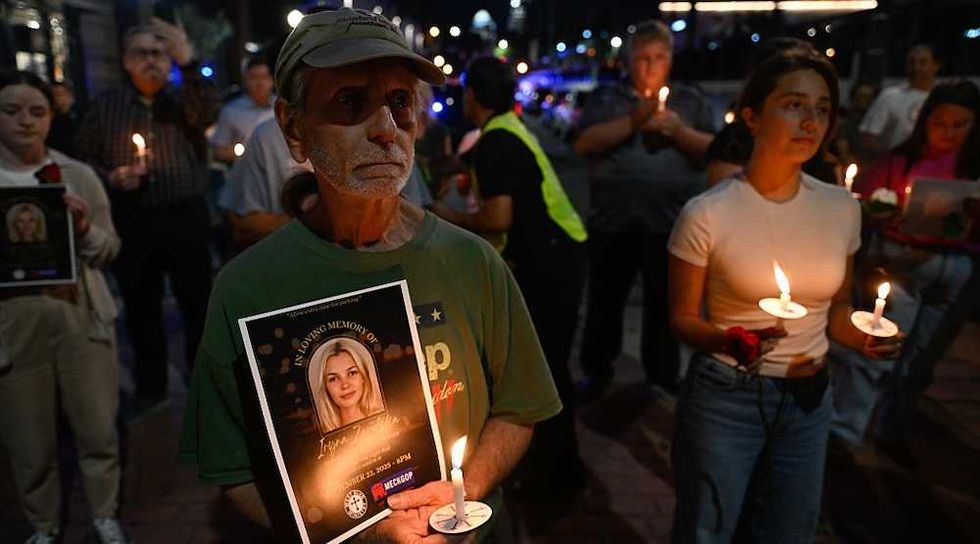 Photo by Peter Zay/Anadolu via Getty Images
If you are a conservative or libertarian who is concerned about the slanted framing of Charlie Kirk’s assassination, get involved. If you are a classical liberal who is alarmed by the anti-Semitism within Wikipedia — like Florida Democrat Debbie Wasserman Schultz — it is time to make your presence felt. Wherever you may fall on the ideological spectrum, I call on good-faith citizens to become engaged editors who take productive discourse seriously, rather than scapegoating “the other side.”
Even a dozen new editors could make a difference, let alone hundreds or thousands who might be reading this column. Given that Wikipedia attracts billions of readers, in addition to featuring prominently in Google Search, Google Gemini, and elsewhere, improving the platform will strengthen our collective access to high-quality information across the board. It will bring us closer to truth.
So how do we solve the Wikipedia problem? With you, me, and all of us — individual action at scale.
Editor’s note: This article was originally published by RealClearPolitics and made available via RealClearWire.
How a pro-life law in Kentucky lets mothers get away with murder

Melinda Spencer allegedly took abortion pills, ended the life of her unborn son, and buried his remains in a shallow grave in her backyard.
Yet a law in Kentucky exempting women from prosecution after obtaining an abortion — a law supported by the most influential pro-life organization in the state — appears to have prevented prosecutors from holding Spencer accountable for murder.
If a state refuses to make murder illegal for everyone, then some human beings will remain unprotected by design.
According to court documents cited by local media, Spencer, 35, told Kentucky State Police that the child “was not her boyfriend’s, and she did not want him to find out she was pregnant with another man’s baby.”
To conceal the pregnancy, Spencer allegedly ordered abortion pills online, intending to end the life of her unborn child without medical supervision.
Police say Spencer took the pills the day after Christmas, placed her deceased son in a light bulb box, and buried him in a shallow grave in her backyard. An autopsy determined the child was around 20 weeks’ gestation at the time of his death.
Initially Spencer was charged with first-degree fetal homicide, abuse of a corpse, concealing the birth of an infant, and tampering with physical evidence.
This week, however, Kentucky prosecutors dropped the homicide charge — not because they doubt that Spencer intentionally caused the death of her unborn child but because Kentucky law explicitly prohibits prosecuting a pregnant woman who murders her own unborn child.
Miranda King, the prosecutor overseeing the case, acknowledged this limitation directly. In a public statement, she explained that the relevant statute “prohibits the prosecution of a pregnant woman who caused the death of her unborn child.” Spencer still faces the remaining, lesser charges.
King made clear that this frustrating outcome was not her preference.
“I sought this job with the intention of being a pro-life prosecutor but must do so within the boundaries allowed by the Kentucky state law I’m sworn to defend,” she said. “I will prosecute the remaining lawful charges fully and fairly.”
Kentucky is widely regarded as a conservative state with strong pro-life laws. Many Americans assume abortion was effectively banned there after the Supreme Court overturned Roe v. Wade in 2022. This case exposes how incomplete that assumption is.
RELATED: Why the pro-life movement fails without a Christian worldview
 jcphoto via iStock/Getty Images
Kentucky’s leading pro-life advocacy organization, Kentucky Right to Life, has long supported laws that shield women from criminal liability for abortion. In practice, this ensures that abortion remains legal for women, even if clinics are closed.
In 2021, Kentucky Right to Life joined more than 70 other pro-life organizations in signing a national letter declaring opposition to “any measure seeking to criminalize or punish women” who obtain abortions.
Since then, the organization has opposed multiple abolition bills that would have established equal protection under the law for unborn children — specifically because such legislation would allow for the prosecution of mothers who willfully procure abortions.
Addia Wuchner, Kentucky Right to Life’s executive director, opposed an abolition bill in 2023 on the grounds that it might expose mothers to criminal charges. She took the same position last year, arguing that women are victims of coercion by the abortion industry.
That framing has deadly consequences.
 Photo by Mandel NGAN / AFP via Getty Images
Following Spencer’s arrest, Wuchner publicly expressed sympathy for the accused, describing Spencer as likely being “on her own” and calling that “probably the greatest tragedy,” before adding that “of course … a child’s life was lost.”
The ordering is revealing. The alleged murder of a child was treated as secondary to the emotional state of the alleged murderer. Empathy displaced justice and accountability.
There are cases in which women are coerced into abortions under genuine duress. But coercion cannot be presumed as a universal explanation. By all available evidence, Spencer appears to have acted deliberately. Kentucky law nevertheless forecloses full accountability — and ensures that the central act in this case cannot be adjudicated as homicide.
Since the Supreme Court overturned Roe, states like Kentucky have continued to see record abortion levels, largely through self-managed chemical abortions ordered online. Laws that categorically exempt women from prosecution guarantee this outcome.
If a state refuses to make murder illegal for everyone, then some human beings will remain unprotected by design. And when that exemption applies even in cases involving concealment, burial, and admitted intent, justice becomes impossible by statute.
So long as that remains the case, women who willfully kill their unborn children in Kentucky will continue to get away with murder.
America tried to save the planet and forgot to save itself

Let’s face it: $20 trillion is a lot of money.
One would expect a big bang to follow the spending of 20,000 billion dollars. It’s a lot of money! In fact, it’s pretty much the total present value of America’s GDP.
The American economy sent trillions to our south and east — putting America second, hollowing out the American middle class, and neutralizing the American dream.
This is the total amount spent globally — largely by Europe and the United States — in a coordinated effort by the developed world to decarbonize the global economy. China, in contrast, sold windmills and solar panels worldwide while opening a new coal-fired power plant every month.
What was the net effect of this “Green” Marshall Plan? Hydrocarbon consumption continued to increase anyway. All that was achieved was a tiny reduction, just 2%, in the share of overall energy supplied by hydrocarbons. Put simply, as the energy pie got bigger and all forms of energy supply increased, hydrocarbons ended up with a slightly smaller share of a larger pie.
We also saw the deindustrialization of the European and American economies — not just with higher prices at the gas pump and on electric bills, but a stealth green tax that was passed on to consumers on everything. This is the culprit of our American and global affordability crisis. So much treasure and pain for a 2% reduction in the share of hydrocarbons.
Ironically, a byproduct of this Green Hunger Games was political populism.
What a waste. The worst bang for the public and private buck ever. Yet the Chicken Little believers of the Church of Settled Science and the grifters who profited from it will still sing in unison that it failed because they did not go far enough. If only the global community spent and regulated more!
In contrast, the Marshall Plan (1948-1951) rebuilt a decimated Europe into an industrial, interconnected, and peaceful powerhouse. It was a great success by any measure. At the time, its price tag was huge: $13.3 billion in nominal 1948-1951 dollars, equivalent to approximately $150 billion in today’s dollars.
Since a trillion is such a large number, let’s divide $20 trillion by an inflation-adjusted Marshall Plan of $150 billion, and we have 133 Marshall opportunities. Money was not the problem. To give a sense of the comparative bang for buck, by the Marshall program’s end, the aggregated gross national product of the participating nations rose by more than 32% and industrial output increased by a remarkable 40%.
President Trump has been on the global funding rounds and has secured more than $18 trillion in foreign investment. That’s roughly the equivalent of 120 Marshall Plans — just 13 shy of $20 trillion — to be invested here and nowhere else.
Unlike NAFTA, through which the rich got richer under the banner of free markets in exchange for cheaper consumer goods, Trump’s policy is a recipe for prosperity for all Americans.
RELATED: Trump administration saves billions in simple move globalists and climate activists alike will hate
 Photo by David Paul Morris/Bloomberg via Getty Images
Making these investments a reality in America will require a growing army of blue- and white-collar workers. With the wealth that it creates, our debt could be paid down and, finally, retired. Social Security and Medicare would be placed on a solid footing for time immemorial. All our public obligations to one another would be met by ever-growing prosperity, not by borrowed money and suffocating debt service.
Nothing approaching this level of intentional investment in a single country has ever been done. Yes, a similar tranche of greenbacks was burned with no discernible environmental benefit and great economic hardship for all. And yes, the American economy, under the guise of comparative advantage, sent trillions to our south and east — putting America second, hollowing out the American middle class, and neutralizing the American dream.
Trump’s plan is the opposite of both failed experiments. Like the original Marshall Plan, Trump’s is a recipe for the reindustrialization of the American economy and military, and it is not going to be fueled by windmills and solar farms but with hydrocarbons and uranium. That’s the Trump plan. It has merit.
Yet if we look at the polls, Trump is under water, and his base is showing signs of stress fractures. You bring peace to the Middle East, stop six other wars, and bring in some $20 trillion in America First investments within your first year, and you come home to find yourself under water and called a “lame duck.” Democracies are known to be fickle and hard to please, but this is still rich — and it will result in poverty if it continues.
Without the use of Trump’s tariffs and dealmaking, there would not be $20 trillion looking to onshore in the United States. You can blame Trump for higher costs on bananas and coffee, but it is the cost of electricity and health care — not the cost of coffee and bananas — that is roiling kitchen-table economics.
Vice President JD Vance recently made the right call for popular and populist patience. Those who are impatient should look at the offsets already passed, such as no taxes on Social Security, tips, and overtime. That helps pay for bananas and coffee and then some.
The sovereign wealth funds that are presently lining up on our shores are coming here based on promises made by a can-do president speaking for a can-do nation. While Trump is a can-do guy, are “We the People” still a can-do people? Or do we at least want to return to becoming a can-do people again?
The “can’t-do” forces are legion, and they are the ones now championing the affordability crisis they caused. When America was a can-do nation, we built the Empire State Building in a year. Today, it would take years to get a permit.
RELATED: From Monroe to ‘Donroe’: America enforces its back yard again
 Photo by Jim WATSON/AFP via Getty Images
Those willing to invest such money will require some certitude that the power they will need will be there to “build, baby, build.” If not, the money and the opportunity will pass before they have the possibility to take needed root.
And what about us, the American family, worker, and business continuing to struggle under the legacy of throttling energy privation? In short, we all have a common good — a shared interest — in righting the wrongs that control our grid and our nation’s future.
The good news is that a bill was introduced in the House during the government shutdown. It’s called the “Affordable, Reliable, Clean Energy Security Act.” Unlike Obamacare, which clocked in at 903 pages, this bill is a lean 763 words. If it becomes law — and it should — it would change everything for the better, unlike Obamacare, which is a recipe for unaffordability.
Trump’s One Big Beautiful Bill Act was missing this one thing. His short- and long-term America First ambitions would be significantly strengthened by making this energy bill law before the midterms. Executive orders don’t provide the energy security these investors require or the American people deserve.
$20 trillion is a lot of money. Coming to our shores is a new lease on the American experiment as we enter our 250th birthday, hopelessly divided and broke. Let us come together to solve not just the affordability crisis but also set the conditions for greatness for the next 250 years.
Editor’s note: This article was originally published by RealClearPolitics and made available via RealClearWire.





